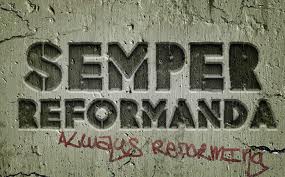
 In the spirit of the Reformation motto: semper reformanda – always reforming, what say we abandon the fortresses of our traditions. Tomorrow, Lutheran churches all over the world will begin their Reformation Sunday worship services vigorously singing “A Mighty Fortress” and I for one wish they wouldn’t. I suspect that the hymn’s author Martin Luther might just agree with me. After all didn’t Luther write a Mighty Fortress in an attempt to bring the popular music of the day into the church? I am convinced that this particular Reformation Sunday tradition has dear old Martin spinning in his grave at the thought that the church that bears his name is still singing a tired old chestnut like A Mighty Fortress to celebrate the Reformation. The very idea of 21st century Lutheran’s celebrating the Reformation by clinging to the events of the 16th century is an affront to the memory of Martin Luther.
We should be singing this centuries music and rather than smugly resting on the laurels of the past, we should be plotting were the reformation goes from here. Perhaps in this the 21st century, when so many of the church’s traditions have seen the institution fall into the malaise of irrelevancy, we need to echo the cry: “Semper Reformanda” — “Always Reforming” the cry of the reformers who insisted that the church in every age stands in need of reformation.
Legend has it that on October 31st 1517, after taking a long hard look at the Roman Catholic Church and having fixed his sights on what he saw as the source of the rot that threatened to destroy the church’s ability to proclaim the Good News of God’s grace that is revealed in the life, death, and resurrection of Jesus Christ, Martin Luther took his 95 Theses on the abuses of the doctrine of indulgences into the streets of Wittenburg and nailed them on the doors of the church. Within a few short weeks, with the aid of the newest technology, copies of Luther’s 95 Theses spread throughout the Holy Roman Empire and sparked a Reformation the likes of which the church hadn’t seen since the Apostle Paul did away with the need to snip the male anatomy to gain entrance to the church. Luther’s words threatened the status quo of centuries of abuse. And the church as is her way, struck back with force so as to ensure that tradition might prevail. The rest, as they say, is history.
Ah history, safely ensconced in the past with its hoards of devils. Let the people rejoice because Martin Luther did it all and we can relax safe in the knowledge that we are justified by grace, through faith. Ain’t it great to be a Lutheran! “A mighty fortress is our God, who himself fights by our side with weapons of the spirit. Were they to take our house, goods, honour, child, or spouse, though life be wrenched away, they cannot win the day. The Kingdom’s ours forever!”
So tell me, if they fought the good fight in the sixteenth century and handed us everything we need, and God is on our side and wins salvation glorious: Where are the children? Where are the young people? Where are the neighbours? Where is everybody? How and why did the church of our ancestors manage to fall into such disrepair? How did we become so irrelevant?
Most of us, can look around and see for ourselves how broken the church is. If we are honest, we all have our own particular theories as to why and how this happened. Yet we continue to go about our business, hoping against hope that someone will notice and finally fix it. Year by year the church slips farther and farther into the morass of it’s own making and more and more people forget the wisdom of the ages and Christ seems to slip further and further from our grasp. We, who go by the name Lutheran, we can’t do much more than point to our glorious past as if we could only turn the clocks back the work of the reformers of old would save us. But time waits for no one and year after year, people drift away and churches close their doors, and those who are left react with fear.
Despite the fact that we’ve tried to immortalize him, it’s as if Martin Luther never lived at all. Back in the dim recess of memory Luther stands, frozen and impotent. And I can’t help but ask the question: “What would Martin do?”
Well in good old Lutheran style, a song comes to mind, a song of the people, a song from the streets, a drinking song…
“If I had a hammer, I’d hammer in the morning, I’d hammer in the evening, all over this land, I’d hammer out danger, I’d hammer out warning…
It’s time to stop celebrating the Reformation as if it is somehow over. The work of reformation continues precisely because the church is always in need of Reformation.
This week I re-read a little book by Matthew Fox. Fox was a Roman Catholic theologian until Mr Ratzinger silenced him. The Roman Catholic church’s loss was the Episcopal church’s gain. Shortly after Mr Ratzinger made himself pope, Matthew Fox took a long hard look at the church he’d served for so many years and became demoralized. Fox noticed the similarities between the sex-abuse scandals that continue to rock the church and the abuses wrought by indulgences, and asked himself what Martin Luther would do. That’s when Matthew Fox decided to write a few Theses of his own. Except where Luther wrote his 95 Theses to object to the practice of indulgences, Fox wrote 95 Theses to object to the many and various abuses of the church. It wasn’t difficult, over the course of a particularly dark night, Matthew Fox found that 95 Theses came flooding out of him. In the morning, he resolved to take his 95 Theses to Wittenburg and nail them to the very same doors where Martin Luther instigated the Reformation.
Well, things have changed a little over the course of nearly 500 years since that fateful day in Wittenburg. You can’t just waltz up to the doors at Wittenburg and nail things there. The doors are no longer made of wood and the city councilors require that you obtain a permit to protest at Wittenburg.
Fox was told that he would need to stay at least 500 feet from the doors, lest he interfere with the tourists who flock to visit the very spot were the church of the protester’s was born. Thus proving one of Fox’s thesis that the church has become for many nothing more than a museum for tourists.
Eventually the town council relented and after some careful construction, on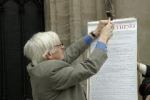 October 31st 2005, Matthew Fox nailed his 95 Thesis to the doors of the church in Wittenburg. Rome took no notice. But the churches in Germany did. Just as Martin Luther’s action was aided by the invention of the printing press, Matthew Fox’s action was aided by the invention of the internet and thus began a conversation that led to the publication of Fox’s little book: A New Reformation: Creation Spirituality and the Transformation of Christianity. I return to Fox’s tome annually as part of my preparation to preach on Reformation Sunday.
Here’s a sample of Fox’s theses:
1) God is both Mother and Father.
3) God is always new, always young, and always “in the beginning.
4) God the Punitive Father is not a God worth honouring, but a false god and an idol that serves empire builders. The notion of a punitive, all-male God, is contrary to the full nature of the Godhead, who is as much female and motherly as masculine and fatherly.
5) “All the names we give to God come from an understanding of ourselves” (Meister Eckhart). thus people who worship a Punitive Father are themselves punitive.
6) Theism (the idea that God is “out there” or above and beyond the universe) is false. All things are in God and God is in all things (panentheism).
10) God loves all of creation, and science can help us more deeply penetrate and appreciate the mysteries and wisdom of God in creation. Science is no enemy of true religion.
15) Christians must distinguish between Jesus (a historical figure) and Christ (the experience of God-in-all-things).
16) Christians must distinguish between Jesus and Paul.
18) Eco-justice is a necessity for planetary survival and human ethics; without it we are crucifying the Christ all over again in the form of destruction of forests, waters, species, air, and soil.
20) A preferential option for the poor, as found in the base community movement, is far closer to the teaching and spirit of Jesus than is a preferential option for the rich and powerful, as found, for example, in Opus Dei.
23) Sexuality is a sacred act and a spiritual experience, a theophany (revelation of the Divine), a mystical experience. It is holy and deserves to be honoured as such.
24) Creativity is both humanity’s greatest gift and its most powerful weapon for evil, and so it ought to be both encouraged and steered to humanity’s most God-like activity, which all religions agree is compassion.
32) Original Sin is an ultimate expression of a punitive father God and is not a biblical teaching. Bit Original Blessing (goodness and grace) is biblical.
33) The term original wound better describes the separation humans experience on leaving the womb and entering the world–a world that is often unjust and unwelcoming–than does the term Original Sin.
59) Fourteen billion years of evolution and unfolding of the universe bespeak the intimate sacredness of all that is.
60) Jesus said nothing about condoms, birth control, or homosexuality.
71) A church that is more preoccupied with sexual wrongs than with wrongs of injustice is itself sick.
75) Poverty for the many and luxury for the few are not right or sustainable.
I’m sure that we all have thesis or two that you would like to nail to the door. I know that if I had a hammer, I’d hammer in the morning, I’d hammer in the evening all over this land, right up to the doors of churches everywhere, and I would nail a few theses to the more than a few church doors. I’d begin with a thesis about the need to move beyond the destructive theories of atonement that have only served to pervert the meaning of the life, death and resurrection of Jesus and separate people from the sure and certain knowledge that neither death, nor life nor anything in all of creation can separate us from the love of God in Christ.
I’d include a theses or two about the dumbing down of our best theology and our acceptance of easy answers that have turned most people’s vision of God into a sadomasochistic father who insists on the death of his own son in order to satisfy our definition of justice.
I’d go on and on about the wonders and beauty of creation, and insist that we confess that we are wonderfully made.
I’d confess our obsession with self that lies behind the sin of avarice that permeates our consumer culture and turns our energies toward violence.
I’d call for a return to the Jewish tradition of Sabbath that called upon believers to read the Song of Songs and make love on the Sabbath.
I’d call the church to its responsibility to instill a love of creation in all people so that we can walk upon the earth lightly.
I’d remind the powers that be that all people are created equally and that sexuality is a gift from God to be celebrated and not used to segregate some believers from the priesthood that belongs to all believers.
On this Reformation Sunday, lovers of the church everywhere need to free ourselves from the shackles of tradition and about our 95 theses.
What wisdom do you have to share with the church? What needs reforming? What needs preserving? What needs tossing out? What needs holding up and celebration? When should we cry out in solidarity? When should we sing out with joy and wonder? What should we do? What should we stop doing? Semper Reformanda! Always reforming!
This Reformation Sunday at Holy Cross Lutheran, we will sing new words by Miriam Therese Putzer to Luther’s traditional tune: EIN FESTE BURG which you can find here
You can watch the video of Matthew Fox talking about his book here

 Do we have the courage to confront our doubt in worship? This is the challenge that Peter Rollins who describes “the game” of certainty and triumphalism that passes for worship and insists that God must function as a “feel-good” entity rather than One who helps us engage our suffering, the Mystery, our doubts and uncertainties. Rollins calls for worship leaders who are willing to engage the dark night of the soul and create liturgies of unknowing. Are worshippers ready? Perhaps their hungry for opportunities to confront their realities in worship.





 pastordawn