Hildegard von Bingen – Woman of Vision

Herald of the Divine Feminine, reformer of the church and green prophet! Today is the feast day of the Christian mystic Hildegard von Bingen, a woman of great vision, a woman centuries ahead of her time. During her 81 years Hildegard’s talents as an artist, musician, poet, healer and theologian ought not to be ignored. And yet the Roman Catholic Church only got around to officially canonizing this giant of the church this past May. Rumour has it the Mr. Ratzinger plans to elevate St. Hildegard to the status of Doctor of the Church next month. 

In 2009, German filmmaker Margarethe von Trotta wrote and directed the movie “Vision”. The DVD version is available from Amazon and I highly recommend it!!! 

Matthew Fox’s new book “Hildegard of Bingen a Saint for Our Times, Unleashing Her Power in the 21st Century” will be released next month and I am eagerly awaiting my copy. You can listen to an interview of Matthew Fox on the subject of his new book here.  Fox describes Hildegard as a Trojan horse whose teachings he hopes will shake up the vatican. 

At Holy Cross we have developed an Evening Prayer Service inspired by the work of Hildegard. The worship bulletin and an audio recording of the service are linked below.  Enjoy the video of contralto Karen Clark who preforms Hildegard’s antiphon “O Virtus Sapientie”

Evening Prayer Service Bulletin which is to be printed double-sided

Evening Prayer Audio – the silences are intentional.  Enjoy!


We are Stardust, Billion Year Old Carbon – Sermon

We Are Stardust!!! Billion Year Old Carbon!!!

Creation II – Celebrating Humanity

Great to be back in the pulpit following a splendid four month sabbatical!!!

Thank-you to everyone who contributed to the fabulous welcome home!!!

Listen to the Sermon here

Here’s a little video you’ll want to hum along to after listening to the sermon!

New Beginnings

So many new beginnings: Back to work this week; a new beginning. Team Ministry; a new beginning. As students and teachers head back to school, churches begin a new program year. At Holy Cross we are are using the Alternate Lectionary (scripture readings) for Creation and this Sunday’s readings call for a celebration of Humanity. The first reading is the Hebrew creation myth found in the first chapter of Genesis; the all too familiar story. Churches have been telling this particular story of our beginning for centuries. Standing here at the beginning of a new century makes me wonder why we don’t tell a new story of our beginning.

When I begin to study the Genesis story with Confirmation Students, I ask them to imagine our ancestors sitting around a campfire asking one another, “What’s it all about? Why are we here? Where did we come from? Who are we?” Looking back at how we once approached these questions of meaning is a perfectly fine exercise. But we can’t stop there. It’s time for us to change the scene so that it better reflects who we are here and now. Gone is the campfire. Gone is the three-tired universe. Gone is the belief that Genesis is history.

The time has come for us to imagine a different gathering at which the same questions emerge. Only this time those who have gathered can reach into their pockets and take out their mobile devices to access the wisdom of the ages. This time a new myth emerges to capture our imaginations, a new myth from within which we can begin to imagine who we are, where we came from, why we are here and where we are going???

So this Sunday our first reading will not come to us from the book of Genesis. This Sunday we will begin our celebration of humanity by telling a new creation myth, one that emerges from the wealth of knowledge that science offers us. I can’t wait to begin!

EVOLUTIONARY THINKING: Produces Evolutionary Christians

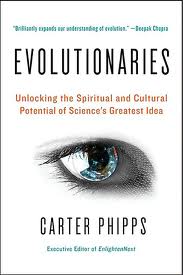
Evolutionary is a term given to thinkers who see evolution as much more than simply a theory that pertains to the biological development of life on this planet. Evolutionaries are generalists who are willing to piece together information from all disciplines in order to explain the cosmos. So, says Carter Phipps in his new bestseller, “Evolutionaries: Unlocking the Spiritual and Cultural Potential of Science’s Greatest Idea”. In which he defines evolutionaries as: “deep time explorers of a universe of infinite becoming.”  In a world where scientists, philosophers, and theologians are borrowing from one another’s insights in order to explore the secrets of existence, evolutionary theory is being applied to more than just biology.  

Inspired by Matthew Fox’s “Original Blessing”, I have long since given up on the medieval doctrine of original sin and moved beyond the atonement theologies that rely on our need to be saved by a “Father God”.  Like many progressive Christians, rather than describing the human condition as sinful or broken, I understand humanity to be incomplete and still evolving. We did not fall from grace in some mythical garden. Humanity, like all of the cosmos continues to evolve. The idea of evolution has all sorts of implications not only for how we see ourselves as human beings, here and know. As we continue to evolve, the determination of who or what humanity becomes requires that we take seriously our role as co-creators not with some grand-puppetier-god-in-the-sky. But as co-creators with a God who is in all and through all. 

The emerging conversation between scientists, theologians, and philosophers makes the question “Do you believe in the bible or do you believe in evolution?” obsolete. The conversations between disciplines are giving birth to a new spirituality. Evolutionary Christianity is emerging. Evolutionary thinkers are developing new theologies that take seriously God’s presence in all things through Christ. 

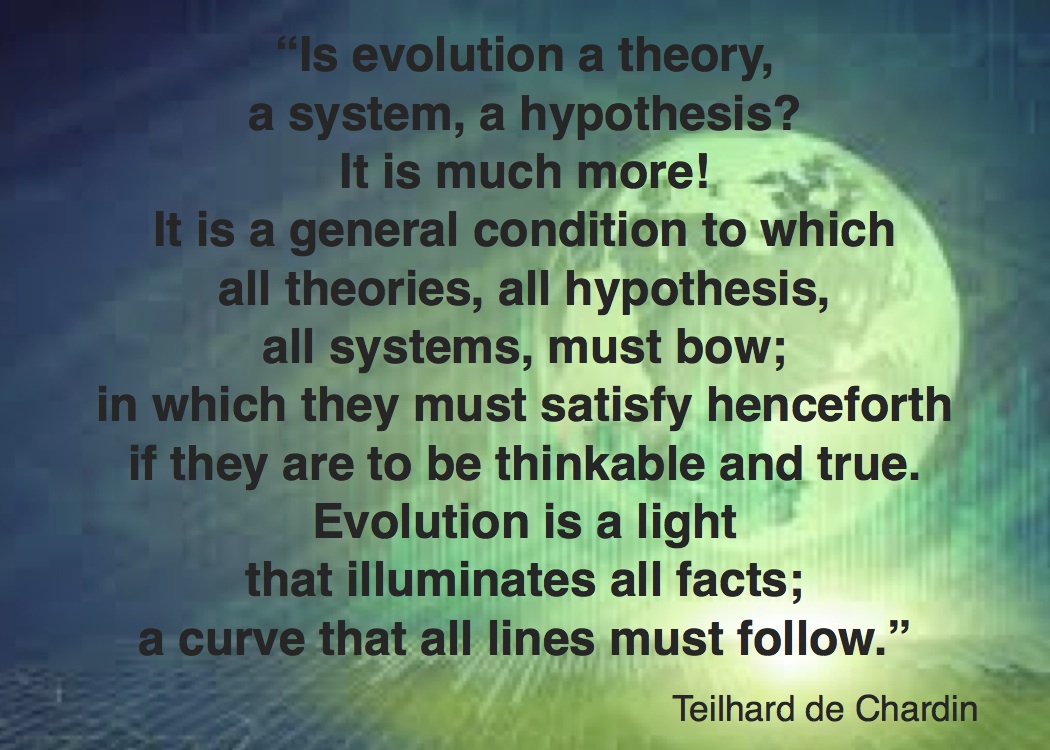
After having spent a week, exploring the work of Teilhard de Chardin; an evolutionary thinker who was decades ahead of his time, I am eagerly devouring my copy of Phipps new book (just released June 12 and it has already it has reached #14 on Amazon).  I will say more in future posts.  In the meantime, for an overview of what it means to be an evolutionary, take a look at the video below which features Carter Phipps speaking at MIT this past May.

20th CENTURY MYSTIC – Teilhard de Chardin

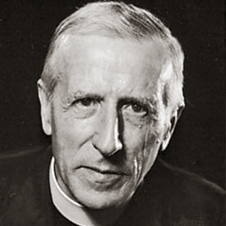
“Our duty, as men and women, is to proceed as if limits to our ability did not exist. We are collaborators in creation.” Pierre Teilhard de Chardin was a mystic whose explorations of creation landed him in hot water with his beloved Roman Catholic Church and propelled him toward visions of a cosmos whose very life-blood is Love. 

Published posthumously, Teilhard’s “Le Phenomene Humain” reads more like the work of a progressive 21st century christian theologian or scientest than that of a devoted 20th century Jesuit priest/biologist/palaeontologist. Teilhard paints a poetic vision that modern theologians would call a panentheistic view of the cosmos (pan: all + theo: god = god is in all and all is in god).  

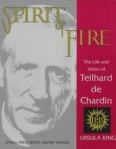
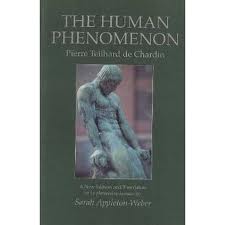
As I work my way through Sarah Appleton-Weber’s translation, “The Human Phenomenon” I am also enjoying Ersula King’s excellent biography “Spirit of Fire”. King is Professor Emerita of Theology and Religious Studies, University of Bristol, and a vice president of the World Congress of Faiths. Her specific areas of expertise are in the life and work of Teilhard. Below you will find her lecture  which provides an excellent overview of Teilhard de Chardin and the “Contemporary Mystic Quest”  (in 5 parts).  Whether you know a great deal about his life and work, or nothing at all, I commend it to you. But beware, it will wet your appetite for more.  

CONSUMED BY TEILHARD de CHARDIN’s FIERY VISION

I first discovered Teilhard’s work while completing my undergraduate work in Religious Studies at the University of British Columbia, when a well-used copy of “The Phenomenon of Man” (Le Phenomene Humain) captured my interest. At the time, Teilhard’s insights were quite a stretch for me and although I finished the book feeling overwhelmed by its complexity, I couldn’t help longing for the day when I might be better able to follow Teilhard beyond the rigid confines of the science versus religion debate toward a more comprehensive approach to understanding the cosmos and our place in it.

Today, in the midst of my sabbatical at UBC, it feels so appropriate that I should once again be consumed by Teilhard, as I luxuriate in Sarah Appleton-Weber’s newer translation: The Human Phenomenon. Lo these many years later, I still feel ill-equipped to grasp the wonders of Teilhard’s vision. But, I am struck by the beauty of his vision of the complex process of unfolding of the universe. 

My comprehension of Teilhard’s work is enhanced by Ersula King’s splendid biography: Spirit of Fire.  King describes his vision as one in which: “love is a spirituality that celebrates the oneness of creation, a spirituality that acknowledges love as the clearest understanding we have of God, of ourselves, of history, and of the cosmos.”

“his vision was one of consuming fire, kindled by the radiant powers of love. It was a mystical vision, deeply Christian in origin and orientation. Yet it broke through the boundaries of traditional orthodoxies — whether those of science or religion — and grew into a vision which is global in intent.”  

In an essay, “The Heart of the Matter” written near the end of his life, Teilhard described this fire at the heart of reality:

“Throughout my life, by means of my life, the world has little by little caught fire in my sight, until a flame all around me, it has become almost luminous from within. Such has been my experience in contact with the Earth. The diaphany of the divine at the heart of the universe on fire. Christ, the heart, a fire capable of penetrating everywhere, and gradually spreading everywhere.”

Teilhard was a scientist/theologian/philosopher/prophet who remains ahead of his time, whose work continues to push scientists and theologians to move beyond the carefully drawn boundaries of their own disciplines so that they might learn from one another. King explains: “His deepest desire was to see the essence of things, to find their heart, and probe into the mystery of life, its origin and goal. In the rhythm of life and its evolution, at the center of the cosmos and the world, Teilhard believed, is a divine center, a living heart beating with the fiery energy of love and compassion. Now, the heart is really a fleshly reality But the image of this very flesh, this concentration of living, breathing matter, came to symbolize for Teilhard the very core of the spirit.”

The warmth of these summer days at UBC are richly complemented by Teilhard’s fiery vision as I savour this divine consumption.

For those of you unfamiliar with this 20th century Christian mystic the American Teilhard Association provides a brief biography at:  http://teilharddechardin.org/index.php/biography

“AT THE HEART OF THE MATTER, A WORLD HEART, THE HEART OF GOD” Teilhard de Chardin

Today, I began to study the work of Pierre Teilhard de Chardin. I have been longing to do this ever since I was first introduced to this 20th century Christian mystic some 25 years ago, when Matthew Fox’s “Original Blessing” helped me to look to the Christian mystics, both ancient and modern, to find new ways of connecting to the cosmos.  After many brief encounters with Teilhard’s work in books and articles by some of my favorite theologians, I have longed to spend some time exploring Teilhard’s purported brilliance. I have begun by reading “The Human Phenomenon” (often mistranslated from the French as “The Phenomenon of Man”). I’ve submerged myself in the delights and challenges of this enthralling work until my mind is about to explode (usually just a chapter or two at a sitting) and then I take a break by reading Ersula King’s  riveting biography: “Spirit of Fire: The Life and Vision of Teilhard de Chardin”. It has been a mind blowing day!

So many connections are emerging and I shall endeavor to post them as they escape from the quagmire of ideas that are swirling around in my brain. But as the Sabbath approaches I leave you with this playful tune from Peter Mayer which celebrates this blessed Ordinary Day in a way that complements this mystic moment!


‘WE ARE ALL THE UNIVERSE BECOMING MORE AWARE OF ITSELF” Rev. Michael Dowd

Michael Dowd, a self-proclaimed Evolutionary Evangelist is committed to spreading the good news that evolution is humanity’s common creation story as he proclaims that science illuminates the evidence with which God is communicating to humans today.

Inspired by the work of Fr. Thomas Berry who portrayed the epic of evolution as a sacred story Dowd seeks to popularize Berry’s insistence that humanity is the universe becoming conscious of itself. 

Dowd’s work is especially intriguing to this particular 21st century pastor who connects to the cosmos from the perspective of panentheism (God is in everything and everything is in God). Evolutionary Christianity is an exciting way of using the explosions in scientific evidence to illuminate our religious quest to understand our place in the cosmos. 

I am indebted to a blog-follower from South Africa for linking me to this excellent video by New Hampshire Outlook that explores the work of the Rev. Michael Dowd. In addition to a fabulous interview this video provides an enticing overview of Evolutionary Christianity that will leave you wanting to learn more.  You can begin by visiting Evolutionary Christianity’s Blog. I’m anxiously waiting for my copy of Dowd’s “Thank God for Evolution” to explore more of Dowd’s insights.

EVOLUTIONARY GOOD NEWS – Rev. Michael Dowd

Evolutionary theologian Michael Dowd, author of “THANK GOD FOR EVOLUTION” advocates for an “Evolutionary Christianity”.  A self-described “New Theist” Dowd explains: New Theists are not believers; we’re evidentialists. We value scientific, historic, and cross-cultural evidence over ancient texts, religious dogma, or ecclesiastical authority. We also value how an evidential worldview enriches and deepens our communion with God. New Theists are not supernaturalists; we’re naturalists. We are inspired and motivated more by this world and this life than by promises of a future otherworld or afterlife. This does not, however, mean that we diss uplifting or transcendent experiences, or disvalue mystery. We don’t. But neither do we see the mystical as divorced from the natural. New Theists are legion; we are diverse. Many of us continue to call ourselves Christian, Jew, Muslim, or Hindu. We may also self-identify as emergentist, evidentialist, freethinker, neo-humanist, pantheist, panentheist, or some other label. New Theists don’t believe in God. We know that throughout human history, the word “God” has always and everywhere been a meaning-filled interpretation, a mythic and inspiring personification of forces and realities incomprehensible in a prescientific age. We also know that interpretations and personifications don’t exist or fail to exist. Rather, they are more or less helpful, more or less meaningful, more or less inspiring.”

Here’s the TED TALK: Why We Suffer Now, for those who are pushed for time. But if you have the time, I strongly  recommend the longer CAL TECH Lecture:  Evolution and the Global Integrity Crisis,  below in which Dowd is able to elaborate on his ideas.  Fascinating stuff!!!

For more on Evolutionary Christianity click below:

Ash Wednesday – Embracing Eternity

Click here to listen to the worship service:  Ash Wed Service

Click here to download the worship bulletin Ash Wednesday Feb 22 2012