Lenten Evening Prayer: Parables Ancient and Modern – Betrayal

Orthodox HereticThis year our Lenten Evening Prayer services draw on Peter Rollins collection of Parables found in “The Orthodox Heretic and Other Impossible Tales”. Prayers are drawn from the writings of the Christian Mystics. Each week an audio recording of the service will be posted as well as a copy of our worship bulletin.

March 20, 2013 – Betrayal

Evening Prayer a copy of the worship bulletin can be found here – it is designed to be printed double-sided and folded into a booklet.

Listen to the worship service here

Lenten Evening Prayer: Parables Ancient and Modern – The Book of Love

Orthodox HereticThis year our Lenten Evening Prayer services draw on Peter Rollins collection of Parables found in “The Orthodox Heretic and Other Impossible Tales”. Prayers are drawn from the writings of the Christian Mystics. Each week an audio recording of the service will be posted as well as a copy of our worship bulletin. 

March 13, 2013 – The Book of Love

 Evening Prayer a copy of the worship bulletin can be found here – it is designed to be printed double-sided and folded into a booklet.

Listen to the worship service here

Lenten Evening Prayer: Parables Ancient and Modern

Orthodox HereticThis year our Lenten Evening Prayer services draw on Peter Rollins collection of Parables found in “The Orthodox Heretic and Other Impossible Tales”. Prayers are drawn from the writings of the Christian Mystics. Each week an audio recording of the service will be posted as well as a copy of our worship bulletin. 

Evening Prayer-Feb. 20 2013 NO CONVICTION

A Copy of the worship bulletin can be found hereit is designed to be printed double-sided and folded into a booklet.

Listen to the worship service here (service begins at the 48 sec. mark)

Peter Rollins reads NO CONVICTION

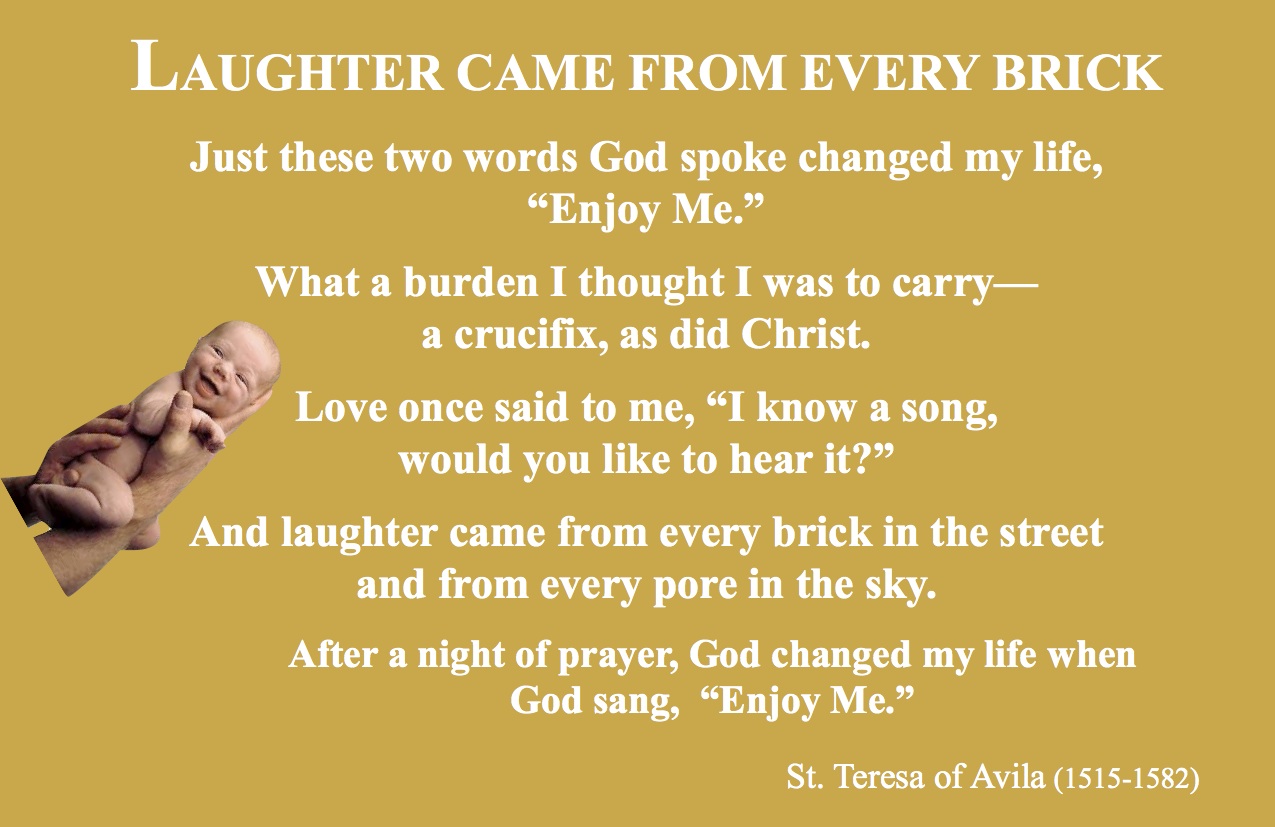
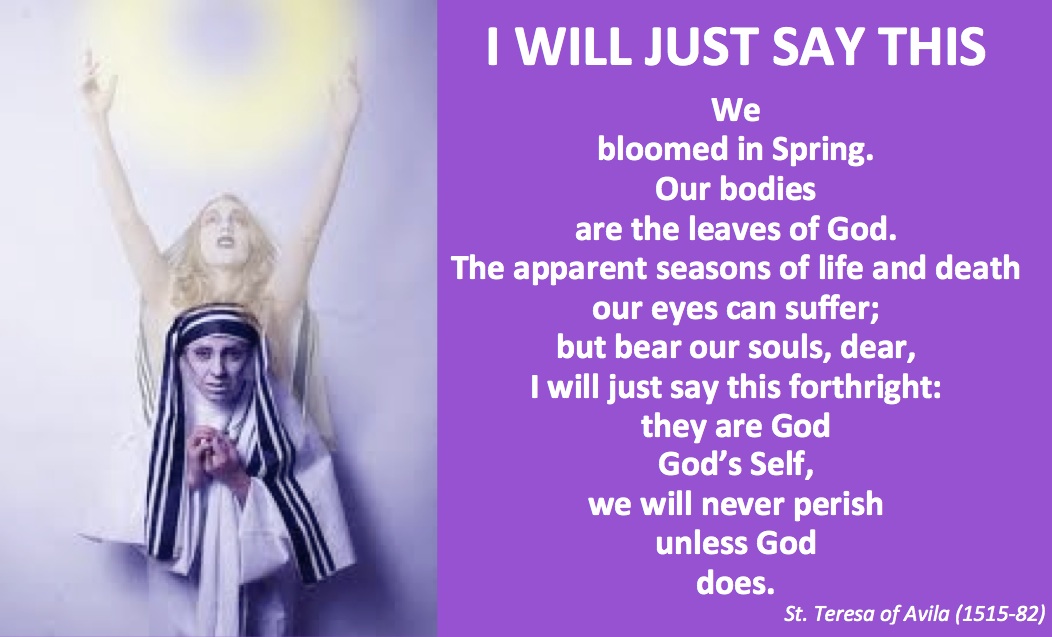
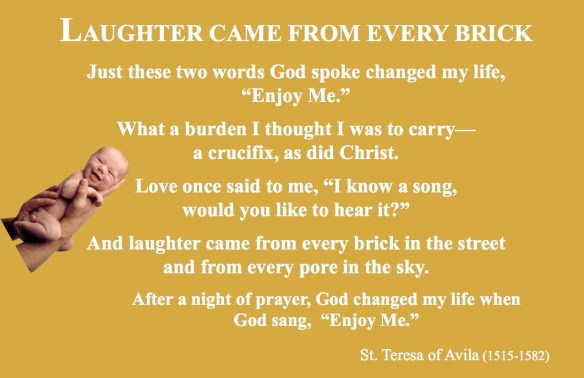
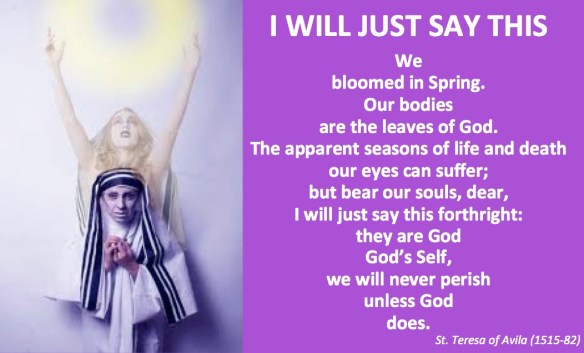
Today We Celebrate the Life and Witness of St. Teresa of Avila

An excerpt from “Love Poems From God” by Daniel Ladinsky,

(Penguin Compass, London: 2002)

(1515-1582)  “Teresa was born in Avila, a beautiful high mountain village of Spain.  She was one of thirteen children, three girls and ten boys, in a wealthy family.  The Spain in which Teresa grew up was permeated with 700 years of Arabian culture; the eradication of Arab power was followed by one of Spain’s darkest periods, the insanity of the Inquisitions, which, in the fourteenth century, along with other grievous deeds, forced mass conversions of Jews to Christianity.”

“Teresa was her father’s favourite child, and the most spirited.  Her mother died during childbirth when Teresa was thirteen, after which she had little supervision.  It is believed she had a lover at the age of fifteen, which caused her father to send her to a convent boarding school, only to see her return home two years later because of poor health.  When she was twenty-one, Teresa ran away from home to join a convent.  At that time many convents were more like hotels for women, allowing them a great deal more independence than they would be allowed at home, though after two years at the convent Teresa had a near-death experience that changed her life.  A spiritual awakening began in which she cultivated a system of meditation that sought quieting the mind to such an extent that God could then be heard speaking.  Over the next twenty years she experienced many mystical states but not until she was fifty did she begin the most far-reaching aspects of her life’s work.”

St. Teresa of Avila “had a great desire for learning and when the Inquisition, in 1559, forbade women to read, Teresa turned to God and asked God to teach her soul about divine love.  She then began to write completely out of her own experience.   Many of her poems are, in fact, intimate accounts of her communion with God. 

The Church’s persecution of Teresa had not waned when she passed away and was buried in Alba de Tormes in 1582.  A year after her death some of her disciples, feeling that she might have wished to be buried in Avila, had her body exhumed.  When her body was found to be perfectly intact and emitting a wonderful fragrance, her sainthood was formally decreed, allowing the publication and preservation of some of her works.

Most of what we see today of Teresa’s work is probably reined way back, for her writings fell into the hands and under the control of the very forces that had so opposed her throughout her life.”

“Teresa of Avila is undoubtedly the most influential saint in the Western world, and she has made great contributions to spiritual literature and poetry.  She was a woman of tremendous courage who is rightfully credited with the remarkable political and religious reform achieved against the strongest—and most insidious—chauvinistic forces.”

“A realistic picture of Teresa’s life did not even reach the English-reading general public until the 1960s.  She was known to have had a remarkable quick wit and a stunning, even provocative, sense of humour, as well as a great physical beauty.  Her complete works include seven books, four hundred and fifty letters, and assorted poetry.  Her writings are considered masterpieces of mystical prose and verse. She personally founded seventeen Carmelite convents and two monasteries, despite enormous opposition from the Church and other men in power.”

Reinventing Christianity – Matthew Fox

Back in 1989, before I ever began entertaining the idea of returning to school to prepare for a life in ministry, a fortuitous Christmas gift in the guise of a copy of Matthew Fox’s newly published The Coming of the Cosmic Christ sent me on a journey that continues to shape my understanding of what it means to aspire to follow Christ.
Barely two chapters into Fox’s challenging tome and I knew that if I was ever to begin to understand Fox’s visions of reality, I would need to begin nearer the beginning. In those days, searching for a book involved more than a web search and so I began travelling from book store to book store to scour the shelves for a copy of Original Blessing.


Original Blessing’
s Introduction begins with two questions: “1. In our quest for wisdom and survival, does the human race require a new religious paradigm? 2. Does the creation-centered spiritual tradition offer such a paradigm?” Having absolutely no idea what the word “paradigm” means, I knew I was about to be challenged. So, I got my dictionary off the shelf and prepared to wade into unknown waters.  

Lead by Fox, I explored the ancient wisdom of Creation Spirituality and began a love affair with the wonders of mysticism and the marvels of science that continue to reveal ecstasies that intrigue and excite my body, mind and spirit! 

Matthew Fox’s work continues to nourish my desire to approach they Mystery we call divinity. In the videos below Fox delivers (in 2 parts) the Jarvis Lecture in which he calls for the Reinventing of Christianity. Fox believes that “if we cannot reinvent our religious then we are doomed, the human species is doomed.” Fox insists that Christianity needs to reset its focus; away from a preoccupation with redemption toward a focus upon creation. 

Chanting with Mathew Fox

Matthew Fox’s Creation Spirituality has provided a pathway beyond the constrictive confines of Christian doctrine  into the Wisdom tradition of the Mystics. Here he plays with the “ah” sounds of the various names for the divine. The exercise which he demonstrates is a wonderful way to open or awaken one’s self to the playfulness of the Spirit.

20th CENTURY MYSTIC – Teilhard de Chardin

“Our duty, as men and women, is to proceed as if limits to our ability did not exist. We are collaborators in creation.” Pierre Teilhard de Chardin was a mystic whose explorations of creation landed him in hot water with his beloved Roman Catholic Church and propelled him toward visions of a cosmos whose very life-blood is Love. 

Published posthumously, Teilhard’s “Le Phenomene Humain” reads more like the work of a progressive 21st century christian theologian or scientest than that of a devoted 20th century Jesuit priest/biologist/palaeontologist. Teilhard paints a poetic vision that modern theologians would call a panentheistic view of the cosmos (pan: all + theo: god = god is in all and all is in god).  

As I work my way through Sarah Appleton-Weber’s translation, “The Human Phenomenon” I am also enjoying Ersula King’s excellent biography “Spirit of Fire”. King is Professor Emerita of Theology and Religious Studies, University of Bristol, and a vice president of the World Congress of Faiths. Her specific areas of expertise are in the life and work of Teilhard. Below you will find her lecture  which provides an excellent overview of Teilhard de Chardin and the “Contemporary Mystic Quest”  (in 5 parts).  Whether you know a great deal about his life and work, or nothing at all, I commend it to you. But beware, it will wet your appetite for more.  

“AT THE HEART OF THE MATTER, A WORLD HEART, THE HEART OF GOD” Teilhard de Chardin

Today, I began to study the work of Pierre Teilhard de Chardin. I have been longing to do this ever since I was first introduced to this 20th century Christian mystic some 25 years ago, when Matthew Fox’s “Original Blessing” helped me to look to the Christian mystics, both ancient and modern, to find new ways of connecting to the cosmos.  After many brief encounters with Teilhard’s work in books and articles by some of my favorite theologians, I have longed to spend some time exploring Teilhard’s purported brilliance. I have begun by reading “The Human Phenomenon” (often mistranslated from the French as “The Phenomenon of Man”). I’ve submerged myself in the delights and challenges of this enthralling work until my mind is about to explode (usually just a chapter or two at a sitting) and then I take a break by reading Ersula King’s  riveting biography: “Spirit of Fire: The Life and Vision of Teilhard de Chardin”. It has been a mind blowing day!

So many connections are emerging and I shall endeavor to post them as they escape from the quagmire of ideas that are swirling around in my brain. But as the Sabbath approaches I leave you with this playful tune from Peter Mayer which celebrates this blessed Ordinary Day in a way that complements this mystic moment!


God and the Evolutionary Mind: The God Who Beckons

Sister Joan Chittister, O.S.B. What does evolution have to tell us about God?  Speaking in April 2012, Sister Joan explores the emerging connections between science, religion and spirituality to find new ways of speaking of about God. The God we know in 2012 is not the God we knew in years past.  We have all known and moved beyond many Gods. As our images of God fail us, we turn to the MYSTERY of God that no one wants: God the fullness of BEING.

LENTEN EVENING PRAYER #4 – Francis of Assisi

Evening Prayer Service Bulletin which is to be printed double-sided

Evening Prayer Audio – the silences are intentional.  Enjoy!

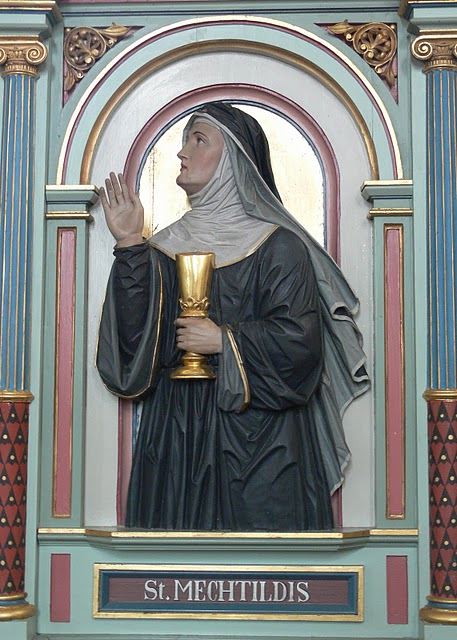
LENTEN EVENING PRAYER #3 – Mechthild of Magdeburg

Evening Prayer Service Bulletin which is to be printed double-sided.

Evening Prayer Service audio – the silences are intentional – enjoy them.

LENTEN EVENING PRAYER #1 – Julian of Norwich

Click here to download the Worship Bulletin which is to be printed double-sided

Click here to listen to the Worship Service