During the season of Advent we approach the MYSTERY through story and song. Unable to fully express our deepest longings with words, we engage the stories handed down to us by our ancestors. Trusting these stories not as history but as truth. For as Marcus Borg teaches, these stories may not have actually happened this way, but they are always happening. Over and over again, we see ourselves and our longings for hope, peace, joy and love in the stories we tell during this season of desire. In the video below Phyllis Tickle tells the stories that speak of the longings and desires of our ancestors. Today, we would do well to remember the stories of old as precursors to the telling of our own stories of longing. For just as our ancestors had the wisdom to engage the MYSTERY with stories, we too know of our need to engage the MYSTERY with our stories. What stories are gestating within us? What stories will we give birth to this Advent.
For those of you using mobile devices my apologies but bliptv is availablehere
Our thanks to Trinity Anglican Church in Aurora who graciously hosted a splendid event on Nov.16-18 at which the great Phyllis Tickle shared her wealth of wisdom on the “the great emergence” that is rocking our world. Phyllis claims that she is not a preacher, but the homily she delivered on the Melchizedek’s importance to Emergence Christianity’s understanding of “where it all began,” suggests that Phyllis is mistaken about her homiletical prowess.
Looking forward to lectures this weekend by Phyllis Tickle. For those of you who will not be able to make it to Trinity Anglican in Aurora, enjoy this video of Tickle doing what she does best, teaching.
In the gospel reading which will be read this Sunday in mainline congregations, the writer of the Gospel According to Mark puts words about the destruction of the Temple into the mouth of Jesus. I can’t help wondering, if we really are a people who believe in resurrection, why are we so reluctant to let our notions about “church” die. Surely, we have enough faith to open ourselves to what may emerge as the last rites are said over the church of bygone days.
All Saints’ Day is a day for remembering. The word saint simply means “holy”. In the New Testament, all those who believe and were baptized were referred to as saints. It wasn’t until round about the third century that the church began using the word saint to refer to those who had been martyred for the faith. Over time these martyred saints were held up for veneration and people used to pray to them to intercede on their behalf. I’m not going to go into all of the institutional abuses that led Martin Luther and the later reformers to abolish the veneration of the saints. Except to say, that while the Reformation put an end to the veneration of the saints in the protestant churches, it did not abolish the concept of sainthood.
Within the mainline protestant denominations, we use the term in much the same way as it was used in the New Testament to describe the faithful. We talk about the communion of saints to describe all the faithful who have gone before us who now rest in God, together with all the living who walk in faith. So today as we celebrate the saints, we give thanks for all the faithful those living and those who have gone before us.
Today, I remember and rejoice as I give thanks and praise to God for the witness of St. Joyce of Belfast. St. Joyce who in her own way taught her children to love God and to pray always. And so today, I give thanks and praise to God for the life and witness of St. Joyce of Belfast, my Mom, who was the first to teach me the Lord’s Prayer, and who puts flesh on Christ’s command that we love our neighbours as we love ourselves.
Today I remember and give thanks for the life and witness of St. John of Wales, whose life in the church as a choir-boy was followed by long years of self-exile and whose keen wit and lack of patience with hypocrisy instilled in me a desire for honesty and integrity in the articulation and living of the faith. I give thanks for St. John, my Dad, whose open heart has stretched his discerning mind and enabled many to see the humour in this God-given life we live.
Today, I remember and rejoice as I give thanks and praise to God for the witness of St. Valerie of Ladner. St. Valerie so loved and feared God that she dared to reach out and invite a wayward soul to come and worship God. St. Valerie sang God’s praise, rejoiced in the communion of saints and helped a young friend find a home in God’s holy church. And so toady, I give thanks and praise to God for the life and witness of St. Valerie, my high school friend, who was the first to invite me to come and worship God.
Today, I remember and rejoice as I give thanks and praise to God for the witness of St. Wilton of Lunenburg. St. Wilton loved God all the days of his life and served God with gladness and distinction. St. Wilton went far beyond his call as pastor, he opened up the scriptures to those who eagerly sought the truth of God’s Word with love and dedication and he went on to inspire a diligence to scholarship that nurtured the faith of so many young people. And so today, I give thanks and praise to God for the life and witness of St. Wilton, my first pastor, who taught me to be uncompromising in my study of the scriptures, and steadfast in my love for God.
Today, I remember and rejoice as I give thanks and praise to God for the witness of St. Lola of Washington. St. Lola whose appreciation for God’s grace overflowed in her love for the world. St. Lola whose desire to share God’s grace and truth, led her to give of her time and talent to the care and redemption of so many young seekers. St. Lola whose love for God’s creation inspired her to teach so many of us to give thanks to God for all that God has made. And so today, I give thanks and praise to God for the life and witness of St. Lola, my mentor in the faith, who taught me to love as I have been loved.
Today, I remember and rejoice as I give thanks and praise to God for the life and witness of St. Fritz of Chicago. St. Fritz whose dedication to the Word of God was displayed in all he did. St. Fritz who opened so many minds to the beauty of God’s ways, who taught, inspired and entertained as he sought to reveal the wonders of God’s unimaginable grace. St. Fritz who taught me that no question is unaskable for it is God who blessed us with minds and who bids us to use them in our love for God and for one another. And so today, I give thanks and praise to God for the witness of St. Fritz, my friend, who was the first to call me to the ordained ministry of Word and sacrament.
Today, I remember and rejoice as I give thanks and praise to God, for the life and witness of St.s Sharon and Irene of Pt. Roberts, St. Ellen of Lonsdale, St.s Jerry and Daniel of Minnesota, St. Nancy of Seattle, St. Anne of Vancouver, St. Donald of UBC, St.s Carol, John, Eduard, and Donna of Waterloo, and for the great cloud of witness both living and dead who have testified to God’s love in my life.
Toady, I give thanks and praise to God for the cloud of witnesses who gather to worship God and to love one another in the parish I serve. I give thanks for all the glorious saints of Holy Cross who have nourished, challenged and helped me to grow in Christ.
Today, I encourage each and every one of you, to remember and rejoice, as you give thanks to God for the great cloud of witnesses who have been a blessing to you; who have revealed God’s love to you; who have taught you God’s holy Word of truth; who have loved you, nourished you, challenged you and inspired you to love God with all your heart, with all your soul and with all your mind and to love your neighbours as you love yourself.
Who are the saints in your life? Think about the saints who revealed God’s love to you. Remember and rejoice for by their love, they taught you God’s Word, and taught you to celebrate God’s grace. Remember and rejoice in the saints of God, who are responsible for having passed the gifts of faith on to each of us. Saints who you may never read about in the church history books, but saints who by their life and witness managed to reveal a measure of God’s amazing grace to the world.
These saints of God who are so dear to us and so precious to God, are just ordinary folks who in the course of seeking to be faithful followers of Jesus Christ, in striving to love God with all their heart, soul, and mind, they ended up touching our lives in ways that changed us and had a profound effect on who we are today.
Today is a day for remembering and rejoicing in the communion of saints. Today is a day for giving thanks to God for their lives and for the witnesses that they have been and are in our lives. But today is also a day for looking around us to discover our own place in the communion of the saints. Take just a moment to think about how people will remember and give thanks for your sainthood. Whose faith have you nourished? Whose faith will you nourish? How will you nourish people in the faith? What role are you prepared to play in the Communion of Saints?
The Reverend Dr. Otis Moss III says it well listen to St. Otis preach it!
“We are here to grow a soul. Not just to sit on one and cash it in at the end of our life.” Matthew Fox explores the undiscovered territories that lie within us. Developing a sense of the sacred that lives in all of us is vital as we engage in the expansion of our consciousness. But has the church, like humanity itself, forgotten the sense of the sacred? Matthew Fox explores a vision of the church that is the place, the space, the happening, where mystics and prophets are birthed, nurtured, championed, supported, and challenged. Fox encourages the church to embrace her prophetic calling to interfere with education, economics, and the environment.
This sermon was inspired by Monty Python’s “We were so poor that…” sketch also known as the Four Yorkshiremen, and Joan Chittister’s book Uncommon Gratitude.
Speaking at the University of Noter Dame’s Centre for Social Concerns, on the 50 Anniversary of Pope John XXIII’s encyclical Pacem in Terris issued in 1963 as a call to “Universal Peace in Truth, Justice and Liberty” Sister Joan describes the “Common Good” as the Holy Grail of politics. She divines the common good as “a vision of public virtue which engages the individual citizen, energizes the government, shapes the public system, and points the public direction in all its policies, all its institutions, and all its legislative intents.”
Fear of diversity has relegated the notion of the common good to the status of an endangered species. Str. Joan points to Pacem in Terris’ insistence that nationality is trumped by one’s global citizenship and responsibilities and warns that pathological individualism threatens our ability to articulate a vision of the common good. She reminds us of the core of our Abrahamic traditions to discover what we hold in common as a seedbed for the reemergence of our desire for the common good in what Chittister describes as a Constitution of the Good Community”.
Sister Joan’s lecture begins at about the 12 minute mark.
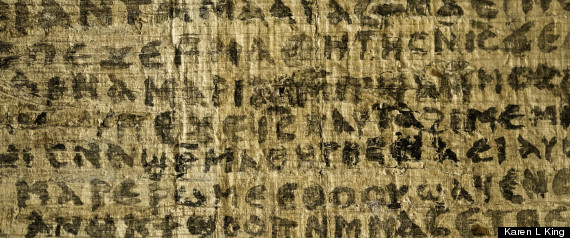
Today, Harvard Divinity scholar Karen L. King went public with new evidence that indicates that the early followers of Jesus believed that he had a wife. King insists that the idea that Jesus did not have a wife does not arise until about 150 years after Jesus’ crucifixion.
King points to a newly rediscovered papyrus fragment from the second century coptic manuscript in which Jesus refers to “my wife.” That pundits commenting on today’s news should call the notion that Jesus had a wife “shocking” is in and of itself shocking to those of us who take the bible seriously. If Jesus was not married, now that would be shocking for a first century, Jewish peasant!
So many new beginnings: Back to work this week; a new beginning. Team Ministry; a new beginning. As students and teachers head back to school, churches begin a new program year. At Holy Cross we are are using the Alternate Lectionary (scripture readings) for Creation and this Sunday’s readings call for a celebration of Humanity. The first reading is the Hebrew creation myth found in the first chapter of Genesis; the all too familiar story. Churches have been telling this particular story of our beginning for centuries. Standing here at the beginning of a new century makes me wonder why we don’t tell a new story of our beginning.
When I begin to study the Genesis story with Confirmation Students, I ask them to imagine our ancestors sitting around a campfire asking one another, “What’s it all about? Why are we here? Where did we come from? Who are we?” Looking back at how we once approached these questions of meaning is a perfectly fine exercise. But we can’t stop there. It’s time for us to change the scene so that it better reflects who we are here and now. Gone is the campfire. Gone is the three-tired universe. Gone is the belief that Genesis is history.
The time has come for us to imagine a different gathering at which the same questions emerge. Only this time those who have gathered can reach into their pockets and take out their mobile devices to access the wisdom of the ages. This time a new myth emerges to capture our imaginations, a new myth from within which we can begin to imagine who we are, where we came from, why we are here and where we are going???
So this Sunday our first reading will not come to us from the book of Genesis. This Sunday we will begin our celebration of humanity by telling a new creation myth, one that emerges from the wealth of knowledge that science offers us. I can’t wait to begin!
Back in 1989, before I ever began entertaining the idea of returning to school to prepare for a life in ministry, a fortuitous Christmas gift in the guise of a copy of Matthew Fox’s newly published The Coming of the Cosmic Christ sent me on a journey that continues to shape my understanding of what it means to aspire to follow Christ.
Barely two chapters into Fox’s challenging tome and I knew that if I was ever to begin to understand Fox’s visions of reality, I would need to begin nearer the beginning. In those days, searching for a book involved more than a web search and so I began travelling from book store to book store to scour the shelves for a copy of Original Blessing.
Original Blessing’s Introduction begins with two questions: “1. In our quest for wisdom and survival, does the human race require a new religious paradigm? 2. Does the creation-centered spiritual tradition offer such a paradigm?” Having absolutely no idea what the word “paradigm” means, I knew I was about to be challenged. So, I got my dictionary off the shelf and prepared to wade into unknown waters.
Lead by Fox, I explored the ancient wisdom of Creation Spirituality and began a love affair with the wonders of mysticism and the marvels of science that continue to reveal ecstasies that intrigue and excite my body, mind and spirit!
Matthew Fox’s work continues to nourish my desire to approach they Mystery we call divinity. In the videos below Fox delivers (in 2 parts) the Jarvis Lecture in which he calls for the Reinventing of Christianity. Fox believes that “if we cannot reinvent our religious then we are doomed, the human species is doomed.” Fox insists that Christianity needs to reset its focus; away from a preoccupation with redemption toward a focus upon creation.
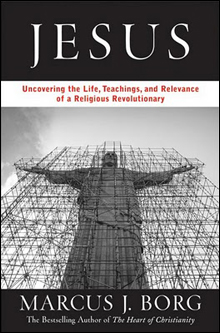
Jesus: Uncovering the Life, Teaching, and Relevance of a Religious Revolutionary If you are looking for an introduction to current scholarship on the man known as Jesus of Nazareth, Marcus Borg’s book is an excellent place to begin.
For those of you (and you know who you are) who tell me you don’t have time to read one more thing: in this video Borg provides a wonderful overview of his book. Borg challenges his listeners and readers to move beyond what they may have learned to believe about Jesus toward a more nuanced understanding of the radical nature of Jesus’ life and teachings. Whether you’re a reader or a viewer, a scholar or a seeker, a believer or a sceptic, I’m sure you will find that Borg’s way of telling the story of Jesus will reveal new ways to integrate Jesus’ story into your life today.
The feast day of Augustine of Hippo is a good time to recall what St. Augustine had to say on the literal meaning of Genesis: “Usually, even a non-Christian knows something about the earth, the heavens, and the other elements of this world, about the motion and orbit of the stars and even their size and relative positions, about the predictable eclipses of the sun and moon, the cycles of the years and the seasons, about the kinds of animals, shrubs, stones, and so forth, and this knowledge he holds to as being certain from reason and experience. Now, it is a disgraceful and dangerous thing for an infidel to hear a Christian, presumably giving the meaning of Holy Scripture, talking nonsense on these topics; and we should take all means to prevent such an embarrassing situation, in which people show up vast ignorance in a Christian and laugh it to scorn. The shame is not so much that an ignorant individual is derided, but that people outside the household of faith think our sacred writers held such opinions, and, to the great loss of those for whose salvation we toil, the writers of our Scripture are criticized and rejected as unlearned men. If they find a Christian mistaken in a field which they themselves know well and hear him maintaining his foolish opinions about our books, how are they going to believe those books in matters concerning the resurrection of the dead, the hope of eternal life, and the kingdom of heaven, when they think their pages are full of falsehoods and on facts which they themselves have learnt from experience and the light of reason? Reckless and incompetent expounders of Holy Scripture bring untold trouble and sorrow on their wiser brethren when they are caught in one of their mischievous false opinions and are taken to task by those who are not bound by the authority of our sacred books. For then, to defend their utterly foolish and obviously untrue statements, they will try to call upon Holy Scripture for proof and even recite from memory many passages which they think support their position, although they understand neither what they say nor the things about which they make assertion.” (from Augustine’s commentary on Genesis: “The Literal Meaning of Genesis” (translated and annotated by John Hammond Taylor, S.J.; two volumes; Newman Press, New York, 1982; pages 42-43 of Volume 1)
Matthew Fox’s Creation Spirituality has provided a pathway beyond the constrictive confines of Christian doctrine into the Wisdom tradition of the Mystics. Here he plays with the “ah” sounds of the various names for the divine. The exercise which he demonstrates is a wonderful way to open or awaken one’s self to the playfulness of the Spirit.
Evolutionary is a term given to thinkers who see evolution as much more than simply a theory that pertains to the biological development of life on this planet. Evolutionaries are generalists who are willing to piece together information from all disciplines in order to explain the cosmos. So, says Carter Phipps in his new bestseller, “Evolutionaries: Unlocking the Spiritual and Cultural Potential of Science’s Greatest Idea”. In which he defines evolutionaries as: “deep time explorers of a universe of infinite becoming.” In a world where scientists, philosophers, and theologians are borrowing from one another’s insights in order to explore the secrets of existence, evolutionary theory is being applied to more than just biology.
Inspired by Matthew Fox’s “Original Blessing”, I have long since given up on the medieval doctrine of original sin and moved beyond the atonement theologies that rely on our need to be saved by a “Father God”. Like many progressive Christians, rather than describing the human condition as sinful or broken, I understand humanity to be incomplete and still evolving. We did not fall from grace in some mythical garden. Humanity, like all of the cosmos continues to evolve. The idea of evolution has all sorts of implications not only for how we see ourselves as human beings, here and know. As we continue to evolve, the determination of who or what humanity becomes requires that we take seriously our role as co-creators not with some grand-puppetier-god-in-the-sky. But as co-creators with a God who is in all and through all.
The emerging conversation between scientists, theologians, and philosophers makes the question “Do you believe in the bible or do you believe in evolution?” obsolete. The conversations between disciplines are giving birth to a new spirituality. Evolutionary Christianity is emerging. Evolutionary thinkers are developing new theologies that take seriously God’s presence in all things through Christ.
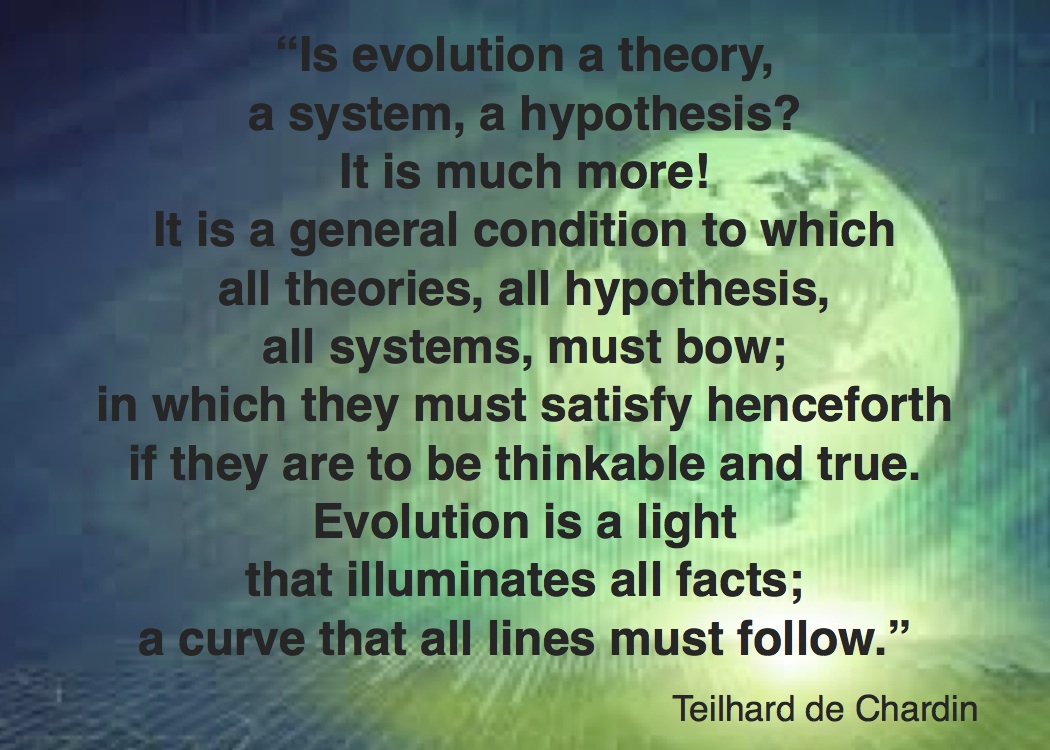
After having spent a week, exploring the work of Teilhard de Chardin; an evolutionary thinker who was decades ahead of his time, I am eagerly devouring my copy of Phipps new book (just released June 12 and it has already it has reached #14 on Amazon). I will say more in future posts. In the meantime, for an overview of what it means to be an evolutionary, take a look at the video below which features Carter Phipps speaking at MIT this past May.
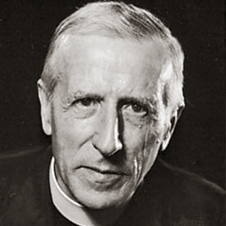
“Our duty, as men and women, is to proceed as if limits to our ability did not exist. We are collaborators in creation.” Pierre Teilhard de Chardin was a mystic whose explorations of creation landed him in hot water with his beloved Roman Catholic Church and propelled him toward visions of a cosmos whose very life-blood is Love.
Published posthumously, Teilhard’s “Le Phenomene Humain” reads more like the work of a progressive 21st century christian theologian or scientest than that of a devoted 20th century Jesuit priest/biologist/palaeontologist. Teilhard paints a poetic vision that modern theologians would call a panentheistic view of the cosmos (pan: all + theo: god = god is in all and all is in god).
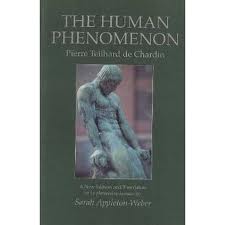
As I work my way through Sarah Appleton-Weber’s translation, “The Human Phenomenon” I am also enjoying Ersula King’s excellent biography “Spirit of Fire”. King is Professor Emerita of Theology and Religious Studies, University of Bristol, and a vice president of the World Congress of Faiths. Her specific areas of expertise are in the life and work of Teilhard. Below you will find her lecture which provides an excellent overview of Teilhard de Chardin and the “Contemporary Mystic Quest” (in 5 parts). Whether you know a great deal about his life and work, or nothing at all, I commend it to you. But beware, it will wet your appetite for more.
I first discovered Teilhard’s work while completing my undergraduate work in Religious Studies at the University of British Columbia, when a well-used copy of “The Phenomenon of Man” (Le Phenomene Humain) captured my interest. At the time, Teilhard’s insights were quite a stretch for me and although I finished the book feeling overwhelmed by its complexity, I couldn’t help longing for the day when I might be better able to follow Teilhard beyond the rigid confines of the science versus religion debate toward a more comprehensive approach to understanding the cosmos and our place in it.
Today, in the midst of my sabbatical at UBC, it feels so appropriate that I should once again be consumed by Teilhard, as I luxuriate in Sarah Appleton-Weber’s newer translation: The Human Phenomenon. Lo these many years later, I still feel ill-equipped to grasp the wonders of Teilhard’s vision. But, I am struck by the beauty of his vision of the complex process of unfolding of the universe.
My comprehension of Teilhard’s work is enhanced by Ersula King’s splendid biography: Spirit of Fire. King describes his vision as one in which: “love is a spirituality that celebrates the oneness of creation, a spirituality that acknowledges love as the clearest understanding we have of God, of ourselves, of history, and of the cosmos.”
“his vision was one of consuming fire, kindled by the radiant powers of love. It was a mystical vision, deeply Christian in origin and orientation. Yet it broke through the boundaries of traditional orthodoxies — whether those of science or religion — and grew into a vision which is global in intent.”
In an essay, “The Heart of the Matter” written near the end of his life, Teilhard described this fire at the heart of reality:
“Throughout my life, by means of my life, the world has little by little caught fire in my sight, until a flame all around me, it has become almost luminous from within. Such has been my experience in contact with the Earth. The diaphany of the divine at the heart of the universe on fire. Christ, the heart, a fire capable of penetrating everywhere, and gradually spreading everywhere.”
Teilhard was a scientist/theologian/philosopher/prophet who remains ahead of his time, whose work continues to push scientists and theologians to move beyond the carefully drawn boundaries of their own disciplines so that they might learn from one another. King explains: “His deepest desire was to see the essence of things, to find their heart, and probe into the mystery of life, its origin and goal. In the rhythm of life and its evolution, at the center of the cosmos and the world, Teilhard believed, is a divine center, a living heart beating with the fiery energy of love and compassion. Now, the heart is really a fleshly reality But the image of this very flesh, this concentration of living, breathing matter, came to symbolize for Teilhard the very core of the spirit.”
The warmth of these summer days at UBC are richly complemented by Teilhard’s fiery vision as I savour this divine consumption.
Today, I began to study the work of Pierre Teilhard de Chardin. I have been longing to do this ever since I was first introduced to this 20th century Christian mystic some 25 years ago, when Matthew Fox’s “Original Blessing” helped me to look to the Christian mystics, both ancient and modern, to find new ways of connecting to the cosmos. After many brief encounters with Teilhard’s work in books and articles by some of my favorite theologians, I have longed to spend some time exploring Teilhard’s purported brilliance. I have begun by reading “The Human Phenomenon” (often mistranslated from the French as “The Phenomenon of Man”). I’ve submerged myself in the delights and challenges of this enthralling work until my mind is about to explode (usually just a chapter or two at a sitting) and then I take a break by reading Ersula King’s riveting biography: “Spirit of Fire: The Life and Vision of Teilhard de Chardin”. It has been a mind blowing day!
So many connections are emerging and I shall endeavor to post them as they escape from the quagmire of ideas that are swirling around in my brain. But as the Sabbath approaches I leave you with this playful tune from Peter Mayer which celebrates this blessed Ordinary Day in a way that complements this mystic moment!
Michael Dowd, a self-proclaimed Evolutionary Evangelist is committed to spreading the good news that evolution is humanity’s common creation story as he proclaims that science illuminates the evidence with which God is communicating to humans today.
Inspired by the work of Fr. Thomas Berry who portrayed the epic of evolution as a sacred story Dowd seeks to popularize Berry’s insistence that humanity is the universe becoming conscious of itself.
Dowd’s work is especially intriguing to this particular 21st century pastor who connects to the cosmos from the perspective of panentheism (God is in everything and everything is in God). Evolutionary Christianity is an exciting way of using the explosions in scientific evidence to illuminate our religious quest to understand our place in the cosmos.
I am indebted to a blog-follower from South Africa for linking me to this excellent video by New Hampshire Outlook that explores the work of the Rev. Michael Dowd. In addition to a fabulous interview this video provides an enticing overview of Evolutionary Christianity that will leave you wanting to learn more. You can begin by visiting Evolutionary Christianity’s Blog. I’m anxiously waiting for my copy of Dowd’s “Thank God for Evolution” to explore more of Dowd’s insights.

 During the season of Advent we approach the MYSTERY through story and song. Unable to fully express our deepest longings with words, we engage the stories handed down to us by our ancestors. Trusting these stories not as history but as truth. For as Marcus Borg teaches, these stories may not have actually happened this way, but they are always happening. Over and over again, we see ourselves and our longings for hope, peace, joy and love in the stories we tell during this season of desire. In the video below Phyllis Tickle tells the stories that speak of the longings and desires of our ancestors. Today, we would do well to remember the stories of old as precursors to the telling of our own stories of longing. For just as our ancestors had the wisdom to engage the MYSTERY with stories, we too know of our need to engage the MYSTERY with our stories. What stories are gestating within us? What stories will we give birth to this Advent.














 pastordawn