Silent night, holy night is a perennial favourite! T’is the season for nostalgia. But what if we are serious about providing more than nostalgia in our worship? Can we, or do we even dare to offer worshippers new images that endeavour to engage our reality? Can we touch the spiritual but not religious crowds that wander into our sanctuaries seeking an encounter with the Mystery we call God, with a hint of our unknowing. Or are we content to address only the nostalgia seekers with safe images designed only to warm and not excite the imagination? Dare we beacon the nostalgia seeks beyond their memories toward the future? I wonder? Maybe we can summon up the courage to compromise by simply adding a few new verses?
The challenge belongs to all of us to write new words to enable us to sing our praise with integrity. Here’s a sample, with thanks to Keith Mesecher.
The figure of John the Baptist looms large during the first half of Advent. This angry misfit shouts and us, convicting us of hastening the end. Do we have the courage to join him? Do we have the stamina to become a prophet of doom?
This weekend, Holy Cross partnered with the Trinity Institute in Manhattan to host a live webinar featuring Sister Joan Chittister. Sister Joan challenged traditional images of God and opened us to new evolutionary images of God which empower us to engage reality. It was an amazing program and you can view the keynote by clicking the link below.
This week the Feast of St. Nicholas, the ancient precursor to the modern Santa Claus, passed without much ado. Today, some will try to encourage us to resurrect St. Nicholas to save us all from Santa’s powers for we have gone astray. To those well meaning souls who would rid Christmas of its flagrant consumerism, I can only offer up a feeble, “Baa Humbug!”
The very best traditions about St. Nicholas suggest that he was a protector of children while the worst tradition has him providing dowries so that young girls could be married off by their father rather than be sold into slavery. Meanwhile, the modern character Santa Claus grooms children to take up their role as consumers in the cult materialism. Some parents may bemoan the little gimmie-monsters that their children become, but most adults are rendered helpless by our own remembered indoctrinations and so we join in what we choose to deem as harmless fun.
T’is the season for contradictions. ‘Tis the season when we prepare to celebrate the incarnation of God in human form while also waiting for Santa Claus to come down our chimneys. Face it; most of the folks dashing about in the malls are more worried about the imminent arrival of Santa Claus than they are about God. I’d even go so far as to say that a good number of people have unconsciously substituted Santa Claus for God. Santa Claus and the baby Jesus get into some pretty fierce competition at this time of year; and in the culture the larger loyalty belongs to Santa.
Besides, I don’t believe that consumerism is the most dangerous thing about Santa. So, before you accuse me of being a Scrooge or even a Grinch, ask yourself who it is that most children worship at this time of year, and I think you’ll agree that Santa is the one we’ve all been trained to bow down to, and not just at Christmas. It is difficult to deny that sometimes our view of God has been more influenced by Santa Claus than by Christ? I dare you to compare the number of children standing in the lines at the shopping centre to get their picture taken on Santa’s lap to the number of children in Sunday School? So many of us made that same trip to see Santa when we were little and when we finally got to Santa’s lap, he asked us the big Judgement Day question that Santa always seems to ask, “Have you been good this year?” There’s only one way to answer that question – even though we may have been as deviousness might qualify us as servants of that other mythical character that begins with santa and ends with n. For all too many people this laptop confession begins a pattern for interactions with an image we create of the Father-God, who watches and records our offences, making a list if only for the purpose of forgiving us because an appropriate blood sacrifice has been made on our behalf.
Think I’m being harsh? Just listen to that song that pours from muzak speakers, the song that spells out a theology of Santa Claus. “Oh, you better watch out. You better not cry. You better not pout. I’m telling you why. Santa Claus is coming to town. He knows when you’ve been sleeping. He knows when you’re awake. He knows if you’ve been bad or good, so be good for goodness sake. He’s making a list, checking it twice, gonna find out who’s naughty and nice. Santa Claus is coming to town.” The trouble with the theology of Santa Claus is that we keep applying it to God as we try to turn the Creator of all that is and ever shall be into a list-checking, gift-giver, whom we better watch out for, lest we be punished. Why then are we surprised that when our Santa-god fails to deliver or bad things happen to good people, that our childish faith in the Santa-god isn’t enough to sustain our trust?
Santa in his present incarnation is indeed pernicious, but like most mythical characters, he cannot be killed and any attempts to resurrect St. Nicholas to replace him are doomed, for the power of Santa’s materialism will always defeat the dim memories of St. Nicholas and his chocolate money. If we are going to break free of the cult of materialism, perhaps we out to try to convince Santa to use his mythical powers for goodness sake!
Yeah, that’s right, I’m going to say it, it’s time to let old St. Nick and his young assistant Santa die, so that a new Santa can be born; a Christmas resurrection if you will. We need a new Santa capable of changing our consuming ways. If the Coca Cola Company could use the advertising industry to transform St. Nick into Santa, surely we can resurrect Santa using the modern persuasive powers of social media to redesign the old salesman extraordinaire into a mythical character with powers fit for the needs of this century.
SANTINA- all decked out in her Advent blue!
Imagine if you will, a new and improved Santina, all decked out in Advent blue, she has the power to open young minds to the needs of our neighbours and travels the world via her magic transporter beam, to gather the hopes and dreams of the poor and oppressed into one internet feed, which she magically imprints in our hearts and minds, so that we change the world, creating peace through justice!
Oh, wait, we already have such a character. We don’t need St. Nicholas or Santa Claus, nor any new-fangled Santina. We need the One we’ve always needed. The One who comes in the guise of a person. The One we seek is Christ. The One who lives and breathes in, with, and through us to create peace on earth through justice and love. The One who uses our hands, our feet, our lives to change the world!
Enjoy this version of Let There Be Peace on Earth in which Vanessa Williams uses not only inclusive language, but celebrates the Earth as our Mother!
A few years back, I came across Michael Morwood’s book “Is Jesus God? Finding Our Faith” and his insightful and concise articulations of a theology which speaks to the heart of this 21st century follower of the Way, led me to his other works: “God Is Near: Trusting Our Faith”, ” From Sand to Solid Ground: Questions of Faith for Modern Christians,” and “Tomorrow’s Catholic: Understanding God and Jesus in a New Millennium,” for which Morwood was silenced by the Roman Catholic Church in his native Australia. Subsequently, Morwood resigned from religious life and priestly ministry with the Missionaries of the Sacred Heart. While I find his theological work both refreshing and enlightening, Morwood’s prayer books “Praying a New Story” and “Children Praying a New Story – A Resource for Parents, Grandparents and Teachers,” to be a God-send in my work as a liturgical planner.(for more info follow this link) Over and over again, I have turned to Morwood for assistance as I struggle to write public prayers which do not re-inscribe old theologies in their language, imagery and metaphors. I have used and adapted Morwood’s work and been inspired to compose new prayers.
Here’s a sample of Morwood’s work: A Christmas Prayer which we have used at Holy Cross Lutheran Church as an “Affirmation of Faith” during the Advent and Christmas Seasons.
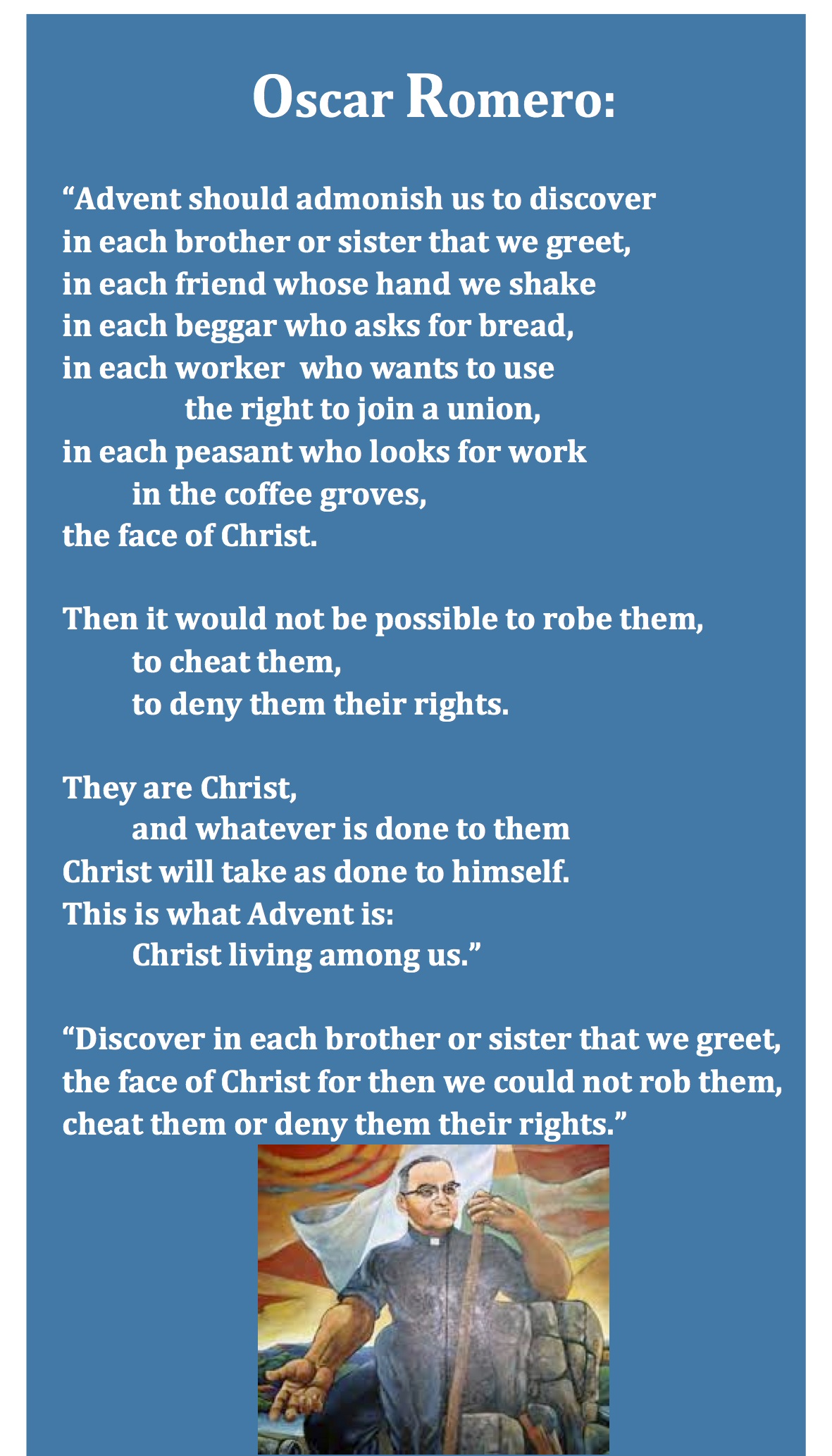
As our Advent waiting continues we hear the cries of John the Baptist who calls to us from the wilderness; a herald preparing the way for Christ. Calling the people to repent, to turn around, to remember who they are and whose they are, heralds are often unwelcome guests in the houses and halls of power. Today, the words of a modern John the Baptist calls out on behalf of the poor and the oppressed. Like the herald of old, Oscar Romero was not welcomed by the rich and the powerful. His words call us to see the face of Christ in the faces of our sisters and brothers. As we hustle and bustle searching for bargains to bestow upon our loved ones, we would do well to remember those who pay the price for our good deals.
You can learn more about the life and witness of Romero from this excellent film
There was a young woman who lived in an apartment, in a very rough neighbourhood. It was the east end of a very large city. Many of the people who lived in this neighbourhood got by on welfare, others earned their living any way they could. The young woman moved into the apartment because it was close to the office where she worked, the rent was cheap and quite frankly she was young and foolish. She ignored all the warnings of her family and friends and moved into the apartment convinced that she could handle anything that came her way.
Her neighbourhood contained the most unsavoury of characters. The office where she worked was just down the street from her apartment and every morning as she walked to work she would meet some of her neighbours returning home from an evening of plying their trade on the streets and in the alleys. Each morning, she would be met at the entrance to her office by an old man named Ed.
Ed had been living on the streets for years. He was very hairy, very dirty, and he tended to rant and rave a lot. Ed was a wild man. He slept on the doorstep of the young woman’s office because it was somewhat protected from the winter weather. Even though Ed made the young woman nervous, she got used to seeing him in her way.
Ed always gave the young woman a warm welcome when she arrived. He knew that when she got inside, she would brew fresh coffee. He used to tease her that, she was a sucker for a sad face as he waited patiently for her to bring him a cup of coffee. They never talked much, though. Ed would just rant and rave about the injustices of the world. The young woman never found out how Ed ended up on the streets. She didn’t know how he spent his days.
As Christmas approached the young woman became very busy with her preparations for the holiday. This was the first year that she had more money than she needed to celebrate with.
She decorated her apartment, she bought all sorts of gifts and spent hours wrapping each one.
This year she wasn’t going to be rushed. She wasn’t going to miss out on anything. Christmas wasn’t going to come and go without finding her in the Christmas spirit.
That year the young woman had drawn the short straw and had to work on Christmas Eve. So, before she left her apartment, she packed a small package of goodies for Ed. She was delighted that she was so well prepared that she could take time for others. But when she got to the office, Ed was no where in sight. She asked some of the women who worked the streets if they had seen old Ed. But no one knew where he was.
The young woman went about her duties and soon forgot all about old Ed. She finished her work early and went off to celebrate Christmas Eve with her friends. She had been looking forward to Christmas for weeks and was eager to celebrate. Together, she and her friends shared a fine Christmas goose with all the trimmings and then they went of to a candle light service. The service was beautiful. They really pulled out all the stops, great music, lots of activity. The preacher even managed to keep his sermon brief. But somehow the young woman was left feeling like there was something missing.
The next morning she celebrated with her family. Her nieces eagerly unpacked dozens of presents and on the whole the family managed to keep their disagreements down to the minimum that year. But the young woman felt detached, like she was just going through the motions. Despite all the elaborate trimmings, she felt like she had missed out on her fair share of the Christmas spirit.
As she drove back to her apartment in the city she found herself wondering if this was all there was to it. Christmas had come and gone and she didn’t feel like anything had changed at all. By the time she had parked her car, she was feeling quite depressed. Christmas was over and nothing much had changed.
When she got to the entrance of her apartment, she saw Ed. She had never seen him anywhere near her apartment before and it made her more than a little nervous. She wondered how he had found out where she lived. Indeed, it frightened her that Ed had taken the trouble to find her apartment. Ed looked very agitated.
Nervously the young woman greeted Ed and asked him why he was at her doorstep. Ed explained to her that he needed her help. The young woman became very uneasy. The odd cup of coffee at work was one thing, but this old man showing up on her door step was quite another. And now he wanted something. Ed asked the young woman if she would come with him to the park. Caught off guard, the young woman reluctantly agreed. When they arrived in the park, Ed introduced the young woman to Karen.
Karen was a very scared looking teenager. She couldn’t have been more than about fourteen years old. Ed explained to the young woman that Karen had run away from home on Christmas Eve. He said that lots of kids ended up on the streets at this time of year and there were usually lots of unsavoury characters to meet them when they arrived. When Karen arrived at the city bus depot, Ed had spotted her. From the moment she arrived, Ed had carefully watched over Karen, making sure that she came to no harm in the city. Karen’s two days on the streets and Ed’s gentle persuasion had convinced her that she should really go back home and try to work things out with her parents. Ed explained to the young woman that Karen needed money for a bus ticket home.
After they had called Karen’s parents and safely loaded her onto a bus, the young woman asked Ed if he would come and share a meal with her. Ed refused the offer of a meal but agreed to share a cup of coffee with the young woman.
In the coffee shop, I took a long hard look at old Ed. That night in the coffee shop, I looked into the eyes of a wild man. I didn’t know it then, but I know it now, in his own way, Ed had helped me to prepare the way for Christ. Ed was the prophet who pointed to Christ. I had almost missed it. Christ had come. I was so busy looking up that I had forgotten to look around me.
Christ came to me in Karen. “Truly I tell you, just as you did it to one of the least of these who are members of my family, you did it to me.” Christ comes to us in the most unlikely of places wearing the most unlikely of faces.
Just as Advent moves us toward the remembrance of the birth of Jesus in Bethlehem in the first century, it also reminds us that most of the world was preoccupied and utterly unprepared for that first Advent and many missed the whole thing. The question is: Will we miss the whole thing again?” For we do not know the day or hour, no one knows.
Therefore keep awake–Christ may come suddenly and find you asleep. So be prepared. Keep awake! Watch for we know not when Christ comes. Watch, so that you might be found whenever and wherever Christ comes. Prepare the way for Christ.
From the very first time I heard it, Jackson Browne’s “Rebel Jesus” has haunted me. In a season dominated by nostalgia, Browne’s stark view of the historical Jesus calls us to remember the one who stood with the poor and the oppressed, the outcast and the wounded. As we enter the season of Advent, can we hold nostalgia at bay long enough to engage our deepest longings and desires for peace? Not some nostalgic peace that stretches only so far as our own needs, or our own loved ones, but the peace that embraces those beyond our circles of care? Can our compassion for the earth and all her creatures move us beyond the idol we have made of the baby in the manger, toward the complexity of embracing the desires and longings of a rebel we probably wouldn’t want to entertain at our festive gatherings? Or will our seasonal madness crucify the rebel once again?
This year, like all the rest, my challenge is to live somewhere within the tension created by the rebel Jesus and the one his contemporary detractors condemned as a glutton and a drunkard; between choosing life and recognizing my culpability in the cries of the ones still waiting for us to join the rebellion.
Advent is a time of waiting in the darkness…if we dare…trusting that the light will come…knowing that the light needs reflectors in order to dispel the darkness! May your Advent be filled with the challenges of rebellion!
The written version of the sermon I preached the last time Luke 21:25-36 came around in the Lectionary. As always the written word is but an approximation of the Word preached.
We have learned to ask questions. Why did the followers of Jesus tell the stories they told about him? Why did the followers of Jesus they tell the stories about Jesus in the way they told them? These questions have revealed new insights into the scriptures and we helped us to understand how Jesus followers understood the life death and resurrection of Jesus.
As we begin a new church year, there is another question that we need to learn to ask. Why did the designers of the church lectionary decided that on this the first day all over the world church goers should read from this particular text from the Gospel according to Luke? It is the first Sunday in Advent, why not read something from the first chapter of the Gospel according to Luke? What are we doing in the 21st chapter of the Gospel According to Luke and why do we have to listen to Jesus going on about the end? Why did the designers of the lectionary decide that we needed to hear what has been described as Jesus’ mini account of the apocalypse? Why take us into this particular darkness?
“Signs will appear in the sun, the moon and the stars. On the earth, nations will be in anguish, distraught at the roaring of the sea and the waves. People will die of fright in anticipation of what is coming upon the earth. The powers in the heavens will be shaken. After that, people will see the Chosen One coming on a cloud with great power and glory. When these things begin to happen, stand up straight and raise your heads, because your ransom is near at hand.” And Jesus told them a parable: “Look at the fig tree, or any other tree. You see when they’re budding and know that summer is near. In the same way, when you see all these things happening, know that the reign of God is near. The truth is, this generation will not pass away until all this takes place. The heavens and the earth will pass away, but my words will not pass away.”
We know that the writer of the Gospel according to Luke wrote very near the end of the first century, some 50 to 70 years after the life, death and resurrection of Jesus. Some 20 to 30 years after the Romans destroyed Jerusalem and for all intents and purposes put an end to the world as Jews and the followers of Jesus had known it. Scholars tell us that in all likelihood the writer of the Gospel according to Luke created this story to reassure the followers of Jesus that even in their present darkness, even though it looked as if the heavens and the earth were passing away, Jesus words will not pass away. But why did the designers of the Revised Common Lectionary decided to begin the church year with this story of Jesus’ apocalyptic vision?
Well the Luke part is easy. This new year is the third in the lectionary’s 3 year cycle and so the mainline churches, that is the Roman Catholic, Anglican, Presbyterian, United, and many other denominations who get their weekly readings from the Revised Common Lectionary read primarily from the Gospel According to Matthew in year A, Mark in Year B and Luke in year C. (John does not have it’s own year and is only read during Christmas and Easter of years A,B, and C.) But why begin with chapter 21 of Luke? Why not Chapter One? Why not begin with that wonderful story of Elizabeth and Zechariah and the birth of John the Baptist? Surely a birth story is more fitting for the first Sunday in Advent when preachers are supposed to preach about hope?
I must confess that I am tempted to ignore the lectionary and skip the darkness of the apocalypse. But the more I read about darkness and the foreboding, the more I realize that at a time of the year when all the world wants to sentimentalize, trivialize and retailize the Christmas story, perhaps we who follow Christ ought to begin our preparations with a sojourn into the darkness.
We do well to remember that even now, for a great many of our sisters and brothers and perhaps even for us the world is coming to an end. And in even in the darkness we need not fear, for God is with us. In the darkness the realization that Christ is coming provides the hope we need to venture forth.
This year, I find myself venturing into Advent not dreading the end, but with the longing for the world to come to an end. I’d very much like the world as we know it to end. I’d like the wars in Afghanistan, Syria and Palestine to come to an end. I long for an end to the regime in Iran that insists on escalating the tensions between our two cultures with their ever-expanding nuclear program. I’d like our own government to live up to its own mandate to put an end to poverty and homelessness here in Canada. I’d like to see the end of an economic system that enslaves 80% of the world’s population in poverty. I’d like to see an end to violence, hunger, plagues and war. But I’ve long since given up the hope that we will be rescued from systemic evil that causes so much grief in the world by a divine rescuer swooping in from somewhere above the clouds.
My hope for the future does not in an apocalyptic vision of Jesus returning to sort out the good from the bad, the wheat from the chaff, rewarding the former and barbecuing the latter. This super-saviour that has long been the hope of Christian communities weighed down and oppressed by savage governments and their policies. While destruction, pain, and oppression are a part of our global reality, a spaceman-saviour is not. We know that, despite our wishes and projections, hope does not come from outer-space. Hope has to be found in our here and now. It has to be worked for, discovered, accepted and developed. This doesn’t mean that as so many pundits and pseudo-intellectuals would have us believe, that God does not exist and we should abandon all hope and run screaming from the church. This does mean that rather than looking to the heavens for salvation, we should look around us, and see that our God is located within our experience, our struggles, our communities and our hearts. Christians believe that God is love.
We believe that permeating our lives, our land, our communities, and all that is beyond us there is a powerful love that can touch our lives. That love is on our side, is for us, and can hold us. That love reaches out to us in a neighbour’s smile, in the strident concerns of a protester, the embrace of a lover and even in a government handout. Love comes in a myriad of ways. Just like hope. That love we call God. That love called God is with us. We are sacred, blest, and loved. The Holy Spirit of love is within us, like a seed waiting to grow and flourish.
Advent is the season pregnant with possibility, when we nurture that love within and prepare to give it birth. The seeds of love are waiting to grow and flourish. Even in the angriest person, in the most arrogant businessman, in the most ridiculous politician, in the toughest tyrant, or the worst murderer, there is a holy seed of love waiting. Those seeds need tending, they need nurturing and they will grow. Hope is not a mental exercise. You don’t just stand up and decide that you are going to be hope-filled. Hope is the result of a combination of encounters with others, our personal receptivity, and our awareness of the spiritual power of love that infuses all of life. Seeds will grow out of the darkness. Advent is a time to build hope. Advent is a time to prepare for Christmas by tending the hope-filled seeds within each other.
Advent is pregnant with possibility, a time to anticipate the coming of Christ by opening our eyes to the Christ growing within us. Advent is a time to acknowledge that at the heart of our world there is a power of love that reaches out to us, believes in us and sustains us, and that power of love is God.
We need not fear the darkness. For it is in the darkness that we will find the seeds. Hope lies in the darkness of our experience. The light of the Holy One is within us. And so this advent, as in all others. we will tell the stories of our experience. And in those stories we will discover the stirrings of Christ who waits to be born in us.
Many of those stories will begin in song. I don’t know what it is about we humans but we tend to sing our best stories. Music opens us in ways that mere words cannot. So let me begin our Advent journey with a story about songs sung in the darkness.
It was a dark and dreary time filled with fear and anticipation. Many years have past, but I can still remember her excitement at being chosen to play the part of the Angel Gabriel in the Sunday School Christmas pageant. Anna was just nine years old and never before had she been well enough at Christmas to take on a role in the annual church extravaganza. When she was just eighteen months old, Anna was diagnosed with leukemia and had spent most of her little life battling the disease.
But this year was different, this year Anna was ready she knew her lines and she must have tried on her angel costume about a million times. My memory is a little fuzzy but I believe that, that year, Christmas fell in the middle of the week.
The pageant was scheduled to take place the Sunday before Christmas Eve. On the Saturday before the pageant was to take place, Anna’s mother called me with the bad news. Anna was in hospital. Her white blood count was dangerously low and it didn’t look like Anna was going to make it home in time for Christmas let alone for the performance of the pageant. Anna’s mother asked me if I would help out with the hospital visiting.
Over the years, a group of us had become all too familiar with this particular routine. Anna had two siblings that kept her parents very busy. Anna didn’t like to be alone when she was in hospital and so friends of the family used to help out when needed. Because I lived only a few blocks from the children’s hospital and because Anna liked my bedtime stories I often found myself taking the night shift with Anna.
Bedtime at the hospital was quite the routine. Anna loved to be told the same bedtime stories over and over again. It sometimes took a couple of hours to get her to the point where she would even consider closing her eyes. And when she got to this point Anna always insisted that I sing to her.
Now you are all too well aware of the fact that my abilities as a chanteuse are severely limited. I’m simply not a great singer. God clearly didn’t see fit to grant me the ability to carry a tune. But this didn’t seem bother Anna. For some unknown reason – perhaps she was tone deaf— or maybe she just had a warped sense of humor—but Anna loved to hear me sing. And so on the Saturday evening before the pageant was to take place, I found myself at Anna’s bedside.
I had already told her several of her favorite bedtime stories when Anna asked if I would read her a story. She pointed to a brand new picture book that lay on the cabinet beside here bed. The book had no words, just pictures. The pictures told the story of Mary and Joseph’s journey to Bethlehem and the shepherds who were watching their flocks out in the fields.
As I turned the pages Anna and I took turns telling the various parts of the story to one another. When we got to the part where the Angel Gabriel appeared before the shepherds, Anna took over and she knew her part well. “Do not be afraid, for see—I am bringing you good news of great joy for all the people: to you is born this day in the city of David a Savior, who is the Messiah, the Lord. This will be a sign for you: you will find a child wrapped in bands of cloth and lying in a manger.”
Anna delivered her lines perfectly and then went on with the story. “And suddenly there was with the angel a multitude of the heavenly host, praising God and saying”Anna signalled to me to join her in the angels’ lines: “Glory to God in the highest heaven, and on earth peace among those whom God favours!”
As I spoke the all too familiar lines, a huge lump rose up in my throat. I wanted nothing more than to curse God. What kind of God allows a beautiful little angel to be stricken with a cruel disease? What kind of God allows the dreams of a beautiful little girl to be destroyed by lousy timing? What kind of God, promises peace on earth and then disappears for 2000 years leaving us to our own devices?
I managed to keep my questions to myself as we continued to turn the pages. When we got to the last scene of the book, Anna declared how wonderful it was that the baby Jesus and the shepherds and the wise guys and Mary and Joseph all got to hear the angels sing. I said that according to the story only the shepherds heard the angels’ song. But Anna told me not to be silly because surely the angels would have started singing again when they saw that everyone had finally arrived at the stable. I asked Anna what she thought the angels might have sung. Anna got a wicked little grin on her face and insisted that they probably sang her favorite bedtime song. I just laughed at the mere thought of angels singing that particular song to the baby Jesus.
You see, over the years of tucking Anna in, I was forced to try to sing quite a few lullabies to her. And with my limited abilities, I can assure you that it wasn’t easy. Not for me and not, I’m sure for the nurses who may have overheard my feeble attempts. But of all my crappy renditions, Anna’s absolute favourite was “You are my sunshine.” And so staring down at the picture of Mary and Joseph and the baby Jesus, the shepherds, wise guys and assorted angels, I began to sing Anna’s favourite lullaby for the baby Jesus.
In order to spare the other people in the ward, I sang ever so softly. “You are my sunshine, my only sunshine, you make me happy when skies are gray. You’ll never know dear how much I love you please don’t take my Sunshine away.”
When I’d finished singing, Anna sang a lullaby for the baby Jesus. And I’ve never heard Away in a Manger sung so sweetly. By the time Anna got to the last verse, a few others had joined in.
That’s how it began. A couple of nurses and some of the other children and their parents joined us in an impromptu caroling session. We sang all the Christmas carols we could think of. And when we couldn’t think of another carol Anna asked me to sing her other favorite.
I couldn’t remember what her other favorite was. Anna just smiled and said you know the one where I get to pretend to play the drum. I thought she meant the little drummer boy and I said that I was sorry but, I don’t think I ever knew that that was one of her favorites.
But from the expression on Anna’s face it was clear that I’d guessed wrong. Anna began to beat out a rhythm on the table by her bed.
And I remembered. Kum by Ah My Lord …someone’s crying lord;… someone’s fighting lord; ….someone’s hurting lord;….someone’s praying Lord;….Come by here
Little Anna didn’t win her battle with leukemia. She died that following spring. But like Christ, Anna lives. She lives in me and she lives in the lives of every life her little life touched.
In a world gone mad, in a world where we have yet to learn just how to love one another, Christ comes to us. When we are hurting or in pain, when our world is darkest, Christ comes to us. When we are sick and tired. Christ comes to us. When we have given up and can no longer bear to hope. Christ comes to us. Because our God is the one who takes on flesh and dwells among us.
Christ is Emmanuel, which means God is with us. Christ, laughs with us, cries with us, rejoices with us, suffers with us, heals with us, walks with us, shouts with us, struggles with us and loves with us. Christ dies with us and we are raised with Christ and born again. And because Christ is with us, death has lost its sting. Because our God is always with us, we will live forever more. And so, today God stands with us and speaks to us a word of hope a word that is the hope of the world.
Come by here my lord, come by here. Come by here and help us to bring the good news of great joy for all the people. Come by here and help us to sing Glory to God in the highest heaven and on earth peace good will to all. Come by here my Lord. Come by here. Amen
Do we have the courage to confront our doubt in worship? This is the challenge that Peter Rollins who describes “the game” of certainty and triumphalism that passes for worship and insists that God must function as a “feel-good” entity rather than One who helps us engage our suffering, the Mystery, our doubts and uncertainties. Rollins calls for worship leaders who are willing to engage the dark night of the soul and create liturgies of unknowing. Are worshippers ready? Perhaps their hungry for opportunities to confront their realities in worship.
Matthew Fox is working to invigorate worship. Silenced by the Vatican and expelled from the Dominican Order, Fox continues to be the most read catholic theologian of our time. For several years Fox has been developing worship for a post-modern world. Taking the cyberspace revolution into sacred space. Quoting African spiritual teacher Malidoma Some who insists that there is no community without ritual, Fox has infused what he learned about rave masses in the United Kingdom with his own Creation Spirituality to create worship for 21st century Americans and dubbed this new form the “cosmic mass.”
“Our first 18 minute dance is during the Via Positiva, the last at the Via Transformativa wherein we receive the energy to be the spiritual warriors we need to be to transform society after we leave worship. In between there is a deep experience of shared grief (via negativa) often including wailing and lamentation and the sharing of communion (via creativa). At the close of the service is a “via transformativa” dance or warrior dance which prepares us to go into the world and back to our communities as healers and strong defenders of compassion. A variety of ages is always represented as well as many kinds of artists and people from diverse religious backgrounds ranging from Christian to Jewish, Hindu, Buddhist, Muslim and Pagan. The worship is so pre-modern in many respects that many find home there. Beauty is everywhere present. And one might say, magic.”
I can’t help wondering what form a cosmic mass might take among Canadian middle-class Christians???
During the season of Advent we approach the MYSTERY through story and song. Unable to fully express our deepest longings with words, we engage the stories handed down to us by our ancestors. Trusting these stories not as history but as truth. For as Marcus Borg teaches, these stories may not have actually happened this way, but they are always happening. Over and over again, we see ourselves and our longings for hope, peace, joy and love in the stories we tell during this season of desire. In the video below Phyllis Tickle tells the stories that speak of the longings and desires of our ancestors. Today, we would do well to remember the stories of old as precursors to the telling of our own stories of longing. For just as our ancestors had the wisdom to engage the MYSTERY with stories, we too know of our need to engage the MYSTERY with our stories. What stories are gestating within us? What stories will we give birth to this Advent.
For those of you using mobile devices my apologies but bliptv is availablehere
Our thanks to Trinity Anglican Church in Aurora who graciously hosted a splendid event on Nov.16-18 at which the great Phyllis Tickle shared her wealth of wisdom on the “the great emergence” that is rocking our world. Phyllis claims that she is not a preacher, but the homily she delivered on the Melchizedek’s importance to Emergence Christianity’s understanding of “where it all began,” suggests that Phyllis is mistaken about her homiletical prowess.
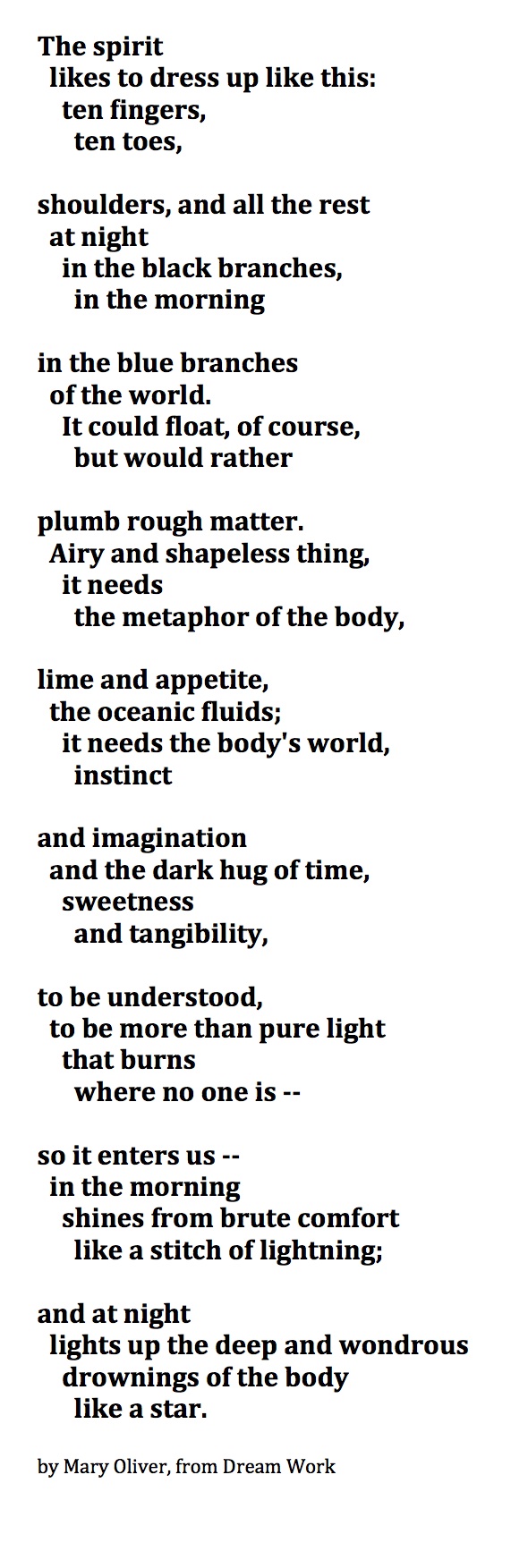
I put away my work and I spent the early morning hours with an old friend. There have been too many theological tomes of late so I have enjoyed thumbing through poetry and rediscovering those things I know in my bones. This morning Mary Oliver swept me down to the riverside and I have been communing with the enfleshed Mystery that lies at the heart of all. I offer her splendid piece simply entitled “POEM” Enjoy!
I am indebted to the Rev. Robert Hensley who provided the turn of phrase “nothing butter” to describe reductionists and directed me to the work of John Polkinghorne whose book Quarks, Chaos and Christianity provides all of the physics cited in this sermon. I first discovered Polkinghorne’s work in his 2003 publication: Living with Hope: A Scientist Looks at Advent, Christmas & Epiphany and since then I have enjoyed his gentle way of opening my non-scientific mind to a plethora of possibilities.
For those who are reluctant to give up the doctrine of “original sin”, Evolutionary Christian evangelist Michael Dowd offers an intriguing re-interpretation of the human condition that uses evolutionary science to offer good news. While I prefer to speak of “original blessing” a la Matthew Fox, Dowd’s re-interpetation offers a radical re-working of a doctrine that has entrenched so many of us in “worm theology” bemoaning our sinfulness. To get a better understanding of Dowd’s approach, I recommend his book “Thank God for Evolution” or check out his website
Since quoting Walter Wink in my sermon yesterday, I learned that he died a few months ago. I will always be indebted to this amazing teacher for all that I have learned and continue to learn from him. The videos below comprise the various parts of a lecture that Wink offered on the subject of Jesus’ teaching on Non-Violence. For anyone who aspires to follow Jesus this lecture is a must see. Wink’s books are well worn friends that I have often thumbed through to find more than a nugget or two to enable me to teach anew something that I have long since come to know as a result of Wink’s excellent work! His excellent trilogy: Naming the Powers, Engaging the Powers, and The Powers that Be along with Jesus and Nonviolence: A Third Wayshould be at every preacher’s fingertips as we proclaim Jesus’ radical way of being in the world.

 Silent night, holy night is a perennial favourite! T’is the season for nostalgia. But what if we are serious about providing more than nostalgia in our worship? Can we, or do we even dare to offer worshippers new images that endeavour to engage our reality? Can we touch the spiritual but not religious crowds that wander into our sanctuaries seeking an encounter with the Mystery we call God, with a hint of our unknowing. Or are we content to address only the nostalgia seekers with safe images designed only to warm and not excite the imagination? Dare we beacon the nostalgia seeks beyond their memories toward the future? I wonder? Maybe we can summon up the courage to compromise by simply adding a few new verses?


















 pastordawn