Surprised by Islam – Lesley Hazleton

Each time I dip into the Qur’an I am surprised by some new insight and I can’t help wondering why I don’t sip more frequently from this deep well’s thirst-quenching wisdom. Over the years, I have tried to keep up my study of Islam which I first began during my years as an undergraduate in Religious Studies at the University of British Columbia. Back then I believed that anyone who intended to seek a career in the church had better understand the religions of the world. Fortunately my naiveté was matched by my enthusiasm and I quickly learned that, despite my good intentions, there was no way to simply learn about the religions of the world. One doesn’t just apply one’s self to the study of a religion and learn what one needs to know and then move on. Islam like any religion that has survived and evolved over centuries, is a multifaceted and multilayered way of living. While I can from time to time open myself to the riches that Islam has to offer, I can only ever hope to be someone who peers in from the outside.

Like many outsiders I find reading from the Qur’an challenging to the point of being daunting. I require a reading partner to guide me along the way.Recently, I discovered the work of Lesley Hazelton, a self-described agnostic Jew whose unique view of Islam is both enlightening and engaging. Hazleton’s work on Islam includes the 2010 publication “After the Prophet: The Epic Story of the Sia-Sunni Split in Islam”. But I came to know about her via her engaging TED Talk which you can view below. I have just pre-ordered her forth-coming book “The First Muslim: The Story of Muhammad”

Some have dubbed Hazleton as Karen Armstrong’s successor. While the comparison is apt, Hazelton’s style is very different from her illustrious counterpart. Hazelton is a psychologist/journalist/historian whose colourful approach, pithy language and diligent research earned her this description by Paul Constant writing for Amazon:

Over the last decade, Hazleton has produced a trilogy of books—Mary: A Flesh-and-Blood Biography of the Virgin MotherJezebel: The Untold Story of the Bible’s Harlot Queen, and After the Prophet: The Epic Story of the Shia-Sunni Split in Islam—that are difficult to categorize. The books land at the intersection of history, religion, and literary criticism; they are informed by hundreds of texts and intensive traveling to the Middle East (Hazleton spent the 1970s living in Jerusalem); and they sing in the voice of a writer who has finally figured out exactly what she wants to say. Her characters are figures who have been trapped, untouchable, in amber for decades by organized religion.

Any given chapter of these books may include a fictionalized narrative of life in biblical times, a puckish interpretation of three wildly differing accounts of an event that occurred over 2,000 years ago, and a personal account of Hazleton’s own travels. In Jezebel, Hazleton undertakes an ambitious rehabilitation of the queen of Israel whose name has become synonymous with whorish behavior. In a fraught passage, Hazleton visits the birthplace of Elijah, the prophet who destroyed Jezebel’s reputation and demanded that she be torn to pieces by dogs in what is the most brutal, explicit murder to take place in the Bible. Of course, Hazleton is beset by ravenous wild dogs: “The car shuddered under the assault. In front of me, open jaws spattered drool on the windshield. To one side, fangs loomed inches from my eyes.”

When I compliment Hazleton for including that passage—you risk breaking the spell for readers when you pepper a historical narrative with personal anecdotes, but the dog attack is perfectly placed to make Jezebel’s story more compelling for the reader—she beams with pride, recalling that as she raced away from Elijah’s birthplace, she thought, “Oh, fuck. No one’s going to believe that happened. It was just too fucking perfect!”

Although only recently acquainted with her work, I am finding Hazleton to be a charmingly rigorous companion as I dip into the oasis of Islam. Her company is giving me the courage to drink more deeply than I have previously dared for fear of drowning in unfamiliar pools.

Enjoy her brief TED Talk which I am sure will wet your appetite for the full lecture given to the Young Muslim Association at the Islamic Centre of America that you will find below.

I Must Confess that I Am Not a Christian. I Aspire to Be a Christian.

Reformation – Confirmation Sunday

Listen to the sermon here

On this Reformation Sunday, we at Holy Cross celebrated the Confirmation of five exceptional young people.  It has been a wonderful journey! I can’t wait to see how they grow into all that God created them to be! 

Enough with “A Mighty Fortress” Already! Sing a New Song!

In the spirit of the Reformation motto: semper reformanda – always reforming, what say we abandon the fortresses of our traditions.  Tomorrow, Lutheran churches all over the world will begin their Reformation Sunday worship services vigorously singing “A Mighty Fortress” and I for one wish they wouldn’t.  I suspect that the hymn’s author Martin Luther might just agree with me. After all didn’t Luther write a Mighty Fortress in an attempt to bring the popular music of the day into the church? I am convinced that this particular Reformation Sunday tradition has dear old Martin spinning in his grave at the thought that the church that bears his name is still singing a tired old chestnut like A Mighty Fortress to celebrate the Reformation. The very idea of 21st century Lutheran’s celebrating the Reformation by clinging to the events of the 16th century is an affront to the memory of Martin Luther.

We should be singing this centuries music and rather than smugly resting on the laurels of the past, we should be plotting were the reformation goes from here.  Perhaps in this the 21st century, when so many of the church’s traditions have seen the institution fall into the malaise of irrelevancy, we need to echo the cry: “Semper Reformanda”  —  “Always Reforming” the cry of the reformers who insisted that the church in every age stands in need of reformation.

Legend has it that on October 31st 1517, after taking a long hard look at the Roman Catholic Church and having fixed his sights on what he saw as the source of the rot that threatened to destroy the church’s ability to proclaim the Good News of God’s grace that is revealed in the life, death, and resurrection of Jesus Christ, Martin Luther took his 95 Theses on the abuses of the doctrine of indulgences into the streets of Wittenburg and nailed them on the doors of the church. Within a few short weeks, with the aid of the newest technology, copies of Luther’s 95 Theses spread throughout the Holy Roman Empire and sparked a Reformation the likes of which the church hadn’t seen since the Apostle Paul did away with the need to snip the male anatomy to gain entrance to the church. Luther’s words threatened the status quo of centuries of abuse. And the church as is her way, struck back with force so as to ensure that tradition might prevail. The rest, as they say, is history.

 Ah history, safely ensconced in the past with its hoards of devils. Let the people rejoice because Martin Luther did it all and we can relax safe in the knowledge that we are justified by grace, through faith. Ain’t it great to be a Lutheran!  “A mighty fortress is our God, who himself fights by our side with weapons of the spirit. Were they to take our house, goods, honour, child, or spouse, though life be wrenched away, they cannot win the day. The Kingdom’s ours forever!”

So tell me, if they fought the good fight in the sixteenth century and handed us everything we need, and God is on our side and wins salvation glorious:    Where are the children? Where are the young people? Where are the neighbours?  Where is everybody? How and why did the church of our ancestors manage to fall into such disrepair? How did we become so irrelevant?

Most of us, can look around and see for ourselves how broken the church is. If we are honest, we all have our own particular theories as to why and how this happened. Yet we continue to go about our business, hoping against hope that someone will notice and finally fix it.  Year by year the church slips farther and farther into the morass of it’s own making and more and more people forget the wisdom of the ages and Christ seems to slip further and further from our grasp.  We, who go by the name Lutheran, we can’t do much more than point to our glorious past as if we could only turn the clocks back the work of the reformers of old would save us. But time waits for no one and year after year, people drift away and churches close their doors, and those who are left react with fear.

Despite the fact that we’ve tried to immortalize him, it’s as if Martin Luther never lived at all. Back in the dim recess of memory Luther stands, frozen and impotent. And I can’t help but ask the question:  “What would Martin do?”

Well in good old Lutheran style, a song comes to mind, a song of the people, a song from the streets, a drinking song…

             “If I had a hammer, I’d hammer in the morning, I’d hammer in the evening, all over this land, I’d hammer out danger, I’d hammer out warning…

It’s time to stop celebrating the Reformation as if it is somehow over. The work of reformation continues precisely because the church is always in need of Reformation.

This week I re-read a little book by Matthew Fox. Fox was a Roman Catholic theologian until Mr Ratzinger silenced him. The Roman Catholic church’s loss was the Episcopal church’s gain.   Shortly after Mr Ratzinger made himself pope, Matthew Fox took a long hard look at the church he’d served for so many years and became demoralized. Fox noticed the similarities between the sex-abuse scandals that continue to rock the church and the abuses wrought by indulgences, and asked himself what Martin Luther would do. That’s when Matthew Fox decided to write a few Theses of his own. Except where Luther wrote his 95 Theses to object to the practice of indulgences, Fox wrote 95 Theses to object to the many and various abuses of the church. It wasn’t difficult, over the course of a particularly dark night, Matthew Fox found that 95 Theses came flooding out of him. In the morning, he resolved to take his 95 Theses to Wittenburg and nail them to the very same doors where Martin Luther instigated the Reformation.

Well, things have changed a little over the course of nearly 500 years since that fateful day in Wittenburg. You can’t just waltz up to the doors at Wittenburg and nail things there.  The doors are no longer made of wood and the city councilors require that you obtain a permit to protest at Wittenburg.

Fox was told that he would need to stay at least 500 feet from the doors, lest he interfere with the tourists who flock to visit the very spot were the church of the protester’s was born. Thus proving one of Fox’s thesis that the church has become for many nothing more than a museum for tourists.

Eventually the town council relented and after some careful construction, on October 31st 2005, Matthew Fox nailed his 95 Thesis to the doors of the church in Wittenburg. Rome took no notice.  But the churches in Germany did.  Just as Martin Luther’s action was aided by the invention of the printing press, Matthew Fox’s action was aided by the invention of the internet and thus began a conversation that led to the publication of Fox’s little book: A New Reformation:  Creation Spirituality and the Transformation of Christianity.  I return to Fox’s tome annually as part of my preparation to preach on Reformation Sunday.
Here’s a sample of Fox’s theses:

1) God is both Mother and Father.

3) God is always new, always young, and always “in the beginning.

4) God the Punitive Father is not a God worth honouring, but a false god and an idol that serves empire builders. The notion of a punitive, all-male God, is contrary to the full nature of the Godhead, who is as much female and motherly as masculine and fatherly.

5) “All the names we give to God come from an understanding of ourselves” (Meister Eckhart). thus people who worship a Punitive Father are themselves punitive.

6) Theism (the idea that God is “out there” or above and beyond the universe) is false. All things are in God and God is in all things (panentheism).

10) God loves all of creation, and science can help us more deeply penetrate and appreciate the mysteries and wisdom of God in creation. Science is no enemy of true religion.

15) Christians must distinguish between Jesus (a historical figure) and Christ (the experience of God-in-all-things).

16) Christians must distinguish between Jesus and Paul.

18) Eco-justice is a necessity for planetary survival and human ethics; without it we are crucifying the Christ all over again in the form of destruction of forests, waters, species, air, and soil.

20) A preferential option for the poor, as found in the base community movement, is far closer to the teaching and spirit of Jesus than is a preferential option for the rich and powerful, as found, for example, in Opus Dei.

23) Sexuality is a sacred act and a spiritual experience, a theophany (revelation of the Divine), a mystical experience. It is holy and deserves to be honoured as such.

24) Creativity is both humanity’s greatest gift and its most powerful weapon for evil, and so it ought to be both encouraged and steered to humanity’s most God-like activity, which all religions agree is compassion.

32) Original Sin is an ultimate expression of a punitive father God and is not a biblical teaching. Bit Original Blessing (goodness and grace) is biblical.

33) The term original wound better describes the separation humans experience on leaving the womb and entering the world–a world that is often unjust and unwelcoming–than does the term Original Sin.

59) Fourteen billion years of evolution and unfolding of the universe bespeak the intimate sacredness of all that is.

60) Jesus said nothing about condoms, birth control, or homosexuality.

71) A church that is more preoccupied with sexual wrongs than with wrongs of injustice is itself sick.

75) Poverty for the many and luxury for the few are not right or sustainable.

I’m sure that we all have thesis or two that you would like to nail to the door. I know that if I had a hammer, I’d hammer in the morning, I’d hammer in the evening all over this land, right up to the doors of churches everywhere, and I would nail a few theses to the more than a few church doors. I’d begin with a thesis about the need to move beyond the destructive theories of atonement that have only served to pervert the meaning of the life, death and resurrection of Jesus and separate people from the sure and certain knowledge that neither death, nor life nor anything in all of creation can separate us from the love of God in Christ.

I’d include a theses or two about the dumbing down of our best theology and our acceptance of easy answers that have turned most people’s vision of God into a sadomasochistic father who insists on the death of his own son in order to satisfy our definition of justice.

I’d go on and on about the wonders and beauty of creation, and insist that we confess that we are wonderfully made.

I’d confess our obsession with self that lies behind the sin of avarice that permeates our consumer culture and turns our energies toward violence.

I’d call for a return to the Jewish tradition of Sabbath that called upon believers to read the Song of Songs and make love on the Sabbath.

I’d call the church to its responsibility to instill a love of creation in all people so that we can walk upon the earth lightly.

I’d remind the powers that be that all people are created equally and that sexuality is a gift from God to be celebrated and not used to segregate some believers from the priesthood that belongs to all believers.

On this Reformation Sunday, lovers of the church everywhere need to free ourselves from the shackles of tradition and about our 95 theses.

What wisdom do you have to share with the church?  What needs reforming?           What needs preserving? What needs tossing out? What needs holding up and celebration? When should we cry out in solidarity?  When should we sing out with joy and wonder? What should we do? What should we stop doing?  Semper Reformanda!    Always reforming!

This Reformation Sunday at Holy Cross Lutheran, we will sing new words by Miriam Therese Putzer to Luther’s traditional tune:  EIN FESTE BURG  which you can find  here

You can watch the video of Matthew Fox talking about his book here

Gratitude Alleluias becoming Reckless Generosity – Sermon

Thanksgiving Sunday

This sermon was inspired by Monty Python’s “We were so poor that…” sketch also known as the Four Yorkshiremen, and Joan Chittister’s book Uncommon Gratitude.

Readings for Thanksgiving here

Listen to the Sermon here

The skit that inspired the sermon:

The Big Bang, Darwin and God – Sermon

Back to Church Sunday

This sermon is inspired by the work of Joan Chittister on Evolution and God.

Readings for Sunday here

Listen to the Sermon here

Early Followers of Jesus Believed He Had a Wife

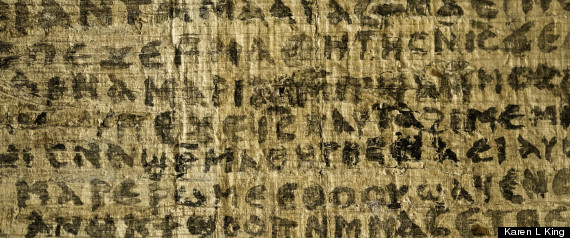
Today, Harvard Divinity scholar Karen L. King went public with new evidence that indicates that the early followers of Jesus believed that he had a wife. King insists that the idea that Jesus did not have a wife does not arise until about 150 years after Jesus’ crucifixion.

King points to a newly rediscovered papyrus fragment from the second century coptic manuscript in which Jesus refers to “my wife.” That pundits commenting on today’s news should call the notion that Jesus had a wife “shocking” is in and of itself shocking to those of us who take the bible seriously. If Jesus was not married, now that would be shocking for a first century, Jewish peasant! 

Link to the New York Time article here

You can download a copy of Karen L. Kings paper: “”Jesus said to them, ‘My wife…’ New Coptic Gospel Papyrus”  here

Scholars will continue to be sceptical of King’s find. For the Smithsonian’s take on the find and details of an upcoming documentary click here.

Hildegard von Bingen – Woman of Vision

Herald of the Divine Feminine, reformer of the church and green prophet! Today is the feast day of the Christian mystic Hildegard von Bingen, a woman of great vision, a woman centuries ahead of her time. During her 81 years Hildegard’s talents as an artist, musician, poet, healer and theologian ought not to be ignored. And yet the Roman Catholic Church only got around to officially canonizing this giant of the church this past May. Rumour has it the Mr. Ratzinger plans to elevate St. Hildegard to the status of Doctor of the Church next month. 

In 2009, German filmmaker Margarethe von Trotta wrote and directed the movie “Vision”. The DVD version is available from Amazon and I highly recommend it!!! 

Matthew Fox’s new book “Hildegard of Bingen a Saint for Our Times, Unleashing Her Power in the 21st Century” will be released next month and I am eagerly awaiting my copy. You can listen to an interview of Matthew Fox on the subject of his new book here.  Fox describes Hildegard as a Trojan horse whose teachings he hopes will shake up the vatican. 

At Holy Cross we have developed an Evening Prayer Service inspired by the work of Hildegard. The worship bulletin and an audio recording of the service are linked below.  Enjoy the video of contralto Karen Clark who preforms Hildegard’s antiphon “O Virtus Sapientie”

Evening Prayer Service Bulletin which is to be printed double-sided

Evening Prayer Audio – the silences are intentional.  Enjoy!


What If? – Remembering September 11, 2001

As our thoughts and prayers turn to that horrendous day, I can’t help wondering about all that has transpired since and wondering “What if…..?”  In the days following the terrorist attacks the following email message was circulated the world over, I’ve kept it all these years.

“Bomb them with butter . . . .”

A military response, particularly an attack on Afghanistan, is exactly what the terrorists want. It will strengthen and swell their small but fanatical ranks.

Instead, bomb Afghanistan with butter, with rice, bread, clothing and medicine. It will cost less than conventional arms, poses no threat of US casualties and just might get the populace thinking that maybe the Taliban don’t have the answers. After three years of drought and with starvation looming, let’s offer the Afghani people the vision of a new future. One that includes full stomachs.

Bomb them with information. Video players and cassettes of world leaders, particularly Islamic leaders, condemning terrorism. Carpet the country with magazines and newspapers showing the horror of terrorism committed by their “guest”. Blitz them with laptop computers and DVD players filled with a perspective that is denied them by their government. Saturation bombing with hope will mean that some of it gets through. Send so much that the Taliban can’t collect and hide it all. The Taliban are telling their people to prepare for Jihad. Instead, let’s give the Afghani people their first good meal in years. Seeing your family fully fed and the prospect of stability in terms of food and a future is a powerful deterrent to martyrdom. All we ask in return is that they, as a people, agree to enter the civilized world. That includes handing over terrorists in their midst.

In responding to terrorism we need to do something different. Something unexpected. Something that addresses the root of the problem. We need to take away the well of despair, ignorance and brutality from which the Osama bin Laden’s of the world water their gardens of terror.”

This morning as the September sun shines as brightly as it did eleven years ago, I can’t help wondering what might have happened if we had paid attention to our better angels. In the  words of Dr. Martin Luther King Jr.:

“The ultimate weakness of violence is that it is a descending spiral, begetting the very thing it seeks to destroy. Instead of diminishing evil, it multiplies it… Through violence you may murder the hater, but you do not murder hate. In fact, violence merely increases hate…. Returning violence for violence multiplies violence, adding deeper darkness to a night already devoid of stars. Darkness cannot drive out hate; only love can do that.” 

We will never know what might have been. But I wonder if we are ready to learn to forgive. On this bright September morning can we turn our hearts, prayers and minds to the challenge of peace? Can we begin to forgive? Do we have the courage to ask for forgiveness? 

As one who strives to follow the teachings of Jesus of Nazareth, I am struck by how quickly my own hunger for justice can so quickly devolve into an acceptance of measures that only appease my own desire for security. The challenge for me is to follow Jesus beyond what seems prudent to a place beyond fear. Do I have the courage to forgive? Do I have the courage to ask for forgiveness? I wonder???

We are Stardust, Billion Year Old Carbon – Sermon

We Are Stardust!!! Billion Year Old Carbon!!!

Creation II – Celebrating Humanity

Great to be back in the pulpit following a splendid four month sabbatical!!!

Thank-you to everyone who contributed to the fabulous welcome home!!!

Listen to the Sermon here

Here’s a little video you’ll want to hum along to after listening to the sermon!

New Beginnings

So many new beginnings: Back to work this week; a new beginning. Team Ministry; a new beginning. As students and teachers head back to school, churches begin a new program year. At Holy Cross we are are using the Alternate Lectionary (scripture readings) for Creation and this Sunday’s readings call for a celebration of Humanity. The first reading is the Hebrew creation myth found in the first chapter of Genesis; the all too familiar story. Churches have been telling this particular story of our beginning for centuries. Standing here at the beginning of a new century makes me wonder why we don’t tell a new story of our beginning.

When I begin to study the Genesis story with Confirmation Students, I ask them to imagine our ancestors sitting around a campfire asking one another, “What’s it all about? Why are we here? Where did we come from? Who are we?” Looking back at how we once approached these questions of meaning is a perfectly fine exercise. But we can’t stop there. It’s time for us to change the scene so that it better reflects who we are here and now. Gone is the campfire. Gone is the three-tired universe. Gone is the belief that Genesis is history.

The time has come for us to imagine a different gathering at which the same questions emerge. Only this time those who have gathered can reach into their pockets and take out their mobile devices to access the wisdom of the ages. This time a new myth emerges to capture our imaginations, a new myth from within which we can begin to imagine who we are, where we came from, why we are here and where we are going???

So this Sunday our first reading will not come to us from the book of Genesis. This Sunday we will begin our celebration of humanity by telling a new creation myth, one that emerges from the wealth of knowledge that science offers us. I can’t wait to begin!

Augustine of Hippo – August 28

The feast day of Augustine of Hippo is a good time to recall what St. Augustine had to say on the literal meaning of Genesis:
“Usually, even a non-Christian knows something about the earth, the heavens, and the other elements of this world, about the motion and orbit of the stars and even their size and relative positions, about the predictable eclipses of the sun and moon, the cycles of the years and the seasons, about the kinds of animals, shrubs, stones, and so forth, and this knowledge he holds to as being certain from reason and experience. Now, it is a disgraceful and dangerous thing for an infidel to hear a Christian, presumably giving the meaning of Holy Scripture, talking nonsense on these topics; and we should take all means to prevent such an embarrassing situation, in which people show up vast ignorance in a Christian and laugh it to scorn. The shame is not so much that an ignorant individual is derided, but that people outside the household of faith think our sacred writers held such opinions, and, to the great loss of those for whose salvation we toil, the writers of our Scripture are criticized and rejected as unlearned men. If they find a Christian mistaken in a field which they themselves know well and hear him maintaining his foolish opinions about our books, how are they going to believe those books in matters concerning the resurrection of the dead, the hope of eternal life, and the kingdom of heaven, when they think their pages are full of falsehoods and on facts which they themselves have learnt from experience and the light of reason? Reckless and incompetent expounders of Holy Scripture bring untold trouble and sorrow on their wiser brethren when they are caught in one of their mischievous false opinions and are taken to task by those who are not bound by the authority of our sacred books. For then, to defend their utterly foolish and obviously untrue statements, they will try to call upon Holy Scripture for proof and even recite from memory many passages which they think support their position, although they understand neither what they say nor the things about which they make assertion.” (from Augustine’s commentary on Genesis: “The Literal Meaning of Genesis” (translated and annotated by John Hammond Taylor, S.J.; two volumes; Newman Press, New York, 1982; pages 42-43 of Volume 1)

Re-Thinking the Human Narrative – We Are Homo-Empathicus

“Humans are soft-wired for empathy.” so says, bestselling author and economist Jeremy Rifkin.

“The Empathic Civilization is emerging. A younger generation is fast extending its empathic embrace beyond religious affiliations and national identification to include the whole of humanity and the vast project of life that envelopes the Earth.”            Jeremy Rifkin

The first and the shortest video is an animation of Rifkin’s TED talk which provides an interesting introduction to Rifkin’s interpretation of recent scientific insights into the nature of our human species.  The animation will wet your appetite for the second video in which Rifkin investigates the evolution of empathy and the profound ways that it has shaped our development and our society.  

Chanting with Mathew Fox

Matthew Fox’s Creation Spirituality has provided a pathway beyond the constrictive confines of Christian doctrine  into the Wisdom tradition of the Mystics. Here he plays with the “ah” sounds of the various names for the divine. The exercise which he demonstrates is a wonderful way to open or awaken one’s self to the playfulness of the Spirit.

EVOLUTIONARY THINKING: Produces Evolutionary Christians

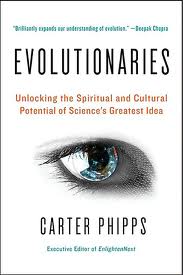
Evolutionary is a term given to thinkers who see evolution as much more than simply a theory that pertains to the biological development of life on this planet. Evolutionaries are generalists who are willing to piece together information from all disciplines in order to explain the cosmos. So, says Carter Phipps in his new bestseller, “Evolutionaries: Unlocking the Spiritual and Cultural Potential of Science’s Greatest Idea”. In which he defines evolutionaries as: “deep time explorers of a universe of infinite becoming.”  In a world where scientists, philosophers, and theologians are borrowing from one another’s insights in order to explore the secrets of existence, evolutionary theory is being applied to more than just biology.  

Inspired by Matthew Fox’s “Original Blessing”, I have long since given up on the medieval doctrine of original sin and moved beyond the atonement theologies that rely on our need to be saved by a “Father God”.  Like many progressive Christians, rather than describing the human condition as sinful or broken, I understand humanity to be incomplete and still evolving. We did not fall from grace in some mythical garden. Humanity, like all of the cosmos continues to evolve. The idea of evolution has all sorts of implications not only for how we see ourselves as human beings, here and know. As we continue to evolve, the determination of who or what humanity becomes requires that we take seriously our role as co-creators not with some grand-puppetier-god-in-the-sky. But as co-creators with a God who is in all and through all. 

The emerging conversation between scientists, theologians, and philosophers makes the question “Do you believe in the bible or do you believe in evolution?” obsolete. The conversations between disciplines are giving birth to a new spirituality. Evolutionary Christianity is emerging. Evolutionary thinkers are developing new theologies that take seriously God’s presence in all things through Christ. 

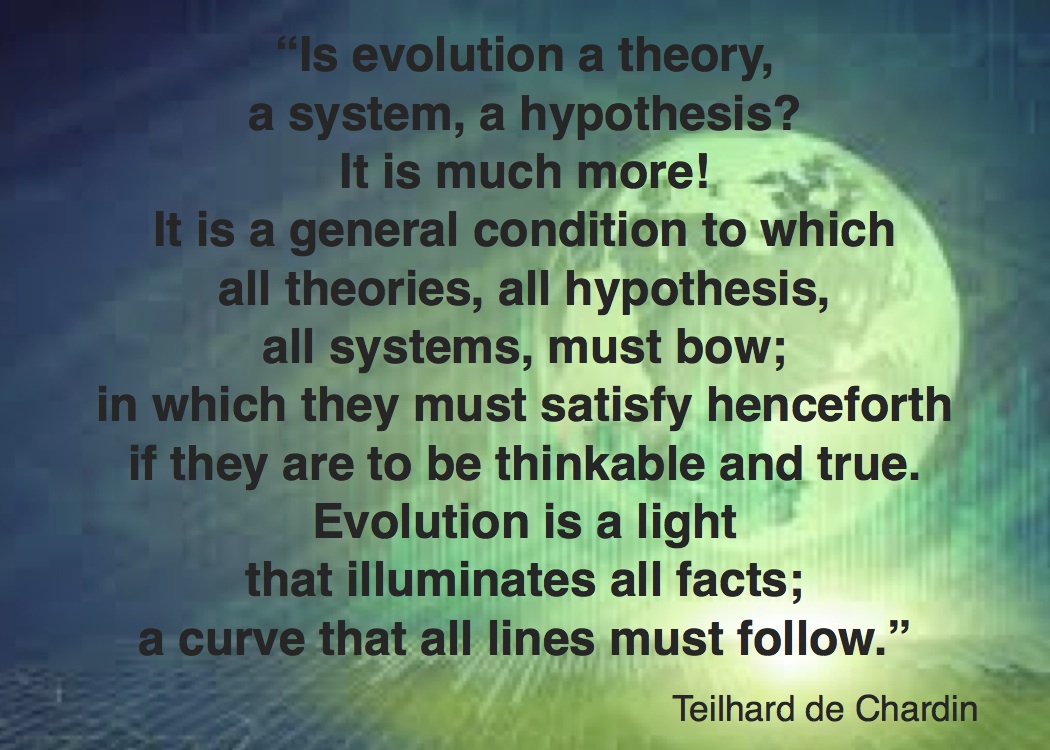
After having spent a week, exploring the work of Teilhard de Chardin; an evolutionary thinker who was decades ahead of his time, I am eagerly devouring my copy of Phipps new book (just released June 12 and it has already it has reached #14 on Amazon).  I will say more in future posts.  In the meantime, for an overview of what it means to be an evolutionary, take a look at the video below which features Carter Phipps speaking at MIT this past May.

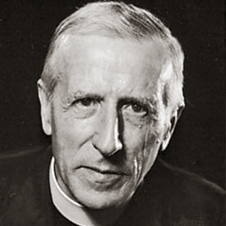
CONSUMED BY TEILHARD de CHARDIN’s FIERY VISION

I first discovered Teilhard’s work while completing my undergraduate work in Religious Studies at the University of British Columbia, when a well-used copy of “The Phenomenon of Man” (Le Phenomene Humain) captured my interest. At the time, Teilhard’s insights were quite a stretch for me and although I finished the book feeling overwhelmed by its complexity, I couldn’t help longing for the day when I might be better able to follow Teilhard beyond the rigid confines of the science versus religion debate toward a more comprehensive approach to understanding the cosmos and our place in it.

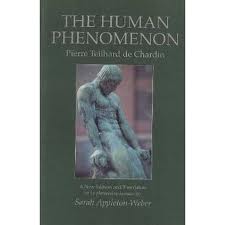
Today, in the midst of my sabbatical at UBC, it feels so appropriate that I should once again be consumed by Teilhard, as I luxuriate in Sarah Appleton-Weber’s newer translation: The Human Phenomenon. Lo these many years later, I still feel ill-equipped to grasp the wonders of Teilhard’s vision. But, I am struck by the beauty of his vision of the complex process of unfolding of the universe. 

My comprehension of Teilhard’s work is enhanced by Ersula King’s splendid biography: Spirit of Fire.  King describes his vision as one in which: “love is a spirituality that celebrates the oneness of creation, a spirituality that acknowledges love as the clearest understanding we have of God, of ourselves, of history, and of the cosmos.”

“his vision was one of consuming fire, kindled by the radiant powers of love. It was a mystical vision, deeply Christian in origin and orientation. Yet it broke through the boundaries of traditional orthodoxies — whether those of science or religion — and grew into a vision which is global in intent.”  

In an essay, “The Heart of the Matter” written near the end of his life, Teilhard described this fire at the heart of reality:

“Throughout my life, by means of my life, the world has little by little caught fire in my sight, until a flame all around me, it has become almost luminous from within. Such has been my experience in contact with the Earth. The diaphany of the divine at the heart of the universe on fire. Christ, the heart, a fire capable of penetrating everywhere, and gradually spreading everywhere.”

Teilhard was a scientist/theologian/philosopher/prophet who remains ahead of his time, whose work continues to push scientists and theologians to move beyond the carefully drawn boundaries of their own disciplines so that they might learn from one another. King explains: “His deepest desire was to see the essence of things, to find their heart, and probe into the mystery of life, its origin and goal. In the rhythm of life and its evolution, at the center of the cosmos and the world, Teilhard believed, is a divine center, a living heart beating with the fiery energy of love and compassion. Now, the heart is really a fleshly reality But the image of this very flesh, this concentration of living, breathing matter, came to symbolize for Teilhard the very core of the spirit.”

The warmth of these summer days at UBC are richly complemented by Teilhard’s fiery vision as I savour this divine consumption.

For those of you unfamiliar with this 20th century Christian mystic the American Teilhard Association provides a brief biography at:  http://teilharddechardin.org/index.php/biography

“AT THE HEART OF THE MATTER, A WORLD HEART, THE HEART OF GOD” Teilhard de Chardin

Today, I began to study the work of Pierre Teilhard de Chardin. I have been longing to do this ever since I was first introduced to this 20th century Christian mystic some 25 years ago, when Matthew Fox’s “Original Blessing” helped me to look to the Christian mystics, both ancient and modern, to find new ways of connecting to the cosmos.  After many brief encounters with Teilhard’s work in books and articles by some of my favorite theologians, I have longed to spend some time exploring Teilhard’s purported brilliance. I have begun by reading “The Human Phenomenon” (often mistranslated from the French as “The Phenomenon of Man”). I’ve submerged myself in the delights and challenges of this enthralling work until my mind is about to explode (usually just a chapter or two at a sitting) and then I take a break by reading Ersula King’s  riveting biography: “Spirit of Fire: The Life and Vision of Teilhard de Chardin”. It has been a mind blowing day!

So many connections are emerging and I shall endeavor to post them as they escape from the quagmire of ideas that are swirling around in my brain. But as the Sabbath approaches I leave you with this playful tune from Peter Mayer which celebrates this blessed Ordinary Day in a way that complements this mystic moment!


‘WE ARE ALL THE UNIVERSE BECOMING MORE AWARE OF ITSELF” Rev. Michael Dowd

Michael Dowd, a self-proclaimed Evolutionary Evangelist is committed to spreading the good news that evolution is humanity’s common creation story as he proclaims that science illuminates the evidence with which God is communicating to humans today.

Inspired by the work of Fr. Thomas Berry who portrayed the epic of evolution as a sacred story Dowd seeks to popularize Berry’s insistence that humanity is the universe becoming conscious of itself. 

Dowd’s work is especially intriguing to this particular 21st century pastor who connects to the cosmos from the perspective of panentheism (God is in everything and everything is in God). Evolutionary Christianity is an exciting way of using the explosions in scientific evidence to illuminate our religious quest to understand our place in the cosmos. 

I am indebted to a blog-follower from South Africa for linking me to this excellent video by New Hampshire Outlook that explores the work of the Rev. Michael Dowd. In addition to a fabulous interview this video provides an enticing overview of Evolutionary Christianity that will leave you wanting to learn more.  You can begin by visiting Evolutionary Christianity’s Blog. I’m anxiously waiting for my copy of Dowd’s “Thank God for Evolution” to explore more of Dowd’s insights.

CHRISTIANITY AFTER RELIGION: The End of Church and the Birth of a New Spiritual Awakening by Diana Butler Bass

Re-reading Diana Butler Bass’ latest tome while on sabbatical in Vancouver allows me the luxury of time to delve deeply into her keen insights with regard to the current state of Christianity in North America. 

Bass offers hope to those of us who remain in the institutional church toiling away at the hard work of renewal. While the powers that be within the institution struggle to hold on to what used to be, by tinkering with doctrines and structures in order to maintain the status quo, Bass sees a “New Spiritual Awakening” happening among the “spiritual but not religious” crowd who seek a more direct experience of God. Rather than choosing between spirituality and religion, Bass calls for a more spirtual religion; one that enables us to become more fully human. 

Take the time to watch Bass describe her book in her own words. For those of you who have already read the book, I would encourage you to listen to the story at the end of the lecture which Bass did not include in the book that captures the flavour of the “New Spiritual Awakening” she sees taking place in the most unlikely of places among the most unlikely participants.

LETTIN’ HER LIGHT SHINE: Dr. Maya Angelou

And such a beautiful light it is!!!