The Messiah Is Among Us!

Christ is born in youDuring these twelve days of Christmas we celebrate the birth of the Messiah. Messiah, is a word the ancient Hebrews used to describe the anointed one. The one whom God would send to change the world. In Greek the word for Messiah is Christ.

My thoughts swirl around a poem written by the unknown writer of the Gospel of John in which the birth of the Christ is describe as the WORD. It’s a mysterious cosmic poem that moves our minds away from the mundane everyday ordinary stuff of life to the extra-ordinary mysteries of creation, which when you think about it is what every birth does.

Just holding a newborn in your arms and before long you’ll find yourself pondering the mysteries of this life. Who are we and where do we come from?  Why are we here? What does it all mean? These are all perfectly wonderful questions and speculating upon the many possible answers to those questions is a fascinating process. But in the end, our words will always fail us when it comes to answers. As we are speculating about the birth of this beautiful little baby, the baby is alive and among us, and needs to be fed and changed, nurtured, guided and protected.

Our speculations about the mysteries of creation are a little like our preparations for Christmas. All the preparations, the decorating, the shopping, the wrapping, the stuffing, the cooking, and the worrying, and in the end all our preparations aren’t really the point. The point is Christmas-tide is now and the guests are all around we’ve arrived and the Messiah has arrived, or not, its up to us to welcome the One who is Love in our midst, to celebrate Christmas.

The trouble is that sometimes, we are so preoccupied with the preparations, with the idea of getting it right that we forget the whole point of Christmas is the celebration itself; the gathering of the clans, the being with one another, the opportunity to be present to one another. It’s one of the reasons why I love the stories that the unknown writers of the gospels of Matthew and Luke put together.    In those familiar tales we hear a story of a couple of parents who were not at all prepared to welcome a child into the world. It’s an earthy story that brings the pungent aroma of a animal dung right into our carefully decorated living-rooms. And the Messiah that we greet in the story found in Matthew has no halo hovering over his head. The writer of Matthew makes it very clear that the Messiah comes from a very dubious pedigree, numbering a prostitute, a product of incest, an adulteress and sexual trickster among his ancestors. The Messiah’s parents were an unwed teenage girl and an unspeaking father, who wasn’t a father, and the pair of them appear to be homeless and then on the run, seeking shelter wherever they can find it.

Our romantic notions of a pretty little stable will have to wait a thousand years for St Francis to pretty up and launch us on a quest for cattle lowing, shepherds kneeling and magi bowing. Our expectations of the Messiah have become so very highfalutin, so otherworldly that I wonder if we are really prepared to welcome the Messiah among us. We hardly know what to expect from the Messiah. Are you really ready to welcome the Messiah? What do you expect?

There’s an old Jewish story, I can’t remember where I first heard or read it. I suspect I might have learned it from Scott Peck? The story is now deep in my bones. It surfaces most Christmas mornings to remind me that Christ is born in us.

Once there was a monastery with a long history of commerce and a thriving spiritual community. But as time wore on, fewer and fewer villagers visited the hallowed halls. Fewer people turned to the monastery for advice. Even the sale of their famous wines began to dwindle. The abbot began to despair for his community. “What should they do?” he wondered.

They prayed daily for guidance, but the brothers only became more dispirited. The monastery itself reflected their mood, becoming shabby and untidy. At last the Abbot, hearing that a wise Jewish rabbi was visiting, swallowed his pride and went to visit the rabbi to ask his advice. The abbot and the rabbi visited for a long time.

They talked of their respective religions, and the fickleness of human nature. The abbot explained his problem to the rabbi and asked for advice, but the Jewish sage only shook his head and smiled.

As the abbot sadly departed, the rabbi suddenly rose and shouted after him, “Ah, but take heart my friend for the Messiah lives amongst you!” All the way home the abbot pondered the rabbi’s words, “The Messiah lives amongst you.” What could he mean? Did the Messiah live in the abbey? The abbot knew all the brothers very well. Could one of them really be the Messiah? Surely he, the abbot, was not the Messiah… Was it possible?”

Upon reaching the monastery the abbot confided the rabbi’s words to another brother, who told another brother, who was overheard telling another brother. Soon the whole abbey had heard the news. “The Messiah lives amongst us!” “Who do you suppose he could be?”

As each brother speculated on who the Messiah could be, his view of his brothers began to change. Brother Louis no longer appeared simple, but rather innocent. Brother Jacques was no longer uncompromising, but rather striving for spiritual perfection.

The brothers began to treat each other with greater respect and courtesy; after all, one never knew when he might be speaking to the Messiah. And, as each brother discovered that his own words were taken seriously, the thought that he might become the Messiah would cross his humble mind. He would square his shoulders and attend his work with greater care and start acting like a Messiah.

Soon the neighboring villages began to notice the change that had come over the monastery. The brothers seemed so happy. Villagers flocked to the monastery and were energized by the spirit of the Brothers. And so the spirit grew and the monastery flourished. As each new brother was welcomed, the question arose, “Could he be the Messiah?”

Apparently the monastery still prospers today and it is often whispered both within its walls and in the surrounding towns that the Messiah lives amongst them. As you celebrate Christmas this year, remember that the Messiah lives among you.

If you are waiting for perfection, Christmas is going to be a lonely and frustrating time. If you are waiting for some future time, the wonders of this moment will pass you by. If you are expecting salvation outside yourself, you might miss your own wisdom. If you hold your loved ones to impossible standards you just might miss the Messiah who sits right next to you. I know that you’ve worked hard, and made all kinds of preparations, but today is the day it’s time to greet the Messiah, now. Don’t miss a moment of it. Enjoy. The Messiah arrives in you and right next to you! Enjoy!

Way Back When: Christmas Oranges- Christmas Eve Sermon 2014

Christmas orangeThis sermon owes much to the work of Richard Rohr whose work opens me to the LOVE who lies at the core of REALITY, the ONE we call God. The source of the story that I tell about a Christmas Eve way back when has been lost to me. I cannot remember when I first heard it. It’s power to open me to the LOVE that is God remains with me and so I treasure the story and tell it so as to open others. To open ourselves to the cosmic nature of the Christ we used different scripture readings. The readings can be found here

You can listen to the sermon here

Jian Ghomeshi, Bill Cosby, Mary the Mother of Jesus, and the Daughters of Jerusalem

Mary pregnantFlipping through Bruce Sanguin’s  collection of sermons, “The Advance of Love: Reading the Bible with an Evolutionary Heart,” I was opened to a new way of pondering the myth of the “virginity” of Mary in Sanguin’s sermon on Luke 1:26-38 entitled “The Future Calls.” 

Sanguin writes, “What about the virgin birth? Despite being a mistranslation of a passage from Isaiah that speaks of a “young woman” and not a virgin, this story has tuck. But let’s explore if at face value. One of the most subversive meanings is captured in a single line from a Bruce Cockburn Christmas song: “Mary grows a child without the help of a man.” The assumptions of patriarchy–that men are favoured ones, that all good things must happen through the male gender, that men should hold all the power, and that women are naturally subservient–are overturned in this single detail. The virgin birth has nothing to do with concern over sexual impurity. The Jewish tradition affirms the body and sexuality as a gift of God. The myth of the Virgin birth is announcing the end of an age, patriarchy, and the beginning of a new creation in Christ. To be Christian is to consent to equality. We are now certain that one of the most radical features of the early Christian church was that women enjoyed equal status with men–unheard of anywhere in the world in the first century. It too men in the church a couple of centuries to wrest control back and exclude women. But the story stands in its affirmation that the world can run just fine without the illusion of the necessity of male dominance. In this story, Spirit bypasses patriarchy in the conception and birth of a new humanity, symbolized by the birth of Christ.”

Would that Sanguin’s reading of the gospel-storyteller’s intention were true! Sadly, whatever glimmer of hope for the end of the age of patriarchy may have been present at the turn of the first century, that glimmer was extinguished over and over again in the succeeding centuries. The slim flickers of equality do continue to burn. But that we need to continue to live in hope rather than the reality of equality is born out by the recent bad news of the downfall of cherished heroes like Bill Cosby and Jian Ghomeshi. That men of such prominence in our society should have resorted to dominance over rather than equality with women, bears testament to the reality that patriarchy continues to haunt our lives together. The peace we all long for continues to be threatened by the violence of patriarchy’s firm grip upon the psyche of so many.  

While Cosby and Ghomeshi are but puny players upon the stage our media has erected to  exhibit the morays of our culture, they are indicative of our delusional insistence that we have defeated the horrors of patriarchy. In a world where young girls continue to be abducted and sold into the slavery of the sex-trade, where so-called honour-killings continue, where little girls are shot in the head for daring to seek and education and we in the West respond by wringing our hands or turning away, we should not be surprised that our celebrated heroes should believe themselves to be impervious to rebuke. 

The crimes, indeed the horrors, which have been perpetrated and continue to be inflicted as a result of the continued inequality between women and men cannot all be linked to the church’s insistence that Jesus was born of a “virgin.” But the church must confess our culpability, for our structures and theologies uphold the delusions of the deranged who continue to cling to the power that patriarchy affords them. 

So this Christmas, as the myth of Mary’s virginity continues to haunt us, listen carefully and hear the cries of the Daughters of Jerusalem as they bewail the plight of the One we call the Christ. Listen to that One who responds to their cries, “Daughters of Jerusalem, don’t weep for me! Weep rather for ourselves and for your children!” And when our weeping is done, let us rise up in unison and equality to tend the wounds that patriarchy has wrought upon the earth so that this Christmas the “birth of a new humanity can be symbolized by the birth of Christ.”  We can begin by remembering that Jesus of Nazareth was, in the words of the Apostle Paul, “born of a woman,” a powerful woman indeed!

The Mother of Jesus: A Symbol of Judaism – Bishop John Shelby Spong

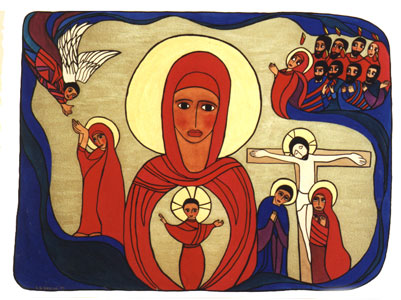
maryuniversalmarywAs we prepare to hear so much about the story of the nativity, Jack Spong’s words serve as a good reminder of the use of symbolism in the gospels. Jack points to the figure of  the mother of Jesus as an interpretive image. 

Tell Us About God. We Have Almost Forgotten – a Christmas Eve/Day sermon Luke 2:1-15

nativity bYou can listen to this sermon here

There’s a story that I love to tell. So many of you have heard it before. But this is the night for telling stories over and over again and because I love this story, tonight’s the night! I first heard it from a very wise seminary professor and since then I’ve heard Marcus Borg and Parker Palmer tell it. I’m not sure that this story actually happened, but I am sure that it is absolutely true!

It’s a story about a three-year-old girl who was the only child in her family. Her mom is pregnant, and this three-year-old girl is very excited about having a baby in the house. The day comes where the mother-to-be delivered, and the mom and dad go off to the hospital. A couple of days later they come home with a new baby brother. And the little girl is just delighted. But after they’ve been home for a couple of hours, the little girl tells her parents that she wants to be with the baby in the baby’s room, alone, with the door shut. She’s absolutely insistent about the door being shut.

It kind of gives her folks the willies, you know? They know she’s a good little girl, but they’ve heard about sibling rivalry and their not sure about what they should do. Then they remember that they’ve recently installed an intercom system in preparation for the arrival of the new baby, and they realize that they can let their little girl do this, and if they hear the slightest weird thing happening, they can be in there in a flash.

So they let their little girl go into the room. They close the door behind her. They race to the listening post. They hear her footsteps move across the room. They imagine her now standing over the baby’s crib, and then they hear her say to her two-day-old baby brother, “Tell me about God. I’ve almost forgotten.”

Tonight we are all that child, standing over the baby’s crib hoping against hope that the newborn baby will tell us about God; maybe because we have almost forgotten, maybe because we don’t believe, maybe because we want to believe, maybe because we’ve lost hope, maybe because we are endlessly curious, or maybe just because T’s the season! Regardless of why, here we are gazing into the crib at the newborn baby hoping that this child will tell us about God. But all we have is this story; a story so simple it sounds as if it was created for children; poor homeless refugees, far from home, in the darkness of a winter’s night, struggling to keep warm amongst the dung of a stable, a tiny baby, swaddled in what we imagine as rags and lying in a feed trough, shepherds, angels and a star in the night sky. It’s a lovely story. A story that warms our hearts, told over and over again in the darkness of so many winters as we struggle to keep our demons at bay. We’ve told it so often that we’ve forgotten why it was told in the first place. We’ve lugged so much of our own baggage into that stable that we can scarcely see the baby. We’ve heaped our expectations and longings onto the images and our need to know has demanded that the facts confirm our desires. Continue reading

The Greatest Birth Story Ever??? Luke 1:26-38, a sermon for Advent 4B

blue madonna babeAs always, I am indebted to the scholarship of John Dominic Crossan and Marcus Borg whose book The First Christmas is the gift that keeps on giving! You can listen to the sermon here

For those looking for a different approach to Advent 4B check out the sermon posted here

Some have said that it was the most amazing birth story ever told. This birth narrative heralded the arrival of a child who was praised as the Son of God, the Saviour of the World who was said to be the personification of peace on earth; God incarnate; fully divine and fully human. Not everyone agrees that this is the most amazing birth story ever told. Among the ancients, some insisted that the story Alexander the Great’s birth was the greatest story every told. 

Alexander the Great’s birth story is truly one of the greats. His was, after all the, son of a Queen and a god and a king. His mother, Olympias was a Queen, betrothed to Philip of Macedonia. The night before they were married, Queen Olympias dreamed that a thunderbolt fell upon her body, which kindled a great fire, whose divided flames dispersed themselves all around her, and then as if by magic they were extinguished. Philip dreamed that he sealed up his Queen’s lady parts with a seal which bore the impression of a lion. The high priests who interpreted the dream warned Philip not to even entertain the idea of consummating the marriage because one wouldn’t go to the trouble of sealing up something that was empty. So Queen Olympias must already be with child, who would undoubtedly be a boy with the courage of a lion. If that wasn’t enough to put Philip off he found a serpent lying beside Queen Olympias as se slept, which was said to have abated his passion. Later the oracle of Apollo at Delphi went on to explain that this was no ordinary serpent, no this was the incarnation of the God Zeus.

The day that Alexander the Great was born, one of the seven wonders of the world burnt to the ground. The temple of the goddess Artemis in Ephesus was the home of the Goddess Artemis who was said to have been attending to the birth of Alexander at the time. Alexander the Great was heralded as the Son of God and Saviour of the World and as one of the greatest warriors the world has ever known, he went on to conquer a good portion of the planet. But by the time our hero was born, the glory days of the Greeks had long since passed. The Empire of Rome had replaced the Greeks as rulers of the world and they had the conquered lands to prove it. By the time our hero was born, Julius Caesar had established an Empire the likes of which the world had never seen before. Gaius Julius’ prowess on the battlefield was matched only by his cunning in the senate and together had one him the title of Caesar.  But as great and marvellous a leader as Julius Caesar may have been, history tells us that he and his wife were not blessed with children. Alas, Caesar did have a son by virtue of his dalliance with Cleopatra but that’s another story all together; suffice it to say, that that little fellow didn’t stand a chance against the one Julius would appoint as his heir. Born to Julius Caesar’s niece, little Octavian was eventually adopted as his great-uncle’s heir apparent who eventually amassed powers that far outshone his illustrious uncle’s. Continue reading

The de Chardin Project: a theatrical triumph!

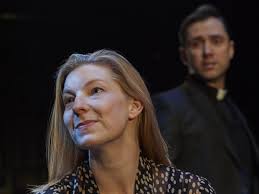
de chardin projectYesterday, I enjoyed an expansive evening at Toronto’s Theatre Passe Muraille as playwright Adam Seybold’s “The De Chardin Project” brought one of my theological heros to vivid life. Before my very eyes, Pierre Teilhard de Chardin gave new meaning to “forever!” Seybold’s bravery in taking on the complex work of Teilhard is matched by his sensitivity for the life and ideas of the man whose thinking continues to impress those who seek ways of expressing the complicated marriage of theology and science. In ninety short minutes Seybold’s script propelled us to the sun and back over and over again as the talents of Maeve Beaty and Cyrus Lane breathed life in to the divine/human love affair that is life

After years of pouring over Teihard’s work, I can empathize with the challenges of bringing his genius to a wider audience. The combination of talents that have come together in this production to stretch the audience’s perspective beyond the limits of tired arguments has succeeded in creating an experience which far exceeded my expectations. When I entered the theatre, I was sceptical. I wondered what would become of the ideas that I treasure. But it only took a few moments for Seybold’s words to woo me and before I knew it, Cyrus Lane’s tortured and dying Teilhard had me opening myself to a series of transformative moments, the like of which I’ve not enjoyed in the theatre for a long time. With Maev Beaty’s steady hand as our guide, Teihard’s questions took us on an adventure worthy of our deepest wonderings. Beaty’s moving ability to transform herself was aided by the subtle and sometimes startling staging. Director Alan Dilworth managed to not only direct his actors but his audience as well as we transcended the stage up, up, up, to the sun and back again into the deep interior of our being to capture precious grains of sand.

If you live in the Greater Toronto Area, whether you’ve read Teihard or never heard of him before, this play is a must see. The run ends December 14. So don’t delay. After the adventure of The De Chardin Project the expansion of my ideas about reality, like forever, is just beginning as Maev Beaty’s passionate “Yes” echoes throughout my being!

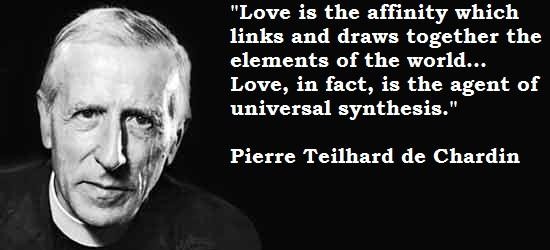
Teilhard Love

Advent Blue

When we leave behind our personifications of the Deity, we can’t help but rekindle our love of God in whom all of creation rests. Recognizing the Earth as sacred and moving toward an understanding of the Earth as a beautiful part of the Body of God is vital to our being in God. Peter Mayer’s hymn to our Blue Boat Home puts a whole new hue in my perception of Advent Blue!

WAKE UP for CHRIST’s SAKE! – sermon for Advent 1B

purple universeOn this the first Sunday in Advent we awakened ourselves to the cosmic contours of the darkness. Our first reading was The Star Within: a creation story by Dr. Paula Lehman & Rev. Sarah Griffith, followed by a musical video reflection My Soul by Peter Mayer which you can watch below. Our Gospel reading was from Mark 13:24-37. Listen to the sermon here


Pregnant with Possibility: Advent 1B sermon Mark 13:24-37

Advent pregnant2014 pastordawnThis sermon for the first Sunday of Advent was inspired by a sermon written by Ian Lawton entitled “The Mother of All Virgin Births” in which I was captivated by his use of the phrase “pregnant with possibility.” I read Lawton’s sermon after first reading John Dominic Crossan and Marcus Borg’s book “The First Christmas” in anticipation of Dom Crossan’s first visit to our congregation (2008). I was so eager to prepare the congregation for Dom’s historical approach to Christmas that  I fear the sermon is overflowing, perhaps a little too pregnant with details.  Luckily, the congregation was treated to the wonders of Dom Crossan’s brilliance for several days and learned well from the master about the delights of historical details. I post the sermon here, trusting that some of the details may be enlightening as we once again prepare ourselves for the Season of Advent.

Let me tell you a story from down-under; an Australian story that was doing the rounds a few years ago. Like all stories it may never have actually happened, but it is absolutely true because it happen again and again, in various and myriad ways. This story happened a while ago in Brisbane, Australia…

“The story begins in the dark. A university student named John was on the side of the road hitch hiking on a very dark night and in the midst of a storm. The night was rolling on and no car went by. The storm was so strong John could hardly see a few feet ahead of him. Suddenly he saw a car slowly coming towards him and slowly it stopped. John was desperate for shelter and without thinking about it; he got in the car and closed the door.

It took only a moment for John to realize that there was nobody behind the wheel and the engine wasn’t on! But the car started moving slowly. John looked at the road and saw a curve approaching. John was so scared, that he started to pray, begging for his life. Then, just before he hit the curve, a hand appeared through the window and turned the wheel. John, paralyzed with terror, watched how the hand repeatedly came through the window but never harmed him. Eventually, John saw the lights of a pub down the road and so gathering his strength, he jumped out of the car and ran into the pub.  Wet and out of breath, he rushed inside and started telling everybody about the horrible experience he had just had. A silence enveloped the pub when everybody realized he was crying and he wasn’t drunk.  Suddenly two other people walked into the pub.    They, like John, were also wet and out of breath. They looked around and saw John sobbing at the bar, one of the men said to the other, ‘Look, Bruce, there’s that idiot that got into the car while we were pushing it.’

Spiritual Philosopher, Ian Lawton insists, “There is always more to life than meets the eye. There is more to life than what our sight is able to see. Our eyes don’t simply pick up information relayed from an outside world and relay it to our brains. Information relayed from the outside through the eye accounts for only 20 percent of what we use to create a perception. At least 80 percent of what the brain works with is information already in the brain. We only use a small fraction of our brainpower. We very rarely exercise the full potential of our physical strength. We rarely access all that is available to our senses. We rarely maximize the potential of our mind, body and spirit in harmony. There is always more to life than meets the eye.” Continue reading

Quest for the Cosmic Christ – a sermon

Cosmic Christ pastordawnWe begin our quest for the Cosmic Christ on this the last Sunday of the Church calendar; traditionally the festival of Christ the King or Reign of Christ Sunday. Readings: John 1:1-6; Colossians 1:15-20; and Matthew 9:16-17. This sermon is the first in a series of sermons on our Quest for the Cosmic Christ which anticipates the season of Advent’s waiting and hoping for Christ to be born in us.

Listen to the sermon here:

Movements are Shaking Monuments: Bishop Yvette Flunder

Acts 16-28Many progressive Christians were introduced to  Bishop Yevette Flunder by the Living the Questions interactive dvd series. She is a phenomenal preachers whose extraordinary gifts  have the power to shake us out of our safe, comfortable, ways of being church. As we at Holy Cross Lutheran continue our ReVisioning process, Flunder’s sermon to the community at Drew Theological Seminary (2012) reminds me that there’s a whole lot of shaking going on in and around the church. Which begs the questions: What needs to continue to stand? and What needs a good shaking to make it fall down to make room for something else? Flunder’s sermon sent me back to the Book of the Acts of the Apostles, (16:23-28) to review the story that inspired her powerful images. There I noticed for the first time a line which has previously eluded me. Following the shaking of the great earthquake, Paul and Silas’ jailer presumes that they have fled the scene. But the Apostle Paul shouts: “Don’t harm yourself! We’re all still here!.” Despite the shake up of christianity which progressive and evolutionary thinkers are championing: Don’t worry! We’re all still here!” Some of our great monuments have fallen and more will follow suit. But they give way so that something new can be born. Sounds like resurrection to me!

Questions, Questions, Questions – ReVisioning Sunday

puzzle on copyOur worship this morning preceded a congregational gathering in which we began the work of ReVisioning our congregation. After years of ReThinking Christianity we are beginning to move on to the work of articulating those things what it is that we do hold in common.

Using the Parable of the Good Samaritan the sermon explores the art of living in the questions. Listen to the sermon here

Parable of the Talents! It Really Isn’t About God!

Yesterday’s post about the the parable Jesus told in Matthew 25:14-30 inspired some feedback which suggested that I was reading too much into the parable. It seems to me that the whole point of storytelling is to evoke something in the audience. The best storytellers (of which Jesus is one) recognize that they can have absolutely no control over where their audiences might take their stories. Parables are stories designed to shock and transform their audiences. Jesus could have selected a different style of storytelling. That the stories that have been passed down to us by Jesus’ followers come to us as parables suggests that shocking interpretations are consistent with the desires of those who pass them on. But for those who insist that God is the slave-master in the parable of the talents, here’s a little animated version of the parable; no dialogue, just the actions. I’m not prepared to identify the master in this tale with the Divine One who Jesus described as Love. It isn’t really about about God. But then again, it IS.

Jesus and ISIS – adult education class 2

Jesus & ISIS

Listen to the class here

Walter Wink video shown during the class:

You Are the Saints – a sermon in response to Psalm 34

All Saints d

Listen to the sermon here

Empire of Faith: A Brief History of Islam

Jesus & ISISAt Holy Cross, our adult education class has been involved in a conversation about Jesus’ teachings about non-violent resistance and loving our enemies and how or what impact those teachings have on our response to ISIS. During our conversations, many participants have expressed concern about our lack of knowledge about Islam. Without an understanding of the history, traditions, teachings and practices of Islam it is difficult to comprehend just how far violent jihadists deviate from the Islamic faith.  I loved history when I was in school, but I do not recall ever learning anything about the history of Islam. Over the years, I have been blessed with friends and associates who have helped me to realize just how much I have to learn about the faith of my neighbours. My love of history continues to serve me well as I explore the wonders of Islam. I realize that many people just don’t have the time or inclination to put in the hours it takes to gain a working knowledge of Islam. However, we do owe it to our neighbours to gain an inkling of their traditions.  So, as a way to begin to understand the history of Islam, I suggest watching the excellent PBS documentary series, Empire of Faith. Our conversation continue Sunday Oct 26 at 9:15am

What Is the Purpose of My Life? – Sister Joan Chittister

sage-ing“What do you do?” not “What is your job?”  Pushing us to move beyond limiting our understanding of who we are. At 78, Sister Joan Chittister continues to be an inspiration to those of us who seek to know the purpose of our creation. To those of us who are nearing or have reached retirement, Sister Joan insists that there is so much for us to do in the world. “If you want to know if your work on earth is done, if you are still alive it is not done!” There is vital work that needs doing and you have the wisdom and skills necessary to be vital. Recorded on October 12, 2014 at Christ Church Charlotte’s Faith Forum. 

Wrestling with God: a Confirmation sermon – Genesis 32

wrestlingIn addition to celebrating Reformation Sunday it was also Confirmation Sunday as two young men Affirmed their faith. Listen to the sermon below or click here


Bishop Munib Younan receives the Civis Mundi Award for Global Citizenship

Civis Mundi evening

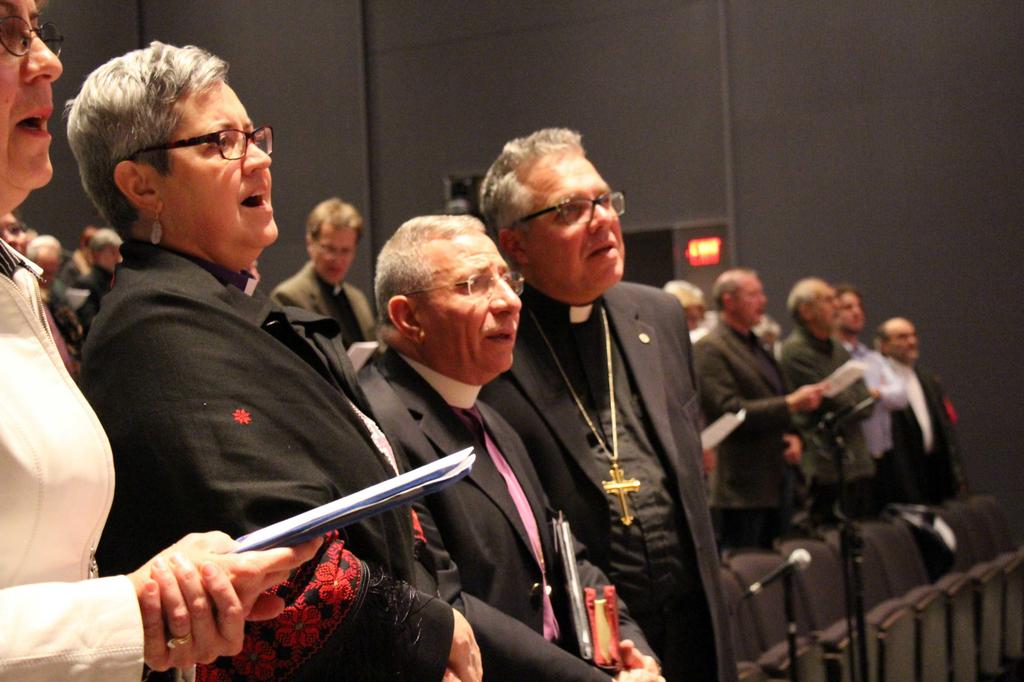
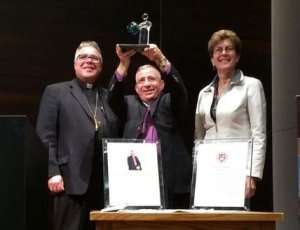
Waterloo Lutheran Seminary’s inaugural Civis Mundi award was presented to Bishop Munib Younan (Evangelical Lutheran Church in Jordan and the Holy Land) on the evening of October 22; a day when Canadians were reeling from the tragic events in Ottawa which saw a deranged man brutally murder Cpl. Nathan Cirillo and burst into the halls of our parliament threatening the lives of those who toil at he very heart of our democracy. Bishop Younan’s words are especially poignant as we continue to struggle to maintain inclusivity and celebrate our diversity as a nation. click on the photo below to watch the video – Bishop Younan’s speech begins at the 23 min mark

civis mundi

http://new.livestream.com/accounts/1734671/events/3493415/player?width=560&height=315&autoPlay=true&mute=false