All Saints – Giving thanks for the Divine in One-another!

All Saints’ Day is a day for remembering.  The word saint simply means “holy”. In the New Testament, all those who believe and were baptized were referred to as saints. It wasn’t until round about the third century that the church began using the word saint to refer to those who had been martyred for the faith. Over time these martyred saints were held up for veneration and people used to pray to them to intercede on their behalf. I’m not going to go into all of the institutional abuses that led Martin Luther and the later reformers to abolish the veneration of the saints. Except to say, that while the Reformation put an end to the veneration of the saints in the protestant churches, it did not abolish the concept of sainthood.

Within the mainline protestant denominations, we use the term in much the same way as it was used in the New Testament to describe the faithful. We talk about the communion of saints to describe all the faithful who have gone before us who now rest in God, together with all the living who walk in faith. So today as we celebrate the saints, we give thanks for all the faithful those living and those who have gone before us.

Today, I remember and rejoice as I give thanks and praise to God for the witness of St. Joyce of Belfast. St. Joyce who in her own way taught her children to love God and to pray always. And so today, I give thanks and praise to God for the life and witness of St. Joyce of Belfast, my Mom, who was the first to teach me the Lord’s Prayer, and who puts flesh on Christ’s command that we love our neighbours as we love ourselves.

Today I remember and give thanks for the life and witness of St. John of Wales, whose life in the church as a choir-boy was followed by long years of self-exile and whose keen wit and lack of patience with hypocrisy instilled in me a desire for honesty and integrity in the articulation and living of the faith. I give thanks for St. John, my Dad, whose open heart has stretched his discerning mind and enabled many to see the humour in this God-given life we live.

Today, I remember and rejoice as I give thanks and praise to God for the witness of St. Valerie of Ladner. St. Valerie so loved and feared God that she dared to reach out and invite a wayward soul to come and worship God. St. Valerie sang God’s praise, rejoiced in the communion of saints and helped a young friend find a home in God’s holy church. And so toady, I give thanks and praise to God for the life and witness of St. Valerie, my high school friend, who was the first to invite me to come and worship God.

Today, I remember and rejoice as I give thanks and praise to God for the witness of St. Wilton of Lunenburg. St. Wilton loved God all the days of his life and served God with gladness and distinction. St. Wilton went far beyond his call as pastor, he opened up the scriptures to those who eagerly sought the truth of God’s Word with love and dedication and he went on to inspire a diligence to scholarship that nurtured the faith of so many young people. And so today, I give thanks and praise to God for the life and witness of St. Wilton, my first pastor, who taught me to be uncompromising in my study of the scriptures, and steadfast in my love for God. Continue reading


What if the point of Jesus life, death, and resurrection isn’t about that? – a Reformation Sermon

nightListen to the sermon here


This Persistent Woman Is Wearing Me Out – a sermon on Genesis 32 and Luke 18:1-8

wrestlingBefore I read our Gospel text I took a few moments to reflect upon the story from the Torah that was our First Reading (Gen.32).  I showed the short film below which was created by Jewish scholars to help rabbis teach the stories of the Torah to young children. I use this video to teach the stories of the Torah to our Confirmation students. I think it is important for those of us who follow the teaching of the Rabbi Jesus, to pay attention to the way in which the stories that spoke to Jesus continue to speak to Jewish people here and now. Watch the video and then listen to the sermon here 

Our Gospel reading comes to us from a story told by an anonymous writer named Luke, who tells a parable that he attributes to the Rabbi Jesus: According to Luke: “Jesus told the disciples a parable on the necessity of praying always and not losing heart. “Once there was a judge in a certain city who feared no one—not even God. A woman in that city who had been widowed kept coming to the judge and saying, ‘Give me legal protection from my opponent.’ For a time the judge refused but finally the judge thought, ‘I care little for God or people, but this woman won’t leave me alone. I’d better give her the protection she seeks or she’ll keep coming and wear me out!’” Jesus said, “Listen to what this corrupt judge is saying. Won’t God then do justice to the chosen who call out day and night? Will God delay long over them? I tell you, God will give them swift justice. But when the Promised One comes, will faith be found anywhere on earth?”

I too have met this tiresome, troublesome, annoyingly, persistent widow who constantly cries out for justice. This woman won’t leave me alone. I must confess that I would rather not have this woman clamouring at my door! Each and every time I encounter this woman, she goes on and on, she wears me out! I cannot go anywhere without seeing this woman. She is everywhere. Pointing to her oppressor and demanding justice. She is on the radio in my car as I go about my business. She is on my computer screen as I try to keep up with the news of the day. She is in my living room as I try to relax flipping channels seeking respite from her persistent cries for justice. She appears in my facbook feed, and tweets at me from my phone, I cannot escape her cries for justice. I am sick and tired of this annoying woman. I cannot escape her shouts for justice.
I’m not sure that anything at all can be done to secure justice for this annoying woman. Too much time has passed. There are no witnesses. Boys will be boys. She needs to forgive, forget and move on. Why doesn’t she just leave me alone. There’s nothing that I can do for her. There’s nothing I want to do for her.
I have my own troubles. People to see, places to go, things to do. If only she’d leave me alone. Her persistent cries for justice have begun to haunt me and not even sleep gives me respite from her persistent cries for justice. If only she’d stop going on and on and on and on about her oppressor, about the injustice that has been perpetrated against her.
Maybe if she would just shut up about it, I wouldn’t have to wrestle with her in the night. Round and round we go, pinning one another down, she demanding justice, me pleading for peace. This wrestling over things beyond my control is wearing me down. I’m starting to wonder who this woman thinks she is. Hell, I’m beginning to wonder who I think this woman is. In the darkness of the night I sometimes wonder if this persistent, complaining woman, is just some trumped up version of myself. In her eyes, I sometimes think I see a glimmer of something far too familiar, something ugly, fearsome, unpleasant, and lurking in my own memories. In the wee hours before dawn, I think I can actually see myself in her.
But no, I’m not going there. We are not going there. Women all over the world don’t want to go there. Defenseless, innocent, naive children all over the world we dare not see them in the face of this persistent woman.
And then, just when I think that I have her pinned down and I’m about to wrestle something anything out of this insane encounter, the light begins to dawn on me, as I realize that there in the face of this persistent woman is the ONE in whom we all live and breathe and have our being; the ONE whose name eludes us.
I awaken to the realization that this place where we have all been, this place where we cannot escape is indeed Peniel, for here and now, in the face of this persistent woman, in the face of every persistent woman, indeed in the face of every persistent man, woman, and child, crying out for justice we have seen God face to face. It isn’t always pretty, it isn’t always what we want to see or where we want to see it, but it is the face of the ONE that we call God; the face of God shouting, crying, pleading, for justice.
Wrestling with the persistent, pleading, ones who continue to demand justice from me, I rise wounded from Peniel – the place where I know that I have seen God face to face, and yet my life has been spared. Limping away, forever changed, knowing that the wound that changes the way I walk in this world is the blessing given to me by those who have the courage to cry out for justice. Transformed by this wound I begin to see that I am at one and the same time both the judge who has the power to create justice and the one who cries out for justice.
In this Peniel, is  where ever and when ever we have the courage to look into the face of another and see the face of God, and our lives have been preserved. We cannot walk away from an encounter such as this without responding to the ONE in whom we see the face of God, with justice. Whether our role in this life long wrestling match is that of the judge or the seeker of justice, may we see God face to face.

The Science of Happiness – An Experiment in Gratitude

thanksgiving canadaIn place of the sermon this Sunday, we watched the video “An Experiment in Gratitude” followed by brief comments about embodied gratitude. You can watch the video below and listen to our conversation here below are the notes from on which the comments are based:

Your Mom and Dad were right when they taught you that “thank-you” is a magic word. Science now confirms what we learned at our parents’ knees all those years ago. However, many of us do not need science to confirm the power of gratitude. As far back as the 14th century Meister Eckhart insisted that “If the only prayer you said in your whole live was “Thank –you, That would suffice!”
What does gratitude look like when you no longer worship an image of God that personifies or anthropomorphizes God? When God is more than the source of our being, when God is being itself, how do we offer our thanksgiving? When God is the One in whom we live and move and have our being, how do we say thank-you? When we begin to understand that everything is in God and God is in everything, what prayer of thanksgiving will suffice? Leaves – seeing the hand of our Creator in Creation – who do we embody gratitude to creation? Humans seeing God in everyone – how do we embody gratitude to everyone? Jesus pointed to LOVE as the definition of God, God is LOVE and those who know LOVE know God. Jesus said, that he Jesus, this imperfect human being was ONE with God. Jesus taught us to see God in one another, when you give a cup of water to the least of these, you give it to me. Our gratitude is expressed in our loving.

LOVE encompasses a whole lot of things.

John Shelby Spong: “If God is the source of life, I worship God by living. If God is the source of love
I worship God by loving. If God is the ground of being, I worship God by having the courage to be more fully human;the embodiment of the divine.”
Augustine described God as: “LOVER, BELOVED, AND LOVE ITSELF” let LOVE be our embodiment of gratitude!

Happy Thanksgiving!

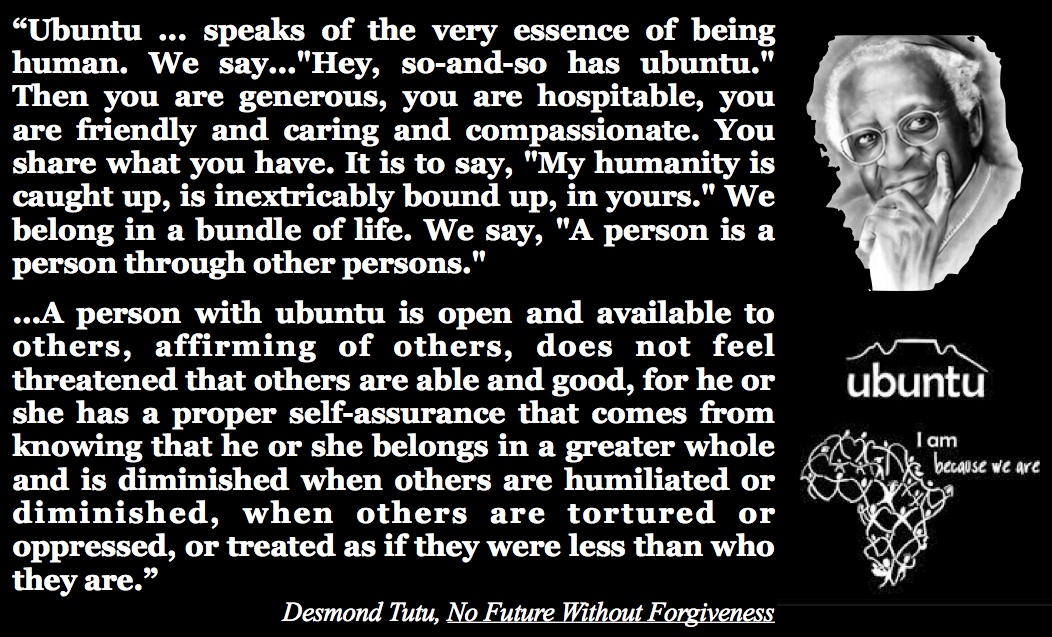
Ubuntu: A Person Is A Person Through Other Persons – Luke 17:5-10 – The Parable of the Mustard Seed

Ubuntu -- pastordawn.com

colemansListen to the sermon here: 

In his book, “The Orthodox Heretic”, Peter Rollins creates a parable which he calls “Finding Faith.”

According to Pete, “There was once a fiery preacher who possessed a powerful but unusual gift. He found that, from an early age, when he prayed for individuals, they would supernaturally lose all of their religious convictions. They would invariably lose all of their beliefs about the prophets, the sacred Scriptures, and even God. So the preacher learned not to pray for people but instead he limited himself to preaching inspiring sermons and doing good works. However, one day while travelling across the country, the preacher found himself in a conversation with a businessman who happened to be going in the same direction. The businessman was a very powerful and ruthless merchant banker, who was honored by his colleagues and respected by his adversaries. Their conversation began because the businessman, possessing a deep, abiding faith, had noticed the preacher reading from the Bible. He introduced himself to the preacher and they began to talk. As they chatted together this powerful man told the preacher all about his faith in God and his love of Christ. He spoke of how his work did not really define who he was but was simply what he had to do.

“The world of business is a cold one,” he confided to the preacher, “And in my line of work I find myself in situations that challenge my Christian convictions. But I try, as much as possible, to remain true to my faith. Indeed, I attend a local church every Sunday, participate in a prayer circle, engage in some your work and contribute to a weekly Bible study. These activities help to remind me of who I really am.’

After listening carefully to the businessman’s story, the preacher began to realize the purpose of his unseemly gift. So he turned to the businessman and said, ‘Would you allow me to pray a blessing onto your life?’

The businessman readily agreed, unaware of what would happen. Sure enough, after the preacher had muttered a simple prayer, the man opened his eyes in astonishment. ‘What a fool I have been for all these years!’ he proclaimed.  ‘It is clear to me now that there is no God above, who is looking out for me, and that there are no sacred texts to guide me, and there is no Spirit to inspire and protect me.’

As they parted company the businessman, still confused by what had taken place, returned home. But now that he no longer had any religious beliefs, he began to find it increasingly difficult to continue in his line of work. Faced with the fact that he was now just a hard-nosed businessman working in a corrupt system, rather than a man of God, he began to despise his work. Within months he had a breakdown, and soon afterward he gave up his line of work completely.

Feeling better about himself, he then went on to give to the poor all of the riches he had accumulated and he began to use his considerable managerial expertise to challenge the very system he once participated in, and to help those who had been oppressed by the system.

One day, many years later, he happened upon the preacher again while walking through town. He ran over, fell at the preacher’s feet, and began to weep with joy.

Eventually he looked up at the preacher and smiled, ‘thank you, my dear friend, for helping me to discover my faith.’”

In a parable handed down to us from our ancestors in the faith, Jesus’ disciples ask him to “increase their faith”. It is a request that I believe many of us can identify with for who among us has not at some point or other asked for the gift of more faith? If only we had more faith we would be able to believe and if we could believe we’d have the courage to  cope with whatever crisis is overwhelming us. If we could only believe, we’d be able to understand why, or how, this or that. If we could just believe strongly enough, we’d have the courage to risk, to speak out, to stand-up for, to open up to, to ask for, to go on, to do something. If only we could believe in God, believe in the life death and resurrection of Jesus, believe in the power of the Holy Spirit if only we could get it all straight in our heads we’d be able to tell all the world what it is we believe. In the meantime, we’ll just keep on struggling to believe.

For years, and years, I used to believe that what was necessary was to just believe. So, I struggled to understand what all those “I believe statements” that the church, the community of believers asks its followers to make.

“I believe in God the Father Almighty,

maker of heaven and earth and in Jesus Christ,

his only Son our Lord,

he was conceived by the power of the Holy Spirit

and born of the virgin Mary.

He suffered under Pontius Pilate,

Was crucified, died and was buried.

He descended into hell.

On the third day he rose again,

He ascended into heaven,

and is seated at the right hand of the Father.

He will come again to judge the living and the dead.

I believe in the Holy Spirit,

the holy catholic Church, the communion of saints,

the forgiveness of sins,

the resurrection of the body and the life everlasting. Amen.”

Over and over again, in liturgies, Sundays after Sunday, the church; the institution of the faith, offered me the opportunity to stand among the faithful to declare what it is that we believe. Whether it was the Apostles or the Nicene or heaven forbid the Athanasian creeds, the Church made it very clear exactly what it is that we are supposed to believe in order that we might number ourselves among the faithful. The very word “creed” itself, was handed down to us from our ancestors creed from the Latin “creedo” which translates into English as “I believe”. Continue reading

Filthy Rich – a conversational Bible Study of Luke 16:19-31

jesus-benchA conversation sermon on Jesus’ parable of the Rich Person. This parable has often been interpreted in ways that fail to see beyond the parable to the hell of our making to the possibility of creating heaven here and now. The website referred to in the in the conversation is http://www.globalrichlist.com Listen to the sermon/conversation here


Entertaining Angels: Hebrews 13:1-3 a sermon for Pentecost 15C

Hebrews 13Readings:  Luke 14:1,7-14; Mechthild of Magdeburg’s “The Flowing Light of the Godhead”; Hebrews 13:1-3

Listen to the sermon here:

Earlier this week I was reminded of the fact that one of the most basic parts of my job of being a pastor is pointing out the sacred. Most of what I do revolves around noticing when we are in the presence of the Holy, the Mystery, the One who is so much more that we are, the Love that lies at the heart of all that is. My job is to point to the sacred Oneness, the Love that many call God and say “there,” or “here,” or “now,” “don’t miss it.” All too often we find ourselves in the company of angels, messengers of the LOVE that IS God, and we don’t even notice it.
For the most part we humans can’t quite grasp the magnitude of the Mystery that lies at the very heart of reality and so we do what humans always do: we personify this ONEness, or we use symbols and metaphors to indicate the presence of the sacred in our midst, and we tell stories. Stories that include burning bushes, ladders into the sacred realm, shepherds, lost coins, all sorts of symbols and metaphors that point to the ONE who IS. We have told some of those stories so often that the Reality of the Mystery that these stories were created to bring down to earth, seems ever so distant and far away, lost in the mists of time. The Reality that so many call God has been cast out there far away beyond our reach. So, week after week, I try to bring the stories, symbols and metaphors a little closer to the world that we inhabit so that you might be able to see in your own stories the angels that you have entertained without even knowing it. This morning I’d like to tell you a story that I’ve told twice before. It’s been about seven years since I last told this story, so some of you may not have heard it before and those of you who have heard it before; well we’ve been on quite a journey here at Holy Cross, and you’ve all helped me to understand my own story in a completely new way.
The story takes place back in October of 1977, when I was twenty years old. I was young and adventurous. With a rail pass in my hand, a back pack slung over my shoulders and several hundred dollars worth of American Express Travellers cheques in my pocket, I boarded a train in Zurich, Switzerland, bound for Athens, Greece. I was tired. Several months of back-packing in Northern Europe had left me weary. In just five days my rail-pass would expire, so I decided to head for Greece, where the living is easy, where the warm sun, blue skies and equally blue waters held the promise of rest and relaxation.
As the train made its way through the Alps, I remembered a similar trip which I had made the year before and I tried to calculate whether my remaining funds would allow me to return to the village of Chania on the island of Crete. I knew that on Crete I could find work. So, I planned to mix a lot of rest and relaxation with just a little work and try to live out the winter on the Mediterranean. As the train rattled through Austria, towards what was then called Yugoslavia, it began to get dark. I was disappointed that my journey through Yugoslavia would be completed in darkness. I remembered my previous journey, by car, through Yugoslavia and how at the time, I had marvelled at the diversity of this strange little country. I remembered men and women driving oxen as they ploughed their fields in much the same way as their ancestors had done. I also remembered my surprise at entering the ultra modern city of Belgrade; the showcase of what was then Tito’s communist regime.I fell asleep pondering the sharp differences between the lives of the poor people in the villages who appeared to live without any modern conveniences at all and the lives of those who inhabited the city of Belgrade with its towering sky-scrapers and streets filled with automobiles. Several centuries seemed to co-exist in Yugoslavia.
I was awakened from my dreams by the sound of people shuffling to find their papers as the train conductor instructed us to get our passports and visas ready for customs inspection. When the Yugoslavian custom officials, with their rifles over their shoulders boarded our train they were preceded by men guided by vicious looking German shepherds. Even though I knew that I had all the right papers and that my back pack contained nothing more offensive than some dirty laundry, the sight of the dogs, guns, and uniformed officials struck fear into my heart. I nervously handed over my precious passport to an official who looked younger than my twenty years. He carefully read over the Visa which I had obtained in Zurich the day before; a visa that I could not read because it was written in an unfamiliar language and an unfamiliar alphabet.The young man handed my passport over to an older official and before I knew what was happening, I was being escorted off the train. I was shaking so badly that the young men on either side of me had to hold me up. I am not sure that my feet even touched the ground. After a long lonely wait in a drab windowless room, a woman entered. In broken English she told me that my visa was not in order. I gathered from what she was trying unsuccessfully to explain to me, that my passport contained the visa from my previous visit to Yugoslavia, but was missing an official exit stamp. She demanded to know why there was no exit stamp in my passport. Needless to say, I could not explain. I told her that I had only spent a little over a week in Yugoslavia the year before and then gone on to Greece. I told her that I didn’t know that an exit stamp was necessary and that I couldn’t understand why the Yugoslavian consulate would have issued my current visa if my paper work was not in order. She kept insisting that I needed an exit stamp. After several fruitless attempts to try and get her to tell me what I was supposed to do, I found myself in a small room. Its only window was reinforced with bars.
In the darkness of a Yugoslavian holding cell, I sat down and I began to cry. I cried like I have never cried before or since. I was terrified and my sobbing was uncontrollable. After a while I became conscious of a sound that did not come from me. “Susssssssssh.”
I realized that I was not alone in the darkness. Someone else was in the room with me. In the shadows, I could make out the shape of a woman. My sobbing began to subside as she continued, “Shussssssh.” The woman began to pace back and forth in our tiny room and gradually her shusssh turned into humming. She hummed unfamiliar tunes that somehow managed to calm me. Occasionally her humming would turn to singing. She sang softly and quietly and my sobbing began to ease.
In the shadows I could not tell how old she was. Her hair was long, dark and curly. She wore a plain cotton dress, ankle socks and a beaten up pair of shoes, whose laces flapped back and forth as she paced. It took only a few hours for my travelling companion to contact the British Embassy, sort out the mess and secure my freedom. The sunlight was just beginning to find its way into our room when my captor arrived to release me. As I left, I took a close look at my roommate. I smiled, hoping that she would understand my smile as gratitude for her kindness. Her tender sounds had calmed me and helped me through one of the darkest nights of my life. She returned my smile and added a wave of her own. Then the guard roughly escorted me out into the bright lights of the customs house.
Before I boarded a train that would take me safely out of Yugoslavia, I thought that perhaps I should try to help my roommate. Maybe I should try to find out why she was being detained. Perhaps I should try to help her get out. But this was not a place that welcomed questions and the warm sun of Greece beckoned me. And so, I boarded the train and I left. My few hours of captivity – I chalked up to just one more adventure on the road and I rarely thought of my room-mate again. Continue reading

The Moon-Dancing Bear and the Bent Over Woman: a sermon for Pentecost 14C – Jeremiah 1:4-10 and Luke 13:10-17

nightsky moonPrior to the reading of the gospel the congregation took the Awareness Test.

View it yourself here

Listen to the sermon here


The Bent Over Woman – Luke 13:10-17

bentover woman1It was hot. Already the sun had parched the earth. The air was still. The ground beneath her feet radiated the heat. She was tired. Earlier she had thought about staying at home. Her weary body could use a rest. All week long she had toiled in the heat of the sun. On this Sabbath she longed to rest her crumpled, aching body. She tried to ignore the weakness she felt. She had suffered long and hard. She couldn’t even remember when or how she had become so weak. Over the years, her weakened spirit had left her body bent and crippled. The evidence of her heavy burdens could be seen in her crooked spine. She was ashamed of her appearance.

It had been eighteen long years since she had stood straight and tall. She vaguely remembered running when she was a child. She ran everywhere back then. She ran faster than anyone else in the town. She loved to run. Running made her feel free.

Her mother used to warn her not to run. Her mother tried to stop her. But she was so full of life. She wanted to see everything. She wanted to do everything. She wanted to go everywhere.

Her mother warned her not to be so curious. Her mother tried to keep her busy. Her mother tried to keep her out of trouble. But it was no use, no matter how many tasks her mother gave her; she always managed to find time to explore. She had so many questions. She wanted to know how things worked. Life was so very exciting. She dashed from one adventure to the next. She ran everywhere, everyday. Except of course on the Sabbath. On the Sabbath she walked. She walked with her family to the synagogue. She loved to go to the synagogue. As her father and brothers took their places at the feet of the rabbis, she sat quietly with her mother and sisters and the other women and girls in the back of the synagogue. She listened carefully as the men and boys talked.  Continue reading

I’m a Doubter Not a Believer – Preaching on FAITH – Pentecost 12C

Preaching on Luke 12:32-40 and Hebrews 11:1-16

doubters welcome“Do not be afraid, little flock, for it is your Abba’s good pleasure to give you the kin-dom” So begins the gospel reading for this coming Sunday. But I am afraid and my fear is not about the the thief who this text insists may break into my house or that the Human One is coming at some unexpected hour. No my fear is wrapped up in my desire to pay little or no attention to the second reading prescribed for this Sunday from the letter to the Hebrews:

“Faith is the reality of all that is hoped for; faith is the proof of all that is unseen. Because of faith, our ancestors were approved b God. By faith, we understand the world was created by the word from God, and that what is visible came into being through the invisible…..”

Do I have faith? Do any of us have faith? For that matter: What is faith? According to Hebrews faith “is the reality of all that is hoped for; faith is the proof of all that is unseen.” Faith is the stuff that makes it possible for us to hear Jesus words: “Do not be afraid, little flock, for it is your Abba’s good pleasure to give you the kin-dom.”  Faith is the stuff that makes it possible for us to believe. So I wonder: Do I have faith? Do I have the faith that makes it possible for me to believe? Do you? Do any of us?

I write this as one who finds it difficult and sometimes even impossible to believe much of anything. I am a doubter by nature. Doubting is part of who I am. I know that there are those who are more inclined to believe and I am envious of believers. I envy those who are sure and are able to find comfort in the Scriptures. For a very long time I was ashamed of my inability to believe. I often sat in church and wondered if I might just be a hypocrite. I wondered if someone who had as many doubts as I have belongs in the church. And so, I tried to conquer my doubts by studying the Scriptures. Continue reading

Hosea: the Coronation Street of Ancient Israel

A Sermon on the Book of the Prophet Hosea

Coronation StI am indebted to Bishop John Shelby Spong for his insights into the Book of the Prophet Hosea. Without Jack’s thoughtful portrayal of Gomer, I would not have recognized her as the Leanne Battersby of her time. Also, thanks to Marcus Borg for his definition of the verb “believe”!

Listen to the sermon:

I must confess that I am one of the millions and millions of people across the globe who enjoys a guilty pleasure about five days a week. It’s a habit that began back when I was but a wee child. From time to time, circumstances have forced me to give up this guilty pleasure, but over the years, as technology has improved I’ve been able to indulge myself on a more regular basis than I would have thought possible back when I was just a little girl and only able to enjoy this pleasure during the summer holidays. Now a days, I can delay my indulgence to a convenient time. So about 5 times a week, I find myself relaxing in my favourite chair with a mug of tea, ready to enjoy a episode of my favourite soap opera.  

Continue reading

Feast Day of St. Mary of Magdala: the Apostle to the Apostles

THE RESURRECTION OF MARY – An Idle Tale

Mary-Magdalene egg

To commemorate this festival day, I repost this not-so-long-ago encounter with a visiting New Testament scholar to entice you to follow Mary out of her tomb and beyond the streets to her place at the head of the fledgling community that became the church: 

He just said it for the third time! “Harlots!” He keeps calling them “harlots”, while I rack my brains to come up with one harlot. Then he points to the text and his charges become clearer, he says, “she is a “prostitute!”

My carefully reigned in anger is unleashed. “Where?  Where?  Where? Show me where it says this woman is a prostitute!”

As he refers to the Gospel text and insists that, “It is there, right there in the text”,

I want to scream, I want to cry, I want to wipe the bemused expression from his face. I want to rub his nose in the damned text. Instead, I begin the uneasy process of reigning in my anger. I slow my speech, I try to erase the tremor from my voice and I ask him to, “Show me, show me where it says this woman is a prostitute.”

He consults his text and says, “a woman in the city who was a sinner.”

“A sinner not a prostitute.”  I respond.

He insists, “Yes a prostitute.”

“Where?” I ask.

Again he insists, “A woman who was a sinner.”

I demanded to know, “Where does it say she was a prostitute?”

He insists, “The author means that she was a prostitute.”

I lose control, “How do you know?  What words does the author use to say that his woman was a prostitute? Show me in the text where it says she was a prostitute?”

He still doesn’t get it, “What do you mean? It is clear that this woman was a prostitute.”

Once again I push, “Show me.  Show me where?”

He continues to say, “She was a woman from the city who was a sinner.”

I know that the text says that, so I implore him to tell me, “The Greek… What does the Greek say?”

He replies, “amartolos”.

I push, “Does that mean prostitute?” We both know that it does not.

He replies, “Sinner. But the context clearly shows that she was a prostitute.”

Still pushing I ask him to “Show me.  Show me how the narrative says this woman was a prostitute. Show me where it says her sins were sexual.             Show me where it says so in the narrative.”

He says, “It’s clear.”

Clearly we disagree, so I try again, “Clear to you.  Show me. Show me!”

As he fumbles through the pages, I offer him a way out, “Okay.  Even if I concede the point that her sins were sexual, show me where it says that these sexual sins were nothing more than lust or adultery, show me where it says that she was a prostitute.  Show me!”

He couldn’t show me.  It’s simply not there.

Nowhere in the New Testament does it ever say in Greek or in English that Mary of Magdala is a prostitute.  But over and over again scholars, theologians, popes, preachers, and dramatists, have continued to cast Mary of Magdala as a prostitute.  

In the years that have transpired since than day in seminary, when a visiting New Testament scholar insisted that “the context clearly shows that she was a prostitute,” I’ve delighted in being able to participate in the phenomenon of Mary’s resurrection as the first Apostle. Continue reading

The Steadfast LOVE that GOD IS: a sermon for Hosea 11:1-11

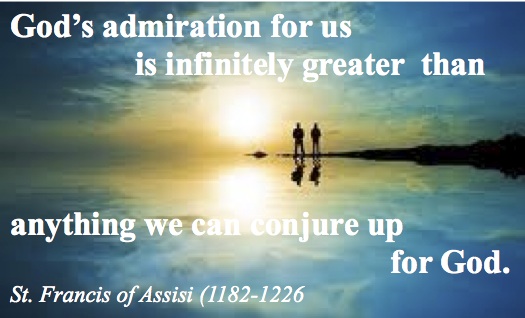
God's Admiration for us copyHere’s a sermon I preached a few years ago on this Sunday’s reading from the Book of the Prophet Hosea. Just as the people of Israel’s images of God changed over time, my own images of the Divine have changed since I preached this sermon. However, I still resonate with ways in which the Book of Hosea seeks to broaden the reader’s understanding of God away from traditional notions of anger and wrath toward images of steadfast love, for I too have had to broaden my own understanding of the Divine many times over the years. I suspect that I am only just beginning to imagine the contours of the steadfast Love that God Is.

Tommy was one of those kids that, no matter how hard he tried, he just couldn’t stay out of trouble. I was never quite sure whether or not Tommy was rotten or whether trouble just followed him wherever he went. Whatever the reason, Tommy managed to live up to the reputation of the typical middle child. His older brother seemed to be perfect in every way, the model child and his younger sister was the cute and adorable baby of the family, leaving the field wide open for Tommy to become the black sheep of the family. And as black sheep go, Tommy was a doosey.  Tommy was also the son of my friends and so even though, I would have rather not have been part of this kid’s life, the fact that he was the Karen’s beloved son, meant that I had to learn to deal with him.

I can still remember an afternoon, long ago, when Tommy was barely three years old. A bunch of us had gathered to celebrate Karen’s birthday.  Tommy was in a foul mood.  I decided that he just didn’t like the fact that on this particular day he wasn’t the center of attention.  He seemed to do whatever he could to upset his mother. 

Her patience with him was beginning to get on my nerves and I was relieved when Karen announced that it was time for Tommy to take his nap. After a very long and loud temper tantrum, Tommy was eventually quiet in his room; a little too quiet, it seems. It wasn’t until I got into my car to leave and happened to glance up toward Tommy’s bedroom window that I realized just why he had been so quiet. Hanging outside of Tommy’s bedroom window was the evidence of this little boy’s stubborn streak. Somehow, to this day I still don’t know how he managed to do it, but somehow little Tommy had managed to stuff the mattress from his bed out the window. Continue reading

Preaching on Prayer: Shush!

BATH QOLIn this coming Sunday’s gospel reading Luke 11:1-13, Jesus’ disciples ask him to teach them to pray. As a pastor I have been asked to teach people to pray. Each time I have been asked to teach someone to pray I have cringed inside because I do not feel up to the task. For some reason the old hymn “I Come to the Garden Alone” keeps playing in my mind. I keep telling it to, “Shush!” so that I might hear the “bath qol” but the daughter of a sound eludes me. Below is a portion of a sermon I preached a couple of years ago on the subject of prayer. If nothing else, it reminds me to shush!

I began this sermon by asking the congregation to sing from memory the old hymn: I Come to the Garden Along. Feel free to sing it to yourself!

I think my earliest memory of prayer is a distant memory I have of skipping along the sidewalk chanting a familiar refrain: “Don’t step on a crack or you’ll break your mother’s back.” Most of us can remember a moment from our childhood when a superstition was instilled in us that caused us to perform some ritual in order to placate the unseen power that could determine our fate. Whether it was avoiding cracks, or walking under ladders or black cats, we were trained from an early age to believe that there were powers out there that could determine our future.   Continue reading

Three Queens, the Birth of Laughter, and the Non-Existent Kitchen – a sermon for Pentecost 9C

three queens

Scripture Readings:  Genesis 18:1-15 and Luke 10:38-42

Listen to the sermon here 

The eightenth chapter of the book of Genesis provides us with is a great story of a marvelous genesis! Everytime I hear this story it makes me laugh! I laugh and then I wonder, what are we supposed to do with a story like this? Are we supposed to believe it? Is it true? Is it history or is it myth? Is it an exaggeration or is it a fairytale? If were supposed to believe it, tell me how? I can just about believe that a 99 year old man could impregnate a woman, but I’m not likely to believe that a 90 year old woman could give birth to a child; not in the desert, not in a time when healthy young women died in childbirth; I mean its laughable really. And maybe that’s the whole point!

I’d ask all the women in the congregation who’ve successfully completed menopause to put up their hands, but I’m smarter than that. So, let me just ask the women in the congregation who’ve got all that behind them, what would you do if you overheard a bunch of men who claimed to be God suggesting that you were going to give birth. There’s precious little to do but laugh! I’m nowhere near 90 and I can tell you that I’d laugh so hard I’d be on the floor in hysterics! Hysterics  please don’t pardon the pun; the pun is definitely intended; for hysterics comes from exactly the same Greek word that we get hysterectomy from; and there’s about as much chance of me believing that a 90-year-old woman could give birth as there is of me believing that a woman who has had a hysterectomy could give birth. So, obviously I’m not about to suggest that we should take this story literally.

When we reduce the stories of Genesis to the level of literal history, we tend to reduce the story to the ridiculous and we make them all the more unbelievable. Notice I said reduce the stories, because I really do think that we do the stories an injustice when we try to literalize  or historicize them.Indeed, not only do we do the stories an injustice, but more importantly we do the story-tellers and injustice. For I am convinced that those ancient story-tellers told these stories they way they told them for very important reasons. I’m willing to conceed that there may indeed be a trace of history in this particular story, but that over the generations the storytellers embellished the history more than just a little. There are a great many biblical scholars who suggest that Abraham and Sarah weren’t really that old. They insist that Sarah was simply past the normal childbearing age. We know that the average childbearing age in the ancient near east began just after a young girl began menstruating at about twelve and ended sometime before the young woman died. The mortality rate for women in the ancient near east was high precisely because of the risks of childbirth, so most women didn’t make it out of their 20’s. A 30 or 40 year old woman was a rare creature indeed, so a 90 year old Sarah was positively miraculous. About as miraculous as a 99 year old Abraham.   Men did live longer than women in Ancient times but not that much longer…40 was considered old, 50 was remarkable and 60 was amazing, so 99 would have been a miracle indeed.

So, if this is a case of exaggerating the facts, well then the Hebrew storytellers, were a lot like the Irish storytelling I grew up listening to: full of blarney. Every good exaggerator knows that if you are going to exaggerate, you will only get away with it if you exaggerate a little. Think of all the fishing stories you’ve ever heard, if the fish that got away is this big, your less likely to believe the story than if the fish is this big. This big you can get away with. A forty-year-old woman giving birth would have been something, but a 90-year-old woman giving birth well as they say in the south, that dog just ain’t gonna hunt. Continue reading

Compassion and Kinship – That We May Be ONE: Fr. Gregory Boyle

Greg BoyleDuring my visit to Chautauqua last week, I was introduced to Fr. Gregory Boyle. As the Chaplain for the week, Fr. Boyle introduced us to his work at Homeboy Industries in Los Angeles. “Homeboy Industries provides hope, training, and support to formerly gang-involved and previously incarcerated men and women allowing them to redirect their lives and become contributing members of our community. Each year over 10,000 former gang members from across Los Angeles come through Homeboy Industries’ doors in an effort to make a positive change. They are welcomed into a community of mutual kinship, love, and a wide variety of services ranging from tattoo removal to anger management and parenting classes. Full-time employment is offered for more than 200 men and women at a time through an 18-month program that helps them re-identify who they are in the world, offers job training so they can move on from Homeboy Industries and become contributing members of the community – knowing they count!” Fr. Boyle’s work in and of itself is astonishing. But his ability to share the wisdom his work has taught him through the art of storytelling is miraculous. It was a joy to sit at this master’s feet!!! Here’s a talk he gave back in 2012.  I’ve already ordered his book Tattoos on the Heart and look forward to gleaming more from this wise holy man!!!

Demons or Baggage: Stop and Listen – a sermon for Pentecost 5C: Luke 8:26-39

voice withinBobby wasn’t like any other 10-year-old boy. Bobby had the face of an angel but the temperament of a devil. Bobby was a beautiful child. His blond hair and blue eyes together with his alabaster skin, pointed toward his Scandinavian heritage.  At first sight, Bobby appeared to be the kind of child that any congregation would be proud to count as a member. But, Bobby’s physical appearance was deceiving and Bobby’s presence in church was not welcome. Bobby didn’t go down to Sunday school classes with the other children.  The Sunday school teachers had tried to include Bobby, but after several parents threatened to withdraw their children, they asked Bobby’s parents not to send Bobby anymore. So Bobby stayed in the sanctuary with the adults. Most of the adult members tried to tolerate Bobby’s presence but for some, Bobby’s presence was simply unnerving. Bobby is autistic. Sitting and behaving in church was impossible for him. As long as we were singing hymns, Bobby was happy.  He would catch the rhythms of the music and rock back and forth and sing. He never sang the same words as the rest of the congregation.  But it was clear from his movements and the sounds that emanated from his lips that Bobby was singing. The trouble was that Bobby never stopped singing when we did. When his parents would attempt to put an end to Bobby’s song, he would flail about and sometime throw himself on the floor.

Now there are some churches where flailing about and throwing one’s self to the floor would be interpreted as a sign that the Holy Spirit was at work. But in this little Lutheran church, the reaction of the worshippers to Bobby’s outbursts made it clear that they feared that Bobby was possessed by spirits of the evil variety. Oh, they would never have come out and said that Bobby was possessed by demons, they just acted as if he were. Bobby’s favorite part of the service was communion.  I think that he enjoyed the opportunity to walk up to the front of the church and kneel at the altar.  When the Pastor would place a communion wafer in his hands, Bobby would giggle with glee.  Bobby never ate the communion wafer; he would just hold it up to the light and smile. The communion wine was another thing altogether. Sometimes Bobby’s mother would try to help him drink from the common cup.  Sometimes Bobby would dunk his wafer into the intinction cup and slop wine everywhere.  At other times Bobby would be so preoccupied with his wafer that he just let the cup pass him by. On a good day Bobby’s behavior only made people uncomfortable. On a bad day, Bobby’s behavior embarrassed some, offended others, and sometimes outraged many.

I remember being summoned to an extra-ordinary council meeting. The meeting had been called to deal with the complaints and concerns of several long time members of the congregation that had decided that Bobby’s presence could now longer be tolerated at worship. The people who were complaining were not bad people.  They were fine upstanding members of the congregation who found themselves unable to deal with Bobby’s presence in their midst. During the meeting we agonized over what to do.  Continue reading

St. Mary of Magdala: the Apostle to the Apostles: Luke 7:36-8:3 – Pentecost 4C

THE RESURRECTION OF MARY – An Idle Tale

Mary-Magdalene egg

He just said it for the third time! “Harlots!” He keeps calling them “harlots”, while I rack my brains to come up with one harlot. Then he points to the text and his charges become clearer, he says, “she is a “prostitute!”

My carefully reigned in anger is unleashed. “Where?  Where?  Where? Show me where it says this woman is a prostitute!”

As he refers to the Gospel text and insists that, “It is there, right there in the text”,

I want to scream, I want to cry, I want to wipe the bemused expression from his face. I want to rub his nose in the damned text. Instead, I begin the uneasy process of reigning in my anger. I slow my speech, I try to erase the tremor from my voice and I ask him to, “Show me, show me where it says this woman is a prostitute.”

He consults his text and says, “a woman in the city who was a sinner.”

“A sinner not a prostitute.”  I respond.

He insists, “Yes a prostitute.”

“Where?” I ask.

Again he insists, “A woman who was a sinner.”

I demanded to know, “Where does it say she was a prostitute?”

He insists, “The author means that she was a prostitute.”

I lose control, “How do you know?  What words does the author use to say that his woman was a prostitute? Show me in the text where it says she was a prostitute?”

He still doesn’t get it, “What do you mean? It is clear that this woman was a prostitute.”

Once again I push, “Show me.  Show me where?”

He continues to say, “She was a woman from the city who was a sinner.”

I know that the text says that, so I implore him to tell me, “The Greek… What does the Greek say?”

He replies, “amartolos”.

I push, “Does that mean prostitute?” We both know that it does not.

He replies, “Sinner. But the context clearly shows that she was a prostitute.”

Still pushing I ask him to “Show me.  Show me how the narrative says this woman was a prostitute. Show me where it says her sins were sexual.            

Show me where it says so in the narrative.”

He says, “It’s clear.”

Clearly we disagree, so I try again, “Clear to you.  Show me. Show me!”

As he fumbles through the pages, I offer him a way out, “Okay.  Even if I concede the point that her sins were sexual, show me where it says that these sexual sins were nothing more than lust or adultery, show me where it says that she was a prostitute.  Show me!”

He couldn’t show me.  It’s simply not there.

Nowhere in the New Testament does it ever say in Greek or in English that Mary of Magdala is a prostitute.  But over and over again scholars, theologians, popes, preachers, and dramatists, have continued to cast Mary of Magdala as a prostitute.  

In the years that have transpired since than day in seminary, when a visiting New Testament scholar insisted that “the context clearly shows that she was a prostitute,” I’ve delighted in being able to participate in the phenomenon of Mary’s resurrection as the first Apostle. Continue reading

In the Sweet By and By, I’ll Fly Away! – a sermon for Pentecost 3C – Luke 7:11-17

Metaphor - pastordawnThird Sunday after Pentecost

June 9, 2013 – Readings: 1 Kings 17:17-24 and Luke 7:11-17

Listen to the sermon here

As some of you know, I had a short vacation. I booked the last week of May for a little stay-cation and we had all sorts of plans for the week. Unfortunately, those plans all came to naught because Carol was sick with bronchitis. So, in between playing nurse-maid, I was able to read a few books and catch up on all sorts of movies and tv shows. One of the most incredible dramas that I was able to watch happened toward the end of my week off, when I watched 13-year-old Arvind Mahankali win the 86th annual Scripps National Spelling Bee. Spelling Bees always freaked me out when I was a kid, because I have never been able to spell. I used to come down with a mysterious version of the flue whenever a spelling bee was scheduled and the symptoms of this strange flue always convinced my mother to keep me home from school. But I’ve really been missing out all these years because spelling bees are really incredibly exciting. Now even though young Arvind is only 13, this was not the first time that he has been a finalist.  Arvind finished in third place in both 2011 and 2012 and both times he was eliminated on German-derived words. So, after correctly spelling “tokonoma” a Japanese derived word that isn’t even in my spell-check, Arvind was the last speller standing when his inquisitors announced the word that stood between him and the championship: “Knaidel.” When Arvind asked for the derivation of the word his quizzer revealed that it was German-derived-Yiddish. The audience groaned. But Arvind was prepared. Indeed, when he was interviewed after the competition he revealed that he had indeed studied this word. Which you can see in the instant reply of the event, when Arvind smiles and nods slightly when the definition of the word was given to him. The roar that went up from the crowd when Arvind correctly spelled a word that would have surely stumped me. 

I have always been a lover of words. As a young child, I loved learning new words. Each new word opened up a whole new way of expressing reality. To this very day I like nothing better than learning a new word so that I can better express myself and the world around me. Selecting just the right words each week with which to comment upon the connections between the written words on the pages of scripture with our reality is one of the joys and the torments of my life’s vocation. When I discover just the right words to shed some light on a particular text, all is well in my world, and there’s such relief when I can string together the words. But there are also those days and nights when words fail and I am left staring at a blank computer screen. Fortunately for us, our worship does not stand or fall on the quality of the words I string together in a sermon. Our liturgy is filled with music and the words of the songs we sing are all designed to shed light upon the connections between the scriptures we read and the reality of our lives. So, whenever I can’t find the right words for a sermon I often find myself review the music I have chosen for our liturgy.

Yesterday, when my blank computer screen caused me to begin to sing, the African American spirituals that we’re singing today, sent me on an internet search for a song I remember from my childhood. It’s a country and western piece that I hear in my head being sung by none other than Johnny Cash and his wife June Carter. The words go like this: Continue reading

Wolf Blitzer Learned that there are Indeed Atheists in Fox-holes! – a sermon for Trinity Sunday

Eckhart rid me of GodThis Trinity Sunday sermon owes much to John Shelby Spong’s book a “New Christianity for a New World” You can listen to the sermon here then watch the tail end of the Wolf Blitzer interview mentioned in the sermon.   

In the midst to the devastation and debris that was left of the town of More, Oklahoma, it was all to clear that the power of the tornado that whipped through such a heavily populated area had left behind the kind of destruction that tears not only the foundations of buildings but also of lives. In living rooms around the world millions of people watched as the news media descended on what was left in the wake of nature’s wrath. One particular news report is still reverberating around the Internet. I had just come from my office where I had spent the afternoon, reviewing the Doctrine of the Trinity in order to write this sermon. My wife Carol was in the kitchen cooking supper and I sat down to catch up on the news events of the day. I tuned into CNN and there amidst the rubble of More Oklahoma was the familiar face of Wolf Blitzer. It was the day after the tornado and the big name newscasters had been rushed to the scene in time to provide color-commentary on the evening news. Wolf was interviewing a young mother named Rebecca Vitsmun who was holding a squirming her 19 month old, toddler Anders in her arms. The young mother gave a blow-by-blow account of her narrow escape from. All afternoon Rebecca was paying attention to the weather reports. Rebecca was not from More, but rather from New Orleans and so she was not used to tornado warnings. She’d grown up with Hurricane warnings and so her first instinct was to evacuate the area. But her husband and neighbours had told her that the safest thing to do would be to take shelter. Six-teen minutes before the tornado struck the weather service issued a warning to take shelter. As Rebecca’s husband raced home from work, this young mother grabbed her laptop, a mattress and her toddler and took shelter in the bathtub. Huddled in the tub covered by a mattress she anxiously watched the reports on her laptop. Tracing the path of the tornado, Rebecca realized that the tornado was headed straight for her street. Rebecca’s New Orleans’ instinct kicked in and with her baby in her arms she jumped into her car and without taking time to put her baby in the car seat, she drove as fast as she could out on to the freeway where she pulled over and put Anders into his car seat and then drove some more. After the tornado, Rebecca reunited with her husband, and they headed back to what was left of their home. The bathtub was so full of debris that it was clear to them that Rebecca’s instincts had saved her life.

After telling her harrowing tale, Wolf Blitzer congratulated Rebecca for saving her baby’s life and then said to this young woman, “You gotta thank the Lord.” Rebecca was clearly taken aback by the comment and hesitated. I held my breath, annoyed as hell at Blitzer for asking such a stupid question. Rebecca’s hesitation gave Blitzer the opportunity to move on, but no he just had to have an answer, and so he persisted. “Do you thank the Lord?” Rebecca gave Blitzer the kind of look that says, “Are you kidding me?” Then Rebecca gave Blitzer an answer that he sure wasn’t expecting from an American from the heartland of Oklahoma; Rebecca smiled as she answered, “I’m actually an atheist.”

As Rebecca laughed awkwardly, I cheered so loudly that Carol came into the room to see what was going on. I was so proud of that young woman for not going along with Blitzer’s nonsense. Who in their right minds would believe in a Lord who would pluck one family out of a bathtub and let seven children die in an elementary school? I mean, if this Lord that Bilitzer is so willing to give credit too is such a great rescuer, why didn’t this Lord change the twister’s path and send it out over the cornfields where the only damage it could do would be to crops?

I know they say there are no atheists in fox-holes, but I for one think that that bathtub Rebecca was hunkered down in was indeed a fox-hole and I’m delighted that when all was said and done, she and little Anders were saved by her instinct for survival. As for this Lord of Blitzer’s, well, judging by the awkwardness that Blitzer exhibited after Rebecca stood her ground, I can only guess that this reporter misjudged the situation. Blitzer a city-slicker from New York, assumed that all the local yokels must be bible-thumping Christians, and he probably thought that his question would have received a mindless ra, ra, yeah God, kind of response from all Oklahomans. I trust he won’t make that mistake again. I kind of feel sorry for him, because after all it only took a few hours before some televangelist’s were suggesting that God did indeed send the tornado to teach people a lesson. According to some bible-thumpers, if people prayed hard enough they would have been saved. Some even went so far as to suggest that the tornado was punishment for gay marriage. Continue reading