Jesus Was and Is an Absolute Fool – a sermon on Luke 15 for Pentecost 17C

lost-and-foundI am indebted to two beloved seminary professors for the formation of this sermon: Dr. Donna L. Seamone and Dr. Ed Riegert. All preachers stand on the shoulders of those who have gone before us!!!

Jesus was and is an absolute fool! An absolute fool, I tell you! Among the teachings of Jesus, the parables of the lost and found are so well known, so familiar that we are in peril of failing to hear the foolishness they advocate.

Although only a few of us have had the opportunity to tend a flock of sheep, most of us at one time or another have been responsible for the welfare of a flock. Whether that flock be sheep or co-workers, clients, customers, students, friends, or children none but the foolish among us would leave 99 to the perils and dangers of the wilderness in order to go looking for one idiot who’d been stupid enough to get themselves lost.

We may not keep our coins at home, but I daresay that most of us have felt the sting of loosing a drachma or two or three in this recession. Only a fool would waste a moment searching for our losses when our portfolio’s are so full. I dare say that if we managed to find or recoup our loss, we’re hardly likely to invite the neighbourhood to a party that would in all likelihood eat up more than we had found. Continue reading

Love Made Visible – a sermon for Labour Day Weekend

No Hands but yours pastordawn

The extensive quote from Joan Chittister is from her essay entitled

“A Spirituality of Work” 2011

Listen to the sermon here

The Sacred City – Diana Butler Bass

Recorded Aug 8/2016 at the Chautauqua Institution.

city on a hillDiana Butler Bass moves from her latest book Grounded‘s focus on nature to examine the sacredness of the city. Bass explores the theological images that appear in scripture that help us to think in new ways about the urban environments of our day. Seeking transformative images to usurp our tendency toward building empires toward a vision of the “urban cosmos” that empowers its inhabitants to live with justice, love, and humility, Bass paints a seductive vision of a universal city on a hill; a dwelling place of peace. In contrast to the system of globalization which seeks market control in the service of empire, Bass points to cosmopolitanism, a world view based upon our shared common humanity. 

Jesus You’ve Got to be Kidding!!! a sermon Luke 14:25-33 and Deuteronomy 30:15-20 for Pentecost 16C

choose lifeI am indebted to Pastor Michael Rodgers for preaching a sermon long ago that stuck with me for decades. This sermon is inspired by his work! 

Jesus you’ve got to be kidding! “Whoever comes to me and does not hate father and mother, wife and children, brothers and sisters, yes and even life itself, cannot be my disciple?…None of you can become my disciple if you do not give up all your possessions?”

Hate your father; hate your mother; hate your wife; hate your children; hate you brothers; hate your sisters; hate even life itself and oh yes while you are at it give up all you possessions and then, and only then will you be ready to take up your cross and follow Jesus. What is Jesus talking about? Has Jesus forgotten about the fourth commandment? Are we to forget about honouring our parents? Wasn’t it Jesus who said that we are to love our neighbours as we love ourselves? Didn’t Jesus try to talk people into loving their enemies?  Has Jesus forgotten that God is love? Why does Jesus rant and rave about hating our father’s, mothers, children, sisters, brothers and even life itself?

It is difficult to recognize the Jesus in this text. This is not the gentle Jesus of my childhood. This is not the happy Jesus who smiled out from the pictures in my illustrated Bible.This is not the Jesus that the rightwing conservative Christians point to when they harp on about family values. This is not the gentle Jesus we have come to expect. This Jesus sounds to harsh. This Jesus wants to turn us into religious fanatics who hate everybody and give up everything, even life itself.

For a few years now, there has stood on the shelf above my desk a quotation from Deuteronomy 30. I put it there so that these word’s of God might guide me in my decision making. According to the writers of Deuteronomy, God says:  “I have set before you life and death, blessings and curses. Choose life so that you and your descendants may live”. God says “Choose life!” How do I reconcile this to the Gospel lesson in which Jesus  says whoever does not hate even life itself, cannot be a disciple of Jesus? Why was Jesus so harsh?  What is going on here? Continue reading

Entertaining Angels: Hebrews 13:1-3 a sermon for Pentecost 15C

Hebrews 13Readings:  Luke 14:1,7-14; Mechthild of Magdeburg’s “The Flowing Light of the Godhead”; Hebrews 13:1-3

Listen to the sermon here:

Earlier this week I was reminded of the fact that one of the most basic parts of my job of being a pastor is pointing out the sacred. Most of what I do revolves around noticing when we are in the presence of the Holy, the Mystery, the One who is so much more that we are, the Love that lies at the heart of all that is. My job is to point to the sacred Oneness, the Love that many call God and say “there,” or “here,” or “now,” “don’t miss it.” All too often we find ourselves in the company of angels, messengers of the LOVE that IS God, and we don’t even notice it.
For the most part we humans can’t quite grasp the magnitude of the Mystery that lies at the very heart of reality and so we do what humans always do: we personify this ONEness, or we use symbols and metaphors to indicate the presence of the sacred in our midst, and we tell stories. Stories that include burning bushes, ladders into the sacred realm, shepherds, lost coins, all sorts of symbols and metaphors that point to the ONE who IS. We have told some of those stories so often that the Reality of the Mystery that these stories were created to bring down to earth, seems ever so distant and far away, lost in the mists of time. The Reality that so many call God has been cast out there far away beyond our reach. So, week after week, I try to bring the stories, symbols and metaphors a little closer to the world that we inhabit so that you might be able to see in your own stories the angels that you have entertained without even knowing it. This morning I’d like to tell you a story that I’ve told twice before. It’s been about seven years since I last told this story, so some of you may not have heard it before and those of you who have heard it before; well we’ve been on quite a journey here at Holy Cross, and you’ve all helped me to understand my own story in a completely new way.
The story takes place back in October of 1977, when I was twenty years old. I was young and adventurous. With a rail pass in my hand, a back pack slung over my shoulders and several hundred dollars worth of American Express Travellers cheques in my pocket, I boarded a train in Zurich, Switzerland, bound for Athens, Greece. I was tired. Several months of back-packing in Northern Europe had left me weary. In just five days my rail-pass would expire, so I decided to head for Greece, where the living is easy, where the warm sun, blue skies and equally blue waters held the promise of rest and relaxation.
As the train made its way through the Alps, I remembered a similar trip which I had made the year before and I tried to calculate whether my remaining funds would allow me to return to the village of Chania on the island of Crete. I knew that on Crete I could find work. So, I planned to mix a lot of rest and relaxation with just a little work and try to live out the winter on the Mediterranean. As the train rattled through Austria, towards what was then called Yugoslavia, it began to get dark. I was disappointed that my journey through Yugoslavia would be completed in darkness. I remembered my previous journey, by car, through Yugoslavia and how at the time, I had marvelled at the diversity of this strange little country. I remembered men and women driving oxen as they ploughed their fields in much the same way as their ancestors had done. I also remembered my surprise at entering the ultra modern city of Belgrade; the showcase of what was then Tito’s communist regime.I fell asleep pondering the sharp differences between the lives of the poor people in the villages who appeared to live without any modern conveniences at all and the lives of those who inhabited the city of Belgrade with its towering sky-scrapers and streets filled with automobiles. Several centuries seemed to co-exist in Yugoslavia.
I was awakened from my dreams by the sound of people shuffling to find their papers as the train conductor instructed us to get our passports and visas ready for customs inspection. When the Yugoslavian custom officials, with their rifles over their shoulders boarded our train they were preceded by men guided by vicious looking German shepherds. Even though I knew that I had all the right papers and that my back pack contained nothing more offensive than some dirty laundry, the sight of the dogs, guns, and uniformed officials struck fear into my heart. I nervously handed over my precious passport to an official who looked younger than my twenty years. He carefully read over the Visa which I had obtained in Zurich the day before; a visa that I could not read because it was written in an unfamiliar language and an unfamiliar alphabet.The young man handed my passport over to an older official and before I knew what was happening, I was being escorted off the train. I was shaking so badly that the young men on either side of me had to hold me up. I am not sure that my feet even touched the ground. After a long lonely wait in a drab windowless room, a woman entered. In broken English she told me that my visa was not in order. I gathered from what she was trying unsuccessfully to explain to me, that my passport contained the visa from my previous visit to Yugoslavia, but was missing an official exit stamp. She demanded to know why there was no exit stamp in my passport. Needless to say, I could not explain. I told her that I had only spent a little over a week in Yugoslavia the year before and then gone on to Greece. I told her that I didn’t know that an exit stamp was necessary and that I couldn’t understand why the Yugoslavian consulate would have issued my current visa if my paper work was not in order. She kept insisting that I needed an exit stamp. After several fruitless attempts to try and get her to tell me what I was supposed to do, I found myself in a small room. Its only window was reinforced with bars.
In the darkness of a Yugoslavian holding cell, I sat down and I began to cry. I cried like I have never cried before or since. I was terrified and my sobbing was uncontrollable. After a while I became conscious of a sound that did not come from me. “Susssssssssh.”
I realized that I was not alone in the darkness. Someone else was in the room with me. In the shadows, I could make out the shape of a woman. My sobbing began to subside as she continued, “Shussssssh.” The woman began to pace back and forth in our tiny room and gradually her shusssh turned into humming. She hummed unfamiliar tunes that somehow managed to calm me. Occasionally her humming would turn to singing. She sang softly and quietly and my sobbing began to ease.
In the shadows I could not tell how old she was. Her hair was long, dark and curly. She wore a plain cotton dress, ankle socks and a beaten up pair of shoes, whose laces flapped back and forth as she paced. It took only a few hours for my travelling companion to contact the British Embassy, sort out the mess and secure my freedom. The sunlight was just beginning to find its way into our room when my captor arrived to release me. As I left, I took a close look at my roommate. I smiled, hoping that she would understand my smile as gratitude for her kindness. Her tender sounds had calmed me and helped me through one of the darkest nights of my life. She returned my smile and added a wave of her own. Then the guard roughly escorted me out into the bright lights of the customs house.
Before I boarded a train that would take me safely out of Yugoslavia, I thought that perhaps I should try to help my roommate. Maybe I should try to find out why she was being detained. Perhaps I should try to help her get out. But this was not a place that welcomed questions and the warm sun of Greece beckoned me. And so, I boarded the train and I left. My few hours of captivity – I chalked up to just one more adventure on the road and I rarely thought of my room-mate again. Continue reading

The Guests Watched Jesus Closely: sermon – Pentecost 15C – Luke 14:1, 7-14

humbleI have often heard Jesus’ teaching about who sits where at a wedding feast used to encourage a kind of humility that requires those who would follow Jesus to take a back seat or better still adopt a cloak of invisibility lest we be mistaken for the proud and self-righteous.  Canadians have a special affinity for this particular way of interpreting this text. It seems to me that the image of Canadian humility suggests that Canadian Christianity has had a huge impact upon our national psyche. I know that there are many who would insist that our humble national character is a direct result of living in the shadow of the Americans, whose national identity is anything but humble. I have to admit that the constant drumbeat of “We’re number one!”, “We’re number one!” coupled with a patriotism that champions the idea of American Exceptionalism which is the notion  that the United States alone has the right, whether by divine sanction or moral obligation, to bring civilization, or democracy, or liberty to the rest of the world, by violence if necessary. With such pride of place, you can be sure that each and every one of our American cousins is endowed with the confidence on knowing exactly where they belong at the head table. So, is it any wonder that living next-door to a nation that instills such patriotic ardor in its citizens, that we Canadians would find a more humble approach more appealing.

Don’t get me wrong; I know that stereotypes rarely express the full character of a nation and so, it would be a mistake to paint all Americans with the same brush. But I dare say that you’d be hard pressed to find a Canadian who would disagree that even the most enlightened of our American cousins who might be found from time to time to speak softly, doesn’t underneath it all carry a big stick. Where Bravado flows through our American cousin’s national character, most Canadians prefer a quieter, softer, gentler approach, lest we be confused with the worst of American stereotypes:  “the ugly American.” Continue reading

The Moon-Dancing Bear and the Bent Over Woman: a sermon for Pentecost 14C – Jeremiah 1:4-10 and Luke 13:10-17

nightsky moonPrior to the reading of the gospel the congregation took the Awareness Test.

View it yourself here

Listen to the sermon here


So Bent Out of Shape are We! Stand Up and See Beyond the “war on terror!” – a sermon on Luke 13:10-17

salaam alaikumOver and over again as I have explored the stories handed down to us by our ancestors, I have been struck by the significance of names in ancient literature. The ancient writers used names as a tool to reveal important details. A character’s name in a story can be used to remind us of other characters in other stories that also carried that name, or a character’s name can be taken from a word that has significant meaning.  We can use the names of biblical characters to explore deeper meanings within the stories. We would do well to pay attention to the names of biblical characters. The lack of a name is just as important as any given name. I believe that there’s a reason that the anonymous gospel storyteller we call Luke failed to give a name to the woman we find bent over in chapter. The writer we call Luke can be very deliberate about names when he wants to be. I believe that the storyteller wants us to see this woman as our very selves.

So, let’s play along shall we? Stand up. Stand up and bend over. Please, if you are able stand up and lean over 45 degrees. I want you to have a sense of the woman’s predicament. For a few moments, just a few moments I want you to feel the strain on your back, and the burden on your shoulders that that woman felt for 18 years. I want you to look and see how being bent limits your vision. See how your perspective is shorter. Stooping, you cannot easily look into the faces of those around you, you can’t be on the same level with anyone, you can’t see the whole church. It’s not so easy to look toward the horizon to see a glorious sunrise or sunset. Vistas of God’s wondrous works on earth are restricted. So bent out of shape, how could you ever gaze into the awesome stars at night.

Listen to the story one more time: Jesus was teaching in one of the synagogues on the Sabbath. And there appeared a woman with a spirit that had crippled here for eighteen years. How many of us arrive on the Sabbath with spirits that have crippled us? She was bent and quite unable to stand up straight. She was bent….in Greek the word is “kyphotic.” She was a kyphotic woman. The word kyphotic literally translates as bent together or bent with. It is as if this woman is bent in on herself. It’s a picture of someone who has not only borne the yoke but who really owns it in her very body. She is not just a woman with an infirmity but the Scripture says, with the spirit of an infirmity. Whatever it was that had bent her, whatever emotional or physical burden she had borne, the Scripture suggests, ultimately became part of her until her very body was confirmed to its image. There is nothing she can do now to help herself out of the spiritual pretzel her life has become. Each of us knows this infirmity intimately. At one time or other, over and over again, we have all experienced this infirmity in our lives and in our bones.* (Jana Childers “The Kyphoptic Woman” 2005)

Each of us have been bent with the burdens of our relationships, our jobs, our finances, or our health and sometimes even our lovelessness. We have all been this woman who is bent out of shape by her burdens. We have all been bent in on ourselves. But today, I want to take the image of this woman a few steps further to see what she reveals about our culture.

Okay, you can sit down now. Sit back and relax as I tell you the story of two communions; two communions that are not limited in time or space to the actual communions that they reveal. The first communion is indeed my first communion. I was just 15 years old and I’d only just begun to attend church. It was a small Lutheran church and back then they only celebrated communion a few times a year. I wasn’t prepared for communion. I’d only been attending church for a few weeks and I had no idea what it was all about. I still remember wondering what I should do. I was leaning toward just sitting where I was and waiting until after the service so that I could ask the pastor for an appointment to talk to him about what I needed to do in order to make sure that I was prepared properly to go to the table. That’s when my friend’s mother Lola leaned over and asked me if I wanted to go up for communion with them. I whispered that I’d never been to communion before. She smiled and took my hand and said that’s okay, you’re welcome at the table. I didn’t see any table and I was sure that I was missing something. So, I stood there with my hand in hers and listened very carefully as the Pastor told the story,  “In the night in which he was betrayed, our Lord Jesus took bread and gave thanks; broke it and gave it to his disciples saying: Take and eat; this is my body, given for you. Do this for the remembrance of me. Again after supper, he took the cup gave thanks and gave it for all to drink….” Continue reading

The Bent Over Woman – Luke 13:10-17

bentover woman1It was hot. Already the sun had parched the earth. The air was still. The ground beneath her feet radiated the heat. She was tired. Earlier she had thought about staying at home. Her weary body could use a rest. All week long she had toiled in the heat of the sun. On this Sabbath she longed to rest her crumpled, aching body. She tried to ignore the weakness she felt. She had suffered long and hard. She couldn’t even remember when or how she had become so weak. Over the years, her weakened spirit had left her body bent and crippled. The evidence of her heavy burdens could be seen in her crooked spine. She was ashamed of her appearance.

It had been eighteen long years since she had stood straight and tall. She vaguely remembered running when she was a child. She ran everywhere back then. She ran faster than anyone else in the town. She loved to run. Running made her feel free.

Her mother used to warn her not to run. Her mother tried to stop her. But she was so full of life. She wanted to see everything. She wanted to do everything. She wanted to go everywhere.

Her mother warned her not to be so curious. Her mother tried to keep her busy. Her mother tried to keep her out of trouble. But it was no use, no matter how many tasks her mother gave her; she always managed to find time to explore. She had so many questions. She wanted to know how things worked. Life was so very exciting. She dashed from one adventure to the next. She ran everywhere, everyday. Except of course on the Sabbath. On the Sabbath she walked. She walked with her family to the synagogue. She loved to go to the synagogue. As her father and brothers took their places at the feet of the rabbis, she sat quietly with her mother and sisters and the other women and girls in the back of the synagogue. She listened carefully as the men and boys talked.  Continue reading

Starry, Starry, Darkness: sermon for Pentecost 12C

van-gogh-vincent-starry-night-79005662Readings:  Genesis 15:1-6, Hebrews 11:1-16, Luke 12:32-40

Listen to the sermon

‘Have no fear little flock. Have no fear little flock. It is you Abba’s good pleasure to give you the kin-dom.” Have no fear. Do not be afraid. But what is it that we are all afraid of? What is fear is Jesus trying to sooth? What fear drives us? In the deepest darkest hours of the night what are we afraid of? Does it all come down to the darkness in the end? Darkness in the end?
Darkness in the end? Have no fear. Do not be afraid. But how can I not be afraid? What if in the end it all comes down to darkness?
Have faith! Have faith. ”Faith is the reality of all that is hoped for; faith is the proof of all that is unseen.” Have no fear little flock. Do not be afraid. Have faith. But what is faith? The reality of all that is hoped for; faith is the proof of all that is unseen. I’d love to get me some of that. I’d love to have faith; faith that in the end all is not darkness. If I only had faith, I could believe that in the end I will not be left in the darkness of the abyss. If I only I had faith.
After this morning’s worship, I will begin five weeks of vacation. Five glorious weeks to do whatever I want, whenever I want to.I am richly blessed!!! Not only do I have five weeks stretching before me. My vacation begins at the peak of the Perseids. In fact the absolute best time to view the most spectacular meteor shower of the year will be tonight and tomorrow night. From about 10:30 to 4:30 am the universe will be putting on a show. It will start off slowly and then peek just before dawn and if you lie out under there’ll be more falling stars to wish upon than you’ll be able to count. I’ve spoken to you many times about my experiences out under the stars. I’ve been a fan of the Perseids ever since I was a teenager and felt the nearness of something so much bigger than myself under a starlight night. Stars have always given me the courage to peer into the darkness and trust that we are not alone. Stars in the night-sky and not doctrines, or theologies or creeds or a list of things I ought to believe, but stars in the darkness of the night sky. Stars in the night sky take me back to all hope filled nights I’ve spent peering into the darkness for a trace of the One for whom my heart yearns. Stars in the night sky help me to see beyond the darkness. Stars in the night sky are best viewed far away from the lights of the city. In the city there is too much man-made light interfering with our view. In the city there is just too much of everything and there is good reason to be afraid.
I still remember my first trip to New York City. I was a young woman, and the hustle, and bustle, and reputation of New York City gave me so much to be afraid of. New York City is dirty and gritty. In an effort to escape the stickiness of the busy streets, I ducked into the Museum of Modern Art. Back then I didn’t have much of an appreciation for great art, but even I was left breathless when I turned a corner and was confronted by Van Gogh’s masterpiece, Starry Night. Vincent Van Gogh’s image of the night sky swirls across the canvas full of vitality and power that speaks of God’s presence. The stars don’t just sparkle; they explode in radiance. Looking closer, I could see that the earth itself seems to respond to the movement in the heavens, forming its own living waves in the mountains and the rolling trees beneath them. In the sleepy village, the windows of the houses glow with the same light that illuminates the universe. The church steeple in the center seems to struggle to point to God, who is so alive in this scene. But the little church is dwarfed by the cypress trees at the left, which seem to capture the joy of the inhabited creation around them by erupting in a living flame of praise.
I spent a couple of hours standing and sitting in front of that masterpiece and that afternoon was just the beginning of my love affair with Vincent Van Gogh’s work. Over the years I have travelled to Amsterdam many times and spent hours in the Van Gogh museum gazing in wonder at the work of this master. If you have only ever seen a print of a Van Gogh then you have missed the wonder of the thousands and thousands of brush strokes that make up one of his masterpieces and you have missed the opportunity to be mesmerized by the wonders of the details imbedded in each painting. I have traipsed around Europe exploring the various museums that contain Van Goghs and I have often gone out of my way to catch a glimpse of a Van Gogh tour. I’ve seen hundreds of his masterpieces, but none can compare to the splendour of Starry Night.

Continue reading

Doubt: Preaching on Hebrews 11:1-16

The Place Where We Are RightLooking over the readings for this coming Sunday and the subject of faith jumps out from the Hebrews reading (Hebrews 11:1-16) which begs questions about doubt.  I have read and blogged about Richard Holloway’s “Faith and Doubt” and Lesley Hazleton’s insistence that “Doubt is Essential to Faith” and both posts provide an interesting jumping off point. This little video of Richard Holloway on “Why doubt is a good thing” provides insights for preaching on doubt as the foundation of faith!!!

Hosea: the Coronation Street of Ancient Israel

A Sermon on the Book of the Prophet Hosea

Coronation StI am indebted to Bishop John Shelby Spong for his insights into the Book of the Prophet Hosea. Without Jack’s thoughtful portrayal of Gomer, I would not have recognized her as the Leanne Battersby of her time. Also, thanks to Marcus Borg for his definition of the verb “believe”!

Listen to the sermon:

I must confess that I am one of the millions and millions of people across the globe who enjoys a guilty pleasure about five days a week. It’s a habit that began back when I was but a wee child. From time to time, circumstances have forced me to give up this guilty pleasure, but over the years, as technology has improved I’ve been able to indulge myself on a more regular basis than I would have thought possible back when I was just a little girl and only able to enjoy this pleasure during the summer holidays. Now a days, I can delay my indulgence to a convenient time. So about 5 times a week, I find myself relaxing in my favourite chair with a mug of tea, ready to enjoy a episode of my favourite soap opera.  

Continue reading

Feast Day of St. Mary of Magdala: the Apostle to the Apostles

THE RESURRECTION OF MARY – An Idle Tale

Mary-Magdalene egg

To commemorate this festival day, I repost this not-so-long-ago encounter with a visiting New Testament scholar to entice you to follow Mary out of her tomb and beyond the streets to her place at the head of the fledgling community that became the church: 

He just said it for the third time! “Harlots!” He keeps calling them “harlots”, while I rack my brains to come up with one harlot. Then he points to the text and his charges become clearer, he says, “she is a “prostitute!”

My carefully reigned in anger is unleashed. “Where?  Where?  Where? Show me where it says this woman is a prostitute!”

As he refers to the Gospel text and insists that, “It is there, right there in the text”,

I want to scream, I want to cry, I want to wipe the bemused expression from his face. I want to rub his nose in the damned text. Instead, I begin the uneasy process of reigning in my anger. I slow my speech, I try to erase the tremor from my voice and I ask him to, “Show me, show me where it says this woman is a prostitute.”

He consults his text and says, “a woman in the city who was a sinner.”

“A sinner not a prostitute.”  I respond.

He insists, “Yes a prostitute.”

“Where?” I ask.

Again he insists, “A woman who was a sinner.”

I demanded to know, “Where does it say she was a prostitute?”

He insists, “The author means that she was a prostitute.”

I lose control, “How do you know?  What words does the author use to say that his woman was a prostitute? Show me in the text where it says she was a prostitute?”

He still doesn’t get it, “What do you mean? It is clear that this woman was a prostitute.”

Once again I push, “Show me.  Show me where?”

He continues to say, “She was a woman from the city who was a sinner.”

I know that the text says that, so I implore him to tell me, “The Greek… What does the Greek say?”

He replies, “amartolos”.

I push, “Does that mean prostitute?” We both know that it does not.

He replies, “Sinner. But the context clearly shows that she was a prostitute.”

Still pushing I ask him to “Show me.  Show me how the narrative says this woman was a prostitute. Show me where it says her sins were sexual.             Show me where it says so in the narrative.”

He says, “It’s clear.”

Clearly we disagree, so I try again, “Clear to you.  Show me. Show me!”

As he fumbles through the pages, I offer him a way out, “Okay.  Even if I concede the point that her sins were sexual, show me where it says that these sexual sins were nothing more than lust or adultery, show me where it says that she was a prostitute.  Show me!”

He couldn’t show me.  It’s simply not there.

Nowhere in the New Testament does it ever say in Greek or in English that Mary of Magdala is a prostitute.  But over and over again scholars, theologians, popes, preachers, and dramatists, have continued to cast Mary of Magdala as a prostitute.  

In the years that have transpired since than day in seminary, when a visiting New Testament scholar insisted that “the context clearly shows that she was a prostitute,” I’ve delighted in being able to participate in the phenomenon of Mary’s resurrection as the first Apostle. Continue reading

Prayer: 21st Century Questions – There’s an App for that! Luke 11-1-13

prayer appJesus’ teaching on prayer in the gospel reading Luke 11:1-13 leaves me wondering what an enlightened 21st humanoid is supposed to do with Jesus 1st century ideas???

Cast you minds back to another time and place and tell what the numbers 33, 45, and 78 have in common??? Vinyl Records anyone? When I was a kid music came from a portable RCA record player. The sound quality wasn’t all that great, but somehow we didn’t seem to care. Later when I was a teenager, my parents got a fancy state of the art Phillips stereo cabinet and suddenly sound seemed to be coming from booth ends of the room. I never did understand how those old record players managed to pick up sound from the grooves in the vinyl to45 produce music. I still remember my father’s first reel-to-reel tape recorder, and then there were the eight-tracks, followed by cassettes, followed by CD’s.  I can remember these things, but I have no idea how they made music. It doesn’t matter how many times people try to explain it to me, I still think it’s a miracle that such beautiful sounds can come out of machines.

These days I don’t use records, tapes or CDs to listen to music. My music is stored in “the cloud” and when I want to hear I song I make sweeping motions on my iphone screen and presto, I can make music fill the room. I don’t know what the cloud is. I asked the personal assistant on my iPhone, her name is Siri and she told me she was sorry but she couldn’t tell me because Steve told her not to tell anyone. Some people think the cloud is located in a 225-acre facility that Apple built in North Carolina. Continue reading

The Steadfast LOVE that GOD IS: a sermon for Hosea 11:1-11

God's Admiration for us copyHere’s a sermon I preached a few years ago on this Sunday’s reading from the Book of the Prophet Hosea. Just as the people of Israel’s images of God changed over time, my own images of the Divine have changed since I preached this sermon. However, I still resonate with ways in which the Book of Hosea seeks to broaden the reader’s understanding of God away from traditional notions of anger and wrath toward images of steadfast love, for I too have had to broaden my own understanding of the Divine many times over the years. I suspect that I am only just beginning to imagine the contours of the steadfast Love that God Is.

Tommy was one of those kids that, no matter how hard he tried, he just couldn’t stay out of trouble. I was never quite sure whether or not Tommy was rotten or whether trouble just followed him wherever he went. Whatever the reason, Tommy managed to live up to the reputation of the typical middle child. His older brother seemed to be perfect in every way, the model child and his younger sister was the cute and adorable baby of the family, leaving the field wide open for Tommy to become the black sheep of the family. And as black sheep go, Tommy was a doosey.  Tommy was also the son of my friends and so even though, I would have rather not have been part of this kid’s life, the fact that he was the Karen’s beloved son, meant that I had to learn to deal with him.

I can still remember an afternoon, long ago, when Tommy was barely three years old. A bunch of us had gathered to celebrate Karen’s birthday.  Tommy was in a foul mood.  I decided that he just didn’t like the fact that on this particular day he wasn’t the center of attention.  He seemed to do whatever he could to upset his mother. 

Her patience with him was beginning to get on my nerves and I was relieved when Karen announced that it was time for Tommy to take his nap. After a very long and loud temper tantrum, Tommy was eventually quiet in his room; a little too quiet, it seems. It wasn’t until I got into my car to leave and happened to glance up toward Tommy’s bedroom window that I realized just why he had been so quiet. Hanging outside of Tommy’s bedroom window was the evidence of this little boy’s stubborn streak. Somehow, to this day I still don’t know how he managed to do it, but somehow little Tommy had managed to stuff the mattress from his bed out the window. Continue reading

Preaching on Prayer: Shush!

BATH QOLIn this coming Sunday’s gospel reading Luke 11:1-13, Jesus’ disciples ask him to teach them to pray. As a pastor I have been asked to teach people to pray. Each time I have been asked to teach someone to pray I have cringed inside because I do not feel up to the task. For some reason the old hymn “I Come to the Garden Alone” keeps playing in my mind. I keep telling it to, “Shush!” so that I might hear the “bath qol” but the daughter of a sound eludes me. Below is a portion of a sermon I preached a couple of years ago on the subject of prayer. If nothing else, it reminds me to shush!

I began this sermon by asking the congregation to sing from memory the old hymn: I Come to the Garden Along. Feel free to sing it to yourself!

I think my earliest memory of prayer is a distant memory I have of skipping along the sidewalk chanting a familiar refrain: “Don’t step on a crack or you’ll break your mother’s back.” Most of us can remember a moment from our childhood when a superstition was instilled in us that caused us to perform some ritual in order to placate the unseen power that could determine our fate. Whether it was avoiding cracks, or walking under ladders or black cats, we were trained from an early age to believe that there were powers out there that could determine our future.   Continue reading

Preaching on Hosea

Hosea and GomerThe next few Sundays will include readings from the Book of the Prophet Hosea. To say that this is a strange little book is an understatement. However, I’m tempted try my hand at writing a sermon on this ancient soap opera. For those colleagues who are considering doing the same these short videos provide images to get you in the mood. Of course you could just tune into a modern soap opera to get your creative juices flowing.

Three Queens, the Birth of Laughter, and the Non-Existent Kitchen – a sermon for Pentecost 9C

three queens

Scripture Readings:  Genesis 18:1-15 and Luke 10:38-42

Listen to the sermon here 

The eightenth chapter of the book of Genesis provides us with is a great story of a marvelous genesis! Everytime I hear this story it makes me laugh! I laugh and then I wonder, what are we supposed to do with a story like this? Are we supposed to believe it? Is it true? Is it history or is it myth? Is it an exaggeration or is it a fairytale? If were supposed to believe it, tell me how? I can just about believe that a 99 year old man could impregnate a woman, but I’m not likely to believe that a 90 year old woman could give birth to a child; not in the desert, not in a time when healthy young women died in childbirth; I mean its laughable really. And maybe that’s the whole point!

I’d ask all the women in the congregation who’ve successfully completed menopause to put up their hands, but I’m smarter than that. So, let me just ask the women in the congregation who’ve got all that behind them, what would you do if you overheard a bunch of men who claimed to be God suggesting that you were going to give birth. There’s precious little to do but laugh! I’m nowhere near 90 and I can tell you that I’d laugh so hard I’d be on the floor in hysterics! Hysterics  please don’t pardon the pun; the pun is definitely intended; for hysterics comes from exactly the same Greek word that we get hysterectomy from; and there’s about as much chance of me believing that a 90-year-old woman could give birth as there is of me believing that a woman who has had a hysterectomy could give birth. So, obviously I’m not about to suggest that we should take this story literally.

When we reduce the stories of Genesis to the level of literal history, we tend to reduce the story to the ridiculous and we make them all the more unbelievable. Notice I said reduce the stories, because I really do think that we do the stories an injustice when we try to literalize  or historicize them.Indeed, not only do we do the stories an injustice, but more importantly we do the story-tellers and injustice. For I am convinced that those ancient story-tellers told these stories they way they told them for very important reasons. I’m willing to conceed that there may indeed be a trace of history in this particular story, but that over the generations the storytellers embellished the history more than just a little. There are a great many biblical scholars who suggest that Abraham and Sarah weren’t really that old. They insist that Sarah was simply past the normal childbearing age. We know that the average childbearing age in the ancient near east began just after a young girl began menstruating at about twelve and ended sometime before the young woman died. The mortality rate for women in the ancient near east was high precisely because of the risks of childbirth, so most women didn’t make it out of their 20’s. A 30 or 40 year old woman was a rare creature indeed, so a 90 year old Sarah was positively miraculous. About as miraculous as a 99 year old Abraham.   Men did live longer than women in Ancient times but not that much longer…40 was considered old, 50 was remarkable and 60 was amazing, so 99 would have been a miracle indeed.

So, if this is a case of exaggerating the facts, well then the Hebrew storytellers, were a lot like the Irish storytelling I grew up listening to: full of blarney. Every good exaggerator knows that if you are going to exaggerate, you will only get away with it if you exaggerate a little. Think of all the fishing stories you’ve ever heard, if the fish that got away is this big, your less likely to believe the story than if the fish is this big. This big you can get away with. A forty-year-old woman giving birth would have been something, but a 90-year-old woman giving birth well as they say in the south, that dog just ain’t gonna hunt. Continue reading

“Martha, Martha, Martha!” – Preaching on an all too familiar text! Luke 10:38-42

From an Academic Paper to a Sermon

You can read the academic paper here and the sermon here

martha 2I am usually on vacation at this time of the year. So, I have only had a couple of  opportunities to preach on this coming Sunday’s gospel text (Luke 10:38-42). The story of Jesus’ sojourn at the home of Mary and Martha is such a familiar text, which over the years has been used and abused by preachers to inflict such harm on their listeners. During my seminary years, this text awakened the feminist in me in ways that I am still unpacking. So, I went back to my seminary years to uncover an academic treatment of this text that I included in my Masters Comprehensive paper in 1998. Reading the paper took me back to a time when I seriously doubted my call to ordained ministry. Back then I was unsure about my ability to tolerate the institutional church or indeed whether or not the institutional church would be able to tolerate me. I am happy to report that there are pockets of the institutional church were feminists can thrive and I have been blessed to be called to serve in one of those pockets. 

I preached on this text was in 2004 and I post both the academic paper and the sermon based on the paper as a resources for those of you who will take up the text this week. I have not edited the sermon, despite my inclination to do so. Old sermons provide a snapshot of old preachers. Like most snapshots, I’m not altogether happy with the picture of myself. I’ll post a copy of a more recent sermon on this text in the next blog post…stay tuned!

You can read the academic paper here   and   the sermon here

Compassion and Kinship – That We May Be ONE: Fr. Gregory Boyle

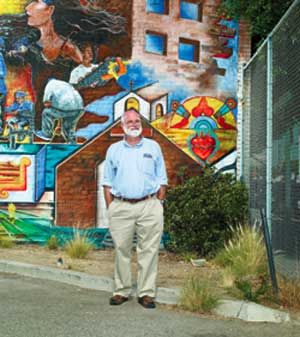
Greg BoyleDuring my visit to Chautauqua last week, I was introduced to Fr. Gregory Boyle. As the Chaplain for the week, Fr. Boyle introduced us to his work at Homeboy Industries in Los Angeles. “Homeboy Industries provides hope, training, and support to formerly gang-involved and previously incarcerated men and women allowing them to redirect their lives and become contributing members of our community. Each year over 10,000 former gang members from across Los Angeles come through Homeboy Industries’ doors in an effort to make a positive change. They are welcomed into a community of mutual kinship, love, and a wide variety of services ranging from tattoo removal to anger management and parenting classes. Full-time employment is offered for more than 200 men and women at a time through an 18-month program that helps them re-identify who they are in the world, offers job training so they can move on from Homeboy Industries and become contributing members of the community – knowing they count!” Fr. Boyle’s work in and of itself is astonishing. But his ability to share the wisdom his work has taught him through the art of storytelling is miraculous. It was a joy to sit at this master’s feet!!! Here’s a talk he gave back in 2012.  I’ve already ordered his book Tattoos on the Heart and look forward to gleaming more from this wise holy man!!!