Facing Our Demons – a sermon on Matthew 4:1-11, Lent 1A

1100A long time ago, when I was just a young woman, I think I was about 22 or 23, still young enough to believe that all the answers to all my questions were out there somewhere, just waiting for me to discover. I was a serious young woman full of serious questions, always pondering the meanings of thins – big things like life and death, goodness and evil, love and hate, sickness and health, sin and forgiveness, God and no-god. I truly believed that if I actually applied myself to my questions, I would be able to discover the answers. It was the pursuit of particular answers that lead me into the wilderness of the desert.

Now, it may come as a surprise to some of you, but there are real deserts in British Columbia. You will discover one of those deserts as you travel between Ashcroft down to Merritt.  They’ve improved the roads since then, but back in the day that particular route was quite the challenge. Mind you, it didn’t help that I was driving an old beat up 1969 Austin 1100, that had no business being on mountain roads, let alone mountain roads that wound their way through a desert. Now if you don’t know what an Austin 1100 looks like, picture an old Austin Mini; an 1100 is only slightly bigger than an Austin Mini, and my old 1100 was purchased for the grand sum of $300.00. About the only thing this car had going for it was my faith in it to take me places.

 On this trip, I had loaded my little car down with all sorts of camping equipment along with several plastic milk jugs that held a gallon of water each, because the car’s radiator had a nasty habit of overheating. The woman that I am know, looks back on the young woman that I was, and I can’t help wondering what possessed me to head out into the desert in that stupid little car. I can almost see myself sitting on the side of the road waiting for the radiator to cool down, so that I could risk loosening the radiator cap, to fill it up with cool water so that I could travel another hour or so, before it over-heated again.

To say that I was young and foolish, would be an understatement. But I was also, adventurous and inquisitive. I had traveled into the wilderness to do some thinking. I needed to find some answers. I had some decisions to make; decisions, that at the time, felt like life and death. I truly believed that some time away by myself would guarantee me the kind of peace and quiet I needed to discover the answers to my questions.

Sitting there, on a rock, hoping against hope, that the 95 degree heat from the blazing sun would be enough to guarantee that any rattle snacks would remain tucked away in some distant shade, I couldn’t believe that I’d been driving for two hours without seeing another car on the road. I was out there in the middle of nowhere, which is exactly where I had intended to be. I had travelled into the wilderness to find a place where there were no distractions, so that I could apply myself to finding an answer that I desperately needed. You see, some stuff had happened in my life; stuff that had lead me to doubt the god that over the years I had come to love.

Looking back, I think that I went out into the wilderness looking for a sign; a sign that God existed. My faith in the God who lives out there somewhere, who from time to time hears my prayer and decides to intervene in my life, my faith in that God, had been fairly strong, right up to the point where some really tough stuff started to happen to some folks I cared a great deal about, and no matter how long or how hard I prayed, the great Sky God that I had been taught to worship, simply refused to show himself. So, I decided to take a page or two out of the bible and follow Jesus right out into the wilderness to see if God would show up. Sitting there on a rock, roasting in the hot sun, as the tumble-weeds tumbled by, I wondered what I would do, if I discovered that God wasn’t really there. What if it was all just wishful thinking? I desperately wanted to meet the god that I’d been taught to believe in to be there in the wilderness. Isn’t that why Jesus wandered out into the wilderness of the desert? Surely, he didn’t go out there to meet the devil? Or did he? Maybe Jesus went out into the wilderness to meet his demons.

Over the years, I’ve learned enough about the anonymous  gospel storytellers to know that their stories are more than just history. I’ve learned to read beyond the words that have been handed down to us, to ponder the multi-layered texture of meanings that lie hidden waiting to be discovered. The storytellers’ careful crafting of their tale of Jesus time in the wilderness uses images and illusions that harken back to earlier stories of Moses leading the people of Israel into the wilderness where they spent not 40 days, but 40 years forming themselves into the nation that would go on to inhabit the promised land. In the wilderness, Jesus encountered his own demons. I can well imagine Jesus contemplating his own future and realizing his own desires for power were actual temptations that would distract him from his overriding desire to embody a new way of being in the world. A quest for power would have seen Jesus giving the people what they wanted a leader who could feed them with bread and everything that bread represents, wealth and power; the kind of power that would enable them to fight their Roman oppressors. The temptation to be the kind of messiah that the people wanted was Jesus’ temptation.

In the wilderness, alone with his desires and temptations Jesus fought his personal demons. According to the gospel storytellers, Jesus didn’t conquer his demons, “The Devil awaited another opportunity.” As the storytellers follow Jesus to Jerusalem and beyond, the temptation to forsake the new way of being in the world that Jesus embodied, in favour of being the kind of messiah that the people wanted continues to haunt Jesus. Jesus steadfastly refuses to take the mantle of power that so many would have handed to him the power to form an army the likes of King David, to rise up and violently resist the tyranny of Rome. As tempting as it may have been for Jesus to become the people’s messiah, Jesus summons up the courage to be a new kind of messiah. Jesus chooses to embody a posture of non-violent resistance to evil even though he knows full well that such a posture against the Romans could get him killed. Jesus refuses to give into his fears, trusting that even death cannot defeat the LOVE that he chooses to embody. Continue reading

First Sunday in LENT – sermons

Giving Up Theories of Atonement for Lent in Favour of Listening for God’s Laughter here

Facing Our Demons here

Awe and Wonder: A Lenten Practice here

Lent: Letting Go of Our Tightly Held Piety to See Our Need of Confession here

We Don’t Know What We Don’t Know here

Giving Up God for Lent? here

What a Joke: These Stories Never Actually Happened! here

Don’t Give Up Chocolate, Give Up God for Lent here

Ashes of Transformation!

Remember that you are dust and to dust you shall return.

Tonight, we pause to remember our reality.

Reminding people that we are all going to die is a daunting task; a task made even more daunting by our modern practices of denying death.

Tonight, we set aside our culture’s denial of death and we remember that we are dust and to dust we shall return.

Our impending death has always been, and this side of the grave, will always be with us.

I believe that we push away thoughts about our own death simply because we do not know precisely how or when we shall die.  In the face of such unknowing, we feel helpless and for some of us, that helplessness provokes our fear.

Our fear is precisely why we need to remember that we are dust and to dust we shall return. For in the remembering fear itself can turn to dust.

Ashes to ashes. Dust to Dust. Earth to Earth.

Earth dust.  We are part of something far bigger than we can ever begin to imagine.

Earth dust. Particles assembled in a 14-billion-year-old adventure; a MYSTERY born out of stardust. WOW!

Tonight, we pause to take notice of our eternal REALTY; for we are stardust!

Eternally begotten, of ONE BEING with our CREATOR.

The Irish poet and mystic, John O’Donohue writes this about death:

 “Maybe at death, there is a very beautiful meeting between you and yourself, and then you go together into the invisible kingdom where there is no more darkness, suffering, separation or sadness, and where are you are one with all those that you love in the seen world and in the unseen world. Death in that sense is a time of great homecoming, and there is no need to be afraid.”…

“If you could interview a baby in the womb, a baby that was about to be born, and the baby asked you what is going to happen to it and you said, “You are going to go through a very dark channel. You are going to be pushed out. You are going to arrive into a vacant world of open air and light. The cord that connects you to your mother is going to be cut. You are going to be on your own forevermore, and regardless of how close you come to another, you will never belong in the way you have been able to belong here.””…

“The baby would have no choice but to conclude that it was going to die! Maybe death is that way too. As it seems that we die from inside the womb of the world, we are born into a new world where space and time and all the separation and all the difficulties no longer assail us. We are coming home!”

O’Donohue’s words point us away from our fear of death toward our hopes for death.  So, tonight, let me suggest that these Ashes may be for us, transformative ashes; ashes of transformation.

May our fear of death be transformed into hope.

As we begin our Lenten journey, we are encouraged to “repent.”  This word “repent” comes to us from the Greek word, “metanoia” which can be translated as “to turn around” or “to change our way of thinking.”

So, tonight may these transformative ashes help us to repent, to change our way of thinking about our death.  May these transformative ashes transform our fear into hope.

May we be transformed from fearful beings, into hope filled beings, who rejoice in our eternal reality.  For we are part of something so much bigger than we can ever begin to imagine.

Ashes to ashes. Dust to Dust. Earth to Earth. Stardust to Stardust.

This too shall pass.

In the twinkling of an eye we shall all be reborn.

And all shall be well.  All shall be well. For we are dust and to dust we shall return.

Eternally begotten, of ONE BEING with our CREATOR.

Amen.


Lent: Letting Go of our Tightly Held Piety to See Our Need of Confession

JOHN OF THE CROSS as
Little Crystal was only two and a half years old when she got hopelessly stuck.
 And when she got stuck she did what all small children do, when they have gotten themselves into a situation that the can’t get out of, little Crystal cried for help. She went into her mother’s study, holding in one hand a family treasure and her other hand couldn’t be seen.  Crystal cried out, “Mommy I’m stuck”. Her unseen hand was stuck inside her great-grandmother’s vase.  The precious vase had been handed down from her great-grandmother to her grandmother, to her mother. Crystal had always been told that one day the magnificent vase would be hers.

Crystal’s mother tried to move quickly without panicking. She scooped the vase and her little girl up into her arms and carried them to the kitchen sink. She used warm soapy water to try to loosen the toddler’s hand, which was stuck all right. When soap didn’t work she reached for the butter. While greasing her child’s wrist like a cake pan, she asked the obvious “mother question.” “How in the world did you do this, child?” Crystal carefully explained that she had dropped candy down into the vase to see if she could still see it when it was at the very bottom. But she couldn’t see it, so she reached in for her candy and that’s when she got stuck and she couldn’t get her hand back out.

Well, as time passed, the situation became more and more serious. Crystal’s mother called for re-enforcements. She phoned her own mother and told her to get there as fast as she could. A neighbour suggested Vaseline. The apartment manager got out some WD40. Still no luck.  It began to seem like the only way to get Crystal’s hand out was to break the family heirloom.

When Grandma finally arrived, both Crystal and her mother were almost hysterical. They were both more than a little relieved to have Grandma’s calming presence. Grandma sat little Crystal on her knee. 

Crystal was very upset and still very stuck. Grandma took a good look at the vase that used to sit on her mother’s kitchen table all those years ago.  She looked at the miserable look on her grand-daughter’s face, and she said, “Crystal, sweetheart.  Your mommy told me that you reached into the vase for candy.  Is that right?”

Crystal was a little breathless from all the crying she had been doing and all she could manage was a whimpered, “Mmm hummm.” “Honey, tell grandma the truth now. Do you still have a hold of that candy?” “Mmm humm”.  Crystal sobbed. Then Grandma rubbed little Crystal’s back, held her close and gently, but firmly said: “Let it go, child.  Let it go.” Sure enough, the vase slipped off as smooth as silk. (I have searched for the source of this story, without success. I first heard it at a retreat on the West Coast a lifetime ago)

In this fast paced world of ours, I often find myself in little Crystal’s predicament.  Surrounded by a treasured family heirloom, desperately clinging to a treasure.  My predicament often makes it difficult for me to appreciate the beauty of the heirloom. Letting go isn’t as simple as it sounds. But sometimes letting go is the only way to preserve the integrity of the heirloom. When I think about the church’s practice of public confession, I can see how desperately I have been holding on to candies that no longer satisfy my need for forgiveness.  Continue reading

Giving Up God for Lent?

Eckhart rid me of GodAn article by Brandon Ambrosino in the Religion section of the Hufington Post sent the wheels in motions. I am indebted to Pete Rollins  book the Idolatry of God as well as his video Atheism for Lent for providing me with the courage to preach this sermon. Lent 1 – February 17, 2013 – Listen to the sermon here.

I swear to you it happens to me every year! It usually happens when the first person asks me what I’m giving up for Lent. When you’re in the line of work that I’m in, I suppose you should just get used to it. But somehow that particular question makes me wish I did something else for a living. People don’t usually mean much by asking the question. At this time of the year, “What are you giving up for Lent?” is sort of like when people ask you, “How are you doing?” They’re not really interested unless you have a pithy answer. I I must confess that over the years, I’ve come up with more than a few pithy answers. Like the time, shortly after I first came to Newmarket to be a pastor and my Mother, who does not observe Lent asked me what I was giving up for Lent and in a feeble attempt to make my Mother laugh, I told her I was giving up drugs and sex for Lent. Things went very quiet on Mom’s end of the phone line.  The truth is that the answer I most feel like giving when people ask me what I’m giving up for Lent requires so much time to explain that I rarely answer the question truthfully. But t’is the season for confession, so please forgive me but I’d really, really, really, like to give up Lent for Lent! I mean who among you, woke up this morning and said to yourself, “Oh goodie it’s the first Sunday in Lent! Yippie!!!”

I remember when I first started going to church, I was a teenager, and I don’t mind telling you that my first experience of Lent almost sent me packing. All I heard was that we are in bondage to sin and cannot free ourselves. All that talk about sin made me feel so guilty and worthless. I was just 15 years old and I hadn’t had much of an opportunity to commit much in the way of sin, and all I kept hearing was repent, repent! The message I received loud and clear during those first few Lents in the church was that I was nothing but a wicked sinner, a worthless worm! Poor, poor, pitiful me! But have no fear, cause Jeeezus can make you better. And all you have to do is give something up for Lent!!! Jeeezus, he’s on his way to be executed on a cross, because of you, so you owe it to Jesus to feel lousy because he’s going to sacrifice everything for you. They’re going to nail him to a cross because of you. You wicked sinner. The least you can do is give something up for Lent. Continue reading

Giving Up Theories of Atonement for Lent in Favour of Listening for God’s Laughter

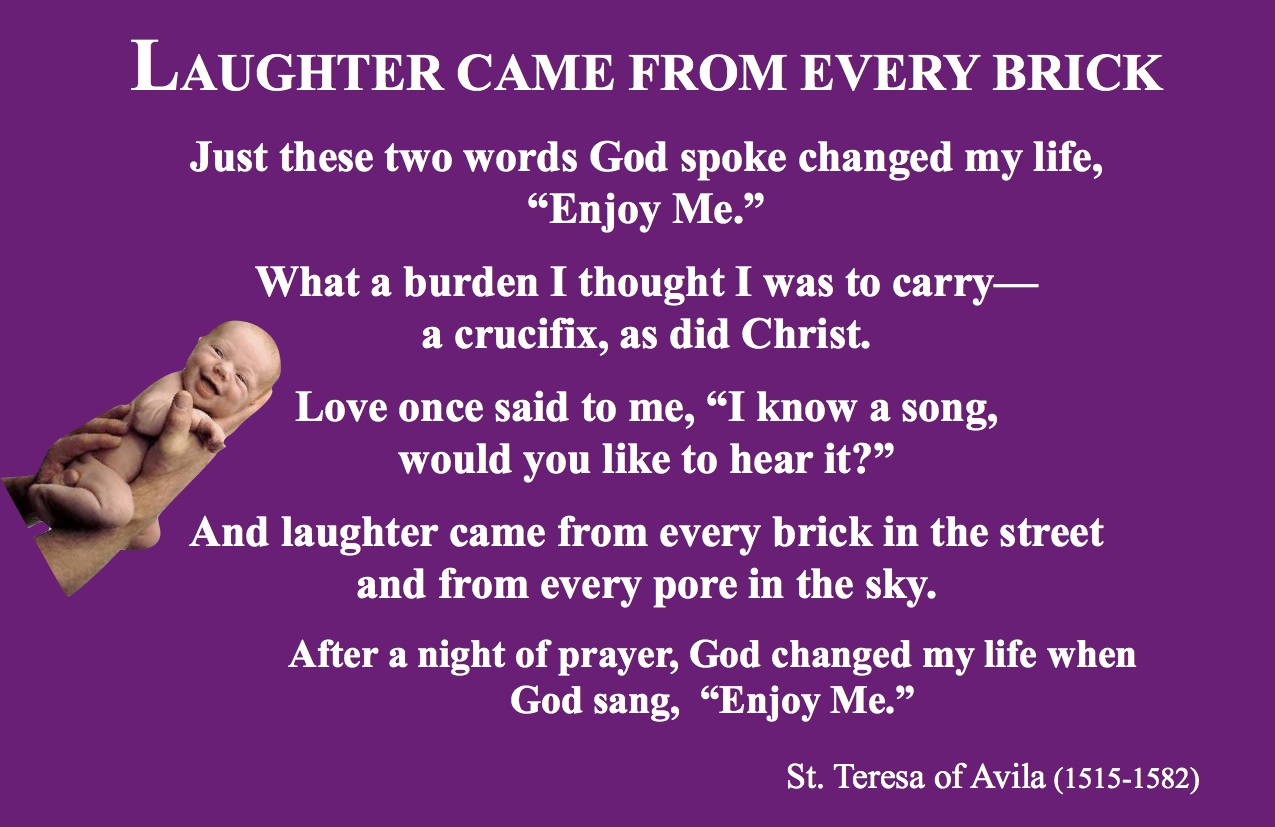
Laughter St Teresa

Traditionally the season of Lent is a mournful time filled with calls to repentance and self-examination as we follow Jesus into the wilderness to be tempted and then on that long march to Jerusalem where the powers that be will have their wicked way with him. Our liturgies take a mournful tone as we lament our woeful human existence, confess our sinfulness, and hear exultations to take up our crosses so that we too can follow Jesus to the bitter end. Over and over again we are asked to remember that we are in bondage to sin and cannot free ourselves, as we gaze upon the cross remembering that Jesus our savior bled and died as a result of our wicked sinfulness.

Lent is a strange season that harkens back to a forgotten era. Unlike so many of the seasons of the church year it’s not exactly a season that attracts people to church. Not many of you got out of bed this morning and said, “Yippy it’s the first day of Lent. Oh goodie!  We get to be reminded that we are sinful, that life is miserable and unless I’m willing to take up my cross and follow Jesus all the way to Golgotha, there’s precious little hope cause we’re all going to die and when the time comes we want Jesus to remember us.”

Now I know that there are some people who just love Lent and I must confess that I like the quieter, more somber tone that our liturgies take. I actually enjoy the opportunity to slow things done and be more reflective in our worship together. I savor the silences and the opportunities to be more contemplative. I love the colour purple with all its vibrant hues and the best part of all is that the beginning of Lent means that spring is just around the corner. What I don’t like about Lent are the signs, symbols, hymns and stories that make it so easy for us to fall back into the 11th century. Continue reading

Ash Wednesday Sermons

Embrace Your Mortality in MYSTERY here

I long to spend time in this “secret place” where God IS – reflecting on Ash Wednesday’s strange Gospel text – Matthew 6:1-6; 16-21 here

On Ash Wednesday, Let Us Revel in the Knowledge that We are Dust and to Dust We Shall Return here

Evolution – There’s No Going Back here

Embracing Mortality: a reflection here

Stardust here

We Are ONE here

Transfiguration Sermons

transfigurationSermons for Transfiguration Sunday:

Beyond the Veil here
LOVE Transforms here
Twinkle, Twinkle, Little Star, How I Wonder What You Are? here
Looking Back at the Way Forward here
You Have the Power to Transfigure the Face of God here
Transfiguration Just an Old-Fashioned Love Song here
Just an Old Fashioned Love Song/Truly, Madly, Deeply here
Transforming into something more beautiful here


Twinkle, Twinkle, Little Star, How I Wonder What You Are? – reflecting on Transfiguration

This week, we find ourselves studying the transfiguration of Jesus. So much has been written and said about this strange little story given to us by the early followers of Jesus. I was planning to do what I’ve done on many Transfiguration Sundays and preach  about the power of myth to open us to new ways of understanding who and what Jesus embodies. But then, I remembered to look beyond my theological perspective and low and behold what I discovered transfigured my own images of the transfiguration of Jesus.

My own images have been shaped by the mythological language used by the crafters of the story of Jesus’ transfiguration, peering beyond myth, has transfigured Jesus in ways that reveal the glory of DIVINE MYSTERY beyond the pages of scripture and into the realms of the cosmos and beyond. What our species has learned about the Cosmos impacts our images of the DIVINE in ways we have scarcely begun to articulate.

A while back, NASA, announced, and I quote: “the discovery of seven worlds orbiting a small, cool star some 40 light-years away, all of them in the ballpark of our home planet in terms of their heft (mass) and size (diameter). Three of the planets reside in the “habitable zone” around their star, TRAPPIST-1, where calculations suggest that conditions might be right for liquid water to exist on their surfaces—though follow-up observations are needed to be sure. All seven are early ambassadors of a new generation of planet-hunting targets.”

NASA’s announcement was accompanied by an artist’s rendition of what has taken place. Watch for yourselves…

Struggling to comprehend the reality of what has been discovered, I remembered o leaning over my little two-year-old granddaughter Evelyn’s travel cot as she began to sing. It took a moment or two before I recognized her tentative little voice attempt to capture the tune. It didn’t take too long for me to join her: “Twinkle, Twinkle, little star how I wonder what you are. Up above the sky so high, Like a diamond in the sky. Twinkle, twinkle, little star, how I wonder what you are. In a darkened room, I stroked my granddaughter’s cheek and I was transported to a long-ago darkness that still overwhelms me. The memory of a long-ago night, far, far, far, away, in an alpine meadow at the foot of the Black Tusk mountain, near Whistler.   After a long day’s hike up the Black Tusk trail, we’d camped out in Taylor Meadows, a spectacular spot located more than 7,000 feet above sea-level.  Twinkle, twinkle, little star, evoked an intense memory of staring into the night sky, mesmerized by the sight of more than my mind could comprehend.

Darkness, darkness, like you never experience near the city. Darkness so deep and so vast. Darkness full of twinkling lights. Twinkle, twinkle, little star. How I wonder what you are. Vast, immensities, stretching, beyond, the beyond, and beyond that also. 40 light years from here. 40 light years. That’s how long it would take you to travel to the newly discovered Trappist 1 system.  According to Google, travelling at a speed of 15 miles per second, it would take us just about 12,770 years to travel one light year. 12,770 years, that’s close to the entire history of humans since the dawn of civilization to travel one light year and to travel 40 light years, well it would take us about half a million years. That’s about twice as long as humans have existed on earth. Talk about beyond. Vastness beyond my mind’s ability to comprehend. And yet, staring into the night sky, or peering through the darkness to the outline of my beloved granddaughter’s little face, I can almost touch the face of God. Like all the generations who have gone before us, the energy that permeates all that is, this LOVE that Creates over and over again, this LOVE that brings forth life in all its glorious dimensions, this radiance which pervades all that is, this ISNESS that bursts forth in, with, through, and beyond the cosmos, this IS, that we call God, reveals ITSELF in the splendor that IS all around us. When I think back to our ancient forbearers wandering around in the wilderness, desperate for a sign that they were not alone and forsaken, I can almost hear the confusion of those who demanded to know the presence of the one who lies at the very heart of reality. Continue reading

Abundant Life in the Cosmos – Evolution Sunday

The extreme cold which we have been experiencing this week reminded me of an experience of the Cosmos which left me awestruck. It happened one long-ago spring when I was working in Whitehorse for a big tour company. One morning, my boss asked me to drive to Skagway to help oversee the meet and greet of a large cruise ship. I’d been on the road for about an hour, so it must have been about 8 o’clock in the morning. In the Yukon, at that time of the year the sun wouldn’t come for a least a couple of hours.  I had just pulled out of Carcross, a tiny town. In those days there was just a small general store in Carcross where, I’d picked up a cup of coffee for the road. I was sipping on the last of my coffee and thinking about how very bright the stars were up in the Yukon. The lack of city lights meant that the sky was illuminated in ways that were positively astonishing to this town dweller.  I was enjoying the view, when something began to happen which caused me to pull the car over and venture out into the cold.

Now if you know me, you know that once it gets down below zero, I’m not much interested in venturing out into the cold.  So, for me to have gotten out of my warm car when it was more than 25 below zero, you know that what was happening must have been something spectacular. The beauty of the star-filled sky began to dance with colours so dazzling that I could scarcely believe what I was seeing. I cannot adequately describe the dance of the Aurora Borealis. The magic of colours dancing across the sky evoked such wonder in me. I tried to imagine just how far the particles of colour had travelled in order to dance above me.

If you’ve ever had the privilege of experiencing the Northern Lights, you will understand when I say that the dance of colourful rays is breath-taking. But the sound of the Northern Lights is positively other-worldly. There’s a kind of crackling and hissing which rises to a gentle clapping as if the Cosmos itself is applauding the intricacies of the dance. Standing there in amazement, I couldn’t help but join the Cosmos in rapturous applause. Looking back on my frozen adventure, the profound beauty that continues to dance in my memory reminds me of a quote I love that comes from Sir Francis Bacon who insisted that: “God has, in fact, written two books, not just one.”  Of course, we are all familiar with the first book God wrote, namely Scripture.  But God has written a second book called creation. Lift up your hearts and listen again as the Cosmos declares in infinite and magnificent ways the Gospel of Christ: “I have come that they may have life and live it abundantly!”

Abundance:   the dictionary defines the word abundance as an adjective meaning “existing or available in large quantities: plentiful. Copious, ample, profuse, rich, lavish, abounding, liberal, generous, bountiful, large, huge, great, bumper, prolific, teeming, plentiful, bounteous. We stand in the midst of the abundance of Creation. Jesus said, “I have come that they may have life and live it abundantly!” Abundant life, abounding life, generous life, bountiful life, large life, huge life, great life, bumper life, liberal life, prolific life, teeming life, plentiful life, bounteous life. Look around and you, look outside the windows of this humble dwelling and you will see the Earth living abundantly. Take a deep breath and you can actually taste the abundance of life, teeming life, bounteous life, plentiful life, abounding life. Continue reading

Living Between the Old Story and the Emergence of the New Story

fullsizeoutput_544e

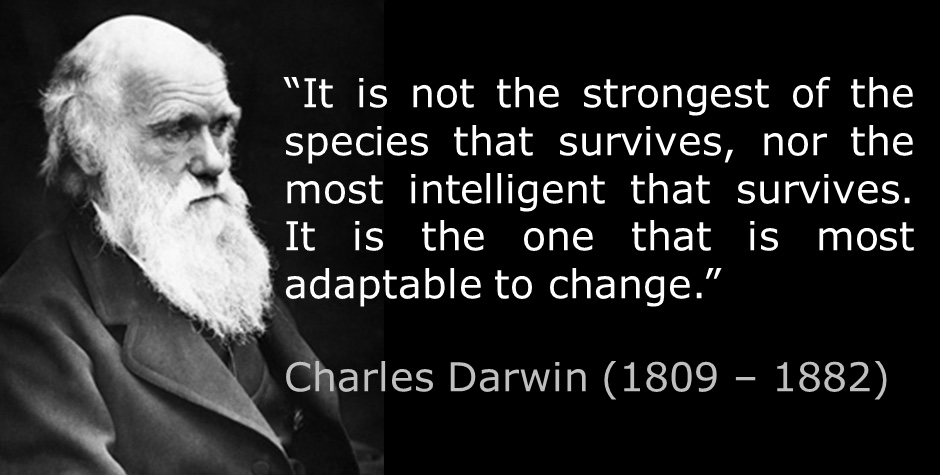
On this the 211th anniversary of Charles Darwin’s birth, progressive Christian communities are preparing to celebrate Evolution Sunday

Readings from Thomas Berry and John 10:10 can be found here

I am indebted to the work of Richard Rohr for several insights found in his audio recordings of lectures entitled “The Sermon on the Mount”


How many of you remember your very first day at school? When I think back to my very first day at school my memories are disjointed, filled not with words but with images and emotions. The over-riding emotion that floods my memories of my first day at school is excitement. I started school in Belfast, Northern, Ireland when I was only four-and-a-half years old and to this day I can still feel the excitement. So, many things happened that day and I can see flashes and images in my mind’s – eye, but in her in my gut I can feel the excitement. I remember the contours of the schoolroom and I can feel the excitement of wondering which desk would be mine. I don’t know about you, but my memories of the desks are quite vivid. I’d never in my short little life seen anything quite like a desk and to be told that one of them would be mine.    Well I just couldn’t wait to find out which one.

Back then, in Belfast, in the olden days, there was no kindergarten; at the tender age of 4 ½ I was enrolled in P1 – primary one and in primary one we had desks that had chairs attached to them, and a lid that went up and down. When I sat down at my very own desk, I opened and closed that lid over and over again, wondering what on earth I would be given to put inside the desk.   It was so exciting. I began imagining books, maybe they’d give us books. I can still feel the excitement I felt at the very idea of placing a book inside my very own desk; I couldn’t wait.

My desk was absolutely perfect in every way except for one. In the top right-hand corner of my beautiful desk there was a hole. I looked around at the other desks and sure enough each one of them had the same kind of hole. I couldn’t begin to imagine what the holes were for. I wanted to ask the teacher, but I remembered feeling like I should keep quiet, so I waited, and I waited for the teacher to tell us what the holes in our desks were for, but she never said a word. So, the first thing I did when my father picked me up from school was to ask him why all the desks at school had holes in them. My Dad knew absolutely everything there was to know about everything and sure enough he knew exactly what those holes were for. Ink. Inkwells. Every desk in my class had an inkwell built right into them.  So, what’s ink? And, what’s an inkwell? That very afternoon I learned about quills made of feathers, dipped into ink so that you could write letters. Dad was a fountain of knowledge about writing with ink.

That night I went to bed dreaming about quills, and feathers, and ink; lots and lots of lovely ink, and writing, writing lots and lots of words. School was going to be great! I couldn’t wait to get my quill. I dreamed a pretty pink feather. So, you can imagine my disappointment when the next day at school, after being told that we were going to learn how to print, because printing comes before writing, and I simply couldn’t wait, as the teacher announced she was going to give us slates and chalk which we could keep in our desks.  Slates and chalk. I had a slate at home. We even had some chalk. When would we get feathers? At that point I would have settled for a plain old black feather, but slates and chalk, what a disappointment.  I never did get a quill. We never even got the fabled fountain pens that my Dad spoke of with fondness. Eventually, we did get a pencil and some paper. But pens had to wait until P3. My slate was wonderful, and I did learn to print using the little broken pieces of chalk that we shared.

Right now, the image of my two-year-old grand-daughter begging me to lend her my iPad and imagine what wonders her fist day at school might bring. My old slate was about the same size as this iPad, but the wonders that my little granddaughter can access on this device make that old slate seem so very primitive indeed. It has been said that you and I have experienced in our lifetime more changes that any other generations before us and I expect that our grandchildren will experience even more changes that we can begin to imagine. Continue reading

Progressive Christianity: A Journey Flowing from Our Lutheran Heritage

“What do you mean when you say, ‘progressive christianity?'” I am often asked this question and so rather than a sermon, this Sunday’s reflection explores the contours of our journey as we wrestle with the MYSTERY that is our SOURCE.    

Below is a copy of our 9 points of progressive christianity which is adapted from http://www.progressivechristianity.org latest 8 Points of Progressive Christianity

Blessed Are We Who Mourn – Matthew 4:1-12

She had no family.  She lived alone. For the purposes of this sermon I will call her Sophia. Sophia, the Greek word for wisdom. I became her pastor because she knew somebody who used to be a member here and when the doctors told her that she was dying she thought she ought to have a pastor. I was summoned to her bedside. I was afraid. I had been told that she only had a few weeks before “the cancer would take her,” not that she would die, but that “the cancer would take her.” No one used the word death or said that she was going to die. To be present to a stranger when they are so close to death is a daunting task.  No time for gentle hello’s, or warming up to one another, just a long, painful and sometimes awkward good-bye.

I went to Sophia’s bedside every day. Some days, when she was able, the questions just tumbled out of her. She wanted to know what I believed. No pat answers or trite platitudes if you please, just the facts. I liked her no-nonsense approach even though I knew that the meager facts that I possessed might not sustain us on our journey. It didn’t take me long to figure out that she’d spent a great deal of time in the church. Her parents saw to it that she was raised in the church, but a lifetime of tragedy and heartache had led her far away from the faith she’d grown up with. But as death drew near, she longed for the certainty of her youth. She’d like to believe. It would be nice to think that there would be a place for her, not exactly heaven per se but someplace heavenly, perhaps like Paris in the springtime. She so loved Paris in the springtime. If only heaven were full of cafés, or patisseries where she could while away the hours talking with others who appreciate the finer things of life. Life, would there be life beyond death? She’d like to believe so.

One morning, I stopped by the bakery that Eduard had on Main Street and picked out the most Parisian looking pastries I could find, then I swung by a coffee shop and had them grind some fresh beans. As I brewed the coffee in Sophia’s kitchen, the aroma wafted up the stairs and she shouted down and asked me to heat up some milk so that we could have lattes. It was as heavenly a breakfast as we could muster. Our conversation took us back to Paris and a springtime before I was born when Sophia was young and beautiful, and the men all fell at her feet. Some of her stories actually made me blush. We laughed and laughed and laughed until we cried.

After Paris, we travelled to London by way of some excellent fish n’ chips and a few glasses of cider. It was cold and wet in London. Sophia managed to complete her nursing studies even though a certain young man begged her to give up work and come and be his love. Over sausages and beer, we travelled to Hamburg, where Sophia fell in love with an orphanage full of refugee children.  By the time our conversations took us to India, Sophia was too ill for a curry, so we sipped tea as we wept over her stories of poverty and disease. One afternoon, I arrived to find Sophia’s care-worker crushing ice for mint juleps.  It took me a while to figure out that we were going deep into the southern states, where Sophia had worked long and hard to help establish a medical center among the poorest Americans.  By the time our travels led us back to Newmarket, Sophia was growing weak and I had gone from being a suspected bible-thumper to a trusted travelling companion. The most difficult part of our journey lay before us.

“What will become of me?” Sophia pleaded. I told her that the doctors would see to it that there was no pain. That wasn’t what she meant. “What will become of me? Will there just be darkness? Or Will I see a bright light?”

“I don’t know?” was all I could honestly say.

Sophia was patient with me. She asked me if I thought there was more to life or if death was the end. “No religious platitudes please. Just the facts.”

“I don’t know Sophia. I believe that we live and die in God and that God is LOVE and in LOVE we have nothing to fear. All will be well? I trust that in death we fall into the LOVE that IS God.”

Sophia took my hand firmly and confessed, “I’m afraid.”

I did not know how to comfort her, so I asked, “What are you afraid of Sophia?”

“Not of dying! Good God no! I’m not afraid of dying.” Sophia insisted, “I’m afraid of being forgotten. Who will remember me?”

Yesterday, I was struggling with this sermon. I’d been reading about our gospel text for hours and hours trying to figure exactly what to say to you about the line in Jesus’ Sermon on the Mount which kept jumping out at me. “Blessed are those who are mourning:  they will be consoled.” Some translations say, “Blessed are those who mourn, for they shall be comforted.” Mourning has fallen out of fashion these days. People don’t like to talk about mourning. They’d rather celebrate life than mourn a death. “Blessed are those who are mourning:  they will be consoled.” Continue reading

Blessed Are We Who Mourn – Matthew 5:1-12

She had no family.  She lived alone. For the purposes of this sermon I will call her Sophia. Sophia, the Greek word for wisdom. I became her pastor because she knew somebody who used to be a member here and when the doctors told her that she was dying she thought she ought to have a pastor. I was summoned to her bedside. I was afraid. I had been told that she only had a few weeks before “the cancer would take her,” not that she would die, but that “the cancer would take her.” No one used the word death or said that she was going to die. To be present to a stranger when they are so close to death is a daunting task.  No time for gentle hello’s, or warming up to one another, just a long, painful and sometimes awkward good-bye.

I went to Sophia’s bedside every day. Some days, when she was able, the questions just tumbled out of her. She wanted to know what I believed. No pat answers or trite platitudes if you please, just the facts. I liked her no-nonsense approach even though I knew that the meager facts that I possessed might not sustain us on our journey. It didn’t take me long to figure out that she’d spent a great deal of time in the church. Her parents saw to it that she was raised in the church, but a lifetime of tragedy and heartache had led her far away from the faith she’d grown up with. But as death drew near, she longed for the certainty of her youth. She’d like to believe. It would be nice to think that there would be a place for her, not exactly heaven per se but someplace heavenly, perhaps like Paris in the springtime. She so loved Paris in the springtime. If only heaven were full of cafés, or patisseries where she could while away the hours talking with others who appreciate the finer things of life. Life, would there be life beyond death? She’d like to believe so.

One morning, I stopped by the bakery that Eduard had on Main Street and picked out the most Parisian looking pastries I could find, then I swung by a coffee shop and had them grind some fresh beans. As I brewed the coffee in Sophia’s kitchen, the aroma wafted up the stairs and she shouted down and asked me to heat up some milk so that we could have lattes. It was as heavenly a breakfast as we could muster. Our conversation took us back to Paris and a springtime before I was born when Sophia was young and beautiful, and the men all fell at her feet. Some of her stories actually made me blush. We laughed and laughed and laughed until we cried.

After Paris, we travelled to London by way of some excellent fish n’ chips and a few glasses of cider. It was cold and wet in London. Sophia managed to complete her nursing studies even though a certain young man begged her to give up work and come and be his love. Over sausages and beer, we travelled to Hamburg, where Sophia fell in love with an orphanage full of refugee children.  By the time our conversations took us to India, Sophia was too ill for a curry, so we sipped tea as we wept over her stories of poverty and disease. One afternoon, I arrived to find Sophia’s care-worker crushing ice for mint juleps.  It took me a while to figure out that we were going deep into the southern states, where Sophia had worked long and hard to help establish a medical center among the poorest Americans.  By the time our travels led us back to Newmarket, Sophia was growing weak and I had gone from being a suspected bible-thumper to a trusted travelling companion. The most difficult part of our journey lay before us.

“What will become of me?” Sophia pleaded. I told her that the doctors would see to it that there was no pain. That wasn’t what she meant. “What will become of me? Will there just be darkness? Or Will I see a bright light?”

“I don’t know?” was all I could honestly say.

Sophia was patient with me. She asked me if I thought there was more to life or if death was the end. “No religious platitudes please. Just the facts.”

“I don’t know Sophia. I believe that we live and die in God and that God is LOVE and in LOVE we have nothing to fear. All will be well? I trust that in death we fall into the LOVE that IS God.”

Sophia took my hand firmly and confessed, “I’m afraid.”

I did not know how to comfort her, so I asked, “What are you afraid of Sophia?”

“Not of dying! Good God no! I’m not afraid of dying.” Sophia insisted, “I’m afraid of being forgotten. Who will remember me?”

Yesterday, I was struggling with this sermon. I’d been reading about our gospel text for hours and hours trying to figure exactly what to say to you about the line in Jesus’ Sermon on the Mount which kept jumping out at me. “Blessed are those who are mourning:  they will be consoled.” Some translations say, “Blessed are those who mourn, for they shall be comforted.” Mourning has fallen out of fashion these days. People don’t like to talk about mourning. They’d rather celebrate life than mourn a death. “Blessed are those who are mourning:  they will be consoled.” Continue reading

Do Justice, Love Kindness, and Walk Humbly with Our God – But Not Too Humbly! a sermon for Epiphany 4a

“In the Far East, the emperor was growing old and knew it was time to choose his successor. Instead of choosing one of his assistants or his children, he decided to do something different.

He called young people in the kingdom together one day. He said, “It is time for me to step down and choose the next emperor. I have decided to choose one of you.” The children were shocked, but the emperor continued. “I am going to give each one of you a seed today – one very special seed. I want you to plant the seed, water it, and come back here one year from today with what you have grown from this one seed. I will then judge the plants that you bring, and the one I choose will be the next emperor.”

One boy, named Ling, was there that day and he, like the others, received a seed. He went home and excitedly, told his mother the story.  She helped him get a pot and planting soil, and he planted the seed and watered it, carefully.  Every day, he would water it and watch to see if it had grown.  After about three weeks, some of the other youths began to talk about their seeds and the plants that were beginning to grow. Ling kept checking his seed, but nothing ever grew. Three weeks, four weeks, five weeks went by, still nothing.  By now, others were talking about their plants, but Ling didn’t have a plant and he felt like a failure.  Six months went by — still nothing in Ling’s pot. He just knew he had killed his seed. Everyone else had trees and tall plants, but he had nothing. Ling didn’t say anything to his friends, however.  He just kept waiting for his seed to grow. Continue reading

More than Just the Be Happy Attitudes: a sermon for Epiphany 4A

jesusThe beatitudes, from the Gospel According to Matthew have become  so very familiar to us that they have almost lost their ability to touch us. “Blessed are the poor in spirit; blessed are those who mourn, blessed are the meek, blessed are those who hunger and thirst for righteousness, blessed are the merciful, blessed are the pure in heart, blessed are the peacemakers, blessed are those who are persecuted for righteousness sake, blessed are you when people revile you and persecute you and utter all kinds of evil against you falsely on my account.”  Blessed, blessed, blessed, yeah, yeah, yeah, we know, we know, we’ve heard all before. So, tell us something we don’t know.

These twelve verses are from the introduction to what’s known as Jesus’ Sermon on the Mount. A sermon that strikes fear and trembling into the hearts of any preacher worth her salt. I remember hearing that it’s insane to try to preach on Jesus’ sermon, after all it is the greatest sermon ever written. It has been said that preachers shouldn’t even try to preach on this, because it is in and of itself a sermon. We should simply read it and then sit down. Jesus is the preacher; he has said it all. He has said it like no has ever said it before or since. This sermon is the heart of the Christian message. It is what Jesus is all about. Blessed be the name of Jesus. Hallelujah! Pass the bread and wine and we’re ready to face the world as followers of Jesus. Continue reading

The Beatitudes and the Power of One: a sermon for Epiphany 4A – Matthew 5:1-12

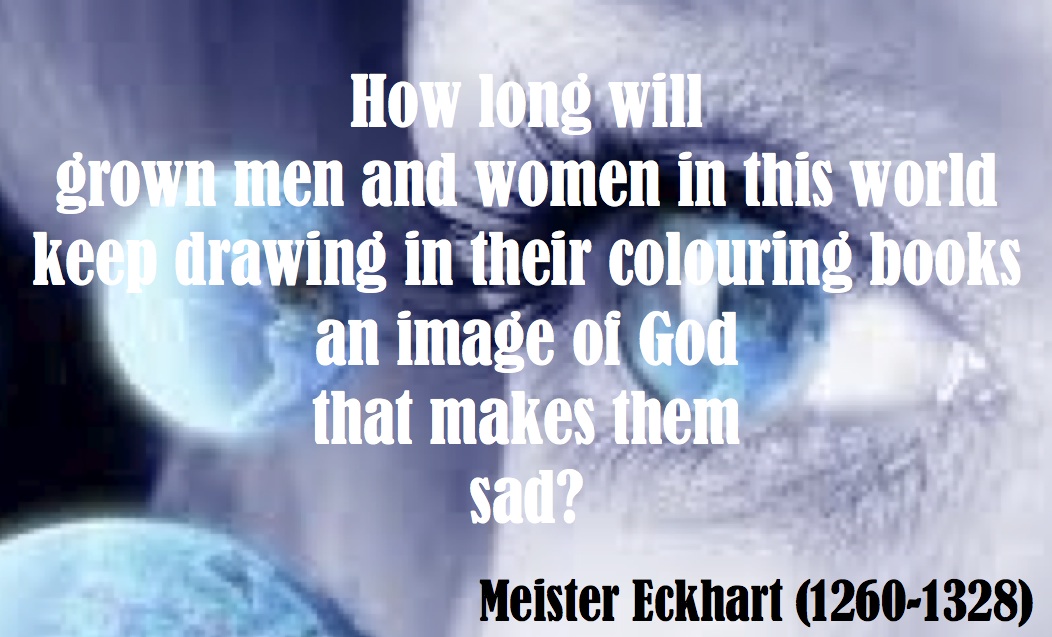
sad EckhartMost us us have heard the words from Matthew 5, known as the Beatitudes, so many times that we can recite them from memory. Indeed, the Beatitudes are at the very core of our Christian tradition. But there is a danger in our familiarity with these words because it allows us to distance ourselves from them as we relegate them to some idealized notion of some unattainable goal.

I have studied these words many times and I do not believe that Jesus intended these words to become a prescription for how to be a better Christian. So, I won’t be encouraging anyone to be poor in spirit, to mourn, or to be meek in the hope that they might gain the kindom of heaven, or be comforted, or inherit the earth. While hungering and thirsting for righteousness is in and of itself a good thing, along with being merciful, pure of heart, and peace-making, all of which I heartily encourage. However, these attributes or beatitudes are not a prescription for holiness or wholeness.

So, if Jesus wasn’t prescribing the beatitudes from atop the mountain, what was he doing? Well, there’s an old storytellers’ ploy that I’d suggest in order to better understand Jesus words. The ploy doesn’t have a name, but most of us are very familiar with the trick. It’s the one where you tell an unfamiliar story alongside of a very familiar story in the hope that the unfamiliar story will help to shed some new light on the words of the familiar story. The unfamiliar story is taken from Bryce Courtenay’s autobiographical novel “The Power of One.” The Power of One was are into a movie about twenty years ago, so the story may be somewhat familiar. Continue reading

Follow Me! I’m right behind you! – Matthew 4:12-23

Whenever I come across Jesus’ words, “Follow me”, I can’t help remembering my Nannie. Nannie was from Belfast and whenever we got into a tough spot, Nannie would laugh and say, “Follow me! I’m right behind you!” Like many Irish sayings, on the surface it sounds ridiculous, laughable. How can I follow you if you are behind me? And then the penny drops, and you realize how can I follow you if you aren’t behind me? Good leaders always have your back.

So, fellow followers of the Way, what does it mean for us to respond to Jesus’ invitation, “Come follow me, and I will make you fishers of people”? For generations this invitation has been interpreted by the church as a mission. Jesus wants you to go out there into the world and fish for people. There’s plenty of fish in the sea! So, let’s go out there and get them, hook, line, and sinker, and then let’s reel ‘em in, in here. Let’s fill up our nets, so that the church will be full to overflowing. As my Nannie would say, “Ah Jesus!”

Ah Jesus, if only it were as simple as that! Some of us are of an age where we can remember hordes of little children standing up in front of congregations, singing their little hearts out, casting imaginary fishing rods, and reeling em in.“I will make you fishers of men, fishers of men, fishers of men.  I will make you fishers of men, if you follow me.” If you follow me?

Ah Jesus? What are we doing wrong Jesus? Come on Jesus. How about it? Won’t you lead us back to the good old days? If only we could point Jesus in the right direction? It certainly would make following Jesus easier if only Jesus would lead us where we want to go? Trouble is, Jesus never was much interested in taking people where they want to go. Continue reading

In the Wake of Trumpism, Progressive Christians Must Not Be Nice! – a sermon in response to the Jesus call, “Come Follow me!”

I never in a million years dreamt that I would begin a sermon by quoting not the scriptures but Alice in Wonderland, but…“The time has come” the walrus said, “to talk of many things: Of shoes and ships—and sealing wax—of cabbages and kings”

To say that the last couple of years have been unusual, would be an understatement of epic proportions. These days, it is as if we are all following Alice in Wonderland and together the world has gone through the looking glass and we find ourselves in a strange new world, were up is down and down is up, facts no longer matter, the way forward has a strange orange hue about it, and I can’t quite see a path through to reality. Everywhere I look the darkness appears deeper and darker than I ever imagined possible. Just when I think I have seen a glimmer of light to guide me, the orange hue blinds me with its outrageous, narcissistic, bellicose, outpourings of hubris, designed to lead us all up the garden path. For days, I’ve felt strangely uneasy. I don’t know where to turn, how to feel, or what to do and there is nowhere, I mean nowhere, I can flee to; nowhere to escape the darkness of this strange new world.

As my stomach churns at each outrageous upheaval of basic human decency, and I feel in every fiber of my being the impending dangers, as we all bear witness to the abandonment of common sense, as the Mad Hatter tweets his demands that we all believe “as many as six impossible things before breakfast.” It is true dear friends, the leader of the so-called free world is a mad hatter who is going to make America great again. Welcome to wonderland, a strange world where a man in a read baseball hat, a thrice bankrupt, reality tv celebrity, comb-over, lives in a world oblivious to reality and we all now live in a wonderland not of our choosing but rather in his peculiar dream; a nightmare in which, just like Alice’s Wonderland we find ourselves falling, spiraling downward into the rabbit hole to  a world where, “everything would be nonsense. Nothing would be what it is, because everything would be wat it isn’t. And contrary wise, what is, wouldn’t be. And what it wouldn’t be, it would. You see?”

My memories of the story of Alice’s boat ride down the river are distant and vague, I can’t for the life of me remember how when, or how she emerged from her voyage. These past couple of days, I’ve tried to imagine Jesus walking along the shore calling me to abandon my own small boat. I can just about hear Jesus calling me, “Come follow me.” But I can’t quite seem to imagine where Jesus will lead us. I want to abandon my small boat, but today even the shore looks treacherous.

So, bobbing up and down, my queasiness increases as I struggle to hold down the bile that keeps rising up in me. I thought I was doomed to ceaselessly bobbing up and down in this upside down wonderland, and then I through the light of my own white hot anger, I began to see beyond the topsey-turvey madness that threatens to become our new normal. My anger was inspired by a sermon I did not hear but was directed to by a colleague whose anger was whiter and hotter than my own. It was a sermon delivered on Friday morning by the Reverend Robert Jeffress at a very special worship service attended by the mad-hatter himself. It was the sermon that the orange, self-aggrandizing, braggart, heard immediately before taking the oath of office that would give him the football; I’m talking about “the football” the one that launches not a game but the horrendous destruction of all that we hold dear upon this planet; the nuclear codes were in his possession when the mad hatter was treated to a sermon the likes of which cause me to tremble, tremble, tremble….

According to the Washington Post and I quote:

“The sermon was delivered by Robert Jeffress, senior pastor of First Baptist Church, who compared Trump to the story of the biblical leader Nehemiah who helped rebuild the city of Jerusalem and its walls after the people of Judah had been exiled from the land of Israel.

Israel had been in bondage for decades, Jeffress explained, and the infrastructure of the country was in shambles, and God did not choose a politician or a priest but chose a builder instead.

The first step of rebuilding the nation, Jeffress said, was the building of a wall around Jerusalem to protect its citizens from enemy attack.

“You see, God is not against building walls,” Jeffress said in his sermon at St. John’s Episcopal Church in D.C.

Nehemiah, according to the biblical account, completed the project in 52 days. Why was Nehemiah so successful in building the wall and rebuilding the nation?

Jeffress said that Nehemiah refused to allow his critics to distract him, noting how some people still don’t believe Trump will succeed in his agenda.

Nehemiah, Jeffress said, had two antagonists named Sanballat and Tobiah. “They were the mainstream media of their day,” he said.

“They continued to hound and heckle Nehemiah and spread false rumors while he and the Israelites were building the wall.”

He noted that Nehemiah answered his critics by saying: “I’m doing a great work. . . . Why should I stop the work and come down to you?” (Nehemiah 6:3). Trump’s work, he said, “is a work far too important to stop and answer your critics.”

Nehemiah faced setbacks, Jeffress noted, including an economic recession, terrorist attacks from enemies and discouragement among the citizens.

“The true measure of a leader is what it takes to stop him,” he said.

“And knowing you, I believe it’s going to take a lot to stop you.”

Jeffress said Trump has assembled an “unbelievably talented group of advisers” and has Vice President-elect Mike Pence by his side, “a great and godly man.”

“Mr. President-elect, I don’t believe we have ever had a president with as many natural gifts as you,” he said.

But, Jeffress said, “we need God’s supernatural power.”

He said Trump’s slogan “Make America Great Again” resonated with Americans and that “Psalm 33:12 gives us the starting point for making that happen: ‘Blessed — great — is the nation whose God is the Lord.’” Unquote.

JEEZZZES H CHRIST!!! Suddenly, the bile rose in me, only now, I refuse to stifle it. I am angry. I am angry that the scriptures have been transformed into succor for a narcissistic, megalomaniac, whose dreams and visions threaten all that I hold dear. Now I know that there are those among you who might counsel me to calm down. Well that’s just not going to happen. Living in the land of the shadow of death, the light has dawned and I happen to believe that anger, I’m talking about hot, vivid, piercing, anger is the only light that people who are living in darkness have available to them at this moment in time. I ain’t about to calm down. In fact I hope that I can provoke or tap into some of the anger that’s gotta be rising in so many of you right about now. You see, I can hear Jesus call us, and I hope that you too can hear Jesus calling us from the shore to abandon our small boat and follow him. Continue reading

Following Prostitutes and Christ – a sermon for Epiphany 3A – Matthew 4:12-23

Vancouver's east endWhen I was in my early twenties, I grew weary of sharing space and I decided that I wanted an apartment all to myself, despite the fact that I couldn’t really afford an apartment all to myself. But I was determined and that’s how I ended up living in a very rough neighborhood in the east end of Vancouver. My parents weren’t’ very happy about the neighbourhood and worried about the unsavory characters that lived in the run-down building where I found a spacious one bedroom apartment that I could just about afford. The apartment was just a couple of blocks away from the office where I worked, so I was able to walk to work. I ignored all the warnings of my family and friends and I convinced myself that I could handle anything that came my way.

In my heart of hearts I was rather pleased to be living in such a poor rough and tumble neighbourhood. I was young and foolish and the neighbourhood was exciting. Every Sunday I would make the trip back to my home church in the suburbs. Sometimes I would make a second trip out during the week to attend a Bible study. Like so many young people, I was harsh in my criticisms of the elaborate life-styles of my elders. At bible studies, I was always bringing up the plight of the poor and the oppressed and challenging people to do something. Various members of my own family often accused me of being a bleeding heart liberal. I wore their criticism with a certain amount of pride, convinced that I was living out my beliefs.

Although I walked to work each day, I didn’t know any of my neighbours, until one morning I was surprised by a knock on my apartment door. I wondered how anyone would get past the lock on the front door. So, I peered through the peephole and was relieved when I saw a young woman at my door. I unbolted the door and in swept Brenda. Brenda was all smiles and laughter as she explained that she and her roommates were out of coffee and she wondered if I might be able to lend them some coffee.  When I explained that I had just used up the last of my coffee making my own morning brew, Brenda told me not to worry, she and her roommates would be happy to join me. When Brenda returned, she introduced her roommates, Janice and Sue and we all sat down together for our morning coffee. Continue reading