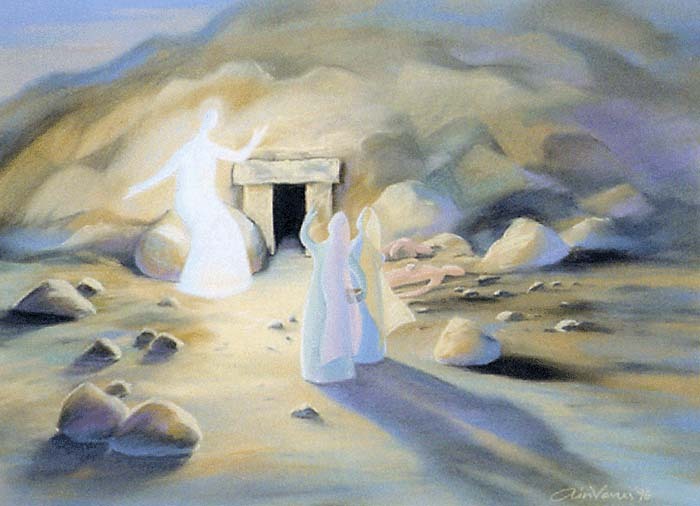
THE RESURRECTION OF MARY – An Idle Tale

St. Mary of Magdala the Apostle to the Apostles

As our Easter celebrations continue, the readings for this coming Sunday quickly move our attention to the story of Thomas.  Poor old doubting Thomas.  It’s the same every year.  Thomas’ doubts greet the faithful on “low Sunday”.  But before you let Thomas’ doubts capture Easter’s hope, consider exploring the resurrection of Mary.  Perhaps my not-so-long-ago encounter with a visiting New Testament scholar will entice you to follow Mary out of her tomb and beyond the streets to her place at the head of the fledgling community that became the church: 

He just said it for the third time! “Harlots!” He keeps calling them “harlots”, while I rack my brains to come up with one harlot. Then he points to the text and his charges become clearer, he says, “she is a “prostitute!”

My carefully reigned in anger is unleashed. “Where?  Where?  Where? Show me where it says this woman is a prostitute!”

As he refers to the Gospel text and insists that, “It is there, right there in the text”,

I want to scream, I want to cry, I want to wipe the bemused expression from his face. I want to rub his nose in the damned text. Instead, I begin the uneasy process of reigning in my anger. I slow my speech, I try to erase the tremor from my voice and I ask him to, “Show me, show me where it says this woman is a prostitute.”

He consults his text and says, “a woman in the city who was a sinner.”

“A sinner not a prostitute.”  I respond.

He insists, “Yes a prostitute.”

“Where?” I ask.

Again he insists, “A woman who was a sinner.”

I demanded to know, “Where does it say she was a prostitute?”

He insists, “The author means that she was a prostitute.”

I lose control, “How do you know?  What words does the author use to say that his woman was a prostitute? Show me in the text where it says she was a prostitute?”

He still doesn’t get it, “What do you mean? It is clear that this woman was a prostitute.”

Once again I push, “Show me.  Show me where?”

He continues to say, “She was a woman from the city who was a sinner.”

I know that the text says that, so I implore him to tell me, “The Greek… What does the Greek say?”

He replies, “amartolos”.

I push, “Does that mean prostitute?” We both know that it does not.

He replies, “Sinner. But the context clearly shows that she was a prostitute.”

Still pushing I ask him to “Show me.  Show me how the narrative says this woman was a prostitute. Show me where it says her sins were sexual.             Show me where it says so in the narrative.”

He says, “It’s clear.”

Clearly we disagree, so I try again, “Clear to you.  Show me. Show me!”

As he fumbles through the pages, I offer him a way out, “Okay.  Even if I concede the point that her sins were sexual, show me where it says that these sexual sins were nothing more than lust or adultery, show me where it says that she was a prostitute.  Show me!”

He couldn’t show me.  It’s simply not there.

Nowhere in the New Testament does it ever say in Greek or in English that Mary of Magdala is a prostitute.  But over and over again scholars, theologians, popes, preachers, and dramatists, have continued to cast Mary of Magdala as a prostitute.  

In the years that have transpired since than day in seminary, when a visiting New Testament scholar insisted that “the context clearly shows that she was a prostitute,” I’ve delighted in being able to participate in the phenomenon of Mary’s resurrection as the first Apostle.

I’ve gobbled up all the many books that have recently been written about the woman commonly known as Mary Magdalene. Some of them have been great scholarly texts like Jane Schaberg’s tome entitled “The Resurrection of Mary Magdalene.” While others have been little more than a salacious romp like Dan Brown’s:  The Davinci Code. But whether its scholarly speculation on the nature of Mary’s leadership in the Early Church or scandalous speculation on her sexual exploits with none other than Jesus himself, what these books hold in common is their ability to touch an insatiable curiosity about this enigmatic biblical character whose feminine attributes have ruffled the cassocks of those patriarchs of the priestly persuasion for centuries.

The recent resurrection of Mary has offered up portraits of a character whose historical roots go all the way back to a relationship with Jesus of Nazareth. And that relationship situates Mary at Jesus’ right hand. Now you’d think that someone whom all four gospels declare to be so very close to Jesus, ought to be someone your hear about in the church all the time.  You’d think that someone who the gospels record as having supported Jesus fledgling ministry out of her own resources, someone who if the gospels are to be believed, followed Jesus all the way to the cross and to whom the risen Christ first appeared and who is the first to be sent by Christ to proclaim the good news of the resurrection, you’d think that such a someone would be heralded down through the centuries, from pulpit to pulpit across the length and breadth of Christendom as the First Apostle. For indeed the literal definition of apostle is “one who is sent”. And if the gospels are to be believed,  Mary was sent by none other than the Risen Christ, so you’d think she would be honored by the very church that professes to follow Christ.  

But there’s just something about Mary….  that has made priests and preachers down through the centuries abhor her.  That the historical evidence clearly points to Mary’s role as a leader, perhaps the foremost leader of the first, fledgling followers of Jesus Christ, has not seemed to help Mary’s case. Indeed, it may be that her leadership position as the Apostle to the Apostles, the first witness to the resurrection and the first to proclaim that Christ is alive, is the very thing that set the proverbial cat among the priestly pigeons.

Now I know that there are those who would say that the swirling conspiracy theories that abound around any discussion of Mary are little more than the rumblings of ill-advised detractors who seek to undermine the teaching authority of the church.  But the evidence is clear that dear old Pope Gregory the Great, whether it was by accident or design actually misrepresented the Scriptures when he pontificated in a way that only popes can, about a woman’s sexuality. That this particular woman happened to be a close confidant of the one his holiness Pope Gregory called, “Lord and Saviour” did not save her from falling (pardon the pun) falling prey to his holiness’s foibles as he confused Mary Magdalene with the woman caught in adultery and made the perilously, presumptuous leap from adultery to prostitution.  And low and behold for 14 centuries after Gregory’s not so great condemnation, Mary has remained relegated to the ranks of those whose bodies are bought and sold for the sake of those who care little for the female gender. And despite biblical and historical evidence to the contrary, Mary has been denied the titles that befit her rank.

But if you want to believe that it is merely a coincidence that the denial of Mary’s rank coincides with the church’s adamant denial down through the centuries that women could ever hope to enter the ranks of the priesthood, well I’m sure that God will forgive you, I’m just not sure Mary or her sisters will.

So what do the scriptures tell us about the disciple whom Jesus loved?             Well for starters Mary was a woman whom Jesus healed.  The gospel according to Luke tells us that:

“With Jesus went the twelve, as well as some women he had healed of evil spirits and sickness;  Mary of Magdala, from whom Jesus had cast out seven demons; Joanna, the wife of Herod’s steward Chuza; Suzanna; and many other women who were contributing to the support of Jesus and the Twelve with their own funds.”

Evil spirits and sickness; 7 demons, no mention of sex.  No mention of prostitution. Now I don’t know about you, but if a prostitute showed up at your church tongues would be wagging.  And whoever wrote the gospel of Luke was more than capable of passing on a sexual tidbit or two. In fact just before he tells us about the women who support Jesus’ ministry, the writers tells the tale of a woman caught in adultery. But the writer never mentions that Mary was a prostitute.

Now there are some who insist that Gregory the not so great was simply confused by this story and so we should understand that it was an easy mistake to make. But to accept this is to accept that adultery and prostitution are the same thing. Now I get that popes are not well versed in matters of sex, but sadly that’s never stopped them from pontificating.

What irks me more is that a 20th Century New Testament scholar, who ought to know better, could suggest that adultery and prostitution are the same thing or indeed that one woman is the same as the next.

Okay, I’ll admit that I have an ax to grind. Many women do. But can you blame us?

Gentlemen.  I know that I have the rare privilege of serving in ministry with the most enlightened generation of men any woman has had the privilege of serving. You guys are great! So, please don’t hear this as some sort of angry tirade against men. Because sadly, the attitudes that have confined Mary to walking the streets at night are not confined to men. The entire church culture is steeped in antiquated attitudes that will take all of us, women and men together, decades to recover from.

But recover we will.  We will recover the witness of St Mary of Magdala, whose dedicated faith in Jesus, helped her to follow Jesus, despite the fact that all of the Twelve Disciples abandoned him, Mary stayed and followed Jesus all the way to the foot of the cross and beyond. Even in her grief, while the disciples remained locked behind closed doors because they were afraid, Mary ventured out to perform with her ointments ready, not knowing how she would be able to roll the stone away, only knowing that they could not fail to do what she thought would be the last loving act for her beloved Jesus.

It is long past time for the church to celebrate the resurrection of Mary of Magdala, the Apostle to the Apostles. 

Mary faithfully ventured forth, not knowing how; only knowing that she must.  And it was Mary who recognized in the face of someone she thought was just a gardener; Mary recognized the face of Christ. In Mary Magdalene we see a woman whose love of Jesus pushed her to keep going in the face of torment and death. It was Mary’s love of Jesus that sent her into the garden alone. Even though she though that her beloved Jesus was dead and gone, her love helped push her forward and she discovered that everything old has been made new through love.

So, looking back to Mary, I wonder what it would take for us to proclaim, “I have seen Christ”?  Where can we find God in our lives and thereby find new life, new hope, new love?  Where can we find what Mary found; Mary who when she found this new thing, was able to go on to found a community of followers of Christ who endured despite the odds against them.  A community who although their writings were suppressed by the powers that be, they could not be kept silent. A community whose gospel lay buried for centuries, and whose restoration preserves the traditions if not the words of Mary who encourages us down through the centuries with these words:

“Do not weep and be distressed nor let your hearts be troubled. For Christ’s grace will be with you all and will shelter you. Rather we should praise Christ’s greatness, for Christ has joined us together and made us true human beings.”(Gospel of Mary and no I won’t supply the exact reference, in the hope that you might just read the entire Gospel)

Mary saw the risen Christ in the face of a gardener. Were can we find the face of Christ? Can we begin to see the face of Christ in the human beings that surround us?  Perhaps when we begin to share Mary’s faith that the risen Christ can bee seen, we will begin to see the ace of Christ in those around us; in face of the stranger we meet on the road, in the face of the homeless man as we sit and share a meal with them, in the face of a child we reach out to lift up out of poverty, in face the woman upon whose shoulders we stand, in the face of our opponent as together we struggle for understanding, in the face of our enemy as we work for peace, in the face of our tormentors as we strive for justice, in the face of the sick as we seek healing, and in the face of the poor as we offer aid.

When we can look into the face of those we meet and see the face of Christ then perhaps we can follow in the footsteps of Mary and all the world will know by our love, that we too follow Christ.

St. Mary of Magdala, the first Apostle, the Apostle to the Apostle, the one in whom the Risen Christ entrusted the good news of eternal life.

May the power of Mary’s witness inspire you to see the face of Christ in the world.
I PLEAD GUILTY TO THE CHARGE of` DENYING THE RESURRECTION

BUT I AINT LEAVING!!!

             Blogging is new to me and I must say that I am overwhelmed by the responses to yesterday’s post about resurrection.  While many have emailed or posted their ardent “amens” others have been scathing and some hostile to my remarks.  I am grateful to everyone who has responded.  All of your comments help me as I continue to ponder the theological and practical implications of the Easter story.  For those of you who have suggested that I have no business calling myself a Christian or a pastor and have suggested that I ought to consider leaving the church, I offer the following.

            Last year, I got together with clergy colleagues to talk about the challenges of preaching during Holy Week. When the subject of the crucifixion and the resurrection came up, the conversation became very lively as the traditionalists challenged the progressives. Toward the end of our conversation, it became clear that because I was unwilling to concede to the notion that Jesus corpse was physically resuscitated; I stood accused of having denied the resurrection.

            Some colleagues rose to my defense and insisted that I wasn’t saying anything different than what we all learned in seminary. But they also insisted that most lay-people simply don’t want to hear it. So, I asked them if they were going to preach about what they had learned in seminary and beyond and the general consensus was that there are too many guests on Easter Sunday to tackle theology.

            Some said, they were simply too afraid of the fundamentalists in their congregations to ever even attempt to preach what they knew. A few confessed that they were working up to it; but not on Easter Sunday.

            The traditionalists in the group were disgusted. One colleague went so far as to insist that I had no business being in the church because my very presence puts the beliefs of the faithful at risk. He wondered aloud, “Why do you stay in the church if you don’t believe?   If the church’s theology no longer works for you, why don’t you just leave?”

            “Why do you stay?” is a question I am all too familiar with.

            Well, before I can answer that, I have to say, that I’ve taken a leaf out of Joan Chittister’s book. Chittister insists that we should all be asking ourselves why we stay.  She cautions that those of us who stay, need to respect those who decide to leave and those who leave must respect those who stay. Chittister also insists that while we continue to ask ourselves why we stay, we ought to remember that “if we go, we must not go quietly and if we stay we must not stay quietly”. We must speak out because the church needs us to speak out.

            I confess that I am constantly asking myself why I stay and there are days when I feel like leaving, days when I feel like staying quietly, and days when I am convinced that it is in the church where I must not only stay but echo the words of Luther with gusto:  for in here I stand!

            I stay, because I still believe that it is possible to change the church from within. I stay, despite the fact that each time I go out into the wider church, the traditions and traditionalists that I meet there often make me want to leave. But then I remember all of the people in the faithful community that I serve. I remember their wiliness to dwell in the questions of our faith. I remember their courage and their determination. I remember their thirst for knowledge. I remember the amazing ways they reach out to the people outside the walls of the church. I remember their faithfulness, their love,  and their keen sense of justice. I remember the image of Christ that I see in their faces and I know without a doubt that the church is where I belong, even though I know that as a community we will continue to ask ourselves,  “Why do we stay?”  And I know that if we stay we will not stay quietly. And if we should ever decide to leave, we will not leave quietly. I stay because in the church community that I serve, I have encountered the Body of Christ.

            Here in the church, I have seen the risen Christ reach out to our neighbours in need, fight for justice, and love God with all our hearts, with all our souls and yes with all our minds.  So, I stay surrounded by such a great crowd of witnesses.  But like so many before us, we must not stay quietly. Together we must continue to speak out for change in our church.  And together we must continue to explore what the best minds of this century have to teach us about the nature of our God.

            My desire to work together with others to move the church into the 21st century is precisely why I preach the sermons I preach on Good Friday and Easter Sunday mornings.  And for the most part, despite the dire warnings of some of my clergy colleagues, our visitors take it all very well. Indeed many are relieved to hear that there is more than one way to follow Christ.  But there was this one person last Easter Sunday, who on the way out the door, insisted that I had denied the resurrection.  This person was quite distressed and wondered aloud how a Christian could deny the resurrection and still call themselves a Christian.

            Now even though I assured this person that I do indeed believe in the resurrection, it was clear to me, what this person heard me say was not exactly the same as what I actually said.  So, let me make it clear. There is, and there has always been, from the very beginning disagreement among the followers of Christ as to the exact nature of the resurrection. And things aren’t any different today than they were in the first century. There is a distinct disagreement between the Christianity of biblical scholarship and the Christianity of fundamentalists.  And 21st century Christians can be found faithfully following Christ all along the spectrum of beliefs about the resurrection.

            Fundamentalists are quite sure of their truth.  On Easter the crucified Jesus, who was laid in the grave as a deceased man on Good Friday, was by the mighty act of God, restored to life on Easter. Jesus had broken the power of death for all people. If the body of Jesus was not physically restored to life, the fundamentalists claim, then Easter is fraudulent. There can be no compromise here. Those who waver on this foundational truth of Christianity have, according to this perspective, abandoned the essential core of their faith tradition.

            Well, to borrow the words from an old song and say, “”Tain’t necessarily so!” When you read the New Testament in the order in which these books were written, a fascinating progression is revealed.  Paul, for example, writing between the years 50 and 64 or some 20 to 34 years after the earthly life of Jesus came to an end, never describes the resurrection of Jesus as a physical body resuscitated after death.  There is no hint in the Pauline corpus that one, who had died, later walked out of his grave clothes, emerged from the tomb and was seen by his disciples.

            What Paul does suggest is that Easter meant that God had acted to reverse the verdict that the world had pronounced on Jesus by raising Jesus from death into God. It was, therefore, out of God in a transforming kind of heavenly vision that this Jesus then appeared to certain chosen witnesses. Paul enumerates these witnesses and, in a telling detail, says that this was the same Jesus that Paul himself had seen. No one suggests that Paul ever saw a resuscitated body.

            The Pauline corpus later says, “If you then have been raised with Christ, seek the things which are above, where Christ is, seated at the right hand of God.” Remember, the story of the Ascension had not been written when these Pauline words were formed. Paul did not envision the Resurrection as Jesus being restored to life in this world but as Jesus being raised into God. It was not an event in time but a transcendent and transforming truth.

            Paul died, according to our best estimates, around the year 64 C.E. The first Gospel was not written until the early 70’s. Paul never had a chance to read the Easter story in any Gospel. The tragedy of later Christian history is that we read Paul through the lens of the Gospels.  So, we have both distorted Paul and also confused theology.

            When Mark, the first Gospel, was written the Risen Christ never appears. The last time Jesus is seen comes when his deceased body is taken from the cross and laid in the tomb. Mark’s account of the Resurrection presents us with the narrative of mourning women confronting an empty tomb, meeting a messenger who tells them that Jesus has been raised and asking these women to convey to the disciples that Jesus will meet them in Galilee. Mark then concludes his Gospel with a picture of these women fleeing in fear, saying nothing to anyone.  So abrupt was this ending that people began to write new endings to what they thought was Mark’s incomplete story. Two of those endings are actually reproduced in the King James Version of the Bible as verses 9-20. But thankfully, these later creations have been removed from the text of Mark in recent Bibles and placed into footnotes.  The sure fact of New Testament scholarship is that Mark’s Gospel ended without the Risen Christ ever being seen by anyone.

            Both Matthew, who wrote between 80-85, and Luke, who wrote between 88-92, had Mark to guide their compositions. Both changed, heightened and expanded Mark. It is fascinating to lift those changes into consciousness and to ask what was it that motivated Matthew and Luke to transform Mark’s narrative. Did they have new sources of information? Had the story grown over the years in the retelling?

            The first thing to note is that Matthew changes Mark’s story about the women at the tomb. First, the messenger in Mark becomes a supernatural angel in Matthew’s story. Next Matthew says the women do see Jesus in the garden.             They grasp him by the feet and worship him. This is the first time in Christian history that the Resurrection is presented as physical resuscitation. It occurs in the 9th decade of the first century.  It should be noted that it took more than 50 years to begin to interpret the Easter experience as the resuscitated body of the deceased Jesus.

            I don’t have time to go into the details of the development of this interpretation. But you can trace its growth through the gospels of Matthew and Luke until finally at the end of the first century to the Gospel of John. And when you read these chronologically, you will see that the Easter story appears to have grown rather dramatically over the years.

            Something happened after the crucifixion of Jesus that convinced the disciples that Jesus shared in the eternal life of God and was thus available to them as a living presence.   This experience was so profound that the disciples, who at his arrest had fled in fear, were now reconstituted and empowered even to die for the truth of their vision.  This experience had the power to force the Jewish disciples to redefine the God of the Jews so that Jesus could be seen as part of who God is. Finally this experience was so profound that it ultimately created, on the first day of the week, a new holy day that was quite different from the Sabbath, to enable Christians to mark this transforming moment with a liturgical act called “the breaking of bread.”

            When these biblical data are assembled and examined closely, two things become clear. First something of enormous power gripped the disciples following the crucifixion that transformed their lives. Second, it was some fifty years before that transforming experience was interpreted as the resuscitation of a three days dead Jesus to the life of the world. Our conversation about the meaning of Easter must begin where these two realities meet.

            As for those who condemn those of us who choose to follow the biblical strains of our resurrection theology as non-Christians, well there will always be those who will insist that it is their way or the highway.  As for the person who greeted me on the way out the door last Easter Sunday and questioned my ability to call myself a Christian, I would say, “Thank-you!”.  This question allowed me the opportunity to communicate clearly and concisely my thoughts on the resurrection, so please allow me to repeat myself. To those who have responded to my blogs, I say, “Thank-you!”  I thank-you for engaging me in the questions of our faith.  I thank-you because your questions make me a better follower and I trust that my questions will do the same for you.  Let us together be the church in our own time and place and have the courage to follow where-ever Christ leads.

            So, without equivocation or hesitation I fully and completely admit that I deny the resurrection of Christ. This is something that anyone who knows me could tell you, and I am not afraid to say it publicly, no matter what some people may think.  I deny the resurrection of Christ.  Theologian Peter Rollins puts it far better than I ever could, and with him, let me just say:

             “I deny the resurrection of Christ every time I do not serve at the feet of the oppressed, each day that I turn my back on the poor;  I deny the resurrection of Christ when I close my ears to the cries of the downtrodden and the oppressed.

            Every time I do not serve my neighbour, every time I walk away from the poor.

            I deny the resurrection every time I participate in an unjust system.

            However there are moments when I affirm that resurrection, few and far between as they are.

            I affirm the resurrection when I stand up for those who are forced to live on their knees,

            I affirm the resurrection when I speak for those who have had their tongues torn out,

            I affirm the resurrection, when I cry for those who have no more tears left to shed.

            I affirm the resurrection each and every time I look into your eyes and see the face of Christ.”

             Christ has died. Christ has risen.  Christ will come again and again.

            This is the mystery of our faith.

            Christ is Risen!

            Christ is Risen Indeed!  Alleluia!

            Christ is risen in you and in me. 

            In the words of Martin Luther:

            “This is most certainly true!”

            Can I get an Amen?


PALM SUNDAY SERMON – An Inconvenient Messiah

Palm Sunday Sermon Audio  here

Palm Sunday Worship Bulletin here  to be printed double-sided

PREPARING FOR MAUNDY THURSDAY – When you don’t believe that Jesus was a sacrifice for sin!

I was asked by a colleague, “So, if you do not believe that Jesus died for your sins, then why bother celebrating the events of Holy Week?”  Behind this question lies the assumption that the only way to understand Jesus’ death is to frame it within the context of the theology of “penal sacrificial atonement” ie “we are judged to be sinful creatures, punishment is required, God sends Jesus to pay the price for our sin”.  That Anslem’s theory of sacrificial atonement was formulated in the 11th century and continues to hold sway in the minds of so many followers of Christ is a testament to the power of our liturgies and hymns to form our theology.  However, Anslem’s theory is not they only faithful way to understand Jesus’ death. 

         When one seriously engages the question, “What kind of god would demand a blood sacrifice?” the answers often render God impotent at best and at worst cruel and vindictive. I have often said that atonement theories leave God looking like a cosmic son of #%#%# !

         Progressive Christian theologians are opening up new ways of understanding the death and resurrection of Jesus that empower the faithful to see new possibilities. 

         To my colleague, who fears that I am leading the faithful astray, and to those who find little comfort in the theories of an 11th century monastic, I the following notes, crafted in my preparation to lead Maundy Thursday worship.

Jesus said, “I give you a new commandment:  Love one another.   And you’re to love one another the way I have loved you. This is how all will know that you’re my disciples: that you truly love one another.”

That we should love one another is not a new commandment. There have been many before Jesus and many who came after Jesus who have commanded, advised, encouraged, implored, and even begged us to, “love one another.”

What is new about Jesus commandment is that we are to love one another the way that Jesus loved us.

Which begs the question:  How exactly did Jesus love?

I believe that Jesus loved in ways that I am only beginning to understand. I believe that Jesus was so open to the power of the LOVE that is God; that Jesus was able to live his life fully without fear.

I believe that Jesus wanted more than anything else for his followers to be so open to the power of LOVE that is God so that they too would live their lives fully without fear.

I believe that that’s what Jesus meant when he said, “I have come that you might have life and live it abundantly.”

I believe that Jesus lived life abundantly and that means that he loved abundantly and without fear.

Jesus was so open to the power of LOVE that is God that Jesus would not let the powers of darkness stop him from loving and living fully.

The kind of LOVE that Jesus embodied and taught has no boundaries.  No darkness, no power, no fear, not even death can limit the power of LOVE.

For if LOVE is limited by death, then love will always be qualified and quantified.

That Jesus was willing to LOVE without boundaries, came at great cost to himself.

But Jesus was willing to pay that price in order to show  others the way.

The way to LOVE without limit, without fear, without boundaries.

LOVE without boundaries is abundant life.

That Jesus’ LOVE endured the worst that the world could send his way, that Jesus’ LOVE was for all the world, dead and buried, and yet bursts free from the grave, bears witness to the power of LOVE.

That Jesus LOVE could not be destroyed, not even by the thing we fear the most, death itself, saves us from the need to fear death.

Jesus has shown us the way.

         We can live abundantly lives that are free from the fear of death. Because Jesus has shown us the way we are free to live fully, to love extravagantly and be all that we were created to be.

LOVE shines in the darkness and darkness shall not overcome LOVE.

If Jesus, life, death, and resurrection teach us anything, surely they teach us not to be afraid.

Not to be afraid of the darkness.

Not to be afraid of living fully.

Not to be afraid of loving extravagantly.

Not to be afraid of the powers of evil.

Not to be afraid of the power of death.

LOVE will endure.

All will be well.

Jesus can’t save us from life.

There is evil to contend with.

There will be darkness and there will be death.

Jesus couldn’t save himself and he cannot save us from life. Darkness and death are part of life.  Each of us must walk into the darkness that lies before us.  We can beg God to take the cup from us!  But the darkness will still come.  And there will be days when the darkness will triumph.  There are good Fridays too many to mention out there.  We can shout all we want for Jesus to save us, but in the end we too will have to take up our cross and find a way to follow Jesus into the darkness and beyond, trusting that even though it feels for all the world that God has forsaken us, we will make it beyond the darkness.

The cross will not look the same for each of us. But there will be crosses to bear. Jesus has showed us the way. If we are to follow Jesus, then we must love one another they way that Jesus loved.  It is the way beyond the darkness. Do not be afraid of evil, of death, or of the darkness. Follow Jesus who by love frees us from the power of darkness to hold us captive to our fears so that we can have life and live it abundantly.

How exactly did Jesus love?

Without limit.

What did Jesus save us from?

Our fears.

LENTEN EVENING PRAYER #5 – Hildegard von Bingen

Evening Prayer Service Bulletin which is to be printed double-sided

Evening Prayer Audio – the silences are intentional.  Enjoy!

LENTEN SERMON SERIES: ANCIENT WISDOM MODERN PRACTICES

LENT FIVE – DREAMING: NIGHTMARES & VISIONS

All Shall Be Well Julian of Norwich

Click here to listen to the SERMON:  Lent 5 March 25 2012

Click here to download the Worship Bulletin:  to be printed double-sided

LENTEN SERMON SERIES: ANCIENT WISDOM MODERN PRACTICES

LENT FOUR:  LETTING GO – CONFESSION

 Click here to listen to the SERMON:  Lent 4 March 18 2012

Click here to download the Worship Bulletin:  to be printed double-sided

LENTEN SERMON SERIES: ANCIENT WISDOM-MODERN PRACTICES

LENT TWO:  LAMENT – TRANSFORMATION

Click here to listen to the SERMON: Lent 2 Mar 4 2012

Click here to download the WORSHIP BULLETIN Lent 2B Mar 4 2012

Ash Wednesday – Embracing Eternity

Click here to listen to the worship service:  Ash Wed Service

Click here to download the worship bulletin Ash Wednesday Feb 22 2012

TRANSFIGURATION – Looking back at the way forward.

Thirteen years ago, I travelled to Newmarket to preach for the first time at Holy Cross Lutheran Church.  It was Transfiguration Sunday and I was preaching for Call.  I knew that the following Sunday the Congregation would gather to vote on whether or not to call me as their pastor.  I’ve been serving as the Pastor of Holy Cross for almost thirteen years and over the years the people of Holy Cross have nourished and challenged me and transformed me into a pastor.  What follows is a transcript of the sermon I preached on that long ago Transfiguration Sunday.  Old sermons reveal our old selves.  While my theology has changed over the years and I would not preach this sermon in the same way now,  I treasure the memory of that hopeful candidate for call.  To the people of Holy Cross:  Thank-you for transfiguring me!  Shalom!

           When I was a teenager, I was always in a hurry.  I wanted to see and do everything there was to see and do.  When I was nineteen, I knew that I just had to get out there and see what the world had to offer.  So with nothing more than a backpack, a three month Euro-rail pass, and eight-hundred dollars in travellers cheques, I boarded an airplane bound for Amsterdam. 

            I was searching for adventure and I was convinced that Europe held the excitement I was looking for. Inside my backpack was the book that would make it all possible.  Europe on Ten Dollars a Day.  I was determined to make my eight-hundred dollars stretch the length and breadth of Europe.  I was going to see and do it all!  It wasn’t easy.  In fact when I look back on it now, it seems like such a lot of hard work.  Up early in the morning sightseeing all day long. Meeting new people.   Fighting my way through the crowds of tourists.  Searching for cheap places to eat and sleep. 

            After two months of travelling from one European city to the next, I just couldn’t face one more castle or museum.  I figured that it was time to get away from the cities so I headed for the Alps. After a long train ride from Munich, I arrived in the Swiss town of Interlaken.  There I boarded a coggle train that would take me to the Alpine village of Grunewald.  The train was filled with tourists anxious to fill their rolls of film with pictures of the mountains, but it was overcast and there were no mountains to be seen. 

            When I arrived in Grunewald, I was told that the youth hostel was only about three kilometres from the station, so I and several other young backpackers that I had met on the train decided to walk to the hostel.  What we didn’t know was that the hostel was three kilometres straight up the side of a mountain.  As we trudged up the mountain we were embarrassed by the speed with which villagers three times our age passed us by.  Despite our youth, the Swiss were much more adept at climbing than we were. 

            When we finally arrived at the hostel there was much complaining about how tired we were.    We were exhausted.  Tired of the demands of travelling.  Too tired to be impressed by the fact that here we were, in a Swiss chalet in the middle of the magnificent Alps.  It was only two-o’clock in the afternoon, but we collapsed onto our beds in the dormitory and promptly fell asleep. 

            I remember waking before any of the others in the room.  From my bed I could see out the window.  The sky was still overcast.  But, I was too weary to even be bothered that I couldn’t see the mountains.  I lay there blankly staring as the clouds drifted by.  Then something seemed to flash by the window.  Out of nowhere there appeared a magnificent snow-covered mountain peak.  It hit me like a flash and then it was gone.  It happened so fast that I wasn’t sure whether or not I had actually seen the mountain or just imagined it. 

            I knew that the Eiger Mountain should be just outside the window behind the clouds.  I had seen pictures of the Eiger in travel brochures.  I had even seen the movie the Eiger Sanction and marvelled as Clint Eastwood navigated the Eiger’s steep slopes.  But had the clouds really opened up or had I just imagined the mountain It was only a moment.  A moment alone.  A moment that lingers still, to this day.  Imagination or reality?  It doesn’t matter.  The effect was the same.  That moment transformed me from a weary traveller into an energetic explorer. 

            The disciples had been travelling with Jesus for quite some time.  They had walked the length and breadth of the arid Judean wilderness.  They had listened as Jesus proclaimed that the Reign of God was near.   They heard him declare good news to the poor, release to the captives, recovery of sight to the blind and freedom for the oppressed.  They watched as he healed the sick and drove out demons.  They listened as Jesus told parable after parable that threatened to shake up the world as they knew it.  They felt the sting of Jesus’ rebuke when they failed to understand.  And still they followed this itinerate preacher as he trudged through the desert.

            They felt the sweltering heat of the mob as crowds pressed in upon them, bringing their sick and lame to Jesus.  They felt the penetrating heat of the religious officials who rebuked him.  The pressure was on Jesus’ followers to produce proof that this Jesus of Nazareth, a carpenter’s son, was really who he said he was.

            In the middle of all this, Jesus took time out.  Jesus took Peter, James and John and together they left the demands of the anxious crowds behind and they climbed up a high mountain, by themselves.

            On top of that high mountain, something hit them with a flash and was gone.   They seemed to come out of nowhere, and before the disciples could focus and draw it all in, they were gone. Was it really Moses, and Elijah too, that they saw there with Jesus? 

            They all agreed that they had seen the same thing.  And that voice — or was it thunder?– that exploded from the clouds and left their ears ringing.              “This is my Son, my Chosen, listen to him!” As they descended the mountain, the voice still echoed in their ears, “Listen to him…listen to him…listen to Jesus.” 

            It was only a moment away from the press of the crowds, but it was a moment that would linger in their minds and hearts forever.   A mystical moment.  An intense and vivid encounter with the holiness and radiance of an epiphany.  And the voice from the cloud echoed in the disciples’ ears, Listen.

             Breakfast tastes incredibly good when you eat it in a Swiss chalet surrounded by friends you have only just met.  People from all over the world with just two things in common: youth and an incredible thirst for adventure.  There was only one thing for us to do.  We had to get a closer look. 

            So about a dozen of us decided to climb to the top of what was called the Oberaletschgletscher  so that we could get a better look at the Eiger. We had been assured by the hostel manager that we could easily walk to the top of the glacier that lay adjacent to the Eiger and from their the view would be magnificent. 

            So right after breakfast we set off; new found fiends from the farthest reaches of the earth.  Canada, South Africa, Tokyo, England, Finland, Australia,  New York and California, and there wasn’t a real climber in the bunch.

            The first part of the journey was pleasant enough.  The alpine meadows were delightful and the conversation was playful.   The switch back trail was a bit more of a challenge as our calf muscles began to feel the strain.  But when we reached the cliffs, I wondered if we were up to the challenge.  Before us lay a series of cliffs into which the Swiss had embedded a series of wooden ladders.  My fear of heights began to surface.  But I was determined to give the first cliff a try.  So one by one we began to climb. 

            Each rung of the ladder was a challenge and I resolved never to look down.   As I climbed hand over fist, step by step, I kept my vision firmly fixed on the butt that was up ahead of me and I forced my self up the cliff one rung at a time. 

            When all of us had safely negotiated the first ladder, several people suggested that perhaps we were overreaching ourselves. Maybe the Oberaletschgletscher was more of a climb than we could handle.  But the keeners in the group encouraged us to go on. 

            After we had slowly made our way up about half a dozen ladders, there was more dissension in the ranks.  But we had come this far and so we headed towards the next ladder.  It was a doozy.  We moved ever so slowly.  I resolved that I had had enough.  Once I got to the top of this ladder, I wasn’t going to go any higher. 

            As I scrambled to the top I was relieved that my climb at least was over. My legs were a little shaky as I straightened up and took a look around.  It took my breath away.  There we were on top of a plateau opposite the Eiger.  We had made it to the foot of the Oberaletschgletscher.  The view was magnificent.  I was awe-struck. 

            Our once talkative little group, was silent as each of us tried to take it all in.  I found a spot of grass and sat down.  The air was fresh and clear, the sun burned bright, and the snow glistened as though it were a sea of diamonds. 

            Over-whelmed by the beauty, no one spoke a word.  I wish I could share the wonder of that moment with you.  It was a glimpse of God’s creative power and majesty.  Everywhere I looked I saw the evidence of God’s grace.  It was truly a once in a life-time mountaintop experience.   One of those rare moments when you are totally conscious of the presence of God. One of those moments that has the power to transform you.

            In some ways it was easier for Jesus’ followers.  They were given a glimpse of God’s power, majesty and grace that I envy.  God’s glory was revealed to them in the person of Jesus of Nazareth. Theirs was a first hand experience.  To them was given a vision.  A vision in which Jesus was transformed and God revealed that this itinerate preacher from Nazareth is indeed the Christ; the one sent to proclaim the Reign of God. They heard the voice that spoke from the cloud, “This is my Son, the Beloved; with him I am well pleased.  Listen to him!”  They heard Jesus declare good news to the poor, release to the captives, recovery of sight to the blind and freedom for the oppressed.  Their vision made it absolutely clear to them just who Jesus was and the voice from the cloud made it absolutely clear just what it was they were supposed to do:  “Listen to him!”

            There are days when I wish that it could be just as clear for us.   I wish that we too could see God’s glory revealed just as clearly as Jesus followers did.              I wish that we too could have a vision and that a voice would tell us just what to do.  Not many of us will ever have it spelled out so clearly.  But as I remember my own mountaintop experience, I realize that the voice from the cloud continues to rumble and pound and echo down through the centuries and that if we listen we can hear it today. But in order to hear it, we must take the trouble to listen.              To have the mountaintop experience we must first climb the mountain.  Like the followers of Jesus we must set aside the demands of our life in the world and follow Jesus. 

            Today, more than ever, we need to leave our work behind, put down our paperbacks, turn off our TVs, shut down our computers, get away from the demands of our lives and listen. 

            Stop and listen to the voice of God.  Take the time, clear our calendars and pause.  Be still and know God.   The disciples were indeed fortunate to have Jesus in their midst.  But we too are fortunate.  God revealed God’s self to the disciples in the person of Jesus of Nazareth.  And we can look to the Gospel to hear the Word as it was revealed by Jesus. 

            But God’s revelation didn’t end with Jesus.  The revelation of God’s grace continued through the resurrection of Christ.  And by the grace of God, Christ comes to us through our sisters and brothers.  Today the voice continues to echo from the cloud.  God is here, in this place, present with you and with me in worship and in prayer.   God comes to us in Word and in Sacrament.  Be alert and ready to listen. 

            Don’t miss an opportunity to see the beauty of creation in the faces of the Creator’s daughters and sons.    Be alert and ready to listen.  Don’t miss an opportunity to hear God speak through the Scriptures.  Listen to the prayers.  Listen to the hymns.  Listen to the voice.  Listen.   And remember that listening is not a passive activity.  To listen to someone, really to listen, means to enter into a loving, caring relationship, where our actions are faithful, where what we do comes from what we hear, where we respect and value the insights and ideas of another, where we listen to another’s wisdom and foolishness, to another’s pain and joy.  And when we refuse to listen, the relationship is soon broken.

            Listen and hear the voice of God.  God’s Word comes to us with power and with authority.  When Jesus speaks to us through the Gospels, it may come to us as a great revelation, as if spoken for the first time, spoken only to you.  Listen to Jesus!  Hear God’s word of grace and comfort and forgiveness.  Hear God’s word of challenge and commitment.  Hear God’s word of law and command.              Hear Jesus’ passionate words of love and acceptance spoken clearly to you .  Be alert and ready to listen.  Be watchful and attentive.  Be ready to absorb all the sights and sounds of Gods grace and mercy.

            On a mountaintop in Switzerland, the warmth from the sun woke me from my slumber.    My eyes tried desperately to adjust to the vivid colours.  Before me stood the Eiger. I looked out across picture post card Switzerland and I marvelled at the glory and majesty of God’s creation.  Slowly I became aware of my travelling companions. 

            We had gathered together just a few hours earlier.  We came from the farthest reaches of the earth and each of us felt the wonder of the moment.  There on the top of a mountain a rag tag group of travellers was transformed by a glimpse of God’s glory. 

            Without words we began to dig around in our daypacks for something to eat.  With little or no preparation we created a feast from what we were able to scrounge together.  Out of one pack came two apples, out of another a crust of bread, an orange, a banana, a few Swiss chocolate bars and even the remains of a bottle of red wine.  In silence we passed around the ingredients of our feast. 

            I was conscious of God’s presence with us as we enjoyed this holy communion.  Together we held on to the splendour of those moments.  I don’t think that any of us wanted it to end.  God’s glory was revealed at the transfiguration and the disciples received a glimpse of the power and majesty of God.  It was a moment that transformed the disciples forever. 

            Glimpses of the divine splendour of God come to each of us in different ways.  These glimpses of Gods power and majesty are not confined to mountaintops.  Some glimpses come to us in a moment of prayer, or through a word of Scripture, or in the midst of music or praise.  Still other glimpses come to us through a tender word from a friend, a gentle touch of a lover, a word of praise from a parent or a grateful look from a child. 

            God’s revelation of God’s love comes to us in all sorts of moments.  Be alert and attentive.  Be ready to draw in the moment and make it your own.  Be alert and listen.  Enjoy and be nourished by these moments, because just like the disciples of Jesus we too must come down from the mountain.   Because the one to whom we listen to in these moments is the one who, proclaims that the Reign of God is near.  The one who we listen to has anointed us to bring good news to the poor.  The one who we listen to sends us  to proclaim release to the captives and recovery of sight to the blind, to let the oppressed go free.  The one whom we listen to nourishes us on the mountaintop and walks with us down into the valleys. The one whom we listen to transforms us into the beloved children of God.

            This sisters and brothers is the Gospel of our God.  Amen.


PRAYER to a Super-Natural Deity or a Panenthistic God?

click here to listen to the sermon preached at Holy Cross on January 15  Prayer sermon 2