Pentecost Tongues Aflame with the Prayer attributed to Jesus

flaming tonguesIt was the first prayer I ever learned. I suspect my Mother taught it to me, but I have no memory of ever learning it. It is part of who I am. I suspect that the origins of this prayer are as murky as my own memory of learning it. Many New Testament scholars have disputed the historicity of Jesus’ authorship of this prayer. While I agree that the prayer’s antecedents can be found in the Jewish tradition, I’ll leave those arguments to another post and turn my attention to the various interpretations of the prayer. All translations are in and of themselves translations. The festival of Pentecost with it’s images of speaking in tongues provides an excellent opportunity to explore some of the many interpretations of the prayer.

In the language of Aramaic, Jesus is said to have taught his followers the prayer we know as “The Lord’s Prayer.” It was then translated into Greek and recorded in the Gospels (Matt. 6:9-13; Luke 11:2-4).  Since then this prayer attributed to Jesus has been translated into hundred’s of languages. Most familiar to many of us are the English translations based on adaptations of the King James and NRSV versions of the Bible. The fact that language continues to change over time, means that the work of translation is never complete. Jesus’ prayer is alive and well in all the world and many translations embody the breath of life that this rich Word of God inspires.

For several years our Pentecost liturgy has included a cacophony of voices as our worshipping tongues pray this prayer using an interpretation of their choice. A selection of interpretations is printed in a folder and while the presider prays the prayer in Aramaic the congregation prays an interpretation. Follow this link for a copy of the interpretations (designed to be printed double-sided and folded together in a booklet) and enjoy the video which will give you an idea of how the Aramaic may have sounded.

This Pentecost practice moved our community beyond the “contemporary versus traditional” arguments over which translation of the “Lord’s Prayer” ought to be used in worship. We know have a plethora of choices!

You Shall Be Like a Garden: John Philip Newell

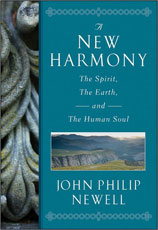
john philip newellI am currently reading John Philip Newell’s “A New Harmony: The Spirit, The Earth, and The Human Soul. It is a wonderful excursion into the depths of a modern Celtic soul which I find difficult to put down. Newell provides a new vision of what he sees as the “new Pentecost” and I’ve already discovered several sermons waiting to be written. Happily Newell will be speaking in Guelph next week and I will have the opportunity to journey further along the way with this gentle soul. I suspect that his vision of Pentecost will spark some flames of the Spirit as I prepare for the celebration of Pentecost!  A New Harmony

Newell is a poet, author, and peacemaker. He is the co-founder of Salva Terra: A Vision Towards Earth’s Healing. Formerly Warden of Iona Abbey in the Western Isles of Scotland, he is currently Companion Theologian for the American Spirituality Center of Casa del Sol at Ghost Ranch in the high desert of New Mexico.

Enjoy this video “Prayer for Creativity Chant: You Shall Be Like a Garden”. Music composed by Linda Larkin.

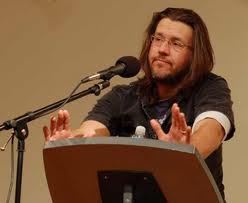
This is Water: David Foster Wallace

goldfish“Because here’s something else that’s weird but true: in the day-to day trenches of adult life, there is actually no such thing as atheism. There is no such thing as not worshipping. Everybody worships. The only choice we get is what to worship.” David Foster Wallace
– This Is Water: Some Thoughts, Delivered on a Significant Occasion, about Living a Compassionate Life

As a pastor, I am often asked to define spirituality. Over the years I have explored many definitions of spirituality; all of which fall short of capturing the experience of the awareness of the sacredness of life that I believe spirituality is. In his efforts to define the value of the value of an education, David Foster Wallace comes close to describing an awareness that is spirituality. Spirituality opens us to the awareness that there is life before death, here and now and that life is sacred. Enjoy the video. You can read the full text of the speech here

The audio comes from a commencement speech given by David Foster Wallacewallace in 2005 to at Kenyon College. The video was made after David Foster Wallace died. Wallace was an American novelist, short story writer, essayist, and professor at Poma College who has been described as “the most gifted and linguistically exuberant American novelist and short story writer of his generation. 

Remembering Who We Are: a sermon for Easter 6C

Inner Peace Kempis

Readings: Acts 16:9-15; Merger Poem (Judy Chicago); John 14:23-29

Listen to the sermon here

Merger Poem (The Dinner Party) by Judy Chicago

And then all that has divided us will merge

And then compassion will be wedded to power

And then softness will come to a world that is harsh and unkind

And then both men and women will be gentle

And then both women and men will be strong

And then no person will be subject to another’s will

And then all will be rich and free and varied

And then the greed of some will give way to the needs of many

And then all will share equally in the Earth’s abundance

And then all will care for the sick and the weak and the old

And then all will nourish the young

And then all will cherish life’s creatures

And then all will live in harmony with each other and the Earth

And then everywhere will be called Eden once again


The Raising of LOVE: the “more-than-literal” meaning of the Raising of Tabitha – a sermon on Acts 9:36-41

dorcas

“Can the ways in which we tell the stories of resurrection transform us into followers of Jesus who embody a way of being in the world that can nourish, ground, and sustain the kind of peace that the world yearns for?”  I preached this sermon on the raising of Tabitha years ago, as an attempt to convey the academic essay of New Testament scholar Rick Strelan into the form of a sermon. I believe that it is vital for preachers to convey the wealth of insights that are bandied about in the halls of academia, so that congregations can let go of so many interpretations of scripture that insult their intelligence, so that we can  begin to explore the “more-than-literal meaning” (Marcus Borg) of biblical texts. Rick Strelan’s essay appeared in “Biblical Theology Bulletin, May 1, 2009, under the title “Tabitha: the gazelle of Joppa”. 

Yesterday, I went for a walk. As I was walking along, minding my own business, a bright light appeared in the sky. The light nearly blinded me and so it took a while for me to figure out what was happening. Suddenly, it was so clear that the light was actually coming from a very large spaceship. I could scarcely believe by eyes. I stood frozen to the spot as the space ship landed in the middle of the road. You’ll never believe what happened after it landed. A couple of little green creatures with giant eyes gout out, took my picture, and then got back in the spaceship and flew off into the farthest reaches of space.

You don’t believe me, do you? You think that I’m making a joke of some sort, or maybe I’ve been working too hard and I’ve finally lost the plot. I know there’s probably nothing that I can say that would convince you that little green men have photographed me. Quite frankly that’s a relief because if you’ll believe that, you’d probably believe anything.

I do find it interesting that you won’t allow yourself to believe that I encountered aliens from another planet, and yet, you’ll suspend your disbelief when I tell you a story from the Bible. Or will you? Take our first lesson from the book of Acts.    The miraculous story of how the Apostle Peter raised a disciple named Tabitha from the dead. You all know that when someone is dead, that’s it they are dead. You can pray over them all you want, but they’re never going to sit up, let alone stand up like Tabitha. There’s about as much chance of a person standing up after they’ve actually been dead as there is little green men from outer space landing on the street outside this church.The story of the raising of Tabitha is one of those stories that we wouldn’t believe for a second if it weren’t in the Bible. I suspect that when it comes to stories from the Bible, most of us don’t really believe that they happened exactly the way the Bible says they happened. Or do we?Now maybe you’re the generous type and so you say, “Don’t be too hasty, it could happen if the person wasn’t really dead.”  I mean, maybe Tabitha’s friends got it wrong and she just appeared to be dead. The story says that Tabitha died, then her friends washed her body and laid her out in an upper room. Then, since Lydda was near Joppa, the disciples sent two couriers to Peter, who was in Lydda and they asked Peter to head back to Lydda, which was about 10 miles away. That’s a 20 mile round trip on foot with a walking speed of about 3 miles per hour it would take at least 7 hours. She was definitely dead. According to the story Peter sends everyone out of the room, knelt down and prayed and then said, “Tabitha, stand up!”  and she did just that.

The story of the raising of Tabitha is one of those stories that we wouldn’t believe for a second if it weren’t in the Bible. I suspect that when it comes to stories from the Bible, most of us don’t really believe that they happened exactly the way the Bible says they happened. Or do we? Continue reading

A Resurrection Story In Memory of Nellie, My Gran

I post this sermon, which I preached last Easter Sunday, touched by the memories it evokes. Resurrection came to my Gran this past summer. Her 100 years were and are a blessing to her family and friends. She comes to me often in so many ways; this sermon is but one. 

Tredegar, Wales the village where Nellie was born in 1911

Tredegar, Wales the village where Nellie was born in 1911

Sisters and brothers in Christ, today we gather to celebrate the greatest story ever told! Christ is risen!  Christ is risen indeed!  Alleluia! Christ is risen in you and in me. And because Christ is risen, I can welcome each of you to your very own resurrection!!!  Christ is risen in you and in me!  Alleluia!!!       

It is the greatest story ever told. Like all the best stories ever told it does not answer all our questions. Poet Mary Oliver insists that, “There are many stories more beautiful than answers.” The bible is full of great stories. The sacred scriptures contain responses to some of humanity’s greatest questions. The stories in the scriptures provide us with responses to some of our deepest longings, but those responses do not come in the form of answers. The Bible is full of stories that touch the deepest mysteries of life. The ancients knew that eternal truths are best communicated through stories, and so we plumb the depths of the scriptures’ parables, myths and similes to discover our reality. The story that bursts forth on this Easter Sunday is the greatest story ever told. It is a story told in response to our deepest reality and our darkest fear: death. Continue reading

GOOD FRIDAY. Searching beyond the talk of sacrifice to see the Good News.


Re-posted from last year.

The Church’s Good Friday obsession with talk of  “sacrifice for sin” has been breed into the bones of this particular preacher.  I have been trained to speak the language of the Church.  I know full well the many doctrines of atonement that have been proposed to explain the reasons Jesus died upon a cross.  I’ve been studying the historical context and the theological consequences of Jesus’ death for more years than I care to admit.   Yet every year, I find myself wanting to book a vacation or call in sick so that I can avoid the awesome task of preaching on Good Friday.

 I’ve put it off tackling the Good Friday texts as long as I dare.  So today, I picked up my copy of “The Last Week” by John Dominic Cross and Marcus Borg, together with my copies of John Shelby Spong’s “Resurrection: Myth or Reality” and “Jesus for the Non Religious” and spent the day in pursuit of a sermon.

What follows is not the sermon I will preach on Good Friday, but rather, the notes I made to remind myself not to fall into the trap of talking about the events surrounding Jesus’ death in the way I was trained to speak of those events.  I offer up my notes hoping that those who are engaged in the struggle of grappling with how to talk about the cross in the 21st century might find some solace in a fellow struggler’s ruminations. 

For those of you who don’t have to come up with a sermon for Good Friday, I offer these notes as my humble attempt to see beyond the rhetoric about the cross to the Good News. As always I am indebted to Dom and Jack for their scholarship. 

There are many ways in which our focus upon the cross is disturbing.   Not the least of which is the way in which we as Christians tend to talk about the crucifixion as Jesus’ passion.  I have always thought it a tragedy that we should describe the events of Jesus’ crucifixion as Jesus’ passion. I’ve always understood talk of an individual’s passion to be concern with those things that people lived for. And so to insist that Jesus’ lived to die a horrible death might sooth those who seek to turn Jesus into some sort of preordained blood sacrifice.

But for those of us who look to Jesus in search of the face of God, such talk seems is indeed a crime against divinity. For what kind of petty, sadistic god would engineer the birth of, foster the life of, and then engineer the death of a beloved child. Surely such a god is no more than a wicked illusion of our own making.

I wonder what Jesus himself would make of the god we have created. I wonder what Jesus himself would make of our Good Friday commemorations? I suspect that if Jesus is anything like the accounts of his life suggest, he would be mortified, and I mean that literally…I think that Jesus would be mortified …mortified ie shamed to death…of what has become of his life’s passion; for if Jesus’ was passionate about anything, he was passionate about life. Jesus declared, “I have come so that you may have life and live it abundantly.” Jesus’ passion was about living. Living fully, abundantly.  Continue reading

MAUNDY THURSDAY – When you don’t believe that Jesus was a sacrifice for sin!

Maundy Thursday

Re-posted from last year’s preparations for Maundy Thursday

I was asked by a colleague, “So, if you do not believe that Jesus died for your sins, then why bother celebrating the events of Holy Week?”  Behind this question lies the assumption that the only way to understand Jesus’ death is to frame it within the context of the theology of “penal sacrificial atonement” ie “we are judged to be sinful creatures, punishment is required, God sends Jesus to pay the price for our sin”.  That Anslem’s theory of sacrificial atonement was formulated in the 11th century and continues to hold sway in the minds of so many followers of Christ is a testament to the power of our liturgies and hymns to form our theology.  However, Anslem’s theory is not they only faithful way to understand Jesus’ death. 

When one seriously engages the question, “What kind of god would demand a blood sacrifice?” the answers often render God impotent at best and at worst cruel and vindictive. I have often said that atonement theories leave God looking like a cosmic son of #%#%# !

Progressive Christian theologians are opening up new ways of understanding the death and resurrection of Jesus that empower the faithful to see new possibilities. 

To my colleague, who fears that I am leading the faithful astray, and to those who find little comfort in the theories of an 11th century monastic, I offer the following notes, crafted in my preparation to lead Maundy Thursday worship.

Jesus said, “I give you a new commandment:  Love one another.   And you’re to love one another the way I have loved you. This is how all will know that you’re my disciples: that you truly love one another.”

That we should love one another is not a new commandment. There have been many before Jesus and many who came after Jesus who have commanded, advised, encouraged, implored, and even begged us to, “love one another.”

What is new about Jesus commandment is that we are to love one another the way that Jesus loved us.

Which begs the question:  How exactly did Jesus love?  Continue reading

Loss of Innocence and Innocents

BLUE HEAD 3An Advent Lament for Newtown

Listen to the sermon here

I am indebted to Rabbi Evan Moffic for reminding me of Kafka’s story of the lost doll.

We also sang Carolyn Winfrey Gillette’s “A Prayer for Our Children” which can be found here