
Listen to the sermon here


Listen to the sermon here
A sermon for the celebration of the Baptism of Jesus Mark 1:4-11
Listen to the sermon here
Wading into the waters of baptism is no simple matter for a progressive Christian. Once you leave the myth of perfection in some distant garden back there in the mists of time, reject the notion of humanity’s fall from grace as a result of original sin, and give up worshipping the sadistic image of a god who demands a blood sacrifice, it’s difficult to navigate the waters of baptism without spouting notions that the institutional church condemns as heresy. But today is the day when the church celebrates the baptism of Jesus and the stories about the baptism of Jesus that have been handed down to us by our ancestors suggest that on this day of all days, we should have the courage to follow Jesus into the river of life even if it does challenge some of our long held assumptions about what it means to be a child of God.
I venture into these troubled waters as someone who treasures the sacrament of baptism. Long before I ever entertained the idea that I might one day respond to the call to become a baptizer, I became a lover of this particular sacrament of the church. I am now, and I have always been one of those people who find it almost impossible not to shed a tear or two at baptisms. The beauty of all that hope and expectation all wrapped up in the guise of a tiny little human has a way of generating in me a watery contribution as my tears join the sprinkling to wet the babies head. When the baptized is an adult my tears flow even more bountifully. Let’s face it folks these days the reality is that infant baptisms are rare enough. Adult baptisms, especially in mainline churches are so rare that the nostalgia alone is enough to send us into spasms of uncontrollable weeping for seer joy at the thought that it is even remotely possible that someone has been able to see beyond the church’s doctrine long enough to embrace the amazing possibilities of the sacrament to provide any benefit in this the twenty-first century.
When we look back to the stories told in the synoptic gospels about the baptism of Jesus we are sometimes so distracted by the opening of the heavens, the descent of the dove and the voice of God declaring Jesus to be the beloved, that we miss an important detail of the way in which the early followers of the Way chose to tell the story of Jesus public coming out party. New Testament scholars remind us that the stories told by the writers of the gospels were written at the end of the first century; a time when it would have been clear to all those who had ears to hear, that by going down to the river Jordan to be baptized by John would have stirred up the political and religious waters. John the Baptist was a revolutionary who made no bones about the fact that the religious authorities and the political rulers were leading the people down the wrong path. John’s shouting in the wilderness was his way of warning the people to repent; to literally turn around and follow a different path. John was doing far more than ranting when he condemned the religious authorities as a brood of vipers; he was calling on the people to reject the teachings of the authorities. John’s insistence on repentance was a call to revolution, a revolution designed to overthrow the status quo. John was out there in the wilderness because it wasn’t safe for him to spout his own particular brand of incendiary fire and brimstone rhetoric within earshot of the authorities. By going down to the River Jordon and submitting to John’s baptism of repentance Jesus was choosing to identify himself with a political revolutionary.
That the writers of the gospels chose to tell there story in ways that see the God of Israel give Jesus a shout out, and the very spirit of God descending like a dove onto the shoulders of Jesus, turns John’s baptism of repentance into a kind of passing of the torch from one revolutionary to the next. Yet, despite the gospel-writers having cast Jesus into the role of revolutionary torchbearer none of the gospel writers shows Jesus following the ways of his predecessor John. There is no record of Jesus calling people to repent nor is there any record of Jesus ever having baptized anyone. All we have is Jesus “Great Commission” which if New Testament scholars are to be believed, Jesus probably never even said, “go therefore and baptize them in the name of the Father and of the Son and of the Holy Spirit.” Yes, it’s true, most preachers, dare I say modern-day baptizers, learned in seminary that rather than being an instruction given by Jesus the Great Commission was actually added to the story by the early followers of Jesus. But I digress, the point I’d like to emphasize about Jesus’ trip down to the waters of the Jordan, is that by choosing to publicly submit to John’s baptism, Jesus was making an important statement about his own public ministry. For just like John, Jesus intended to challenge the religious and political authorities. Continue reading
 Each year, I begin my preparations for preaching on the Baptism of Jesus with this video in which Heather Murray Elkins tells her story, “The Secret of Our Baptism.” Elkins opens us to a new way of hearing the Bat Col, the Daughter of a Sound, the Voice of the Divine, the Word, who speaks in this Sunday’s Gospel reading. Mark 1:4-11

 I have just completed reading James Carroll’s latest book “Christ Actually: The Son of God for the Secular Age” for the second time. I know that I will read it many more times as I continue my own work of articulating an understanding of Jesus for the 21 century. Carroll’s way of exploring Christianity has always been enlightening and refreshing because he has the courage to question the tradition from the vantage point of someone who has lived the tradition with passion. Carroll is former Roman Catholic priest who now serves as Distinguished Scholar-in-Residence at Suffolk University and is a columnist for The Boston Globe, whose books include: “Constantine’s Sword: The Church and the Jews,” “American Requiem: God My Father,” and the “War That Came Between Us, Crusade: Chronicles of an Unjust War,” “Toward a New Catholic Church: The Promise of Reform,” as well as eleven novels.
Carroll’s critique of Christianity is infused with a sense of responsibility for the ways in which our anti-Jewish texts have misremembered the story of Jesus. His exploration of first century history points to the profound influence of the Roman destruction of the Temple in 70 C.E. upon the way in which the gospel-storytellers crafted their accounts of Jesus for their late first century communities. Insisting that we must measure everything we say about Jesus now against Jesus’ Jewishness, Carroll asks a compelling question: “What if the so-called divinity of Jesus lays bare not so much the mystery of God as it does the majesty of what it means to be human?” Carroll sees that the divinity of Jesus in some way suggests the Divinity in which we all participate. Carroll’s work is a must read for those of us who are working to articulate a 21st century Christology!
The video below was recorded at First Parish in Cambridge on Wednesday, December 10, 2014
 Thanks to science and all we have learned about creation, we are beginning to develop new images of the ultimate reality we call God. New images of God challenge the patriarchal misogyny of religious traditions. When it comes to re-imagining the faith, Sister Joan Chittister paints a picture of God as One Who Summons from among us – Emmanuel. The Summoning One calls and encourages us toward a world of equals. “Evolution is shedding new light on our lives.”
The art of blessing is often neglected. The birth of a New Year calls forth the desire in us to bestow a blessing upon those we love. Several years ago, John O”Donohue, one of my favorite Irish poet’s created a New Year’s blessing for his mother entitled Beannacht-for Josie. It is a blessing of superior quality. And so, on this New Year’s Eve, may you all receive this beannacht with my added blessing for a peace-filled New Year in which the God in whom all of creation is held, might find full expression in your miraculous life!

For those who are preparing to preach on Matthew 1:1-12 this coming Sunday, Jack Spong provides an important view of the context.
A sermon preached on the Second Sunday after Christmas – the readings for this sermon include: John 1:1-9, The Gospel of Thomas 70; Matthew 2:1-12. You can listen to the sermon here
Two cars were waiting at a stoplight. The light turned green, but the man didn’t notice it. A woman in the car behind him was watching traffic pass around them. The woman began pounding on her steering wheel and yelling at the man to move. The man didn’t move. The woman started to go ballistic inside her car; she ranted and raved at the man, pounding on her steering wheel. The light turned yellow. The woman began to blow her car horn; she flipped off the man, and screamed curses at him. The man, hearing the commotion, looked up, saw the yellow light and accelerated through the intersection just as the light turned red. The woman was beside herself, screaming in frustration because she missed her chance to get through the intersection. As she is still in mid-rant she hears a tap on her window and looks up into the barrel of a gun held by a very serious looking policeman. The policeman tells her to shut off her car while keeping both hands in sight. She complies, speechless at what is happening. After she shuts off the engine, the policeman orders her to exit her car with her hands up. She gets out of the car and he orders her to turn and place her hands on her car. She turns, places her hands on the car roof and quickly is cuffed and hustled into the patrol car. She is too bewildered by the chain of events to ask any questions and is driven to the police station where she is fingerprinted, photographed, searched, booked, and placed in a cell.
After a couple of hours, a policeman approaches the cell and opens the door for her. She is escorted back to the booking desk where the original officer is waiting with her personal effects. He hands her the bag containing her things, and says, “I’m really sorry for this mistake. But you see, I pulled up behind your car while you were blowing your horn, flipping that guy off, and cussing a blue streak at the car in front of you, and then I noticed the “What Would Jesus Do” and “Follow Me to Sunday School” bumper stickers, and the chrome plated Christian fish emblem on the trunk, so naturally I assumed that you had stolen the car.”
We can scoff at this, but I must tell you that one of the things I had to learn when I first began to wear a clergy collar was that I could no longer give people the finger when I was driving. If you give people the finger when you are driving, it’s not you giving that person the finger but the whole of Christian Church; people will use your outburst to condemn the hypocrisy of the entire church.
During Advent we used a question from Meister Eckhart not once but twice during each of our worship services: “What good is it to me if Mary gave birth to Christ twenty centuries ago and I don’t give birth to Christ in my person and my culture and my times?” And now, in this the last day of Christmas, I find myself wondering what it actually means for Christ to be born in me or in you. Continue reading
 An Epiphany Sermon, preached in 2008. I had just read “The First Christmas” by John Dominic Crossan and Marcus Borg. Our congregation played host to Dom Crossan a month before I wrote this sermon. So, Dom’s insights run through this effort. But the heart of this sermon beats as the result of a sermon preached by Bruce Sanguin a self-proclaimed evolutionary christian who is a United Church Minister (Canadian Memorial Church, Vancouver). I had the privilege of meeting this modern mystic while on sabbatical this summer and his compelling way of unlocking the scriptures using the wealth of the christian tradition together with the insights of modern science and psychology borders upon the poetic. This sermon was anchored by Sanguin’s words (Epiphany 2007). Sermons are a “live” event. So, this manuscript is an approximation of what was actually preached.
Just five days before Christmas (2008), The Archbishop of Canterbury, The Most Reverend Doctor Rowan Williams, the leader of the worldwide Anglican Communion started a firestorm. During a BBC interview, His Grace was quoted to say that the story of the “three wise men is a legend”. The Archbishop was also heard to say that he remained unconvinced that there was indeed a star that led the legendary trio to the birth place of the Christ Child.
If that wasn’t enough to send folks off the deep-end, it has been revealed that the Presiding Bishop of the U.S. Episcopal Church The Most Reverend Doctor Katherine Jefferts Schori, who just happens to be the first woman elected primate in Anglican history, has fanned the flames of the fire-storm by sending out what has been judged by some to be an incendiary Christmas card.
I downloaded a copy of the offensive card, so that you could see for yourself. Her Grace’s choice of card has offended the good deacons of Ft Worth Texas who claim that their Primate’s actions defy explanation. As you can see the wise folks depicted on this image look a lot like women. Can you imagine the nerve of the first woman primate! How could she be so bold as to select such an offensive image? Leave it to straight talking Texans to set things straight: for despite the audacity of the Primate, the Texans have pledged to “stand for the traditional expression of the Faith.” Continue reading

Do you see the baby?
Some of us have followed the star, we have journeyed to Bethlehem and we have seen the ONE who comes into the world as a child. Now what? Do we see the needs of the child? Are we ready to roll up our sleeves and be about the work of ushering in the Reign of Justice that this child, any child needs in order to live in peace? I wonder?
I still hear the echoes of Rachel’s voice weeping unconsolable in Ramah; weeping for the lost children of every town where violence, greed, madness or neglect robs the child of those things that belong to children: playful laughter, safe homes, warmth, nourishment, learning, embraces, peace….a future.
Mystic, poet, philosopher, and theologian Howard Thurman’s poem “The Work of Christmas” comes to me as a challenge for the days, months and year ahead:
When the song of the angels is stilled,
When the star in the sky is gone,
When the kings and princes are home,
When the shepherds are back with their flock,
The work of Christmas begins:
To find the lost,
To heal the broken,
To feed the hungry,
To release the prisoner,
To rebuild the nations,
To bring peace among brothers,
To make music in the heart.
The Herods of this world have had their way for far too long. Let the slaughter of innocents end. We have seen the child and we know the wonders of a star-lit peace-filled night. So, let the work of Christmas begin with all of us seeking justice and making peace so that children everywhere can grow in LOVE. Shalom!
 I have tried to locate the source of the parable told in this sermon about the encounter between the little boy and the old woman. But despite the many authors who claim it as their own, I suspect that its origins go back farther than I have been able to trace. The Readings for this first Sunday after Christmas offer us the parable of the Presentation of in the Temple: Psalm 42:1-3, Galatians 4:4-7, Luke 2:8-20
You can listen to the sermon here
 While the world hurdles toward the New Year celebrations, we linger in the Twelve Days of Christmas. I do believe that the counting begins on the first day after Christmas; which means this is only the Third Day of Christmas. That means there is still time to enjoy the music of Christmas and so, I offer up one of my favourite singers: Odetta proclaiming the Good News in her own splendid style with Go Tell it on the Mountain.
 During these twelve days of Christmas we celebrate the birth of the Messiah. Messiah, is a word the ancient Hebrews used to describe the anointed one. The one whom God would send to change the world. In Greek the word for Messiah is Christ.
My thoughts swirl around a poem written by the unknown writer of the Gospel of John in which the birth of the Christ is describe as the WORD. It’s a mysterious cosmic poem that moves our minds away from the mundane everyday ordinary stuff of life to the extra-ordinary mysteries of creation, which when you think about it is what every birth does.
Just holding a newborn in your arms and before long you’ll find yourself pondering the mysteries of this life. Who are we and where do we come from? Why are we here? What does it all mean? These are all perfectly wonderful questions and speculating upon the many possible answers to those questions is a fascinating process. But in the end, our words will always fail us when it comes to answers. As we are speculating about the birth of this beautiful little baby, the baby is alive and among us, and needs to be fed and changed, nurtured, guided and protected.
Our speculations about the mysteries of creation are a little like our preparations for Christmas. All the preparations, the decorating, the shopping, the wrapping, the stuffing, the cooking, and the worrying, and in the end all our preparations aren’t really the point. The point is Christmas-tide is now and the guests are all around we’ve arrived and the Messiah has arrived, or not, its up to us to welcome the One who is Love in our midst, to celebrate Christmas.
The trouble is that sometimes, we are so preoccupied with the preparations, with the idea of getting it right that we forget the whole point of Christmas is the celebration itself; the gathering of the clans, the being with one another, the opportunity to be present to one another. It’s one of the reasons why I love the stories that the unknown writers of the gospels of Matthew and Luke put together. In those familiar tales we hear a story of a couple of parents who were not at all prepared to welcome a child into the world. It’s an earthy story that brings the pungent aroma of a animal dung right into our carefully decorated living-rooms. And the Messiah that we greet in the story found in Matthew has no halo hovering over his head. The writer of Matthew makes it very clear that the Messiah comes from a very dubious pedigree, numbering a prostitute, a product of incest, an adulteress and sexual trickster among his ancestors. The Messiah’s parents were an unwed teenage girl and an unspeaking father, who wasn’t a father, and the pair of them appear to be homeless and then on the run, seeking shelter wherever they can find it.
Our romantic notions of a pretty little stable will have to wait a thousand years for St Francis to pretty up and launch us on a quest for cattle lowing, shepherds kneeling and magi bowing. Our expectations of the Messiah have become so very highfalutin, so otherworldly that I wonder if we are really prepared to welcome the Messiah among us. We hardly know what to expect from the Messiah. Are you really ready to welcome the Messiah? What do you expect?
There’s an old Jewish story, I can’t remember where I first heard or read it. I suspect I might have learned it from Scott Peck? The story is now deep in my bones. It surfaces most Christmas mornings to remind me that Christ is born in us.
Once there was a monastery with a long history of commerce and a thriving spiritual community. But as time wore on, fewer and fewer villagers visited the hallowed halls. Fewer people turned to the monastery for advice. Even the sale of their famous wines began to dwindle. The abbot began to despair for his community. “What should they do?” he wondered.
They prayed daily for guidance, but the brothers only became more dispirited. The monastery itself reflected their mood, becoming shabby and untidy. At last the Abbot, hearing that a wise Jewish rabbi was visiting, swallowed his pride and went to visit the rabbi to ask his advice. The abbot and the rabbi visited for a long time.
They talked of their respective religions, and the fickleness of human nature. The abbot explained his problem to the rabbi and asked for advice, but the Jewish sage only shook his head and smiled.
As the abbot sadly departed, the rabbi suddenly rose and shouted after him, “Ah, but take heart my friend for the Messiah lives amongst you!” All the way home the abbot pondered the rabbi’s words, “The Messiah lives amongst you.” What could he mean? Did the Messiah live in the abbey? The abbot knew all the brothers very well. Could one of them really be the Messiah? Surely he, the abbot, was not the Messiah… Was it possible?”
Upon reaching the monastery the abbot confided the rabbi’s words to another brother, who told another brother, who was overheard telling another brother. Soon the whole abbey had heard the news. “The Messiah lives amongst us!” “Who do you suppose he could be?”
As each brother speculated on who the Messiah could be, his view of his brothers began to change. Brother Louis no longer appeared simple, but rather innocent. Brother Jacques was no longer uncompromising, but rather striving for spiritual perfection.
The brothers began to treat each other with greater respect and courtesy; after all, one never knew when he might be speaking to the Messiah. And, as each brother discovered that his own words were taken seriously, the thought that he might become the Messiah would cross his humble mind. He would square his shoulders and attend his work with greater care and start acting like a Messiah.
Soon the neighboring villages began to notice the change that had come over the monastery. The brothers seemed so happy. Villagers flocked to the monastery and were energized by the spirit of the Brothers. And so the spirit grew and the monastery flourished. As each new brother was welcomed, the question arose, “Could he be the Messiah?”
Apparently the monastery still prospers today and it is often whispered both within its walls and in the surrounding towns that the Messiah lives amongst them. As you celebrate Christmas this year, remember that the Messiah lives among you.
If you are waiting for perfection, Christmas is going to be a lonely and frustrating time. If you are waiting for some future time, the wonders of this moment will pass you by. If you are expecting salvation outside yourself, you might miss your own wisdom. If you hold your loved ones to impossible standards you just might miss the Messiah who sits right next to you. I know that you’ve worked hard, and made all kinds of preparations, but today is the day it’s time to greet the Messiah, now. Don’t miss a moment of it. Enjoy. The Messiah arrives in you and right next to you! Enjoy!
 This sermon owes much to the work of Richard Rohr whose work opens me to the LOVE who lies at the core of REALITY, the ONE we call God. The source of the story that I tell about a Christmas Eve way back when has been lost to me. I cannot remember when I first heard it. It’s power to open me to the LOVE that is God remains with me and so I treasure the story and tell it so as to open others. To open ourselves to the cosmic nature of the Christ we used different scripture readings. The readings can be found here
You can listen to the sermon here
On this blessed Christmas Eve, I suspect many are rushing around trying to finish every last thing. This little video entitled, “The Christmas Scale” reminds me of the importance of the pauses! May you find a moment or two today to slow down, breathe and enjoy the Joy in those pauses. Happy Christmas!!!
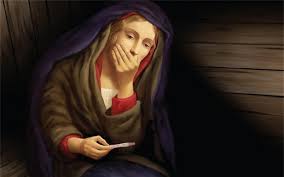 Flipping through Bruce Sanguin’s collection of sermons, “The Advance of Love: Reading the Bible with an Evolutionary Heart,” I was opened to a new way of pondering the myth of the “virginity” of Mary in Sanguin’s sermon on Luke 1:26-38 entitled “The Future Calls.”
Sanguin writes, “What about the virgin birth? Despite being a mistranslation of a passage from Isaiah that speaks of a “young woman” and not a virgin, this story has tuck. But let’s explore if at face value. One of the most subversive meanings is captured in a single line from a Bruce Cockburn Christmas song: “Mary grows a child without the help of a man.” The assumptions of patriarchy–that men are favoured ones, that all good things must happen through the male gender, that men should hold all the power, and that women are naturally subservient–are overturned in this single detail. The virgin birth has nothing to do with concern over sexual impurity. The Jewish tradition affirms the body and sexuality as a gift of God. The myth of the Virgin birth is announcing the end of an age, patriarchy, and the beginning of a new creation in Christ. To be Christian is to consent to equality. We are now certain that one of the most radical features of the early Christian church was that women enjoyed equal status with men–unheard of anywhere in the world in the first century. It too men in the church a couple of centuries to wrest control back and exclude women. But the story stands in its affirmation that the world can run just fine without the illusion of the necessity of male dominance. In this story, Spirit bypasses patriarchy in the conception and birth of a new humanity, symbolized by the birth of Christ.”
Would that Sanguin’s reading of the gospel-storyteller’s intention were true! Sadly, whatever glimmer of hope for the end of the age of patriarchy may have been present at the turn of the first century, that glimmer was extinguished over and over again in the succeeding centuries. The slim flickers of equality do continue to burn. But that we need to continue to live in hope rather than the reality of equality is born out by the recent bad news of the downfall of cherished heroes like Bill Cosby and Jian Ghomeshi. That men of such prominence in our society should have resorted to dominance over rather than equality with women, bears testament to the reality that patriarchy continues to haunt our lives together. The peace we all long for continues to be threatened by the violence of patriarchy’s firm grip upon the psyche of so many.
While Cosby and Ghomeshi are but puny players upon the stage our media has erected to exhibit the morays of our culture, they are indicative of our delusional insistence that we have defeated the horrors of patriarchy. In a world where young girls continue to be abducted and sold into the slavery of the sex-trade, where so-called honour-killings continue, where little girls are shot in the head for daring to seek and education and we in the West respond by wringing our hands or turning away, we should not be surprised that our celebrated heroes should believe themselves to be impervious to rebuke.
The crimes, indeed the horrors, which have been perpetrated and continue to be inflicted as a result of the continued inequality between women and men cannot all be linked to the church’s insistence that Jesus was born of a “virgin.” But the church must confess our culpability, for our structures and theologies uphold the delusions of the deranged who continue to cling to the power that patriarchy affords them.
So this Christmas, as the myth of Mary’s virginity continues to haunt us, listen carefully and hear the cries of the Daughters of Jerusalem as they bewail the plight of the One we call the Christ. Listen to that One who responds to their cries, “Daughters of Jerusalem, don’t weep for me! Weep rather for ourselves and for your children!” And when our weeping is done, let us rise up in unison and equality to tend the wounds that patriarchy has wrought upon the earth so that this Christmas the “birth of a new humanity can be symbolized by the birth of Christ.” We can begin by remembering that Jesus of Nazareth was, in the words of the Apostle Paul, “born of a woman,” a powerful woman indeed!
 The story told in this sermon can be found in Maeve Binchy’s book of short stories “This Year it Will be Different.” As always I am indebted to those progressive grinches Marcus Borg, John Dominic Crossan, John Shelby Spong, and Michael Morwood for their insights into the sacred. Our sermon hymn was No Obvious Angels. The readings were all from Luke 1:1-56.
You can listen to the sermon here
One of my favorite Christmas movies. Produced in England in 1952, there is no sentimentality here. The story is raw and engaging. Clergy will hear the echoes of their lives in the frustration and doubts expressed by the Parson who is brilliantly portrayed by Ralph Richardson. This movie was censored in the United States because too many of the characters do not believe in God and say so. The ending does not resolve their unbelief. It is a brilliant snapshot of another time that reminds us that the good old days never really where. I love this film’s honest unresolved angst. Enjoy!

 pastordawn