Leap of Doubt – How Do We Believe Resurrection? – an interactive sermon (Easter 2)

Leap of Doubt pastorDawnThis sermon is an interactive exploration which was recorded last year. It provides a timely reminder of the journey we have been on in our progressive Christian community. Below, you will find the text of my introduction to this powerful conversation which took place in the midst of an internet furor that erupted on the internet following several posts in which I denied the resurrection of the body.  Many thanks to the people of Holy Cross for their participation and to Peter Rollins for his beautiful words from his book Insurrection. Readings:  John 20:1-18, Philippians 3:10-14, John 20:19-31

Listen to the sermon here 

“They gathered in an upper room and the doors were locked because they were afraid of the religious authorities.” While I struggled to write this morning’s sermon, I was tempted not to lock the doors but rather to make sure that the recording device was turned off when I preached on the resurrection. I thought that I might just have a bit of a lock in, just you and me, no recording for our followers on the internet, so that together we could explore the ways in which some of us are beginning to understand the meaning of resurrection. Whenever I have posted anything on the resurrection, traffic on the blog goes up. Some visitors are just like us, trying to find ways to understand resurrection in light of all that we are learning about the nature of the cosmos There are some visitors who stop by the site to confirm their suspicions that I am a heretic and they take great delight in reporting my heresy to the religious authorities.

When letters are written in which charges are made and discipline is demanded those letters usually make reference to something I’ve posted on the subject of resurrection.So, rather than incur the wrath of those who know for sure that Jesus physically rose from the dead, I thought why not just turn off the recorder and have a private conversation among ourselves about the nature of the resurrection, not because we are afraid of the religious authorities, but just because we’d be able to go much further if we didn’t have to worry about the people who know exactly what happened But then I remembered an email that I received during last year’s Easter season. The email came from a life-long Lutheran who had been struggling to believe in the resurrection; let’s call him FRED…

Fred lives in Alberta of all places. Fred is tempted to leave his congregation, because every time Easter rolled around and he heard the story of Thomas’ encounter with the risen Christ, he knew that if he’d been Thomas he would have stuck his fingers in those wounds just to make sure that they were real. Fred wrote that during the Easter season he feels like a hypocrite because for the life of him he cannot bring himself to believe in the physical resuscitation of a corpse. Fred’s pretty sure that the people sitting in the pews with him each Sunday are also struggling to believe in the physical resuscitation of a corpse but none of them are willing to take the risk of saying anything about their struggles for fear of the religious authorities. So, even though it’s tempting to turn off the recording and lock our doors, so to speak, let’s throw caution to the wind, trusting that the wind; the breath, the Ruach, the Spirit will live and breath in, with, through and beyond us. So, I hope that you are willing to engage in as open a conversation as we can have together about the nature of the resurrection, knowing that people will be listening in to our conversation.

Now we have been blessed in this congregation by having enjoyed multiple visits from two of the world’s leading progressive Christian thinkers; John Shelby Spong has been here three times and John Dominic Crossan has been here twice and we have learned a great deal from both of them. But despite all the work we’ve done studying the historical and theological materials that have been generated about the resurrection, I suspect that just like Fred, some of us, myself included, are left wondering exactly how a 21st Century Christian can reconcile our expanding knowledge of the cosmos with the church’s teachings about resurrection

So, I’m going to stop talking for a bit and take a big risk here and ask you to be brave and share your thoughts about the resurrection…..Now I realize that this is a big subject, so let me help you with a question: Do you think it necessary to believe that Jesus physically rose from the dead in order to call yourself a Christian?  What do you think happened? Is resurrection physical, or more than physical?

Conversation. At the end of our conversation I reminded the congregation of Peter Rollins powerful words on Resurrection

 Peter Rollins: “Without equivocation or hesitation I fully and completely admit that I deny the resurrection of Christ. This is something that anyone who knows me could tell you, and I am not afraid to say it publicly, no matter what some people may think… I deny the resurrection of Christ every time I do not serve at the feet of the oppressed, each day that I turn my back on the poor; I deny the resurrection of Christ when I close my ears to the cries of the downtrodden and the oppressed. Every time I do not serve my neighbour, every time I walk away from the poor. I deny the resurrection every time I participate in an unjust system. However there are moments when I affirm that resurrection, few and far between as they are. I affirm the resurrection when I stand up for those who are forced to live on their knees, I affirm the resurrection when I speak for those who have had their tongues torn out,  I affirm the resurrection, when I cry for those who have no more tears left to shed. I affirm the resurrection each and every time I look into your eyes and see the face of Christ.”

Christ has died. Christ has risen. Christ will come again and again. This is the mystery of our faith. Christ is Risen! Christ is Risen Indeed! Alleluia! Christ is risen in you and in me and beyond you and I. In the words of Martin Luther:  “This is most certainly true!” Can I get an Amen?

Other sermons for the Second Sunday in Easter: 

Humpty Dumpty, Doubting Thomas, and Resurrection click here

Oh Me of Little Faith: reflecting upon Doubting Thomas click here

Practicing Resurrection click here

Is God Coming Back to Life? – an Easter Sermon from 2014 – with links to previous sermons

time god coversThis sermon is the second of a two parter which began on Good Friday (you can find that sermon here). It is the fruit of conversations that have been going on at Holy Cross Lutheran Church for a number of months. I am indebted to the members of the congregation for their courage, wisdom and curiosity which they so graciously share. I am indebted to Dom Crossan, Jack Spong, Barbara Brown Taylor, Michael Morwood, and Dick Rauscher whose work has inspired and emboldened me in my preaching. You can listen to the sermon below and I have also provided the manuscript (which is never quite the same as what comes out from the pulpit) Shalom. 

Links to previous sermons:  Easter: Yes, Yes, Yes, Laugh – here 

Easter: The Greatest Story Ever Told – here

I Plead Guilty to Denying the Resurrection – But I aint’ leaving – here

Preparing to Preach on Resurrection: Giving up the notion of a physical resuscitation. here

Approaching Resurrection: What Did Paul Actually Say – here

A Resurrection Story In Memory of Nellie, My Gran – here

On Good Friday we gathered here to grieve the death of God. I began my Good Friday sermon with the Parable of the Mad Man that was written by Frederich Nietzsche back in 1882. The mad man in the parable goes around announcing that God is dead. The parable gained notoriety 1966 when an issue of Time Magazine asked the question: Is God Dead? The question appeared on the cover of the magazine and created quite a stir. It referenced Nietzsche’s parable as the inspiration behind the “God is dead movement” which insisted that “man” has killed God because “man” has evolved beyond our need for gods.

So, on Good Friday my sermon took a long hard look at the god who is indeed dead. In my sermon, I grieved the death of The Father-god, the Sky-god, God the grand puppeteer, who watches over us like a kindly shepherd, and listens to us, and interferes on our behalf, and judges us and longs to welcome us into heaven, but is willing to let us languish in hell if need be.

I pointed out that parables like the parable of the mad man are stories that tell us what we already know and Nietzsche’s Mad Man was right, this god that so many of us have loved and worshipped for so many years is indeed dead; sacrificed on the altars of reality.All that we have learned about the cosmos; all the scientific breakthroughs, our technologies, our philosophies, biblical scholarship and our evolving theologies have killed the personification of god that we once worshipped and adored.

I looked upon the cross and I wept because the death of the personified god is not easy to bear and I miss the Father-god because I really did love him, and he really did save me. For most of my life the personification of God was the only way I had of knowing anything of the Force that lies at the very heart of reality. God is dead; the Father God, the Sky God, the kindly Shepherd that I was counting on to make me lie down in green pastures, is dead. Our science, technology, philosophy, history, and our theologies have killed this personified deity that we both feared and adored.  God is dead and we have killed him.  Continue reading

Preparing for Maundy Thursday: When you don’t believe that Jesus was a sacrifice for sin!

MAUNDY THURSDAY SERMONS:

Click here for Two Suppers – Maundy Thursday- A Strange Night

Click here for Scuffed Up Reddish Pumps

Click here for Is This A Big Hoax?

I was asked by a colleague: “So, if you do not believe that Jesus died for your sins, then why bother celebrating the events of Holy Week?” Behind this question lies the assumption that the only way to understand Jesus’ death is to frame it within the context of the theology of “penal sacrificial atonement” ie “we are judged to be sinful creatures, punishment is required, God sends Jesus to pay the price for our sin”. That Anslem’s theory of sacrificial atonement was formulated in the 11th century and continues to hold sway in the minds of so many followers of Christ is a testament to the power of our liturgies and hymns to form our theology.  However, Anslem’s theory is not they only faithful way to understand Jesus’ death. 

When one seriously engages the question, “What kind of god would demand a blood sacrifice?” the answers often render God impotent at best and at worst cruel and vindictive. I have often said that atonement theories leave God looking like a cosmic son of #%#%# ! Progressive Christian theologians are opening up new ways of understanding the death and resurrection of Jesus that empower the faithful to see new possibilities.

To my colleague, who fears that I am leading the faithful astray, and to those who find little comfort in the theories of an 11th century monastic, I offer the following:

Jesus said, “I give you a new commandment: Love one another. And you’re to love one another the way I have loved you. This is how all will know that you’re my disciples: that you truly love one another.”

That we should love one another is not a new commandment. There have been many before Jesus and many who came after Jesus who have commanded, advised, encouraged, implored, and even begged us to, “love one another.” What is new about Jesus commandment is that we are to love one another the way that Jesus loved. Which begs the question:  How exactly did Jesus love?

I believe that Jesus loved in ways that I am only beginning to understand. I believe that Jesus was so open to the power of the LOVE that is God; that Jesus was able to live his life fully without fear.

I believe that Jesus wanted more than anything else for his followers to be so open to the power of LOVE that is God so that they too would live their lives fully without fear.

I believe that that’s what Jesus meant when he said, “I have come that you might have life and live it abundantly.”

I believe that Jesus lived life abundantly and that means that he loved abundantly and without fear.

Jesus was so open to the power of LOVE that is God that Jesus would not let the powers of darkness stop him from loving and living fully.

The kind of LOVE that Jesus embodied and taught has no boundaries.  No darkness, no power, no fear, not even death can limit the power of LOVE.

For if LOVE is limited by death, then love will always be qualified and quantified.

That Jesus was willing to LOVE without boundaries, came at great cost to himself.

But Jesus was willing to pay that price in order to show  others the way.

The way to LOVE without limit, without fear, without boundaries.

LOVE without boundaries is abundant life.

That Jesus’ LOVE endured the worst that the world could send his way, that Jesus’ LOVE was for all the world, dead and buried, and yet bursts free from the grave, bears witness to the power of LOVE.

That Jesus LOVE could not be destroyed, not even by the thing we fear the most, death itself, saves us from the need to fear death.

Jesus has shown us the way.

We can live abundantly lives that are free from the fear of death. Because Jesus has shown us the way we are free to live fully, to love extravagantly and be all that we were created to be.

LOVE shines in the darkness and darkness shall not overcome LOVE.

If Jesus, life, death, and resurrection teach us anything, surely they teach us not to be afraid.

Not to be afraid of the darkness.

Not to be afraid of living fully.

Not to be afraid of loving extravagantly.

Not to be afraid of the powers of evil.

Not to be afraid of the power of death.

LOVE will endure.

All will be well.

Jesus can’t save us from life.

There is evil to contend with.

There will be darkness and there will be death.

Jesus couldn’t save himself and he cannot save us from life. Darkness and death are part of life.  Each of us must walk into the darkness that lies before us.  We can beg God to take the cup from us!  But the darkness will still come.  And there will be days when the darkness will triumph.  There are good Fridays too many to mention out there.  We can shout all we want for Jesus to save us, but in the end we too will have to take up our cross and find a way to follow Jesus into the darkness and beyond, trusting that even though it feels for all the world that God has forsaken us, we will make it beyond the darkness.

The cross will not look the same for each of us. But there will be crosses to bear. Jesus has showed us the way. If we are to follow Jesus, then we must love one another they way that Jesus loved.  It is the way beyond the darkness. Do not be afraid of evil, of death, or of the darkness. Follow Jesus who by love frees us from the power of darkness to hold us captive to our fears so that we can have life and live it abundantly.

How exactly did Jesus love?

Without limit.

What did Jesus save us from?

Our fears.

Faith and Begorrrah – A St. Patrick’s Day Sermon

Tomorrow is  St. Patrick’s Day and I was asked about the sermon I preached two years ago when the celebration fell upon a Sunday. The person who asked about the sermon remembered laughing a lot during its delivery and encouraged me to re-post it. So, pour yourself a glass of your favourite tipple, sit back and enjoy a laugh.

Readings:  Numbers 27: 1-11; Acts 13:44-51; John 12:1-8

guinnessbeerSt. Patrick’s Day doesn’t often fall on a Sunday, but as our congregation’s Annual Meeting would begin immediately following our worship service, I decided to be somewhat playful and irreverent with a sermon designed encourage folk to think beyond words on a page. The first reading brought the wonderful story of the Daughters of Zelophehad to church and as this reading does not appear in the Revised Common Lectionary it was fun to play withirish these feisty women. The reading from the book of Acts is actually the prescribed reading for the commemoration of St. Patrick and the Gospel text is prescribed for Lent 5C. The Guinness was just for fun! Enjoy.

Read a transcript of the sermon here

Listen to the sermon

https://pastordawn.com/wp-content/uploads/2013/03/st_patricks_sermon.m4a

Irish Twelve Days of Christmas

This blog is made possible thanks to the support of the people of Holy Cross Lutheran Church. Holy Cross is a small progressive congregation with a wide variety of ministries. Like all small congregations, we engage in various fund-raising activities to support the work we do. The video below is from Songs for the Season a fabulous set of fund-raising concerts. Our own incomperable Gary Curran takes on the persona of Gobnait O’Lúnasa as he preformed Frank Kelly’s “Christmas Countdown”. Accompanying Gary is the fabulous Marney Curran. A great time was had by all!  On the GIVING TUESDAY, if you enjoy this blog, please consider mailing a donation to Holy Cross Lutheran Church 1035 Wayne Dr., Newmarket, On. L3Y 1N3, so that we can continue host this site!

Women of Courage – a sermon

Women of Courage

The worship service prepared the congregation for the Women of Courage event highlighting the stories of Canadian Aboriginal Stories which followed. Pastor Tom Doherty preached a powerful sermon on power directed pointedly to men. You can listen to the sermon here

Wolf Blitzer Learned that there are Indeed Atheists in Fox-holes! – a sermon for Trinity Sunday

Eckhart rid me of GodThis Trinity Sunday sermon owes much to John Shelby Spong’s book a “New Christianity for a New World” You can listen to the sermon here then watch the tail end of the Wolf Blitzer interview mentioned in the sermon.   

In the midst to the devastation and debris that was left of the town of More, Oklahoma, it was all to clear that the power of the tornado that whipped through such a heavily populated area had left behind the kind of destruction that tears not only the foundations of buildings but also of lives. In living rooms around the world millions of people watched as the news media descended on what was left in the wake of nature’s wrath. One particular news report is still reverberating around the Internet. I had just come from my office where I had spent the afternoon, reviewing the Doctrine of the Trinity in order to write this sermon. My wife Carol was in the kitchen cooking supper and I sat down to catch up on the news events of the day. I tuned into CNN and there amidst the rubble of More Oklahoma was the familiar face of Wolf Blitzer. It was the day after the tornado and the big name newscasters had been rushed to the scene in time to provide color-commentary on the evening news. Wolf was interviewing a young mother named Rebecca Vitsmun who was holding a squirming her 19 month old, toddler Anders in her arms. The young mother gave a blow-by-blow account of her narrow escape from. All afternoon Rebecca was paying attention to the weather reports. Rebecca was not from More, but rather from New Orleans and so she was not used to tornado warnings. She’d grown up with Hurricane warnings and so her first instinct was to evacuate the area. But her husband and neighbours had told her that the safest thing to do would be to take shelter. Six-teen minutes before the tornado struck the weather service issued a warning to take shelter. As Rebecca’s husband raced home from work, this young mother grabbed her laptop, a mattress and her toddler and took shelter in the bathtub. Huddled in the tub covered by a mattress she anxiously watched the reports on her laptop. Tracing the path of the tornado, Rebecca realized that the tornado was headed straight for her street. Rebecca’s New Orleans’ instinct kicked in and with her baby in her arms she jumped into her car and without taking time to put her baby in the car seat, she drove as fast as she could out on to the freeway where she pulled over and put Anders into his car seat and then drove some more. After the tornado, Rebecca reunited with her husband, and they headed back to what was left of their home. The bathtub was so full of debris that it was clear to them that Rebecca’s instincts had saved her life.

After telling her harrowing tale, Wolf Blitzer congratulated Rebecca for saving her baby’s life and then said to this young woman, “You gotta thank the Lord.” Rebecca was clearly taken aback by the comment and hesitated. I held my breath, annoyed as hell at Blitzer for asking such a stupid question. Rebecca’s hesitation gave Blitzer the opportunity to move on, but no he just had to have an answer, and so he persisted. “Do you thank the Lord?” Rebecca gave Blitzer the kind of look that says, “Are you kidding me?” Then Rebecca gave Blitzer an answer that he sure wasn’t expecting from an American from the heartland of Oklahoma; Rebecca smiled as she answered, “I’m actually an atheist.”

As Rebecca laughed awkwardly, I cheered so loudly that Carol came into the room to see what was going on. I was so proud of that young woman for not going along with Blitzer’s nonsense. Who in their right minds would believe in a Lord who would pluck one family out of a bathtub and let seven children die in an elementary school? I mean, if this Lord that Bilitzer is so willing to give credit too is such a great rescuer, why didn’t this Lord change the twister’s path and send it out over the cornfields where the only damage it could do would be to crops?

I know they say there are no atheists in fox-holes, but I for one think that that bathtub Rebecca was hunkered down in was indeed a fox-hole and I’m delighted that when all was said and done, she and little Anders were saved by her instinct for survival. As for this Lord of Blitzer’s, well, judging by the awkwardness that Blitzer exhibited after Rebecca stood her ground, I can only guess that this reporter misjudged the situation. Blitzer a city-slicker from New York, assumed that all the local yokels must be bible-thumping Christians, and he probably thought that his question would have received a mindless ra, ra, yeah God, kind of response from all Oklahomans. I trust he won’t make that mistake again. I kind of feel sorry for him, because after all it only took a few hours before some televangelist’s were suggesting that God did indeed send the tornado to teach people a lesson. According to some bible-thumpers, if people prayed hard enough they would have been saved. Some even went so far as to suggest that the tornado was punishment for gay marriage. Continue reading

Resurrection: Leap of Doubt – Easter 2A sermon

Leap of Doubt pastorDawnThis sermon is an interactive exploration. Many thanks to the people of Holy Cross for their participation and to Peter Rollins for his beautiful words from his book Insurrection. Readings:  John 20:1-18, Philippians 3:10-14, John 20:19-31

Listen to the sermon here 

Humpty Dumpty, Doubting Thomas, and Resurrection – John 20:19-31 – Easter 2A

humpty dumptyChrist is Risen! Christ is Risen Indeed! Alleluia! Here we are still in the early days of the fifty daylong celebration of Easter and I’m already wondering how long we should keep chanting that Christ is risen! Sometimes, it seems that after the first flush of Easter Sunday’s excitement, our shouting that Christ is Risen sounds a little like we doth protest too much. The crowds of Easter are pretty much gone and churches all over Christendom are trying to keep up the excitement with the remnant of believers who turn up at church more often than Christmas and Easters. Our shouts of Christ is risen seem a little feeble; almost as if we are trying to convince ourselves that the celebrations of last Sunday actually mean something. After all it’s pretty safe to shout that Christ is risen in church. Nobody is going to challenge us in here about what we mean by that. But what if we were shouting that Christ is risen on the street corners or at work? Would we be comfortable telling people what we mean?

Christ is risen! Are we really willing to shout when it comes to declaring our belief in the resurrection? And if we are willing to shout about the resurrection, what is it that we would be shouting about? After all people have been arguing about the resurrection ever since the rumors about the empty tomb first began and after 21 centuries we still can’t agree what happened to Jesus after he died. Over the centuries the word resurrection has taken on so much baggage that it is difficult for many of us to talk about resurrection because we all bring so much to the conversation whenever we try to discuss it. Most of us grew up believing that we needed to believe in physical resurrection in order to belong. So we have learned to accept that resurrection means the physical resuscitation of a corpse. Yet even the stories that we tell in church don’t necessarily insist that Jesus physically rose from the dead.

The Irish novelist who wrote the famous book about his childhood in Ireland called Angela’s Ashes, also wrote a less famous book about his early years as a teacher in the United States. The book was called T’is and even though it didn’t sell quite as well as his first novel, McCourt’s I love it because it lends some keen insights into a teaching and teaching is one of the things I love about being a pastor. McCourt tells a story about Humpty Dumpty that illustrates some of the difficulties we face when we begin a discussion of the resurrection. McCourt tells his class the story of Humpty Dumpty to his class and for a whole class period there’s a heated discussion of “Humpty Dumpty” itself. (I’m using the term “itself” because no where in this English nursery Rhyme does it indicate what gender Humpty Dumpty is) In McCourt’s class Humpty Dumpty’s gender was automatically assumed to be male. But it was the sixties and so nobody argued about Humpty’s gender when McCourt recited the well known rhyme: “Humpty Dumpty sat on the wall, Humpty Dumpty had a great fall; All the kings horses And all the king’s men Couldn’t put Humpty together again.” Then Frank asked his class what is going on in the nursery rhyme and all the hands shot up to say things like: This egg falls off the wall and if you study biology or physics you know that you can never put an egg back together again. I mean it’s common sense really. That’s when Frank asked the question that set the class at odds with him. “Who says it’s an egg? Of course it’s an egg! Everyone knows that! Where does it say that it’s an egg? The class is thinking. They’re searching the text for egg, any mention, any hint of egg. They just won’t give in. There are more hands and indignant assertions of egg. All their lives they knew this rhyme and there was never any doubt that Humpty Dumpty was an egg. They’re comfortable with the idea of egg and why do teachers have to come along and destroy everything with all this analysis. McCourt insists that he’s not destroying. He just wants to know where they got the idea that Humpty Dumpty is an egg. Because the class insists, it’s in all the pictures and whoever drew the first picture must have known the guy who wrote the poem or he’d never have made it an egg. So Frank says, All right. If you’re content with the idea of egg we’ll let it be but I know the future lawyers in this class will never accept egg where there is no evidence of egg. And so by tacit agreement Humpty Dumpty becomes now and always an egg. (I am indebted to Bernard Brandon Scott’s reminder of the story about Humpty Dumpty in  Frank McCourt’s novel “T’is”)

For me the subject of the resurrection of Jesus has a great deal in common with Humpty Dumpty because by some sort of tacit agreement it was decided long ago that the resurrection of Jesus just has to be a physical resuscitation of a corpse; this despite the fact that the earliest writer on the subject of the resurrection, the Apostle Paul denies that the resurrection of Jesus was a physical resuscitation of a corpse. Continue reading

Is God Coming Back to Life? – Easter Sunday sermon – April 20, 2014

time god coversThis sermon is the second of a two parter which began on Good Friday (you can find that sermon here). It is the fruit of conversations that have been going on at Holy Cross Lutheran Church for a number of months. I am indebted to the members of the congregation for their courage, wisdom and curiosity which they so graciously share. I am indebted to Dom Crossan, Jack Spong, Barbara Brown Taylor, Michael Morwood, and Dick Rauscher whose work has inspired and emboldened me in my preaching. You can listen to the sermon below and I have also provided the manuscript (which is never quite the same as what comes out from the pulpit) Shalom. 

On Good Friday we gathered here to grieve the death of God. I began my Good Friday sermon with the Parable of the Mad Man that was written by Frederich Nietzsche back in 1882. The mad man in the parable goes around announcing that God is dead. The parable gained notoriety 1966 when an issue of Time Magazine asked the question: Is God Dead? The question appeared on the cover of the magazine and created quite a stir. It referenced Nietzsche’s parable as the inspiration behind the “God is dead movement” which insisted that “man” has killed God because “man” has evolved beyond our need for gods.

So, on Good Friday my sermon took a long hard look at the god who is indeed dead. In my sermon, I grieved the death of The Father-god, the Sky-god, God the grand puppeteer, who watches over us like a kindly shepherd, and listens to us, and interferes on our behalf, and judges us and longs to welcome us into heaven, but is willing to let us languish in hell if need be.

I pointed out that parables like the parable of the mad man are stories that tell us what we already know and Nietzsche’s Mad Man was right, this god that so many of us have loved and worshipped for so many years is indeed dead; sacrificed on the altars of reality.All that we have learned about the cosmos; all the scientific breakthroughs, our technologies, our philosophies, biblical scholarship and our evolving theologies have killed the personification of god that we once worshipped and adored.

I looked upon the cross and I wept because the death of the personified god is not easy to bear and I miss the Father-god because I really did love him, and he really did save me. For most of my life the personification of God was the only way I had of knowing anything of the Force that lies at the very heart of reality. God is dead; the Father God, the Sky God, the kindly Shepherd that I was counting on to make me lie down in green pastures, is dead. Our science, technology, philosophy, history, and our theologies have killed this personified deity that we both feared and adored.  God is dead and we have killed him.  Continue reading

Giving Up the Theories of Atonement in Order to Move Toward an Evolutionary Understanding of Jesus: a Good Friday sermon

eloi eloi lamaI am indebted to Michael Morewood for the theological insights in his book “It’s Time: Challenges to the Doctrine of the Faith” for helping me to see beyond the idols in my head! This sermon was preached on Good Friday 2013 at Holy Cross Lutheran Church. Additional Good Friday sermons can be found here and here

The account of Jesus’ execution that we have just heard from the Gospel according to John lacks the rawness of the earlier accounts of Jesus death. The author of this account wrote at the turn of the first century, some seventy to eighty years after the Romans executed Jesus. That’s enough time for two, maybe three, or possibly even four generations to have pondered these events. The first account of these events, the Gospel According to Mark was written slightly earlier, sometime after the year 70. Most scholars date it between the years 70 and 85. That’s still 40 to 65 years after the execution; still time for one or two generations to have pondered these events. Perhaps it’s the closer proximity of the Gospel according to Mark that gives it much shaper raw feeling when it is read. Or maybe it’s the decision of translators down through the ages to preserve the intensity of Jesus’ cry from the cross in Aramaic. I don’t know about you, but I cannot begin to contemplate the events of this dreadful day without hearing the echoes of Jesus’ plaintive cry, in his mother tongue: “Eloi, eloi, lama sabachthani?”

“Eloi, eloi, lama sabachthani?” “My God, my God, Why have you forsaken me?” The rawness, the bitterness, the desperation of this horrendous moment, and all the horrendous moments that have transpired before or since are captured in Jesus plea, “My God, My God, Why have you forsaken me?” I have always imagined a dying Jesus gathering up what little strength he has to raise his head to the heavens and cry: “Eloi, eloi, lama sabachthani?” In most of the films depicting the crucifixion that I can remember seeing, Jesus looks up, up toward the heavens to utter this painful cry to God.Jesus’ question has haunted the followers of Jesus for centuries as Christians have struggled to understand how and why Jesus died.This question has left the followers of Jesus tied up in knots for nearly 21 centuries as our ancestors in the faith have struggled to offer up answers to the questions of the faithful. Why did Jesus have to die?

In pulpits all over the planet, preachers are struggling to help their listeners cope with the realities of the violence that murdered the One whom we seek to follow. I have spent most of my life, struggling to understand exactly why Jesus died and what Jesus’ death means for all the generations who have trusted and followed Jesus. I have studied the answers that have been offered by successive generations of Jesus’ followers. I can recite chapter and verse of the various theories that have been offered by the church to explain Jesus’ death as all part of God’s grand plan to reconcile humanity to God. I can tell you about the Apostle Paul, who looked back to the Book of Genesis to try to fathom a reason for it all and settled upon the story of Adam’s disobedience as the source of our sinfulness. I could talk for hours about the theologies that hang on that apple. I know far too much about the fall and original sin and the need for reconciliation. I could recount the various theories of how God went about settling the score; of making us one with God. The theologians called this process of reconciliation with God, atonement and then proceeded to develop all sorts of theories of atonement. Lutheran pastors are required to study them all; all the way from the moral authority and ransom theories to the favorite of the last few centuries aptly named the satisfaction theory. Continue reading

Good Friday Rituals or Crimes Against Divinity? – A Good Friday Sermon

A Good Friday Sermon preached at Holy Cross Lutheran Church in 2012

it is finished 22The memory of it still haunts me to this day. I was 18 years old. Some friends of mine from church convinced me to go to a big youth gathering. I don’t remember who sponsored the gathering, I do remember that most of the Lutheran youth groups in the greater Vancouver area were in attendance and various Lutheran pastors were involved in the leadership. At some point near the beginning of the event we were each given a small nail, divided into groups and asked to line up behind one of the three wooden crosses that were laying in the hall. We were then given our instructions. We were about to hear a dramatic reading of the Gospel According to John’s account of the crucifixion. When the reading was over we would be invited to proceed to the cross nearest us, knell down, take a hammer, and drive our nail into the cross. With each blow upon the nail we were asked to remember our own responsibility for the death of Jesus. We were asked to remember that it was we who had crucified Jesus, for we were the guilty sinners for whom Jesus died. It was a powerful, gut wrenching experience that still haunts me to this day.

I wasn’t the only young person who wept buckets that day. I immersed myself into the ritual act as I recounted inwardly the list of my own sins. Together with my friends, we left that hall believing that Jesus died because of us. We left judged, convicted, guilty, tormented, anguished, and full of hope, for we knew that Jesus had died to save us from our sinfulness. Like so many who have gone before us and like so many who will gather on this Good Friday, we left that hall believing that God sent Jesus to die for us; to pay the price for our sin.  Continue reading

When you don’t believe that Jesus was a sacrifice for sin, why bother with Maundy Thursday???

I was asked by a colleague: “So, if you do not believe that Jesus died for your sins, then why bother celebrating the events of Holy Week?”  Behind this question lies the assumption that the only way to understand Jesus’ death is to frame it within the context of the theology of “penal sacrificial atonement” ie “we are judged to be sinful creatures, punishment is required, God sends Jesus to pay the price for our sin”.  That Anslem’s theory of sacrificial atonement was formulated in the 11th century and continues to hold sway in the minds of so many followers of Christ is a testament to the power of our liturgies and hymns to form our theology.  However, Anslem’s theory is not they only faithful way to understand Jesus’ death. 

When one seriously engages the question, “What kind of god would demand a blood sacrifice?” the answers often render God impotent at best and at worst cruel and vindictive. I have often said that atonement theories leave God looking like a cosmic son of #%#%# ! Progressive Christian theologians are opening up new ways of understanding the death and resurrection of Jesus that empower the faithful to see new possibilities.

To my colleague, who fears that I am leading the faithful astray, and to those who find little comfort in the theories of an 11th century monastic, I offer the following:

Jesus said, “I give you a new commandment:  Love one another.   And you’re to love one another the way I have loved you. This is how all will know that you’re my disciples: that you truly love one another.”

That we should love one another is not a new commandment. There have been many before Jesus and many who came after Jesus who have commanded, advised, encouraged, implored, and even begged us to, “love one another.” What is new about Jesus commandment is that we are to love one another the way that Jesus loved. Which begs the question:  How exactly did Jesus love?

I believe that Jesus loved in ways that I am only beginning to understand. I believe that Jesus was so open to the power of the LOVE that is God; that Jesus was able to live his life fully without fear.

I believe that Jesus wanted more than anything else for his followers to be so open to the power of LOVE that is God so that they too would live their lives fully without fear.

I believe that that’s what Jesus meant when he said, “I have come that you might have life and live it abundantly.”

I believe that Jesus lived life abundantly and that means that he loved abundantly and without fear.

Jesus was so open to the power of LOVE that is God that Jesus would not let the powers of darkness stop him from loving and living fully.

The kind of LOVE that Jesus embodied and taught has no boundaries.  No darkness, no power, no fear, not even death can limit the power of LOVE.

For if LOVE is limited by death, then love will always be qualified and quantified.

That Jesus was willing to LOVE without boundaries, came at great cost to himself.

But Jesus was willing to pay that price in order to show  others the way.

The way to LOVE without limit, without fear, without boundaries.

LOVE without boundaries is abundant life.

That Jesus’ LOVE endured the worst that the world could send his way, that Jesus’ LOVE was for all the world, dead and buried, and yet bursts free from the grave, bears witness to the power of LOVE.

That Jesus LOVE could not be destroyed, not even by the thing we fear the most, death itself, saves us from the need to fear death.

Jesus has shown us the way.

We can live abundantly lives that are free from the fear of death. Because Jesus has shown us the way we are free to live fully, to love extravagantly and be all that we were created to be.

LOVE shines in the darkness and darkness shall not overcome LOVE.

If Jesus, life, death, and resurrection teach us anything, surely they teach us not to be afraid.

Not to be afraid of the darkness.

Not to be afraid of living fully.

Not to be afraid of loving extravagantly.

Not to be afraid of the powers of evil.

Not to be afraid of the power of death.

LOVE will endure.

All will be well.

Jesus can’t save us from life.

There is evil to contend with.

There will be darkness and there will be death.

Jesus couldn’t save himself and he cannot save us from life. Darkness and death are part of life.  Each of us must walk into the darkness that lies before us.  We can beg God to take the cup from us!  But the darkness will still come.  And there will be days when the darkness will triumph.  There are good Fridays too many to mention out there.  We can shout all we want for Jesus to save us, but in the end we too will have to take up our cross and find a way to follow Jesus into the darkness and beyond, trusting that even though it feels for all the world that God has forsaken us, we will make it beyond the darkness.

The cross will not look the same for each of us. But there will be crosses to bear. Jesus has showed us the way. If we are to follow Jesus, then we must love one another they way that Jesus loved.  It is the way beyond the darkness. Do not be afraid of evil, of death, or of the darkness. Follow Jesus who by love frees us from the power of darkness to hold us captive to our fears so that we can have life and live it abundantly.

How exactly did Jesus love?

Without limit.

What did Jesus save us from?

Our fears.

Click here for a Maundy Thursday sermon

Atheism for Lent Class 5: The New Atheists

Our final class in this series provided an opportunity to explore the so-called New Atheists: Christopher Hitchens, Daniel Dennett, Sam Harris, Richard Dawkins and Lawrence Krauss. The video below includes the keynote and videos that were used to stimulate conversation in the class.

Can These Bones Live? – a sermon for Lent 5A: John 11:1-45

can these bones liveI am indebted to John Dominic Crossan and Gretta Vosper for the content and the challenges of this sermon.

Readings: Ezekiel 37:1-14, John 11:1-45

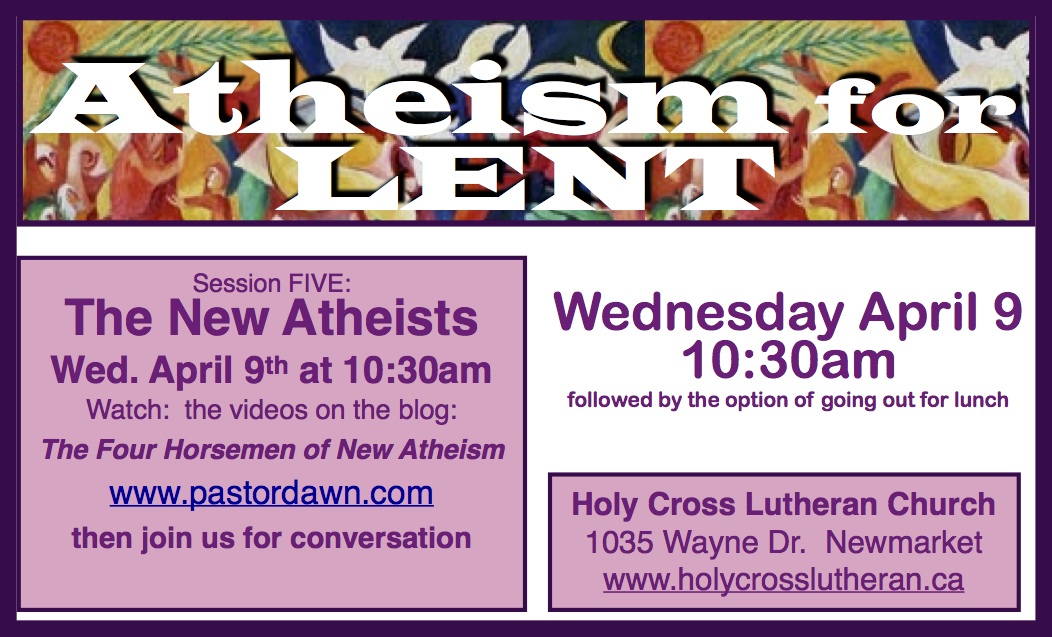
ATHEISM for LENT: WEEK 5 – The New Atheists

AfL 5 New AtheistsOur last class in the series will be an introduction to what has been dubbed New Atheism. We will explore the work of the 21st centuries New Atheists who have become famous or infamous for the careers they have carved out of their “unbelief.” The videos below “The Four Horsemen of New Atheism” provide an introduction for the class. The Four Horsemen include: Christopher Hitchens, Daniel Dennet, Richard Dawkins and Sam Harris.

ATHEISM for LENT: WEEK 4 – Delusion: Sigmund Freud

4 AFL UNBELIEF

Watch Richard Dawkins’ THE GOD DELUSION
and then join us for conversation on
Wednesday April 2, at 10:30 am
when we will explore Sigmund Freud’s critique of religion.

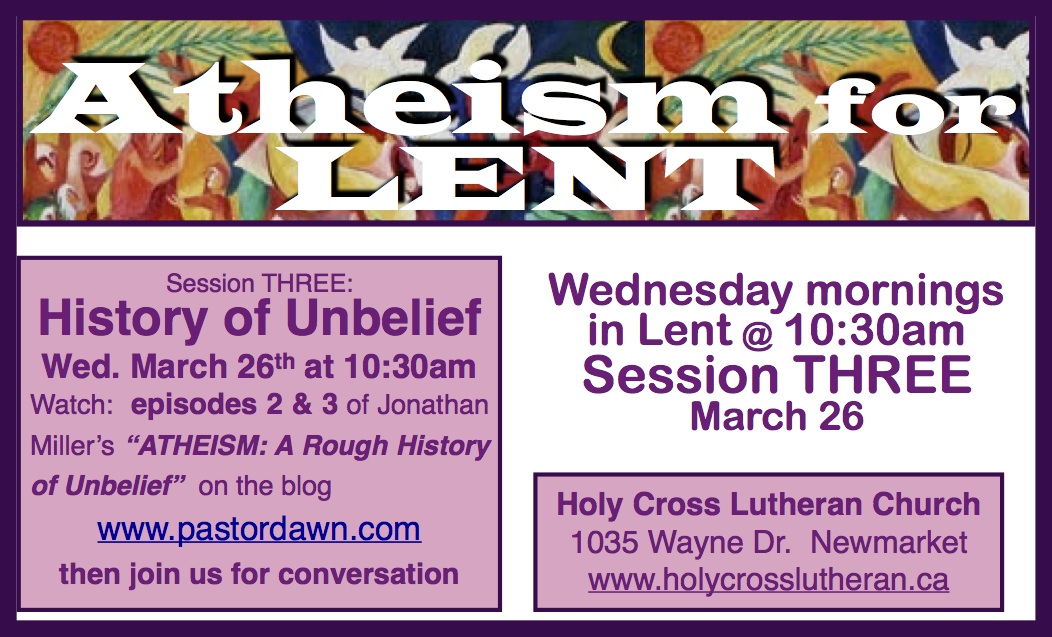
ATHEISM for LENT: WEEK 3 – History of Unbelief

AFL UNBELIEF 3We will wrap up our conversation on Nietzsche’s critique and how it might help us to examine our own expression of Christianity. You can read a summary of Nietzsche’s views on Christianity here and watch a short lecture on Nietzsche and Christianity below. Please watch episodes 2 and 3 of Atheism: A Brief History of Unbelief (below) to prepare for our next class on Wed. March 23 so that we can begin to look at the critiques of Marx and Freud. 

Faith and Begorrrah – A St. Patrick’s Day Sermon

With St. Patrick’s Day just around the corner, I was asked about the sermon I preached last year when the celebration fell upon a Sunday. The person who asked about the sermon remembered laughing a lot during its delivery and encouraged me to re-post it. So, pour yourself a glass of your favourite tipple, sit back and enjoy a laugh.

Readings:  Numbers 27: 1-11; Acts 13:44-51; John 12:1-8

guinnessbeerSt. Patrick’s Day doesn’t often fall on a Sunday, but as our congregation’s Annual Meeting would begin immediately following our worship service, I decided to be somewhat playful and irreverent with a sermon designed encourage folk to think beyond words on a page. The first reading brought the wonderful story of the Daughters of Zelophehad to church and as this reading does not appear in the Revised Common Lectionary it was fun to play withirish these feisty women. The reading from the book of Acts is actually the prescribed reading for the commemoration of St. Patrick and the Gospel text is prescribed for Lent 5C. The Guinness was just for fun! Enjoy.

Listen to the sermon

https://pastordawn.com/wp-content/uploads/2013/03/st_patricks_sermon.m4a

Read a transcript of the sermon here


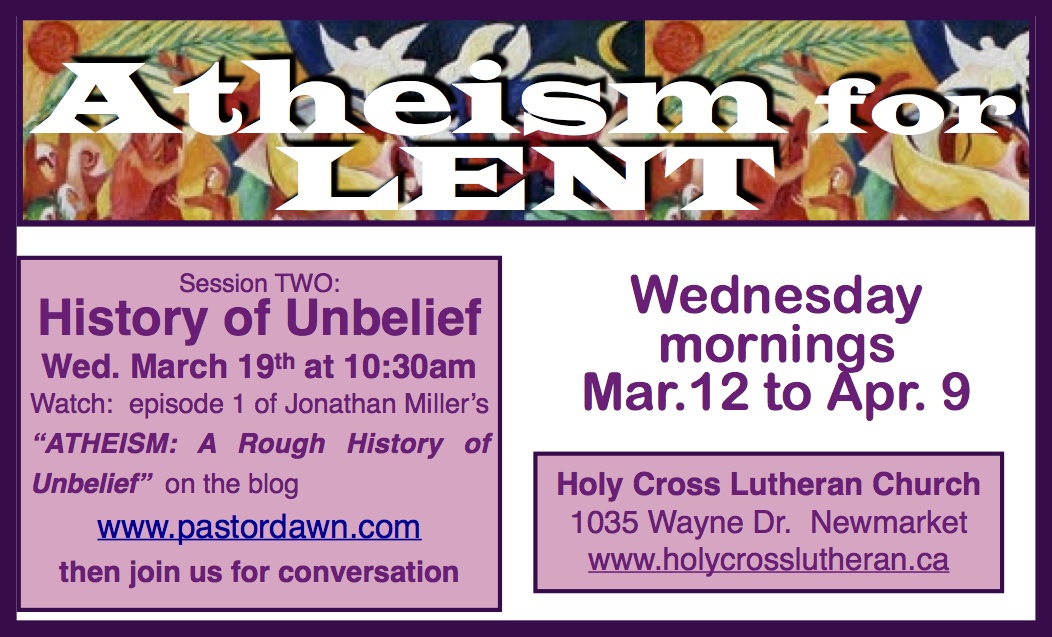
ATHEISM for LENT: Week 2 – History of Unbelief

AFL UNBELIEF pastordawn

Watch Episode One of “Atheism: A Rough History of Unbelief” and then john us for conversation March 19 at 10:30am – For details of the program click here

)