There was a young woman who lived in an apartment, in a very rough neighbourhood. It was the east end of a very large city. Many of the people who lived in this neighbourhood got by on welfare, others earned their living any way they could. The young woman moved into the apartment because it was close to the office where she worked, the rent was cheap and quite frankly she was young and foolish. She ignored all the warnings of her family and friends and moved into the apartment convinced that she could handle anything that came her way.
Her neighbourhood contained the most unsavoury of characters. The office where she worked was just down the street from her apartment and every morning as she walked to work she would meet some of her neighbours returning home from an evening of plying their trade on the streets and in the alleys. Each morning, she would be met at the entrance to her office by an old man named Ed.
Ed had been living on the streets for years. He was very hairy, very dirty, and he tended to rant and rave a lot. Ed was a wild man. He slept on the doorstep of the young woman’s office because it was somewhat protected from the winter weather. Even though Ed made the young woman nervous, she got used to seeing him in her way.
Ed always gave the young woman a warm welcome when she arrived. He knew that when she got inside, she would brew fresh coffee. He used to tease her that, she was a sucker for a sad face as he waited patiently for her to bring him a cup of coffee. They never talked much, though. Ed would just rant and rave about the injustices of the world. The young woman never found out how Ed ended up on the streets. She didn’t know how he spent his days. Continue reading →
Many thanks to the blog follower who, after reading this morning’s posting, reminded me of Peter Mayer’s hymn to our Blue Boat Home. It sure puts a whole new hue in my perception of Advent Blue!
I didn’t know it at the time, but I actually met John the Baptist when I was fifteen years old. She didn’t look much like you’d imagine John the Baptist would look, but she had that same crazy intensity, that same focus on the fact that we’d better change our ways, we’d better repent, and start doing things differently or we’d be in real serious trouble. Lola was my friend Valerie’s mother and she simply couldn’t stop going on and on about the environment and how we were destroy the earth. At the time, I remember thinking she was a bit of a nut-case and on more than one occasion I wished she’d just shut up about it. I was just a kid, and the earth was just something I took for granted. The earth was just there to provide for our needs. I couldn’t believe how much Lola went on and on about all the stuff we humans were doing to destroy the earth. I just wished she’d leave us along to get on with things, I couldn’t abide her incessant nonsense about how we were going to destroy the planet. All her feeble little attempts to be kind to the earth, made me seriously question her sanity.
I tolerated Lola not just because she was my friend’s mother, but I didn’t really understand her until one day when the three of us were travelling together. We were coming home from church. I had only been going to church for a few months. I was trying hard to understand this whole God thing. So, I went to church a lot. My friend Valerie had persuaded me to start going to church with her and family had become like my second family as they supported me during my first attempts to explore the mysterious world into which I had begun to feel pulled. As we drove home from church, I was feeling a little glum. Try as I might, I couldn’t really understand this church thing; all that singing and praying didn’t really help me to feel closer to God. Mostly I just liked how people at church treated each other. I liked how they went out of their way to help me feel at home. Whether or not God was there, well I really wasn’t sure.
Anyway, we were driving along the road. It was a partly over-cast day on the west coast of British Columbia, just a few clouds. You could see the mountains off in the distance. We were chatting back and forth when all of a sudden Lola pulled the car over to the far side of the road, switched off the engine and got out. Valerie followed her mother out of the car, so I figured I had better do the same. Val and her mother scampered down from the road and onto the beach. When they reached the water’s edge, they stopped and just looked off into the distance. Apart from a tanker-ship making its way across the horizon, I couldn’t see much of anything. Lola had the most amazing expression on her face. She positively glowed with happiness. Valerie wore a similar expression. I must have looked somewhat puzzled because Val smiled at me and said, “Isn’t it the most beautiful thing you have ever seen?” This only confused me more. What were they looking at that had made them stop the car, scamper down the bank and stand there at the water’s edge on a cold autumn evening?
Maybe my parents were right, these religious types are a little bit weird. Happy, glowing, smiling people make me nervous. There they stood grinning from ear to ear. What were they on? And then, I saw it. For the first time in my life, I saw it. It had been there before. But I had never really seen it before. The sky was amazing. The colours were overwhelming. It almost didn’t look real. It looked like someone must have painted it that way. It was magnificent, a work of art, the most beautiful thing I have ever seen!
If you’ve never seen a late October, Pacific Coast Sunset before, you’ve missed one of the great wonders of the world. Neither Emily Carr’s paintings nor picture perfect post cards do a western sunset justice. Believe it or not, even though I had been living on the west coast for about four years, at that point I had never before really noticed just how beautiful a sunset could be. No one in my experience had ever taken the time to stop and look at one. No one had ever pointed one out to me before. I would never have dreamed of stopping a car and getting out to watch as the sun put on a show while setting. So I stood there. Overwhelmed by it all. Amazed at just how beautiful it was. Wondering just who or what could be responsible for such a spectacular thing as this. Before long my thoughts drifted to the Creator. Suddenly this God, that I had been trying so hard to fathom, was there. Right there. Not just in the magnificence of the sunset, but right there on the beach. At that moment, I was just as sure of God’s presence as I was of my own. I remember an overpowering feeling of gratitude, gratitude for God’s presence, gratitude, because for the first time in all my life I was at home. I knew that I was home. Home, not because of the place; home not because of the beauty of the sunset, but home because of God’s presence. That longing that I had always felt; that longing that I have always labelled as homesickness, that over-powering longing was gone. In that glorious moment, the presence of God, filled my longing and I was at home.
I’m sure that each of you could tell of a similar experience. So many of us have been blessed by the presence of God in creation. So many of us have had our longing for God filled by the wonder and majesty of creation. I suspect that our love of creation comes as a direct result of our relatedness to creation. For like creation and everything in creation we share a common Creator. My own love affair with creation kicked into high gear on the beach gazing at the magnificence of the setting sun and it has grown in intensity over the years. This past summer, Carol and I drove out to Vancouver and I have to say, if you want to renew your love for creation, drive across this magnificent country of ours.
You’ll find yourself absolutely besotted with creation as you fall in love all over again. By the time we reached my beloved Rocky Mountains, it was like some star-crossed lover, who simply couldn’t help herself from bubbling over with excitement. Not even the first rainy day of our trip could dampen my excitement as we drove south from Jasper toward the Columbia Ice fields. I couldn’t wait to gaze upon the grandeur of the glacier that I remembered from so many visits over the years. The rain was falling quite heavily as we pulled into the massive parking lot perfectly situated across from the ice-field. As we climbed the steps toward the viewing station, I couldn’t see much because I’d pulled my hood up over my head to protect me from the rain. When I reached the top and looked across the highway, it took my breath away, the mass of ice that was frozen in my memory, was gone.
I’m not sure if the drops of water falling down my cheeks were raindrops or teardrops, as I stood there frozen by a strange mixture of fear and sadness. In the decades that have passed since I first began to visit the ice-fields back in the 1970’s the ice has been receding at a rate of between 10 and 15 centimeters per decade. 120 centimeters may not seem like a great distance, but couple that with a decrease in the thickness of the ice and it is positively shocking to see the amount of ice that has vanished from view.
Take a look at the iceberg that I asked Andrew to hang. This photograph was taken in a place I visited long ago. It’s a place were icebergs are born. I ended up there back in the days when I was in the travel business and ended up on a cheap Air Iceland flight that was delayed for a week in Reykjavík for a week. Back then Iceland’s airline must have had only two airplanes and when one of them suffered mechanical difficulties you literally had to wait around for them to fix it. It’s one of the reasons that flights were so cheap on Air Iceland. You simply never knew how long your stopover in Iceland might be. I was trapped there for a week and during that time we decided to explore some of the most amazing geological sites that the earth has to offer. We travelled about 400 kilometers outside of Reykavik to the Jokulsarlon Lagoon; the birthplace of glaciers. It was in this strange lagoon, under an eerie twilight that lasted for the entire duration of my stay in Iceland, that I stud on the hull of a small tourist vessel, staring up at a magnificent glacier. I have no words to describe my terror. Continue reading →
Sometimes it feels like a progressive thief has stolen Advent and Christmas from us! Sometimes being a progressive Christian is about as sad as being a who down in Who-ville; why sometimes I even miss old Santa Claus himself and in my nostalgic haze, I long for a simpler time and faith! How are we supposed to celebrate Advent and look forward to the coming of Christ, when some of the best stories of the season never actually happened they way we’ve been lead to believe?
Readings: Isaiah 2:1-5, “Amazing Peace” by Maya Angelou, Matthew 24:36-44
As we venture into the season of Advent, the disciplines of the season encourage us to step back from the hustle and bustle of our culture’s preparations for the holiday season. To prepare ourselves we are encouraged to slow down and spend time in silence and contemplation. I wonder how much our fear of being lonely when we are alone prevents us from embracing the darkness???
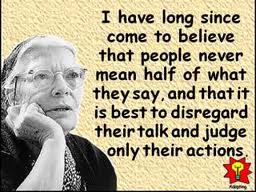
Dorothy Day is a shero of mine! But I will never call her a saint! The tradition of commemorating saints on the day of their death makes a today a day for celebrating Dorothy Day! But, Dorothy Day insisted, “Don’t call me a saint! I don’t want to be dismissed so easily!”
Dorothy Day died in 1980, at the age of 83. She was one of the greatest religious figures of the century, and one of the most paradoxical. She was a Catholic and she was an anarchist. She condemned poverty and she advocated it. She founded the Catholic Worker, a loose aggregation of ”houses of hospitality,” communal farms, newspapers and round-table discussions for ”further clarification of thought” — and called her memoirs ”The Long Loneliness.” The movement was wary of authority, yet revered her as its leader.
When she died, a multitude came down to the old dwelling off the Bowery to pay their respects, the way people had come to Catholic Worker houses for soup ever since the Depression. There were Catholic Workers, social workers, migrant workers, the unemployed; addicts, alcoholics, anarchists; Protestants, Jews and agnostics; the devout and the strident and the curious, there to see what a saint looked like.
On this day, I celebrate the life and witness of Dorothy Day a shero, a Christian mystic with all the attributes of a saint!
I have listened to these lectures several times. Each time Taylor leads me into the darkness something new is revealed. This week, I have been busy preparing for the Season of Advent fearful that I might not be able to capture the anticipation of the season. In a bit of a panic, I shut my eyes and saw the darkness pulsing with a kind of invitation to enter into the sacredness of the dark. So, after a long winter’s sleep, I awoke wondering if darkness itself might be the key to embracing Advent. Over a leisurely breakfast, Taylor’s musings on the power of darkness have opened me to a whole new vision of the wonders and mysteries of Advent.
Taylor spent fifteen years in parish ministry and was named one of the twelve most effective preachers in the English-speaking world by Baylor University in 1996. She became a professor of religion at Piedomont College in 1998 and also teaches spirituality at Columbia Seminary. Still a priest in the Episcopal church, Taylor has travelled the world in pursuit of sacred wisdom finding most of what she needed in her backyard.
These 3 lectures are rich in images as Taylor explores the “thick darkness” in which God dwells. The lectures were described as “a negative theology for emergents” and I do believe that progressive Christians would do well to revisit Brown’s mastery of mythic communication. So, if you are afraid of the dark, stumbling in the dark, or intrigued by the dark you will find in these lectures a familiar darkness in which lies beauty and wisdom. If you are a preacher, take the time to linger over Taylor’s images, you will be rewarded with inspiration. Linger over the richness of her words, you will not be dissapointed!
LEARNING TO WALK IN THE DARK – LECTURE 1
LEARNING TO WALK IN THE DARK – LECTURE 2 – Night Guides
Tamar, Rahab, Ruth, Bathsheba, Mary by Sallie Poet
As we enter Advent to await the coming of Christ, it is important for us to remember who Jesus was. I offer this snippet from an Advent sermon given by Bishop John Shelbly Spong on the first seventeen verses of the Gospel according to Matthew. After exploring the lives of the women the gospel writer includes in the genealogy of Jesus, Bishop Song invites us to re-think our image of Jesus. You can read a rough transcript of Bishop Spong’s sermon here There have been several Advent seasons when we have gone off lectionary in order to facilitate a re-thinking of our traditions. Using Matthew 1 as a gospel lesson has worked well for the first Sunday of Advent.
In this snippet, Bishop Spong invites us to re-think our image of God in light of our knowledge of Jesus.
You are the Bethlehem point.
Let the power of God in Christ enable you to live and to love and to be.
Let the God presence within you flow through you so that the love of God might
be known among all the people that God has created
If eternity is beyond the confines of time, then the definition of eternity is that which has no beginning and no end. As wayward snowflakes begin to fall, eventide on this December day promises a very long night. And I can’t help wondering about how long this soul of mine has been kicking around. Does this soul of mine have eternal life: life without beginning or end? I wonder? Does the stardust that continues to live in this body of mine point toward a limitless life? I wonder? But for now, the wayward snowflakes remind me of falling stars and the dust which I will one day return to with confidence. Enjoy!
From the very first time I heard it, Jackson Browne’s “Rebel Jesus” has haunted me. In a season dominated by nostalgia, Browne’s stark view of the historical Jesus calls us to remember the one who stood with the poor and the oppressed, the outcast and the wounded. As we enter the season of Advent, can we hold nostalgia at bay long enough to engage our deepest longings and desires for peace? Not some nostalgic peace that stretches only so far as our own needs, or our own loved ones, but the peace that embraces those beyond our circles of care? Can our compassion for the earth and all her creatures move us beyond the idol we have made of the baby in the manger, toward the complexity of embracing the desires and longings of a rebel we probably wouldn’t want to entertain at our festive gatherings? Or will our seasonal madness crucify the rebel once again?
This year, like all the rest, my challenge is to live somewhere within the tension created by the rebel Jesus and the one his contemporary detractors condemned as a glutton and a drunkard; between choosing life and recognizing my culpability in the cries of the ones still waiting for us to join the rebellion.
Advent is a time of waiting in the darkness…if we dare…trusting that the light will come…knowing that the light needs reflectors in order to dispel the darkness! May your Advent be filled with the challenges of rebellion!
This sermon was preached at Holy Cross Lutheran November 28, 2010. The readings included Isaiah 2:1-5, “Amazing Peace” by Maya Angelou, and Matthew 24:36-44, during the sermon I read from the Qur’an Sura 19:1-30 which you can find by following the link in the body of the sermon.
While I was studying for an undergraduate degree in Religious Studies at the University of British Columbia, I worked as a volunteer women’s center. Because I was studying the religions of the world, women who were being persecuted as a result of religious belief were often referred to me.
I’d been working with a young woman who was being abused by her father and brothers because they felt that she was adopting Canadian ways and thereby abandoning Islam. I remember visiting her in the hospital emergency room after her brothers had beaten her nearly to death. She told me that the last thing her brother said to her before tossing her out of the back of a van, was that she should consider herself lucky that they had talked their father into letting them beat her, instead of doing what he had ordered in the first place which was to kill her. I sat at her bedside wondering how a brother could do such a thing to his sister. I decided that they must be religious fanatics and I wondered how any religion could drive a father to seek the death of his own daughter.
The next morning I didn’t feel much like going to my Religious Studies Methodology Seminar. The Seminar was comprised of 7 students from various faith traditions along with 4 atheists and 3 agnostics. Together we studied the various methods of studying religion. We were about to embark on the phenomenological approach to the study of religion. “The Phenomenology of Religion” is a fancy academic way of describing the study of actual religious experiences of the divine. As we stumbled to our seats the professor announced that he would be dividing us into groups of two and he wanted us to learn all that we could about our partner’s religious experience. We would have two weeks to come up with a 1,000 words describing on the phenomenology of our partner’s religious life. I was paired with an Imam who was studying Western approaches to religion prior to taking up a position in a local mosque. Ibrahim was a recent immigrant from Pakistan. But he might as well have been from Mars as far as I was concerned. On that day of all days, Muslim men were not exactly my favorite characters. Continue reading →
Occasionally we replace one of the Sunday Bible readings with a contemporary. On the First Sunday of Advent three years ago (Advent 1A) we used the poem “Amazing Peace” by Maya Angelou. It was first recited at the lighting of the National Christmas Tree in Washington. Since then it has been illustrated by Steve Johnson and Lou Fancher. The poem captures the longing for peace that permeates the Advent and Christmas seasons.
Attention progressive christians who despair over the lectionary!!!
A new Church Year brings a new lectionary resource for progressive christians. This coming Sunday, the church begins a new year. Which for preachers and those who partake of our sermons means the beginning of lectionary readings for “Year A”. For those of you who have been spared the need to know, many of the so-call “mainline” churches follow a three year cycle of readings call the Revised Common Lectionary which include four prescribed readings for each Sunday. During “Year B” the gospel readings are largely drawn from the Gospel According to Matthew.
Theology From Exile is written by Sea Raven, D.Min., an Associate of the Westar Institute (that’s right the home of the Jesus Seminar). In the Introduction Raven declares, “This project is grounded in the paradigm-shifting biblical scholarship of Karen Armstrong, Marcus J. Borg, John Dominic Crossan, Robert Funk, and Amy-Jill Levine, as well as the transformative work of Rev. Dr. Matthew Fox, whose theology of Creation Spirituality has reclaimed Catholic mysticism for post-modern cosmology.” Yippie!!! Yippie only begins to capture my delight at having found this resource!!! In addition to providing a lectionary commentary Raven puts her considerable skills as a worship leader and planner to good use by providing suggestions for liturgical innovations. I only wish I’d discovered Raven’s excellent work last year’s Volume I – The Year of Luke.
For colleagues who have the daunting task of preaching in this the 21st century this resource is a must. For those who listen to sermons, you will find Raven’s work to be an excellent resource for Bible Study!!! Raven in her introduction accurately accesses the current conundrum of christianity which she hopes this provocative series will address: “The continued existence of a Christian “faith” as a religious system of belief is clearly under siege by twenty-first century Biblical scholarship as well as the continuing evolution of scientific knowledge. The question addressed by this series of commentaries is whether and how ancestral scriptures remain relevant and revelatory to twenty-first century cosmology.” Amen! Amen! Amen!
Phil Ochs was an activist/folksinger who died way too soon (1940-1976). I remember back when I was becoming politically aware and making my first forays into the church, at the tender age of fifteen I would lie in the sanctuary of my room and listen as his lyrics moulded me. I rediscovered these lyrics in an old journal. They still ring true. I wonder if the budding progressive movement will be able to re-think christianity before it’s too late?
The Cannons of Christianity
Christian cannons have fired at my days With the warning beneath the holy blaze And bow to our authority Say the cannons of Christianity
Oh the children will be sent to schools Minds of clay are molded to their rules Learn to fear all of eternity Warn the cannons of Christianity
Holy hands will count the money raised Like a king the Lord is richly praised On a cross of diamond majesty Say the cannons of Christianity
Missionaries will travel on crusades The word is given, the heathen souls are saved Conversions to our morality Sigh the cannons of Christianity
Come the wars and turn the rules around To bend your soul on the battle ground And the Lord will march beside me Drone the cannons of Christianity
Cathedral walls will glitter with their gold And the sermons speak through silver robes Building castles amidst the poverty Say the cannons of Christianity
Worship now and wash your sins away Drop the coins, fall to your knees and pray Cleanse the world of all hypocrisy Smile the cannons of Christianity
Christian cannons have fired at my days With the warning beneath the holy blaze And bow to our authority Say the cannons of Christianity
Earlier this week, way down in Texas, officials argued over science textbooks in what seems to be the never ending debate between biblical literalists and the rest of the world. In this stunningly beautiful video the wonders of creation are explored in ways that creatures ought to explore: with open minds and hearts. Most of us have a limited knowledge about theories of evolution, but as time goes by scientists are learning so much about what was once relegated to the realm of the unknowable. Science is sacred knowledge and those of us who haunt the religious realm would do well to explore the wealth of sacred knowledge that science is revealing.
In the past fifteen years, I have only preached on Reign of Christ Sunday twice. I usually have the presence of mind to book my vacation or some sort of continuing education event for this festival of the church year. Formerly known as “Christ the King Sunday” an attempt to move beyond exclusively male imagery for Christ (in whom there is no east or west, male nor female) some church-folk have attempted to change the name of this festival to Reign of Christ Sunday. But neither title gets away seems to suffice in a pluralistic world.
Born in an age that was birthing fascist regimes, this particular festival of the church clings to it’s christian imperialist past. Instituted in 1925, by Pope Pius XI, (you can read the full proclamation here) the festival was designed to remind the world that Christ is the King of the World. The irony of proclaiming Christ as “King” when the life of Jesus of Nazareth positively denies “kingliness” seems lost on the church. The appropriateness of asserting Christ over the religions of the world lacks the kind of humility embodied by Jesus of Nazareth. So, even though it’s too late to book a vacation, I for one would rather not have the task of preaching on this particular festival.
I was tempted to welcome the congregation on Sunday morning with something like: “Welcome to what I hope will be the last celebration of Reign of Christ Sunday here in this place.” But I suspect that between now and Sunday, I will find it within myself to be somewhat more circumspect. I suspect that rather than proclaiming Christ as the King of the World, I will look at the reign of the current rulers of the world and explore the contrasts between their reign and the justice that Jesus of Nazareth lived and died for. This video clip seems like the place from which to begin writing the sermon.
In 1963, I was in grade one. My memories of my five-year-old self are vague; filled with blurred images and impressions. But one memory stands out. George Kennedy sat up close in the front row with me. George Kennedy was an odd looking little boy. I only know that he was an odd looking little boy because my classmates were in the habit of teasing him about his looks. I cannot tell you why they thought that he was odd looking because in my memory he looks like a cute little five-year-old boy. George Kennedy and I must have lived near one another because I can remember him walking up ahead of me and so I choose to believe that we were headed in the same direction and not that I was stalking him. My most vivid memory of George Kennedy happened the day that we were all unexpectedly sent home from school.
The crackly voice of the school principal announced over the PA system that President Kennedy had been shot and was dead and we were all told to go straight home. I did not know what a president was, I only knew that Mr. Kennedy was dead and so I remember walking home behind George Kennedy and feeling really bad because George’s daddy was dead.
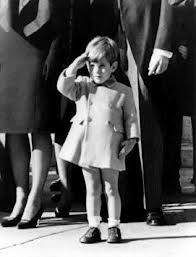
I have flashes of memory from that week, spent huddled around the TV set with my mother and father, knowing that they were so very sad. I remember their tears. It is my first memory of them crying. President Kennedy’s funeral was the first funeral I can remember attending. The first three funerals that I remember from my childhood were John Kennedy’s, Martin Luther King’s and Robert Kennedy’s funerals. In my mind’s eye, I can see clearly little John John’s salute, Corretta’s black veil, and Ethel standing there with all Bobby’s children. There is a song from those long ago days, a song that to this day makes me weep no matter where or when I hear it. It begins with the sound of a mournful flute.
“Anybody here seen my old friend Abraham, can you tell me where he’s gone?
He freed a lot of people but it seems the good they die young.
You know I just looked around and he’s gone.”
The sound of the electric organ gives us but a moment to breath as verse by verse our good friends John, Martin and Bobby are snatched from us. That song is a lament that lives in the souls of those of us who grew up grieving common losses.
There have been other times when we have grieved together, times when we have lamented, like September 11, 2011, our cries of lamentation at the loss of so many lives on a day that forever changed our world. Not all our losses have been shared so widely. Sometimes we have gathered to lament losses that don’t quite make it to the world stage, but which are earth-shattering in their own circles. Sometimes we have lamented the ongoing pain that exists as a result of the lack of justice in this world.
The art of lament, in a world that hungers for closure so that it can be about its business, is a struggling art-form. It seems that our ancestors were so much better and lamenting and could launch forth into wailing and gnashing of teeth with much more abandon than we like are likely to tolerate in public places.
These days we think it unseemly for mourners to wail at a funeral, choosing celebrations of life over the wailing in the face death. But the act of lament has over the centuries played an important part in our human development and I would argue that the act of lament has also played an important role in the life of our God.
Lament is a transformative act. Lament moves us from one place in our lives to another. Lament moves us and thereby transforms our humanity. Lament is very much a part of our human evolution. And so I lament the disappearance of lament from our worship. Lament is the voicing of one’s anguish or complaints to God.
Lament provides us with the opportunity to gather together and express our anguish in the presence of the ONE who is, was and ever more shall be. The ONE we call God. For in the pit of despair we are made painfully aware that our hope lies beyond ourselves. Because hope is the only way out of the pit of despair we look to the ONE who is so much more than we can comprehend to through us a life-line and so we wail and weep, and shout and rant until we can begin to know the presence of the ONE. Often, the knowledge of the presence of the ONE comes to us through the presence of one-another. Sometimes, the knowledge of the presence of God comes to us in the very lament itself as we discover God in the midst of our pain. All too often our modern sensibilities tempt us to arrive at hope by trying to avoid the lament. But when we fail to utter our rage over suffering or injustice we tend to arrive at false hope, or failing hope.
Lament allows us to fully engage our despair, and by engaging one another and indeed God in our despair we are transformed. Lament is where we must begin if our rage at the suffering and injustice in this life is to be transformed into peace and justice. Lament is the place where our grief begins to move us from deadness of our shock and horror into a place were we can begin to cope and find healing. Lament is the place where we can begin to discover our God weeping with us; grieving with us and being transformed with us.
There’s a line from the Mystic Meister Eckhart that has been a sort of mantra for me of late: Eckhart insists that: “Every act reveals God and expands God’s Being.” As I look around me at the pain and suffering that exists in the world, I can’t help but lament all the poverty, the violence, and the hatred that exists as a result of our incomplete humanity. Most of us cope with the magnitude of suffering by limiting our exposure to it. We try not to dwell on it because we are afraid that it will overwhelm us and we won’t be able to cope. From time to time we let just a little bit of the suffering in; just a little lest we be overcome by despair. Sometimes we have no choice and the suffering bursts in on us and we are forced to deal with it. Either way, whether we let ourselves be touched by suffering or we have suffering thrust upon us, that suffering transforms us. Suffering can transform us in unhealthy ways or in healthy ways. But suffering will change us. If we have the courage to lament, to engage our God in our rage over the suffering; I mean really engage our God, we can be changed in ways that were once unimaginable.
In our lament we touched the pain of the suffering, we didn’t heal it, we didn’t cure it we just touched it. And the power of our lament changed us. We were changed by their impotent silence. And God, well God was revealed in our lament. And God’s being was expanded. Now I know that some will say that it was our perception of God’s being that was expanded and not God’s being itself. But to deny that God’s Being is capable of expansion as a result of interaction with us, is to deny the reality of relationship. God lives and breathes in with and through us so our evolution as beings changes God. In with and through us God weeps, God bleeds, God cries and God waits, for transformation. Our lament is an act of trust. An act that declares our intent to wrestle with God, to struggle with God as we begin the difficult transformation into the beings that we are becoming. The power of lament to transform our mourning into dancing, injustice into justice, and violence into peace is transformative.
Lament is a process, a process of transformation. There’s absolutely no point in lamenting the suffering of the world unless you’re prepared to be touched by that suffering and transformed by it.We are called to suffer with the poor in order that we might lend our strength to transform suffering into life-giving joy. Our God will wipe away every tear from every eye and our God will do this as God lives and breathes in with and through you. Taking up the cross of suffering is not about signing up for suffering for suffering’s sake. Taking up the cross of suffering is about engaging with those who suffer in ways that will forever change the world. It is about lamenting alongside, so that together we can be transformed. Engaging in the act of lament is no easy thing. But just like the blues, lament has the power to transform our mourning into dancing. To transform our weeping, bleeding, crying, suffering God, into a powerful loving, justice making, peace keeping, God who works in with and through us to transform our world. Let it be so.

 There was a young woman who lived in an apartment, in a very rough neighbourhood. It was the east end of a very large city. Many of the people who lived in this neighbourhood got by on welfare, others earned their living any way they could. The young woman moved into the apartment because it was close to the office where she worked, the rent was cheap and quite frankly she was young and foolish. She ignored all the warnings of her family and friends and moved into the apartment convinced that she could handle anything that came her way.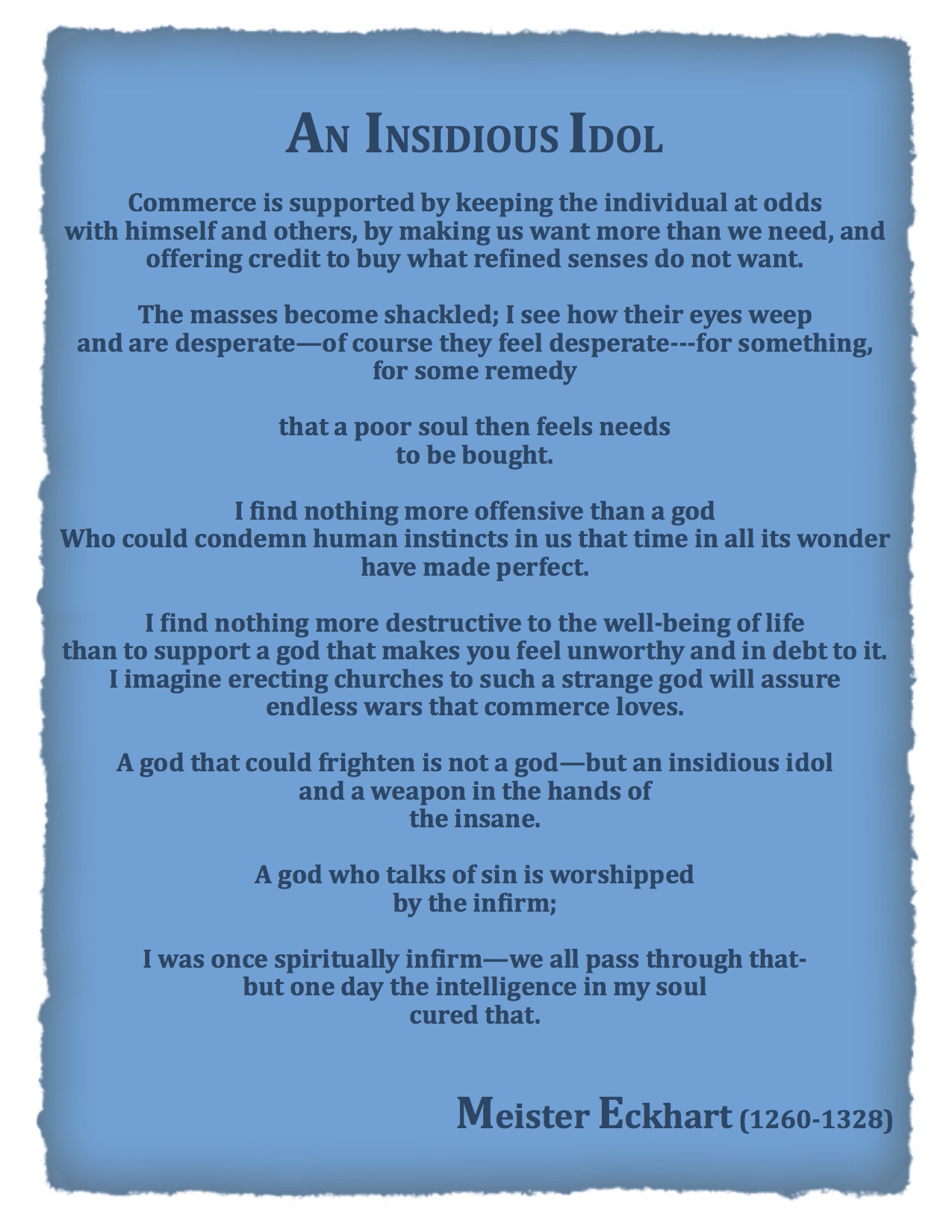









 pastordawn