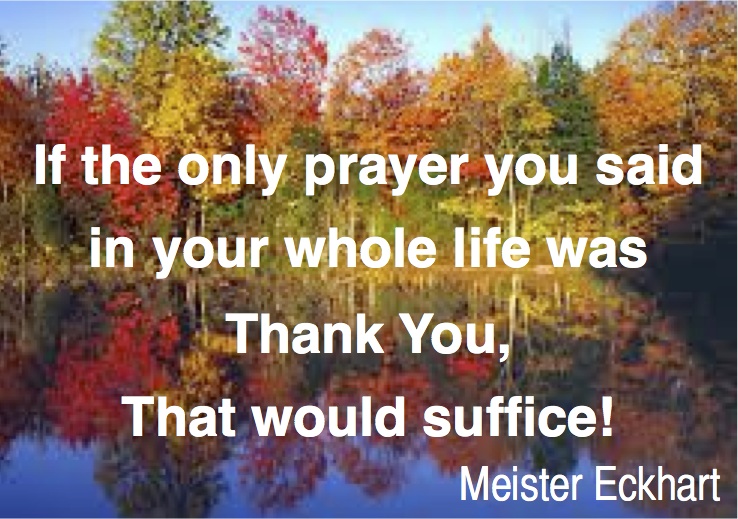
To Whom Shall We Go to Say Thank-you? – Thanksgiving Sunday sermons

Thankyou autumn

Follow the links for previous sermons:

Reckless Generosity a sermon with a Monty Python flair!

Who IS God? – Not One, Not Two – inspired by Garrison Keillor & Joan Chittister

Brussel Sprouts, Ebola, and Thanksgiving – seeking the ONE who IS

To Whom Shall We Go to Say Thank-you

After You Move Beyond Personifying God?

Over the course of the past nine years a group of little people have come into my life. Lovely little people who call me Gran. There are seven of them and participating in their little lives is a source of such great joy. Each stage of their development is a wonder to behold. I particularly enjoy watching their parents as they attempt to teach these little darlings the things that they need to know about being human. One of the first things that we teach little humans is the fine art of saying thank-you. It takes a fair amount of repetition to teach a child to say thank-you. Over and over again, after giving them exactly what they want, we ask, “Can you say thank-you?” and the little darlings repeat the words “Thank-you.” Sometimes all we have to do is ask the question: “What do you say?” in order to hear the words “Thank-you” uttered in such a delightful way as to inspire us to praise them as such good little girls and boys.

Expressing gratitude is a skill that all tiny little people must learn in order to develop into well-rounded human beings. Indeed, scientists insist that being grateful is a prerequisite of happiness. Happy humans it seems, are humans who embody gratitude. But there is more to gratitude than simply saying thank-you. I remember learning that gratitude includes more than simply expressing our thanks. It happened when I was about sixteen and actually noticed the beauty of a sunset and for the first time I realized that I was part of something so much bigger than myself. I know I must have seen the sunset before, but this time I actually saw the sun set. We were driving down the road, my friend Valerie and I were riding in a car driven by her mother, Lola. It was a partly over-cast day on the west coast of British Columbia.  Just a few clouds.  You could see the mountains off in the distance. We were chatting back and forth when all of a sudden, Lola pulled the car over to the far side of the road, switched off the engine and got out. Valerie followed her mother out of the car, so I figured I had better do the same. Val and her mother scampered down from the road and onto the beach. When they reached the water’s edge, they stopped and  just looked off into the distance. Apart from a tanker-ship making its way across the horizon, I couldn’t see much of anything. Lola had the most amazing expression on her face. She positively glowed with happiness. Valerie wore a similar expression. I must have looked somewhat puzzled because Val smiled at me and said “Isn’t it the most beautiful thing you have ever seen?” This only confused me more. What were they looking at that had made them stop the car, scamper down the bank and stand there at the water’s edge on a cold autumn evening. 

These happy, glowing, smiling people made me nervous. There they stood grinning from ear to ear.  What were they on? And then, I saw it. For the first time in my life, I saw it.  It had been there before. But I had never really seen it before. The sky was amazing.  The colours were overwhelming. It almost didn’t look real. It looked like someone must have painted it that way. It was magnificent. A work of art. The most beautiful thing I have ever seen. If you’ve never seen a late October, Pacific Coast Sunset before, you’ve missed one of the great wonders of the world. Neither Emily Carr’s paintings nor picture perfect post cards do a western sunset justice.          

Believe it or not, even though I had been living on the west coast for about four years, at that point I had never before really noticed just how beautiful a sunset could be. No one in my experience had ever taken the time to stop and look at one. No one had ever pointed one out to me before. I would never have dreamed of stopping a car and getting out to watch as the sun put on a show while setting. So, I stood there.  Overwhelmed by it all. Amazed at just how beautiful it was. Wondering just who or what could be responsible for such a spectacular thing as this. Before long my thoughts drifted to the Creator. Actually noticing a magnificent sunset was the beginning of a journey beyond myself as the reality that I am part of something so much bigger than myself continues to permeate my being.

Back then, I expressed my gratitude by very much the same way as my grandchildren are being taught to express their gratitude, simply by saying “Thank-you”. The object of the Thank-you being God. At the time, God was an old bloke up there in the sky somewhere. As my images of God changed over the years, my Thank-you’s continued to be expressed to my ever-changing images of God. But I must confess, that it was a whole lot easier to say thank-you to God when God was some big guy up there, out there somewhere? It was so much easier when I thought of God as “Father” or even as “Mother” to express my gratitude by simply mimicking the behaviour that I’d been taught as a child, “Can you say “Thank-you” Oh yes indeed I can say thank-you. “God is great, God is God, let us thank him for our food. By his hand we must be fed, Give us Lord Our Daily Bread.” Continue reading

Feed the Wolves – a sermon for St. Francis Sunday – Matthew 6:25-30

It has been a very strange week. Many of us, indeed not just us but people all over the world have been transfixed by the goings on with our neighbours to the south. Not even Solomon in all his splendor could match the full array of bombasity dressed up like fair play. Portrayed as a “he said, she said” fight for the truth, judgements are being made, that expose the fearsome truths of human tribalism. From the security of our various cultural silo’s, we have born witness to a wrenching polarization of our culture that threatens to tear us apart one from another. If only the wisdom of Solomon could be trusted to prevent us from ruthlessly tearing in two the tightly woven fabric of what is left of the fair-play that we struggle to raise up.  Emotions have risen to the surface and exposed the rot that permeates our precious hierarchal structures. White privilege and male dominance have been laid bare and the pain of that exposure has triggered more pain.

This week several women have reached out to me to weep again over wounds so deep that they fear the tears will never end. The word “triggered” has taken on a whole new meaning, as vibrant memories seared upon the minds of survivors ricochet with such intensity; an intensity that rips those of us who have experienced the pain first hand. I still can’t believe the power of such memories to tear through us afresh.  

I have listened as women have wept, and their tears have opened the wounds we share. We have seen the angry of the privileged blaze across screens, as powerful men bare their teeth and threaten dire consequences.  Anger has been stirred on both sides, and unlike Solomon, I don’t possess the wisdom to dispassionately judge who should win and who should lose. My anger burns in me like a white-hot fury and I cannot see beyond to the beauty of the lilies in the field. Ah sweet Jesus, if only the memory of the future you envisioned for us, could calm our fears.

To those of you who haven’t been watching, or won’t watch, or cannot watch, and encourage those of us who can’t help but watch to simply turn off and tune out, well you may be right. Maybe, just maybe, the answer is to simply refuse to engage the madness that is transpiring. Just turn it off and walk away, move on and look at the beauty that surrounds us. The leaves are putting on a much better show as they begin their bursting forth into a beauty that is far worthier of our attention than the muck-raking display that constantly demands that we watch.

I was reminded this week of an old native story, a story that brought me some respite from my anger and frustration. I’ve read that it is a story first told by our indigenous sisters and brothers. It’s about a boy and his grandfather:

One day the boy says to his grandfather, “How is it you never seem to get upset?  Don’t you ever feel angry?”His grandfather replies, “I sometimes feel there are two wolves inside me, each of whom fights to tell me what to do.  Whenever something angers me, one of the wolves is full of fire, and wants to attack and act nasty. The other is calmer, thinks clearly, and makes better choices. But they’re both always there.And the boy asks, But if they are always fighting, how do you know which wolf is going to win?”  The grandfather answers, The wolf who wins is the one I choose to feed.”

Our angry wolves have been well-feed this week and there are a few great feasts just waiting to be served up in the weeks to come. But surely that doesn’t mean that I have to feed my angry wolf? There’s a very big part of me that sees the wisdom of this old story and I am sorely tempted to starve my own anger. Indeed, I had resolved to do just that, turn it off, tune it out, pretend it isn’t happening, walk away, enjoy a more beautiful autumn view. But alas, this is St. Francis Sunday, and another wolf has caught my attention; and yes, it is an angry wolf demanding to be fed. Continue reading

Weeds Upon the Altar

As the Season of Creation winds to a close, some of us will take the opportunity to comemmorate St. Francis of Assisi this Sunday.  You can follow the links to previous sermons for this celebration:  A Feminist, the Niquab, St. Francis and the Sultan, The Saint and the Sultan Daring to Dance in the Midst of a March

Weeds Upon the Altar

On this the last Sunday of the Season of Creation we celebrate the teachings of St. Francis of Assisi. Our Gospel text is Matthew 6:25-28

Listen to the sermon here

Sisters and Brothers, hear again the words of St. Francis of Assisi:

I think God might be a little prejudiced.

For once God asked me to join God on a walk

through this world,

and we gazed into every heart on this earth,

and I noticed God lingered a bit longer

before any face that was

weeping,

and before any eyes that were

laughing.

And sometimes when we passed

a soul in worship

God too would kneel

down.

I have Come to learn:  God

adores God’s

creation.

In the spirit of St. Francis, I bid you peace. Please take a long deep breath…..Peace. Now if you would focus your attention upon these two beautiful bouquets upon the altar. Yes, I am well aware that these bouquets are little more than a collection of weeds. Yes, I know that many of us were taught by the Church, I’m talking here about the capital “C” Church; we were taught by the Church that flowers don’t belong upon the altar. Flowers upon the altar distract people from the presence of God and the acts of worshipping God, so if we must have flowers in the sanctuary, we were all trained to place them anywhere other than upon the altar; the holy of holies, the place where God works in, with, through, and under the bread and wine to touch us, love us, strengthen us, and empower us. We can’t, reasoned the Church, we can’t have people distracted from the actions of God that center upon the altar. So, the Church banished flowers from the altar. But on this the feast day of St. Francis, I asked Carol to gather up some bouquets of weeds and place upon the altar. I did so, because these bouquets are beautiful!

Take a good look…..In this beautiful season of autumn these particular weeds are everywhere. You cannot go for a walk or a drive in and around town without being confronted by the existence of these spectacular weeds. Take a good look….aren’t they beautiful.In the words of St. Francis,

I have Come to learn: 

God adores God’s

creation.

Now look around you, take a very good look at this spectacular gathering, this splendid bouquet of what some might call weeds but, if you look very closely you will see in one another a breathtakingly beautiful bouquet of awe-inspiring flowers.  Aren’t you lovely? Made from LOVE. Gathered around this makeshift altar of ours God will indeed work in, with, through, and under each one of us to touch us, to love us, to strengthen us and to love us. In, with, through, and under this is the way that Lutheran theology describes the way in which God comes to us in the bread and wine of holy communion. I have gotten into the habit of always reminding you that we live and move and have our being in God and that God lives and breathes in, with, through, and beyond us. I repeat this over and over again, not only to remind all of you but to remind myself that God is not some far off distant being, who lives up there or out there somewhere. God is here, right here, all around us, in us and beyond us just as surely as we are in God. So, on this the final Sunday in the Season of Creation it is so very appropriate for us to turn our attention to St. Francis who reminds us that all of creation is in God. Continue reading

Beyond Christianity’s Imperial Endings – Mark 16 the Long and the Short of It?- a sermon for Mountain Sunday

The Season of Creation was established in 1989 by European Christians and embraced by the Roman Catholic Church as recently as 2015. It is the newest addition to the Church year, designed to respond to the groaning of creation as the Earth suffers at the hands of humanity. We hear at Holy Cross have been observing the Season of Creation since 2011. The Season begins on Sept 1stand ends on October 4, which is the feast day of St. Francis of Assisi – the patron saint of animals. Today is the 4thSunday in the Season of Creation – the day for the celebration of Mountain Sunday.

When I began my preparations for this Mountain Sunday I was more than a little perplexed by the prescribed readings for this Sunday. I must confess that I struggled to understand why the powers that be chose to prescribe such strange readings. So, I changed the first 2 readings. I was about to change the gospel reading, from this strange and dubious text to something like a reading from the sermon on the Mount, when I thought, “No” let’s stick with the prescribed reading and see what we can learn from it.

When you go home today, open up your bible to the very end of the Gospel According to Mark and you will discover a biblical chapter unlike any other chapter in the Bible. (click here to see chapter 16) The last chapter of this gospel is chapter 16. When you get to the end of verse 8 you will find a note from the editor of your bible. Some editors tell you that “The gospel ends here.” Others simply put in a note that says two other endings were added by later writers. The Shorter Ending or the Longer Ending. The prescribed reading for Mountain Sunday is the Longer Ending which was added by a later writer. The Gospel of Mark was written by an anonymous storyteller that was given the name Mark by something called “TRADITION” We don’t know who wrote it.  We do know that it is the first of the gospels to be written. We also know that it was written sometime after the year 70. That’s some 40 years after the execution of Jesus by the Romans and about 20 years after the Apostle Paul’s first letter to the Thessalonians; Paul’s writings about Jesus that we have.
The anonymous gospel-storyteller that we know as Mark was not an eyewitness to the life of Jesus. He wrote his story sometime after the Roman Empire destroyed the city of Jerusalem. The Romans leveled the city and sent Jews and followers of the Way running for their lives. His gospel is the shortest of the gospels. There is no Virgin Birth in this gospel; no birth narrative at all. Joseph is never mentioned in this gospel. Jesus is referred to as the “son of Mary” which at the time would have been an insult that implied that Jesus was a bastard. Continue reading

Encountering the Divinity Within Us – Mark 9:30-37

Then Jesus brought a little child into their midst and putting his arm around the child, said to the Twelve, “Whoever welcomes a child such as this for my sake welcomes me. And whoever welcomes me welcomes not me but the One who sent me.” Readings included Exodus 40:34-38, Mark 9:33-37 

Listen to the sermon here 

(September 2015)  For the past few days Carol and I have been blessed to have two of our little grand-daughters staying with us. Audrey is about to become a two-year-old and little Evelyn is just seven months old. It has been an amazing couple of days as our very tidy, ordered, quiet, home has been turned upside down and inside out by these two bundles of beautiful energy and all the amazing baby paraphernalia that their Mom brought with them. Between toys, bottles, diaper bags, baby beds, and all the stuff that had to be moved from their regular resting spots to spots out of reach from tiny little hands, our house became a beautiful cluttered mess. It’s wonderful, it’s chaotic, it’s noisy, it’s exhausting and it’s the best fun imaginable. I’ve loved every wild and crazy moment every bit as much as I’ve enjoyed each and every sweet and tender joy filled moment. There is nothing quite like staring into the eyes of a baby and seeing all that precious potential and marveling at the miracle of life. Children have the power to open us to the wonders of this amazing mystery that we are a part of. But even as a wax on about the joy and wonder that children can inspire in us, I know that when all is said and done, their Mom will take them home and our world can return to its quiet, ordered, everything in its place, and a place for everything kind of way.

Children can be quite demanding and there are even people on this planet that find children annoying. I’ve even heard tell of people who don’t like children. So, when I read of Jesus, the great master and teacher of wisdom, bringing a little child into the midst of his most ardent students, in order to teach them something, I can see how they might have been a little perplexed. After all, the Twelve as they were called had given up everything to study with Jesus. They left their lives and jobs behind and followed him where ever he went listening and learning. They attended his public classes where he taught the masses and they also attended his very private classes where Jesus delved deeper and farther teaching them more and more about his program and broadening their vision of a new way of being in the world. Even when Jesus wasn’t actively instructing the Twelve, they were watching and listening to him as they traveled to and fro, risking their safety in a world where life for their people was lived under the persecution of their conquerors.  So, when they returned home to Capernaum, perhaps they were expecting a little R & R, or maybe even a couple of masters’ classes in the relative peace and quiet of familiar territory. Continue reading

Life is a Gift – LOVE is the point! a sermon for Homecoming Sunday

Homecoming Sunday provided an opportunity to welcome folks home with roses and ice-cream. Readings from Mark 12:28-34 and 1 Corinthians 12:27-13:13.  I am indebted to Brian McLaren’s book The Great Spiritual Migration for inspiring me to explore what it might mean to be a church that focusses on learning together how to be LOVE in the world. 

Technical difficulties prevented us from filming the sermon. The audio recording is provided below (here)

On this Homecoming Sunday, I wanted to welcome you home with flowers. Aren’t they beautiful. I love roses. Roses always remind me of my Granda and my Mom. I have this vague memory of my Granda tending his roses. I couldn’t have been more than 3 or 4 years old. I remember watching him ever so lovingly prune his roses. My Granda was a very austere man.  Austere is a kind way to put it. Other people might use other words to describe my Granda. You might say he was mean; some people would go so far as to say he was nasty. But I was his first grand-child and I always knew that my Granda loved me. Granda also loved his roses. The earliest memories I have of my Granda are of watching him tend his roses.Even though I was just a little girl I knew not to bother him when he was tending his roses. The ice-cream helped me learn to be patient. I can still remember patiently watching my Granda prune his roses and then after each and every rosebush had been lovingly cared for, my Granda would finally turn his attention to me. Granda would take me by the hand and we would walk to the shop and Granda would buy me an ice-cream.

I can still see my Granda, who was not the kind of man that often showed his gentle side, I can see him gently licking the ice-cream with such a smile of pure delight. Granda loved his ice-cream. I know it sounds strange, but that ice-cream melted is grumpy old heart. That ice-cream opened him us just enough so that he could play with me. I learned to love my Granda over ice-cream; ice-cream and roses.

I don’t know it for a fact, but I suspect that my Mom must have had some equally loving moments with Granda because my Mom also loves roses and she loves ice-cream. We moved around a lot when I was growing up. Feeling at home is difficult when you move as much as we did. So many different houses over the years were turned into homes partly as a result of my Mom efforts. One of those home-making efforts included the planting of rose-bushes.

I’m not much of a gardener myself. Carol is the gardener at our house. Carol picks out the kinds of flowers that get planted at our house. But if you look closely, in one of our flower beds you will find a small rose-bush. My attempt to make our house a home.

Home is the place where we are first loved. Home is the place where we learn how to LOVE. When asked by a religious authority to explain what is the most important law of all the laws, we are told that Jesus said,  “Our God is one. You must love the Most High God with all your heart, with all your soul, with all your mind and with all your strength.’  The second is this:  ‘You must love your neighbour as yourself.’ There is no commandment great than these.”

LOVE is the Way. LOVE. It sounds simple. LOVE. But LOVE is anything but simple. LOVE is the Way.  LOVE God, LOVE your neighbour as you LOVE yourself. Jesus sifts centuries of religious seeking, religious teaching, and religious practice and reveals what is most import LOVE.

LOVE is such a simple word. And yet, anyone who has ever loved knows that LOVE is also a word that can be one of the most complicated, challenging, misunderstood, difficult, intimate, spectacular, passionate, gratifying, mysterious words we have. LOVE God. LOVE our neighbours as we LOVE our selves. LOVE is the Way. LOVE is the Way that Jesus taught. LOVE is a Way of being in the world. LOVE is the Way of being that Jesus was passionate about teachings with all his heart, with all his soul, with all his mind. LOVE was Jesus’ Way of being in the world. LOVE is the Way that Jesus taught his followers; a Way of being in the world that was perceived as a threat by the powers that be. Continue reading

Jesus ain’t no super-hero!

On this the Second Sunday of the Season of Creation, we celebrate Humanity. In Mark 7: 24-37, the anonymous gospel storyteller that we call Mark reveals that Jesus ain’t no super-hero! Jesus is a flesh and blood, down to earth, fallible, short-tempered, and sometimes narrow-minded human being, very much like the rest of us.

Listen to the audio only here

The anonymous gospel storyteller that we call Mark, provides us with the shortest of the four gospels — just 16 brief chapters. But don’t let that fool you. The writer of this account of the life and times of Jesus of Nazareth packs more action into his short gospel than any of the racy novels, spy thrillers, mystery novels or tell all biographies that you can find today on Amazon. Today’s reading occurs barely half way through our anonymous storyteller’s account of the life, death, and resurrection of Jesus and already Jesus has: been baptized in the river Jordan and been tempted in the wilderness by the evilest of villains, Satan himself.  Jesus has gathered together a motley crew of disciples, and he has cast out demons, cured lepers, healed the sick, the lame, and the blind. Jesus has preached to the multitudes, appointed apostles, and he has even been restrained from preaching by his own family because they feared that Jesus had gone out of his mind. Jesus has turned away his own mother and brothers in favor of teaching the crowds of people who gather to hear what this itinerate preacher has to say. Jesus has taught the crowds in parables, calmed the stormy sea and if that wasn’t enough he brought a dead girl back to life only to be rejected and scorned in his hometown of Nazareth. Jesus has had to face the death and decapitation of his cousin and fellow evangelist John the Baptist. He has somehow managed to feed five thousand people with just five loaves and two measly fish. To top it all off, Jesus, this walking, talking, healing, miracle working, super-hero has managed to walk on water.

In just six brief chapters, the anonymous gospel storyteller we call Mark has painted the picture of a mythical super-hero. A man of the people who is capable of amazing feats of daring do.  Not even Superman, Superwoman, Spider Man, Wonder-woman, Bat Man, Cat-woman, James Bond or Lara Croft could match the heroic deeds of the anonymous storyteller’s amazing Jesus. Our storyteller’s Jesus is a super hero’s, super hero.

In many ways this picture of Jesus keeps our mind’s eye far away from understanding just who this itinerant preacher, who somehow managed to change the world, really was. According to our anonymous storyteller, Jesus really is some kind super-natural, super-human being. Jesus is a hero beyond all other heroes, whose abilities are beyond the bounds of the natural order of things.  A hero who stands head and shoulders above all the rest. A super-hero whose abilities, sensibilities, wisdom, knowledge and kindness are beyond those of us who are but mere mortals. And if this was all there was to our storyteller’s Jesus, then there really wouldn’t be much of a story here. You see as long as we see Jesus as SUPER – super hero, super natural or super human, then following Jesus is no more demanding than following your favorite super hero in a comic strip. The exploits of these heroes may be interesting, intriguing and maybe even enlightening, but each and every one of us knows that we can’t do what they do. We may be able to follow their exploits and applaud their heroism, but we cannot be like them, any more than we can do what they do. They are after all super heroes; heroes whose abilities are beyond the average mortal. Indeed, I am sure that many of us follow Jesus in much the same way as we follow the exploits of the other heroes we have set for ourselves. We admire Jesus, we trust Jesus, we may even wish we could be more like Jesus, and we are even willing to listen to some of the things that Jesus said. But when it comes to following Jesus, we often let ourselves off the hook, because after all look at what happened to Jesus. They nailed him in the end and if it weren’t for intervention from God on high, Jesus would never have escaped the clutches of death.

Fortunately for us, there is more to our anonymous storyteller’s gospel, than there is to the story of the average comic-strip super hero. You see unlike the average super hero, Jesus is all too human. In today’s story, Jesus is a flesh and blood, down to earth, fallible, short-tempered, and sometimes narrow-minded human being, very much like the rest of us. In this story Jesus’ humanity is revealed.

Jesus has just finished teaching and feeding a huge crowd of five thousand people. After dismissing the crowd, he and a few of his followers climb aboard a small boat and head off to the other side of the sea. Jesus goes ashore alone and retreats to a mountaintop to pray. A storm picks up and Jesus walks across the water, and calms both his followers’ fears and the wind itself. When they get ashore, Jesus is quickly recognized by the waiting multitudes.  Continue reading

A Spirituality of Work – Labour Sunday – a sermon Matthew 5:13-16

Audio only here

It is but a distant memory now. The details are all but forgotten. But I can still feel the emotions as if it were yesterday. I couldn’t have been more than about five or six years old. I desperately wanted to be a big girl. I wanted, so very much, to show my mother that I could help her. Still, I can almost feel the heat and see the steam as it rose from the iron. I knew it was dangerous. I knew that the heat that pressed the cloths could burn me. But I wanted to help.

Either I nagged my mother so much that she finally gave in, or her own loathing of the chore of ironing was so intense that she just couldn’t help herself, and somehow taught her little girl. I can’t remember Mom showing me how it was done. But, I do remember carefully moving the hot steaming iron over the dishtowels and pillow cases and marveling as the creases disappeared. I remember carefully folding the cloth and then magically creating new sharp creases in the folds. I remember the pile of neatly pressed items growing in stature. I can still feel the pride welling up in me as I completed my work. I was a big girl. I was helping my Mom. I was brilliant! I was so proud of myself and proud of the fruits of my labour. I could wait to show my Dad when he got home. I was a good little worker!  And yet, even now as I remember the pride swelling in me, I remember also, the quick rebuke. Don’t be a smart-alec! Who do you think you are?

I don’t think my Mother actually said the words, “Pride goeth before a fall.” but my memory of these events provokes these words in me. The words well up inside me. Indeed, the words are part of my being – “pride goes before a fall” – don’t get too big for your britches.

All too often, I feel the self-rebuke. Who do you think you are? Oh, there are other memories other clichés. If a job is worth doing, it’s worth doing right. Take pride in your work. I heard these phrases from parents and teachers as I grew up.      But somehow the warnings not to be proud of myself, these warnings undid any pride that I could ever muster.

 On this Labour Day weekend, when we are all encouraged to celebrate our labours, I’ve been thinking a great deal about the gift that work is. In the stories handed down to us from the anonymous gospel storytellers we are told that Jesus was a “tekton.” The Greek word tekton is often translated as “carpenter” but a more accurate translation of tekton is worker. Jesus we are told was a worker, but the anonymous gospel storytellers are not clear about what kind of worker Jesus was. They also tell us that Jesus was a rabbi – a teacher. Whatever kind of work that Jesus did, I hope convinced that Jesus took pride in his work. For how else could Jesus teach his followers that they are light of the world, unless Jesus had also known the pride of a job well done? Continue reading

As Labour Day Weekend approaches: some thoughts about Work: a job? a profession? or LOVE made visible!

Labour Day weekend marks a milestone in my life. You see 24 years ago, after a driving about 4,000 kilometres, all the way from Vancouver, I arrived in Waterloo, Ontario, just in time for the long Labour Day weekend. I didn’t know anyone in Waterloo. I didn’t have a place to live. But on the Tuesday after Labour Day, I was scheduled to report to Waterloo Lutheran Seminary to begin orientation for what would be a four year masters of Divinity program. In the course of that long ago Labour Day weekend, I found a place to live, unpacked all the belongings that I’d been able to stuff in to my old 84 Oldsmobile, and discovered that in Ontario, milk comes out of in plastic bags. You have no idea how mystified I was wondering just how those plastic bags functioned as an appropriate container for milk. I actually remember standing in the grocery store wondering what people here in Ontario did once they’d opened the plastic bag. Visions of milk spilling everywhere caused me to well up with such a feeling of homesickness. Since then, Labour Day Weekends have been strange combination of nostalgia for what once was and excitement for what is yet to be.
I came to Ontario in the midst of a transition. I’d just completed a 4 year undergraduate degree in Religious Studies and I was about to begin Seminary. Both my undergraduate and my masters degree would qualify me to be a pastor. After a years in the travel industry working as both a tour wholesaler and an accountant, I wanted something more out of my work; I wanted something more than just a job I wanted a profession. Religion, Christianity, the Church, the inner workings of reality, books, studying, teaching, deep conversations, these things were and are expressions of my passion. Travel Brochures, numbers, spread-sheets, office politics, sales-figures, the day to day commute into the city, these things represented a means of making money to pay the bills. Don’t get me wrong, my work in the travel industry was usually interesting, sometimes challenging and often quite satisfying. But it had nothing what so ever to do with passion.I viewed my work as a job. What I wanted was a profession. I was caught up in a way of seeing that divided work into categories of meaningful and meaningless. I was incapable of seeing the sacred in my work. Despite the fact that I worked with interesting, beautiful, people and was privileged enough to enjoy the world in ways that some people can only dream of, I couldn’t see meaning in my work.
I was for all intents and purposes an arrogant snob.I was raised in a culture and in a time when education, and fancy letters after one’s name, meant that your work was more important and therefore more meaningful than the work of folks who didn’t have a professional calling. Not surprisingly, I am a product of my experience. I was raised by British working-class parents who struggled to ensure that I had access to the kind of educational opportunities that would result in more than just a job. Their dreams and visions were of having their children become “someone”. A job was something anyone could get. A career was something special. A career meant that you were someone who was involved in something more; a career meant that you were a professional. Even the word job is designed to put the worker in their place. Job comes from the word “jobbe” which describes piece work. A person who does a job is like a cog in a wheel of a much larger machine, who preforms a task that is often disconnected from the end product. A profession is defined as a vocation, a calling that requires specialized educational training. I was tired of functioning in a job and I felt called to a profession in which I could put my own particular passions to work. It took me a long time to understand that a profession could also be just a job and that a job could indeed be the expression of one’s passion.
While I was busy judging the quality of particular occupations, I failed to see the inherent dignity of work itself. The legacy of the class system that divided us into tribes based on the money our work could generate leaves many of us with the miss-guided notion that work is simply a means to an end. All too often we direct our attention to the end and judge the work by how much the worker is able to accumulate. How big is your pile of money? That becomes the point of our work. We express the value of our work in the size of our homes, our cars, the vacations we take, the clothes we wear, the toys we play with. The object of our work becomes the pile. How high can we build our towers? What mark can we leave upon the earth?

Seabright Farmhouse

Years ago, when I was working as a volunteer at a retreat centre, I remember the most satisfying work that I did as a volunteer, was not serving as a board member, not even when I was elected Treasurer and controlled the purse strings of the organization. No! The most satisfying work that I ever did at the retreat centre, which was such a big part of my life for so many years, a place I loved, and worked hard to make a success, the place where my passions all came together, the place where I worked night and day at after putting in long hours at my job, the most satisfying work I did at the retreat centre was scrubbing the floors.
You see the main building of the retreat centre was an old farmhouse. The kitchen had an old and ugly linoleum floor. That floor had seen so much traffic that the the pattern was worn off in places. I remember getting up before sunrise, or wandering in late in the evening, to get down on my hands and knees and scrub that floor because it was a job best done when no one was around. First, I’d scrub it with a scrub brush and Comet; you know that old fashioned abrasive powder. Then I’d have to rinse it with hot water and a cloth. Then after it dried, I’d wax it. It wasn’t a very big kitchen, but it took a couple of hours to do it right. Yet, even when it was finished, that old linoleum wasn’t really up to much. But it was clean. You could have eaten off that floor.

Continue reading

Spiritual AND Religious – a sermon for Pentecost 12B – John 6:35,41-51

Listen to the sermon here

As many of you know, I’ve been on a diet for the past few years. Dieting is not easy in this land of such great abundance. I have had to work very hard to resist so very many temptations. Some foods have been cut out of my diet all together. Most of the foods that I have had to eliminate from my diet are foods that I love. The most difficult food for me to resist is bread. I love bread and in order to lose the weight that I needed to lose, I had to eliminate bread from my diet. For the first few months of this diet, the only time I ate any bread was here in this sanctuary during communion. I must confess that I was only able to abstain from bread for about three months and then I simply needed a fix. So, after the initial shock of no bread, I gradually introduced just a little bread back into my diet. But I really miss bread. All kinds of bread. I miss great big hunks of crusty bread, endless slices of buttered toast, croissants, baguettes, bagels, rye bread, sourdough bread, white bread, raisin bread, stuffing, croutons, buns, rolls, breadsticks…I could go on and on and on…telling you about all the breads that I miss…I just can’t eat any of them. So, I hope that you will all give me a big “aahh  poor Dawn” when I remind you that for the past few weeks all of the gospel readings prescribed by our lectionary have Jesus talking about bread. Come on I’m serious let me hear a big sigh of sympathy: “aah poor Dawn”.

Bread, Bread, Bread, the gospel according to John: “I am the bread of life. I am the bread that came down from heaven. This is the bread that comes down from heaven, and if you eat it you’ll never die. I myself am the living bread come down from heaven. If any eat this bread they will live forever.” Bread, Bread, Bread, for five weeks in a row, preachers all over the world are doing our darnedest to serve up Jesus as the bread of life, bread for the world, bread that comes down from heaven, bread that provides eternal life. Bread, Bread, Bread. I who am not supposed to be letting bread pass my lips; I have been called upon to create sermons that will satisfy the lectionary’s insistence that we gorge ourselves on words and images which offer up Jesus as bread for the world. So, to help you understand a little bit of what it is like to be so hungry for bread, whilst trying to create sermons which inspire hunger for bread, I decided to bring you this basket of bread. Look at it isn’t it beautiful. Buns, buns, and more buns…bagels, croissants, more buns. Bread, bread, bread. Isn’t it beautiful? Take a long, deep breath and smell just how marvelous this is?

It is the aroma of bread that gets to me. There’s nothing like the smell of fresh bread. I read somewhere that it is not the smell of bread that makes us hungry for bread, but rather that the aroma of bread alerts us to our hunger. Which means that the hunger is already there, and the smell of bread simply reminds us of our desire for bread. It doesn’t make much difference to me, which comes first the smell or the hunger, I just want some bread. I love me some bread. Bread is comfort food to the enth degree!!! When it comes to comfort food, just give me bread. I don’t think I’ve ever met a bread that I don’t like; as long as it’s fresh, I’m hungry.

So, for weeks now, Jesus the great I AM has had his mouth filled by the storyteller we call John with words about bread. And all the while I have been hungry for bread. Jesus keeps promising to satisfy that hunger; Jesus is the bread of life, bread for the world, bread that provides eternal life. For weeks now, our liturgies have been full of hymns about bread, so have our prayers. It’s a good thing that I’m on vacation after today, because next Sunday the gospel according to John will give you more images of Jesus as the living bread. My hunger for bread, might just surpass my hunger for something more important than bread, so, before I gorge myself on this basket full of bread, let me try to shift our attention beyond the bread to that to which all this talk of bread is designed to point us toward. Remember it is not the bread that makes us hungry but rather the bread that alerts us to our hunger. So, what is it exactly that we are hungry for. As humans we all share this insatiable hunger for something more. Something beyond mere food. Something beyond that which we can explain with words. Something beyond all the images and symbols. Something beyond our very selves. Something beyond the sum of all of us. Something that we call God.

This longing to know, this desire to touch or be touched by, this hunger for that which is bigger than us, more than us, beyond us, out there and yet deep, deep, within here, this appetite that drives us to seek out, to question, to wonder, is the very stuff that drives us as a species. We call this something God. Others call it by other names; names like knowledge, wisdom, force, energy, spirit or love. This object of our desire, our hunger, our thirst, our quest, our longing, this thing beyond words or symbols which is sought after by those who see themselves as spiritual or religious. These days the seekers of this experience beyond words all too often describe themselves as spiritual BUT NOT religious.

Spiritual but not religious is a phrase that has come into fashion as religion has gone out of fashion. I am the first to admit that there are all sorts of good reasons for religion to fade from favour. The excesses and abuses of religion and the religious are legion. The number of times people have regaled me with stories justifying their desire to have absolutely nothing to do with organized religion has put flesh on the phrase, “I love Jesus, but his followers scare me to death.” Continue reading

We Are the Bread of Heaven: a sermon on John 6:24-35 for Pentecost 11B

Hungry for?When last this text appeared in the lectionary, it was, as it is this weekend, a holiday weekend here in Ontario. So, in the midst of our relaxed worship, I decided not to preach the sermon I had written and simply spoke briefly in response to the video animation which was shown after the reading of the Gospel John 6:24-35. You can watch the video: The Stonecutter here and listen to the recording of my comments here. The sermon which I prepared but did not preach is printed below. 

Following the video The Stonecutter (1960) Japanese Folklore  view here

Jesus said, “Do not work for the food that perishes, but for the food that endures for eternal life.” Food that endures for eternal life: WOW! Talk about satisfying. Who wouldn’t want some of that? Who isn’t hungry for food that does not perish but lasts for eternal life? No wonder the people cried out to Jesus. “Sir, give us some of that.” To which Jesus replied, “I AM it!” It’s clear that were not talking about ordinary food here. Jesus said to them, “I AM the bread of life. Whoever comes to me will never be hungry, and whoever believes in me will never be thirsty.”

But isn’t hunger and thirst the very stuff of life? Isn’t hunger, thirst, desire, longing, yearning, the very thing that drives us all? Don’t we all hunger for a better, fuller, more satisfying life? Don’t we all want to feed that emptiness that lies within? Aren’t we all looking for something?

If I were to try to tell that ancient Japanese fable in our modern Canadian context what might it sound like? You’re driving along in the car, widows open, listening to some tunes thinking hey look at me, I’ve got it pretty good, when all of a sudden a guy pulls up along side of you in a beautiful in a sleek e-type jag convertible, woe! If I could afford a car like that, just think about how great it would be to pull away from all the other traffic, the wind blowing through my hair, wouldn’t that be great. Well you save your pennies and you finally get the car of your dreams, and your driving along and you see this house, not just any house, but the most beautiful house in the neighbourhood, and you know there’s just got to be a pool in the backyard, and you wonder maybe, just maybe there’s a Jacuzzi in one of the dozen or so rooms and you know that if you could come home to a place like that, well then you’d be really happy. So you work hard and you scrimp and you save and one day, you get your hearts desire and you turn the key in the lock an all of a sudden your living in the house of your dreams. But there’s the pool to clean, and the gardens to maintain, and a lot of rooms that need dusting and you see that your neighbours have a pool boy, a gardener, and a housekeeper and you know if you could only afford to hire some help then you’d be happy. You know that with just a few more bucks in your bank account you’d be happy. So, you wish and you wish and one day you win the 649 and you have millions of dollars, several beautiful cars, lots of staff to keep everything ticking over, and no one to share it with. Continue reading

Jesus is the Human One: Just Look Beneath the Surface of the Text: a sermon on John 6:1-21 for Pentecost 10B

Fully HumanI am indebted to the work of Origen of Alexandria, John Dominic Crossan and Peter Rollins for providing a deeper understanding of the stories of Jesus’ Feeding of the Multitude and Walking on the Water. You can listen to the sermon here

There’s a story from the Zen Buddhist tradition that I love, and I know that I’ve told before. But like all really good stories it is well worth repeating.  So, there are these three monks, who decided to practice meditation together. They went to a quiet place at the side of a lake and closed their eyes and began to concentrate.  Then suddenly, the first monk stood up and said, “I forgot my prayer mat.” Miraculously the monk stepped onto the water in front of him and walked across the lake to their hut on the other side.  He returned his fellow monks just the way he had gone; striding upon the water. When he sat back down, the second monk stood up and said, “I forgot to bring my prayer mat.” Miraculously the second monk stepped onto the water in front of him and he tow walked across the lake to their hut on the other side. When the second monk returned to his fellow monks he too returned striding upon the water. The third monk had watched the first two monks very carefully and he decided that this must be some sort of test. So, he stood up and loudly declared: “Is your learning so superior to mine? I think not! I too can match any feat you two can perform!” With that the young monk rushed to the water’s edge so that he too could walk upon the water. The young monk promptly fell into the deep water. Surprised and annoyed, the young monk climbed out and promptly tried again, and again he sank into the deep water. Over and over again he dragged himself to up on the bank, shook himself off, and confidently set out to walk upon the water and over and over again he promptly sank into the deep water as the other two monks watched from the shore. After a while the second monk turned to the first monk and said, “Do you think we should tell him where the stones are?”

When I peer back through the mists of time to the miracle stories that have been handed down to us, I feel like that third monk who continues to sink each time he tries to find his way across the lake. So many interpretations of the miracle stories continue to rely upon us leaving our understanding of the way the planet actually works, suspending rational thought, and setting off knowing that neither we nor Jesus are or were super-natural beings. Such interpretations set us up for failure and threaten to sink our faith. Fortunately, there are other monks, many more monks than simply three to guide us. But let me draw your attention to three of those monks because I believe that these two monks tell us were the stones are so that we can navigate the waters, even in the midst of whatever storms may come. Continue reading

Come Away With Me…Sanctuary for Refugees: a sermon for Pentecost 9B, Mark 6:30-34,53-56 and Ephesians 2:11-22

Sadly, the plight of refugees has worsened since these readings last came up in our lectionary. I repost this sermon to inspire others to continue to speak out for sanctuary. Three years ago, I chose to extract two readings from the lectionary to reflect upon sanctuary for refugees. Splitting the prescribed gospel text into the first and second readings and using the epistle text as the Gospel: Mark 6:30-34, Mark 6:53-56, Ephesians 2:11-22. The video which was shown during the sermon, along with the English translation, can be viewed here, listen to the sermon here

Come away with me. To the Apostles Jesus said, “Come away with me, by yourselves to someplace more remote where you can rest awhile.” It’s summertime, and we are blessed to live in a land of remote places where we can rest awhile. Come away with me to someplace more remote could describe so much of this great land.  Vast stretches of trees and rocks, open prairies that stretch for miles, epic shorelines where waves crash roll in from open seas, long winding rivers, tall majestic mountains, open tundra, ice covered land and sea that stretches farther than the eye can see. Come away with me to someplace more remote where you can rest a while; we are positively spoilt for choice. Come away with me to someplace more remote, to the lake, to the riverside, to the park, to the beach, to the woods, to the prairie, to the mountains, to the great white north. Come away with me to someplace more remote where you can rest awhile, each one of us has our favorite spots; places where we can find sanctuary from the cares and woes of life.

Sanctuary is such a beautiful word. Sanctuary from the Latin: sanctum, sanctus, sacred or holy. Sanctuary – a holy place, the word has come to mean a place of safety. We are so very blessed with sanctuaries- safe places where we can hide away from the cares and woes of life, sacred places, holy places, places that revive our very souls.

Come away with me by yourselves to someplace more remote where you can rest awhile. Jesus says this to his new appointed Apostles right after they had returned to him from the big bad world into which Jesus had sent them to proclaim the good news. The Apostles came back to Jesus and reported all that they had done and taught, and Jesus said to them, “Come away with me by yourselves to someplace more remote and rest awhile.” So many people wanted and needed them. So many people were coming and going, and the apostles hadn’t had time to eat. So, they went away to a deserted area. They sought sanctuary so that they could rest. Most of us take sanctuary for granted. We have our safe places, our sacred places, places where we can rest, recharge our batteries, get ready for what lies ahead. From the safety of our sanctuaries we know that the world is still out there, needing us, wanting us, calling upon us. But we have the luxury of time and place and we take our rest. We live in the second largest country in the world – over 4 million square miles. We also have one of the smallest populations in the world. This is a very big, very empty country. There are just over 34 million people in Canada. That’s just under 9 people for every square mile in Canada. Such a vast empty country, most of us are crowded down here in the south, but even along our southern border there are so many places where we can drive for miles and miles and not see another person. Finding remote places in which to seek sanctuary is not a difficult task in this vast country of ours. Continue reading

I Am Not a Christian! I Aspire to Be a Christian! – BRUNCHtalks 3

In our third BRUNCHtalks, we continue to explore what it means to be “Progressive in Approach: Christ-like in action!” Focusing upon a progressive approach to Christianity, we look to the Way of Jesus to reveal ways of being Christian in the 21st century.

The Reign of God Is At Hand: Our Hands – a sermon for Pentecost 8B – Mark 6:14-29

John the Baptist's headThe beheading of John the Baptist is an unusual subject for a beautiful summer morning. However, from time to time the lectionary takes us where we are reluctant to go. Our readings included: Mark 1:1-11, Mark 1:14-15 and Mark 6:14-29

Listen to the sermon here

I can’t exactly tell you how it felt after a wonderful week of summer vacation to return to work on Wednesday morning and discover that there was a beheading on the menu for this morning. I was sorely tempted to forget about the prescribed reading for this particular morning. I mean, who among us has the stomach to gaze upon John the Baptist’s severed head on this gorgeous summer morning? We could all be relaxing on our various patios and sun decks enjoying a leisurely breakfast, listening to the birds sing, tending to our gardens or catching up with friends. I’d much rather head up to the lake for a swim than contemplate the fate of a radical like John the Baptist. Summertime and the living is easy. Fish are jumping and the cotton is high! At first, I thought just crank up the tunes and maybe our love of singing together will get us through and help us to ignore the horrors of the main course. But the image of John’s piercing eyes staring up from my imagined silver platter made each hymn-choice seem trite. So, I opened up my sermon files to see what I’ve done in the past when this horrendous gospel reading has come up. It turns out that I’m rarely here at this time of the year. I’m either at convention or on vacation and some other preacher has had the privilege of this particular main course. Oh, there’s one sermon that I preached years ago, but when I read it, I couldn’t help wondering what I was thinking; I told a cute story about bears in the mountains being dangerous and moved on to insist that Jesus wasn’t some cute cuddly teddy bear, but a wild radical bear who if taken seriously is far more dangerous than any wild bear we might meet in the woods. It wasn’t a bad sermon really, but I just couldn’t bear to preach it a second time. So, I started playing around with other readings. I thought I’d find something more fitting for a lovely summer morning; maybe preach on the beauty of creation and encourage us all to enjoy the pleasures of life. But John’s eyes wouldn’t stop looking up at me from the banquet table, taunting me to prepare the way for our God. I tried to avoid his gaze by promising to do him justice when Advent rolls around and the lectionary goes on for 3 consecutive Sundays about John the Baptist, but John’s severed head sent my mind to the Garden of Gethsemane and I ran into that Jesus fellow down on his knees begging to God to spare him, to take this cup from him and I couldn’t help hearing John in the background yelling, “You brood of vipers as we tried to enjoy this beautiful morning. So, here we are sisters and brothers, gathered around the table with the vision of a main course served up on a silver platter, encouraged by the traditions of the church to partake of the radical fare that lies staring up at us. Prepare the way for our God. Now we could prepare the way simply by exploring the text. Continue reading

Canada: Not the Promised Land – But a Land Full of Promise – a sermon in celebration of Canada

Readings for Canada Day weekend: Deuteronomy 26:1-11; Psalm 72:1-8a; Matthew 5:43-48

Listen to the sermon here

“A wandering Aramean was my ancestor; he went down into Egypt and lived there as an alien, few in number and there became a great nation, mighty and populous.”  So, mighty and so populous that some of our ancestors wandered all the way to Northern Ireland. As a child in Belfast a long time ago, longer than I care to remember, so long  ago that life was very different than it is now. Life in Belfast during the sixties was simple. We didn’t have much. Life was simple and basic and so many of the things that we take for granted, simply didn’t exist back then.  Looking back on it now, I suppose you could say that we were poor. The truth is, we may indeed have been poor but I never knew it. Back then “the troubles” were reigniting in Northern Ireland as protestants and Roman Catholics began to slip back into their old violent ways. Looking back, I realize that the poverty and violence of Belfast in the 1960’s made it a tough place to raise a family. So, it makes sense that my family would leave Belfast as what today we would call refugees, fleeing both economic hardships as well as the threat of violence. But as a child in neither knew nor understood the realities of our migration. Nevertheless, arriving in Canada was just like arriving in the “Promised Land.”

On this Canada Day weekend, I can still vividly remember my first full day in Canada, even though it happened so very long ago. My Mother, my brother, and I arrived at the old Malton Airport. I don’t have any actual memories of walking across the tarmac, but legend has it that it was snowing on what should have been a spring day.  I do have memories of my very first car-ride. I can still see the massive 1957 Plymoth.  It was the first car my family ever owned and it had these huge fins at the back that were taller than I was at the time. The back seat was positively enormous and riding back there, I was thoroughly convince that my Dad had struck it rich in Canada. 

We pulled into the parking lot of the tallest building I had ever seen and Dad announced that we were home.  He pointed out a balcony way up on the fourth floor and said that this was our flat.Then we climbed aboard an elevator. I had never been in an elevator before and I was amazed at the skill with which my father took charge of the controls. When the door magically slide open, we walked down a long hallway to arrive at our front door.  I can still see the gold numbers on the door, “407”. We must be rich indeed, if we had good on our front door. I could hardly believe my eyes when Dad opened the door.  I remember the shiny wood floors, the brand new furniture, and the big TV set.

 As we toured the rest of the apartment, I simply couldn’t speak. This new home looked nothing like the homes I was used to.  What’s more inside the kitchen stood a sparkling white refrigerator. I had never seen such a thing. All I remember is that this refrigerator had magic powers that allowed us to keep food cold. Visions of ice-cream must have danced through my head.  Just imagine the marvelous ability to be able to keep ice-cream in your very own kitchen. No more walking to the corner shop or waiting for the ice-cream man to pass by.Ice-cream right there as cold as you like in your very own home. It blew my tiny little mind! Continue reading

Created for LOVE by LOVE. Rejoice and be glad! – a sermon for PRIDE Sunday – Acts 8:26-40

It certainly hasn’t been a great week for the bible! You can’t tune into any kind of media right now without hearing the Attorney General of the United States quoting the bible to support the draconian practices of the US Justice Department. It’s not the first time that evildoers have used biblical quotations to justify the unjustifiable and sadly, it won’t be the last time.  On this Pride Sunday, we are all too aware of the age-old practice of weaponizing the Bible. I know that there are many people in the queer community who would like to abandon the bible all together. During times like these, I too struggle with the reality that the bible contains some pretty weird shit.  But as annoying as some of the stuff in the Bible is, I know that there is some amazing wisdom that I’m not prepared to give up just because some throw-backs to a bygone era can’t seem to read beyond their own narrow mindedness. The current narrow-mindedness of the abysmal administration of our neighbours to the south serves as a case in point. While the bible does indeed say, that we should obey the law, if you read a little beyond the quote that was bandied about, you will find, just a few lines later that the bible also says, and I quote: “Love your neighbour as yourself. Love never wrongs anyone—hence love is the fulfillment of the Law.”

Like any book, when you isolate a small section of text, and fail to take into consideration the full context from which that isolated section has been drawn, you run the risk of abusing the actual intent of the original authors. The bible is a collection of books, brought together over hundreds of years in order to create an over-arching narrative. Those of us who have found value in the biblical stories, we have a particular responsibility to ensure that evildoers do not get away with abusing people with quotes from the very Bible that seeks to set all people free from false narratives. Sadly, many of us simply don’t know many of the biblical stories that make up the over-arching narratives of freedom, of justice and of peace. This morning, I’d like to draw our attention to an all too often hidden gem of a story that is particularly relevant to us as we celebrate Pride in all that we are created to be. Continue reading

Confronting Our Nakedness – Genesis 2-3

My granddaughter Audrey is just four years old. A couple of weeks ago, I received a text message from Audrey’s mother Laurel about a conversation over dinner. Said four-year-old Audrey, “Who made the world?” Her mother Laurel responded, “God made the world.” To which Audrey asked, “Who is God?” Audrey’s Dad, Jeff is a lawyer responded with a marvelous answer, “God is an all-powerful spirit who is everywhere. He made everything including you.” My brilliant granddaughter Audrey took her father’s answer in her stride and just like a four-year-old does, she pushed her parents even further by asking, “Who made God?” Jeff and Laurel answered in unison, “You should really talk to Gran.”

While I chuckled with delight at my granddaughter’s ability to stump her parents, I couldn’t help hoping that they might have spared me the prospect of trying to answer the unanswerable question of the ages. Little Audrey’s line of questioning echoes the questions of all the generations that have gone before her. I suspect that her parents swerved her theological challenge to their answers in much the same way as generations of parents have, by passing the question back to the generation that went before them; perhaps hoping that there might be an inkling of an answer that they might have missed along the way. But even though as Audrey’s Gran, I have spent the better part of my adult life dwelling in Audrey’s questions about the nature of reality, when it comes to questions about who made us, and who made God, all I can really do is look back to the wisdom generated by the generations who have gone before me. Just like my granddaughter, each answer that I discover, only generates a deeper more piercing question that leaves me to cope with the MYSTERY that lies at the very heart of reality, that which is beyond every answer, beyond the beyond, and beyond that also. So, this morning as we peer back beyond the beyond, we turn our attention to a story that has been handed down from generation to generation.

Genesis, the very name of this the first book of the Torah, genesis means the beginning. But don’t let the name of this ancient book fool you into believing that it will reveal the answer to age old questions. For we know that Genesis is but the beginning of a multitude of questions. Most of us have heard the answers that have been wrestled from Genesis so many times that we have already formed opinions about the stories in Genesis based on arguments about whether or not the creation stories are literally true. I have little or no interest in such childish arguments, as our friend Dom Crossan insists, it “is not that those ancient people told literal stories and we are now smart enough to take them symbolically, but that they told them symbolically and we are now dumb enough to take them literally.” Let’s just agree that the mythological stories contained in the book of Genesis were told to symbolize the nature of reality. Continue reading

A Little Knowledge Is A Dangerous Thing: Jesus embodies a way that contradicts everything we know to be true! a sermon for Pentecost 3B

Genesis 3:8:15 and Mark 3:20-35

Listen to the sermon Pentecost 3B sermon

We have all heard the axiom: “A little knowledge is a dangerous thing.” An axiom is a premise or a starting point of reasoning so evident as to be accepted as true without controversy. “A little knowledge is a dangerous thing.”  or this old chestnut: “You should not mix religion and politics” Failure to adhere to the logic of accepted axioms is unsettling.

A long time ago, when I was but a teenager – back in the by gone days of yore—I remember believing beyond a doubt that all I needed to do in order to be successful in life was to learn. I figured any problem in life could be solved merely by studying the problem, figuring out the possible solutions, eliminating incorrect ideas, reviewing past solutions, anticipating possible outcomes and factoring in the various laws which apply to the subject, and arriving at the correct answer. Studying, the facts in a reasonable way, analyzing the various emotions that might arise, and determining what was best possible outcome for the largest number of people; this rational approach was the key to success in life. I resolved to learn all that I could about how people had done things in the past in order that I might succeed in the future.

It helped that I was a history buff. History and English were my favorite subjects in high school and I excelled in both. Math and science, I struggled with; biology and geography I could manage, but algebra, physics and chemistry just about did me in. But I wanted to go on learning and it was made clear to me that if I could not master high school math and science, I wouldn’t be able to go on to university to study anything. So, I worked hard not to learn math and science but rather to pass all the math and science tests.

It wasn’t easy! Physics was just about the end of me. Not only was I incompetent when it came to learning the lessons of physics, the teacher couldn’t teach his way out of a wet paper bag; and besides he was just about the meanest marker in all the world, so I figured I was doomed. So, you can forgive me if I took a little pride in the fact that I actually got around to going to university as what they call a mature student. I didn’t actually go to university until I was 32 years old. I wasn’t entirely sure that I was going to make it through my first year, because in addition to all the subjects that I was wildly interested in, I was required to take a science class…but that’s another story. I was enrolled in a general arts program, majoring in religions of the world, with a minor in psychology. The subject matter in most of my classes was absolutely fascinating and I even remember being grateful to my high school physics teacher for drumming Newtonian physics into my non-scientific brain. You see little Isaac Newton went a long way in the study of theology. It turns out that when you are studying theodicy which is a fancy word for the reason behind the fact that God appears to let bad things happen and evil prosper; well when it comes to theologians trying to explain why God acts the way God does, there’s a whole branch of theology that figures God out using the rules of Newtonian physics. Although I didn’t learn much science in high school, I certainly did learn Newton’s laws of motion. So, I could understand how Newton’s explanation of how the physical world worked, was applied by theologians to explain why God let bad things happen in the world; even to good people. God wasn’t causing bad things to happen we were, because as everyone knows Newton’s third law of motion is an axiom, which is absolutely true; a fact beyond challenge, and I knew because not only did I memorize it to pass the test, but I actually thought I understood it. For every action, there is an equal and opposite reaction. Zippiddy do da! there you have it. When two objects interact, the size of the force on the first object equals the size of the force on the second object.

A little knowledge of Newton and you can solve the problem of evil in theology. The bad stuff isn’t God’s fault. The bad stuff happens to good people, not because God is testing them, or because God is capricious, or because God is powerless to act. Bad stuff happens because people who are not good do bad stuff and their action creates more bad stuff. The theology proof asked us to imagine Newton’s mechanized view of reality, by thinking of a pool table. One ball is bad, very bad, that one ball’s badness hits a good ball with force, and that good ball is compelled to move, hitting another good or bad ball it doesn’t matter, one ball hitting another ball with force, has a ripple effect, the ripple effect isn’t chaos, it’s the nature of reality, the way things were originally created, and what is necessary is for enough good balls to use good force as apposed to bad force in order for justice to prevail.

Now it’s been a while, so I’m making a bit of a hash of this, but I hope you get the idea that I thought I was figuring it all out, wrapping my brain around theology; beginning to understand how a good God can let bad things happen to good people. It was the nature of creation itself that was getting in the way. God could still be considered good even though bad stuff happened, because God was not responsible for the bad stuff, we were with all our bashing about on that pool table. It sounds ridiculous now. But at the time it was like being hit with a blinding light; an epiphany of sorts. God didn’t cause bad things to happen, but because of God’s commitment to our free will God would not intervene, but God’s goodness compelled God to be there with us as the bad forces were hitting us. I even figured out that Jesus was thrown into the mix because all those crashing balls were causing so much pain that God was compelled not to intervene directly but to set an example of goodness in the midst of evil; an example that we could look to and follow, so that with enough good people exerting enough good force we could create an equal and opposite reaction of goodness. It was all slotting into place. Here was a theory about God which used reason and logic to arrive at the goodness of God, while demonstrating the need for Christ, and a way forward out of the pain of bad forces and onto a table where the force of goodness was matched with more goodness. Do onto others as you would have them do onto you. Stop all the bad forces with goodness. Everybody get together try to love one another right now. Love, love, love, all we need is love. Love is all you need.

I was delighted with my new understanding and they way in which the God I was learning about fit so nicely into the Newtonian world view as I understood it. But remember the axiom I began with: A little knowledge is a dangerous thing. One day, during a second-year course in which we were studying the patristic explanations of the cross, we were arguing about the relative merit of a God who would demand human sacrifice when my carefully constructed vision of God was blown sky high. My defense of the goodness of God was challenged by a kid who had more than a little knowledge and whose broader knowledge of science just about robbed me of my sanity as I watched my carefully constructed vision of the goodness of God fall into the abyss. “Sadly,” this kid said, “Sadly your argument for the nature of divinity is constructed on a false premise.”

The arrogant little sod, “What false premise?”

Continue reading

Moving beyond doctrines of Original Sin, The Fall, and maybe even the Doctrine of Grace, so that we can embrace our role in the Evolution of Humanity – a sermon on Genesis 3:8-15 for Pentecost 3B

We Are Stardust!!! Billion Year Old Carbon!!!

We Are Stardust!!! Billion Year Old Carbon!!!

Try to remember the summer of 69. Pierre Trudeau had only been in office for a year. Richard Nixon was in the White House. The Vietnam was raging. Chappaquiddick and the Manson Murders dominated the news that summer. Neil Armstrong became the first man to walk on the moon. The Beatles’ Album Abbey Road was number one. Sesame Street debuted on Public television while the Brady Bunch debuted in prime time to compete with I Dream of Jeanie and Bewitched. In that last beautiful summer of the 60’s, 350,000 young people flocked to a farm in upstate New York for the three-day musical extravaganza that was Woodstock.

My family moved to Vancouver that summer and I turned twelve; too young to be a flower child of the sixties, but old enough to become a fan of the music of the sixties. Not many of us knew about Woodstock while it was happening. But when we found out, many of us wished we’d been there. Over the years millions of people have claimed that they were at Woodstock, despite the fact that the site could barely manage to accommodate the 350,000 thousand who did attend. News didn’t travel so quickly in those days. Woodstock may have captured the imaginations of millions but that was almost a year after the event when record albums began to hit the shelves.

Back then one of my prized possessions was my small transistor radio, which I held up to my ear so that I could listen to all my favorite tunes. The quality of the sound was abysmal. So, if you liked a song you heard you just had to rush out and buy a 45, for less than a dollar. I remember lining up to buy a copy of the number 1 tune that summer: Sugar Sugar by the Archies. But if you really liked a singer or a group, then you would have to save your money so that you could plunk down $5.00 for an LP, shot for Long Playing Album. That summer I spent weeks saving my baby-sitting money, about .25 cents an hour so that I could get my very own copy of The Fifth Dimension’s latest album, The Age of Aquarius. I was dancing and singing, “Let the Sunshine” and dreaming of becoming a teenager. Back then it took a whole year for the music from Woodstock to begin to seep into the culture. And so it was long after the summer of 69, that I got my very own copy of the quintessential album of the Woodstock generation: Crosby, Stills, Nash and Young – Déjà vu. I wore that album out. Our House, is a very, very, fine house! Teach your children well! Helpless, helpless, he…lpless! And then there was the best song on that album. Joni Mitchell may have written the song called Woodstock, but it took Crosby, Stills, Nash and Young to make it timeless.

Well, I came upon a child of God


He was walking along the road


And I asked him, Tell where are you going?


This he told me


Said, I’m going down to Yasgur’s Farm,


Gonna join in a rock and roll band.


Got to get back to the land and set my soul free.


I must have listened to that song a thousand times trying to learn the lyrics, but try as I might a line from the chorus eluded me. I just couldn’t figure out what they were saying. Do you remember the chorus? We are stardust, we are golden,
 We are ???? what was the next line? We are stardust, we are….something, something, and we’ve got to get ourselves back to the garden. We are stardust, we are golden… We are ….billion year old carbon,
 And we got to get ourselves back to the garden.

 Well, then can I walk beside you?


When I finally figured out the lyrics, I was no wiser, I was lost…I couldn’t for the life of me figure out what they were on about. But it sounded good!!! So, I kept playing and I kept singing.

Over the years, I’ve hummed and sung along, trusting that we’ve got to get ourselves back to the garden. And longing for a simpler time, when I was young and still believed that Adam and Eve had once frolicked blissfully in the pristine garden of Eden, and if we could only recapture the innocence of that garden all would be right with the world. I remember as a teenager, hearing sermons about Adam and Eve’s fall from grace, as the start of it all. Something went terribly wrong; if only Eve hadn’t have listened to that snake and if only Adam hadn’t listened to Eve, then evil wouldn’t have entered creation and we’d all be able to frolic in the garden with God. If only we could get ourselves back to the garden, Jesus would not have to suffer and die for us: “For we are in bondage to sin and cannot free ourselves. We have sinned against God in thought, word and deed, by what we have done and by what we have left undone. We have not loved God with our whole heart; we have not loved our neighbours as ourselves. And so for the sake of your Son , Jesus Christ, have mercy on us. Forgive us, renew us, and lead us, so that we may delight in our will and walk in your ways, to the glory of your holy name. Amen.” Week after week, year after year, Sunday after Sunday, I grew to understand that I along with all of humanity am in bondage to sin and we cannot free ourselves. Because Adam and Eve fell from grace, the stain of that original sin marks me as inherently sinful. Continue reading