Butterfly Effect: Small But Not Insignificant!

butterfly effectReturning to work after a week’s vacation and I am inundated by a slew of emails urging me to do something/anything about this or that disaster/dilemma/outrage. Do the authors of these electronic pleas really believe that I can make a difference? Will anyone really notice if I delete a week’s worth of urgent requests for my attention? Will anything really change if I lend my attention to one or two of the more compelling pleas? Paralyzed by the enormity of need, I fixed myself a cup of coffee and went outside to think. I was joined by a butterfly; a red admiral to be precise. Remembering that the ancient Greeks called butterflies “psyche” which was also their word for “soul”, I could help wondering how far this brief little life would take this little soul. Had she travelled here from South America? How far north would she go? I used to have a little six-year-old friend who called them “flutter-bys” and his backwards utterances of delight at their presence brought a smile to my lips that came to me from a time long ago. My reverie was interrupted by what I gather an entomologist would call a “rabble” as more and more butterflies fluttered by. It was then that I remembered the “butterfly effect”. 

It seems that back in the sixties there was this mathematician named Edward Lorenz who worked at MIT as a meteorologist. Lorenz was trying to use complicated mathematical formulas to develop models to predict the weather. During the course of his research, Lorenz discovered that his precise mathematical formulas could not process the weather data in a rational way. No matter how many times he ran his models, he could not predict the weather. Apparently, small differences along the way could have huge implications down the road. Lorenz coined the phrase:  “Butterfly Effect” to describe the phenomena that he was observing in his laboratory. Nowadays, quantum physicists use the same term in chaos theory to describe what happens when a small change in one place in a system can result in large difference to a later state.  Apparently, when a butterfly flaps its wings in Brazil it can create a storm in Central Park. The mere flapping of a butterfly wing has a ripple effect that multiplies over time and changes weather patterns thousand of miles away.

Small though our responses may appear when compared to the colossal need in the world, they are not in and of themselves insignificant! Remembering the Christian use of butterflies as a symbol of resurrection, I returned to my office to give those electronic pleas my utmost attention.

Jonah: I love a big fish story!!!

jonahI believe that I was all of ten years old when I first read Hemingway’s “The Old Man and the Sea.”  I loved each and every mesmerizing page of it and I’ve been a fan of big fish stories ever since. I didn’t actually read the Book of Jonah until I was in my twenties and it took me many more years to appreciate it too as a splendid big fish story. This short film written by Jack Thorne and directed by Kibwe Tavares revisits the Jonah story with prophetic urgency and reminds me that though we may never go back to the way things were, we can dream of how things may be, so that we might never have to long so desperately to return. Enjoy this feast for the eyes!

Sudokos and Symphonies: Killing Time

leaving alexandriaI am enjoying a week off from work, with no agenda but to relax; a delicious luxury! Fortunately, it has been raining off and on for the past couple of days. The refreshing spring downpours mean that I can indulge myself by doing nothing in particular, without feeling like I out to go out and do something. Relaxing and I have been strangers of late and the ability to watch a movie before breakfast, read a novel with no redeeming social value what so ever, sip gin and tonic and discover new music is splendid indeed.  

Ever since I was a child one of my favourite forms of relaxation is to curl up with a good biography. So taking a break from Dan Brown’s latest thriller Inferno, I opened Richard Holloway’s auto-biography “Leaving Alexandria: A Memoir of Faith and Doubt”. I am grateful to my colleague Brian for introducing me to this wise, passionate, Scottish bishop who describes himself as an agnostic Christian. Holloway is perhaps best known as the “barmy bishop” a name given to him by the press while he occupied the post of Bishop of Edinburgh and head of the Scottish Anglican Episcopal Church. Holloway resigned from the church in 2000 and has become a popular broadcaster, lecturer and writer.

Holloway is a gifted story teller and his autobiography reads like an intellectual search for a better way that takes the reader from the streets of Glasgow (Alexandria is a suburb of Glasgow) to the halls of ecclesiastical power whilst he ponders his own faith and doubts. Holloway’s humour is compelling! His honesty refreshing! His story reveals a struggle with the institutional church moves him to encourage those who are seeking meaning to raid what is good from the institution and move beyond its boundaries.    

Enjoy the short video teaser and let it wet your appetite for Holloway’s lecture “Sudokos and Symphonies: Killing Time” in which he argues for the value of play! I’m off to watch a BBC biopic on Stephen Hawking starring Benedict Cumberbatch of Sherlock Holmes fame! Let it rain!!!

Wolf Blitzer Learns that there are Indeed Atheists in Fox-holes!

Eckhart rid me of GodToday’s Trinity Sunday sermon owes much to John Shelby Spong’s book a “New Christianity for a New World”

You can listen to the sermon here then watch the tail end of the Wolf Blitzer interview mentioned in the sermon.   

We sang Shadow and Substance as our Hymn of the Day: view it here

The Athanasian Creed and an Unholy Trinity – A sermon for Trinity Sunday

Beyond the Beyond - Dawn Hutchings

I don’t remember the first time I ever saw him. I was barely 18 months old when my brother Alan arrived. Despite the fact that he ruined my gig as an only child, Alan and I grew close over the years. We moved around a lot so we became one another’s best friends. But we went our separate ways when we became teenagers. When I tell the stories, I say that we went our separate ways because Alan became preoccupied with sports.  I suspect that when Alan tells the stories, he says that we went our separate ways because I became preoccupied with the church. Either way you tell it, family and friends used to say that it was hard to believe that we grew up in the same household. Alan developed a reputation for been a bit of a redneck. I developed a reputation for being a bit of a radical. Alan drove four-wheel-drives and went hunting. I drove old beat up cars and lived at an ecumenical retreat centre.  Alan learned a trade, settled down and raised a family. I travelled the world and didn’t get around to figuring out what I was going to be when I grew up, I went back to school at the age of 30.

Alan and I didn’t get around to understanding one another until we were in our mid-40’s. When I grew to appreciate the gentle man that he has become and Alan began to respect the person I’ve become. We still love to talk politics, but these days we tend to agree more than we disagree, I’m not sure who mellowed, the redneck or the radical. We don’t talk much about religion, though. Growing up, Alan would claim to be an atheist, and scoffed at my involvement with the church. These days, Alan, calls suggests he is an agnostic, and although he’s come to respect my life in the church, he still scoffs at the hypocrisy of the church.

I still remember the very first time that I saw Manjit. Her face was the colour of pure milk chocolate. Her jet-black hair was long and wavy. She sat at the very back of the classroom. When the teacher introduced me to Manjit, her toothy grin welcomed me. We were twelve years old. I was the new kid in town and Manjit was the only East Indian in the class. We were to share a double-desk for the remainder of the school year. I remember my first trip to Manjit’s home. A science project needed our attention. I can still smell the aroma of Manjit’s home where exotic curries released their pungency into the air. Over several meals at Manjit’s, I learned to like my food hot and spicy. Manjit’s mother would blend her own spices and she never forgot to send a package or two of her specially blended curries home with me.

Manjit is a gentle soul who introduced me to the wonders of her faith. Manjit is a Hindu. Manjit never tried to encourage me to become a Hindu.  Although over the years she would remind me of the Hindu saying that admonishes Hindus to be better Hindus, Muslims to be better Muslims, Jews to be better Jews, Buddhists to be better Buddhists, and Christians to be better Christians.  Manjit grew into a kind and gentle woman. She works as a social worker in Vancouver’s rough east-end neighborhoods. The last time I saw Manjit she was patiently guiding the students of a confirmation class that I taught, around her Temple. Later that evening Manjit and I talked a long time about Jesus. Manjit told me that she’d always been fascinated with Jesus’ teachings and that she had no problem believing that Jesus is God, but then she explained that Hindus have a thousand god’s.

I can still remember the very first time that Henry walked into my office. A long black beard together with the yarmulke that he wore on his head gave Henry away. So, from the very beginning I knew that Henry was Jewish. But it took a few years of working together before I discovered that in addition to being a graphic artist, Henry is also a rabbi. Henry became a dear friend of mine and over the years he shared so much of his wisdom with me. Many a night Henry and I sat up to the wee hours discussing the Scriptures. Henry even arranged for me to study Hebrew at his Yeshiva. I learned a great deal from Henry. We often talked about Jesus. We rarely agreed about Jesus, but we often talked about him.

Alan, Manjit and Henry, some would call them an unholy Trinity. But to me they are, each of them, sacred. Trinity Sunday is my least favorite Sunday of the Church year. It’s the only festival of the church year that is designed to celebrate not God, nor Jesus, not even the Holy Spirit, but rather a doctrine of the church. The notion that God is One in Three; a doctrine that was created by theologians to explain the inexpressible, a doctrine the church “fathers” began to cast in stone in the words of the Apostle’s, Nicene and Athanasian Creeds.  Three Creeds that make up an unholy trinity in and of themselves. Three Creeds that the Lutheran Church continues to hold as articles of the faith. Three Creeds that continue to hold sway in our church.Three Creeds that in my humble opinion make up an unholy trinity. Three Creeds upon which the doctrine of the Trinity rests.

The Apostles’ and Nicene creeds are familiar to most people who’ve spent time in the churches of Christendom. But it’s the 3rd creed of this unholy Trinity that makes Trinity Sunday my least favorite Sunday of the Church year and for me calls into question the entire doctrine of the Trinity. I still remember the first time I actually heard the third creed. I was about 20. I’d been attending church for about five years and I’d already learned to recite the Apostles creed which we used almost every Sunday and the Nicene Creed which we used on the high holy days like Easter, Pentecost and Christmas. But somehow in those five years I never came across the Athanasian Creed. I must have missed a few Trinity Sundays because in the Lutheran Church tradition dictates that on Trinity Sunday the Athanasian Creed be used. So, on this particular Sunday after the Hymn of the Day the pastor instructed us to turn to page 54 in our Lutheran Book of Worship.    Continue reading

While Preachers Dutifully Ponder the Doctrine of the Trinity, Our Congregations Shrink???

This Sunday is Trinity Sunday.  In anticipation, preachers all over the world are dutifully pondering the Doctrine of the Trinity desperately searching for something to say to encourage their congregations.

Preachers will trot out tired old clichés conjuring up images of triangles, shamrocks around, or point to H20’s ability to appear as water, ice, or steam while still maintaining it’s unified essence. Or have you heard the one about the 3 blind men and the elephant in the room. That old chestnut is trotted out by many a desperate preacher struggling to put flesh on the doctrine of the trinity. But for the life of me I can’t see how 1 blind man touching the elephant’s trunk and presuming that there is a tree in the room, while a second blind man catching wind of the elephant’s ear is convinced that there is some sort of giant fan in the room, while a third man grabs hold of the tail and is sure that he has hold of a rope, helps you to conclude that just because they’re all sharing a room with an elephant you can now confess that God is indeed Father, Son, and Holy Spirit, one God, forever and ever amen. But all sorts of mental gymnastics will be exercised in the vain attempt to make some sort of sense of the doctrine of the Trinity!

On Trinity Sundays, mindful of the fact that trying to explain the doctrine of the Trinity usually leads to heresy: dusty theological books that have not seen the light of day since last Trinity Sunday have been poured over to ensure that the formula’s learned in seminary are repeated correctly and heresy scrupulously avoided. The imaginative among us have attempted to baffle our congregations with our theological intellect, the pragmatic among us have attempted to baffle our congregations with something akin to BS, while the desperate among us have simply tried to survive the Trinity Sunday hoping against hope that no one will notice that we haven’t a clue what we’re talking about.

Perhaps only dear old Dr. Martin Luther possessed the theological integrity sufficient to save a preacher from the perils of preaching on Trinity Sunday. So, before I launch, forth, let me remind you what the instigator of the Reformation had to say on the subject of the Trinity. Martin Luther warned that: “To deny the Trinity is to risk our salvation; to try and explain the Trinity is to risk our sanity.”

I will confess that Martin Luther had much more at stake, literally at stake, than I do, because the truth is that for centuries the punishment for heresy would have found many an ancient preacher burned at the stake. But while the death penalty for heresy has been lifted, the risk to one’s sanity remains.

Now, I will confess that when faced with a particularly difficult theological knot, I prefer to begin by quoting Jesus and not Luther, but alas Jesus remained silent on the issue of the Trinity. So, I did try to find something helpful in the words of the Apostle Paul. But alas, without some really amazing theological gymnastics that are beyond my abilities to comprehend, even the Apostle Paul remains mute on the issue of the Trinity. So keeping in mind Dr. Luther’s dire warning that to,  “To deny the Trinity is to risk our salvation; but to try and explain the Trinity is to risk our sanity.”

Let me remind you that the Trinitarian formula appears in Scripture only once, in Matthew 28, during what is called the Great Commission, when Jesus commands the disciples to go forth, baptizing in the name of the Father, and of the Son, and of the Holy Spirit. But the doctrine of the Trinity does not appear in the Bible

– The doctrine of the trinity, as we know it, was first formulated in the fourth century, by a couple of guys named Gregory and a woman called Marcrina.

– The doctrine of the Trinity was then developed over hundreds of years

– The doctrine of the Trinity was at the heart of several wars

– Thousands of Christians were killed because they came down on the loosing side of arguments over the doctrine of the Trinity

– No one has ever been able to adequately explain the Trinity

– Every explanation of the Trinity that I have ever come across includes some form of heresy

By the way, just so we’re clear, I rummaged through some of my previous sermons on the doctrine of the Trinity and I must confess that if this were the twelfth century, an angry mob would be stoking up the fires beneath my feet  because based on things I have proclaimed on various Trinity Sundays a charge of Modalism could very successfully be laid against me, as could a charge of Sabellianism. You might be interested to know, that more traditional preachers than I, will no doubt preach sermons this Sunday which will prove them guilty  of Arianism or at the very least Subordinationism. All of these heresies in a bygone age would have left us with a severe shortage of clergy in the church, as many of us would be smoldering at the stake for our crimes. Deciding who is right and who is wrong, who is in and who is out is a deadly preoccupation of humanity, a preoccupation that the church has not been able to escape.

So, with apologies to Dr. Luther, I’m going to go ahead and risk my salvation by declaring that the doctrine of the trinity is but a feeble attempt to comprehend the incomprehensible mystery of the very nature of our God.  We can echo all the creeds of Christendom with as much confidence as we can muster, and as enlightening as some of those creeds may be, they cannot begin to unravel the mystery of the creator of everything that ever was and ever shall be, nor can they fully describe the magnitude of the revelation provided in the life, death and resurrection of the one we call Christ, and when it comes to the power of the Holy Spirit, all our creeds together cannot tell the story of her wondrous beauty.

The doctrine of the trinity is just a tool to help us along the way, the trinity is not God, nor is God the trinity. The trinity is merely a way to speak of the unspeakable. And yet down through the centuries we have used the doctrine of the trinity as an idol and demanded that we worship the trinity as if it were God’s very self.

We have worried more about believing in the trinity than relating to the very One whose relationship the Trinity attempts to describe. For when it comes down to it, what we know of our God finds expression our attempts to describe God as a relational being. For what is the doctrine of the Trinity if it is not the declaration that God is Creator, Christ and Spirit, intimately connected as One; at God’s very core we find a relationship. This should be our first clue that any understanding of God must begin with relationship. Surely it is more important to experience God than to explain God. Surely it is more important to relate to God than it is to preserve a doctrine that has long since failed to describe God.

You’d think that after nearly 2000 years the Christian church would have learned to be more humble in its declarations about God. And yet, today, as we strive to learn more and more about creation, some things remain out of bounds. The church remains unwilling to revisit long established doctrines, choosing instead to insist that we simply believe, because what was good enough for grandma ought to be good enough for us. And if we should doubt the doctrine of the Trinity then all we need to do is study harder and we will eventually understand. And if we are unwilling to work at understanding the Trinity we should simply trust that folks much smarter than us have figured it out so we should simply stop questioning and simply mouth the words. Let the tired clichés and the worn out illustrations suffice, forget about our questions and simply drink the kool-aid and our doubts will somehow magically disappear. And so together we focus on believing what has been handed down to us. And for a great many people that’s good enough. All we really need to do is believe, to have faith and all will be well. But oh so many more of us have grown weary of the tired insistence on belief; you only have to think of the children missing from our churches to know that our doctrines are failing to engender relationship.

I’d like to be able to say, here just learn this and believe this and all will be well,  all we need to do is figure out more up to date methods to deliver the same old doctrines and your grown children will learn to believe, but  I too have my doubts.   You see I don’t believe that the point of a religion is to engender belief. I believe that the point of religion is much bigger than belief. For if a religion does no help you relate to God or to God’s creatures, or enhance your experience of creation, then religion is not life giving and all its doctrines are but fleeting attempts to deny death.

It is far more important to have a relationship with our God than it is to understand doctrines about God. In so far as the doctrine of the trinity helps us to relate to God then it can be said to be life-giving. When the doctrine of the trinity helps us relate to God’s creatures and to God’s creation, then it can be said to be life-giving. But reduced to a formula that we must believe the doctrine of the trinity runs the risk of inhibiting our experience of God and robbing us of a life-giving relationship with God and with the world that God loves.

I am convinced that the only way to ensure that the doctrine of the trinity remains life-giving is to free it from the confines of the past. Despite it’s fear, the church must re-examine its creeds and confessions, open up our dusty doctrines to the light of the 21st century so that those that fail to enhance our relationship to God and to one another can be given a decent Christian burial and those that nurture our relationship to God and to one another can thrive.

We need to prioritize relationship and experience over ancient creeds and doctrines, least our preoccupation with correct belief causes us to miss an encounter with our God.

Trying to understand the very nature of God, is, when you think about it actually an arrogant thing for simple creatures such as we. We cannot hope to understand the nature of God.  So perhaps the most faithful sermon on the Trinity is one that merely sniffs around the edges of the mystery, hunting for something closer to an experience rather than an understanding.  God is the elusive stranger.

Sometimes it is possible to identify God, before God gets away. But most of the time we only recognize God after God is gone, like the drifter who wants to tell you his story only you do not have time, so you hand him a dollar and walk away.  Or the woman with the tearstained face who disappears while you decide whether to ask her what is wrong; or the bewildered child whose mother scolds him for being alive and whose sorrowful eyes catch yours just as she drags him away. These are the strangers who lay claim to our hearts, although they make no claims for themselves.  In their presence we fail them.  It is only after they are gone that we know who they were.  That is why it is so easy for us to sacrifice them.  We did not know.  How could we have known?  Who expected Christ to show up looking like that?

Is it possible for us to attend to our peripheral vision, to see out of the corner of our eyes, to notice those faint sounds of birdsong in the background, to catch those elusive fragrances, that might well be God, the Holy One, coming to us in ordinary space and matter, longing for an intimate encounter?

Let us be ready to notice the Spirit of God in a burning bush, to turn aside for a moment in order to encounter the mysterious, intimate God who comes to us, so that in the power of the trinity we ourselves may be made holy!

            Heirs with Christ –  inheritors and distributers of all God’s love.

            There you see, I’m not suggesting that we toss it all away.

            Down through the centuries God has revealed so much.

            I’m simply pleading that we walk humbly with our God.

            And revel in the mystery.

In a dusty library years ago, I discovered a pearl about the Trinity, which I treasure. It came from St. Augustine, a 4th century bishop who helped to craft the doctrine of the trinity.

            Augustine’s metaphor for the Trinity is that

            God is:  Lover, Beloved, and Love itself.  

            May we learn to walk humbly with that love.

Beyond Tribalism – Preaching a 21st Century Pentecost

Ideas gleamed from Clay Nelson, John Shelby Spong,

John Dominic Crossan and Marcus Borg

The splendid preacher Clay Nelson of St. Matthews-in-the-City, Auckland, New Zealand, opened me up to a new way of seeing Pentecost.  Nelson tells this lovely little story written by fellow Kiwi Judy Parker, entitled simply “The Hat.”

A priest looked up from the psalms on the lectern, cast his eyes over all the hats bowed before him.   Feathered, frilled, felt hats in rows like faces.  But there was one at the end of the row that was different. What was she thinking, a head without hat.  Was like a cat without fur. Or a bird without wings. 

That won’t fly here, not in the church. The voices danced in song with the colours of the windows.  Red light played along the aisle, blue light over the white corsage of Missus  Dewsbury, green on the pages of the Bible.  Reflecting up on the face of the priest. The priest spoke to the young lady afterwards:  “You must wear a hat and gloves in the House of God. It is not seemly otherwise.”

The lady flushed, raised her chin, and strode out. “That’s the last we’ll see of her,” said the organist.

Later:  The organ rang out; the priest raised his eyes to the rose window.  He didn’t see the woman in hat and gloves advancing down the aisle as though she were a bride.The hat, enormous, such as one might wear to the races. Gloves, black lace, such as one might wear to meet a duchess.  Shoes, high-heeled, such as one might wear on a catwalk in Paris.    And nothing else.

Now some people might ask, “Is this a true story?”  And I’d have to answer that this story is absolutely true!  Now for some that answer might not be enough and they’d want to know, “Did this actually happen?” Well, I’d like to think so. But I doubt that it actually happened. But whether it actually happened or not, most of us know that the truth in this story lies in the power of metaphor.

Metaphor, which literally means:  beyond words. The power of metaphor is in its ability to point beyond itself to truths beyond those that are apparent. And the metaphor in this story points us to buck-naked truths about tradition, worldly power, patriarchy, hierarchy, orthodoxy and many more truths about the very nature of the church itself and religion in general. It doesn’t matter whether or not this actually happened or not. What matters is what we can learn about ourselves and our life together from this story. Continue reading

Another Option for Preaching on Mothers’ Day – Bring Many Names

Until we can fully recover images and names for God that include the feminine, it will continue to be difficult for many to see the face of God in women and girls. Mothers’ Day is an opportunity for preachers to uncover, explore and proclaim the feminine names, attributes, images and activities of the Divine. This Sunday we will begin our liturgy by singing “Bring Many Names” (Voices United Hymnal), we will sing an invocation to Sophia “Come, Sophia” (Miriam Therese Winter), “Sing Lo! Sing, O Sophia” (Miriam Therese Winter), acclaim women of faith in song with “Come Celebrate the Women” (Shirley Erna Murray), praise the Breasted One with our Hymn of the Day, “Womb of Life” (Ruth Duck), after communion we will “Rock-a My soul in the Bosom of She Who Is” (Miriam Theresa Winter) and send folks off rejoicing to “Faith of Our Mothers”. (copyright laws prevent me from posting the music, so message me and I’ll hook you up)

I offer this repost to inspire the bold women and lovers of women to proclaim the love of She Who Dwells Among Us this Mothers’ Day!

GOD’s Radical Mastectomy

divine feminine 3Recently, I found myself in conversation with a young woman who insisted that inclusive language for God is nothing more than political correctness that has been imposed upon the church by feminists. She insisted that because women have now achieved equality with men, the need for inclusive language for God has served its purpose and need no longer be of concern to worship leaders. I am grateful that my age afforded me the maturity not to explode on this young woman who can well afford her opinion as a direct result of some of the language battles that I and my contemporaries struggled to overcome while she was but knee high to a grasshopper. Our conversation has stuck with me and caused me to review some things that I wrote long ago about the impact our language has not only on our images of the Divine but on the way we live together in community. What follows is a portion of a piece I wrote about the disappearance of the Breasted One as a name for God.

“We believe in one God, the Father the Almighty… We believe in one Lord, Jesus Christ, the only Son of God, eternally begotten of the Father…  We believe in the Holy Spirit, the Lord, the giver of life, who proceeds from the Father and the Son.  With the Father and the Son he is worshipped and glorified.  He has spoken through the prophets. In this God:  “We believe” and “His kingdom will have no end!”  God in three persons: Father, Son and Holy Spirit, our blessed Trinity.  As we proclaim our faith in the words of the Nicene, Apostles’, or (heaven forbid) the Athanasian creeds we proclaim a particular image of the Triune God.  For generations,  a majority of Christians have assumed all three persons in this Trinity are male.  Until recently this assumption has resulted in the exclusive use of male images, symbols and pronouns to represent the Triune God which Christians worship.  God has been declared to be male.  This is not an easy declaration to make.  In order to make such a declaration, many of God’s attributes which are revealed in the biblical accounts have been eradicated from the Christian tradition. 

     Long before the Christian church began to formulate its exclusively male image of the triune God, the Hebrew people used several words to refer to God.  The earliest of these words is “El” which is the generic Semitic word for a god.   

to read the more click here

Preaching on Mothers’ Day – Don’t Compromise!

True Mother Julian of NorwichPreachers have several choices when it comes to proclaiming the Gospel on Mothers’ Day.  We can of course ignore the fact that it is Mothers’ Day. After all Mothers’ Day does not appear on the Church calendar of feasts and commemorations. However, Mothers’ Day is reported to be the third highest attendance day; out numbered only by Easter and Christmas! I suspect that a great many offspring choose the day to placate their mothers. So ignoring the event seems like adding insult to injury to those guilt-ridden offspring who hope that their efforts won’t go unnoticed. Sadly, the presence of the Christmas and Easter crowd, all too often tempts the preacher to resort to sentimentality in order to entertain the infrequent worshippers. The history of the creation of Mothers’ Day ought to compel preachers to resist temptation and find the courage not to compromise. 

Most of us think of Mothers’ Day as a kind of conventional holiday that celebrates traditional family values; the kind of traditional values that encourage women who are mothers to keep on keeping on.  But celebrating the traditional motherhood is definitely not what Mothers’ Day was originally intended for.  The very first Mothers’ Day was intended to be a celebration not just of mothers, but rather it was designed to be a call to action by all women. 

One of the first founders of Mother’s Day was Anna Jarvis back in 1858.  Anna Jarvis gathered women of the Appalachian mountains together in what she called mother’s day work clubs. Where women worked together to eliminate poverty.  When the Civil War came about, the mother’s day work clubs created medical camps.  They were places of nonviolence for men from both sides who were wounded in the war. 

At the end of the Civil War, Anna Jarvis organized the Mother’s Day Friendship Day, which was a call for radical peace.  Anna Jarvis brought together the leaders from the north and the south for a time of reconciliation.  Mother’s Day was originally about reconciliation and peace.

Then along came a  woman named, Julia Ward Howe who wrote “The Battle Hymn of the Republic”. Julia Ward Howe called for women to protest the cruelties of war everywhere and to gather together to call for peace.  She called for a national day of peace for all women.  She issued women’s’ declaration, and from the streets women shouted :

“Arise then women of this day, arise all women who have hearts, say firmly our husbands shall not come to us reeking with the carnage for caresses and applause.  Arise women of peace.” 

Anna Jarvis’ daughter also named Anna Jarvis approached President Wilson and petitioned for a national Mother’s Day.  It was Woodrow Wilson who called for the second Sunday of May to be the national Mother’s Day. Shortly thereafter, n anti-suffragette movement spoke out against the women who were calling for peace.  So instead of being a day for women who were active and present in the world, it became a day to celebrate mothers who stayed at home with the children.

Anna Jarvis the founder of Mother’s Day was so angry with Woodrow Wilson that she filed a law suit, that petitioned the courts to put a stop to Mother’s Day because as the court papers insisted, instead of it being run by women, suddenly Mother’s Day was being run by men in an effort to keep them in the house barefoot and pregnant. 

Sadly, the world was not ready for such strong willed women to shout out loud. And so, Anna Jarvis was arrested at a Mother’s Day celebration and she spent the rest of her life in a sanatorium? 

On mothers’ day we would all do well to remember Julia Ward Howe’s Mothers’ Day Proclamation.  Dated 1870 but sadly it is still so very relevant today:

Arise, then, women of this day! Arise, all women who have hearts, whether your baptism be that of water or tears!

Say firmly: “We will not have great questions decided by irrelevant agencies. Our husbands shall not come to us, reeking with carnage, for caresses and applause. Our sons shall not be taken from us to unlearn all that we have taught them of charity, mercy and patience. We women of one country will be too tender of those of another to allow our sons to be trained to injure theirs.”

From the bosom of the devastated earth, a voice goes up with our own. It says, “Disarm, Disarm!” The sword of murder is not the balance of justice. Blood not wipe out dishonor, nor violence indicate possession. As men have often forsaken the plow and the anvil at the summons of war, let women now leave all that may be left of home for a great and earnest day of counsel. Let them meet first, as women, to bewail & commemorate the dead. Let them solemnly take counsel with each other as to the means whereby the great human family can live in peace, each bearing after his own time the sacred impress, not of Caesars but of God.

In the name of womanhood and of humanity, I earnestly ask that a general congress of women without limit of nationality may be appointed and held at some place deemed most convenient and at the earliest period consistent with its objects, to promote the alliance of the different nationalities, the amicable settlement of international questions, the great and general interests of peace.”

Knowing Beyond Belief: Julian of Norwich

dying and rising copy

Today the church commemorates the life and witness of Julian of Norwich.

Click here for an Evening Prayer liturgy with texts from Julian of Norwich

Julian of Norwich lived as a contemplative; that is to say she spent a good deal ofhazelnut time pondering the big picture. One day Julian had a vision. It was a vision of Jesus and in that vision Jesus was holding a ball; that ball was all of creation and instantly Julian understood that contained in the vision was the gift of knowledge and that knowledge is that all of creation was created by God, held by God and loved by God. Suddenly, there was in Julian’s hand a hazel nut. A tiny little hazel nut and staring down and that hazel nut, Julian knew that that beautiful, wondrous little nut was created by God, held by God and loved by God.  The gift of that knowledge led to an even greater gift of knowledge because suddenly Julian knew beyond the shadow of a doubt that she Julian was created by God, held by God, and loved by God and that very knowledge led her to have the faith she needed to believe that “all will be well; all things will be exceedingly well.”

I see Julian’s insight as a beautiful definition of what faith is: knowing beyond belief that you are created by God, you are held by God, you are loved by God. There’s no need to sweat the details, because “All will be well; all things will be exceedingly well.” That’s the gift of faith, the knowledge that we are created held and loved by God and that all will be well; all things will be exceedingly well. That gift of faith, the knowing beyond belief that you are created, loved and held, gives you the freedom to live and the freedom to die: to die secure in the knowledge that all will be well; all things will be exceedingly well. As for the details, the gift of faith means you don’t need to worry about the details. It’s enough to know that when a seed falls into the earth and dies, it remains a single grain; but if it dies, it bears much fruit. We don’t have the details. I can’t give you a list of details and say, “hey here you go just believe these answers and all will be well.”  All I can tell you is the same thing that I declare loudly and clearly at every graveside I’ve ever presided over: in the words of the Apostle Paul I declare: “Lo! I tell you a mystery.  We shall not all sleep, but we shall all be changed, in a moment, in the twinkling of an eye, at the last trumpet. For the trumpet will sound, and the dead will be raised imperishable, and we shall all be changed.  For this perishable nature must put on the imperishable, and this mortal nature must put on immortality. When the perishable puts on the imperishable, and the mortal puts on immortality, then shall come to pass the saying that is written:  ‘Death is swallowed up in victory. O death, where is they victory? O death, where is thy sting?’”

Trusting that we need not fear death is a powerful freedom that liberates us to live fully here and now, knowing beyond belief that all will be well!

Love Julian

Jesus was wrong! Can I Get an Amen? – a sermon for Easter 7C – John 17:20-26

window4Before I could go to seminary I had to obtain an undergraduate degree.  So I enrolled at the University of British Columbia in their religious studies program. In order to obtain a degree in religious studies, we were required to study the religions of the world. My professors and classmates were Islamic, Hindu, Jewish, Christian, Buddhist, atheist, agnostic, and together we explored all sorts of religions, both ancient and modern.  I remember registering in a course on ecumenism where I expected that we would study the various movements to restore unity to Christianity.  We did that, but we also did so much more.  We learned that ecumenism is not just about Christian unity.  Ecumenism includes inter-faith dialogue.

During the course I was required to write papers on Hindu-Christian dialogue, as well as a paper concerning what was written about Jesus in the Islamic Qur’an.  This course introduced me to the reality that unity does not mean uniformity. In his book entitled Who Needs God, Rabbi Harold Kushner writes: “Religion is not primarily a set of beliefs, a collection of prayers, or a series of rituals. Religion is first and foremost a way of seeing. It can’t change the facts about the world we live in, but it can change the way we see those facts, and that in itself can often make a real difference.”

Sadly, over the centuries the religions of the world have shaped the way we see people whose religious practices are different than our own in ways that have made it possible for us to pre-judge our neighbours. Studying the religions of the world broadened my horizons and I actually began to believe that at long last I had escaped the prejudices that were bred into me. Continue reading

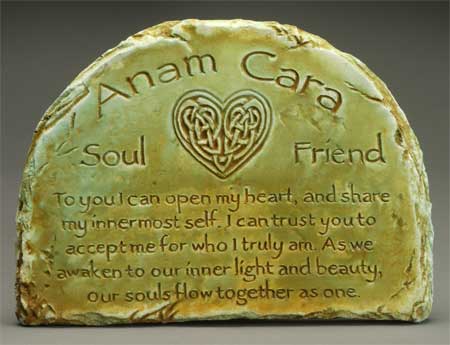
Anam Cara, The Blessing of a Soul Friend

anam-cara-wall-plaque

The sunshine of these May days have beaconed me outside into the newly awakened garden. My companion on these respites is John O’Donohue’s “Anam Cara: A Book of Celtic Wisdom.” Anam Cara is Irish Gaelic for “soul friend”. As the gentle breezes and the warm sunlight caress me, I am struck by the pleasure of knowing the Earth as my anam cara.

“God is the crack where the story begins. We are the crack where the story gets interesting.”

Padraig O'TuamaPadraig O’Tuama describes himself as a “gay catholic theologian” he is also a poet and a troubadour. I was introduced to his work by Peter Rollins and I have spent much of this week enjoying his book of poetry: “Readings from the Book of Exile”. O’Tuama is quite the performer. I suspect that his ability to tell a good story has much to do with his life in Belfast. Like all good storytellers, O’Tuama’s stories have the ability to transfix his listeners and he uses his beguiling powers to challenge theological doctrines and move people to places that a mere lecturer or preacher would be heard pressed to lead them. On the power of story told to him by his mother, O’Tuama opines: “Does it matter if that actually happened? It did happen that she told it to me. Does it matter where it came from? There is an examination of truth that is vulgar. Truth as empirical fact or truth as something that creates a life? I suppose that what I’d like to say that part of the value of story is to create a way to live a life. It is only the most vulgar analysis that depends purely and solely on whether or not the empirical analysis works.  There are other measures of success for story.” 

A line from one of O’Tuama’s poems insists that, “God is the crack where the story begins. We are the crack where the story gets interesting.” A beautiful Belfast word is “crack”! It can mean anything from “news” to “debauchery”. Some folk use it to mean gossip, music, drinking, fun, party or good times. I remember relatives using it to mean “word”.  So what is the crack? In Padraig’s case the WORD dances through the crack! The notion that God is the “good times” where the story begins, that we are the  “party” where the story gets interesting is “good news” indeed! 

Padraig O’Tuama is one storyteller whose crack I look forward to hearing more of! Enjoy!

Padraig O’Tuama begins at the 4.25 minute mark.

The Story of Judas Iscariot – John Shelby Spong

judas and jesusThis Sunday, in churches all over the world the story of Judas Iscariot will be read. So, this video of John Shelby Spong’s lecture on Judas Iscariot is a timely one. Both  preachers and listeners of sermons will find Jack’s take on Judas’ story thought-provoking. Enjoy!

Easter: 50 Days to Practice Resurrection!

Reposted from last year – Sermon for the Second Sunday of Easter April 15 2012

resurrection

This Sunday I tried something new: introducing a video clip into the sermon! You can view the video within the written text of the sermon below or listen to the audio version provided. I am indebted to the work of James Rowe Adams for much of the New Testament Scholarship in this sermon.

The Scripture texts were John chapter 20:19-31 and Acts 4:32-35

Audio Version of the Sermon click here

Practicing Resurrection

Christ is Risen! Christ is Risen indeed!  Alleluia!

So, Christ is Risen!  So What???

What can it possibly mean to you and to me, that a rag-tag bunch of Jesus’ followers gathered together in an upper-room and talked about their experiences of Jesus and decided that not even death could extinguish the life that they experienced in Jesus? What difference does it make to you or to I that Christ is risen?

The truth is that it can make absolutely no difference what so ever. Now there are a whole lot of people who will tell you that the important thing about resurrection is that you believe it. Those same folks absolutely love the story of doubting Thomas. And so every year on the second Sunday of Easter we read the story of doubting Thomas as a kind of inoculation against Thomas’ disease.

I sometimes think that the designers of the lectionary were trying to build up our resistance to doubt. Having problems believing in resurrection, well don’t do what Thomas did, don’t doubt, because you’ll be proven wrong. Jesus is alive, the wounds in his hands proved that to Doubting Thomas, so have no doubt about it the resurrection happened!  Believe in the resurrection!

The trouble with believing in stuff is that it belief can make absolutely no difference what so ever. I can believe in justice for all, but unless I’m prepared to seek justice, to be fair, or to resist injustice, it makes absolutely no difference what so ever. You can shout, “Christ is risen!” all you want but unless you are willing to live it, the resurrection means very little at all.

In order to live the resurrection you have to begin practicing resurrection. In order to practice something, you have to know what it looks like, what it sounds like, or what it feels like.

I’ve been trying to figure out how to show you what resurrection looks like in the flesh. Then I remembered a video that’s been doing the rounds on the internet, so I want you to watch this modern miracle of resurrection.

WATCH THE VIDEO CLIP FROM:  Alive Inside

Christ is Risen! Christ is Risen indeed!  Alleluia!

            2000 years ago a bunch of rag-tag Jesus followers were huddled together in fear. Their beloved leader had been brutally executed by the powers that be and they were terrified that they would be next. Paralyzed by their fear, hiding behind a locked door, something happened that gave them the strength to burst forth from their own tomb and change the world.

Ever since they began to practice resurrection, people have been trying to figure out exactly what happened; what could have changed these bumbling, terrified, betrayers, abandoners, who seemed to be always getting things wrong, into a bunch of leaders who began a movement that spread through out the Empire within their own life-times and then based on the power of their witness, spread throughout the world and continues to nourish and sustain millions of people from generation to generation?

Now there are those that insist that it was the power of Jesus having been physically resuscitated from the dead that motivated his followers to change their lives and the lives of millions who have come after them.  But we live in the 21st century and we have access to all sorts of information that the generations who have gone before us did not. Most of us, myself included, are not swayed by arguments about a physical resuscitation of Jesus’ body. But I can tell you without a doubt that I do believe in resurrection and I know that Christ is risen and I also know that the same power that the early followers of Jesus used to change the world is available to you and to me.  And now more than ever the world needs us to start using that power. It’s long past time for us to start practicing resurrection.

So, if they weren’t talking about a physical resuscitation when they spoke of Jesus’ resurrection, what did the early followers of Jesus actually mean when they spoke of Jesus having been raised from the dead? During the first century many Jews had adopted a vision of the future that dealt with the prevailing question of the day:  “How could a just God allow his people to suffer endlessly at the hands of their enemies?” Or as Dom Crossan puts it:   When was God going to clean up the world so that justice could prevail? Continue reading

Yes, Yes, Yes, Yes, Yes, Laugh! – Easter Sunday Sermon

Christ is risen! Christ is Risen Indeed!Easter Roll away the stone

I am indebted to John Claypool’s sermon from back in 1997 for the story of Eugene O’Neill’s play “Lazarus Laughs” and to Henri Nouwen’s “Our Greatest Gift: A Meditation on Dying and Caring” for the “Parable of the Twins”. 

Listen to the Sermon here

Download the worship bulletin here

A Resurrection Story In Memory of Nellie, My Gran

I post this sermon, which I preached last Easter Sunday, touched by the memories it evokes. Resurrection came to my Gran this past summer. Her 100 years were and are a blessing to her family and friends. She comes to me often in so many ways; this sermon is but one. 

Tredegar, Wales the village where Nellie was born in 1911

Tredegar, Wales the village where Nellie was born in 1911

Sisters and brothers in Christ, today we gather to celebrate the greatest story ever told! Christ is risen!  Christ is risen indeed!  Alleluia! Christ is risen in you and in me. And because Christ is risen, I can welcome each of you to your very own resurrection!!!  Christ is risen in you and in me!  Alleluia!!!       

It is the greatest story ever told. Like all the best stories ever told it does not answer all our questions. Poet Mary Oliver insists that, “There are many stories more beautiful than answers.” The bible is full of great stories. The sacred scriptures contain responses to some of humanity’s greatest questions. The stories in the scriptures provide us with responses to some of our deepest longings, but those responses do not come in the form of answers. The Bible is full of stories that touch the deepest mysteries of life. The ancients knew that eternal truths are best communicated through stories, and so we plumb the depths of the scriptures’ parables, myths and similes to discover our reality. The story that bursts forth on this Easter Sunday is the greatest story ever told. It is a story told in response to our deepest reality and our darkest fear: death. Continue reading

Rob Bell Comes Out as an Inclusive Christian

Lost and Found – Lent 4C

Lost-and-foundThis morning I tried something very different – in place of the sermon I tried an interactive exercise designed to help the congregation experience the parable. I was inspired by a lecture I heard down in Chautauqua when Jewish New Testament Scholar, Amy-Jill Levine  was exploring the parables.  

Listen to the interactive/sermon here

You can watch Amy-Jill Levine’s lecture which inspired me to challenge the congregation to move beyond allegorizing this parable here (look real close and you’ll see me down near the front, just soaking it al in!

Letting Go of our Tightly Held Piety to See Our Need of Confession

JOHN OF THE CROSS as
Little Crystal was only two and a half years old when she got hopelessly stuck.
 And when she got stuck she did what all small children do, when they have gotten themselves into a situation that the can’t get out of, little Crystal cried for help. She went into her mother’s study, holding in one hand a family treasure and her other hand couldn’t be seen.  Crystal cried out, “Mommy I’m stuck”. Her unseen hand was stuck inside her great-grandmother’s vase.  The precious vase had been handed down from her great-grandmother to her grandmother, to her mother. Crystal had always been told that one day the magnificent vase would be hers.

Crystal’s mother tried to move quickly without panicking. She scooped the vase and her little girl up into her arms and carried them to the kitchen sink. She used warm soapy water to try to loosen the toddler’s hand, which was stuck all right. When soap didn’t work she reached for the butter. While greasing her child’s wrist like a cake pan, she asked the obvious “mother question.” “How in the world did you do this, child?” Crystal carefully explained that she had dropped candy down into the vase to see if she could still see it when it was at the very bottom. But she couldn’t see it, so she reached in for her candy and that’s when she got stuck and she couldn’t get her hand back out.

Well, as time passed, the situation became more and more serious. Crystal’s mother called for re-enforcements. She phoned her own mother and told her to get there as fast as she could. A neighbour suggested Vaseline. The apartment manager got out some WD40. Still no luck.  It began to seem like the only way to get Crystal’s hand out was to break the family heirloom.

When Grandma finally arrived, both Crystal and her mother were almost hysterical. They were both more than a little relieved to have Grandma’s calming presence. Grandma sat little Crystal on her knee. 

Crystal was very upset and still very stuck. Grandma took a good look at the vase that used to sit on her mother’s kitchen table all those years ago.  She looked at the miserable look on her grand-daughter’s face, and she said, “Crystal, sweetheart.  Your mommy told me that you reached into the vase for candy.  Is that right?”

Crystal was a little breathless from all the crying she had been doing and all she could manage was a whimpered, “Mmm hummm.” “Honey, tell grandma the truth now. Do you still have a hold of that candy?” “Mmm humm”.  Crystal sobbed. Then Grandma rubbed little Crystal’s back, held her close and gentle, but firmly said: “Let it go, child.  Let it go.” Sure enough, the vase slipped off as smooth as silk. (I have searched for the source of this story, without success. I first heard it at a retreat on the West Coast a lifetime ago)

In this fast paced world of ours, I often find myself in little Crystal’s predicament.  Surrounded by a treasured family heirloom, desperately clinging to a treasure.  My predicament often makes it difficult for me to appreciate the beauty of the heirloom. Letting go isn’t as simple as it sounds. But sometimes letting go is the only way to preserve the integrity of the heirloom. When I think about the church’s practice of public confession, I can see how desperately I have been holding on to candies that no longer satisfy my need for forgiveness.  Continue reading