Radical Theology and Piracy

female pirateFor those of you who enjoyed Kester Brewin’s playful, pirate theological take on the Prodigal this conversation will help you walk off the plank and into the sea of “radical theology. Kester Brewin, Peter Rollins, and Barry Taylor engage in conversation at Fuller Theological Seminary explore what they and others in the emergent church are calling “radical theology”.  Radical theology seeks to move beyond current concerns about how we do church or express our faith in the 21st century to a movement that seeks to reject traditional notions of “God”.    

Prodigal Pirate Tragedy?

prodigal childKester Brewin certainly has a different take on the story of the prodigal! Pirate Theology is not a homiletical method that I’ve ever employed. But then pirates tend to work for themselves. Brewin’s playful pirate theology encourages us to leave our places of comfort in order to view a familiar story as a tragedy in order to grasp what he calls “radical theology” in which we take responsibility for who we are rather than defer to “the Big Other”.

Brewin is a founding member of Vaux-London, a collective of artists and faithful urban dwellers that served as an early model of fresh expressions of church in the UK.

Kester teaches Mathematics in London and works as a consultant for the BBC, as well as writing for the national educational press. He is also an acclaimed poet and has been described by Brian McLaren as ‘one of the leading public theologians for a new generation of thoughtful Christians.’ 

Embracing Mystery and Unknowing – Peter Rollins

Peter RollinsPeter Rollins uses contradictions to communicate what he calls the “radical” reality of Christian theology which he believes enables us to embrace and celebrate our brokenness and thereby move toward healthy community. “The church is not designed to give you things…it helps you experience the depth, the sacredness and the beauty of what you already have.”

This interview was recorded by ChurchNext on Dec. 14, 2012

Epiphany: Evolution is Shedding New Light on Our Lives – Joan Chittister

sad EckhartThanks to science and all we have learned about creation, we are beginning to develop new images of the ultimate reality we call God. New images of God challenge the patriarchal misogyny of religious traditions. When it comes to re-imagining the faith, Sister Joan Chittister paints a picture of God as One Who Summons from among us – Emmanuel. The Summoning One calls and encourages us toward a world of equals. “Evolution is shedding new light on our lives.”

The Idolatry of God – Peter Rollins

Peter Rollins new book The Idolatry of God: Breaking the Addiction to Certainty and Satisfaction has just been released in North America. I didn’t wait for this release, I had a copy shipped out from the UK last month. So, I can whole-heartedly recommend it!  I’ll post a full review soon.  Peter Rollins will be our guest at Holy Cross in Newmarket for the weekend of April 12-14: tickets will go on sale in a couple of weeks–so stay tuned.

In the meantime, enjoy the video of Pete talking about his new book.  

The Journey of the Magi never happened and yet it is always happening.

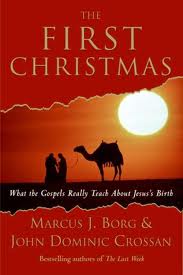
Epiphany-Wise+WomenAn Epiphany Sermon, preached in 2008. I had just read “The First Christmas” by John Dominic Crossan and Marcus Borg. Our congregation played host to Dom Crossan a month before I wrote this sermon. So, Dom’s insights run through this effort. But the heart of this sermon beats as the result of a sermon preached by Bruce Sanguin a self-proclaimed evolutionary christian who is a United Church Minister (Canadian Memorial Church, Vancouver). I had the privilege of meeting this modern mystic while on sabbatical this summer and his compelling way of unlocking the scriptures using the wealth of the christian tradition together with the insights of modern science and psychology borders upon the poetic. This sermon was anchored by Sanguin’s words (Epiphany 2007). Sermons are a “live” event. So, this manuscript is an approximation of what was actually preached.   

Just five days before Christmas (2008), The Archbishop of Canterbury, The Most Reverend Doctor Rowan Williams, the leader of the worldwide Anglican Communion started a firestorm.  During a BBC interview, His Grace was quoted to say that the story of the “three wise men is a legend”. The Archbishop was also heard to say that he remained unconvinced that there was indeed a star that led the legendary trio to the birth place of the Christ Child.

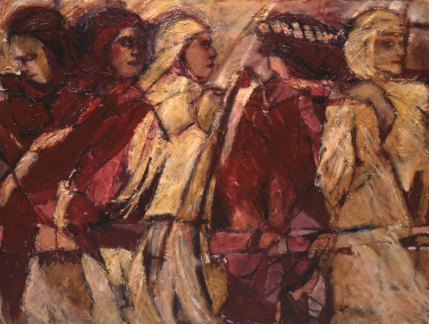
If that wasn’t enough to send folks off the deep-end, it has been revealed that the Presiding Bishop of the U.S. Episcopal Church The Most Reverend Doctor Katherine Jefferts Schori, who just happens to be the first woman elected primate in Anglican history, has fanned the flames of the fire-storm by sending out what has been judged by some to be an incendiary Christmas card.

I downloaded a copy of the offensive card, so that you could see for yourself. Her Grace’s choice of card has offended the good deacons of Ft Worth Texas who claim that their Primate’s actions defy explanation. As you can see the wise folks depicted on this image look a lot like women. Can you imagine the nerve of the first woman primate! How could she be so bold as to select such an offensive image? Leave it to straight talking Texans to set things straight: for despite the audacity of the Primate, the Texans have pledged to “stand for the traditional expression of the Faith.”

I must confess, that I deliberately chose our opening hymn. I wanted us to sing “We Three Kings” so that the traditional interpretation of this Gospel story would be fresh in your minds. It’s a lovely little song; I’ve been singing it since I was a child. It’s a lovely little song about a lovely little story; a story that’s been embellished over the centuries. A song that conjures up images of Caspar, Melchoir and Balthazar riding atop their camels, following the star to the stable where the baby Jesus lays waiting for their precious gifts of gold, frankincense and myrrh .

But, at the risk of offending our Texas cousins, I’m afraid that I much prefer to imagine the possibility that the magi may have been women, and although I would use the Archbishop of Canterbury’s exact words, I too believe that these events are not historical. And I don’t mind telling you, that despite the efforts of the biblical literalists to pinpoint the star or to determine the identity of the magi, I don’t believe that the writer of the Gospel of Matthew ever intended his readers to take this story literally. But, I do believe that the writer of the Gospel of Matthew did intend for us to take the story seriously. Very seriously indeed. For the writer of the Gospel of Matthew is trying to put into words that which words cannot explain.

The writer is trying to express the wonder that was experienced by those who encountered Jesus of Nazareth; an experience so real, so amazing so life transforming that only the language of parable could hope to capture even a hint of who Jesus was, is and ever more shall be.

The story of the magi’s visit is a parable; and like all parables it is a story that captures a timeless and enduring truth about the human condition. I don’t believe it actually happened. But then I don’t believe that the parables of the Good Samaritan or the Prodigal Son, actually happened either, but they couldn’t be more true. 

That’s right, the visit of the magi never happened and yet it ‘s always happening. This wonderful tale of three astrologers scouring the heavens for signs of new happenings on the planet captures the imagination of every generation. You see, we humans are meaning-making creatures eternally searching for the Mystery at the heart of the universe that dignifies and enchants our lives. Human beings just can’t help trying to understanding the meaning of it all. We are constantly trying to understand the how and the why of existence.

But alas the indignity of our modern times lies precisely in our being told that the cosmos—this universe in which we live and move and have our being—is essentially purposeless, without meaning or direction.

There’s this thing that some people call Scientism afoot that threatens our ability to see beyond our noses. Scientism is the religion of those scientists who refuse to concede that the phrase, “I don’t know” is sometimes the only answer that we have. Scientism is science that slips into an ideology of materialism—an ideology of materialism is the idea that every thing and every body is nothing more than the random collision of atoms and molecules. Scientism is the assertion that we and the universe are nothing more than  a cosmic fluke of enormous proportions going nowhere in particular. According to the dictates of scientism: any meaning that we might attribute to our existence is therefore just that—our own arbitrarily generated attributions of purpose to a journey to what is at the end of the day nothing more than the purposeless march of time. Unlike science, that provides for the possibility of a creator, scientism would have us believe, that there is no meaning behind our existence, we simply randomly evolved and we will someday randomly devolve, or dissolve into a pile of dust. (Sanguin)

That’s why I love the parable of the magi’s visit! For these ancient astrologers had their own ways of determining meaning,“the heavens are telling the glory of God, and the earth proclaims God’s handiwork”. A new star appears in the heavens and for those with enchanted hearts, it means that God is on the move—something new is about to happen.  So they chased down the star, to see this thing that God had done.

Unlike our ancestors, we live in a culture in desperate need of enchantment and awe. We are so meaning-starved as citizens of the Western world in the 21st century that we chase after almost any kind of novel spiritual movement.             The pendulum swings from scientific materialism to the latest cult so starved are we for spiritual re-enchantment. In our state of spiritual hunger we’ll accept any morsel from the smorgasbord of new age spirituality. But there are few among us who would take seriously the study of the stars. Apart from a fleeting glance at our own horoscope, we’ve long since given up the notion that there’s any wisdom in astrology.

But what of those modern day magi who study the stars, what wisdom can we gleam from the astronomers of our day who peer into the sky seeking the answers to our riddles? We may no longer care if the moon is in the seventh house or if Jupiter is aligned with mars, and I don’t even know if this is still the dawning of the age of Aquarius, or if we’ve moved on to some other season of the Zodiac, but I’ve heard tell of  black-holes, the death of stars, and light-years.

The sages of our age, the astronomers who seek meaning from the skies are not all so quick to subscribe to the big bang theory of randomness. For they have seen great things in the sky and there are many among this wise folks who insist that the cosmos is infused with meaning and purpose—Indeed, they tell us that  stars and the planetary bodies participate in this journey of cosmic meaning.

Those sages who are engaged in scientific study are not all followers of scientism. The notion of a creator, a first cause, or a driving force, dare we say God, as the power that drives all of existence is seriously explored by the wise folks of academia and science has refused to exclude the possibility. And yet there is the illusion afoot that the followers of science find faith incompatible with the pursuit of meaning. When the truth is that scientism seems to be the choice of those who have given up or forsaken the pursuit of meaning. Science itself would seem to deny scientism!

More and more, scientists, are beginning to speak out and more and more academics are joining the chorus of those who insist that there is indeed a power at work in the large-scale structures of the universe, in the evolutionary unfolding of the planet, and in our own personal and collective lives. To pursue knowledge is to continue the journey of the magi who pursued light, the timeless symbol of knowledge. To follow the light, to go where wisdom and knowledge lead, is to seek the answer to the age old questions: Where do we come from and where are we going?  Why are we here?. You don’t need to be a scientist or an academic to ponder the secrets of existence. Like the magi, we too can seek the light. Just as the magi gazed up at the light in the heavens and followed it to the place where it lead—and found the Christ-child—we too can follow the light in our own lives.

Scientist Brian Swimme has a theory, a theory that coincidently, theologians and priests have been taking about for centuries. Swimme calls his theory the principle of allurement. According to this theory there is a power at work in the universe that works by alluring one body to another, until eventually all bodies are drawn into the very power that provides the force of allurement. (Sanguin)

In simple terms it works like this: five billion years ago, our planet became fascinated by an enormous star, a million times its own size. The earth spends a billion years just hanging out in its orbit in a relationship which physicists actually call adoration. There is something about the star that has the capacity to awaken this planet, and the planet gives this source of allurement its undivided “attention”. When it figures out how to make a chlorophyll molecule, the love affair really begins. Through photosynthesis, the earth, discovered how to convert the sun’s light into the energy required for the procession of life to emerge. This is why the earth found the sun’s presence so alluring. The sun had the capacity to awaken the latent potential of the planet earth to come to life. (Sanguin)The theory of allurement isn’t confined to astronomy, it dips into to theology and from the priest come palaeontologist, Pierre Teilhard de Chardin, it borrows the notion of the Omega Point. The Omega Point is the completion and perfection of all creation to which we are being drawn, no-coercively, gently, and in a way that respects our freedom. (Sanguin)

How do we find our way to the Omega Point?  Well that’s the real beauty of this theory, you see it’s described as a completely natural process that kicks in the moment we decide to trust this Power—this power that goes by many names, you and I are bold enough to call this power God, some call it Wisdom, but there are other names. (Sanguin)

The point of the Omega Point, is that all we must do is to follow the way of the Magi and look for the light. Physicists call this quest for the light, “attending to our allurement”. The dynamic of allurement is a powerful force in the psychological make-up of the human being. (Sanguin)

Each of us is drawn by this mysterious force toward what for each of us provides ultimate meaning for our lives. If we resist the force, ignore it, deny it or fight it we loose our way. Like the Magi we must follow the light.

Think of the Christmas presents you were given as a child that charted a course for your life; the lego set for the future engineer, the microscope of the future biologist, Gretsky’s first hockey stick, the artist’s first set of water-colour paints. For me it was the books; those wonderful, marvellous books, that lead me through the words to The Word, and back to words about The Word.

The light shining in the darkness can draw us toward divinity, with books, music, other people, world events, dreams; anything and everything may function as the light. The spiritual journey involves following the light to its source—like the Magi.

God has made it easy to find God. The points of light to guide our feet to the Christ are as numerous as the stars in the sky. The essential skill to hone is the capacity to notice your life.

As you begin to take notice of your life, an enchanting awareness may surface—that there is a Mysterious Power at work weaving together all the various strands of your life into a unique and beautiful symmetry or tapestry.

The next step—after noticing that there is this Light guiding your path—is to set out upon a conscious spiritual journey. Become the Magi. Load up your metaphorical camels and set out across the landscape of your soul to where it is that the light stops. (Sanguin)

Here’s a little secret pearl of wisdom to take with you on your way: There is no single, final destination that we’re ever going to arrive at in our lifetime. Do you think that the Magi’s spiritual journey was over when they arrived at the stable—that they found Christ and then stopped growing spiritually? Don’t you believe it!

Christ is the ever-present light of our lives, beckoning from the many stars that allure us, calling us toward our own divine image and inspiring us to give our lives as an offering so that all of creation may continue to evolve.             Evolution is not random; each of us has a unique role to play. But let’s not be naïve. Each of us possesses an inner Herod who doesn’t like that we’re paying homage to any king other than our self. The story of the Magi got this detail exactly correct. Something within us resists God—call it ego if you will—but there is something within us that thinks that it alone deserves gifts of gold, frankincense and myrrh. It does not want to worship or pay homage; it wants to be on the receiving end of both and will go to great lengths to make it happen. It wants to know where the light is leading, not to submit to it, not to give thanks, not to sing praise and be in awe, but rather to scope out it’s rival, in a vain attempt to outshine it, or even destroy it.

Herod is also found in our families, and in our social, political, economic and religious systems. Herod is present as the power of domination. Herod hates the fascination of others unless it is directed toward him. Herod—within and without—refuses to serve any higher power; Herod refuses to fit in, to take his place in grace. Herod will try to rule the show.

But fear not. Your inner Magi is very wise. And just like the parable teaches us, Herod may summon the Magi in an effort to find out where the light is leading.  Herod may pretend to want to offer gifts.  But another light shines upon the Magi. An angel; a messenger speaks to the Magi in a dream, warning them not to cooperate with Herod. The Magi ignore Herod, leave their gifts with the Christ child, and head home by another path.

This is the path of Epiphany, then; the “other” path, the path of spiritual wisdom that trust the light, follows it wherever it may lead, discerns the wily, violent intentions of the inner Herod, and returns home—always home—to the heart of God.

So, you see, the story of the Magi’s journey, never happened, and yet it is always happening. May the light of the world lead you home! Always home—to the heart of God!  Amen.


Chris Hedges – Prophet of the Occupy Movement

Chris HedgesOne of the joys of these winter holiday days is the opportunity to do some catching up. Most days, I peruse the news and words about corporate greed and abuse of power penetrate my consciousness only as far as I can afford to allow them to. But the gift of time that these holydays give enable me to let the words touch me. Chris Hedges is a journalist whose work I respect. I regularly read his columns at “truthdig: drilling beneath the headlines”  I loaded is newest book: Days of Destruction, Days of Revolt onto my iPad several weeks ago, knowing that I could not afford to give it the time it deserved until now. Hedges ability to peer through the venire of so much political punditry   to expose the rotting underbelly of modern life is, dare I say it, prophetic. But prophets are dangerous because they move us beyond the dull passive acceptance of the headlines we are fed by the corporate media and compel us to question the status quo. As I read Hedges latest work, I find myself questioning what it means to be human.

“The book examines the impoverished lives of people and their communities “offered up in the name of profit” and forms of resistance. Hedges is a foreign correspondent, author, and part of the team of  New York Times reporters awarded a Pulitzer Prize for the paper’s coverage of global terrorism. He has most recently been in the news for having sued the Obama administration for signing a law that, he and other activists and writers,  believe infringe on their first-amendment rights.”

For those of you who are unfamiliar with Hedges, you will find in 3 parts a video of Hedges speaking about life and work.  The final video focusses on Days of Destruction, Days of Revolt which he wrote with graphic novelist Joe Sacco.

Joy to the World


Joy to the worldFirst Sunday after Christmas

Sunday December 30, 2012

Listen to Pastor Tom Doherty’s sermon here

Do You See What I See?

baby in a tree

Do you see the baby?

Some of us have followed the star, we have journeyed to Bethlehem and we have seen the ONE who comes into the world as a child. Now what? Do we see the needs of the child? Are we ready to roll up our sleeves and be about the work of ushering in the Reign of Justice that this child, any child needs in order to live in peace? I wonder? 

I still hear the echoes of Rachel’s voice weeping unconsolable in Ramah; weeping for the lost children of Newtown and every town where violence, greed, madness or neglect robs the child of those things that belong to children: playful laughter, safe homes, warmth, nourishment, learning, embraces, peace….a future. 

Mystic, poet, philosopher, and theologian Howard Thurman’s poem “The Work of Christmas” comes to me as a challenge for the days, months and year ahead:

When the song of the angels is stilled,
When the star in the sky is gone,
When the kings and princes are home,
When the shepherds are back with their flock,
The work of Christmas begins:

To find the lost,
To heal the broken,
To feed the hungry,
To release the prisoner,
To rebuild the nations,
To bring peace among brothers,
To make music in the heart.

The Herods of this world have had their way for far too long. Let the slaughter of innocents end. We have seen the child and we know the wonders of a star-lit peace-filled night. So, let the work of Christmas begin with all of us seeking justice and making peace so that children everywhere can grow in LOVE. Shalom!

Christ is Born in You!

Christ is born in youToday we celebrate the birth of the Messiah. Messiah, is a word the ancient Hebrews used to describe the anointed one. The one whom God would send to change the world. In Greek the word for Messiah is Christ.

This morning my thoughts swirl around a poem written by the unknown writer of the Gospel of John in which the birth of the Christ is describe as the WORD. It’s a mysterious cosmic poem that moves our minds away from the mundane everyday ordinary stuff of life to the extra-ordinary mysteries of creation, which when you think about it is what every birth does.

Just begin to think about the arrival of any newborn and before long you’ll find yourself pondering the mysteries of this life. Who are we and where do we come from?  Why are we here? What does it all mean?

Now while those are all perfectly wonderful questions and speculating upon the many possible answers to those questions is a fascinating process. But, in the end our words will always fail us when it comes to answers. And as we are speculating about the birth of this beautiful little baby, the baby is alive and among us, and needs to be fed and changed, nurtured, guided and protected.

Our speculations about the mysteries of creation are a little like our preparations for Christmas. All the preparations, the decorating, the shopping, the wrapping, the stuffing, the cooking, and the worrying, and in the end all our preparations aren’t really the point. The point is it’s Christmas day and the guests are here or we’ve arrived and the gathering is upon us, or not, and its up to us to welcome the Messiah, to celebrate Christmas.

The trouble is that sometimes, we are so preoccupied with the preparations, with the idea of getting it right that we forget the whole point of Christmas is the celebration itself; the gathering of the clan, the being with one another, the opportunity to be present to one another. It’s one of the reasons why I love the stories that the unknown writers of the gospels of Matthew and Luke put together.    In those familiar tales we hear a story of a couple of parents who were not at all prepared to welcome a child into the world. It’s an earthy story that brings the pungent aroma of a animal dung right into our carefully decorated living-rooms. And the Messiah that we greet in the story found in Matthew has no halo hovering over his head. The writer of Matthew makes it very clear that the Messiah comes from a very dubious pedigree, numbering a prostitute, a product of incest, an adulteress and sexual trickster among his ancestors. The Messiah’s parents were an unwed teenage girl and an unspeaking father, who wasn’t a father, and the pair of them appear to be homeless and then on the run, seeking shelter wherever they can find it.

Our romantic notions of a pretty little stable will have to wait a thousand years for St Francis to pretty up and launch us on a quest for cattle lowing, shepherds kneeling and magi bowing.      Our expectations of the Messiah have become so very highfalutin, so otherworldly that I wonder if we are really prepared to welcome the Messiah this very morning. We hardly know what to expect from the Messiah. Are you really ready to welcome the Messiah? What do you expect?

There’s an old Jewish story, I can’t remember where I first heard or read it. I suspect I might have learned it from Scott Peck? The story is now deep in my bones. It surfaces most Christmas mornings to remind me that Christ is born in us.

Once there was a monastery with a long history of commerce and a thriving spiritual community. But as time wore on, fewer and fewer villagers visited the hallowed halls. Fewer people turned to the monastery for advice. Even the sale of their famous wines began to dwindle. The abbot began to despair for his community. “What should they do?” he wondered.

They prayed daily for guidance, but the brothers only became more dispirited. The monastery itself reflected their mood, becoming shabby and untidy. At last the Abbot, hearing that a wise Jewish rabbi was visiting, swallowed his pride and went to visit the rabbi to ask his advice. The abbot and the rabbi visited for a long time.

They talked of their respective religions, and the fickleness of human nature. The abbot explained his problem to the rabbi and asked for advice, but the Jewish sage only shook his head and smiled.

As the abbot sadly departed, the rabbi suddenly rose and shouted after him, “Ah, but take heart my friend for the Messiah lives amongst you!”

All the way home the abbot pondered the rabbi’s words, “The Messiah lives amongst you.”

What could he mean? Did the Messiah live in the abbey?

The abbot knew all the brothers very well. Could one of them really be the Messiah? Surely he, the abbot, was not the Messiah… Was it possible?”

Upon reaching the monastery the abbot confided the rabbi’s words to another brother, who told another brother, who was overheard telling another brother. Soon the whole abbey had heard the news. “The Messiah lives amongst us!” “Who do you suppose he could be?”

As each brother speculated on who the Messiah could be, his view of his brothers began to change.

Brother Louis no longer appeared simple, but rather innocent. Brother Jacques was no longer uncompromising, but rather striving for spiritual perfection.

The brothers began to treat each other with greater respect and courtesy; after all, one never knew when he might be speaking to the Messiah. And, as each brother discovered that his own words were taken seriously, the thought that he might become the Messiah would cross his humble mind.

He would square his shoulders and attend his work with greater care and start acting like a Messiah.

Soon the neighboring villages began to notice the change that had come over the monastery. The brothers seemed so happy. Villagers flocked to the monastery and were energized by the spirit of the Brothers. And so the spirit grew and the monastery flourished. As each new brother was welcomed, the question arose, “Could he be the Messiah?”

Apparently the monastery still prospers today and it is often whispered both within its walls and in the surrounding towns that the Messiah lives amongst them. As you celebrate Christmas this year, remember that the Messiah lives among you.

If you are waiting for perfection, Christmas is going to be a lonely and frustrating time.

If you are waiting for some future time, the wonders of this moment will pass you by.

If you are expecting salvation outside yourself, you might miss your own wisdom.

If you hold your loved ones to impossible standards you just might miss the Messiah who sits right next to you.

I know that you’ve worked hard, and made all kinds of preparations, but today is the day it’s time to greet the Messiah, now.

Don’t miss a moment of it.

Enjoy.

The Messiah is arriving in you and right next to you!

Enjoy!

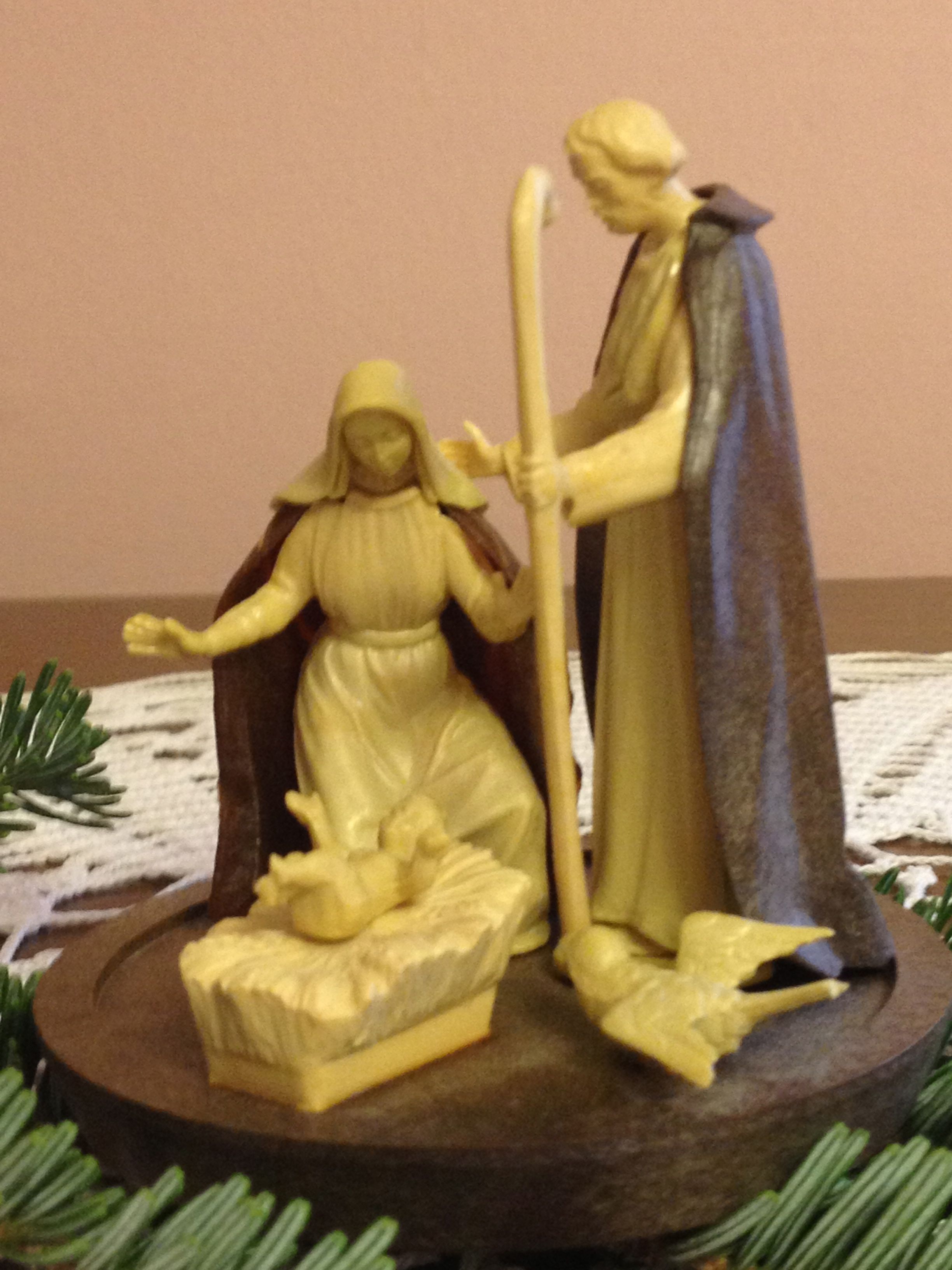
The First Nativity – Cheap, Small, and Plastic

The First Nativity for My First Apartment

The first Nativity purchased years ago for my first apartment – Cheap, small, and plastic.

A Christmas Eve Sermon for Progressive Christians

The First Nativity: Cheap, Small,

and Plastic

Listen to the sermon here

The Greatest Birth Story Ever?

WOMAN DOVE


Fourth Sunday of Advent

December 23, 2012

Listen to the sermon here

Greatest Birth Story Ever?

Christmas Stories

I have been asked to post these Christmas Stories, written and preached over the years. Enjoy: “Shattered Angel”     “Mary’s Story”     and    “Keep Awake”

SHATTERED ANGEL

As Christmas draws near, we turn to stories to express the inexpressible.

Like the Gospel writers we are at a loss to explain the activity of our God in the world and so we too resort to story telling.

Families gather and the reliable old stories are told.

And each year new stories are added to our treasure troves as we seek to express the inexpressible and touch the hem of our God who is love.

And what better way to touch and be touched by God than to tell stories of God’s love in the world.

We all have treasure troves of stories of Christ taking on flesh and dwelling among us.

My story took place when I was a young woman determined that my first Christmas living out in the world would be the type of Christmas that dreams are made of.

It’s a story about the quest for the perfect Christmas.

When I was growing up, I always wanted Christmas to be just so.

But the reality of family life with all its inherent dysfunctions coupled with financial limitations meant that we just couldn’t pull off the perfect Christmas.

And so every year, I used to comfort myself with the notion that when I grew up things would be different.

When I grew up, I’d do things better.

I’d save up my money so that no one would be disappointed and there’d be enough to ensure that the house would be filled with Christmas cheer!

The decorations would be perfect and no family arguments or disappointments would be allowed to ruin my.

I dreamed of the perfect Christmas and I knew that just as soon as I had my own place, I’d be able to pull off the kind of Christmas that would be so full of peace and harmony that the angels wouldn’t be able to keep from singing.

But, when I did finally move out, I only sort of got my own place.

I couldn’t quite afford the rent by myself, so I put a notice up in the office where I worked and I got myself a roommate to help with the expenses.

Helen and I had very little in common.

And those first few months were tough.

She liked things her way and I liked things my way.

We didn’t really like each other much, but we tolerated one another because we loved the house.

It was an old barn of a place perched on a hilltop above Vancouver’s Jericho Beach.

The location was truly magnificent.

So, Helen and I put up with one another’s strange ways.

We tried to get along, but in various subtle and not so subtle ways we let each other know that if we had been able to afford the house on our own we certainly wouldn’t put up with a roommate.

We were both strong willed and opinionated but we didn’t argue instead we used passive aggression to get our points across.

Looking back on it now, I wonder why we ever thought that having a Christmas party was a good idea!

Why we ever thought that we could celebrate together I don’t know, but at the beginning of December we decided to have a tree trimming party and invite our respective friends to gather in our home to usher in the Christmas season.

There was trouble right from the very beginning.

Helen wanted an artificial tree, I insisted on a real one.

Helen thought we should have a potluck meal, I insisted on serving our guests a three-course meal.

Helen wanted us to make decorations for our tree, I insisted of purchasing only the finest decorations I could afford.

Helen wanted to serve all sorts of alcohol, I insisted on limiting it to beer and wine.

Helen wanted to play games; I don’t play games at parties.

It went on and on with both of us insisting on something and then the inevitable negotiations in order to arrive at a compromise.

But I was convinced that everything would work out fine once our guests arrived, so I plowed ahead with the preparations.

When the day of the party arrived, Helen and I experienced a bit of a break through.

We admitted to one another that we were too tired and pre-occupied to actually enjoy the party.

Over a cup of coffee we actually considered canceling the silly party.

When our guests arrived, it seemed as though we might have done them a favour if we had cancelled because they too were tired and preoccupied.

Apparently we’d all just carried on out a sense of social obligation.

Not surprisingly, during the course of the evening the conversations, fueled by the beer and wine, became a little heated.

A bunch of guests were arguing over something so important that I can’t even remember what they were arguing about now.

Ronald Regan’s name came up; and somebody tried to get the conversation off politics; which led to some people arguing about sports and other people arguing about religion and whether or not Jesus was actually born in a stable.

Comments were made.

Helen’s friends thought my friends were outrageous and my friends felt the same about Helen’s friends and so the party limped along to a merciful end.

When the guests finally left, the tree was decorated, with an odd mixture of tacky homemade decorations and cheap store bought items.

It was far from perfect, and there was no chance that it would ever end up on the cover of a Christmas card.

Helen had won the day, and instead of the beautiful shiny star that I had purchased for to top the tree, some old family air loom, china angel of Helen’s was perched precariously atop if our limp little tree.

I was simply trying to straighten it; I swear I never meant for it to come crashing down.

It mustn’t have been put in the stand correctly in the first place.

Why else would it have fallen over, just as Helen was telling me to be careful?

The tree and all its stupid decorations crashed to the floor; including Helen’s precious china angel.

The angel’s neck was broken.

It was a clean break, the head severed with one crack.

I must have known that some glue could have put that angel back together, so I don’t know why I did what I did.

But I picked up the headless body and I flung it at the floor.

My perfect Christmas shattered into pieces on the floor along with Helen’s precious angel, given to her by her sainted grandmother when she was just a little girl.

It smashed into a thousand pieces, the shards and splinters skittering through the living room, into the kitchen and into two adjoining rooms and out the door and down the steps.

The evidence of my rage and the hopelessness of it all spread everywhere.

Tears filled Helen’s eyes as she picked up the angel’s head.

Its seraphic smile mocked us both.

Helen looked at me with the saddest expression I’d ever seen and I expected her to launch forth into a tirade.

But all Helen could manage were the words, “It doesn’t matter.”

Without another word, she left the living room.

I listened to her climb the stairs and walk slowly to her bedroom.

I stood in the aching silence and felt tears trickle down my cheeks and realized that I had ruined Christmas.

Not my friends, not my family, not even Helen or her friends, but me; I had ruined Christmas; it was my fault.

I had tried so hard to make it right, and then I’d ruined it all.

I leaned against the kitchen counter and stared at the pieces of china lying on the floor, casualties of some strange warfare in me.

Why couldn’t I be as good as I wanted to be?

I don’t know how long I stood there, but my self-pity was interrupted by the sound of Helen’s footsteps coming back down the stairs.

Without a sideward glance, she got out the broom and dustpan, and in silence we began to sweep up the shattered angel.

I couldn’t find words for my shame.

It seemed so pitiful to say, “I’m sorry,” but I did, and Helen simply said, “I know.”

We cleaned up our party in silence.

Regret and remorse kept me awake most of the night.

In the morning, Helen told me not to worry, stuff happens, things get broken.

She seemed to be trying to make the best of things, but I knew her grandmother’s cherished angel was no more, and worse, something in her granddaughter’s heart had been broken.

As for me, all I could feel was a dull lingering ache.

For the next few weeks leading up to Christmas, I kept finding fragments and splinters of that shattered angel in strange places.

I kept finding them in out-of-the way corners when the light hit them just so—they were everywhere.

Each time I found another piece of that angel, I thought about how much it had meant to Helen, how many memories it held in its eyes, and how much love beneath its wings.

I wondered about Helen’s grandmother and how she must have treasured such it.

I wondered how she got it in the first place and what made her give it to Helen.

And then there was the decapitated head.

Helen had carefully put it on the mantle the night I broke it.

I didn’t dare move it, so it stared accusingly at me whenever I went into the living room.

I wanted to buy Helen a new angel, but she wouldn’t let me.

Helen insisted that we put my shiny star on top of our tree.

I suggest that we make something.

I don’t know what I was thinking, I’m just not a crafty person, but together we made a beautiful angel.

Well, not exactly a beautiful angel; more like the body of an angel.

Somehow, Helen devised a cloth body, on which we attached the precious china head.

So, on top of our tree, sat the most unusual angel; who watched over something quite miraculous.

Somehow, the shattering of the china, released something in Helen and I.

The passive aggression left our house and was replaced by the beginnings of a real friendship

We talked together about Christmases past; about hopes and disappointments.

We learned about one another’s lives and we began to laugh and to cry, and to talk and to shout, and to disagree and to compromise and to care about one another.

And when each shattered piece of the angel would appear, I would truly apologize and Helen would genuinely forgive me.

I find it ironic, that the very season that offers the message of Peace on Earth, Good Will to All, brings instead Stress on Earth, and Bad temper to Many.

The challenge is to balance the traditions that manifest the joy of the season with the gift that embodies the reason for the season; and that gift is love.

For God is love.

And as the carol says:

Love came down at Christmas

Love all lovely, love divine

Love was born at Christmas

Stars and angels gave the sign.

Stars and angels gave the sign.

So did wise folks and shepherds then;

so do presents and mistletoe; homecomings and holly; trees, lights, and embraces now.

All the things that make Christmas Christmas point us to that gift of love if we let them.

Someone emailed this to me years ago; and I’ve kept it even though I thought when I received it that it was smaltzy:

but I think it speaks to some of our desires for the perfect Christmas, so you’ll have to forgive the smaltz:

“If I decorate my house perfectly with plaid bows, strands of twinkling lights and shiny balls, but do not show love, I’m just another decorator.

If I slave away in the kitchen, baking dozens of Christmas cookies, preparing gourmet meals and arranging a beautifully adorned table at mealtime, but do not show love to my neighbour, I’m just another cook.

If I work at the soup kitchen, carol in the nursing home and give all that I have to charity, but do not show love to my family, it profits me nothing.

If I trim the spruce with shimmering angels and crocheted snowflakes, attend a myriad of holiday parties and sing the solo in the Christmas Cantata but lose sight of the Christ in Christmas, I have missed the point.

Love stops cooking to hug the child. 

Love sets aside the decorating to kiss the lover.

Love is kind, though harried and tired.

Love doesn’t envy another’s home that has coordinated Christmas china and table linens.

Love doesn’t yell at the kids to “get out of the way; I’m baking Christmas cookies here.

Love bears all things, believes all things, hopes all things, and endures all things.

Love never fails.

Video games will break, pearl necklaces will be lost, golf clubs will rust.

But the gift of Love will endure.

Love never fails; well the truth is: our love often fails, it is God’s love that never fails.

For God is love.

We are created in the image of God.

Love is in the very fiber of our DNA, so you see

we were created to be love and

it is in our very nature to love.

The gift of Christ is a gift given to remind us who we are.

Love will endure.

The promise of new life in the birth of the Christ child becomes the hope of life eternal in the resurrection of Christ who lives and breathes in with and through us.

It is love that triumphs over death—love that is the Christmas Truth, a truth greater than the traditions it inspires; the mystical longing of the creature for the creator, the finite for the infinite, the human for the divine.

It is a longing that transcends culture, religion, language and custom; it is a longing that is represented for us in the baby in the manger—the sudden amazing and incomprehensible gift of grace:

a God who loved us enough to be with us.

Yes, we embody the wonder of Christmas in the gifts given, the meals shared, the gathering of family and loved ones; and not so loved ones.

But the greater wonder is that the God who is love incarnate comes to us at Christmas and is among us as one of us showing us how to share that love with a world in such desperate need of it.

St. Athanasius summarized the message of Christmas by saying that in the birth of Christ:

“God became human that we might become God.”

Another way of putting that in Christ that we can see, know, and feel God.

In Christ we learn that in those moments when we love are the times when we are most like God.

When we use love to overcome injustice, war and anything else that dehumanizes and demonizes anyone, we are most like God.

The gift of Christmas is the humanization of God so that human beings can become more like God.

The gift of Christmas is that we are loved so that we can become love.

Becoming love is a process; a beautiful, wonderful, painful, difficult, glorious process; kind of like picking up those pieces of shattered china.

They were everywhere.

I found what might have been the last piece of that angel before going to bed early Christmas morning, after coming home from the midnight Christmas Eve Communion.

Maybe it had fallen out of the trash bag, but however it got there, the small piece was lying on the driveway just where it intersected with the back alley.

I found it because the light of the moon, or the stars, or the neighbours’ window, hit it just so.

It occurs to me that maybe Christ is like finding those pieces in curious places after the shattering happens.

Finding little pieces and slivers of what Christmas means, of what the gift is, in the corners of our lives, in the cracks of our failures and shattered dreams, in friends’ small expressions of love and forgiveness and trust, in chances to begin again, and again.

Alleys and starlight.

God then and now, here and there and everywhere.

The light penetrating the darkness and hitting just so, unexpectedly, off what is broken and somehow mysteriously reflecting hope.

I picked up the broken piece from the driveway and held it as I walked to the back door, somewhere between Christmas Eve and Christmas morning.

I remembered the grandmother, and the granddaughter, and then another woman who long ago had been in painful labour on this night and a child born in a not so perfect out of the way place; a gift of love.

God then and now, here and there, working in a broken world amidst broken people who break things.

Christmas isn’t about perfection.

Christmas is about Love; Love that is determined to dwell with us in the midst of our brokenness; Love that is willing to work with us to heal our brokenness.

I took that broken piece of angel wing into the house and I got out the glue gun and I fixed some red string to it and when it was dry I hung it on our pitiful Christmas tree and the next morning when I Helen and I came down to greet the new day, a broken angel smiled down on us.

Helen saw the hideous excuse for a decoration that I’d put together and laughed out loud.

She warned me that if I wasn’t careful, I’d ruin Christmas with my hopeless sentimentality!

But it wasn’t me who insisted on taking that hideous excuse for a decoration when we eventually moved from that old house.

But it was me who packed away the love, which that hideous decoration bore witness to, and who treasures the memory of that hopelessly imperfect Christmas in my heart.

Strengthened by the love of a friend for the work of love.

MARY’s STORY:  Let It Be 

Maryuniversalmaryw

The way you tell the Christmas story, it all sounds so simple.

So simple.

Oh, don’t get me wrong, I really like it.

It’s just that for so long now people have been telling my story and the way they tell it, it all sounds so simple and easy, so neat and tidy, that I hardly recognise myself in the story.

It’s not your fault.  It all started a long time ago.

Luke and that other fellow Matthew, they started it all.  They wrote my story down and wouldn’t you know it they cleaned it all up.

But who can blame them.  Nobody likes messy birth stories.

And as birth stories go, my baby’s birth was a really messy one.

But when Luke tells the story, he likes to down play the messy bits.

But it was messy right from the start.

There I was, no more than fourteen, part of the young and the restless crowd.

My parents wanted me to settle down and it seemed like all my friends were getting married.

So I agreed to let my parents find me a husband and they picked out a local carpenter.

Joseph was a good man.

A little quiet perhaps, but a good man.

So it was all arranged and I was engaged to Joseph.

I was feeling pretty pleased with myself, when along came somebody claiming to be a messenger from God.

An angel no less.  Called himself Gabriel.

What an entrance he made.

There I was, all alone, minding my own business and along comes an angel.

Bold as brass, in he comes.  He scared the life out of me.

I had no idea what I was in for.

Imagine my surprise when he says to me, “Greetings, favoured one!  God is with you.”

I was struck dumb.  What sort of greeting was this?

He tells me not to be afraid and then with out so much as a “by your leave” he comes out with it.

He tells me that I, Mary have found favour with God.  Imagine that!

Then he says that I am about to conceive in my womb and bear a child.

And no ordinary child mind you but the Child of the Most High who will take over David’s throne and his reign will have no end.

Well would you believe it?  Not me.

I told that fool Gabriel that he must have the wrong girl.

I was a virgin!

Then he says that the Holy Spirit will come upon me and that the power of the Most High will overshadow me and that a child will be born.

He must have noticed that I wasn’t buying any of it because then he tried to convince me that nothing was impossible for God.

He told me that my cousin, old Elizabeth who had been barren for as long as I could remember had also conceived a child and was sixth months pregnant.

He kept insisting that nothing was impossible for God.

He had me so worked up that I didn’t know what to say.

Does that ever happen to you?

You hear something so incredible you just don’t know how to respond and then you end up saying something really stupid.  I can’t believe what I said to this guy.

When I think back on it, I suppose I could claim that it was the Holy Spirit that prompted me to say it.

I sure don’t know where I got the moxy to say what I said.

I looked that Angel Gabriel right in the eyes and I said, “Here am I, the servant of God; let it be with me according to your word.”

I must have been crazy!

But it must have been just what he wanted to hear because after that Gabriel was out of there.

I don’t mind telling you that it took a while for things to sink in.

I’m not sure I really believed Gabriel’s grand announcement until the Holy Spirit actually showed up.

Now I know that you’re all really curious about how it all came about.

But there are some things that a lady just doesn’t reveal.  And being overshadowed by the Most High is one of them.

All you need to know is that I became pregnant.

And what a mess that was.

In Nazareth, they did a far sight more than just frown upon young girls who get pregnant before they‘re married.

In those days you could be stoned if anyone found out.

So I kept things to myself.

I couldn’t help wondering about what the angel had said about Elizabeth.

Could it be true that at her age Elizabeth had finally become pregnant?

I wondered if she had had any angels visiting her house.

And I thought that maybe she could help me to understand what was happening.

So I convinced my parents to let me go and visit Elizabeth.

When I arrived, I couldn’t believe my eyes.

There was Elizabeth, stomach out to there.

When she caught sight of me she let out a loud cry and started going on about how I was blessed among women, and so was the fruit of my womb.

She wanted to know why I had come.

She asked me why the mother of her Lord should come to her house.

I wasn’t sure what to make of all that she said.

She told me that the moment she saw me the baby in her womb leapt for joy.

She went on and on about how blessed I was.

And by this time I was beginning to believe her.

I didn’t fully understand what was going on inside my body but I knew that God had some special plans for my child and for me.

I remembered some words from the Torah, words from the prophets Isaiah and Habakkuk, words that Hannah had spoken and words from the psalms.

These words from the scriptures flooded into my mind and I began to speak them:

“My soul magnifies the Most High,

and my spirit rejoices in God my saviour,

who has looked with favour on the lowliness of God’s servant:

Surely, from now on all generations will call me blessed;

for the Mighty One has done great things for me,

and holy is God’s name.

God’s mercy is for those who revere God from generation to generation.

God has shown strength with God’s arm,

and has scattered the proud in the thoughts of their hearts.

God has brought down the powerful from their thrones,

and lifted up the lowly;

God has filled the hungry with good things,

and sent the rich away empty.

God has helped God’s servant Israel,

in remembrance of God’s mercy,

according to the promise God made to our ancestors,

to Abraham and Sarah and to their descendants forever.”

Incredible words.  Unbelievable words.

Generations will can me blessed.  That’s for sure.

Generations have indeed called me blessed.

For nearly two thousand years, my story has been told in word and song.

But like I told you before, they have made it sound so simple and easy.

They have prettied it up.

I hardly recognise myself in the stories that have been told about me.

They’ve turned me into something that I am not.

For one thing they go on and on about the “Blessed Virgin.”

They make me out to be so meek and mild.

They constantly talk about how I surrendered myself to God, how I am the perfect model for the submissive obedient woman.

They have created an image of me as the perfect woman, and what an image a virgin and a mother.

They point to their image of  me as the obedient virgin mother as an example for women to follow.

Who could live up to that.  Not me!

Virgin and a mother indeed.  Totally submissive!  Hah!

Is that how you see me?

Have you any idea what it means to carry the Child of the Most High in your womb?

Submissive and obedient!  I was a scared little girl.

I was no one special.  Why God choose me, I will never know.

I was just an ordinary young woman.

I was a woman for heaven sakes.

A woman who lived two thousand years ago in a little town called Nazareth.

I had no special virtues, no power of my own.

I was the epitome of the lowly.

And God choose me.

God did what God is always doing.

God choose what was ordinary and accomplished something extra-ordinary.

God looked with favour upon me, lowly little Mary and God choose me to help change the world.

The Mighty One has done great things for me.

I am part of God’s plan to scatter the proud and bring down the powerful from their thrones, to lift up the lowly.

To help fill the hungry with good things, and to send the rich away empty.

I am part of God’s plan.

Part of the promise God made to our ancestors, to Abraham and Sarah and to their descendants forever.

I will admit that there were days when I wondered if I was the first woman that Gabriel visited.

Was I the first woman asked to bear God’s child or had the angel approached several young women who declined the honour.

I wouldn’t blame them if they did.

If I had known what was coming, I might have said no myself.

I don’t know how I found the courage to say yes.

But I do know one thing, if you want an example to follow, choose that one.

Forget the image of me as the submissive and obedient virgin mother and look at who I really am.

I had the courage to say yes.  I had the courage to let something grow inside me.

I had the courage to harbour the Child of God in my body.

If you want to emulate something emulate that.

Do you have the courage to harbour Christ in your body?

If you want to set me up as an example to follow, follow that, and have the courage to bear Christ.

But I ask you, when the power of the Most High overshadows you will you have the courage to trust God.

Will you have the courage to be a bearer of God to the world?

That’s the terrifying challenge that my story offers.

I challenge you to be at God’s disposal, to become filled with God’s life–for the sake of the world.

But let me warn you, God-bearing is more than a little inconvenient:  it can be heart breaking and even lethal.

Bearing God to the world means letting some of God’s passion for the world become flesh and that can be costly.

Bearing God to the world means being part of God’s plan to redeem the world; to scatter the proud and to bring down the powerful from their thrones; to lift up the lowly; to fill the hungry with good things, and to send the rich away empty.

When God sends a messenger to you, will you have the courage to say “Here am I, the servant of God; let it be with me according to your word.

Will you have the courage to join me in bearing God to the world?

So you see, it’s not so easy!  Mine is not a pretty little story.  It’s not so simple.

I said before that I don’t know why I answered Gabriel the way that I did.

I said that perhaps it was the Holy Spirit that prompted me to say it.

And over the years I have come to believe that.

And just as God gave me the courage and the strength to be part of God’s plan –

I trust that God will grant you that same courage and strength.

Let it be, oh God.

Let it be, according to your word.  Amen.


ADVENT 1

“Keep awake! Watch for we know not when Christ comes.  Watch, so that you might be found whenever and wherever Christ comes.” Mark 13 The Gospel of Mark tells us to “Beware, keep alert”.  Advent is about waiting and watching: waiting and watching for the coming of Christ.  We wait for just the right time to celebrate the birth of Christ in our midst and we watch for Christ’s promised return.  But how do we wait and where do we watch? A long time ago I lived in an apartment, in a very rough neighbourhood in the east end of Vancouver.  Many of the people who lived in this neighbourhood got by on welfare, others earned their livings any way they could.  I moved into the apartment because it was close to the office where I worked, the rent was cheap, and quite frankly I was young and foolish.  I ignored all the warnings of my family and friends and moved into the apartment convinced that I could handle anything that came my way.  The apartment building housed the most unsavoury of characters.  The office where I worked was just down the street and every morning as I walked to work I would meet some of my neighbours returning home from an evening of plying their trade on the streets and in the alleys. Each morning, I would be met at the entrance to my office by an old man named Ed.  Ed had been living on the streets for years.  He slept on the doorstep of the office because it was somewhat protected from the winter weather.  Ed always gave me a warm welcome when I arrived.  He knew that when I got inside, I would brew fresh coffee. He used to tease me that, I was a sucker for a sad face as he waited patiently for me to bring him a cup of coffee.  We never talked much, though.  I never found out how Ed ended up on the streets.  I didn’t know how he spent his days. That year I drew the short straw and had to work on Christmas Eve.  Before I left my apartment, I packed a small package of goodies for Ed, but when I got to the office, Ed was no where in sight.  I asked some of the women who worked the streets if they had seen old Ed.  But no one knew where he was.  I went about my duties and soon forgot all about old Ed.  I finished work early and went off to celebrate Christmas Eve with my friends.  I had been looking forward to Christmas for weeks and was eager to celebrate. Together, my friends and I shared a fine Christmas goose with all the trimmings and then we went of to a candlelight service.  The service was beautiful.  They really pulled out all the stops, great music, lots of activity.  The preacher even managed to keep his sermon brief.  But somehow I was left feeling like there was something missing.  The next morning I celebrated with my family.  But I felt detached, like I was just going through the motions.  The next morning as I drove back to my apartment in the city I found myself wondering if this was all there was to it.  Christmas had come and gone and I didn’t feel like anything had changed at all.  By the time I had parked my car, I was feeling quite depressed.  Christmas was over and nothing much had changed. When I got to the entrance of my apartment, I saw Ed.  I’d never seen him anywhere near my apartment before and it made me a little nervous.  I wondered how he had found out where I lived.  Indeed, it frightened me a little that he had taken the trouble to find out where I lived.  Ed looked very agitated.  Nervously I greeted Ed and asked him why he was at my doorstep.  Ed explained to me that he needed my help.  I became very uneasy.  The odd cup of coffee at work was one thing, but this old man showing up on my doorstep was quite another.  And now he wanted something. Ed asked me if I would come with him to the park.  Caught off guard, I reluctantly agreed.  When we arrived in the park, Ed introduced the me to Karen.  Karen was a very scared looking teenager, who couldn’t have been more than about fourteen years old.  Ed explained that Karen had run away from home on Christmas Eve.  He said that lots of kids ended up on the streets at this time of year and there were usually lots of unsavoury characters to meet them when they arrived.  When Karen arrived at the city bus depot, Ed spotted her.  From the moment she arrived, Ed had carefully watched over Karen, making sure that she came to no harm in the city.  Karen’s two days on the streets and Ed’s gentle persuasion had convinced her that she should really go back home and try to work things out with her parents.  Ed explained to me that Karen needed money for a bus ticket home. After we had called Karen’s parents and safely loaded her onto a bus, I asked Ed if he would come and share a meal with me.  Ed refused the offer of a meal but agreed to share a cup of coffee with me.  In the coffee shop, I took a long hard look at old Ed.  I didn’t know it then, but I know it now.  That night in the coffee shop, I looked into the eyes of Christ.  I had almost missed it.  Christ had come.  I was so busy looking up that I had forgotten to look around me.  Christ came to me in Ed.  Ed’s care and concern for Karen helped me to understand what it means for us to be christs to one another.  “Truly I tell you, just as you did it to one of the least of these who are members of my family, you did it to me.”  Christ comes to us in the most unlikely of places. Just as Advent moves us toward the remembrance of the birth of Jesus in Bethlehem in the first century, it also reminds us that most of the world was preoccupied and utterly unprepared for that first Advent and many missed the whole thing. The question is:  Will we miss the whole thing again?”  For we do not know the day or hour, no one knows.  Therefore keep awake–Christ may come suddenly and find you asleep.  And what I say to you I say to all:  “Keep awake! Watch for we know not when Christ comes.  Watch, so that you might be found whenever and wherever Christ comes.” Prepare the way of our God!


Who is this Jesus Whose Birth We Celebrate?

Tamar, Rahab, Ruth, Bathsheba, Mary by Sallie Poet

Tamar, Rahab, Ruth, Bathsheba, Mary by Sallie Poet

As we await the big celebration of the coming of Christ, it is important for us to remember who Jesus was. I offer this snippet from an Advent sermon given by Bishop John Shelbly Spong on the first seventeen verses of the Gospel according to Matthew. After exploring the lives of the women the gospel writer includes in the genealogy of Jesus, Bishop Song invites us to re-think our image of Jesus. You can read a rough transcript of Bishop Spong’s sermon here 

In this snippet, Bishop Spong invites us to re-think our image of God in light of our knowledge of Jesus. 

You are the Bethlehem point.

Let the power of God in Christ enable you to live and to love and to be.

Let the God presence within you flow through you so that the love of God might

be known among all the people that God has created

and that God still loves.

Be the light and love of the world,

In the name of Yahweh,  Christ, and Spirit, One

Maranatha, Come Lord Jesus.   Amen.

Eternity: That Which Has No End and I Dare Say – No Beginning

Catching StarsIf eternity is beyond the confines of time, then the definition of eternity is that which has no beginning and no end. As wayward snowflakes begin to fall, eventide on this December day promises a very long night. And I can’t help wondering about how long this soul of mine has been kicking around. Does this soul of mine have eternal life: life without beginning or end? I wonder? Does the stardust that continues to live in this body of mine point toward a limitless life? I wonder?  But for now, the wayward snowflakes remind me of falling stars and the dust  which I will one day return to with confidence. Enjoy!

Was Mary a Virgin or Was Mary Raped?

pregnancy test

Mary Pregnant? St. Matthew-in-the-City (Auckland, NZ)

As Advent draws to a close, our readings turn toward the woman from Nazareth known as Mary. This enigmatic  woman has remained in the shadows for centuries. All too often the epithet “virgin” has been applied to the young woman who fell pregnant so long ago. I have been asked to post a sermon which I preached a couple of years ago in which I asked some questions about Mary. At the time I was reading Jane Schalberg’s “The Illegitimacy of Jesus”, John Shelby Spong’s “Born of a Woman” and “Jesus for the Non Religious” along with John Dominic Crossan and Marcus Borg’s “The First Christmas” and this sermon is laced with their scholarship. As always the written text is but a reflection of the sermon preached on the Fourth Sunday of Advent 2009.

Sadly, one doesn’t have to travel too far into the past to arrive at the time when women’s voices were not heard. Indeed, in the Lutheran church, it was only a few short decades ago.  For most of us that time is within our own lifetime. For generations, men have told our sacred stories. Men have decided which stories made it into the canon of Sacred Scriptures. Men have interpreted the stories that were allowed to be told. Men have translated, taught, and commented upon those stories from pulpits, in universities, in seminaries, in commentaries and in the public square.

Today, as more and more women take on the tasks of translating, interpreting, writing, teaching, preaching and imagining the texture of our sacred stories are changing in ways that our mothers and grandmothers may not have been able to imagine. This morning, I’d like to ask you to imagine with me a radical re-telling of the birth narratives; a re-telling based on the New Testament and the hidden gospels of the apocrypha; a retelling based on good sound historical scholarship; a retelling grounded in the ways of the world; a retelling by women; religious women, scholarly women, women trained in Hebrew, Greek, Latin, theology, doctrine, and the ways of the world.

Our story begins thousands of years ago in the occupied territories of Palestine were being a woman was a very dangerous and even death defying occupation. It is the story of a young girl; who couldn’t have been more than about 12 or 13, who fell pregnant. Notice the verb, it is chosen deliberately. The heroine of our sacred story is a young girl, a child, who fell pregnant. A dangerous and fall one for which the penalty was clear, for there was no ambiguity in the law, such fallen women were subject to stoning; stoning unto death.

But before I tell you this story, let me tell you another story. It’s the story of a woman who made it into the sacred halls of academia.  She was a daughter of the Roman Catholic Church who against all odds managed to earn a PHD and teaches at a Roman Catholic University in Detroit.  In 1987, when she dared to publish her scholarly account of our fallen heroine, she faced the wrath of the men in academia, who poo pooed her work and discounted her evidence without so much as a by your leave.  This much she had expected, what she didn’t expect was the violence or the strange characters who showed up at her lectures hurling more than verbal insults; and she certainly didn’t expect to wake up in the middle of the night to find her car burning out in her driveway. The police told her to keep a low profile. She did for a while, but then people outside the academy picked up her book and the odd reporter quoted her theories and that’s when the death treats got really serious. You may not have heard of this obscure New Testament Scholar, but Jane Schaberg is a hero to many female biblical scholars, for daring to speculate on exactly how a young girl may have fallen pregnant 2000 years ago.

You see then like now, rape was not just a random crime committed by isolated individual men. Then like now, rape was a military tactic designed to terrorize an occupied population. Jane Schaberg uncovered, what many believe to be a deep dark family secret about a young woman, a child who fell pregnant a long time ago and fled for her life. She wasn’t the first to talk about it.  There were men in the past that had dared to speculate about it and felt the wrath of the institution.

Some say the evidence is clear, if you’re willing to see it.  After all there was a large cohort of Roman soldiers encamped near Nazareth.  The people of Nazareth had participated in an uprising against their oppressors and the Roman’s had raided Nazareth in retaliation.  There are numerous Jewish accounts of Roman raids that include details of strategic rapes. Could our young heroine be the victim of such a rape?

There are New Testament scholars who ask you to simply consider the New Testament story of Jesus’ audacious first sermon in Nazareth.  What could have made the good people of Nazareth so angry that they wanted to kill Jesus? Nazarenes were accustomed to listening to itinerate preachers make all sorts of outlandish claims. But this Jesus was a mamzer Jewish texts written within 500 years of his birth attest to it. Historians do not even dare to translate mamzer for fear of reprisals. I won’t translate it for you now, not out of fear but rather because there are children present.  I’ll let you guess the English term we used to use to describe a child born without benefit of wedlock a term that is now used to describe many a man.  Could Jesus’ neighbours have been offended that this mamzer had dared to occupy their pulpit?

 Deuteronomy 23 is clear, “A mamzerim shall not enter into the congregation of the Lord; even to his tenth generation shall he not enter into the congregation of the Lord.” The writer of the Gospel of Matthew alluded to Jesus status as a mamzer in his very first chapter. The writer traced Jesus lineage back through four women who could be described as fallen women. These four women by the standard of the day in which this story was told, these four women were sexually tainted women, “shady ladies” a couple seductress a couple of prostitutes and an adulterer.   These women:  Tamar, Rahab, Ruth, and Bathsheba, were all under the shadow of scandalous sexual activity and the inclusion of these women in Jesus genealogy should alert us that we should expect another women who becomes a social misfit by being wronged.

But if imagining Jesus as a mamzer is offensive to you, set it that aside for a moment and let’s look at the Gospel according to Luke and try to see past our rose coloured glasses.        The Gospel of Luke tells the story from the perspective of Mary. Over the years generations of listeners and readers have taken the author’s depiction of Mary and created an image of Mary that is larger than life.

The popular image of Mary paints her as the ideal woman, the ideal woman that none of us could ever live up to. The image of Mary is that of both virgin and mother, meek and mild, obedient and perfect. She is impossible as a role model of course and totally unreal.

In order to see Jesus we have to move beyond the popular image and look at what the author of Luke actually wrote about Mary. It’s in the words of the Magnificat that the author reveals the revolutionary Mary. The Magnificat is the song Mary sings when she meets Elizabeth. When read in its original Greek it is clear that Mary bursts into song. The text of the song is a revolutionary text full of historical meaning that would have been clear to it’s first century listeners, but the radical nature of this song has been lost as successive generations have set it to music and prettied it up as best they can. But in the first century Mary was a revolutionary figure. The author of the gospel of Luke, does not intend her to be “mother Mary meek and mild.” The references, with which the author and his audience would be familiar, are to heroines of Israel, to revolution and to war.

The song of the Magnificat is written in the style of two other songs from the Scriptures that would have been so familiar to the gospel writer’s audiences. Elizabeth addresses Mary as “Blessed…among women.” This was not a normal greeting. There are only two other texts in the Scriptures where this phrase is used. In the Book of Judges, Deborah, who was herself a prophetess and a judge of Israel sings, “Blessed among women be Jael”.  And Deborah’s song goes on to tell us who Jael was and what she did. “Most blessed of women be Jael, the wife of Heber the Kenite, of tent-dwelling women most blessed. He asked for water and she gave him milk she brought him curds in a lordly bowl. She put her hand to the tent peg and her right hand to the workman’s’ mallet; she struck Sisera a blow, she crushed his head, she shattered and pierced his temple. He sank, he fell, he lay still at her feet; at her feet he sank, he fell; where he sank, there he fell dead.” Sisera was the commander of the Canaanite army. Deborah the ruler of Israel promised her general Barak, that Sisera would be delivered into his hands. So, Barak summoned up his troops and went into battle. As the Israelites seemed to be winning Sisera fled to the camp of his ally Heber the Kenite—who was married to Jael. Jael invites Sesera into her tent, offers him hospitality, and after a meal of milk and curds he falls asleep. While Sesera the enemy of the Israelites lies sleeping, Jael bashes a tent peg through his skull. And for this Jael is heralded as a great heroine of the people as Deborah sings her praises calling her blessed among women.

The second woman in the Scriptures who is hailed as blessed is Judith. Judith is also a heroine of Israel.   Her story takes place as the Assyrians are laying siege to the town of Bethulia, where the Israelites have almost run out of water. Judith leaves the city, allows herself to be captured by they Assyrians and taken to their leader Holofernes. Judith pretends to be fleeing from the Hebrews and offers to betray them to Holofernes. Holofernes welcomes Judith and offers her hospitality.

Judith then seduces Holofernes. After taking him to bed, while he is sleeping, Judith chops off his head with his own sword. She tucks his severed head in her food bag, escapes and returns to the Israelites. When she returns Uzziah, one of the elders greets her with the words, “O daughter, your are blessed by the Most High God above all other women on earth.” Later at a party giving to celebrate her victory, Judith sings a song to God in which God’s support for the oppressed is proclaimed, just as Mary proclaims that the rich and mighty will be brought down.

The author of Luke makes other references in his narrative, which would have been equally clear to his first century audiences. Starting with that angel who appears to Mary. Read Judges 13 for a similar story of an angel appearing to a woman and declaring that she will conceive and bear a son. There you will find the story of Manoah ‘s wife and the miraculous conception that led to Samson’s birth.

Today the angel Gabriel is usually portrayed as a white effeminate male in a flowing white gown. But this depiction is not one that would have been recognized as Gabriel in the first century. Back then Gabriel was understood to be the angel of war and he was associated with metal and metal workers. The mere mention of Gabriel would have conjured up images of a fierce warrior clothed in amour, ready to do battle on the side of the Israelites.

The name that the warrior angel insists on for Mary’s child is Jesus. Jesus is the Greek form of the Hebrew, Joshua. Joshua succeeded Moses, conquered Canaan and established the twelve tribes of Israel in the Promised Land. Joshua was a hero and a warrior. The author of the gospel of Luke makes a deliberate link suggesting to his readers that Jesus will follow in the same mould.

First century audiences would have been very familiar with the parallels being drawn. Mary is being clearly established as a revolutionary heroine, in a nationalistic and violent tradition.  And the Magnificat is a song of revolution which proclaims the downfall of the prevailing order.  The Magnificat is a rallying cry to overturn the established order of wealth; a tune intended to rouse the troops.   

The author of the Gospel of Luke knew exactly the kind of Messiah the people are waiting for. Two thousand years ago in the dusty streets of Jerusalem, revolutionary ideas passed from house to house. The bitterness of Roman bondage had robbed the Jewish people of their ideals but not their Messianic hope. Jewish eyes continued to peer through the darkness imploring hands were still lifted towards heaven and the plaintive cry of Israelites begged the question:  “When will the dark night be over?” In their despair, the idea of revolution was born. It was linked to the coming Messiah; the promised Saviour whom they were counting on to free them from oppression; the longed for a Saviour to lead Israel to freedom.  That was the kind of Messiah the Jews living in the first century wanted.       

The author of the gospel of Luke knows his audience well and he plays to their expectation of a Messiah who will lead them in battle; a military hero. The author presents Mary as a woman, who has a vision of what God will do.  Mary’s song is the song of a heroine of Israel, for blessed is she among women. Mary’s song echoes the words of the Hebrew Scriptures: “My soul magnifies the Most High, and my spirit rejoices in God my Saviour, who has looked with favour on the lowliness of God’s servant: Surely, from now on all generations will call me blessed; for the Mighty One has done great things for me, and holy is God’s name. God’s mercy is for those who revere God from generation to generation.            God has shown strength with God’s arm, and has scattered the proud in the thoughts of their hearts. God has brought down the powerful from their thrones, and lifted up the lowly;  God has filled the hungry with good things, and sent the rich away empty. God has helped God’s servant Israel, in remembrance of God’s mercy, according to the promise God made to our ancestors, to Abraham and Sarah and to their descendants forever.”     

Mary’s song takes on new meaning when heard within the context of violence and rape. Mary’s song takes on new meaning in our world where rape continues to be a military tactic. Let me give you the figures according to a report by the United Nations dated this past June.  In Rwanda more than 500,000 women were raped during the genocide that ravaged that country. In Sierra Leon 64,000 women were raped as part of an attempt to impregnate women in order to shift the racial makeup of that war torn nation. 40,000 military rapes were reported in Bosnia Herzegovina. In the first six months of this year 4500 rapes were documented in the Democratic Republic of the Congo. The UN estimates that every day 100 women are raped in Darfor. This past summer the government of South Africa released statistics that reported that 28% of South African men polled admitted to having committed rape in the past year, many of these men admitted to having raped more than one woman.

I need not tell you that the fate of women who are raped is one of shame and isolation, more often than not disease. Indeed in some places in Africa rape ends in death. The children of rape are stigmatized, abandoned and in some cases left to die. The world remains a cruel place for the mamzerim.

The church has told the story of Mary in it’s own particular way for centuries, holding up the image of unattainable femininity to women and men; an image that offers as an example of the perfect woman as both virgin and mother. That image may have suited the purposes of an institution that had a vested interest in having women behave in a certain way, but the time has come to tell Mary’s story differently. For in a world were over half the population is oppressed by attitudes that kill, maim, terrorize, oppress and enslave in poverty, isn’t it time we heard the story of a God who can do great things against all the odds. Isn’t it time to hear the story of God told in ways that liberate, empower those who have been most afflicted. Isn’t it time to hear Mary’s story told in ways that proclaim God’s plan for justice in a world obsessed with violence?

We can re-inscribe the image of Mary as the passive handmaiden of the Lord or we can tell the story of Mary a victim of abuse who with steely grit, courage and support struggles to raise her son not as a mamzer but as a child of God.  The choice of how we read and tell Mary’s story will affect how we read the whole Christian story, and how we understand sin, sex, holiness, and redemption. The Mighty One has done great things for us. 

Now, we like Mary, are part of God’s plan to scatter the proud and bring down the powerful from their thrones, to lift up the lowly.  To help fill the hungry with good things, and to send the rich away empty.  We like Mary, are part of God’s plan.  Part of the promise God made to our ancestors, to Abraham and Sarah and to their descendants forever.

The truth is: Mary had the courage to say yes, to trust God.  Mary had the courage to let something grow inside her.  She had the courage to harbour a Child of God in her body.  Do we have the courage to harbour Christ in our bodies?  When the power of the Most High overshadows you will you have the courage to trust God? Will you have the courage to be a bearer of God to the world? 

That’s the terrifying challenge that this story offers.  This story challenges us to be at God’s disposal, to become filled with God’s life–for the sake of the world.  But be warned, God-bearing is more than a little inconvenient:  it can be heart breaking and even lethal.  Bearing God to the world means letting some of God’s passion for the world become flesh and that can be costly.      

When God sends a messenger to you, will you have the courage to say “Here am I, the servant of God; let it be with me according to your word.  Will you have the courage to join the legions of Mary in bearing God to the world?  Let it be, oh God.  Let it be, according to your word….

May El Shaddai, the Breasted One,

who is God our Mother,

hold you in the love of Christ the Sophia of God,

so that the Holy Spirit can empower you

to follow in the footsteps of Mary

and bring God to birth in the world.

In the name of She who is was

and ever more shall be,

Mother, Christ and Spirit One. Amen.

Loss of Innocence and Innocents

BLUE HEAD 3An Advent Lament for Newtown

Listen to the sermon here

I am indebted to Rabbi Evan Moffic for reminding me of Kafka’s story of the lost doll.

We also sang Carolyn Winfrey Gillette’s “A Prayer for Our Children” which can be found here

Preaching Christmas Eve in the Wake of New Testament Scholarship

the first christmasIn 2008, our little congregation played host to John Dominic Crossan who has been acclaimed as world’s most famous New Testament scholar. Crossan’s visit to our congregation began with a public lecture based on his best-selling book The First Christmas in which he and Marcus Borg provide a splendid historical outline of the development of the birth narratives. I had the dubious honour of standing before his enlightened audience on Christmas Eve to preach in the great man’s wake. What follows is the Christmas Eve sermon I preached just three weeks after Dom’s illuminating visit.

Just a few weeks ago, this congregation was privileged to play host to a man who has the reputation of being the greatest New Testament scholar in the whole world. Dom, (we get to call him “Dom” now) wrote The First Christmas with Marcus Borg who is the guy who is heralded as the world’s leading expert on Jesus and Christianity in the 21st century. During his lecture, Dom provided us with all sorts of marvellous ways to understand the stories surrounding the birth of Jesus.  Ever since that visit, there have been folks who listened very carefully to what Dom had to say and who have been positively gleeful when they’ve asked me what I’m going to do about preaching on Christmas Eve.

I mean what could I possibly say to you after so many of you have just finished hearing from the best in the business! And then there are those of you who bought the book and you’ve read what the experts have to say about the first Christmas. Some of you weren’t able to hide the smirks when you wondered out loud just exactly how I’d go about following the eminent Dr. John Dominic Crossan.

I don’t mind confessing that on several occasions since, I’ve woken up in the middle of the night and wondered what on earth I’d say to you this evening. Even those of you who didn’t manage to hear Dr. Crossan; you’ve probably seen him on TV this week on one of the dozen or so, documentaries on which he appears as the expert scholar who the media turns to in order to unravel the Mysteries of the Bible or to dig up the truth about Jesus. In this the age of information, you can simply go to YOUTUBE  or to ITUNES U and download all sorts of podcasts where you’ll discover what pastors have been learning at seminaries for decades as the academic world has unlocked so many of the secrets of the ancient world in an effort to discover the real truth about what may or may not have happened so very long ago.  Ever since: “The shepherds returned, glorifying and praising God for all they had heard and seen, as it had been told them.”

Since the end of the first century, some 1900 years now, the story of the nativity has been told. Lately the church has become a little embarrassed by the way in which this story has been told. All sorts of experts have weighed in to tell us that it could never have happened the way we all remember it. Biblical scholars, historians, theologians, bishops, pastors, professors even scientists have cast doubt on the details of the story of the nativity. But even though we know how impossible some of the details may be, we cling to this powerful story.  Despite the wisdom of the experts, regardless of our doubts, this story still has the power to stop us in our tracks. No other story or image is more recognizable to people the world over than the Nativity scene of the birth of Jesus.

Tonight the images of a stable in Bethlehem, with Mary and Joseph gazing fondly at the baby Jesus, while the shepherds look on and the heavenly host sing their praises, these images are crystal clear to all of us. The story is part of us; it’s in our bones. And every year this story causes our lives to shift from the routine of winter, to the marvel of this night, when families are drawn together, and strangers greet one another with kindness and from near and far the hope of peace on earth is a dream shared by us all.

Now I know that somewhere in the deepest darkest recesses of our being, or for some of us, just beneath the surface of this dream,  the wisdom of the experts causes a shiver to run across our spines as we wonder how the hope for peace on earth can possibly lie with such an unbelievable story. That shiver used to haunt me, until the day I recognized the power of the truth that lies in the story of the birth of Christ.

You see truth is an amazing reality. Truth is never simple. And yet truth is quite simple really. At least for those who have eyes to see and ears to hear. But before I tell you about the truth, let me do what I do every Christmas Eve, Let me tell you a story. It’s a true story about a story about a story.

You see, the easiest way I know to reveal the truth about a story is to tell a story that sheds light on a story. It’s the most ancient way to reveal the truth and it’s the way that Jesus used when he wanted to reveal the truth about the scriptures.

This story took place just about two weeks ago. Our Confirmation students had gathered together for our last class before the Christmas break. Their final assignment was due. Each of the students was required to tell a story that revealed something about the nature of God. They were asked to write a gospel according to them.

One by one they got up and from this very pulpit and they told their gospel stories. I asked one of the students for permission to re-tell their gospel story this evening. The student agreed on the condition that I not reveal to you who actually wrote the story. Which is perfect really because despite all our best efforts nobody can really say who actually wrote the four gospels attributed to Matthew, Mark, Luke and John.  So, here I give you the gospel as it was told by one of Holy Cross’ confirmation students and recorded, after a fashion, by me.

It was a cold and snowy night in the town of Newmarket and a homeless couple wandered the streets of Davis and Yong searching for shelter and warmth. They were a strange looking couple; a man and a very, very, very, fat woman.

They were dirty and grubby and they wore layers and layers of clothes trying to macdsxmaskeep warm. They’d been wandering for a very long time and they were very, very, very hungry.

So they trudged up to Wendy’s, hoping to get a warm meal. But when they made their way up to the counter the guy behind the counter shouted at them and said, “Get outta here!  We don’t serve fat people at Wendy’s!”

So the hungry couple headed over to Tim Horton’s, but the woman was so fat that she couldn’t fit through the door so the people told her to go away cause there was no room for fat people at Tim Hortons.

So, on they trudged up to MacDonalds and low and behold the fat woman made it through the door and the man managed to get the servers to provide them with a warm meal and just as they were settling into a booth, there appeared a great flood!

And the very, very, very, fat woman leaped up onto the table, right there in the middle of MacDonalds! And the woman began to scream and moan. Because she wasn’t just some fat homeless person, she was with child. And after a lot of screaming and moaning a baby was born in the city of Newmarket. And all the people rejoiced! For unto us a child was given, a child born in the poverty of MacDonalds. For if God came to earth today, God would come where we least expect God to be. 

The Holy Gospel as it is told by a young person of this congregation. Thanks be to God.

So, if your struggling over some of the details of the nativity story, if the experts have left you perplexed, cynical or worried, do not be afraid, for I bring you tidings of great joy. The story is true, every last word of it is true. For just like Dom so wisely revealed to us, the story of the nativity is a parable and like all parable’s it represents a truth that cannot be fully expressed in words. Like all good parables the truth is not to be found in the details, but rather in the Spirit of God that breathes life into the parable. It’s a parable about so many things, but most of all it is a parable about peace on earth giving glory to God.

Now there are many down through the ages that have tried to weave stories of peace on earth, but none so everlasting as this.  And yes some of us would have rather have had a road map or an expert to set us on the path to peace. But alas, all the experts have failed in their efforts to guide us. The truth that they impart has been rejected. So, once again we are left with this parable.  A story so simple that even a child can understand it.  A parable that depicts the truth that was experienced by those who walked and talked, loved and learned from Jesus. And the truth echoes through the centuries and the message is clear to everyone who has ears to hear.

“And suddenly there was with the angel a multitude of the heavenly host praising God and saying, “Glory to God in the highest heaven, and on earth peace, goodwill among all people.” And we are left wondering at the power of a love great enough to triumph over death and we claim a Christmas Truth greater than any of the tradition it inspires: the truth of the mystical longing of the creature for the creator—the finite for the infinite— the human for the divine. It’s a longing that transcends culture, religion, language and custom—a longing that is represented tonight for us in the baby in the manger—the sudden, amazing and incomprehensible gift of grace: a God who loved us enough to become one of us.

Yes, we embody the wonder of Christmas in the gifts given, the meals shared, the gathering of family and loved ones. But the greater wonder is that the God who is love incarnate comes down to be among us over and over again. Christ comes to show us how to share that love with a world in desperate need of it— to a world yearning for “peace on earth, good will among all people”.           

That shalom—that peace—that unfamiliar hush is the peace on earth I’m praying for this Christmas— the shalom that doesn’t just mean the peace that comes when we’re no longer at war but the shalom that means that all human beings live together at peace with one another and with God, and in right relationship with all of the rest of God’s wondrous creation.        

Shalom, the Hebrew word for what we might describe as “turning the human race into the human family” —the peace on earth that we, are called to be about as followers of Christ, not just at Christmas but all year long.  The truth is that peace is the only way we can truly give Glory to God.

Peace is the only way to insure that every child born into this world will have an opportunity to play, to learn and to grow. To accomplish peace on earth we will all have to go out into this Christmas night and into this New Year and put our faith into action. That means prayers and protests; speaking up and stepping out; offering whenever and wherever possible the Good News of God’s shalom and realizing the truth of the angels chorus. For we are the followers of the one whose birth they herald. Howard Thurman, a fellow follower of Christ, put it best declaring that:

            When the song of the Angel is stilled,

            When the Star in the sky is gone,

            When the kings and the princes are home,

            When the shepherds are back with their flock,

            The work of Christmas begins:

            To find the lost,

            To heal the broken,

            To feed the hungry,

            To release the prisoner,

            To rebuild the nations,

            To bring peace among brothers and sisters—

            To make music in the heart.        

            And to radiate the Light of Christ,

            every day, in every way,

            in all that we do and in all that we say.

            The work of Christmas lies before us.

So, dear friends, rejoice and be glad, for unto us a child has been born, a child who is Christ our Saviour. May Christ lead each of us as we go forth to make peace on earth and good will to all.   Amen.


Opening to the Embrace of the DIVINE

cosmic eyeWhen we begin to let go of the various images we have fashioned into the idol that for so long has been the focus of our worship, we open ourselves to the embrace of the ONE who is so much more than we can possibly imagine or describe.  We live in a culture that encourages us to abdicate our role of peering   beyond our fears in order to  catch a glimpse of the HOLY so that we can become like children who faithfully follow in the footsteps of the loud and the powerful. And so, we have settled for definitions and images of the DIVINE that are mere talismans from which we dare only to ask for good fortune to somehow come our way.   Letting go of the  grand-pupiteer-in-the-sky-father-god is not easy. Moving beyond the idolatry born of our fears requires a faith that trusts that our movement is supported by the ONE we seek. 

I offer this video of Neil deGrasse Tyson’s testimony (I use this term in its full religious sense because Tyson’s proclamation represents the best of what this medium of communicating a profound experience can be) as a way to inspire questions about the nature of the DIVINE.

Tyson’s testimony about his encounters with the universe open me to an understanding of the DIVINE that has been described as panentheism which suggests that all of creation is in God and God is in all of creation; (pan=all, en=in, theism=god). Panentheism is not to be confused with pantheism which looks at the tree and sees god and so worships the tree.  Panentheism sees the tree as sacred because it is in God who is also in all that is. Where Tyson sees us held by the universe, I wonder if the universe is another way of speaking of the MYSTERY we call GOD, or is the universe held in God, and if so how might we begin to relate to all the various aspects of the universe knowing that that are both in and of God?  

Such an image of the DIVINE implies that everything that is is held in God and so all that is is sacred. It also means that as we move beyond our fears God is the very GROUND OF OUR BEING (Tillich). With all that is being revealed to us about the wonders of creation, can we begin to move beyond our idols trusting that as we put one foot in front of the other, God will uphold us? As we leave behind the talismans can we begin to seek more than merely good fortune and turn our ardent desires toward the adventure of an ever evolving universe? I wonder, can we possibly begin to feel the tender embrace of the DIVINE?

We Need New Words to Praise the Silent Night Cosmically!

Silent NightSilent night, holy night is a perennial favourite! T’is the season for nostalgia. But what if we are serious about providing more than nostalgia in our worship? Can we, or do we even dare to offer worshippers new images that endeavour to engage our reality? Can we touch the spiritual but not religious crowds that wander into our sanctuaries seeking an encounter with the Mystery we call God, with a hint of our unknowing. Or are we content to address only the nostalgia seekers with safe images designed only to warm and not excite the imagination? Dare we beacon the nostalgia seeks beyond their memories toward the future? I wonder?  Maybe we can summon up the courage to compromise by simply adding a few new verses?  

The challenge belongs to all of us to write new words to enable us to sing our praise with integrity. Here’s a sample, with thanks to Keith Mesecher.