Marcus Borg is often quoted as having said something to the effect that the average adult has but a grade five understanding of Christianity. Which is okay if you are in grade five but it won’t sustain you through a lifetime of questions. While I agree with Borg that a good many people have rejected Christianity on the basis of what they learned as children and we have a great deal of work to do to educate adults about the breadth and depth of the Christian faith, I wonder what it would mean for the church if we stepped up our game when it comes to the education of children.
I can still remember taking my first religious studies class as an adult and being blown away by the revelation that so many of the biblical stories that I was struggling with actually had their origins in tales that were told long before a wandering Aramean went down to Egypt. I remember being both fascinated with the story of Gilgamesh and angry at the Church for failing to let me in on the reality that human’s have been myth-making since forever. I’m sure that I would have been far less traumatized by the realization that the biblical writers engaged in the ancient art of myth-making had I been introduced to it in my adolescence. Needless to say, since I have been teaching Confirmation classes (ages 11-15) I have taken the opportunity to introduce the Epic of Gilgamesh as a precursor to discussions on the book of Genesis.
Several years ago, the task of introducing Gilgamesh to young people was illuminated by the discovery of a two of books by Ludmila Zeman designed to bring the tales first carved onto clay tables in Mesopotamia to life. Both Gilgamesh the King and The Last Quest of Gilgamesh are beautiful illustrated and even though they are recommended for children ages 8 and up, provide an engaging experience for adolescents. For those Confirmation students who are particularly keen, I have added Zeman’s The Revenge of Ishtar to the Confirmation class’s collection of resources. I have even been known to use this speeded little tomes in Adult Education Classes. Ludmila Zeman emigrated to Canada from Czechoslovakia and lives, works and creates in Vancouver.
Looking back upon what I preached the last time John 1:29-42 appeared in the lectionary, I realize just how indebted I am to John Shelby Spong for giving me the words to articulate my own objections to the label attached to Jesus by a late first century writer also known as John. Most if not all of this sermon is derived from Jack Spong’s work. For more details I would refer you to Jesus for the Non-Religious and The Fourth Gospel: Tales of a Jewish Mystic. We at Holy Cross were privileged to have Jack speak to us about both of these books. In fact a year before it was published, Holy Cross was the test audience for the material in The Fourth Gospel: Tales of a Jewish Mystic. This sermon ought to have all sorts of footnotes, but I trust you will forgive me for simply confessing that I can no longer tell were Jack leaves off and I begin. Suffice it to say that this sermon is my feeble attempt to put Jack’s work into the form of a sermon.
When I turn the gospel according to John and read about John the Baptist pointing to Jesus, saying: “Here is the Lamb of God who takes away the sin of the world!” I want to scream, “NO!” I have come to believe that our images of God are far too narrow. As far as I’m concerned most of our ideas about God fall far short of every even beginning to describe who God might be. One thing I’m absolutely certain of is if we can imagine ourselves being more loving, more gracious, or more merciful that our theology suggests that God is, then we had better go back to the drawing-board and think again. The ways in which we have traditionally interpreted the life, death and resurrection of Jesus the Christ, paint a picture of a God who is far less loving, gracious or merciful than you or I. Nobody in this room, would demand a blood sacrifice of a lamb, let alone the blood sacrifice of their own child. So, the image of God that is based on this kind of theology must be judged as inadequate to the task of evening beginning to provide us with a glimpse of who our God is.
As we go back to the drawing-board, we ought to take a long hard look at how we arrived at this image in the first place. Thank goodness for the work of our friend Jack Spong who has enabled us to see beyond the literal to the more-than-literal meanings of the various ways in which the followers of Jesus have understood the life and teachings of Jesus. During the years that followed the crucifixion, Jesus’ followers were left wondering what it was all about. How could someone in whom they had seen the fullness of God, be taken from them in such a horrendous way? How could their God allow it? What were they to do? Over the years that followed, Jesus’ followers looked back at the life, death, and resurrection of Christ through the lens of their own religious experiences. Jesus’ followers were primarily Jewish and so it didn’t take long for the familiar Jewish symbol of the Lamb of God to be applied to Jesus as a way of making some sense out of his death. Today most Christians associate the symbol of the Lamb of God with the Jewish celebration of Passover. While the Gospel narratives do indeed locate the time of Jesus death during the celebration of the Passover, and there is indeed a sacrificial lamb involved in the Passover, the actual phrase “the Lamb of God” comes not from the religious rites of Passover, but rather the religious rites of Yom Kippur: The Day of Atonement. Phrases like “the Lamb of God”, “died for our sins” and “washed in the blood of the lamb” can all be found in the religious rites of Yom Kippur. Continue reading →
The art of creating blessings is not what it once was. There are days when I wonder if the lost art of blessing will ever escape the dull drums of the hallmark-esk drivel that is passed around to masquerade as sacred text. John O’Donohue is one of my favourite poets. He manages to delve into his Celtic roots to tap into the desire to bless another without resorting to the trite cliches that dominate our modern attempts at this ancient art art form. His blessings are so carefully crafted to open our very selves to the possibility of the Divine.
Christmas Eve sermons are a challenge for any preacher who takes the gathering of folk on a dark and holy night seriously. I am indebted to Marcus Borg, John Dominic Crossan, Parker Palmer, Michael Morwood, Matthew Fox, and Michael Dowd for much of the inspiration for this sermon.
John O’Donohue is a poet whose words open me to the Divine who lives and breaths in me. Here his poem “Beannacht” which translates as “blessing” is read as a prelude to a very ordinary rendition of O Holy Night; surely it is in the ordinary that we are met by the Divine. May each of you find your Beannacht in the ordinary stuff of this your Holy Night.
Several years ago Lesley attended a small church in the suburbs. Every year toward the end of Advent the members of this church would create a living nativity. About a week before Christmas when most people were busy getting ready for the holiday they would conscript a few volunteers to begin the preparations for the living nativity. Out on the front lawn of the church, the volunteers would slap together a few boards in the shape of a stable. Costumes would be created out of old sheets and bathrobes so that children from the congregation could be dressed up as Mary and Joseph, shepherds, angels and wise folks. Then the children would be arranged in the make-shift stable so that people passing by in their cars would be reminded of what took place in Bethlehem on the first Christmas. The church was located at a fairly busy intersection and year after year, Lesley would marvel at the fact that the living nativity had never caused an accident, as drivers strained to see a motley band of children pushing and shoving each other inside what only remotely resembled a stable.
The living nativity was the brainchild of Deedee the dreaded church organist. Deedee was a rather severe woman, who always wanted everything to be done just so. Deedee worked hard to plan various grand events that she felt would benefit the congregation. But somehow, Deedee’s grand plans were always beyond the capabilities of the volunteers that she usually managed to conscript. Over the years, people in the congregation learned to hide whenever they saw Deedee coming toward them with her clipboard. If Deedee managed to corner you and your name got put onto her clipboard, you were sunk. Once your name was on the list, you were one of Deedee volunteers. Deedee’ s conscripts never really knew what it was they had volunteered for until they arrived for their first rehearsal. And by then it was too late, because Deedee had never been known to let a volunteer slip through her hands. Continue reading →
Our worship service was cancelled at Holy Cross this morning. So, there is no recording of the sermon. Just this transcript of what I intended to preach. Transcripts never fully reflect a sermon; all the tangents that occur in the moment are missing from transcripts. So, this morning you will have to provide your own tangents. Enjoy!
The icy weather is playing havoc with the usual hustle and bustle of the season. Usually, the church’s season of Advent offers a sanctuary from the endless demands of preparation for the big day. Our Christmas traditions, if they are to be maintained, require a great deal in the way of preparation. But there’s one Christmas tradition that I’ve been enjoying since I was a child that requires little or no preparation save for the effort to carve out the time, when time seems to be in short supply. Somehow over the years, I’ve never missed the opportunity to watch the old black and white version of Dickens’ classic, A Christmas Carol. There is of course only one portrayal of Ebenezer Scrooge that will do.
If it’s not Alistair Sim, it’s just not Scrooge. I usually wait until Christmas Eve to watch the movie. But this year I found the time to read the book and I’ve got to say, there is much in Dickens exploration of Christmas that I’ve been missing over the years.
In the words of Charles Dickens: Ebenezer Scrooge “was as cold and miserly a man as one could ever meet. “He was a tight-fisted hand at the grindstone, Scrooge! A squeezing, wrenching, grasping, scraping, clutching, covetous, old sinner! He carried his own low temperature always about with him; he iced his office in the dog-days; and didn’t thaw it one degree at Christmas.”
Ebenezer Scrooge’s transformation on Christmas Eve is nothing short of a miracle. Scrooge was a broken man. Broken, years before the story begins. The women he loved, Belle, broke her engagement to him one Christmas, she tells Ebenezer, “you fear the world too much. All your other hopes have merged into the hope of being beyond the chance of its sordid reproach. I have seen your nobler aspirations fall off one by one, until the mast passion, GAIN, engrosses you.”
Belle doesn’t tell us how this fear of the world developed. She doesn’t tell us what Scrooge’s nobler aspirations had been. We don’t know what made Belle fall in love with Scrooge in the first place—but we do know that whatever it is, it is gone now. As the Ghost of Christmas Past moves through Scrooge’s life we catch glimpses of what may have broken him – a distant father, the death of his much loved sister, his exposure to wealth in the first place – but we are never quite told what made Scrooge the man he is at the beginning of Dickens’ tale. All we know is that Scrooge is broken and greed and anger have possessed his very soul. Scrooge’s life was broken. While he had all of the wealth, and then some, that any person might need – he was miserable.
I used to think that A Christmas Carol was the story of Scrooge’s metamorphosis. The scene in the movie were Scrooge realizes that it is Christmas morning and that life doesn’t have to be the way it has always been and he does that wonderful dance and sings: “I don’t know anything! I never did know anything all on a Christmas morning!” I always thought of that wonderful dance as the culmination of Scrooge’s metamorphosis, like a butterfly bursting forth from a cocoon. But now I see it for what it really is. It is a dance of resurrection. For Scrooge was dead. Dead and gazing at his own tombstone, when suddenly, and suddenly for me always indicates the work of the Spirit, suddenly, Scrooge realizes that what he is seeing are only the shadows of things that might be. Suddenly, Scrooge knows “that men’s deeds foreshadow certain ends. But if the deeds be departed from surely the ends will change!” Scrooge is born again and is able to declare with confidence, “I’m not the man I was.”And so, the resurrected Scrooge becomes all that God intended him to be. Scrooge’s past didn’t go away—the hurtful Christmas memory of Belle ending their engagement, all of the ill-spent years somewhere between the party at Fezziwig’s and the visit of the spirits would still be a part of Scrooge’s life, resurrection doesn’t erase the past, but transforms the future, hope becomes part of the resurrected life! And so, Scrooge reborn, becomes “as good a friend, as good a master, and as good a man as the good old City ever knew…and it was always said of Scrooge “that he knew how to keep Christmas well!” Knew how to keep Christmas well. Keeping Christmas well is very different than celebrating Christmas. Keeping Christmas well is about resurrection; resurrection of our very selves. I always thought of that wonderful dance as the culmination of Scrooge’s metamorphosis, like a butterfly bursting forth from a cocoon. Keeping Christmas well is to forget what you have done for other people and to remember what other people have done for you. Keeping Christmas well is to see your neighbours as just as real as you are, and to try to look behind their faces to their hearts, hearts hungry for human connection, for dignity, for love and for joy. Keeping Christmas well is the realization that the only good reason for your existence is not what you are going to get out of life, but what you are going to give to life. Keeping Christmas well means closing your book of complaints against the management of the universe and looking around you for a place where you can accomplish some good. Keeping Christmas well is remembering the weakness and loneliness of people who are growing old; it means not worrying so much about how much your friends love you but asking yourself whether you love, honour and care for them enough; it means stepping down from your pedestal long enough to see that you are not the centre of the universe; it means bearing in mind the things that other people have to bear on their hearts; trying to understand what those who live in the same home with you really want, without waiting for them to tell you; it means burying your ugly, destructive and selfish motives and nurturing your nobler ones.
Keeping Christmas well includes the realization that your generation is not the last generation; that you have received an astonishing inheritance given by God, that your very next breath of life is pure gift; that all your various abilities and capacities were knit together in your mother’s womb and you had nothing to do with this original blessing, and that the bounty planet earth offers—its beauty and majesty – are both a wondrous blessing and an awesome responsibility; it’s the realization that you have duties to perform as citizens of a free nation in a dangerous world; that matters of war and peace are not just problems for others to solve; that much, if not most, of what goes on in the space around you depends upon your choices and your actions.
Keeping Christmas well is about being fully alive to all that life has to offer and being gracious in your responses to this amazing grace and living into all that God created you to be. When you keep Christmas well you are willing to believe that forgiveness is the doorway to a hope-filled future;
that mercy reflects God’s nature; and that love is the most powerful thing in the universes—stronger than hate, stronger than evil, stronger than death! Keeping Christmas well is living with the knowledge that there is nothing in heaven or on earth that can separate you from the love of God in Christ Jesus. e Scrooge’s metamorphous began, dancing and singing: “I don’t know anything, I never did know anything, all on a Christmas morning.” To keep Christmas well you must first realize that in the grand scheme of things you don’t know anything. For then, in humility, you can see the hope that lies in the manger. The hope of resurrection.
Scrooge knew how to keep Christmas well, may that be said of all of us. And as Tiny Tim said, “God bless us everyone!
I have been asked to post last year’s Christmas Eve sermon. You can listen to it or read a transcript. The progressive version of God Rest Ye Progressive Christians appears in the transcript. I searched without success for its source. If you know who wrote it please let me know.
Listen to the sermon
Last night, while suffering from a serious case of writers’ block, panic set in as I desperately struggled to figure out what to say to you all this evening. I’d spent most of the afternoon in my office, reading and re-reading chapters, articles and sermons, searching for a way to express the inexpressible. Christmas Eve is a challenge for a preacher. You all know the story so well that there’s nothing new that I can say. Then there’s the fact that many of you don’t make it to church all that often, so we preachers kinda want to make our Christmas Eve sermons something special, in the hope that we might just inspire you to come back some Sunday morning. Add to that the fact that we at Holy Cross fall in to a category of Christianity that has been called “progressive” which means that we’re pretty clear on the fact that the Christmas stories in the New Testament are full of metaphors and symbols that point to various truths about the nature of the MYSTERY we call God, as well as truths about ourselves and our life in the world.
As Progressive Christians living in the 21st century, we are fond of using the best scholarship available as we study the scriptures and so we know that the New Testament stories about the birth of Jesus are not actual historical accounts of the events of Jesus’ birth. So, last night as the panic began to get the better of me, I did what writers do when we are in the midst of a serious block, under the threat of a looming dead-line, I looked for a way to distract myself in the hope that if I gave my brain a rest, something might occur to me. Well by the time I made it back to my computer, I was determined that I’d throw caution to the wind and write a very informative, scholarly sermon which would give you all a progressive Christian view of the nativity. But you can all relax because, thanks to the arrival of an email, you have all been saved from Satan’s power. The email was from a colleague in Australia for whom the Christmas Eve deadline had already come and gone, so he was feeling more than a little smug about having finished his sermon. His message to me came in the lyric of a song, which I’d love to sing for you. But most of you know that with my singing voice it is better that I just read to you what he wrote:
“God rest ye Progressive Christians, let nothing you dismay.
Remember there’s no evidence that there was a Christmas day.
When Christ was born is just not known, no matter what they say.
Good tidings of reason and fact; reason and fact;
Good tidings of rea-son and fact.
There was no star of Bethlehem; there was no angel song.
There could have been no wise men for the journey was too long.
The stories in the Bible are historical-ly wrong.
Good tidings of reason and fact; reason and fact;
Good tidings of rea-son and fact.
Much of our Christmas custom comes from Persia and from Greece.
From solstice celebrations of the ancient Middle East.
We know this so-called holiday is but a pagan feast.
Good tidings of reason and fact; reason and fact;
Good tidings of rea-son and fact.”
Well after singing that over to myself, I shut down my computer and went to bed. I went to sleep longing for the good old simpler days, when my brother Alan and I could enjoy our very own Christmas Eve tradition of watching the old black and white version of A Christmas Carol; the one were Alistair Sim plays Scrooge. I told myself that if I just went to sleep, something would come to me and I’d wake up knowing just what to say to you all on this night of nights. So, I dozed off with Alistair Sim’s Scrooge dancing in my head and singing, “I don’t know anything. I never did know anything. But now I know that I don’t know. All on a Christmas morning.”
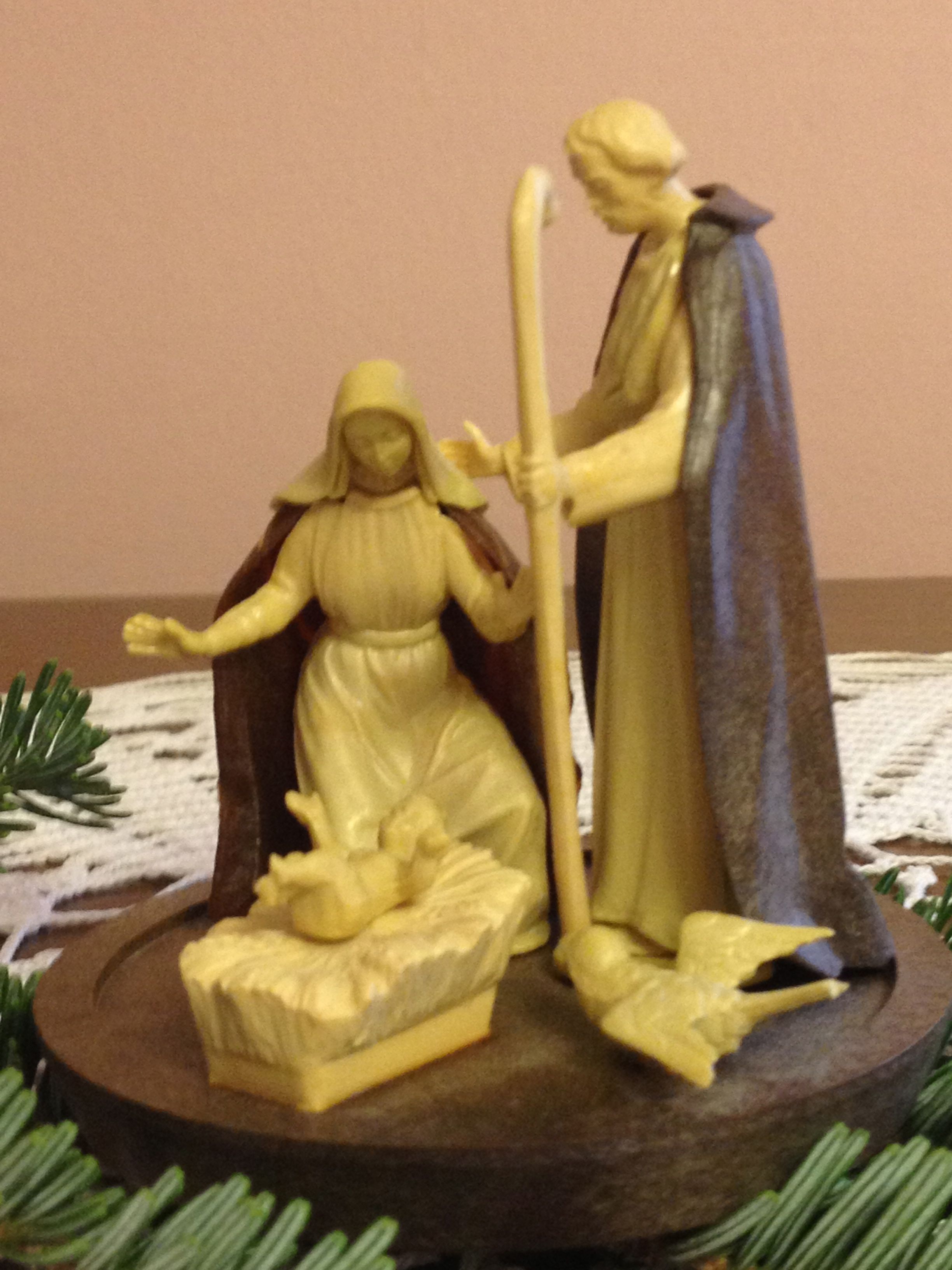
It may not have been the ghost of Christmas past who visited me last night, but it certainly was a Christmas from my past. I must have caught a glimpse of it earlier in the day, when the box of Christmas decorations was hauled upstairs. It’s a small thing really. Something I bought to adorn my very first apartment. You see, my first apartment was just a small studio, everything in one little room, so there was no room for a Christmas tree. So, I decided that if I couldn’t fit a tree in there, I might just be able to manage a nativity set. But I didn’t have much money to spare and all the nativity sets I liked were outrageously expensive and then one day I saw it on a store-shelf, a tiny little nativity that I could actually afford. It had been marked down, from $16 to $12.95. From where I was standing it looked like it had been carved out of the finest wood. I knew that I just had to have it. When I reached out to take it off the shelf, I realized that it was actually made of plastic and suddenly the $12.95 price tag seemed way too much to pay for this mass-produced piece of plastic. But the longer I looked at it the more I knew that my little apartment needed it. Would you like to see it?
It may be small. It may just be a cheap imitation, but when I look at it I see all the hopes and dreams of all the years as they are told in the story of stories. No more ghosts visited me in the night, but just like Ebenezer Scrooge, I woke up knowing just what I had to do. You see Scrooge wasn’t the only movie that my brother and I used to watch. Alan was particularly fond of science-fiction movies. Sometimes, when he would manage to convince me to watch one of this movies with him, I would complain after just a few minutes in, that the premise was just too unbelievable; I mean really nothing like that could ever actually happen. Alan would remind me that you don’t have to believe them; you just have to watch them, go with the story, see where it takes you. When you really think about it, many of our best-loved stories never actually happened the way we tell them. Take Scrooge for example; does any one of us actually believe that Ebenezer was really visited by three ghosts? We know that it is a story that never actually happened the way it has been told to us; and yet it has the power to take us somewhere, to move us as we watch the incredible transformation of old Scrooge and we too are moved to keep Christmas well. Continue reading →
A sermon preached on Christmas Eve 2011 at Holy Cross Lutheran Church.
It has been said that the shortest distance between humanity and the truth is a story.[1] Tonight, as we celebrate the greatest story every told, we also celebrate our own stories. As families gather and festivities progress we will tell our stories to one another; stories that move us to a deeper understanding of who we are; stories that in their own way compliment the greatest story ever told. Every family has them, those little stories that we love to tell one another because they remind us of our deep connections to one another or reveal a truth we treasure in one another. Christmas is a time for stories old and new, stories grand and glorious, happy and sad stories that will cause us to remember, to laugh and to cry.
So, this evening, my story, like the story of Jesus birth, begins with the stories of two pregnant women. The Jesus’ story begins with the stories of Elizabeth and Mary, two cousins who were great with child. My story begins with the news that two of my nieces Ashley and her sister Sheri Lynn, were also pregnant. Ashley was expecting her first child, Sheri Lynn her second. My niece Sheri Lynn’s little girl is my great-niece Isabella.
Isabella is just 3 years old and last month she and her mother, Sheri Lynn, travelled here from Vancouver, so that Isabella could be the flower-girl at my wedding. Before they arrived the story was already being told of Isabella’s response to the news that her Aunt Ashley was going to have a baby and that that baby was going to be a little boy. Isabella proudly announced that her Aunt Ashley’s little boy was going to be her new little brother. Well meaning adults tried to correct Isabella by gently telling her that her Aunt Ashley’s little boy would in fact be her cousin and not her brother. But Isabella insisted that he would be her brother. Various family members tried to convince Isabella that the baby her mommy was expecting would be her little brother or her little sister, but the little boy that her Aunt Ashley was expecting would be her cousin. But no matter how hard or how often they tried to explain it, Isabella went on insisting that her Aunt Ashley’s new baby would be her brother.
One day, while they were visiting, I snapped at the chance to look after Isabella while her mother did some sightseeing. I had some errands to run and it was marvellous to have a little 3 year-old along to help me. It gave me the opportunity to do some great-auntie stuff. And that’s how Isabella and I ended up in the local Christian bookstore trying to find a lightweight nativity set that she would be able to carry home with her on the airplane. I wanted her to learn to tell the greatest story ever told in her own unique way. Continue reading →
Historian and spiritual philosopher, Ian Lawton describes the dilemma of those of us who seek to put a “little reason into the season” this way: “Picture the scene. Mary and Joseph are huddled together in a manger surrounded by farm animals. Joseph is drifting in and out of various dreams. Angels fly in and out of the manger singing songs and bringing earth-shattering messages. Three eastern kings gather around Mary and Joseph with gifts. Out of the window a large star can be seen in the day sky. Two sheep sit beneath the window having a conversation. One says to the other, “I don’t know why you’re being so stubborn. Let me go through this one more time. The virgin is having a baby. They’re naming him Jesus because of a dream. Angels told them that their baby would become the saviour of all humanity. Kings travelled hundreds of miles to find the place of birth like a needle in a haystack because they were led by a giant star moving through the day sky. Now which part of this are you having trouble believing?” The Christmas story is fantastic in the literal sense of the word. It is mostly fantasy. Which parts of it do you have trouble believing?
You’re in good company. This story is as unlikely as talking sheep. The laws of nature tell us that sheep don’t talk, virgins don’t have babies, stars don’t travel across the day sky and then hang like a blip over one home and angels don’t sing choruses. Even if a reliable source suggested that something happened that broke the laws of nature, you would demand evidence and there is little evidence for the details of the Christmas story outside of the Bible which has contradictory details. All in all, the Christmas story is highly unlikely. But don’t let details get in the way of a good holiday story, right? If you’re like me, you’re torn between the desire to be true to your common sense that is skeptical and your heart that just wants to let the story be a good story. The good news is that you can have both. You can question the literal account of the story AND you can enjoy the timeless message of the story. You can put a little reason into the season, and still take a yuletide joyride of inspired meaning. The Christmas story is mostly myth, but the message is real and powerful.”
Since the end of the first century, some 1900 years now, the Christmas story has been told. Lately the church has become a little embarrassed by the way in which this story has been told. All sorts of experts have weighed in to tell us that it could never have happened the way we all remember it. Biblical scholars, historians, theologians, bishops, pastors, professors even scientists have cast doubt on the details of the story of the nativity. But even though we know how impossible some of the details may be we cling to this power of the story. Despite the wisdom of the experts, regardless of our doubts this story still has the power to stop us in our tracks. No other story or image is more recognizable to people the world over than the Nativity scene of the birth of Jesus. The images of an angel announcing the birth, a virgin responding in faith, a carpenter leading a woman on a donkey to a stable in Bethlehem, cumulating with Mary and Joseph gazing fondly at the baby Jesus, while the shepherds look on and the heavenly host sing their praises, these images are crystal clear to all of us. The story is part of us; it’s in our bones. Every year this story causes our lives to shift from the routine of winter, to marveling at the wonder of it all, as we enter into a sacred time, where families are drawn together, and strangers greet one another with kindness and from near and far the hope of peace on earth is a dream shared by us all.
Now, I know that somewhere in the deepest darkest recesses of our being, or for some of us, just beneath the surface of this dream, the wisdom of the experts causes a shiver to run across our spines as we wonder how the hope for peace on earth can possibly lie with such an unbelievable story. That shiver used to haunt me, until the day I recognized the power of the truth that lies in the story of the birth of Christ. It happened a few years back, when my youngest niece Sheri Lynn was about three years old. I have three nieces and over the years I’ve gained a bit of a reputation as their eccentric auntie. I can’t help myself, my love of stories and books just oozed over into my role as their auntie. And so to mark every occasion in their little lives their dear old Auntie Dawn showered them with books. Before every birthday, every Easter, and every Christmas every special occasion I could be found in the children’s section of the bookstore, scouring the shelves to find the perfect book that told the perfect story. My family used to tease me mercilessly and insist that I ought to get those little girls something they could play with. But only books were good enough for my nieces. So, you can just imagine the collection of books they have that tell the story of the Nativity. My family are not churchgoers, so on Christmas Eve I used to go to the Midnight service before heading over to my brother’s house to spend the night. Well the year that Sheri Lynn was just three, I arrived at my brother’s house at about 1:30 in the morning. My brother and his wife, my parents and my nieces were all safely tucked up in bed. On the dining room table were the remains of the milk and eating the cookies that had been left for some other visitor. I poked my head into the room where my youngest niece was sleeping. Little Sheri was snorting as little ones do when they sleep. In the glow of her nightlight I could see a rather unusual gathering on the floor by the foot of her bed. Standing upright on the floor was a large picture book opened to show a picture of an empty stable above which a star hung in the night sky. Beside the book was a doll’s cradle; inside the cradle was a naked doll covered only in a tea-towel. Sitting proudly with their legs sprayed out as if they were doing the splits were what could only be Mary and Joseph even tough they looked a lot like Barbie and Ken. Surrounding this scene were all sorts of little people, some smurfs, a few princesses all, no doubt, standing in for shepherds and angels. The most wonderful part was that all of God’s animals were there, not just the donkey, the sheep and the cattle, but giraffes, zebras, horses, pigs, lions, tigers, turtles, alligators, elephants, hippos, bears and even an alligator and a snake. It was just as the prophet Isaiah had foretold a peaceable kingdom were all the animals lived in peace together and where the lion would eat straw with the ox and the wolf and the lamb would lie down together. The great thing about toddlers playing with animals is that in their minds all of the animals can play together. Sheri Lynn knew that the giraffe eats leaves because I saw her holding it up to the Christmas tree so that it could feast. She knew that the horse and the cow and the sheep and the chickens lived over at the Fisher Price farm and that some of the other animals lived aboard Noah’s ark, and that snakes and alligators could be very scary indeed, but on this night all the animals played together, and all of them gathered together at the baby’s cradle to love and to warm and to care for the child, who lay naked and vulnerable before them. Sheri Lynn had created an image of the Nativity story; an image whose details weren’t exactly correct, but an image that told the truth about all our longings during this most holy season. Continue reading →
Some have said that the birth of Jesus is the most amazing birth story ever told. Jesus birth narrative heralded the arrival of a child who was praised as the Son of God, the Saviour of the World who was said to be the personification of peace on earth; God incarnate; fully divine and fully human. Not everyone agrees that this is the most amazing birth story ever told. Indeed, the story of Jesus birth can’t even claim to be unique. Some claim that Jesus’ birth story is just one of a long line of birth stories. Jesus’ birth story, some claim, is only considered to be unique because it’s our story; a story we tell over and over at the expense of other birth stories that are just as great. Well it’s really not all that difficult to Google “greatest birth story ever told”, select one or two of the greats and put them together to expose Jesus’ birth story as one in a line of ancient birth stories. Allow me to demonstrate.
Among the ancients, some insisted that the story Alexander the Great’s birth was the greatest story every told. Alexander the Great’s birth story is truly one of the greats. He was, after all the, son of a Queen and a god and a king. His mother, Olympias was a Queen, betrothed to Philip of Macedonia. The night before they were married, Queen Olympias dreamed that a thunderbolt fell upon her body, which kindled a great fire, whose divided flames dispersed themselves all around her, and then as if by magic they were extinguished. Philip dreamed that he sealed up his Queen’s lady parts with a seal, which bore the impression of a lion. The high priests who interpreted the dream warned Philip not to even entertain the idea of consummating the marriage because one wouldn’t go to the trouble of sealing up something that was empty. So Queen Olympias must already be with child, who would undoubtedly be a boy with the courage of a lion. If that wasn’t enough to put Philip off he found a serpent lying beside Queen Olympias as se slept, which was said to have abated his passion. Later the oracle of Apollo at Delphi went on to explain that this was no ordinary serpent, no this was the incarnation of the God Zeus. The day that Alexander the Great was born, one of the Seven Wonders of the World burnt to the ground. The temple of the goddess Artemis in Ephesus was the home of the Goddess Artemis who was said to have been attending to the birth of Alexander at the time. Alexander the Great was heralded as the Son of God and Saviour of the World and as one of the greatest warriors the world has ever known, he went on to conquer a good portion of the planet. Continue reading →
In the preface to her beautiful children’s book, “But God Remembered: Stores of Women from Creation to the Promised Land” Jewish writer Sandy Eisenberg Saso tells this revealing story:
“Before God created man and woman, God wanted to create Memory and Forgetfulness. But the angels protested.
The angel of Song said, ‘Do not create Forgetfulness. People will forget the songs of their ancestors.’
The Angel of Stories said, ‘If you create Forgetfulness, man and woman will forget many good stories.’ The Angel of Names said, ‘Forget songs? Forget stories? They will not even remember each other’s names.’
God listened to the complaints of the angels. And God asked the angels what kinds of things they remembered.
At first, the angels remembered what it was like before the world was formed. Then as the angels talked about the time before time existed, they recalled moments when they did not always agree.
One angel yelled at another, ‘I remember when your fiery sword burned the hem of my robe!’
‘And I remember when you knocked me down and tore a hole in my wing,’ screamed another.
As the angels remembered everything that ever happened, their voices grew louder and louder and louder until the heavens thundered.
God said, ‘FORGET IT!’
And there was Forgetfulness.
All at once the angels forgot why they were angry at each other and their voices became angelic again. And God saw that it was good.
God said, “There are some things people will need to forget.’
The angels objected. ‘People will forget what they should remember.’
God said, ‘I will remember all the important things. I will plant the seeds of remembrance in the soul of My people.’
And so it was that over time people forgot many of the songs, stories and names of their ancestors.
But God remembered.”
As we approach the Third Sunday of Advent, I can’t help wondering why the creators of the Revised Common Lectionary (the list of prescribed readings for Sunday worship) have failed to remember the stories and names of our foremothers? John the Baptist will strut across the stage again in this Sunday in churches all over the planet. We have begun a new cycle in the RCL in what is know as Year A the lectionary Gospel readings will focus upon readings from the Gospel according to Matthew. But followers of the RCL will not hear the names of Tamar, Rahab, Ruth, or Bathsheba; no, not even Mary will put in an appearance despite the fact that all of these women are mentioned in the very first chapter of the Gospel according to Matthew! Last year was the same even though the RCL focussed upon the Gospel according to Luke, neither of the women of the Luke’s first chapter make an appearance without a great deal of effort. Unless worship planners are prepared to tinker with the lectionary Elizabeth and Mary will have to cede the stage to John the Baptist. So, all you worship planners and preachers out there, I say to you, “TINKER AWAY! TELL THE STORIES!” Continue reading →
I didn’t know it at the time, but I actually met John the Baptist when I was fifteen years old. She didn’t look much like you’d imagine John the Baptist would look, but she had that same crazy intensity, that same focus on the fact that we’d better change our ways, we’d better repent, and start doing things differently or we’d be in real serious trouble. Lola was my friend Valerie’s mother and she simply couldn’t stop going on and on about the environment and how we were destroy the earth. At the time, I remember thinking she was a bit of a nut-case and on more than one occasion I wished she’d just shut up about it. I was just a kid, and the earth was just something I took for granted. The earth was just there to provide for our needs. I couldn’t believe how much Lola went on and on about all the stuff we humans were doing to destroy the earth. I just wished she’d leave us along to get on with things, I couldn’t abide her incessant nonsense about how we were going to destroy the planet. All her feeble little attempts to be kind to the earth, made me seriously question her sanity.
I tolerated Lola not just because she was my friend’s mother, but I didn’t really understand her until one day when the three of us were travelling together. We were coming home from church. I had only been going to church for a few months. I was trying hard to understand this whole God thing. So, I went to church a lot. My friend Valerie had persuaded me to start going to church with her and family had become like my second family as they supported me during my first attempts to explore the mysterious world into which I had begun to feel pulled. As we drove home from church, I was feeling a little glum. Try as I might, I couldn’t really understand this church thing; all that singing and praying didn’t really help me to feel closer to God. Mostly I just liked how people at church treated each other. I liked how they went out of their way to help me feel at home. Whether or not God was there, well I really wasn’t sure.
Anyway, we were driving along the road. It was a partly over-cast day on the west coast of British Columbia, just a few clouds. You could see the mountains off in the distance. We were chatting back and forth when all of a sudden Lola pulled the car over to the far side of the road, switched off the engine and got out. Valerie followed her mother out of the car, so I figured I had better do the same. Val and her mother scampered down from the road and onto the beach. When they reached the water’s edge, they stopped and just looked off into the distance. Apart from a tanker-ship making its way across the horizon, I couldn’t see much of anything. Lola had the most amazing expression on her face. She positively glowed with happiness. Valerie wore a similar expression. I must have looked somewhat puzzled because Val smiled at me and said, “Isn’t it the most beautiful thing you have ever seen?” This only confused me more. What were they looking at that had made them stop the car, scamper down the bank and stand there at the water’s edge on a cold autumn evening?
Maybe my parents were right, these religious types are a little bit weird. Happy, glowing, smiling people make me nervous. There they stood grinning from ear to ear. What were they on? And then, I saw it. For the first time in my life, I saw it. It had been there before. But I had never really seen it before. The sky was amazing. The colours were overwhelming. It almost didn’t look real. It looked like someone must have painted it that way. It was magnificent, a work of art, the most beautiful thing I have ever seen!
If you’ve never seen a late October, Pacific Coast Sunset before, you’ve missed one of the great wonders of the world. Neither Emily Carr’s paintings nor picture perfect post cards do a western sunset justice. Believe it or not, even though I had been living on the west coast for about four years, at that point I had never before really noticed just how beautiful a sunset could be. No one in my experience had ever taken the time to stop and look at one. No one had ever pointed one out to me before. I would never have dreamed of stopping a car and getting out to watch as the sun put on a show while setting. So I stood there. Overwhelmed by it all. Amazed at just how beautiful it was. Wondering just who or what could be responsible for such a spectacular thing as this. Before long my thoughts drifted to the Creator. Suddenly this God, that I had been trying so hard to fathom, was there. Right there. Not just in the magnificence of the sunset, but right there on the beach. At that moment, I was just as sure of God’s presence as I was of my own. I remember an overpowering feeling of gratitude, gratitude for God’s presence, gratitude, because for the first time in all my life I was at home. I knew that I was home. Home, not because of the place; home not because of the beauty of the sunset, but home because of God’s presence. That longing that I had always felt; that longing that I have always labelled as homesickness, that over-powering longing was gone. In that glorious moment, the presence of God, filled my longing and I was at home.
I’m sure that each of you could tell of a similar experience. So many of us have been blessed by the presence of God in creation. So many of us have had our longing for God filled by the wonder and majesty of creation. I suspect that our love of creation comes as a direct result of our relatedness to creation. For like creation and everything in creation we share a common Creator. My own love affair with creation kicked into high gear on the beach gazing at the magnificence of the setting sun and it has grown in intensity over the years. This past summer, Carol and I drove out to Vancouver and I have to say, if you want to renew your love for creation, drive across this magnificent country of ours.
You’ll find yourself absolutely besotted with creation as you fall in love all over again. By the time we reached my beloved Rocky Mountains, it was like some star-crossed lover, who simply couldn’t help herself from bubbling over with excitement. Not even the first rainy day of our trip could dampen my excitement as we drove south from Jasper toward the Columbia Ice fields. I couldn’t wait to gaze upon the grandeur of the glacier that I remembered from so many visits over the years. The rain was falling quite heavily as we pulled into the massive parking lot perfectly situated across from the ice-field. As we climbed the steps toward the viewing station, I couldn’t see much because I’d pulled my hood up over my head to protect me from the rain. When I reached the top and looked across the highway, it took my breath away, the mass of ice that was frozen in my memory, was gone.
I’m not sure if the drops of water falling down my cheeks were raindrops or teardrops, as I stood there frozen by a strange mixture of fear and sadness. In the decades that have passed since I first began to visit the ice-fields back in the 1970’s the ice has been receding at a rate of between 10 and 15 centimeters per decade. 120 centimeters may not seem like a great distance, but couple that with a decrease in the thickness of the ice and it is positively shocking to see the amount of ice that has vanished from view.
Take a look at the iceberg that I asked Andrew to hang. This photograph was taken in a place I visited long ago. It’s a place were icebergs are born. I ended up there back in the days when I was in the travel business and ended up on a cheap Air Iceland flight that was delayed for a week in Reykjavík for a week. Back then Iceland’s airline must have had only two airplanes and when one of them suffered mechanical difficulties you literally had to wait around for them to fix it. It’s one of the reasons that flights were so cheap on Air Iceland. You simply never knew how long your stopover in Iceland might be. I was trapped there for a week and during that time we decided to explore some of the most amazing geological sites that the earth has to offer. We travelled about 400 kilometers outside of Reykavik to the Jokulsarlon Lagoon; the birthplace of glaciers. It was in this strange lagoon, under an eerie twilight that lasted for the entire duration of my stay in Iceland, that I stud on the hull of a small tourist vessel, staring up at a magnificent glacier. I have no words to describe my terror. Continue reading →
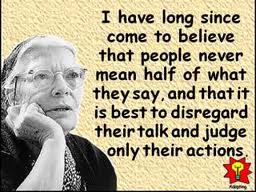
Dorothy Day is a shero of mine! But I will never call her a saint! The tradition of commemorating saints on the day of their death makes a today a day for celebrating Dorothy Day! But, Dorothy Day insisted, “Don’t call me a saint! I don’t want to be dismissed so easily!”
Dorothy Day died in 1980, at the age of 83. She was one of the greatest religious figures of the century, and one of the most paradoxical. She was a Catholic and she was an anarchist. She condemned poverty and she advocated it. She founded the Catholic Worker, a loose aggregation of ”houses of hospitality,” communal farms, newspapers and round-table discussions for ”further clarification of thought” — and called her memoirs ”The Long Loneliness.” The movement was wary of authority, yet revered her as its leader.
When she died, a multitude came down to the old dwelling off the Bowery to pay their respects, the way people had come to Catholic Worker houses for soup ever since the Depression. There were Catholic Workers, social workers, migrant workers, the unemployed; addicts, alcoholics, anarchists; Protestants, Jews and agnostics; the devout and the strident and the curious, there to see what a saint looked like.
On this day, I celebrate the life and witness of Dorothy Day a shero, a Christian mystic with all the attributes of a saint!
This sermon was preached at Holy Cross Lutheran November 28, 2010. The readings included Isaiah 2:1-5, “Amazing Peace” by Maya Angelou, and Matthew 24:36-44, during the sermon I read from the Qur’an Sura 19:1-30 which you can find by following the link in the body of the sermon.
While I was studying for an undergraduate degree in Religious Studies at the University of British Columbia, I worked as a volunteer women’s center. Because I was studying the religions of the world, women who were being persecuted as a result of religious belief were often referred to me.
I’d been working with a young woman who was being abused by her father and brothers because they felt that she was adopting Canadian ways and thereby abandoning Islam. I remember visiting her in the hospital emergency room after her brothers had beaten her nearly to death. She told me that the last thing her brother said to her before tossing her out of the back of a van, was that she should consider herself lucky that they had talked their father into letting them beat her, instead of doing what he had ordered in the first place which was to kill her. I sat at her bedside wondering how a brother could do such a thing to his sister. I decided that they must be religious fanatics and I wondered how any religion could drive a father to seek the death of his own daughter.
The next morning I didn’t feel much like going to my Religious Studies Methodology Seminar. The Seminar was comprised of 7 students from various faith traditions along with 4 atheists and 3 agnostics. Together we studied the various methods of studying religion. We were about to embark on the phenomenological approach to the study of religion. “The Phenomenology of Religion” is a fancy academic way of describing the study of actual religious experiences of the divine. As we stumbled to our seats the professor announced that he would be dividing us into groups of two and he wanted us to learn all that we could about our partner’s religious experience. We would have two weeks to come up with a 1,000 words describing on the phenomenology of our partner’s religious life. I was paired with an Imam who was studying Western approaches to religion prior to taking up a position in a local mosque. Ibrahim was a recent immigrant from Pakistan. But he might as well have been from Mars as far as I was concerned. On that day of all days, Muslim men were not exactly my favorite characters. Continue reading →
Peter Rollins, leader of the “radical Christianity movement” challenges many of the religious assumptions and indeed the religiosity of Christianity in this lecture delivered in early November 2013 at the Festival of Dangerous Ideas in Sydney, Australia.
“Rollins argues for a radical and initially disturbing Gospel: we can’t be satisfied, life is tough, and we don’t know the secret. We should attack the idea of God as that which makes us whole, removes our suffering, and offers us the truth. Rollins is less concerned with the question of life after death than with the possibility of a life before death, and his “churches” challenge escapist versions of spirituality, inviting us to embrace complexity, ambiguity and pain. Doubt is part of life, and religion should be able to explore it — instead of presenting an all-singing, all-dancing distraction.”
In 1998 the Bishop John Shelby Spong looked around at the state of the church and decided that it was time for a new reformation. Just as the invention of the printing press helped to distribute Martin Luther’s protests, the development of the internet spread Jack’s vision around the world. To those who were hungry for change, they were a breath of fresh air. Fifteen Reformation Day celebrations have elapsed since their publication and while there are pockets of progress within the church, what Jack has coined as the “church alumni” continue to bemoan the recalcitrance of the institution as yet another generation has been lost. While so many have pronounced a judgment of irrelevance upon the institution, a remnant has begun to embrace Jack’s questions. I repost them here in the hope that the Spirit of Reformation lives and more and more communities will enthusiastically embrace the challenges of being Church for the 21st century. I hope you will add your own theses in the Spirit of Semper Reformanda!
Jack posted his Twelve Theses with these words: “Martin Luther ignited the Reformation of the 16th century by nailing to the door of the church in Wittenberg in 1517 the 95 Theses that he wished to debate. I will publish this challenge to Christianity in The Voice. I will post my theses on the Internet and send copies with invitations to debate them to the recognised Christian leaders of the world. My theses are far smaller in number than were those of Martin Luther, but they are far more threatening theologically.”

 Marcus Borg is often quoted as having said something to the effect that the average adult has but a grade five understanding of Christianity. Which is okay if you are in grade five but it won’t sustain you through a lifetime of questions. While I agree with Borg that a good many people have rejected Christianity on the basis of what they learned as children and we have a great deal of work to do to educate adults about the breadth and depth of the Christian faith, I wonder what it would mean for the church if we stepped up our game when it comes to the education of children.
 blown away by the revelation that so many of the biblical stories that I was struggling with actually had their origins in tales that were told long before a wandering Aramean went down to Egypt. I remember being both fascinated with the story of Gilgamesh and angry at the Church for failing to let me in on the reality that human’s have been myth-making since forever. I’m sure that I would have been far less traumatized by the realization that the biblical writers engaged in the ancient art of myth-making had I been introduced to it in my adolescence. Needless to say, since I have been teaching Confirmation classes (ages 11-15) I have taken the opportunity to introduce the Epic of Gilgamesh as a precursor to discussions on the book of Genesis.
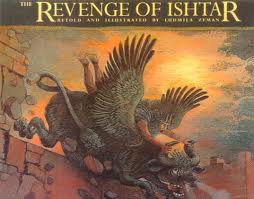 Several years ago, the task of introducing Gilgamesh to young people was illuminated by the discovery of a two of books by Ludmila Zeman designed to bring the tales first carved onto clay tables in Mesopotamia to life. Both Gilgamesh the King and The Last Quest of Gilgamesh are beautiful illustrated and even though they are recommended for children ages 8 and up, provide an engaging experience for adolescents. For those Confirmation students who are particularly keen, I have added Zeman’s The Revenge of Ishtar to the Confirmation class’s collection of resources. I have even been known to use this speeded little tomes in Adult Education Classes. Ludmila Zeman emigrated to Canada from Czechoslovakia and lives, works and creates in Vancouver.









 pastordawn