On the heels of Peter Rollins visit to our congregation last weekend, this Earth Sunday sermon flows out of Peter’s work. You can listen to Peter’s sermon which is the jumping off point for this Earth Day sermon here
“Can the ways in which we tell the stories of resurrection transform us into followers of Jesus who embody a way of being in the world that can nourish, ground, and sustain the kind of peace that the world yearns for?” I preached this sermon on the raising of Tabitha years ago, as an attempt to convey the academic essay of New Testament scholar Rick Strelan into the form of a sermon. I believe that it is vital for preachers to convey the wealth of insights that are bandied about in the halls of academia, so that congregations can let go of so many interpretations of scripture that insult their intelligence, so that we can begin to explore the “more-than-literal meaning” (Marcus Borg) of biblical texts. Rick Strelan’s essay appeared in “Biblical Theology Bulletin, May 1, 2009, under the title “Tabitha: the gazelle of Joppa”.
Yesterday, I went for a walk. As I was walking along, minding my own business, a bright light appeared in the sky. The light nearly blinded me and so it took a while for me to figure out what was happening. Suddenly, it was so clear that the light was actually coming from a very large spaceship. I could scarcely believe by eyes. I stood frozen to the spot as the space ship landed in the middle of the road. You’ll never believe what happened after it landed. A couple of little green creatures with giant eyes gout out, took my picture, and then got back in the spaceship and flew off into the farthest reaches of space.
You don’t believe me, do you? You think that I’m making a joke of some sort, or maybe I’ve been working too hard and I’ve finally lost the plot. I know there’s probably nothing that I can say that would convince you that little green men have photographed me. Quite frankly that’s a relief because if you’ll believe that, you’d probably believe anything.
I do find it interesting that you won’t allow yourself to believe that I encountered aliens from another planet, and yet, you’ll suspend your disbelief when I tell you a story from the Bible. Or will you? Take our first lesson from the book of Acts. The miraculous story of how the Apostle Peter raised a disciple named Tabitha from the dead. You all know that when someone is dead, that’s it they are dead. You can pray over them all you want, but they’re never going to sit up, let alone stand up like Tabitha. There’s about as much chance of a person standing up after they’ve actually been dead as there is little green men from outer space landing on the street outside this church.The story of the raising of Tabitha is one of those stories that we wouldn’t believe for a second if it weren’t in the Bible. I suspect that when it comes to stories from the Bible, most of us don’t really believe that they happened exactly the way the Bible says they happened. Or do we?Now maybe you’re the generous type and so you say, “Don’t be too hasty, it could happen if the person wasn’t really dead.” I mean, maybe Tabitha’s friends got it wrong and she just appeared to be dead. The story says that Tabitha died, then her friends washed her body and laid her out in an upper room. Then, since Lydda was near Joppa, the disciples sent two couriers to Peter, who was in Lydda and they asked Peter to head back to Lydda, which was about 10 miles away. That’s a 20 mile round trip on foot with a walking speed of about 3 miles per hour it would take at least 7 hours. She was definitely dead. According to the story Peter sends everyone out of the room, knelt down and prayed and then said, “Tabitha, stand up!” and she did just that.
The story of the raising of Tabitha is one of those stories that we wouldn’t believe for a second if it weren’t in the Bible. I suspect that when it comes to stories from the Bible, most of us don’t really believe that they happened exactly the way the Bible says they happened. Or do we?Continue reading →
Peter Rollins was our guest preacher this Sunday and took us beyond the surface of the story of Paul’s revelation toward the darkness from which we all too often hide.
The scripture readings can be found here – The Worship Bulletin here
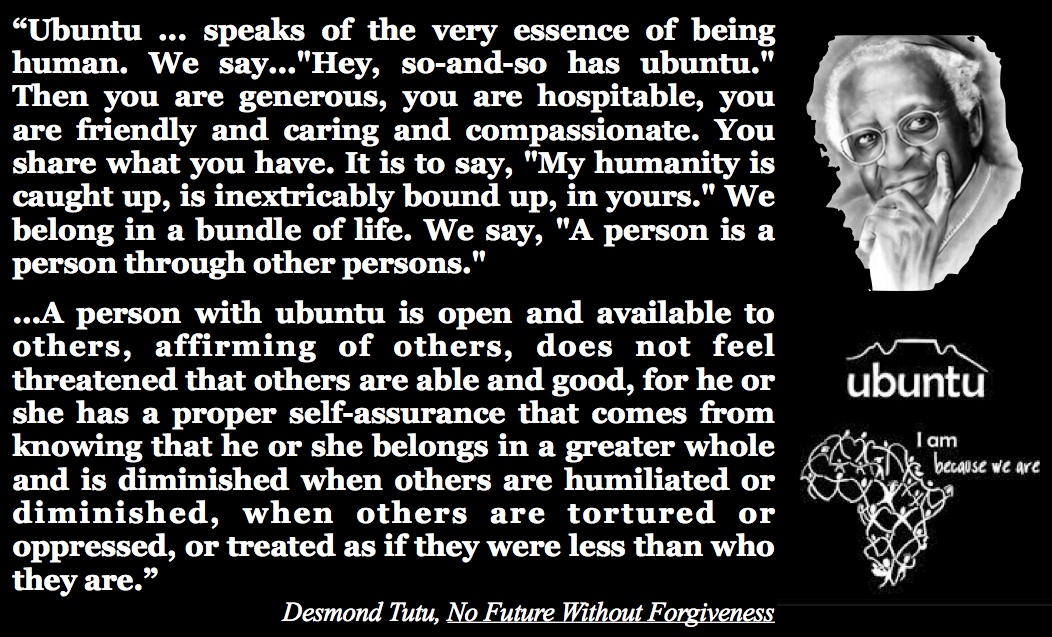
Desmond Tutu, Peacemaker: A conversation with Desmond Tutu and John Allen. Recorded March 21, 2013 by Pepperdine University School of Law. This brilliant video provides an opportunity for Desmond Tutu and his Press Secretary John Allen to reflect upon the work of South Africa’s Truth and Reconciliation Commission. It is a marvellous testament to the potential for goodness that exists in humanity. Tutu’s use of the African word “ubuntu” to express his conviction that we cannot be fully human without other humans is wisdom born of human evolution witnessed up close and personal.
I’m busy preparing the liturgy for this coming Sunday when Peter Rollins will be our guest preacher. It’s an interesting challenge considering the season. Easter is a time when we practice certainty with our shouts of “Christ is risen! Christ is risen indeed! Alleluia!”, so everything I’ve heard and read of Rollins’ work is calling me into the darkness of unknowing. Part of me wishes we’d booked Peter’s weekend visit with us during the season of Lent or maybe even this past weekend when terrified followers of the Way huddled in an upper room in fear for their lives could have set the tone for our worship together. But part of me is relishing Peter’s serious challenges to the church that Peter clearly expresses during the interview in the video below. For those of you who live in Southern Ontario, consider joining us this weekend! For details click here
Speaking on March 17, 2013 at All Saints’ Episcopal Church in Pasadena, Marcus Borg responds to the question about the relevance of Jesus using three words that frame the book he is currently writing: “Memories, Conversions, and Convictions.” Enjoy!
On Sunday, in churches all over Christendom, worshippers will hear the gospel story of Doubting Thomas. The story of Doubting Thomas is prescribed gospel reading every year for the Sunday after Easter. I’ve never understood why Thomas should hold such a prominent place in our lectionary: I mean, when the chips were down, and Jesus could have used their support, Thomas and the guys deserted Jesus; they left him alone and spread out across the city to hide from the Romans and the religious authorities.According to the Gospels, it was the two Marys, together with the other women who had financially supported Jesus’ ministry, who stuck by him to the bitter end. Also according to the gospels, it was Mary, the one they call Magdala who brought back the news that Jesus was not dead, but had risen. But despite the fact that Mary Magdalene was the one chosen to be the Apostle to the Apostles, (the word apostle comes from the Greek for “the one sent”) our lectionary quickly moves on from the empty tomb to the upper room so that we can all once again explore the story of good old, doubting Thomas.
So here, let me honour Mary the Apostle to the Apostles with this my imaginary account of Mary’s story.
Shalom. I greet you in the name of our risen Christ. My name is Mary. You may know me as Mary Magdalene. I am not from around here. I come from a good family in Magdala. Magdala is a wealthy city on the Sea of Galilee, just south of Capernaum. My family made a lot of money in the fishing industry in Magdala. While I was growing up I lacked nothing. But I was not happy. I was sick. I would sit around the house moping and complaining and make everyone miserable. I was so distraught. Often I was so upset that I pulled out my own hair.
Sometimes I would be so excited that people couldn’t stop me from talking. I ran up all sorts of bills in the market place which my parents had to pay. I was always cooking up some mad scheme or other. I would rant and rave at the slightest provocation. From time to time I would become ill and stay in bed for weeks on end. I knew something was terribly wrong and nothing seemed to ease my anxieties. I was a prisoner inside my own mind. Then I met Jesus. He was teaching outside of the synagogue. At first, I just stood back in the crowd and listened as he spoke about a new world which God intended to create. It would be a world where the sick are healed and prisoners are set free. I wanted to taste this freedom which Jesus spoke about. I wanted to ask him so many questions. But the crowd pressed in upon him demanding that he tell them more and I was pushed farther away from him. In despair, I turned to leave. Continue reading →
Reposted from last year – Sermon for the Second Sunday of Easter April 15 2012
This Sunday I tried something new: introducing a video clip into the sermon! You can view the video within the written text of the sermon below or listen to the audio version provided. I am indebted to the work of James Rowe Adams for much of the New Testament Scholarship in this sermon.
The Scripture texts were John chapter 20:19-31 and Acts 4:32-35
Christ is Risen! Christ is Risen indeed! Alleluia!
So, Christ is Risen! So What???
What can it possibly mean to you and to me, that a rag-tag bunch of Jesus’ followers gathered together in an upper-room and talked about their experiences of Jesus and decided that not even death could extinguish the life that they experienced in Jesus? What difference does it make to you or to I that Christ is risen?
The truth is that it can make absolutely no difference what so ever. Now there are a whole lot of people who will tell you that the important thing about resurrection is that you believe it. Those same folks absolutely love the story of doubting Thomas. And so every year on the second Sunday of Easter we read the story of doubting Thomas as a kind of inoculation against Thomas’ disease.
I sometimes think that the designers of the lectionary were trying to build up our resistance to doubt. Having problems believing in resurrection, well don’t do what Thomas did, don’t doubt, because you’ll be proven wrong. Jesus is alive, the wounds in his hands proved that to Doubting Thomas, so have no doubt about it the resurrection happened! Believe in the resurrection!
The trouble with believing in stuff is that it belief can make absolutely no difference what so ever. I can believe in justice for all, but unless I’m prepared to seek justice, to be fair, or to resist injustice, it makes absolutely no difference what so ever. You can shout, “Christ is risen!” all you want but unless you are willing to live it, the resurrection means very little at all.
In order to live the resurrection you have to begin practicing resurrection. In order to practice something, you have to know what it looks like, what it sounds like, or what it feels like.
I’ve been trying to figure out how to show you what resurrection looks like in the flesh. Then I remembered a video that’s been doing the rounds on the internet, so I want you to watch this modern miracle of resurrection.
WATCH THE VIDEO CLIP FROM: Alive Inside
Christ is Risen! Christ is Risen indeed! Alleluia!
2000 years ago a bunch of rag-tag Jesus followers were huddled together in fear. Their beloved leader had been brutally executed by the powers that be and they were terrified that they would be next. Paralyzed by their fear, hiding behind a locked door, something happened that gave them the strength to burst forth from their own tomb and change the world.
Ever since they began to practice resurrection, people have been trying to figure out exactly what happened; what could have changed these bumbling, terrified, betrayers, abandoners, who seemed to be always getting things wrong, into a bunch of leaders who began a movement that spread through out the Empire within their own life-times and then based on the power of their witness, spread throughout the world and continues to nourish and sustain millions of people from generation to generation?
Now there are those that insist that it was the power of Jesus having been physically resuscitated from the dead that motivated his followers to change their lives and the lives of millions who have come after them. But we live in the 21st century and we have access to all sorts of information that the generations who have gone before us did not. Most of us, myself included, are not swayed by arguments about a physical resuscitation of Jesus’ body. But I can tell you without a doubt that I do believe in resurrection and I know that Christ is risen and I also know that the same power that the early followers of Jesus used to change the world is available to you and to me. And now more than ever the world needs us to start using that power. It’s long past time for us to start practicing resurrection.
So, if they weren’t talking about a physical resuscitation when they spoke of Jesus’ resurrection, what did the early followers of Jesus actually mean when they spoke of Jesus having been raised from the dead? During the first century many Jews had adopted a vision of the future that dealt with the prevailing question of the day: “How could a just God allow his people to suffer endlessly at the hands of their enemies?” Or as Dom Crossan puts it: When was God going to clean up the world so that justice could prevail? Continue reading →
I am indebted to John Claypool’s sermon from back in 1997 for the story of Eugene O’Neill’s play “Lazarus Laughs” and to Henri Nouwen’s “Our Greatest Gift: A Meditation on Dying and Caring” for the “Parable of the Twins”.
Preparing sermons this Holy Week and wrestling with texts and doctrines, I have had as my companion Michael Morwood’s new book “It’s Time: Challenges to the Doctrine of the Faith”. Written from the perspective of a former Roman Catholic priest, Morewood’s insights transcend the denominational divide and speak directly to the need for new articulations of the faith. I have been gleaming all sorts of insights that are helping me to proclaim the Gospel in a world where knowledge about the magnificence of creation is expanding at a phenomenal pace. Imagine my delight this morning, when a posting by the author himself alerted me to a brief speech he gave on Good Friday that outlines his hopes for the church of tomorrow. Enjoy!
Michael Morwood is an Australian who is currently the theologian in residence at the Kirkridge Retreat Center, at Bangor, Pennsylvania.
I post this sermon, which I preached last Easter Sunday, touched by the memories it evokes. Resurrection came to my Gran this past summer. Her 100 years were and are a blessing to her family and friends. She comes to me often in so many ways; this sermon is but one.
Tredegar, Wales the village where Nellie was born in 1911
Sisters and brothers in Christ, today we gather to celebrate the greatest story ever told! Christ is risen! Christ is risen indeed! Alleluia! Christ is risen in you and in me. And because Christ is risen, I can welcome each of you to your very own resurrection!!! Christ is risen in you and in me! Alleluia!!!
It is the greatest story ever told. Like all the best stories ever told it does not answer all our questions. Poet Mary Oliver insists that, “There are many stories more beautiful than answers.” The bible is full of great stories. The sacred scriptures contain responses to some of humanity’s greatest questions. The stories in the scriptures provide us with responses to some of our deepest longings, but those responses do not come in the form of answers. The Bible is full of stories that touch the deepest mysteries of life. The ancients knew that eternal truths are best communicated through stories, and so we plumb the depths of the scriptures’ parables, myths and similes to discover our reality. The story that bursts forth on this Easter Sunday is the greatest story ever told. It is a story told in response to our deepest reality and our darkest fear: death. Continue reading →
A powerful series contemplating resurrection in ever deepening ways in order to explore what a risen christianity might look like in terms of its offering of healing and blessing for the earth. Created by John Philip Newell a poet, pastor and scholar who opens our eyes o a vision beyond doctrines and dogmas that fail to proclaim the wonders of the universe in which we live. “Christianity will rise again to the extent that we remember the sacredness of everything that has been born in the universe.”
Re-posted from last year’s preparations for Maundy Thursday
I was asked by a colleague, “So, if you do not believe that Jesus died for your sins, then why bother celebrating the events of Holy Week?” Behind this question lies the assumption that the only way to understand Jesus’ death is to frame it within the context of the theology of “penal sacrificial atonement” ie “we are judged to be sinful creatures, punishment is required, God sends Jesus to pay the price for our sin”. That Anslem’s theory of sacrificial atonement was formulated in the 11th century and continues to hold sway in the minds of so many followers of Christ is a testament to the power of our liturgies and hymns to form our theology. However, Anslem’s theory is not they only faithful way to understand Jesus’ death.
When one seriously engages the question, “What kind of god would demand a blood sacrifice?” the answers often render God impotent at best and at worst cruel and vindictive. I have often said that atonement theories leave God looking like a cosmic son of #%#%# !
Progressive Christian theologians are opening up new ways of understanding the death and resurrection of Jesus that empower the faithful to see new possibilities.
To my colleague, who fears that I am leading the faithful astray, and to those who find little comfort in the theories of an 11th century monastic, I offer the following notes, crafted in my preparation to lead Maundy Thursday worship.
Jesus said, “I give you a new commandment: Love one another. And you’re to love one another the way I have loved you. This is how all will know that you’re my disciples: that you truly love one another.”
That we should love one another is not a new commandment. There have been many before Jesus and many who came after Jesus who have commanded, advised, encouraged, implored, and even begged us to, “love one another.”
What is new about Jesus commandment is that we are to love one another the way that Jesus loved us.
In our parish on Palm Sunday, our liturgy stays with the commemoration of Jesus’ entry into Jerusalem. Trusting that our members will join us on Good Friday, we have not adopted the practice of rushing to the Passion of Christ. This allows us time to linger over our Hosannas.
Our worship began outside with the reading of Luke 19:28-4, followed by a procession of palm waving, hosanna cheering congregation. This year I changed the first reading to the story of Jacob’s wounding during a wrestling match with God in Genesis 32:22-31, followed by an feminist interpretation of Psalm 118, and the Gospel text John 12:12-15.
I am indebted to Michael Morewood’s book “Is Jesus God” for the inspiration behind this sermon and to John Dominic Crossan and Marcus Borg’s “The Last Week” for the historical details.
Philip Clayton is the Dean of Claremont School of Theology and Provost of Claremont Lincoln University. He also holds the Ingraham Chair at CST. Clayton earned a joint PhD in Religious Studies and Philosophy from Yale University and has held visiting appointments at Harvard University, the University of Cambridge, and the University of Munich. He has published over 20 books, the latest of which “Transforming Christian Theology: For Church and Society” is a must read for anyone presuming to do theology in public. The book is close to a definition of “progressive Christianity” as you are likely to find.

 On the heels of Peter Rollins visit to our congregation last weekend, this Earth Sunday sermon flows out of Peter’s work. You can listen to Peter’s sermon which is the jumping off point for this Earth Day sermon here

![peter rollins_thumb[1]](https://pastordawn.com/wp-content/uploads/2013/03/peter-rollins_thumb1.jpg)







 pastordawn