There’s a story that I love to tell. So many of you have heard it before. But this is the night for telling stories over and over again and because I love this story, tonight’s the night! I first heard it from a very wise seminary professor and since then I’ve heard Marcus Borg and Parker Palmer tell it. I’m not sure that this story actually happened, but I am sure that it is absolutely true!
It’s a story about a three-year-old girl who was the only child in her family. Her mom is pregnant, and this three-year-old girl is very excited about having a baby in the house. The day comes where the mother-to-be delivered, and the mom and dad go off to the hospital. A couple of days later they come home with a new baby brother. And the little girl is just delighted. But after they’ve been home for a couple of hours, the little girl tells her parents that she wants to be with the baby in the baby’s room, alone, with the door shut. She’s absolutely insistent about the door being shut.
It kind of gives her folks the willies, you know? They know she’s a good little girl, but they’ve heard about sibling rivalry and their not sure about what they should do. Then they remember that they’ve recently installed an intercom system in preparation for the arrival of the new baby, and they realize that they can let their little girl do this, and if they hear the slightest weird thing happening, they can be in there in a flash.
So they let their little girl go into the room. They close the door behind her. They race to the listening post. They hear her footsteps move across the room. They imagine her now standing over the baby’s crib, and then they hear her say to her two-day-old baby brother, “Tell me about God. I’ve almost forgotten.”
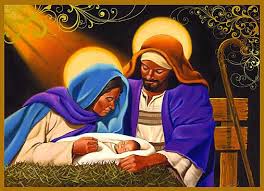
Tonight we are all that child, standing over the baby’s crib hoping against hope that the newborn baby will tell us about God; maybe because we have almost forgotten, maybe because we don’t believe, maybe because we want to believe, maybe because we’ve lost hope, maybe because we are endlessly curious, or maybe just because T’s the season! Regardless of why, here we are gazing into the crib at the newborn baby hoping that this child will tell us about God. But all we have is this story; a story so simple it sounds as if it was created for children; poor homeless refugees, far from home, in the darkness of a winter’s night, struggling to keep warm amongst the dung of a stable, a tiny baby, swaddled in what we imagine as rags and lying in a feed trough, shepherds, angels and a star in the night sky. It’s a lovely story. A story that warms our hearts, told over and over again in the darkness of so many winters as we struggle to keep our demons at bay. We’ve told it so often that we’ve forgotten why it was told in the first place. We’ve lugged so much of our own baggage into that stable that we can scarcely see the baby. We’ve heaped our expectations and longings onto the images and our need to know has demanded that the facts confirm our desires.Continue reading →
The fourth Sunday of Advent is the perfect time to let the Scripture readings speak for themselves and use the sermon to remind the congregation that their coming Christmas celebrations are about so much more than the birth of a baby. Resurrection is afoot! For those preachers who’d like a more scholarly approach to Advent 4B you’ll find it in another sermon posted here
The church’s season of Advent offers a sanctuary from the endless demands of preparation for the big day. Our Christmas traditions, if they are to be maintained, require a great deal in the way of preparation. But there’s one Christmas tradition that I’ve been enjoying since I was a child that requires little or no preparation save for the effort to carve out the time, when time seems to be in short supply. Somehow over the years, I’ve never missed the opportunity to watch the old black and white version of Dickens’ classic, A Christmas Carol. There is of course only one portrayal of Ebenezer Scrooge that will do.
If it’s not Alistair Sim, it’s just not Scrooge. I usually wait until Christmas Eve to watch the movie. But this year I found the time to read the book and I’ve got to say, there is much in Dickens exploration of Christmas that I’ve been missing over the years.
In the words of Charles Dickens: Ebenezer Scrooge “was as cold and miserly a man as one could ever meet. “He was a tight-fisted hand at the grindstone, Scrooge! A squeezing, wrenching, grasping, scraping, clutching, covetous, old sinner! He carried his own low temperature always about with him; he iced his office in the dog-days; and didn’t thaw it one degree at Christmas.”
Ebenezer Scrooge’s transformation on Christmas Eve is nothing short of a miracle. Scrooge was a broken man. Broken, years before the story begins. The women he loved, Belle, broke her engagement to him one Christmas, she tells Ebenezer, “you fear the world too much. All your other hopes have merged into the hope of being beyond the chance of its sordid reproach. I have seen your nobler aspirations fall off one by one, until the mast passion, GAIN, engrosses you.”
Belle doesn’t tell us how this fear of the world developed. She doesn’t tell us what Scrooge’s nobler aspirations had been. We don’t know what made Belle fall in love with Scrooge in the first place—but we do know that whatever it is, it is gone now. As the Ghost of Christmas Past moves through Scrooge’s life we catch glimpses of what may have broken him – a distant father, the death of his much loved sister, his exposure to wealth in the first place – but we are never quite told what made Scrooge the man he is at the beginning of Dickens’ tale. All we know is that Scrooge is broken and greed and anger have possessed his very soul. Scrooge’s life was broken. While he had all of the wealth, and then some, that any person might need – he was miserable.
I used to think that A Christmas Carol was the story of Scrooge’s metamorphosis. The scene in the movie were Scrooge realizes that it is Christmas morning and that life doesn’t have to be the way it has always been and he does that wonderful dance and sings: “I don’t know anything! I never did know anything all on a Christmas morning!” I always thought of that wonderful dance as the culmination of Scrooge’s metamorphosis, like a butterfly bursting forth from a cocoon. But now I see it for what it really is. It is a dance of resurrection. For Scrooge was dead. Dead and gazing at his own tombstone, when suddenly, and suddenly for me always indicates the work of the Spirit, suddenly, Scrooge realizes that what he is seeing are only the shadows of things that might be. Suddenly, Scrooge knows “that men’s deeds foreshadow certain ends. But if the deeds be departed from surely the ends will change!” Scrooge is born again and is able to declare with confidence, “I’m not the man I was.”And so, the resurrected Scrooge becomes all that God intended him to be. Scrooge’s past didn’t go away—the hurtful Christmas memory of Belle ending their engagement, all of the ill-spent years somewhere between the party at Fezziwig’s and the visit of the spirits would still be a part of Scrooge’s life, resurrection doesn’t erase the past, but transforms the future, hope becomes part of the resurrected life! And so, Scrooge reborn, becomes “as good a friend, as good a master, and as good a man as the good old City ever knew…and it was always said of Scrooge “that he knew how to keep Christmas well!” Knew how to keep Christmas well. Keeping Christmas well is very different than celebrating Christmas. Keeping Christmas well is about resurrection; resurrection of our very selves. I always thought of that wonderful dance as the culmination of Scrooge’s metamorphosis, like a butterfly bursting forth from a cocoon. Keeping Christmas well is to forget what you have done for other people and to remember what other people have done for you. Keeping Christmas well is to see your neighbours as just as real as you are, and to try to look behind their faces to their hearts, hearts hungry for human connection, for dignity, for love and for joy. Keeping Christmas well is the realization that the only good reason for your existence is not what you are going to get out of life, but what you are going to give to life. Keeping Christmas well means closing your book of complaints against the management of the universe and looking around you for a place where you can accomplish some good. Keeping Christmas well is remembering the weakness and loneliness of people who are growing old; it means not worrying so much about how much your friends love you but asking yourself whether you love, honour and care for them enough; it means stepping down from your pedestal long enough to see that you are not the centre of the universe; it means bearing in mind the things that other people have to bear on their hearts; trying to understand what those who live in the same home with you really want, without waiting for them to tell you; it means burying your ugly, destructive and selfish motives and nurturing your nobler ones.
Keeping Christmas well includes the realization that your generation is not the last generation; that you have received an astonishing inheritance given by God, that your very next breath of life is pure gift; that all your various abilities and capacities were knit together in your mother’s womb and you had nothing to do with this original blessing, and that the bounty planet earth offers—its beauty and majesty – are both a wondrous blessing and an awesome responsibility; it’s the realization that you have duties to perform as citizens of a free nation in a dangerous world; that matters of war and peace are not just problems for others to solve; that much, if not most, of what goes on in the space around you depends upon your choices and your actions.
Keeping Christmas well is about being fully alive to all that life has to offer and being gracious in your responses to this amazing grace and living into all that God created you to be. When you keep Christmas well you are willing to believe that forgiveness is the doorway to a hope-filled future; that mercy reflects God’s nature; and that love is the most powerful thing in the universes—stronger than hate, stronger than evil, stronger than death! Keeping Christmas well is living with the knowledge that there is nothing in heaven or on earth that can separate you from the love of God in Christ Jesus. Scrooge’s metamorphous began, dancing and singing: “I don’t know anything, I never did know anything, all on a Christmas morning.” To keep Christmas well you must first realize that in the grand scheme of things you don’t know anything. For then, in humility, you can see the hope that lies in the manger. The hope of resurrection.
Scrooge knew how to keep Christmas well, may that be said of all of us. And as Tiny Tim said, “God bless us everyone!
As always, I am indebted to the scholarship of John Dominic Crossan and Marcus Borg whose book The First Christmas is the gift that keeps on giving! You can listen to the sermonhere
For those looking for a different approach to Advent 4B check out the sermon posted here
Some have said that it was the most amazing birth story ever told. This birth narrative heralded the arrival of a child who was praised as the Son of God, the Saviour of the World who was said to be the personification of peace on earth; God incarnate; fully divine and fully human. Not everyone agrees that this is the most amazing birth story ever told. Among the ancients, some insisted that the story Alexander the Great’s birth was the greatest story every told.
Alexander the Great’s birth story is truly one of the greats. His was, after all the, son of a Queen and a god and a king. His mother, Olympias was a Queen, betrothed to Philip of Macedonia. The night before they were married, Queen Olympias dreamed that a thunderbolt fell upon her body, which kindled a great fire, whose divided flames dispersed themselves all around her, and then as if by magic they were extinguished. Philip dreamed that he sealed up his Queen’s lady parts with a seal which bore the impression of a lion. The high priests who interpreted the dream warned Philip not to even entertain the idea of consummating the marriage because one wouldn’t go to the trouble of sealing up something that was empty. So Queen Olympias must already be with child, who would undoubtedly be a boy with the courage of a lion. If that wasn’t enough to put Philip off he found a serpent lying beside Queen Olympias as se slept, which was said to have abated his passion. Later the oracle of Apollo at Delphi went on to explain that this was no ordinary serpent, no this was the incarnation of the God Zeus.
The day that Alexander the Great was born, one of the seven wonders of the world burnt to the ground. The temple of the goddess Artemis in Ephesus was the home of the Goddess Artemis who was said to have been attending to the birth of Alexander at the time. Alexander the Great was heralded as the Son of God and Saviour of the World and as one of the greatest warriors the world has ever known, he went on to conquer a good portion of the planet. But by the time our hero was born, the glory days of the Greeks had long since passed. The Empire of Rome had replaced the Greeks as rulers of the world and they had the conquered lands to prove it. By the time our hero was born, Julius Caesar had established an Empire the likes of which the world had never seen before. Gaius Julius’ prowess on the battlefield was matched only by his cunning in the senate and together had one him the title of Caesar. But as great and marvellous a leader as Julius Caesar may have been, history tells us that he and his wife were not blessed with children. Alas, Caesar did have a son by virtue of his dalliance with Cleopatra but that’s another story all together; suffice it to say, that that little fellow didn’t stand a chance against the one Julius would appoint as his heir. Born to Julius Caesar’s niece, little Octavian was eventually adopted as his great-uncle’s heir apparent who eventually amassed powers that far outshone his illustrious uncle’s.Continue reading →
In the preface to her beautiful children’s book, “But God Remembered: Stores of Women from Creation to the Promised Land” Jewish writer Sandy Eisenberg Saso tells this revealing story:
“Before God created man and woman, God wanted to create Memory and Forgetfulness. But the angels protested.
The angel of Song said, ‘Do not create Forgetfulness. People will forget the songs of their ancestors.’
The Angel of Stories said, ‘If you create Forgetfulness, man and woman will forget many good stories.’ The Angel of Names said, ‘Forget songs? Forget stories? They will not even remember each other’s names.’
God listened to the complaints of the angels. And God asked the angels what kinds of things they remembered.
At first, the angels remembered what it was like before the world was formed. Then as the angels talked about the time before time existed, they recalled moments when they did not always agree.
One angel yelled at another, ‘I remember when your fiery sword burned the hem of my robe!’
‘And I remember when you knocked me down and tore a hole in my wing,’ screamed another.
As the angels remembered everything that ever happened, their voices grew louder and louder and louder until the heavens thundered.
God said, ‘FORGET IT!’
And there was Forgetfulness.
All at once the angels forgot why they were angry at each other and their voices became angelic again. And God saw that it was good.
God said, “There are some things people will need to forget.’
The angels objected. ‘People will forget what they should remember.’
God said, ‘I will remember all the important things. I will plant the seeds of remembrance in the soul of My people.’
And so it was that over time people forgot many of the songs, stories and names of their ancestors.
But God remembered.”
As we approach the Third Sunday of Advent, I can’t help wondering why the creators of the Revised Common Lectionary (RCL: the list of prescribed readings for Sunday worship) have failed to remember the stories and names of our foremothers? John the Baptist will strut across the stage again in this Sunday in churches all over the planet. The followers of the RCL will not hear the names of Tamar, Rahab, Ruth, or Bathsheba; no, even Mary is only suggested as an optional replacement for the reading of the Psalm! Unless worship planners are prepared to tinker with the lectionary Elizabeth and Mary will have to cede the stage to John the Baptist. So, all you worship planners and preachers out there, I say to you, “TINKER AWAY! TELL THE STORIES!” Continue reading →
This sermon included quotes from James Carroll’s new book “Jesus Actually: The Son of God for the Secular Age” Carroll’s book is a splendid exploration prompted by Dietrich Bonhoeffer’s question “Who is Jesus for us today?”
Readings: Isaiah 40:1-11 and Mark 1:1-8. Our sermon hymn was “God Is Within”, Text by George Stuart to the Tune Ar Hyd Y Nos = All Through the Night
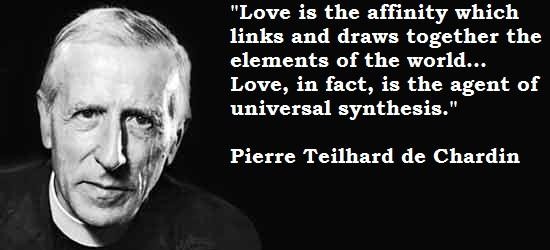
Yesterday, I enjoyed an expansive evening at Toronto’s Theatre Passe Muraille as playwright Adam Seybold’s “The De Chardin Project” brought one of my theological heros to vivid life. Before my very eyes, Pierre Teilhard de Chardin gave new meaning to “forever!” Seybold’s bravery in taking on the complex work of Teilhard is matched by his sensitivity for the life and ideas of the man whose thinking continues to impress those who seek ways of expressing the complicated marriage of theology and science. In ninety short minutes Seybold’s script propelled us to the sun and back over and over again as the talents of Maeve Beaty and Cyrus Lane breathed life in to the divine/human love affair that is life
After years of pouring over Teihard’s work, I can empathize with the challenges of bringing his genius to a wider audience. The combination of talents that have come together in this production to stretch the audience’s perspective beyond the limits of tired arguments has succeeded in creating an experience which far exceeded my expectations. When I entered the theatre, I was sceptical. I wondered what would become of the ideas that I treasure. But it only took a few moments for Seybold’s words to woo me and before I knew it, Cyrus Lane’s tortured and dying Teilhard had me opening myself to a series of transformative moments, the like of which I’ve not enjoyed in the theatre for a long time. With Maev Beaty’s steady hand as our guide, Teihard’s questions took us on an adventure worthy of our deepest wonderings. Beaty’s moving ability to transform herself was aided by the subtle and sometimes startling staging. Director Alan Dilworth managed to not only direct his actors but his audience as well as we transcended the stage up, up, up, to the sun and back again into the deep interior of our being to capture precious grains of sand.
If you live in the Greater Toronto Area, whether you’ve read Teihard or never heard of him before, this play is a must see. The run ends December 14. So don’t delay. After the adventure of The De Chardin Project the expansion of my ideas about reality, like forever, is just beginning as Maev Beaty’s passionate “Yes” echoes throughout my being!
On this the first Sunday in Advent we awakened ourselves to the cosmic contours of the darkness. Our first reading was The Star Within: a creation story by Dr. Paula Lehman & Rev. Sarah Griffith, followed by a musical video reflection My Soul by Peter Mayer which you can watch below. Our Gospel reading was from Mark 13:24-37. Listen to the sermon here
The Gospel reading for this coming Sunday concludes with these words attributed to Jesus by the storyteller know to us as Mark: “And what I say to you I say to all: Keep Awake!” In the stories which have been handed down to us, Jesus is often heard warning, encouraging, sometimes begging us to wake up or to stay awake. So as I prepare for the Advent Season, this tune from Mumford and Sons keeps running through my mind. EMBODIED WAKEFULNESS is emerging as a theme for a season which often has our heads swimming in the clouds.
Sunday’s reading from the gospel according to Mark:
Jesus said: “In those days, after that suffering, the sun will be darkened, and the moon will not give its light, and the stars will be falling from heaven, and the powers in the heavens will be shaken. Then they will see ‘the Son-of-Man coming in clouds’ with great power and glory. Then the Human One will send out the angels, and gather his elect from the four winds, from the ends of the earth to the ends of heaven. From the fig tree learn its lesson: as soon as its branch becomes tender and puts forth its leaves, you know that summer is near. So also, when you see these things taking place, you know that he is near, at the very gates. Truly I tell you, this generation will not pass away until all these things have taken place. Heaven and earth will pass away, but my words will not pass away. But about that day or hour no one knows, neither the angels in heaven, nor the Son, but only the Father. Beware, keep alert; for you do not know when the time will come. It is like someone going on a journey, who leaving home and putting the slaves in charge of their own work, commands the doorkeeper to be on the watch. Therefore, keep awake—for you do know when the lord of the house will come, in the evening, or at midnight, or at crockcrow, or at dawn, or else, coming suddenly, the lord may find you asleep. And what I say to you I say to all: Keep awake. (Mark 13:24-37)
This sermon for the first Sunday of Advent was inspired by a sermon written by Ian Lawton entitled “The Mother of All Virgin Births” in which I was captivated by his use of the phrase “pregnant with possibility.” I read Lawton’s sermon after first reading John Dominic Crossan and Marcus Borg’s book “The First Christmas” in anticipation of Dom Crossan’s first visit to our congregation (2008). I was so eager to prepare the congregation for Dom’s historical approach to Christmas that I fear the sermon is overflowing, perhaps a little too pregnant with details. Luckily, the congregation was treated to the wonders of Dom Crossan’s brilliance for several days and learned well from the master about the delights of historical details. I post the sermon here, trusting that some of the details may be enlightening as we once again prepare ourselves for the Season of Advent.
Let me tell you a story from down-under; an Australian story that was doing the rounds a few years ago. Like all stories it may never have actually happened, but it is absolutely true because it happen again and again, in various and myriad ways. This story happened a while ago in Brisbane, Australia…
“The story begins in the dark. A university student named John was on the side of the road hitch hiking on a very dark night and in the midst of a storm. The night was rolling on and no car went by. The storm was so strong John could hardly see a few feet ahead of him. Suddenly he saw a car slowly coming towards him and slowly it stopped. John was desperate for shelter and without thinking about it; he got in the car and closed the door.
It took only a moment for John to realize that there was nobody behind the wheel and the engine wasn’t on! But the car started moving slowly. John looked at the road and saw a curve approaching. John was so scared, that he started to pray, begging for his life. Then, just before he hit the curve, a hand appeared through the window and turned the wheel. John, paralyzed with terror, watched how the hand repeatedly came through the window but never harmed him. Eventually, John saw the lights of a pub down the road and so gathering his strength, he jumped out of the car and ran into the pub. Wet and out of breath, he rushed inside and started telling everybody about the horrible experience he had just had. A silence enveloped the pub when everybody realized he was crying and he wasn’t drunk. Suddenly two other people walked into the pub. They, like John, were also wet and out of breath. They looked around and saw John sobbing at the bar, one of the men said to the other, ‘Look, Bruce, there’s that idiot that got into the car while we were pushing it.’
Spiritual Philosopher, Ian Lawton insists, “There is always more to life than meets the eye. There is more to life than what our sight is able to see. Our eyes don’t simply pick up information relayed from an outside world and relay it to our brains. Information relayed from the outside through the eye accounts for only 20 percent of what we use to create a perception. At least 80 percent of what the brain works with is information already in the brain. We only use a small fraction of our brainpower. We very rarely exercise the full potential of our physical strength. We rarely access all that is available to our senses. We rarely maximize the potential of our mind, body and spirit in harmony. There is always more to life than meets the eye.”Continue reading →
We begin our quest for the Cosmic Christ on this the last Sunday of the Church calendar; traditionally the festival of Christ the King or Reign of Christ Sunday. Readings: John 1:1-6; Colossians 1:15-20; and Matthew 9:16-17. This sermon is the first in a series of sermons on our Quest for the Cosmic Christ which anticipates the season of Advent’s waiting and hoping for Christ to be born in us.
Many progressive Christians were introduced to Bishop Yevette Flunder by the Living the Questions interactive dvd series. She is a phenomenal preachers whose extraordinary gifts have the power to shake us out of our safe, comfortable, ways of being church. As we at Holy Cross Lutheran continue our ReVisioning process, Flunder’s sermon to the community at Drew Theological Seminary (2012) reminds me that there’s a whole lot of shaking going on in and around the church. Which begs the questions: What needs to continue to stand? and What needs a good shaking to make it fall down to make room for something else? Flunder’s sermon sent me back to the Book of the Acts of the Apostles, (16:23-28) to review the story that inspired her powerful images. There I noticed for the first time a line which has previously eluded me. Following the shaking of the great earthquake, Paul and Silas’ jailer presumes that they have fled the scene. But the Apostle Paul shouts: “Don’t harm yourself! We’re all still here!.” Despite the shake up of christianity which progressive and evolutionary thinkers are championing: Don’t worry! We’re all still here!” Some of our great monuments have fallen and more will follow suit. But they give way so that something new can be born. Sounds like resurrection to me!
I usually have the presence of mind to book my vacation or some sort of continuing education event that takes me far away from the pulpit on Reign of Christ Sunday. Formerly known as “Christ the King Sunday” an attempt to move beyond exclusively male imagery for Christ (in whom there is no east nor west, male nor female) some church-folk have attempted to change the name of this festival to Reign of Christ Sunday. But merely changing the title fails to get beyond the struggles I have with this festival of the church year!!!!
Born in an age that was birthing fascist regimes, this particular festival of the church clings to it’s christian imperialist past. Instituted in 1925, by Pope Pius XI, (you can read the full proclamation here) the festival was designed to remind the world that Christ is the King of the World. The irony of proclaiming Christ as “King” when the life of Jesus of Nazareth positively denies “kingliness” seems lost on the church. The appropriateness of asserting Christ over the religions of the world lacks the kind of humility embodied by Jesus of Nazareth. So, this year I am not prepared to celebrate Christ the King or the Reign of Christ Sunday. Instead, we will take a leaf out of Matthew Fox’s book and craft our worship around the theme of the Quest for the Cosmic Christ.
Years ago, long before I ventured to seminary, Matthew Fox’s book Original Blessing opened me to the wonders of Creation Spirituality. So, I eagerly worked my way through his book The Coming of the Cosmic Christ. I confess that my first reading of Fox’s tome left me in the dust of my own lack of understanding of traditional Christology. But even back then, without the benefit of theological training, I sensed something of the MYSTERY that I had always trust Christ to BE. I have returned to Fox’s work many times over the years and over and over again I have discovered a WISDOM that moves me beyond the limitations of the historical Jesus toward a more holistic vision of Christ which like Fox I believe has the potent ion to move us to a more wholistic relationship with Creation. I trust that the WISDOM of the Cosmic Christ will lead us into the Season of Advent so that we can be about the work of birthing the Cosmic Christ.
Our worship this morning preceded a congregational gathering in which we began the work of ReVisioning our congregation. After years of ReThinking Christianity we are beginning to move on to the work of articulating those things what it is that we do hold in common.
Using the Parable of the Good Samaritan the sermon explores the art of living in the questions. Listen to the sermon here
Yesterday’s post about the the parable Jesus told in Matthew 25:14-30 inspired some feedback which suggested that I was reading too much into the parable. It seems to me that the whole point of storytelling is to evoke something in the audience. The best storytellers (of which Jesus is one) recognize that they can have absolutely no control over where their audiences might take their stories. Parables are stories designed to shock and transform their audiences. Jesus could have selected a different style of storytelling. That the stories that have been passed down to us by Jesus’ followers come to us as parables suggests that shocking interpretations are consistent with the desires of those who pass them on. But for those who insist that God is the slave-master in the parable of the talents, here’s a little animated version of the parable; no dialogue, just the actions. I’m not prepared to identify the master in this tale with the Divine One who Jesus described as Love. It isn’t really about about God. But then again, it IS.
There’s a story that pastors like to tell. I think I first heard it when I was in seminary. It’s the story about a preacher who was leading a children’s sermon. This preacher told the children all about how squirrels gather nuts and hide them away for the winter. He explained to the children how important it was for the squirrels to store up nuts while they were available so that they’d have something to eat when the cold weather arrived. When he was finished, the preacher asked the children if they knew what his lesson about the squirrels was. One small child raised her hand, and she said, “I know, I know, it’s all about God.” The preacher was a little surprised, because he wasn’t talking about God at all, so he asked the little girl why she thought the lesson was about God, and she said, “because you’re the pastor and it’s always about God.”
Unfortunately, many of us have the same reaction when we hear Jesus’ parable of the talents. After all, it’s a story from the Bible, and Jesus told it, so the master handing out the talents must represent God. The only problem is, the master in Jesus’ parable is a real jerk! The kind of jerk, I for one, wouldn’t waste my time trying to worship.
The story says that the man gave the talents, which represent a huge amount of money, to his slaves. If the master in the story is God, then God must be very greedy indeed; expecting massive financial returns, without even bothering to communicate that expectation to the slaves. Fortunately for the first two slaves, they manage to double the master’s investment and the third slave managed to keep the master’s initial investment intact but couldn’t quite manage to earn any interest at all. Now, even given, the precious little I know about the stock market, I’d say the master had nothing at all to complain about. The master entrusted all he had to slaves, and they might have lost a great deal of money on their investments, but they managed to make their master richer than the master had a right to expect.
Let’s do the math. A talent represents about 15 years salary. Most scholars suggest you use a figure of $50,000 per year–times 15, that’s $750,000.00 per talent. So to the first slave the master gave 5 talents, that would be about three million seven hundred and fifty thousand dollars toady. To the second slave, the master gave two talents, that’s about a million and a half dollars today. To the third slave, the master gave, one talent; and that’s about $750,000.00.
According to the story this master had quite the reputation; upon the master’s return the third slave explains why he was so cautious with the master’s money. “Sir, I knew that you were a harsh man, reaping where you did not sow, and gathering where you did not scatter seed; so I was afraid, and I went and hid your talent in the ground.” According to the master’s reputation he is a thief who isn’t above taking what doesn’t belong to him. The third slave was prudent with the master’s money and did what was considered appropriate in the ancient world were banking methods were crude at best, and many people buried treasure for safekeeping; The third slave didn’t loose so much as a penny of the master’s money, and despite the fact that two of the his slaves have just returned to him an additional 7 talents, that’s a whopping great profit of about 5 and a quarter million dollars. Just imagine, that three of us managed to make our boss 5 and a quarter million dollars on an initial investment of 6 million dollars, that’s a return of 75%, well I don’t know where you do your investing but 75% profit is nothing to sneeze about. But instead of rewarding the trio, this master doesn’t deny his own reputation for reaping where he doesn’t sow, and he takes the talent from the fearful salve and gives it to the one who already has ten talents, and then declares that: “to all those who have, more will be given, and they will have an abundance; but from those who have nothing, even what they have will be taken away.” As for the fearful slave who played it safe, the master calls him worthless and orders that he be “thrown into the outer darkness, where there will be weeping and gnashing of teeth.
If this were all about God, then to say that God is harsh would be an understatement indeed. If this were all about God, then why in the world would anybody love God? For who can love such a cruel master? But more importantly, if this cruel master is God, then Jesus’ is describing a god that cannot be compared to the God Jesus boldly calls ABBA. For Jesus’ Abba would never be so greedy as to steal from another’s labour, nor would Jesus’ Abba take from the one who has the least, nor threaten to cast out the least of Jesus’ brothers for the crime of taking care of the gift that was given to him. Such a view of God is inconsistent with all that Jesus’ taught about Bod. So just because Jesus told a story, it doesn’t mean the main character in the story is necessarily God.Continue reading →












 pastordawn