I’m a Doubter Not a Believer – Preaching on FAITH – Pentecost 12C

Preaching on Luke 12:32-40 and Hebrews 11:1-16

doubters welcome“Do not be afraid, little flock, for it is your Abba’s good pleasure to give you the kin-dom” So begins the gospel reading for this coming Sunday. But I am afraid and my fear is not about the the thief who this text insists may break into my house or that the Human One is coming at some unexpected hour. No my fear is wrapped up in my desire to pay little or no attention to the second reading prescribed for this Sunday from the letter to the Hebrews:

“Faith is the reality of all that is hoped for; faith is the proof of all that is unseen. Because of faith, our ancestors were approved b God. By faith, we understand the world was created by the word from God, and that what is visible came into being through the invisible…..”

Do I have faith? Do any of us have faith? For that matter: What is faith? According to Hebrews faith “is the reality of all that is hoped for; faith is the proof of all that is unseen.” Faith is the stuff that makes it possible for us to hear Jesus words: “Do not be afraid, little flock, for it is your Abba’s good pleasure to give you the kin-dom.”  Faith is the stuff that makes it possible for us to believe. So I wonder: Do I have faith? Do I have the faith that makes it possible for me to believe? Do you? Do any of us?

I write this as one who finds it difficult and sometimes even impossible to believe much of anything. I am a doubter by nature. Doubting is part of who I am. I know that there are those who are more inclined to believe and I am envious of believers. I envy those who are sure and are able to find comfort in the Scriptures. For a very long time I was ashamed of my inability to believe. I often sat in church and wondered if I might just be a hypocrite. I wondered if someone who had as many doubts as I have belongs in the church. And so, I tried to conquer my doubts by studying the Scriptures. Continue reading

Hosea: the Coronation Street of Ancient Israel

A Sermon on the Book of the Prophet Hosea

Coronation StI am indebted to Bishop John Shelby Spong for his insights into the Book of the Prophet Hosea. Without Jack’s thoughtful portrayal of Gomer, I would not have recognized her as the Leanne Battersby of her time. Also, thanks to Marcus Borg for his definition of the verb “believe”!

Listen to the sermon:

I must confess that I am one of the millions and millions of people across the globe who enjoys a guilty pleasure about five days a week. It’s a habit that began back when I was but a wee child. From time to time, circumstances have forced me to give up this guilty pleasure, but over the years, as technology has improved I’ve been able to indulge myself on a more regular basis than I would have thought possible back when I was just a little girl and only able to enjoy this pleasure during the summer holidays. Now a days, I can delay my indulgence to a convenient time. So about 5 times a week, I find myself relaxing in my favourite chair with a mug of tea, ready to enjoy a episode of my favourite soap opera.  

Continue reading

Mary and Elizabeth: Visitation or Escape?

rape victimsMay 31st is the day the Church commemorates “The Visitation” the story of Mary’s visit to Elizabeth  as it is recorded in the Gospel According to Luke 1:39-56. Since reading Jane Schalberg’s “The Illegitimacy of Jesus”, I can’t help but wonder if Mary’s visited her cousin Elizabeth or escaped to her cousin Elizabeth seeking protection for the crime of being raped in a culture that all too often blamed the victim.  Historians estimate that Mary may have been all of twelve years old when she became pregnant. There is ample evidence in the New Testament accounts of Mary’s story that suggest that she may indeed have been raped.  So rather than sweep the possibility under the rug, on this the Feast of the Visitation, I’m reposting a sermon I preached a few years ago during Advent.  I do so because women young and old continue to be raped and to this day, are forced to flee from the accusations and persecutions of cultures that continue to blame the victim. What follows is a written approximation of the sermon which in addition to Jane Schalberg is also indebted to John Shelby Spong’s “Born of a Woman” and “Jesus for the Non Religious” along with John Dominic Crossan and Marcus Borg’s “The First Christmas”.

Sadly, one doesn’t have to travel too far into the past to arrive at the time when women’s voices were not heard. Indeed, in the Lutheran church, it was only a few short decades ago.  For most of us that time is within our own lifetime. For generations, men have told our sacred stories. Men have decided which stories made it into the canon of Sacred Scriptures. Men have interpreted the stories that were allowed to be told. Men have translated, taught, and commented upon those stories from pulpits, in universities, in seminaries, in commentaries and in the public square. Continue reading

The Raising of LOVE: the “more-than-literal” meaning of the Raising of Tabitha – a sermon on Acts 9:36-41

dorcas

“Can the ways in which we tell the stories of resurrection transform us into followers of Jesus who embody a way of being in the world that can nourish, ground, and sustain the kind of peace that the world yearns for?”  I preached this sermon on the raising of Tabitha years ago, as an attempt to convey the academic essay of New Testament scholar Rick Strelan into the form of a sermon. I believe that it is vital for preachers to convey the wealth of insights that are bandied about in the halls of academia, so that congregations can let go of so many interpretations of scripture that insult their intelligence, so that we can  begin to explore the “more-than-literal meaning” (Marcus Borg) of biblical texts. Rick Strelan’s essay appeared in “Biblical Theology Bulletin, May 1, 2009, under the title “Tabitha: the gazelle of Joppa”. 

Yesterday, I went for a walk. As I was walking along, minding my own business, a bright light appeared in the sky. The light nearly blinded me and so it took a while for me to figure out what was happening. Suddenly, it was so clear that the light was actually coming from a very large spaceship. I could scarcely believe by eyes. I stood frozen to the spot as the space ship landed in the middle of the road. You’ll never believe what happened after it landed. A couple of little green creatures with giant eyes gout out, took my picture, and then got back in the spaceship and flew off into the farthest reaches of space.

You don’t believe me, do you? You think that I’m making a joke of some sort, or maybe I’ve been working too hard and I’ve finally lost the plot. I know there’s probably nothing that I can say that would convince you that little green men have photographed me. Quite frankly that’s a relief because if you’ll believe that, you’d probably believe anything.

I do find it interesting that you won’t allow yourself to believe that I encountered aliens from another planet, and yet, you’ll suspend your disbelief when I tell you a story from the Bible. Or will you? Take our first lesson from the book of Acts.    The miraculous story of how the Apostle Peter raised a disciple named Tabitha from the dead. You all know that when someone is dead, that’s it they are dead. You can pray over them all you want, but they’re never going to sit up, let alone stand up like Tabitha. There’s about as much chance of a person standing up after they’ve actually been dead as there is little green men from outer space landing on the street outside this church. The story of the raising of Tabitha is one of those stories that we wouldn’t believe for a second if it weren’t in the Bible. I suspect that when it comes to stories from the Bible, most of us don’t really believe that they happened exactly the way the Bible says they happened. Or do we?Now maybe you’re the generous type and so you say, “Don’t be too hasty, it could happen if the person wasn’t really dead.”  I mean, maybe Tabitha’s friends got it wrong and she just appeared to be dead. The story says that Tabitha died, then her friends washed her body and laid her out in an upper room. Then, since Lydda was near Joppa, the disciples sent two couriers to Peter, who was in Lydda and they asked Peter to head back to Lydda, which was about 10 miles away. That’s a 20 mile round trip on foot with a walking speed of about 3 miles per hour it would take at least 7 hours. She was definitely dead. According to the story Peter sends everyone out of the room, knelt down and prayed and then said, “Tabitha, stand up!”  and she did just that.

The story of the raising of Tabitha is one of those stories that we wouldn’t believe for a second if it weren’t in the Bible. I suspect that when it comes to stories from the Bible, most of us don’t really believe that they happened exactly the way the Bible says they happened. Or do we? Continue reading

Resurrection: “Believe Whatever You Want About What Happened. Now Can We Talk About What This Story Means”

borg & Holt

Recorded February 7, 2013: Marcus Borg and Charles Holt discuss Jesus’ resurrection. During this Season of Easter conversations about the meaning of resurrection are crucial to help us move beyond carefully constructed doctrines which we were once instructed to “believe”. At Holy Cross we are exploring the question: “Can the ways in which we tell the stories of resurrection transform us into followers of Jesus who embody a way of being in the world that can nourish, ground, and sustain the kind of peace that the world yearns for?” Marcus Borg and Charles Holt’s conversation contributes so much to this broader conversation. 

Can the ways in which we tell the stories of resurrection transform us into followers of Jesus who embody a way of being in the world that can nourish, ground, and sustain the kind of peace that the world yearns for?

resurrectionA sermon for the
Second Sunday of Easter

Our first reading was the traditional gospel story for the Second Sunday of Easter in which we heard the story of Doubting Thomas for John 20:19-31. This was followed by a video in which Richard Holloway retells the story of Peter’s denial and the encounter between the resurrected Jesus and Peter. You can view the video here . This was followed by the gospel reading from John 21:15-20 You can listen to the sermon here

Good Friday Sermons

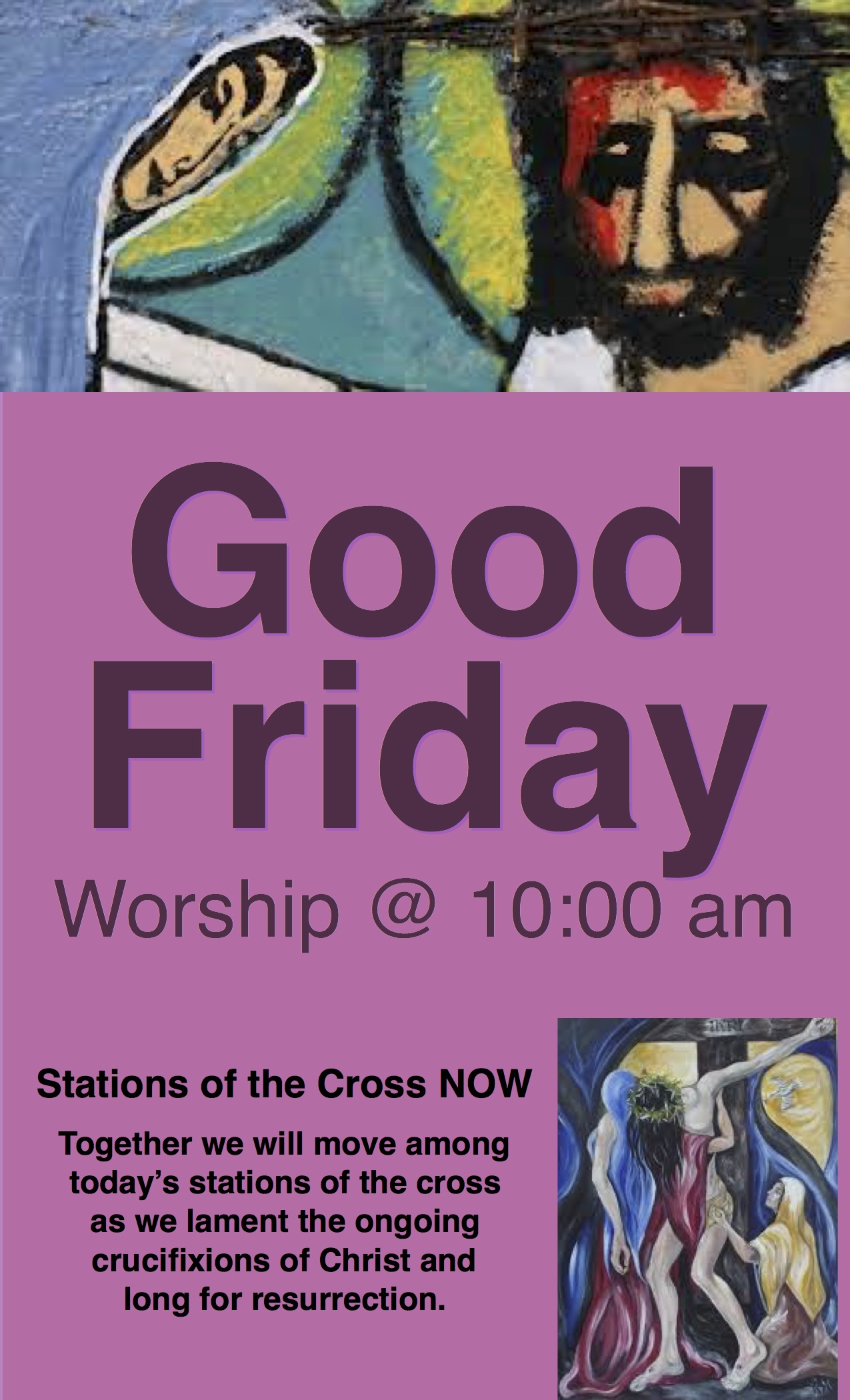
Good Friday 2016Holy Week marks a sharp uptick in visitors to this blog. From comments, messages, and emails I hear from fellow preachers who, like me, are daunted by the task of preparing the Good Friday sermon. That task is even more daunting for those of us who serve progressive communities. My fellow progressive-christian-preachers tell me of the dearth of progressive-christian Good Friday sermons to be found on the internet and encourage me to re-post my own attempts to rise to the occasion. So, here are the links to some of the Good Friday sermons I have preached over the years of my journey with the progressive community which I serve. The people Holy Cross Lutheran Church has over the years provided an invigorating space for me to pursue my questions. They have also provided the resources which make this blog possible. So, if you find the work posted here  of value to you and your community, please consider supporting this ministry of Holy Cross. I rarely solicit donations. But Holy Cross is a small community that continues to give to others in so many ways and your encouragement is greatly appreciated!!! (Holy Cross Lutheran Church, 1035 Wayne Dr., Newmarket, On. L3Y 1N3)

Follow the links to Good Friday sermons and feel free to use/adapt/repost

2015 Not Salvation! Solidarity and Transformation click here

2014 God Is Dead? click here

2013 Giving Up the Theories of Atonement in Order to Move Toward an Evolutionary Understanding of Jesus. click here

2012 Good Friday Rituals or Crimes Against Divinity? click here

Hosanna! Hosanna! Hosanna! Yada, Yada, Yada, we’ve heard it all before…a sermon for Palm Sunday

on a donkeyOur worship began outside in the bright sunshine of the first morning of springtime, where we spoke of the reenactment of one of the two parades that took place in Jerusalem nearly 2000 years ago. Embracing Jesus’ political act of performance art we processed into the sanctuary waving our palm branches and shouting our hosannas. Rather than the familiar Palm Sunday readings our worship included the story from Genesis chapter 32 which tells of Jacob wrestling with God, Psalm 118, and John 12:12-15. you can read them here and listen to the sermon here

Introduction to the Gospel according to Mark

P45 Mk7Holy Cross’ Adult Education Classes begin an exploration of the Gospel according to Mark using as our guides a commentary by Marcus Borg and a New Testament annotated by Amy-Jill Levine. You can listen to the first class, view the keynote slides, and get a copy of the class handout here

Epiphany Sermons

epiphany

You are the Light of the World here

The Journey of the Magi never happened and yet it is always happening. here 

Don’t Forget the Mystery of Our Faith here

Wisdom Seeks Wisdom here


Sermons for Christmas Eve/Day

nativity 3

Click on these links for some of the sermons I have preached on Christmas Eve

Preaching Christmas Eve in the Wake of New Testament Scholarship

Shattered Angel: an Imperfect Christmas Story

Mary’s Story  (also found in Christmas Stories – just scroll down)

Living Nativity

Keeping Christmas Well

The Nativity: A Parable So Simple a Child Can Understand It

The Power of LOVE Who Lives In Us

Cheap, Small, and Plastic: a Christmas Eve Sermon for Progressive Christians

Tell Us About God. We Have Almost Forgotten

Way Back When: Christmas Oranges 

Sermons for the Fourth Sunday in Advent

women Matthew1

Click on these links to find  sermons I have preached on Advent 4

Keeping Christmas Well: a Christmas Resurrection Story

The Greatest Birth Story Ever???

The Nativity: A Parable So Simple a Child Can Understand It!

Mary and Elizabeth: Visitation or Escape 

Fear Not for the Progressive Grinch Who Stole Christmas Does Indeed Have a Heart


Fear Not for the Progressive Grinch Who Stole Christmas Does Indeed Have a Heart – a sermon for Advent 4

GrinchThe story told in this sermon can be found in Maeve Binchy’s book of short stories “This Year it Will be Different.” As always I am indebted to those progressive grinches Marcus Borg, John Dominic Crossan, John Shelby Spong, and Michael Morwood for their insights into the sacred. Our sermon hymn was No Obvious Angels. The readings were all from Luke 1:1-56.

You can listen to the sermon here  

Years ago, I struggled with most of the stuff I was reading both in the bible and about the bible. I’d been attending church every Sunday since I was 15 and I was doing my best to be a Christian. But the more I read the bible, the more I studied the stories in the bible, the more difficult it became to reconcile all of the inconsistencies. Nowhere are those inconsistencies more apparent than in the stories about the birth of Jesus. Long before I ever dreamed of going to seminary to become a pastor, I was introduced to the work of progressive scholars like Marcus Borg, Dom Crossan and Jack Spong. It was a relief to learn how to take the bible seriously without taking it literally. It was also a relief to discover that my pastor and indeed most of the pastors I knew didn’t take the bible literally. But I have to admit that Christmas in the Church just hasn’t been the same since I learned that the stories about the birth of Jesus that appear in the Gospels according to Matthew and Luke are not historical narratives. I must also confess that since we here in this community embarked upon this grand adventure together of ReThinking our Christianity, the celebration of Christmas in our worship together has become more and more of a challenge. There are days when I feel like a progressive Grinch who is determined to steal Christmas. Then there are other days when I feel like the Grinch’s little dog, who try as he might he just can’t seem to balance those reindeer antlers on his tiny little head. There are days, and some sleepless nights when I simply long for the good old days, when we could sink into the sentimentality of the season without having to delve into scholarship or worry about our evolving theology.

I miss those Advents when we all acted as though prophets foretold the birth of Jesus centuries before it happened, when we suspended disbelief and went along with the idea that angels visited Mary and Joseph, and we marveled at the fact that Mary conceived will still a virgin. It was easier when that Star guided wise guys and heavenly hosts actually visited shepherds abiding in their fields. Damn those progressive Grinches who’ve robbed us of our simple ways of celebrating the birth of Jesus

and as for those radical Grinches who have us questioning everything from the divinity of Jesus to the cosmic reality of the Christ, well I for one wish they’d leave us alone to sing our songs in peace. We Whos did just fine down here in Who-ville before those Grinches tossed all the elements of the birth stories upon their sleighs and left us here wondering what to do and how to sing. For however shall we celebrate the birth of the Son of God now that we know Mary couldn’t have been a virgin, and Matthew and Luke were the worst historians ever?

Well fear not my friends, because like all Christmas stories ours too has a happy ending. The good news is that those progressive Grinches who have stolen Christmas, do indeed have a heart after all. Even that Grinch Marcus Borg knows a thing or two about opening his heart to the wonder of the stories about Jesus birth. Yes, Borg, just like the rest of those Grinches like Spong, Crossan, and Morewood, leads us to understand that the stories of Jesus birth didn’t actually happen the way the gospel storytellers wrote them. The good news is that Borg, just like the rest of those Grinches, does have a heart big enough not to just stop with the reality that the birth stories are not history. Borg’s heart is big enough to cope with his mind’s ability to give us a better question than, “Did the birth stories happen they way they were written? When Borg encourages us to ask: “why did the gospel story-tellers tell their stories they way they told them?”

Borg’s heart leads him to remind us that the stories may not have happened exactly the way they are written, but they are absolutely true because these stories are always happening. The sacred is always being discovered in the ordinary stuff of life. Every birth is sacred because in every birth their lies among the muck and the mess of birth the reality of Divinity which lives in, with, through, and beyond each and everyone of us. The birth narratives open us to the reality of the sacred, which lies at the very heart of life; all life. Humanity is born over and over again, and over and over again comes the sacred possibility of abundant life; life in which we are capable of living deeply and loving more fully that we can possibly imagine.

In the life and teachings of Jesus people experienced this divine abundance and it opened them up to the possibilities of a world in which the reign of God who is LOVE accomplishes peace through justice. Why did the gospel storytellers write about the birth of Jesus they way they did? Could it be that the divinity embodied in the life of Jesus of Nazareth could not be killed by the worst that the Romans could conceive? The storytellers told the story of Jesus birth using the tools that they had available to them to open their contemporaries to the reality that in Jesus the sacred dimension of life was experienced in the flesh. These parables about the birth of Jesus have opened generations to the sacred Holy One in whom we live and move and have our being. When we begin to experience the more-than-literal meaning of these parables about the birth of Jesus, we are opened to the sacred in our midst in ways that only LOVE can open humans. Continue reading

Moving beyond doctrines of Original Sin, The Fall, and maybe even the Doctrine of Grace, so that we can embrace our role in the Evolution of Humanity – a sermon on Genesis 3:8-15 for Pentecost 2B

We Are Stardust!!! Billion Year Old Carbon!!!

We Are Stardust!!! Billion Year Old Carbon!!!

Try to remember the summer of 69. Pierre Trudeau had only been in office for a year. Richard Nixon was in the White House. The Vietnam was raging. Chappaquiddick and the Manson Murders dominated the news that summer. Neil Armstrong became the first man to walk on the moon. The Beatles’ Album Abbey Road was number one. Sesame Street debuted on Public television while the Brady Bunch debuted in prime time to compete with I Dream of Jeanie and Bewitched. In that last beautiful summer of the 60’s, 350,000 young people flocked to a farm in upstate New York for the three-day musical extravaganza that was Woodstock.

My family moved to Vancouver that summer and I turned twelve; too young to be a flower child of the sixties, but old enough to become a fan of the music of the sixties. Not many of us knew about Woodstock while it was happening. But when we found out, many of us wished we’d been there. Over the years millions of people have claimed that they were at Woodstock, despite the fact that the site could barely manage to accommodate the 350,000 thousand who did attend. News didn’t travel so quickly in those days. Woodstock may have captured the imaginations of millions but that was almost a year after the event when record albums began to hit the shelves.

Back then one of my prized possessions was my small transistor radio, which I held up to my ear so that I could listen to all my favorite tunes. The quality of the sound was abysmal. So, if you liked a song you heard you just had to rush out and buy a 45, for less than a dollar. I remember lining up to buy a copy of the number 1 tune that summer: Sugar Sugar by the Archies. But if you really liked a singer or a group, then you would have to save your money so that you could plunk down $5.00 for an LP, shot for Long Playing Album. That summer I spent weeks saving my baby-sitting money, about .25 cents an hour so that I could get my very own copy of The Fifth Dimension’s latest album, The Age of Aquarius. I was dancing and singing, “Let the Sunshine” and dreaming of becoming a teenager. Back then it took a whole year for the music from Woodstock to begin to seep into the culture. And so it was long after the summer of 69, that I got my very own copy of the quintessential album of the Woodstock generation: Crosby, Stills, Nash and Young – Déjà vu. I wore that album out. Our House, is a very, very, fine house! Teach your children well! Helpless, helpless, he…lpless! And then there was the best song on that album. Joni Mitchell may have written the song called Woodstock, but it took Crosby, Stills, Nash and Young to make it timeless.

Well, I came upon a child of God


He was walking along the road


And I asked him, Tell where are you going?


This he told me


Said, I’m going down to Yasgur’s Farm,


Gonna join in a rock and roll band.


Got to get back to the land and set my soul free.


I must have listened to that song a thousand times trying to learn the lyrics, but try as I might a line from the chorus eluded me. I just couldn’t figure out what they were saying. Do you remember the chorus? We are stardust, we are golden,
 We are ???? what was the next line? We are stardust, we are….something, something, and we’ve got to get ourselves back to the garden. We are stardust, we are golden… We are ….billion year old carbon,
 And we got to get ourselves back to the garden.

 Well, then can I walk beside you?


When I finally figured out the lyrics, I was no wiser, I was lost…I couldn’t for the life of me figure out what they were on about. But it sounded good!!! So, I kept playing and I kept singing.

Over the years, I’ve hummed and sung along, trusting that we’ve got to get ourselves back to the garden. And longing for a simpler time, when I was young and still believed that Adam and Eve had once frolicked blissfully in the pristine garden of Eden, and if we could only recapture the innocence of that garden all would be right with the world. I remember as a teenager, hearing sermons about Adam and Eve’s fall from grace, as the start of it all. Something went terribly wrong; if only Eve hadn’t have listened to that snake and if only Adam hadn’t listened to Eve, then evil wouldn’t have entered creation and we’d all be able to frolic in the garden with God. If only we could get ourselves back to the garden, Jesus would not have to suffer and die for us: “For we are in bondage to sin and cannot free ourselves. We have sinned against God in thought, word and deed, by what we have done and by what we have left undone. We have not loved God with our whole heart; we have not loved our neighbours as ourselves. And so for the sake of your Son , Jesus Christ, have mercy on us. Forgive us, renew us, and lead us, so that we may delight in our will and walk in your ways, to the glory of your holy name. Amen.” Week after week, year after year, Sunday after Sunday, I grew to understand that I along with all of humanity am in bondage to sin and we cannot free ourselves. Because Adam and Eve fell from grace, the stain of that original sin marks me as inherently sinful. Continue reading

Emmaus is Nowhere because Emmaus is Everywhere: a sermon on Luke 24

Road to EmmausThis sermon was inspired on my own journey to Emmaus where in the space of the same afternoon I heard a stranger declare: “Christianity is dead!” and Karen Armstrong’s now famous TED talk about her call for a world Charter for Compassion.

Has anybody here ever been to Emmaus? Which one? According to the latest issue of Biblical Archeology there are at least nine possible locations that are candidates for the Biblical town of Emmaus. Historians tell us that there is no record of any village called Emmaus in any other ancient source. We simply don’t know where Emmaus might have been. Tradition, tells us that it might have been a place just a few hours walk from Jerusalem. New Testament scholar, Marcus Borg suggests that Emmaus is nowhere. Emmaus is nowhere precisely because Emmaus is everywhere. Each and every one of us has at one time, or indeed for some of us, many times, traveled along the road to Emmaus.

I know that I have been on the road to Emmaus most of my life. I’ve had lots of company on the Road to Emmaus. I’ve had many conversations along the way discussing, with anyone who’d care to accompany me, the ifs, ands, and buts of Christianity, of religion, and indeed of life. If you haven’t traveled down the road to Emmaus you must be very skilled in the fine art of turning off your brain and if you check you just might discover that your heart isn’t actually beating.

It’s so easy to imagine, those two characters striding down the Road to Emmaus that we can almost hear them talking, maybe even arguing about what happened. What on earth were they to make of all this! Jesus was supposed to be the Messiah. Jesus was the One who had come to liberate Israel, to free the people from oppression. Jesus was the One who was supposed to draw the people back to God, restore the relationship between God and God’s people. Now Jesus was gone, and what had changed? Now, Jesus was gone, and the Roman Empire was still oppressing them, still inflicting such pain and hardship, still killing them. Was it all a mistake? Was it all a lie? Had they been fooled by some kind of cruel hoax—were they wrong to put their hopes in this man from Nazareth? They had trusted Jesus believed in Jesus, followed Jesus. Their lives had been changed. They had seen the lives of others changed and they had expected even greater changes to come. Jesus had confronted corrupt powers. Jesus had charmed great crowds. Jews and Gentiles alike responded to the truth of Jesus’ teaching. Rich and poor had come to Jesus, believing in Jesus’ healing power. But Jesus had been shamed, and ridiculed, and humiliated, and crucified and now Jesus was dead. Well, was Jesus dead? Some said they’d seen Jesus, alive! Not that Jesus had survived the crucifixion by some miracle of strength, but that Jesus had risen from the dead. They seemed so totally convinced by their own experience…were they confused by their own grief? Were they delirious? Had they loved this Jesus so much—invested so much hope in Jesus life and leadership—that they simply could not let him go? And what did ‘resurrection” mean? Apparently it was not the resuscitation of a corpse. Jesus wasn’t revived to resume his former life; to take up his broken body until the day he might die again. No, somehow this was some new mode of being that seemed to be spiritual to some and yet real to others. And, if Jesus were risen from the dead, what would be the point of all that? What was the point to a Messiah—to a presumed political and religious leader—if Jesus wasn’t able to lead people here on earth? How could Jesus restore Israel when he had so easily been defeated by a handful of Roman guards? How could he bring release to the captives, how could he bring justice for the poor, how could Jesus advocate for the widows and the homeless? How could Jesus call people to account for all the ways they had strayed from God’s intent, now? What good could come from some kind of spiritual ghost? We can hear these two friends wrestling with each other and with their own hearts on the road that day! Continue reading

On Palm Sunday, An Inconvenient Messiah Parades Into Our Midst

palm sundayI wrote this sermon years ago, when I’d first given up theologies which required a subscription to the notion that humans fell from grace and need a Messiah to save them. It’s funny how we cling to ideas about what it means to be human as if centuries of human evolution have no bearing on who and what we are. The illustrations in this story come from an old shoebox of clippings; they do not cite the source, but the name Ed Riegert is scribbled in the margins. Ed was my homiletics professor. He used to encourage us to keep a file of stories that we might tell. That old shoebox has long since been replaced by a hard-drive. But the shoebox still draws me back from time to time. This sermon was a first attempt to move beyond notions of atonement that paint a picture of humanity I no longer cling to. Perhaps it will be helpful to those who are beginning open themselves to a new understanding of who Jesus is.

For previous Palm Sunday sermons click here, here, or here

There was once a man who suffered from various illnesses for a very long time. This man had seen countless doctors who over the years had performed countless tests on him and had prescribed lots of medicine. But, the man’s condition did not improve. This man even tried home remedies to make himself feel better. He drank herbal teas, and took mega-doses of vitamins along with his prescriptions. But still he did not feel any better. Then one day the man heard about a doctor who was said to be an outstanding diagnostician. So the man called the doctor to make an appointment and even though the doctor was booked for months in advance the man was delighted when the receptionist managed to fit him in. As the date of his appointment drew near the man was excited by the prospect of finally getting to the bottom of his problem. At last, he would find out just what was wrong with him and in no time he was sure that this brilliant doctor whose praises were sung by one and all, this doctor would be able to cure him. The day of the appointment arrived. After the doctor had thoroughly examined the man and had reviewed his tests, she sat down with him and she said, “My friend, you are not a healthy man. But you can be well again if you will only follow my advice. What you need to do is lose about sixty pounds, get involved in a regular program of exercise, and eat more grain, fruit, and vegetables. You don’t need to take any more of the medicine that has been prescribed for you and you don’t need all those vitamin pills.” When the man heard this, he was indignant. He demanded that the doctor prescribe some new medicine for him, possibly some experimental drug not yet on the market, which would cure his illness. The doctor smiled patiently and repeated her advice. “You don’t need medicine,” she said. “You need to change your lifestyle.” The man simply cursed the doctor and stomped out of the office. For the rest of his sickly life, he told everyone that she was a quack who didn’t deserve to be called a doctor. Continue reading

Jesus Sets Us Free to Save Ourselves: a sermon for Palm Sunday – Matthew 21:1-11

palm brsIn our parish, on Palm Sunday our liturgy stays with the commemoration of Jesus’ entry into Jerusalem. Trusting that our members will join us on Good Friday, we have not adopted the practice of rushing to the Passion of Christ. This allows us time to linger over our Hosannas. Our worship began outside with the reading of Matthew 21:1-11, followed by a procession of palm waving, hosanna cheering congregation. This year I changed the first reading to the story of Jacob’s wounding during a wrestling match with God in Genesis 32:22-31, followed by an feminist interpretation of Psalm 118, and the Gospel text John 12:12-15. I am indebted to Michael Morewood’s book “Is Jesus God” for the inspiration behind this sermon and to John Dominic Crossan and Marcus Borg’s “The Last Week” for the historical details. 

For previous Palm Sunday sermons click here, here, here, or here

Hosanna! Hosanna! Hosanna! Save us! Save us! Save us! Save us from who? Save us from what? Save us for what? What is all the shouting about?

Two millennia ago, on the outskirts of Jerusalem, when Jesus mounted that donkey it was pretty clear who needed saving from who; it was clear what they needed saving from and it was fairly clear what people longed to be saved for. The people longed for freedom: freedom from the brutality of their Roman rulers, freedom from the ravages of poverty, freedom from the strict oppression of their religious authorities, and freedom from the fear of illness and death. Life among the conquered peoples of first century Palestine was cruel, oppressive, impoverished and filled with fear and suspicion. Whatever hope of deliverance there was all too often false hope. Among the oppressed there are always calls for revolution and the conquered people of first century Palestine had seen more than their fair share of wanna-be saviours.  Some of their young people had fallen prey to the incitement of the Zealots and in youthful, exuberant, impatience had taken up arms against their Roman oppressors. Some of their neighbours had betrayed their own people and taken up whatever crumbs the Romans were offering, sold their souls and become collaborators, lining their own pockets at the expense of their own people. But far too many people had given up and given in, settling for whatever life they could eke out under the cruel regime hoping against hope, that someday, someone, somehow would come along and save them from the horrors of life. And so, they longed for the good old days; The days when their people and not the Romans dominated the land, the days when one of their own was king. But not just any king, they wanted a king like David; a king who would ride at the head of their army full of pride and power and conquer all their enemies. The elders, the wise ones, pointed to the past and heralded David as a Messiah; an anointed one; anointed by God to lead the people. How they longed for such a messiah to rise up among them and lead them; lead them to victory against all their foes and save them from their miserable existence. One by one, they’d hear these wanna-be messiahs, these trumped up saviours, call the people to rise up. But they knew, with each successive saviour, there was no hope that they could triumph over the mighty Roman army and so over and over again, they hunkered down, waiting and watching, longing and hoping for the one who could save them. Continue reading

Marcus Borg Blessed Us With His Wisdom and He Will Continue to Inspire Us to Be a Blessing

RNS-BORG-OBITNews of Marcus Borg’s death has caused thanksgiving to well up in so many of us who where touched by his generous way of imparting wisdom. Marcus Borg was blessed with a gentle touch which allowed him to challenge us to move beyond our long held beliefs so that we might see the One in whom we dwell as the One who comes to unique expression in each of us. I have been richly blessed by his scholarship. His ability to make his readers and listeners feel as though he was articulating our thoughts, doubts, questions, and insights was matched by his ability to push us beyond the limits we set for ourselves so that we too could challenge the status quo which plagues religious traditions. I am a better pastor, teacher, preacher, and human as a result of Dr. Borg’s skillful expressions of his passion for delving into the riches of our shared christianity and the gentle, generous way in which he challenged us all to think anew about the wisdom of the ages. Marcus Borg was blessed with gifts which he used to bless others. May it be said of us that we use the blessings he bestowed on so many of us to be a blessing to others. Well done Marcus. Thank-you Marcus. Shalom Marcus. Shalom. 

Epiphany Sermons

epiphany

You are the Light of the World here

The Journey of the Magi never happened and yet it is always happening. here 

Don’t Forget the Mystery of Our Faith here


Don’t Forget the Mystery of Our Faith – an Epiphany sermon

Thomas 70 pastordawnA sermon preached on the Second Sunday after Christmas – the readings for this sermon include: John 1:1-9, The Gospel of Thomas 70; Matthew 2:1-12. You can listen to the sermon here

Two cars were waiting at a stoplight.  The light turned green, but the man didn’t notice it.  A woman in the car behind him was watching traffic pass around them. The woman began pounding on her steering wheel and yelling at the man to move.  The man didn’t move. The woman started to go ballistic inside her car; she ranted and raved at the man, pounding on her steering wheel. The light turned yellow. The woman began to blow her car horn; she flipped off the man, and screamed curses at him. The man, hearing the commotion, looked up, saw the yellow light and accelerated through the intersection just as the light turned red. The woman was beside herself, screaming in frustration because she missed her chance to get through the intersection. As she is still in mid-rant she hears a tap on her window and looks up into the barrel of a gun held by a very serious looking policeman. The policeman tells her to shut off her car while keeping both hands in sight.  She complies, speechless at what is happening. After she shuts off the engine, the policeman orders her to exit her car with her hands up.  She gets out of the car and he orders her to turn and place her hands on her car. She turns, places her hands on the car roof and quickly is cuffed and hustled into the patrol car.  She is too bewildered by the chain of events to ask any questions and is driven to the police station where she is fingerprinted, photographed, searched, booked, and placed in a cell.

After a couple of hours, a policeman approaches the cell and opens the door for her.  She is escorted back to the booking desk where the original officer is waiting with her personal effects.  He hands her the bag containing her things, and says, “I’m really sorry for this mistake.  But you see, I pulled up behind your car while you were blowing your horn, flipping that guy off, and cussing a blue streak at the car in front of you, and then I noticed the  “What Would Jesus Do” and “Follow Me to Sunday School” bumper stickers, and the chrome plated Christian fish emblem on the trunk, so naturally I assumed that you had stolen the car.”

We can scoff at this, but I must tell you that one of the things I had to learn when I first began to wear a clergy collar was that I could no longer give people the finger when I was driving. If you give people the finger when you are driving, it’s not you giving that person the finger but the whole of Christian Church; people will use your outburst to condemn the hypocrisy of the entire church.

During Advent we used a question from Meister Eckhart not once but twice during each of our worship services: “What good is it to me if Mary gave birth to Christ twenty centuries ago and I don’t give birth to Christ in my person and my culture and my times?” And now, in this the last day of Christmas, I find myself wondering what it actually means for Christ to be born in me or in you. Continue reading