All Saints – Giving thanks for the DIVINE in ONE-another!

All Saints’ Day is a day for remembering.  The word saint simply means “holy”. In the New Testament, all those who believe and were baptized were referred to as saints. It wasn’t until round about the third century that the church began using the word saint to refer to those who had been martyred for the faith. Over time these martyred saints were held up for veneration and people used to pray to them to intercede on their behalf. I’m not going to go into all of the institutional abuses that led Martin Luther and the later reformers to abolish the veneration of the saints. Except to say, while the Reformation put an end to the veneration of the saints in the protestant churches, it did not abolish the concept of sainthood.

Within the mainline protestant denominations, we use the term in much the same way as it was used in the New Testament to describe the faithful. We talk about the communion of saints to describe all the faithful who have gone before us who now rest in God, together with all the living who walk in faith. So today as we celebrate the saints, we give thanks for all the faithful those living and those who have gone before us.

Today, I remember and rejoice as I give thanks and praise to God for the witness of St. Joyce of Belfast. St. Joyce who in her own way taught her children to love God and to pray always. And so today, I give thanks and praise to God for the life and witness of St. Joyce of Belfast, my Mom, who was the first to teach me the Lord’s Prayer, and who puts flesh on Christ’s command that we love our neighbours as we love ourselves.

Today I remember and give thanks for the life and witness of St. John of Wales, whose life in the church as a choir-boy was followed by long years of self-exile and whose keen wit and lack of patience with hypocrisy instilled in me a desire for honesty and integrity in the articulation and living of the faith. I give thanks for St. John, my Dad, whose open heart has stretched his discerning mind and enabled many to see the humour in this God-given life we live.

Today, I remember and rejoice as I give thanks and praise to God for the witness of St. Valerie of Ladner. St. Valerie so loved and feared God that she dared to reach out and invite a wayward soul to come and worship God. St. Valerie sang God’s praise, rejoiced in the communion of saints and helped a young friend find a home in God’s holy church. And so toady, I give thanks and praise to God for the life and witness of St. Valerie, my high school friend, who was the first to invite me to come and worship God.

Today, I remember and rejoice as I give thanks and praise to God for the witness of St. Wilton of Lunenburg. St. Wilton loved God all the days of his life and served God with gladness and distinction. St. Wilton went far beyond his call as pastor, he opened up the scriptures to those who eagerly sought the truth of God’s Word with love and dedication and he went on to inspire a diligence to scholarship that nurtured the faith of so many young people. And so today, I give thanks and praise to God for the life and witness of St. Wilton, my first pastor, who taught me to be uncompromising in my study of the scriptures, and steadfast in my love for God.

Today, I remember and rejoice as I give thanks and praise to God for the witness of St. Lola of Washington. St. Lola whose appreciation for God’s grace overflowed in her love for the world. St. Lola whose desire to share God’s grace and truth, led her to give of her time and talent to the care and redemption of so many young seekers. St. Lola whose love for God’s creation inspired her to teach so many of us to give thanks to God for all that God has made. And so today, I give thanks and praise to God for the life and witness of St. Lola, my mentor in the faith, who taught me to love as I have been loved.

Today, I remember and rejoice as I give thanks and praise to God for the life and witness of St. Fritz of Chicago. St. Fritz whose dedication to the Word of God was displayed in all he did. St. Fritz who opened so many minds to the beauty of God’s ways, who taught, inspired and entertained as he sought to reveal  the wonders of God’s unimaginable grace. St. Fritz who taught me that no question is unaskable for it is God who blessed us with minds and who bids us to use them in our love for God and for one another. And so today, I give thanks and praise to God for the witness of St. Fritz, my friend, who was the first to call me to the ordained ministry of Word and sacrament.

Today, I remember and rejoice as I give thanks and praise to God, for the life and witness of St.s Sharon and Irene of Pt. Roberts, St. Ellen of Lonsdale, St.s Jerry and Daniel of Minnesota, St. Nancy of Seattle, St. Anne of Vancouver, St. Donald of UBC, St.s  Carol, John, Eduard, and Donna of Waterloo, and for the great cloud of witness both living and dead who have testified to God’s love in my life.

Toady, I give thanks and praise to the SOURCE of ALL that IS for the cloud of witnesses who gather to worship the MYSTERY WHO IS and to love one another in the parish I serve. I give thanks for all the glorious saints of Holy Cross who have nourished, challenged and helped me to grow in LOVE.

Today, I encourage each and every one of you, to remember and rejoice, as you give thanks to the SOURCE of ALL for the great cloud of witnesses who have been a blessing to you; who have revealed the LOVE that IS God to you; who have taught you the Word, the story of LOVE in the world; who have loved you, nourished you, challenged you and inspired you to love God with all your heart, with all your soul and with all your mind and to love your neighbours as you love yourself.

Who are the saints in your life? Think about the saints who revealed the LOVE that IS God to you. Remember and rejoice for by their love, they taught you God’s Word, and taught you to celebrate the MYSTERY. Remember and rejoice in the saints of God, who are responsible for having passed the gifts of faith on to each of us. Saints who you may never read about in the church history books, but saints who by their life and witness managed to reveal a measure of God’s amazing grace to the world.

These saints of God who are so dear to us and the Body of  the LOVE that IS God, the hands of God, are ordinary folks who in the course of seeking to be faithful followers of LOVE, in striving to love God with all their heart, soul, and mind, touched our lives in ways that changed us and had a profound effect on who we are today.

Today is a day for remembering and rejoicing in the communion of saints. Today is a day for giving thanks to the MYSTERY we call God for their lives and for the witnesses they have been and are in our lives. But today is also a day for looking around us to discover our own place in the communion of the saints. Take just a moment to think about how people will remember and give thanks for your sainthood. Whose faith have you nourished? Whose faith will you nourish? How will you nourish people in the faith? How will you embody LOVE in the world? What role are you prepared to play in the Communion of Saints?

          The Reverend Dr. Otis Moss III says it well listen to St. Otis preach it!

            

“Makarios” – Blessed, Happy, Fortunate, EVOLVED – a sermon for All Saints’ Sunday

Listen to the sermon here

Our Gospel reading has often been called the Beatitudes. It is traditional to read the Beatitudes on All Saints’. Some years we read the eight Beatitudes as they have been passed down to us from the anonymous gospel storyteller known as Matthew, who sets Jesus’ sermon on the mount.  But this year is the year of Luke, so we read this anonymous storyteller’s version of the Beauties which appear in Jesus’ sermon on the Plain.  But whether it’s the sermon on the mount or the sermon on the plain what has been passed down to us is a description of the important characteristics of those who are blessed. There are all sorts of ways to interpret the word “makarios” which was translated into Latin as “beatus” the word for “blessed,” “happy, or “fortunate.” Today, I’d like to offer you another way of interpreting the Greek word “makarios”. “makarios” contains the Greek word “karios” Some of you will recognize the word “karios”,

here in Canada the mainline churches work together within the organization that bears the name “karios”. Karios is the organization through which we work together to achieve justice in Canada and in the world.  The name Karios was chosen because it is one of the Greek words for “time”, a special kind of time, the opportune time, or the supreme moment. Karios is used in the scriptures to mean that time when all is well, when people are making the best use of their time, when there is harmony or peace among people, or peace with God. Karios can also be used to describe the time when it is clear that the Divine has somehow visible right here and right now. Karios is sacred time. “Makarios” is related to Karios because a person who achieved “makarios” was said to be a person who had moved beyond the constraints of time and space. Continue reading

Always Reforming: Freedom and Loss

Jesus said: “If you continue in my word, you are truly my disciples: and you will know the truth, and the truth will set you free.”  Semper Reformanda – always reforming! Reformation has a great deal in common with freedom.  Whenever I hear that word “freedom” the lyrics of an old folk song pop into my head: “Freedom’s just another word for nothing left to lose.”

I suppose there is always a price to pay for freedom. A church that holds up the value of always reforming, is a church that will choose freedom over tradition.     Sometimes, choosing freedom over tradition can feel like losing; losing traditions that once seemed precious to us.  When it comes to worship the truth has set us free from all sorts of traditions that we once valued. Sometimes we discover that the traditions we once believed were so very important fall away.

What follows is a reflection on what we have lost and what we have found.

“The Truth Will Set You Free, But First It Will Piss You Off!” – a Reformation Sermon – John 8:31-36

“You will know the truth and the truth will set you free.” Let me take a moment to face the truth about who we are as Lutherans. The truth is that from the beginning Lutherans have participated in hate-filled tribalism that gives rise to anti-Semitism. The irony of attempting to commemorate the Reformation on the day after the slaughter of Jewish sisters and brothers cannot be ignored. Sadly, our church’s tragic participation in anti-Semitism goes all the way back to Martin Luther himself. Luther’s anti-Semitic rants provided the theological grounding that empowered Nazi’s to fan the flames of the Holocaust. It took until 1983 for the Lutheran World Federation to confess and repent Luther’s words.

Let me read from our sister church, the ELCA’s Declaration to the Jewish Community:

“In the long history of Christianity there exists no more tragic development than the treatment accorded the Jewish people on the part of Christian believers. Very few Christian communities of faith were able to escape the contagion of anti-Judaism and its modern successor, anti-Semitism. Lutherans belonging to the Lutheran World Federation and the Evangelical Lutheran Church in America feel a special burden in this regard because of certain elements in the legacy of the reformer Martin Luther and the catastrophes, including the Holocaust of the twentieth century, suffered by Jews in places where the Lutheran churches were strongly represented.

The Lutheran communion of faith is linked by name and heritage to the memory of Martin Luther, teacher and reformer. Honoring his name in our own, we recall his bold stand for truth, his earthy and sublime words of wisdom, and above all his witness to God’s saving Word. Luther proclaimed a gospel for people as we really are, bidding us to trust a grace sufficient to reach our deepest shames and address the most tragic truths.

In the spirit of that truth-telling, we who bear his name and heritage must with pain acknowledge also Luther’s anti-Judaic diatribes and the violent recommendations of his later writings against the Jews. As did many of Luther’s own companions in the sixteenth century, we reject this violent invective, and yet more do we express our deep and abiding sorrow over its tragic effects on subsequent generations. In concert with the Lutheran World Federation, we particularly deplore the appropriation of Luther’s words by modern anti-Semites for the teaching of hatred toward Judaism or toward the Jewish people in our day.

Grieving the complicity of our own tradition within this history of hatred, moreover, we express our urgent desire to live out our faith in Jesus Christ with love and respect for the Jewish people. We recognize in anti-Semitism a contradiction and an affront to the Gospel, a violation of our hope and calling, and we pledge this church to oppose the deadly working of such bigotry, both within our own circles and in the society around us. Finally, we pray for the continued blessing of the Blessed One upon the increasing cooperation and understanding between Lutheran Christians and the Jewish community.”

Semper Reformanda, means always reforming, or keep on reforming, or always reform. I don’t know about you, but after some of the horrendous events this week, I’m almost too tired for any more reforming. Between the Make America Great Again bomber, the white supremist, anti-Semite shooter, the defunding of Ontario colleges, and the abandonment of protections designed to ensure workers at the low end of the pay scale, see not only a dollar an hour raise but more than just a few paid sick days, I’m tried. I don’t even have it in me to pay attention to the worst humanitarian crisis in human history, so please don’t show me any of those horrendous pictures of starving children in Yemen, and whatever you do, please don’t remind me of the genocide of Rohingyan people Between the orange yahoo south of the boarder and our own moronic blowhard at Queen’s Park, I’m so very tired of bad news.  Don’t get me wrong, I want to save the world, I just can’t seem to face the world right now. I am in bondage to compassion fatigue and I cannot free myself. I can’t even begin to live up to the standards I set for myself. The onslaught of news that comes flooding in at a fevered pace, has left me longing to just hide away, curl up into a ball and forget that I ever believed that I had a role to play in making the world a better place.

When I was too young to know any better, I fell in love with an image of myself that I’ve been failing to live up to year after year, decade after decade. The truth about who and what I am is far from the ideal image of the person I long to be. The gap between our ideal self and our real self is a truth most of us would prefer to deny. The truth that we are far from the perfect ideal person that on our good days we aspire too, is tough to swallow. As relatively healthy human beings most of us recognize that we are missing the mark. Missing the mark is how the word sin is defined in the Hebrew Scriptures. We can try to put our faith in ideals, or rules or as the Apostle Paul and Martin Luther would say we try to put our faith “in the Law.” But ideals, or rules, or Law cannot save us from the reality that we are incomplete beings, ever-evolving beings, beings still hoping to become all that we can be. Continue reading

Persistent Woman: Mother Earth – Luke 18:1-8, Genesis 32:22-31

Our worship took a different form as we listened to the cries of Mother Earth using some clips from the documentary Anthropocene: The Human Epoch. Turns out that Mother Earth is a persistent woman which we discovered when we wrestled with the SACRED ONE.  Two reflections instead of a sermon. You can follow along with the bulletin found here

Reflection: Luke 18:1-8

When we expand our image of the DIVINE MYSTERY that we call “God”, God becomes so much more than a far off distant super-hero, waiting around to grant our wishes. Everything is in God and God is in everything. But God is more than the sum of everything. It hurts our brain to imagine the infinite vastness of the MYSTERY and so we create stories to help us to know aspects of the DIVINE.

Jesus told a parable that has become known as the “Parable of the Unjust Judge”. The parable is actually about a “Persistent Woman.” As we listen to the parable I’d like you to imagine this persistent women is the personification of our Mother the Earth and the unjust judge, well that’s you and I, we are the unjust judge.

Reflection:  Genesis 32:22-31

When we expand our image of the DIVINE MYSTERY that we call “God”, God becomes so much more than a far off distant super-hero, waiting around to grant our wishes. Everything is in God and God is in everything. But God is more than the sum of everything. It hurts our brain to imagine the infinite vastness of the MYSTERY and so we create stories to help us to know aspects of the DIVINE.

Some say that Jacob wrestled with an angel; an angel is the word that means a messenger from God. Some say that Jacob wrestled not with an angel, a mere messenger from God, but with God herself. Some say, the Earth is in God and God is in the Earth. Some say, that the Earth is God’s body. Surely, we can all agree that the Earth is sacred.

The sacred Earth is crying out to us. Each one of us must wrestle with this sacred messenger; with the DIVINE ONE of which we are also a part. Wrestling with the sacred is never easy. Not everyone is up to the task. Many will simply roll over in the night, hoping that the sacred messengers, or the DIVINE ONE herself, will simply go away and leave us alone. Some will no doubt find themselves overwhelmed by the messenger, overwhelmed by the immensity of the task of wrestling with such an infinite complexity. Others will resign themselves to their apparent insignificance and accept the paralysis which comes in the darkness.

I’m reminded of a story about Martin Luther who when asked what he would do if word came from an angel, a messenger from God that the world was about to end. Legend has it that Luther insisted that if he was convinced that the world was about to come to an end that he would plant a tree.

Plant a tree. Such defiance, such hope, such faith in the future, gifts such as these are what every wrestler needs so that they may engage the DIVINE.

Wrestling with the sacred will exhaust us, frustrate us, wear us out and maybe even leave us wounded. The reality of this sacred wrestling is that it will forever change us.

May you be blessed in the darkness by Messengers to wrestle with.

May the wounds of the struggle change you in ways you can scarcely begin to imagine.

Like our ancestor Jacob, may you see the face of God and live.

May we all see the DIVINE ONE, in the sacredness of the Earth, and live together in the shalom, the peace that comes when all God’s creatures hobble away from their careless ways of being, forever changed by the blessing of our LOVER, BELOVED, and LOVE HERSELF. Amen.

Wrestling With the Almighty: Locating Our Very Selves in the Sacred Story – a sermon on Genesis 32:3-31

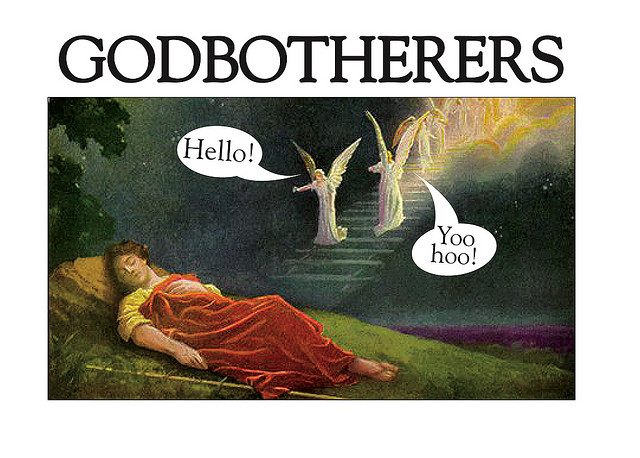
Godbotherers

For those of you preaching on the text from Genesis 32:3-31:

You may not be able to tell from looking at me. But let me assure you that you are looking at someone who used to be a champion wrestler. Believe it or not, my wrestling skills actually helped me rise to the level of a world champion wrestler. Well, perhaps I should qualify that statement. When I was an amateur wrestler, I was a world-class champion wrestler. But like so many athletes, when my status changed from amateur to professional, I lost my championship status and although I still qualify as a professional wrestler, and I like to see myself as a champion, I’m no longer what you would call world-class.

Like many professional wrestlers my career began when I was but a child. Growing up I had a very clear advantage as I developed my wrestling skills. You see having a brother who was just 18 months younger than me meant that I had ample opportunities to hone my wrestling skills. My brother and I were always at it. I’ve got to say that even though we shared the same weight class for most of our childhood, when it came to world class wrestling holds, I had him beat. I had this wicked arm-hold sleeper, and that together with my full Nelson followed by a knee-arm press, was guaranteed to have my brother screaming uncle and agreeing to be my obedient servant until in no time at all. For years I reigned as the champion of our little world! I was unbeatable. My brother didn’t stand a chance. My reign as world champion would have continued if it weren’t for the abrupt ending of my amateur status.

One morning when I was about 13 and my brother was 9 and a half, we were going at it,  and to his credit my bother had me in an ingenious hold. Somehow, he’d managed to secure me with what we professional wrestlers call an arm bar. That’s where you’re opponent wrenches your arm behind your back and applies just enough pressure to cause pain, but not enough to break anything. But just when Alan was approaching the point of no return, I managed with a feat of superhuman strength to rise up, twist around and swing for all I was worth and connect with what I though must be my brothers chest. I expected that such a thrust would have released my arm from Alan’s iron grip. But he still had me. I was about to hit him again, when for no apparent reason Alan released me from his grip. In an instant I wiggled free, spun around and connected with what I figured would be a fatal blow. Just before my blow connected with it’s victim, I realized that I was doomed.

Continue reading

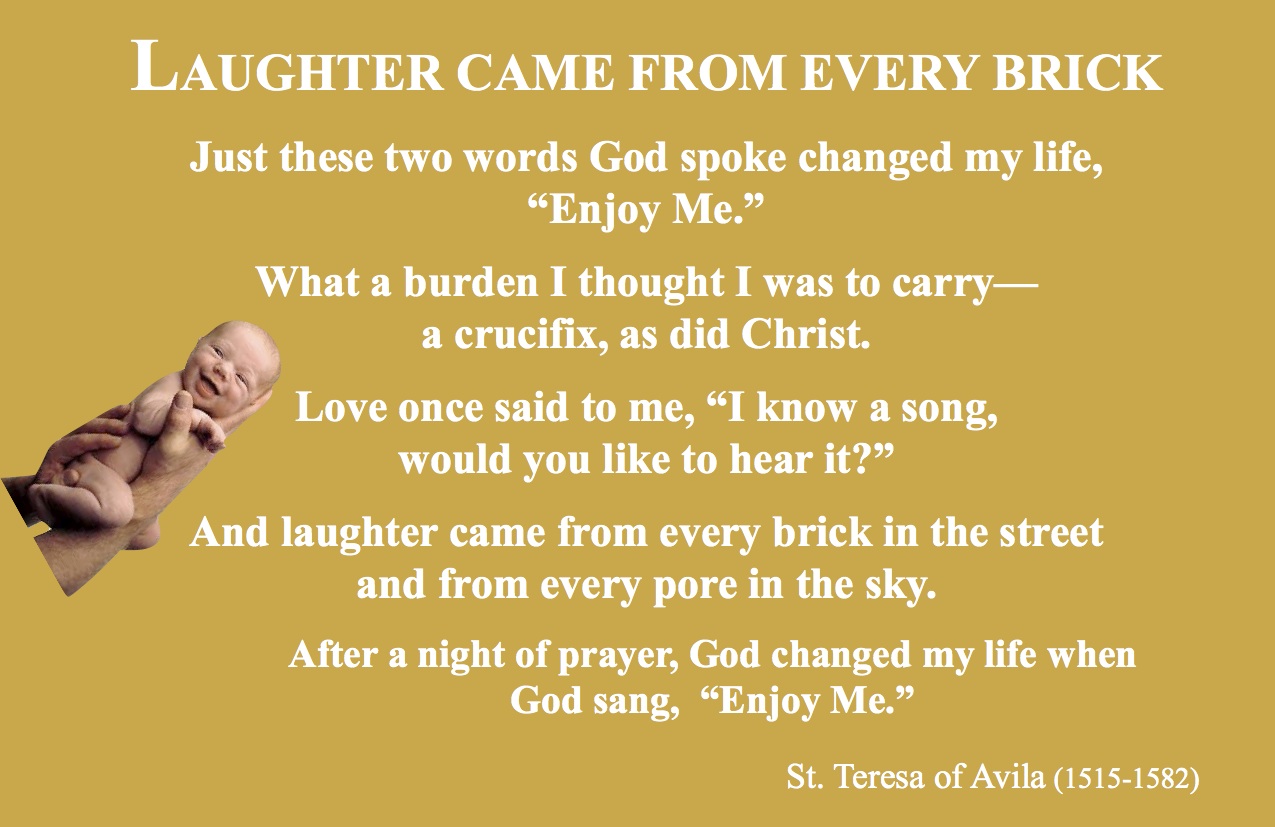
Today We Celebrate the Life and Witness of St. Teresa of Avila

An excerpt from “Love Poems From God” by Daniel Ladinsky,

(Penguin Compass, London: 2002)

(1515-1582)  “Teresa was born in Avila, a beautiful high mountain village of Spain.  She was one of thirteen children, three girls and ten boys, in a wealthy family.  The Spain in which Teresa grew up was permeated with 700 years of Arabian culture; the eradication of Arab power was followed by one of Spain’s darkest periods, the insanity of the Inquisitions, which, in the fourteenth century, along with other grievous deeds, forced mass conversions of Jews to Christianity.”

“Teresa was her father’s favourite child, and the most spirited.  Her mother died during childbirth when Teresa was thirteen, after which she had little supervision.  It is believed she had a lover at the age of fifteen, which caused her father to send her to a convent boarding school, only to see her return home two years later because of poor health.  When she was twenty-one, Teresa ran away from home to join a convent.  At that time many convents were more like hotels for women, allowing them a great deal more independence than they would be allowed at home, though after two years at the convent Teresa had a near-death experience that changed her life.  A spiritual awakening began in which she cultivated a system of meditation that sought quieting the mind to such an extent that God could then be heard speaking.  Over the next twenty years she experienced many mystical states but not until she was fifty did she begin the most far-reaching aspects of her life’s work.” Continue reading

Gratitude for the Great Fullness of Life Is Only the Beginning – Thanksgiving

A couple of years ago, I began experiencing chest pains, nausea, and cold sweats. As these are signs of a heart-attack, I went up to the local walk-in clinic and soon there-after I found myself sitting in the emergency room. The doctors and nurses were convinced that I was in the midst of what they now refer to as a “heart event”. While awaiting some further tests, my mind raced to all the worst possible scenarios that I could imagine. Fear was my over-riding emotion. Fear that my heart was failing. Fear that decades of not putting my health first was catching up with me. Fear of what my future might hold. Fear of impending medical procedures. Fear of not being able to work, to pay our bills, especially our mortgage. Fear of turning into some sort of invalid. Fear that my future was being taken out of my control. Fear that I was getting old long before I expected to.

There is nothing like an emergency room to strike fear into your heart, especially when the pain that drove you there is throbbing in your chest. So, by the time I’d spent several hours enduring various tests, I thought I was ready for anything. That is until a young doctor who looked like he was about twelve years old walked into my cubicle. A part of me wanted to ask this child-doctor to go find a grown-up doctor, because this was serious business and I wanted to talk to an adult. Fortunately, I managed to suppress my ageism.  You cannot even begin to imagine my delight when the child-doctor pronounced his diagnosis. Gallbladder. No heart-attack. A severe gallbladder attack. These kinds of attacks are quite common in people who have recently managed to lose weight.  My reward for loosing 50 pounds was an afternoon in the emergency room.

I couldn’t believe my luck. I begin thanking everyone and everything for my extremely good fortune. Thanks be to God. Thanks be to medical science. Thanks be to my heart. Thanks be to the child-doctor! Thanks be for the opportunity to do better in the future. Thanks be for a future! I wept with joy! A gallbladder attack is a wonderful thing. A gallbladder attack is not a heart attack. I could go home. I could go back to work. I could pay the mortgage.

All my worst fears were gone. I would take this as a warning to never ever take anything for granted. When I went outside, everything looked so beautiful. It was as if I had awakened from a nightmare. I was so very grateful that I promised myself never again to take my health for granted, never again to take life for granted, never again to forget what a precious gift life is. From now on, I was going to pay attention to the wonders of this amazing gift of life. Continue reading

To Whom Shall We Go to Say Thank-you? – Thanksgiving Sunday sermons

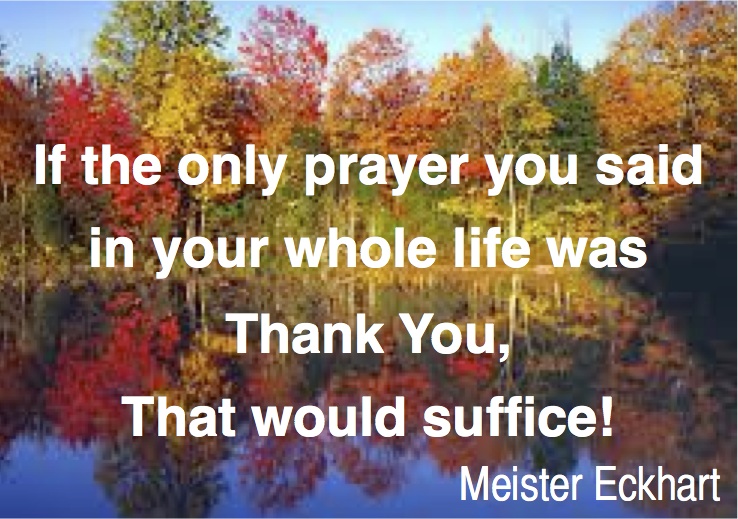
Thankyou autumn

Follow the links for previous sermons:

Reckless Generosity a sermon with a Monty Python flair!

Who IS God? – Not One, Not Two – inspired by Garrison Keillor & Joan Chittister

The Blessing of Michael’s Story – a Thanksgiving

Brussel Sprouts, Ebola, and Thanksgiving – seeking the ONE who IS

To Whom Shall We Go to Say Thank-you

After You Move Beyond Personifying God?

Over the course of the past nine years a group of little people have come into my life. Lovely little people who call me Gran. There are seven of them and participating in their little lives is a source of such great joy. Each stage of their development is a wonder to behold. I particularly enjoy watching their parents as they attempt to teach these little darlings the things that they need to know about being human. One of the first things that we teach little humans is the fine art of saying thank-you. It takes a fair amount of repetition to teach a child to say thank-you. Over and over again, after giving them exactly what they want, we ask, “Can you say thank-you?” and the little darlings repeat the words “Thank-you.” Sometimes all we have to do is ask the question: “What do you say?” in order to hear the words “Thank-you” uttered in such a delightful way as to inspire us to praise them as such good little girls and boys.

Expressing gratitude is a skill that all tiny little people must learn in order to develop into well-rounded human beings. Indeed, scientists insist that being grateful is a prerequisite of happiness. Happy humans it seems, are humans who embody gratitude. But there is more to gratitude than simply saying thank-you. I remember learning that gratitude includes more than simply expressing our thanks. It happened when I was about sixteen and actually noticed the beauty of a sunset and for the first time I realized that I was part of something so much bigger than myself. I know I must have seen the sunset before, but this time I actually saw the sun set. We were driving down the road, my friend Valerie and I were riding in a car driven by her mother, Lola. It was a partly over-cast day on the west coast of British Columbia.  Just a few clouds.  You could see the mountains off in the distance. We were chatting back and forth when all of a sudden, Lola pulled the car over to the far side of the road, switched off the engine and got out. Valerie followed her mother out of the car, so I figured I had better do the same. Val and her mother scampered down from the road and onto the beach. When they reached the water’s edge, they stopped and  just looked off into the distance. Apart from a tanker-ship making its way across the horizon, I couldn’t see much of anything. Lola had the most amazing expression on her face. She positively glowed with happiness. Valerie wore a similar expression. I must have looked somewhat puzzled because Val smiled at me and said “Isn’t it the most beautiful thing you have ever seen?” This only confused me more. What were they looking at that had made them stop the car, scamper down the bank and stand there at the water’s edge on a cold autumn evening. 

These happy, glowing, smiling people made me nervous. There they stood grinning from ear to ear.  What were they on? And then, I saw it. For the first time in my life, I saw it.  It had been there before. But I had never really seen it before. The sky was amazing.  The colours were overwhelming. It almost didn’t look real. It looked like someone must have painted it that way. It was magnificent. A work of art. The most beautiful thing I have ever seen. If you’ve never seen a late October, Pacific Coast Sunset before, you’ve missed one of the great wonders of the world. Neither Emily Carr’s paintings nor picture perfect post cards do a western sunset justice.          

Believe it or not, even though I had been living on the west coast for about four years, at that point I had never before really noticed just how beautiful a sunset could be. No one in my experience had ever taken the time to stop and look at one. No one had ever pointed one out to me before. I would never have dreamed of stopping a car and getting out to watch as the sun put on a show while setting. So, I stood there.  Overwhelmed by it all. Amazed at just how beautiful it was. Wondering just who or what could be responsible for such a spectacular thing as this. Before long my thoughts drifted to the Creator. Actually noticing a magnificent sunset was the beginning of a journey beyond myself as the reality that I am part of something so much bigger than myself continues to permeate my being.

Back then, I expressed my gratitude by very much the same way as my grandchildren are being taught to express their gratitude, simply by saying “Thank-you”. The object of the Thank-you being God. At the time, God was an old bloke up there in the sky somewhere. As my images of God changed over the years, my Thank-you’s continued to be expressed to my ever-changing images of God. But I must confess, that it was a whole lot easier to say thank-you to God when God was some big guy up there, out there somewhere? It was so much easier when I thought of God as “Father” or even as “Mother” to express my gratitude by simply mimicking the behaviour that I’d been taught as a child, “Can you say “Thank-you” Oh yes indeed I can say thank-you. “God is great, God is God, let us thank him for our food. By his hand we must be fed, Give us Lord Our Daily Bread.” Continue reading

Faith: A little dab’ll do ya! – Luke 17:5-10 – World Communion Sunday

Today all over the world, churches of all sorts of denominations will gather to celebrate communion. World Communion Sunday is an opportunity to embrace the embodiment of the infinite variety that exists in within the communities of our fellow Followers of the Way.  Today, we uphold the reality that no matter how communion is celebrated we Followers of the Way are all companions. For to be a companion is to literally share bread together. The word companion is made up of two Latin words, “com which means “with or together” and “panis” which means “bread”. To break bread together is to be a companion.

Humans began engaging in the sacred act of breaking bread together generations before Jesus embraced the sacred act of sharing a meal together to strengthen the bonds of companionship among his followers.

How many of you remember the very first time you participated in the companionship of communion? I suspect that for many of us are of an age where we can remember when are communion practices were less inclusive than they are today.  For several generations many mainline denominations tried to limit communion to those who had been “properly” instructed in the “meaning” of communion. In Lutheran churches children often had to wait until after they were Confirmed in order to be welcomed at the table. Back then, Communion wasn’t so much celebrated as it was endured as a sort of ritual reward for penance. Fortunately, we have come a long way from the somber communion rites of the past. But, I suspect that many of us still carry the residue of less than life-affirming theologies that taught us to view Communion as a sort of ritual that needs to be endured as a way to remember a “blood sacrifice”, a kind of quid pro quo for our sinfulness.

I can still remember my very first communion. It was, for all sorts of reasons, a life changing experience. Fortunately, for me my first Communion was free from the trappings of penitence. There was little or no thought of a blood sacrifice for sin. You see, my first Communion happened by way of what some would call an oversite or an accident, but I think of as a grace-filled DIVINE blessing.

As I’ve told you before, I did not grow up in the Church. My family’s experiences in Belfast had shown us the worst that the Church can offer and so, my brother and I were never encouraged to go anywhere near a Church of any kind. We were baptized as infants as a kind of insurance policy and I never darkened the doorway of a church until I was fifteen years old. I was an incredibly lonely teenager. I had spent my childhood moving from place to place, country to country, school to school; always on the move. I learned very early not to make friends with people because if you make friends it is so much more painful when you have to move away.

Longing and loneliness were predominant emotions that characterized the deep homesickness of my younger self.  Looking back to my younger self, I can see a little girl who was homesick for a home she never really knew because when you move about as much as we did, no place ever feels like home. Eventually all you can feel is this deep longing for something you cannot quite name. So, one day, at the tender age of fifteen, a new acquaintance that I was tempted to turn into a friendship, invited me to come to church with her. Continue reading

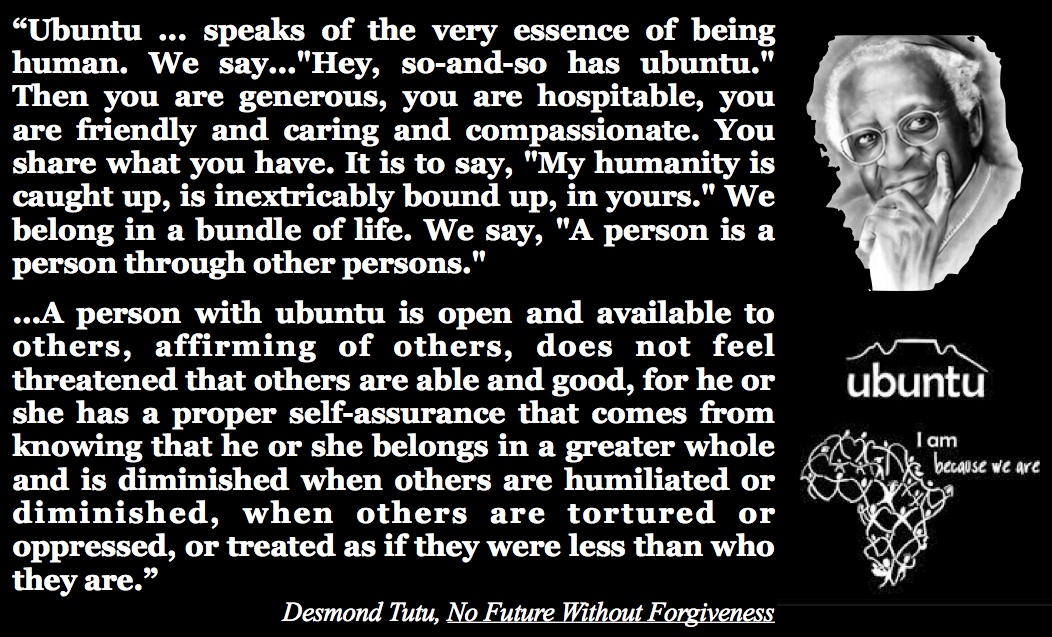
Ubuntu: A Person Is A Person Through Other Persons – Luke 17:5-10 – The Parable of the Mustard Seed

Ubuntu -- pastordawn.com

colemansListen to the sermon here: 

In his book, “The Orthodox Heretic”, Peter Rollins creates a parable which he calls “Finding Faith.”

According to Pete, “There was once a fiery preacher who possessed a powerful but unusual gift. He found that, from an early age, when he prayed for individuals, they would supernaturally lose all of their religious convictions. They would invariably lose all of their beliefs about the prophets, the sacred Scriptures, and even God. So the preacher learned not to pray for people but instead he limited himself to preaching inspiring sermons and doing good works. However, one day while travelling across the country, the preacher found himself in a conversation with a businessman who happened to be going in the same direction. The businessman was a very powerful and ruthless merchant banker, who was honored by his colleagues and respected by his adversaries. Their conversation began because the businessman, possessing a deep, abiding faith, had noticed the preacher reading from the Bible. He introduced himself to the preacher and they began to talk. As they chatted together this powerful man told the preacher all about his faith in God and his love of Christ. He spoke of how his work did not really define who he was but was simply what he had to do.

“The world of business is a cold one,” he confided to the preacher, “And in my line of work I find myself in situations that challenge my Christian convictions. But I try, as much as possible, to remain true to my faith. Indeed, I attend a local church every Sunday, participate in a prayer circle, engage in some your work and contribute to a weekly Bible study. These activities help to remind me of who I really am.’

After listening carefully to the businessman’s story, the preacher began to realize the purpose of his unseemly gift. So he turned to the businessman and said, ‘Would you allow me to pray a blessing onto your life?’

The businessman readily agreed, unaware of what would happen. Sure enough, after the preacher had muttered a simple prayer, the man opened his eyes in astonishment. ‘What a fool I have been for all these years!’ he proclaimed.  ‘It is clear to me now that there is no God above, who is looking out for me, and that there are no sacred texts to guide me, and there is no Spirit to inspire and protect me.’

As they parted company the businessman, still confused by what had taken place, returned home. But now that he no longer had any religious beliefs, he began to find it increasingly difficult to continue in his line of work. Faced with the fact that he was now just a hard-nosed businessman working in a corrupt system, rather than a man of God, he began to despise his work. Within months he had a breakdown, and soon afterward he gave up his line of work completely.

Feeling better about himself, he then went on to give to the poor all of the riches he had accumulated and he began to use his considerable managerial expertise to challenge the very system he once participated in, and to help those who had been oppressed by the system.

One day, many years later, he happened upon the preacher again while walking through town. He ran over, fell at the preacher’s feet, and began to weep with joy.

Eventually he looked up at the preacher and smiled, ‘thank you, my dear friend, for helping me to discover my faith.’”

In a parable handed down to us from our ancestors in the faith, Jesus’ disciples ask him to “increase their faith”. It is a request that I believe many of us can identify with for who among us has not at some point or other asked for the gift of more faith? If only we had more faith we would be able to believe and if we could believe we’d have the courage to  cope with whatever crisis is overwhelming us. If we could only believe, we’d be able to understand why, or how, this or that. If we could just believe strongly enough, we’d have the courage to risk, to speak out, to stand-up for, to open up to, to ask for, to go on, to do something. If only we could believe in God, believe in the life death and resurrection of Jesus, believe in the power of the Holy Spirit if only we could get it all straight in our heads we’d be able to tell all the world what it is we believe. In the meantime, we’ll just keep on struggling to believe.

For years, and years, I used to believe that what was necessary was to just believe. So, I struggled to understand what all those “I believe statements” that the church, the community of believers asks its followers to make.

“I believe in God the Father Almighty,

maker of heaven and earth and in Jesus Christ,

his only Son our Lord,

he was conceived by the power of the Holy Spirit

and born of the virgin Mary.

He suffered under Pontius Pilate,

Was crucified, died and was buried.

He descended into hell.

On the third day he rose again,

He ascended into heaven,

and is seated at the right hand of the Father.

He will come again to judge the living and the dead.

I believe in the Holy Spirit,

the holy catholic Church, the communion of saints,

the forgiveness of sins,

the resurrection of the body and the life everlasting. Amen.”

Over and over again, in liturgies, Sundays after Sunday, the church; the institution of the faith, offered me the opportunity to stand among the faithful to declare what it is that we believe. Whether it was the Apostles or the Nicene or heaven forbid the Athanasian creeds, the Church made it very clear exactly what it is that we are supposed to believe in order that we might number ourselves among the faithful. The very word “creed” itself, was handed down to us from our ancestors creed from the Latin “creedo” which translates into English as “I believe”. Continue reading

St. Francis – More than a bird-bath!

The Season of Creation concludes with the celebration of the life of St. Francis – Matthew 6:25-29


You Are More Powerful Than You Think – Cosmos Sunday – Psalm 139

In our ongoing celebration of the Season of Creation, today we shift our focus to the Cosmos. Usually, the word “cosmos” conjures up starry images of far distant constellations. Staring out into space can make us feel small and insignificant. But on this Cosmos Sunday, I’d like us to move us from our usual perspective of the cosmos. Perspective is a powerful tool, especially when we contemplate our place in the cosmos. You see the word “cosmos” refers to the entire universe, every dimension of time and space, spiritual and material. The cosmos includes the glittering galaxies that are so distant that we must peer at them through sophisticated giant telescopes as well as the deep domains within each minute molecule which we can only peer at through the lenses of sophisticated giant microscopes.

In addition to the material dimension of universes, the cosmos also includes the dimensions of time, our imaginations and of the spirit. Take a cube of sugar for example. Scientists tell us that you could fit the entire human race into the volume of single sugar cube; that’s right all 7 billion of us in a single tiny sugar cube. Something about the emptiness of matter that is beyond my intellectual ability to comprehend.

The cosmos is both infinitely large and infinity small. None of our telescopes and none of our microscopes can actually capture the vastness of the infinitely large nor the infinitely small, we must rely on our imaginations for this perspective on the cosmos. Staring out in the night sky can make you feel very small. Looking around the Earth, which is in and of itself a small planet can make you feel small and insignificant. But as the psalmist insists, you are fearfully and wonderfully made. The Hebrew word that is translated as fearfully can also be translated as awesome. Your very being is so very wonderful that it inspires awe. Awe and wonder are the very first religious impulses. Congratulations, for you are awesome, tremendous, wonderful. And yet, so often we can only see ourselves as small in relation to the cosmos; small and insignificant, small and powerless.

I remember, once long ago, when I was feeling so very small, insignificant and powerless. I was only ten years old. My Grandfather had a way of belittling people that was crushing. Granda had been taunting me over something I had said. The adults had been talking about war in the Middle East. The year was 1967, the year of the Six-Day War. I was just ten and didn’t understand the details of what was happening. But I did understand the drills we went through at school. Those of you of a certain age may remember hiding under your desk as we practiced what we would need to do in the event of a nuclear attack. Somehow our wooden desks were supposed to offer us some sort of protection. It was madness. A kind of madness that all of us, even the adults in the room all bought into. Continue reading

LOST: Done That! Been There! – Homecoming Sunday – Luke 15

They say, whoever they are, that “you can’t go home again.” You can’t go back to a place you once called home because in your absence that place will have changed. I remember, travelling across the world and needing desperately to return home. I’d been travelling for several months and I had intended to stay away for many more months. I was in England when doctors informed me that there was a tumor lodged between two of the bones in my foot that needed to be removed. I can still remember the doctor telling me that there was a distinct possibility that the tumor was a malignant cancer. Suddenly, home seemed like the only place in the world I wanted to be. Even though I was already in the city of my birth, I knew without a doubt that Birmingham was not my home. The only trouble was, that during my travels my parents had moved from the one town to another. Even though the place where my family was living was familiar to me, it was not the home which I had left behind. So, when I arrived at my parents’ new home, everything felt very different. Perhaps the most important change was in me. I was not the starry-eyed young woman that I once was. The future was suddenly very uncertain. Fears that I had never ever had to deal with, were suddenly part of who I had become. But I was home and even though home was the last place I expected to be, home was the only place I wanted to be. So, I set about trying to feel at home in what was for all intents and purposes a very different home than I had hoped to come home to.

When I think about Jesus’ parable of the lost on this Homecoming Sunday, I can’t help wondering how many of us here at Holy Cross feel like we have come home to a different church. Now, I know that many of us haven’t really been away but bear with me for a moment so that we can explore the contours of the metaphor of coming home. All of us carry with us, all sorts of images of what we want and need the church to be. Some of us long to return to an image of the church as it was at a particular time in our lives when we felt at home in the church. Some of us long to come home to a church that was full of particular people, or to a church that sang certain songs, or worshipped in certain ways, or comforted us with particular ideas, or inspired us with certain hopes. Others of us, long to come home to the church of our dreams, a church that never really was, but a church that we are convinced we would feel very at home in. You know the kind of church home I’m talking about, a place full of people who are exceptional, a place filled with inspirational activities, a church that accomplishes stuff, important stuff, vital stuff, a church that has absolutely no financial worries at all.

There’s an old gospel song that comes to mind:

There’s a church in the valley by the wildwood

No lovelier spot in the dale

No place is so dear to my childhood

As the little brown church in the vale

Whatever the contours of the church of your longing, I suspect that the most important ingredients that make up the church of your longing revolve around the people.  A church is not a church without the people and one thing I’ve learned about people, is that people are complex creatures. Take that lost child, the one who is known as the prodigal, no matter how you look at this parable, one thing is clear, the child that returned to his home, was not the same child that left his home.

Think about the other lost child, the one who can’t quite seem to share his father’s enthusiasm for his brother’s return. That lost child, is not the same person as the one who went out into the fields in the morning, the child who thought his future was secure, is no longer the same child as the one who returned to find his Dad throwing a lavish party for his wastrel of a brother, whom he believed he’d never have to contend with again.

Then there’s the Dad, who certainly isn’t the same person that he was before his youngest child left him behind. He’s not even the same person that his older child left that very morning. Nothing stays the same. We are all changing, all the time. Is it any wonder that it is so very easy to get lost? Looking in on this parable, I can see myself in each of these three lost souls. I’ve certainly messed up in ways that make me want to tell the younger child, “Been there. Done that. Bought the T-shirt.”

I’ve also lost people, for all sorts of reasons that have left me miserably longing for their return. So, I can see exactly why the lost father, who let’s face it played a pivotal role in both his children’s angst. I mean, that child would have never left if the Father hadn’t acted the way he did and as for the older child, well how could the Father forget about him? Why didn’t he even bother to invite his eldest child to the party? We’ve all messed up in our dealings with people, enough to cause us to lose them. We can all relate to the kind of longing for the lost that would cause us to throw a party if they ever returned. Continue reading

Jesus Was and Is an Absolute Fool – Luke 15

lost-and-foundI am indebted to two beloved seminary professors for the formation of this sermon: Dr. Donna L. Seamone and Dr. Ed Riegert. All preachers stand on the shoulders of those who have gone before us!!!

Jesus was and is an absolute fool! An absolute fool, I tell you! Among the teachings of Jesus, the parables of the lost and found are so well known, so familiar that we are in peril of failing to hear the foolishness they advocate.

Although only a few of us have had the opportunity to tend a flock of sheep, most of us at one time or another have been responsible for the welfare of a flock. Whether that flock be sheep or co-workers, clients, customers, students, friends, or children none but the foolish among us would leave 99 to the perils and dangers of the wilderness in order to go looking for one idiot who’d been stupid enough to get themselves lost.

We may not keep our coins at home, but I daresay that most of us have felt the sting of loosing a drachma or two or three in this recession. Only a fool would waste a moment searching for our losses when our portfolio’s are so full. I dare say that if we managed to find or recoup our loss, we’re hardly likely to invite the neighbourhood to a party that would in all likelihood eat up more than we had found. Continue reading

Lighten Up! – Luke 12:22-31

“Do not worry about your life. Do not worry about your body. Can any of you, for all your worrying add a single hour to your life?”   Look at the birds! Look at the flowers! Stop worrying! When we try to understand a biblical text, it is helpful if we keep in mind three particular contexts. The first context to keep in mind is the context of the story itself. What is happening in and around the characters in the story itself. The second context to keep in mind is the context in which the storyteller tells the story. What is happening in and around the anonymous gospel-storyteller that we call Luke. The third context to keep in mind is our own context. What is going on in our lives and in the lives of the communities in which we live?

So, let’s begin by looking at the context of the story itself.  Jesus is speaking to his disciples. The year is somewhere between 30 and 33 of the Common Era. The place is Palestine, a far-flung province of the Roman Empire. The people to whom Jesus is speaking are a conquered people, living under the oppression of a foreign power. The people to whom Jesus is speaking have no power. They are being persecuted, oppressed, and terrorized.    Life is difficult. There’s a very thin line between life and death and the people to whom Jesus is speaking understand that by listen to this rebel Jesus they are risking death. All Jesus’ listeners really have is hope, hope that one day their Messiah will rescue them from their cruel taskmasters.

Fast forward about 60 years or more to the context in which the anonymous gospel-storyteller that we call Luke tells this story. Conditions have deteriorated. The Jewish people have rebelled against their Roman oppressors and they have been crushed. The Temple, the very heart of who they are as a people, has been destroyed and much of Jerusalem along with it. Both Jews and the followers of the Way have been driven out into the wilderness as outlaws. Historians tell us that after the rebellion Rome inflicted abominable terrorism upon the people of the once proud Jewish nation. The smell of rotting flesh was very familiar, thousands upon thousands were crucified as enemies of Rome, their corpses left to rot upon makeshift crosses. For the Followers of the Way life was worse. Excommunicated from the synagogues they met in secret fearing not only the Romans but their Jewish neighbours as well.

Fast forward to today. What is going on around us as we hear this story? Well, there’s a crazy orange megalomaniac sitting in the most powerful office the world has ever known. We are told that this powerful buffoon has seriously contemplated exercising his power to nuke hurricanes. All around us the dangers of climate change are being felt as winds blow, and sea-levels rise.  Money, money, money is the order of the day as we all scramble to ensure that we get what is ours.

So, we are busy people. We are well informed people and we know more about what is going on in the world than any other generation before us. We are stressed out and we don’t know what to do first.  And so, we come to church, seeking what? guidance? solidarity? comfort? inspiration? or maybe just a little distraction from the stress of it all. But even here we can’t relax because here too we are met with stress inducing challenges. Churches are closing all over the place. The once mighty flagships of our own Lutheran church have already closed, and our beloved little Holy Cross is struggling to survive. There are just a few of us left and we are finding it more and more difficult to meet our challenges. In all three contexts to which this story speaks, there is so much for people to worry about.

Indeed, in all three contexts the temptation to despair is immense. To all three contexts, Jesus says the same thing: LIGHTEN UP!  “Do not worry about your life. Do not worry about your body.  Can any of you, for all your worrying add a single hour to your life? Look at the birds! Look at the flowers! Stop worrying!  Lighten up!

Look around. Look at the beautiful people who are here. Look at where we are. We live in one of the best places on earth! We are richer than the vast majority of people on this planet. We have wealth beyond the wildest dreams of our ancestors. We have this building! We have each other. There are no oppressors on our doorstep waiting to torture us. The first followers of the Way would have loved the opportunity to worship in such a fine place as this.

We are all relatively healthy. Most of us live very comfortably. So why is it so difficult for us to hear Jesus say: “Do not worry about your life. Do not worry about your body.” “Can any of you, for all your worrying add a single hour to your life?” Look at the birds! Look at the flowers! Stop worrying!

I know, I know, it is easier said than done. It is so very difficult not to worry when we are so stressed out. Stressed out. Think about that phrase for a moment. I don’t remember my parents ever complaining about stress. Being “stressed out” is a condition of our age. We have become masters of the art of catastrophizing. We can awefulize a situation faster than a Roman centurion could grab his sword.

I know I’ve said this many times but think about the way we greet one another. “Hi how are you?”  What is the most common response to this simple question? “I’m busy.” We have become obsessed with our own business and it brings us precious little pleasure. When we tell someone we’re busy, they usually respond with something like, “you think you’re busy. let me tell you how busy I am.” We no longer human beings we are human doers, obsessed and stressed out by all the stuff we need to do and all the stuff that we aren’t doing. It’s no wonder that we catastrophize and awefulize all day long. We’ve forgotten how to enjoy this life of ours.

Take the weather for example. We are entering a spectacularly beautiful autumn. The weather has been fabulous around here.  And yet, all this week instead of remarking on how lovely it is outside, people insist on awefulizing the weather. “Winter’s coming.”

“Yeah it may be lovely now. But winter is coming.”  It’s as bad as Game of Thrones, “Winter’s coming.”  Be afraid. Be very afraid.

Doesn’t matter that winter can be beautiful. Doesn’t matter that we all enjoy the luxury of beautiful centrally heated homes. Most of our cars have heated seats. I even have a car that will heat my steering wheel. Heck we have cars. We won’t have to trudge here on snowshoes. Nevertheless, we moan winter is coming.

There are lunatics running the world. Churches simply can’t survive in our modern world.           We are fighting a losing battle. People these days are spiritual but not religious. So, we huddle together and we do what everyone else is doing these days, we catastrophize and we awefuize because winter is coming. These days seems as though worrying is the only way we connect with one another. So many of our speech patterns revolve around our stress. Take a moment to step out of yourselves and pay attention to how and what we are saying to one another. The experts say that the average person has about 60,000 thoughts in a day. How many of your 60,000 thoughts are negative? How many of the conversations we have with one another lean into your fears? Think about social media? How many posts or articles do you read that strike fear into your hearts?  Global warming may not be as big a problem as global whining.

To all of this catastrophizing and awefulizing Jesus insists:  “Do not worry about your life. Do not worry about your body.”  “Can any of you, for all your worrying add a single hour to your life?” Look at the birds! Look at the flowers! Stop worrying! Lighten up! To which I’m sure you may be thinking, “Easier said than done.”

Don’t get me wrong our problems are real. But can any of you, for all your worrying, add a single hour to your life?   Lighten up. Let’s try to be spiritual but not religious. One of the best definitions of spirituality that I have come across recently comes from the social researcher Bene Brown, who writes, “Spirituality is recognizing and celebrating that we are all inextricably connected to each other by a power greater than all of us,

and that our connection to that power and to one another is grounded in love and compassion.  Practicing spirituality brings a sense of perspective, meaning and purpose to our lives.”   To which I say, in the spirit of Jesus “Lighten up dear friends.”

If we can connect to one another in ways that do not begin with catastrophizing and awefulizing, perhaps we can begin to gain a sense of perspective that will not only bring meaning to our lives together but may just remind us of the many things we love about one another. I know we have all sorts of challenges in our little church. It is difficult not to worry. I stay up nights worrying about our life together as a community.

One of the things that I have come to believe is that if the only level at which we can connect with one another is through our worries, we will lose any desire that we may have to connect in the first place. We need to connect in ways that remind us of our many blessings and inspire us to share our blessings.I’m hoping that we can begin by stepping out of ourselves and looking at how we talk to one another. If we try to become witnesses of our own behavior. Think about what we are thinking. Are we leaning into fear? Are we connecting through negative language? Are we connecting through misery?

The best way I know how to step outside of myself is with humor. When I hear Jesus say, “Do not worry!” I hear him say it with an Irish lilt. “Sure, what da want to be worrying about. Have ya taken leave of yer senses? What good is worrying going to do ya? Look at the birds – sure they’re not worried. Look at the flowers – they can’t worry. Look around the birds can fly. The flowers are lovely. How stupid you to be worrying in such a place as this? Stop worrying.”

Now as lovely as an Irish lit is, I can still find something to worry about. And it doesn’t quite make me laugh. And laughter is what is called for because laughter is one of the deepest surest ways that humans connect. So, the other day, I was wondering how we get from worrying to laughter. Now I’m not a comedian. So, I’m not going to try to joke us out of our troubles. But I am a student of human behavior and apparently, it’s almost impossible to take someone seriously if their wearing one of these.  (put on a Red nose).

“Do not worry about your life. Do not worry about your body.” “Can any of you, for all your worrying add a single hour to your life?” Look at the birds! Look at the flowers! Stop worrying! Lighten up!

Okay, this might work better if we all wear a read nose. (distribute red noses)

As your go through the week and you find yourself slipping into catastrophizing or awefulizing or even just complaining, put on your read nose.  And say: “Do not worry about your life. Do not worry about your body.”   “Can any of you, for all your worrying add a single hour to your life?” Look at the birds! Look at the flowers! Stop worrying! Lighten up!

We have all sorts of challenges to deal with. If we can put our challenges into perspective and connect with one another without catastrophizing or awefulizing, together we can meet whatever challenges come our way in the LOVE that IS the ONE who nourishes grounds and sustains us in the beautiful life, in this beautiful place, in these wonderful times.  For we are after all is said and done, a spiritual people.

“Spirituality is recognizing and celebrating that we are all inextricably connected to each other by a power greater than all of us, and that our connection to that power and to one another is grounded in love and compassion.  Practicing spirituality brings a sense of perspective, meaning and purpose to our lives.”   Therein lies our hope. Lighten up! Look at the birds. Look at the flowers. Remember the CREATOR of ALL that IS created the duck-billed platypus. So, laugh a little.


Jesus You’ve Got to be Kidding!!! – Luke 14:25-33

choose lifeI am indebted to Pastor Michael Rodgers for preaching a sermon long ago that stuck with me for decades. This sermon is inspired by his brilliant work! 

Jesus you’ve got to be kidding! “Whoever comes to me and does not hate father and mother, wife and children, brothers and sisters, yes and even life itself, cannot be my disciple?…None of you can become my disciple if you do not give up all your possessions?”

Hate your father; hate your mother; hate your wife; hate your children; hate your brothers; hate your sisters; hate even life itself and oh yes while you are at it, give up all you possessions and then, and only then will you be ready to take up your cross and follow Jesus. What is Jesus talking about? Has Jesus forgotten about the fourth commandment? Are we to forget about honouring our parents? Wasn’t it Jesus who said that we are to love our neighbours as we love ourselves? Didn’t Jesus try to talk people into loving their enemies?  Has Jesus forgotten that his Abba is LOVE itself? Why does Jesus rant and rave about hating our father’s, mothers, children, sisters, brothers and even life itself?

It is difficult to recognize the Jesus in this text. This is not the gentle Jesus of my childhood. This is not the happy Jesus who smiled out from the pictures in my illustrated Bible.This is not the Jesus that the rightwing conservative Christians point to when they harp on about family values. This is not the gentle Jesus we have come to expect. This Jesus sounds too harsh. This Jesus wants to turn us into religious fanatics who hate everybody and give up everything, even life itself.

For a few years now, there has stood on the shelf above my desk a quotation from Deuteronomy 30. I put it there so that these word’s of WISDOM might guide me in my decision making. According to the writers of Deuteronomy, our CREATOR says:  “I have set before you life and death, blessings and curses. Choose life so that you and your descendants may live”. Our CREATOR says “Choose life!” How do I reconcile this to the Gospel lesson in which Jesus  says whoever does not hate even life itself, cannot be a disciple of Jesus? Why was Jesus so harsh?  What is going on here? Continue reading

Oh I Do Like to Be Beside the Seaside: Job 38:1-18, Luke 5:1-11

On this the first Sunday of the Season of Creation, we pause to contemplate the Ocean. I say the Ocean because even though we can the Ocean by many names, there is only one Ocean. Covering 71% of the Earth’s surface in one interconnected body, the Ocean contains 321 million cubic miles of water. This one gigantic Ocean contains 97% of the Earth’s water in which somewhere in the neighbourhood of 250,000 different species of life make their home. Only about 5% of the Earth’s Ocean has been explored by humans. The truth is that we humans know very little about the Ocean. We do know that at its deepest point, the Ocean reaches a depth of 6.8 miles.

For me, the Ocean has always been, what the Celts describe as a “thin place” – a place where the DIVINE permeates our being; a place where all the divisions we have constructed between the sacred and the ordinary disappear. A distant memory of my small barefooted self, clutching a bucket and spade, splashing in tide-pools, humming an old song, “Oh I do like to be beside the seaside, Oh I do like to be beside the sea!”, a memory that brings with it the sweet, salty smell of the sea.

I have not always been land-locked. Childhood memories of trips to the seaside in Northern Ireland, followed by high school memories of skipping class to pay amongst the waves, youthful excursions sailing up the coast of British Columbia, and long walks along Vancouver’s sea wall, permeate my senses with memories so sweet that I can almost hear the sound of waves lapping on shore, bringing with them the sure and certain knowledge that life is sweet and good. “Oh! I do like to be beside the seaside, I do like to be beside the sea!”

When my Dad was just a teen-age boy, he joined the British Merchant. Years spent travelling the Earth’s Ocean spawned a healthy respect for the power of the Sea; a deep abiding respect that he engendered in his daughter. To this day, while I do like to be beside the seaside, the deep, dark, open waters of the Ocean with their unknown secrets inspire a fear in me that can make my land-loving legs tremble.

What lurks beneath the Sea from which our ancient precursors first emerged? Deep, deep, darkness harbours mysteries of our origins over which the CREATOR of ALL that IS brooded and the RUACH swept over the face of the deep drawing forth life; our primal memories of the Sea inspired perhaps, by the breaking of the waters that heralded our own birth. Some four billion years ago, the miracle of tiny, living cells percolating in the depths remains a mystery we long to unravel. Six hundred million years ago, life miraculously moves onto the land, out of the waters of our gestating mother the Earth life emerges in all its magnificent complexities. Staring down into the depths of the Ocean, I have often been struck by the magnitude of my own insignificance and yet, here I am. Here you are. Here we are. All of us floating along in the blue-boat home of ours, even as sisters and brothers, cousins, and friends in the southlands prepare themselves for the power of the oncoming rush of the Ocean’s furry.

Storms rage upon the Ocean each and every day. But not until the Ocean threatens to encroach upon the Lands, do we shift our gaze and wonder at the depth of life’s mysteries. Knowing that in the coming days, like Job shaking his fist at the heavens, there will be those in the path of a storm named Dorian, who will be left with nothing but their own shaking fists with which to protest the cruel vicissitudes the powers of the Ocean. Dorian from the Greek word meaning “gift” as if such furry could be tamed by a name. This gift-storm will surely stir us, if for but a moment from the momentum of our lives, inviting us to spare a thought for our fellow creatures.

Recalling our connections one to another inspires a kind of concern that causes some to exclaim, “There but for the grace of God…” A kind of trivial response of inconsequential value in the face of such suffering.  Is it any wonder that the god of our ancestors scorns our shaking fists in our sacred scriptures, where out of the storm YAHWEH can be heard to demand: “Who is this obscuring my plans with such ignorant words?”

Dare we turn the pages to seek comfort in a later text. As from the confines of a small boat, Jesus directs us out into deeper waters. Do we have the courage to risk deeper waters? I wonder.

Before a storm the calm upon the surface inspires such confidence in us as we quietly navigate without risk. As the storm rages, the temptation is to rush to the shore and abandon our small boats. Even if there are fish out there to be caught, why take the risk? After all we’ve been work hard for years and have caught nothing and lost more than we can bear. Our boat is too small. Our spirits are weary. And still Jesus says, “Pull out into deep water.”

In the midst of the turbulence we long for calm clear waters in which to sail. Fearful of the depths, can we hear Jesus, urging us to go deeper. Deeper, where pretentions having floated to the surface give way to authentic connections. Deeper, where we must hone our focus in order to see what really matters. Deeper, where conscious communication opens our lungs so that we can breathe with compassion. Deeper, where the LOVE that lives in us longs to stir us beyond our fear. Deeper, where MYSTERY dwells, compels, and empowers. Deeper, where darkness gives birth to awakening.

To this day, while I do like to be beside the seaside, the deep, dark, open waters of the Ocean with their unknown secrets inspire a fear in me that can make my land-loving legs tremble. And yet, here I sand, clutching my bucket and spade, full of visions of castles yet to be built in the sand, nursing my fears that the crashing waves might just wash it all away. Somewhere from deep, deep, within, I hear the words of Jesus, “Do not be afraid.” Do not be afraid. Do not be afraid. “Pull out into deep water.” Go deeper still.

May the ONE who gave birth to the OCEAN fill us with the courage to go deeper still.   Deeper where the LOVE that lives in us longs to stir us beyond our fear. Do not be afraid.


The Guests Watched Jesus Closely: sermon – Luke 14:1, 7-14

humbleI have often heard Jesus’ teaching about who sits where at a wedding feast used to encourage a kind of humility that requires those who would follow Jesus to take a back seat or better still adopt a cloak of invisibility lest we be mistaken for the proud and self-righteous.  Canadians have a special affinity for this particular way of interpreting this text. It seems to me that the image of Canadian humility suggests that Canadian Christianity has had a huge impact upon our national psyche. I know that there are many who would insist that our humble national character is a direct result of living in the shadow of the Americans, whose national identity is anything but humble. I have to admit that the constant drumbeat of “We’re number one!”, “We’re number one!” coupled with a patriotism that champions the idea of American Exceptionalism which is the notion  that the United States alone has the right, whether by divine sanction or moral obligation, to bring civilization, or democracy, or liberty to the rest of the world, by violence if necessary. With such pride of place, you can be sure that each and every one of our American cousins is endowed with the confidence on knowing exactly where they belong at the head table. So, is it any wonder that living next-door to a nation that instills such patriotic ardor in its citizens, that we Canadians would find a more humble approach more appealing.

Don’t get me wrong; I know that stereotypes rarely express the full character of a nation and so, it would be a mistake to paint all Americans with the same brush. But I dare say that you’d be hard pressed to find a Canadian who would disagree that even the most enlightened of our American cousins who might be found from time to time to speak softly, doesn’t underneath it all carry a big stick. Where Bravado flows through our American cousin’s national character, most Canadians prefer a quieter, softer, gentler approach, lest we be confused with the worst of American stereotypes:  “the ugly American.” Continue reading

The Moon-Dancing Bear and the Bent Over Woman: Jeremiah 1:4-10 and Luke 13:10-17

nightsky moonPrior to the reading of the gospel the congregation took the Awareness Test.

View it yourself here

Listen to the sermon here

“Before I formed you in the womb, I chose you. Before you were born, I dedicated you. I appointed you as a prophet to the nations.”

I have this distant memory of walking along a sidewalk. I couldn’t have been more than five years old. I was bent over watching intently, determined not to miss a single crack in the sidewalk. Step on a crack – break your mother’s back. A silly childish rhyme. A wild idea placed into the mind of a child. An idea that kept me hunched over and focussed upon cracks in the sidewalk. So focussed upon a silly childish rhyme, that even my body was hunched over and my vision was restricted, so restricted that I didn’t even the see the telephone pole that jumped out in front of me and smacked me in the forehead, sent me crashing to the ground and left me with a bump the size of a robin’s egg.

Do me a favour, stand up and bend over. Without straightening your back, take a long look around. How far can you see? Can you see the piano? Can you see the banner’s hanging on the wall? How well can you see out of the windows? Do you see the sky? Ok, straighten up. How much more can you see?

When I was a child, my vision was restricted by a silly childish rhyme that used a fearful idea to direct my focus. Just now the posture of your bodies physically restricted your vision. Earlier, when we viewed the Awareness video, the instructions about where to focus, restricted your vision and most of you missed the moonwalking bear that pranced across the screen. Bent out of shape, crippled by ideas, traditions, fears, prejudices, allegiances, peer pressure, or narrow focussed lenses, our vision can be restricted to such an extent that we are blind to what is going on around us. Obstacles to our progress can actually jump out in front of us and knock us down or out. 

I’d like us to focus for a moment on the very narrowness of our focus. How bent out of shape are we as a result of who we are and where we live? How does our history shape the way we see reality? How does our education impact the way we see? How does our family history restrict our vision? How do the things we were taught to believe about God narrow our view of the Source of our existence? How do the stories we have been told narrow our focus? How does our status as privileged, mostly upper-middle-class Canadians narrow our focus and leave us blind to the realities of life in the world around us? What might it take to help us stand up and talk a good look around us? How many Moondancing Bears have we missed? Continue reading