Humpty Dumpty, Doubting Thomas, and Resurrection – John 20:19-31 – Easter 2C

humpty dumptyChrist is Risen! Christ is Risen Indeed! Alleluia! Here we are still in the early days of the fifty daylong celebration of Easter and I’m already wondering how long we should keep chanting that Christ is risen! Sometimes, it seems that after the first flush of Easter Sunday’s excitement, our shouting that Christ is Risen sounds a little like we doth protest too much. The crowds of Easter are pretty much gone and churches all over Christendom are trying to keep up the excitement with the remnant of believers who turn up at church more often than Christmas and Easters. Our shouts of Christ is risen seem a little feeble; almost as if we are trying to convince ourselves that the celebrations of last Sunday actually mean something. After all it’s pretty safe to shout that Christ is risen in church. Nobody is going to challenge us in here about what we mean by that. But what if we were shouting that Christ is risen on the street corners or at work? Would we be comfortable telling people what we mean?

Christ is risen! Are we really willing to shout when it comes to declaring our belief in the resurrection? And if we are willing to shout about the resurrection, what is it that we would be shouting about? After all people have been arguing about the resurrection ever since the rumors about the empty tomb first began and after 21 centuries we still can’t agree what happened to Jesus after he died. Over the centuries the word resurrection has taken on so much baggage that it is difficult for many of us to talk about resurrection because we all bring so much to the conversation whenever we try to discuss it. Most of us grew up believing that we needed to believe in physical resurrection in order to belong. So we have learned to accept that resurrection means the physical resuscitation of a corpse. Yet even the stories that we tell in church don’t necessarily insist that Jesus physically rose from the dead.

The Irish novelist who wrote the famous book about his childhood in Ireland called Angela’s Ashes, also wrote a less famous book about his early years as a teacher in the United States. The book was called T’is and even though it didn’t sell quite as well as his first novel, McCourt’s I love it because it lends some keen insights into a teaching and teaching is one of the things I love about being a pastor. McCourt tells a story about Humpty Dumpty that illustrates some of the difficulties we face when we begin a discussion of the resurrection. McCourt tells his class the story of Humpty Dumpty to his class and for a whole class period there’s a heated discussion of “Humpty Dumpty” itself. (I’m using the term “itself” because no where in this English nursery Rhyme does it indicate what gender Humpty Dumpty is) In McCourt’s class Humpty Dumpty’s gender was automatically assumed to be male. But it was the sixties and so nobody argued about Humpty’s gender when McCourt recited the well known rhyme: “Humpty Dumpty sat on the wall, Humpty Dumpty had a great fall; All the kings horses And all the king’s men Couldn’t put Humpty together again.” Then Frank asked his class what is going on in the nursery rhyme and all the hands shot up to say things like: This egg falls off the wall and if you study biology or physics you know that you can never put an egg back together again. I mean it’s common sense really. That’s when Frank asked the question that set the class at odds with him. “Who says it’s an egg? Of course it’s an egg! Everyone knows that! Where does it say that it’s an egg? The class is thinking. They’re searching the text for egg, any mention, any hint of egg. They just won’t give in. There are more hands and indignant assertions of egg. All their lives they knew this rhyme and there was never any doubt that Humpty Dumpty was an egg. They’re comfortable with the idea of egg and why do teachers have to come along and destroy everything with all this analysis. McCourt insists that he’s not destroying. He just wants to know where they got the idea that Humpty Dumpty is an egg. Because the class insists, it’s in all the pictures and whoever drew the first picture must have known the guy who wrote the poem or he’d never have made it an egg. So Frank says, All right. If you’re content with the idea of egg we’ll let it be but I know the future lawyers in this class will never accept egg where there is no evidence of egg. And so by tacit agreement Humpty Dumpty becomes now and always an egg. (I am indebted to Bernard Brandon Scott’s reminder of the story about Humpty Dumpty in  Frank McCourt’s novel “T’is”)

For me the subject of the resurrection of Jesus has a great deal in common with Humpty Dumpty because by some sort of tacit agreement it was decided long ago that the resurrection of Jesus just has to be a physical resuscitation of a corpse; this despite the fact that the earliest writer on the subject of the resurrection, the Apostle Paul denies that the resurrection of Jesus was a physical resuscitation of a corpse. Continue reading

Good Friday Sermons

Good Friday 2016Holy Week marks a sharp uptick in visitors to this blog. From comments, messages, and emails I hear from fellow preachers who, like me, are daunted by the task of preparing the Good Friday sermon. That task is even more daunting for those of us who serve progressive communities. My fellow progressive-christian-preachers tell me of the dearth of progressive-christian Good Friday sermons to be found on the internet and encourage me to re-post my own attempts to rise to the occasion. So, here are the links to some of the Good Friday sermons I have preached over the years of my journey with the progressive community which I serve. The people Holy Cross Lutheran Church has over the years provided an invigorating space for me to pursue my questions. They have also provided the resources which make this blog possible. So, if you find the work posted here  of value to you and your community, please consider supporting this ministry of Holy Cross. I rarely solicit donations. But Holy Cross is a small community that continues to give to others in so many ways and your encouragement is greatly appreciated!!! (Holy Cross Lutheran Church, 1035 Wayne Dr., Newmarket, On. L3Y 1N3)

Follow the links to Good Friday sermons and feel free to use/adapt/repost

2015 Not Salvation! Solidarity and Transformation click here

2014 God Is Dead? click here

2013 Giving Up the Theories of Atonement in Order to Move Toward an Evolutionary Understanding of Jesus. click here

2012 Good Friday Rituals or Crimes Against Divinity? click here

Good Friday: Not Salvation! Solidarity and Transformation

Listen to a version of this here:

rough crossAccording to the American novelist, Joyce Carol Oates: “Homo sapiens is the species that invents symbols in which to invest passion and authority, then forgets that symbols are inventions.” Following last year’s Maundy Thursday worship, I received a very rude reminder of our all too human habit of investing passion and authority in invented symbols. Our efforts to remember the life and death of Jesus of Nazareth are bolstered year after year, decade after decade, century after century by the symbols we followers of the Way have invented and invested with passion and authority. So, after our regular Maundy Thursday ritual of removing invented symbols from the sanctuary, I went looking for our own sacred Good Friday symbol. Each Maundy Thursday, we followers of the Way get together to remember Jesus by focusing upon the symbols which represent to us the events of the night before Jesus died, when he gathered his followers together to eat the Passover meal. At that supper Jesus took bread, gave thanks and broke it and the rest as they say is history. Our Maundy Thursday Eucharist is packed with symbols, from the hand-basins in which we ritually wash one another to remember Jesus washing of his followers feet, bread and wine which we ritually consume as Christ given and poured out for us, to the ritual stripping of the sanctuary of all of the symbols in which we have invested passion and authority, in our efforts to re-member Jesus.

The rituals of Maundy Thursday prepare us for the rituals of Good Friday and so after our worship, I went downstairs to venture into the cupboard under the stairs to retrieve the stark symbols of this congregation’s Good Friday rituals. It is the same every year, a rough-hewn cross, fashioned out of the trunk of a Christmas tree that once adorned this sanctuary. A Christmas tree – evergreen, a symbol in which we invest our passion for everlasting life, stripped of it’s branches so that only the trunk remains and then cut so that the top section can be lashed with twin to the main section to fashion a cross of sorts. A rough-hewn cross in which we invest our passion for what we have come to call the passion of Christ. Each year, once the sanctuary is stripped of  all the symbols which we have invented to facilitate our ritual remembering, I journey down beneath the stairs to retrieve our rough-hewn cross to facilitate our Good Friday remembering. This year, I had designed our remembering ritual, so that we could pay particular attention to our rough-hewn cross. This sermon was built around an exercise of re-membering which I hoped would help us to participate in the very act for which symbols are invented. Symbols are created to point beyond themselves, to direct our focus to that which lies beyond the symbol. This year, my Lenten sermons had focused on a definition of Divinity which describes God as beyond the beyond and beyond that also. So, this Good Friday sermon was written to use our rough-hewn cross to examine the work of the cross in the lives of the followers of Jesus, so that we might see beyond the symbol to the One who is beyond the beyond and beyond that also. I planned to place the rough-hewn cross here on the floor of the sanctuary, right in the middle of our circle so that as the Gospel according to John’s symbolic narrative, which has become known as the Passion Narrative, was read you could gaze upon our rough hewn cross and as my sermon began I would literally and figuratively take apart our invented symbol so that we might peer beyond it. I planned to sit here in the midst of you and unlash the vine that held our rough-hewn cross together and as I untied the vine, I would do my level best to untie the bonds that our religious tradition have placed upon the symbol of the cross and perhaps encourage you to question the passion and authority which is all too often invested in this invent symbol of the life, death, and resurrection of Jesus of Nazareth. Then with dramatic flare, I planned to put it back together again. As I used the old Christmas tree trunk to pull together our history and tradition, and the withered vine to lash our troubled attempts to remember back into the form of the cross in the hope that we might see the cross from the perspective of the 21st century followers of the way which on this day of days we struggle to be. Continue reading

Hosanna! Hosanna! Hosanna! Yada, Yada, Yada, we’ve heard it all before…a sermon for Palm Sunday

on a donkeyOur worship began outside in the bright sunshine of the first morning of springtime, where we spoke of the reenactment of one of the two parades that took place in Jerusalem nearly 2000 years ago. Embracing Jesus’ political act of performance art we processed into the sanctuary waving our palm branches and shouting our hosannas. Rather than the familiar Palm Sunday readings our worship included the story from Genesis chapter 32 which tells of Jacob wrestling with God, Psalm 118, and John 12:12-15. you can read them here and listen to the sermon here

Approaching the Resurrection – What Did Paul Actually Say?

trouble with resurrection

Far too many preachers stumble into the celebration of Easter without doing our homework. Resurrection is a central tenant of the Christian faith and Easter is the primary celebration of resurrection and yet, too many of us fail to open ourselves to current scholarship surrounding the doctrine of resurrection. Questions about the nature of the resurrection ought to send us back to the words of the Apostle Paul. Bernard Brandon Scott is a charter member of the Jesus Seminar. His book “The Trouble with Resurrection” is a must read for those who preach during the Easter Season.

If you are planning to write a sermon or listen to a sermon this Easter, this video provides essential background information about the words of the Apostle Paul on the nature of the resurrection which may surprise you. Scott’s treatment of 1 Cor. 15 provides a new understanding of resurrection which is compelling as well as liberating.


Those Marys, St. Patrick, and the Daughters of Zelophad: Faith and Begorrra – John 12:1-8

Once again the story of the Mary who anointed Jesus comes to us when St. Patrick’s Day is just around the corner. So I’m reposting this sermon I preached three years ago because the memory of preaching with a Guinness glass still makes me chuckle.  The best way to fully appreciate this sermon is to pour yourself a glass of your favourite tipple, sit back, listen and enjoy a laugh. For those colleagues who are busy searching for sermon ideas for this coming Sunday you can read my attempt to write with a Belfast accent below…you’ll probably need a tipple of some-at to get tru it! Cheers!

Readings:  Numbers 27: 1-11; Acts 13:44-51; John 12:1-8

guinnessbeerSt. Patrick’s Day doesn’t often fall on a Sunday, but as our congregation’s Annual Meeting would begin immediately following our worship service, I decided to be somewhat playful and irreverent with a sermon designed encourage folk to think beyond words on a page. The first reading brought the wonderful story of the Daughters of Zelophehad to church and as this reading does not appear in the Revised Common Lectionary it was fun to play withirish these feisty women. The reading from the book of Acts is actually the prescribed reading for the commemoration of St. Patrick and the Gospel text is prescribed for Lent 5C. The Guinness was just for fun! Enjoy.

Listen to the sermon

https://pastordawn.com/wp-content/uploads/2013/03/st_patricks_sermon.m4a

It’s not every year that St. Patrick’s Day falls on a Sunday. “An so,” and so, that’s a very Irish expression. At least it is in some parts of Ireland. You’ll hear someone use that wee phrase, usually at the end of a sentence. An so…Sometimes they follow it with iy….and so, iy. But not from the part of Ireland that my people are from, sure the never said that. An so… What was I sayin? Sure it’s not every year that St. Paddie’s Day falls on a Sunday. And I don’t think it will every happen again that you’ll get all three lined up together like this, St. Paddie’s Day, Sunday and Holy Cross’ Annual Meeting. And so…. So, let me be tellin ye…Such a grand and glorious day as this, calls for a sermon like no other, an so…

I brought props. Sure St. Paddie had his shamrocks and faith and begorra…an so…I have a book….A book called, “How the Irish Saved Civilization: The Untold Story of Ireland’s Heroic Role from the Fall of Rome to the Rise of Medieval Europe.” By none other than Thomas Cahill, himself. Faith and begorra…did ya ever in all your life hear such a ting as dat??? But that’s not all, I’ve sumtin else…

Take a look at that there??? Sure there’s nothing better on a St. Paddie’s morning than a glass of Guinness….an so… Well you’ll notice that this here particular glass of Guinness, well she’s as empty as Paddie’s pig on market day… An so…for the rest of this wee sermon you just think of me as the preacher who had we tipple before she set about tellin ya what’s what. My glass might be empty, but my heart is full… Full a the devil some may say…or full a the love a Jesus if the truth be told…an so… Where was I? Yeah, sure it’s St. Patrick’s Day and all the world is Irish if only until ya fill there glass. And then faith and begorra…that’s when the truth comes out. That’s when you find out who really saved the world. Now like any good Irish story, we’re gonna wander a bit…so falla me, for like my dear old Nannie used to say, you’d better falla me cause I’m right behind ya. That’s right falla me I’m right behind ya. But that should be no trouble for you lot, cause ya haven’t touched a drop. Yet. And a drop is all you’ll be gettin for have ya seen the size of those Jeesus jiggers;  Why you wouldn’t quench the thirst of the devil’s flees with the wee titch of wine they give ya in dose wee glasses. An so…the Irish and those that want to be Irish well this is a big day indeed. An so… I want to tell us all, exactly how the Irish saved civilization, an, an, I’m gonna tell the truth about St. Patrick himself…an, an, while I’m at it, I wanna take to use about those Daughters of Zolophehad, now there were a bunch of girls if you know what I mean…and speaking about a bunch a girls, while I’m at it I wanna tell ya all about those Marys…Faith and begorra, who’d be havin it?

Sure there’s Mary de Mother of Jesus, and then there’s Mary Jesus’ best friend, you know the girl from over Bethany way…and then there’s that lovely Mary, you know the lovely girl from over there in Magdela who everyone is after confusing with dat other woman, the one the call, Mary who really wasn’t Mary at’al, at’al, at’al… Sure wasn’t she after being healed, her being a sinner from the city and all…Sure there’s more Mary’s in this story, than I have time to be tellin ya about. So, we’ll just leave Mary the mother of Jesus out of it, cause she’s got nothing to do with this really. Unless of course, I loose me, way…and then begorra, I be Jesus, Mary and Joseph, this and Jesus Mary and Joseph that…an so… Were was I ??? I was needin a wee drink that’s where I was…. Continue reading

Amidst the Stink, Be Extravagant for Christ’s Sake – John 12:1-8

anointA sermon for Fifth Sunday of Lent read John 12:1-8 

I got my very first job when I was just ten years old. Our neighbours were going away on holiday and they needed someone to take care of their cat. Now I have never been a cat person. In fact, if the truth be known, I’ve always been sort of afraid of cats.  When I was little I was terrified of them. But as I grew I learned to control my fears and these days I just tend to avoid cats. I don’t really know why, they just give me the creeps. Back when I was ten, cats still had the power to make me very nervous. But our neighbours tempted me with the promise of a dollar a day for ten days. All I had to do was go into their house each day and feed their cat. There was no litter tray to deal with because back then people still had those little trap doors and the cat could go outside whenever it needed to. So, I signed on and each and every day for ten days I mustered up all my courage and I went into the neighbours’ house and I opened a tin of cat food and I filled a dish with water. I did it as quickly and as quietly as I could and in ten days not once did I ever run into that cat. When the neighbours came home they were so delighted with the good job that I had done that they actually gave me a whole dollar as a bonus. Eleven whole dollars, I was wealthy beyond my wildest dreams.  I knew exactly just what I was going to do with that money. You see, Christmas was just a few days away and for the first time in my life I had money to buy Christmas presents! My parents insisted that there was no need for me to buy Christmas presents and they suggested that I should save my money. But I just had to buy presents. To this day I can still remember the joy of hoisting my hard earned cash onto the drugstore counter to purchase my carefully selected merchandise. I can still remember those two amazing gift sets. The first one was for my Dad.  It was manufactured by the Old Spice Company and inside it had a soap on a rope, and a two bottles. One of the bottles contained after-shave and the other something called men’s cologne. I didn’t know what cologne was so I had to ask the saleswoman who explained that it’s what they call perfume for men, and I knew that my Dad just had to have some of that. Now the second gift set was a real bargain it was made by Yardly. I wasn’t fooled by all those tiny bottles of perfume that were so much more expensive.  No, I picked the gift set that had the biggest bottle of perfume. It also had a big container of something that looked like talcum powder but the container said it was actually dusting powder and it came with a little puffy yellow thing for dusting the powder all over your body. I knew that my Mom would just love this. Together the two gift sets cost a just few pennies less than eleven dollars. I don’t think that I have never enjoyed Christmas quite the way I enjoyed that one.

There is something about giving the most extravagant gift that you can afford that brings a special kind of joy to a celebration. Why that Christmas the people that I loved the most in the whole world may have stunk to high heaven, but I dare say my extravagant gift brought them great joy. Maybe that’s why I love this particular gospel story. There’s just something about the outrageous extravagance of Mary’s gift to Jesus that just makes me want to cast caution to the wind and be as extravagant as I can be. A version of this story is told in all four of the gospels. The story is told differently in each of the gospels, sometimes the anointer is Mary of Magdala, sometimes Mary of Bethany and sometimes the women is unnamed, one gospel writer has the woman anoint Jesus head while another account has her anoint his feet. But however the story is told, the act is outrageously extravagant.

The story is so remarkable that each of the Gospel writers include it in their proclamation. So what was it about this event that caused it to be told over and over again and why did they tell it the way in which they told it? The only way to get close to an answer is to fully engage ourselves in the story itself. The writer of the Gospel of John wrote his account at the end of the first century, some 60 to seventy years after the event. By this point the story would have been told over and over again, and you know what happens when people tell a story over and over again…It takes on a life of its own. So, for a short time, I want you to set aside your historical hats and simply walk with me into the story to see what we can learn about how people in the year 99 might have heard this story. Continue reading

Just Wave the White Flag of Surrender and Go Into the Party: a Sermon for the Lost – Luke 15 – Lent 4C

prodigalI am indebted to Amy-Jill Levine’s book “short stories by Jesus” and Bernard Brandon Scott’s book “Hear Then the Parable” for challenging to look beyond the Christian bias of interpreting Jesus’ parables through the lens of the repentance and forgiveness and attempting to hear this story in ways more in keeping with Judaism. 

Following the reading of the three parables of the Lost from Luke 15, we watched the video “Prodigal” before the sermon. You can watch the video below and then listen to the sermon here 

Listen to the sermon here:


Prodigal Pirate Tragedy?

prodigal childKester Brewin certainly has a different take on the story of the prodigal! Pirate Theology is not a homiletical method that I’ve ever employed. But then pirates tend to work for themselves. Brewin’s playful pirate theology encourages us to leave our places of comfort in order to view a familiar story as a tragedy in order to grasp what he calls “radical theology” in which we take responsibility for who we are rather than defer to “the Big Other”.

Brewin is a founding member of Vaux-London, a collective of artists and faithful urban dwellers that served as an early model of fresh expressions of church in the UK.

Kester teaches Mathematics in London and works as a consultant for the BBC, as well as writing for the national educational press. He is also an acclaimed poet and has been described by Brian McLaren as ‘one of the leading public theologians for a new generation of thoughtful Christians.’ 

The Foolishness of God – a sermon for Lent 4C – Parables of the Lost


foolishness of godAmong the teachings of Jesus, the parables of the lost and found are so well known, so familiar that we are in peril of failing to hear the foolishness they advocate. Although only a few of us have had the opportunity to tend a flock of sheep, most of us at one time or another have been responsible for the welfare of a flock. And whether that flock be sheep or co-workers, clients, customers, students, friends, or children none but the foolish among us would leave 99 to the perils and dangers of the wilderness in order to go looking for one idiot who’d been stupid enough to get themselves lost. We may not keep our coins at home, but I daresay that most of us have felt the sting of loosing a drachma or two or three in this recession. Only a fool would waste a moment searching for our losses when our portfolio’s are so full. I dare say that if we managed to find  or recoup our loss, we’re hardly likely to invite the neighbourhood to a party that would in all likelihood eat up more than we had found. Parents, and all of us have been parented, so we know the wisdom of parents not rewarding bad behaviour. Most of us are law-abiding. We all want what is best for our own parents, and so I don’t think any but the foolish among us would consider celebrating the return of someone who has hurt our parents in the past.

These parables of the lost and found are outrageous. None of us would get very fare in life if we lived by these teachings. It is better to put the welfare of the many above the needs of one. It is pointless to cry over spilt milk. Sometimes its better to cut your losses and move on. The best accountants learn quickly to write off losses that would be too time consuming and costly to recoup. Children need to learn that they can’t always get what they want; that there are consequences to their actions, that dues must be paid, that we need to ask for forgiveness and make amends for our crimes, that rules need to be followed, and laws cannot be broken. That doing the right thing will be rewarded. And yet along comes Jesus, spouting such foolishness that even we who are predisposed to agree with him, even we can sympathize with the self-righteous and wonder how anyone could be expected to live like this.  Continue reading

The Fox is in the Henhouse – a sermon for Lent 2C – Luke 13:31-35

foxPope

Our Lenten journey continues even as the news of the day challenges us. Listen to the sermon here

Carcasses Torn Asunder – Do We Really Have to Listen to This In Church?

Genesis 15:1-12,17-18 – Musing About Genesis Bloody Carcasses

Genesis 15From time to time, the prescribed readings from the Common Lectionary fill me with dread and despair. Something about those bloodied, split, rotting carcasses that sealed the deal between God and Abraham makes me wonder about the nature of the god we have projected into the heavens and ask: Have we evolved or has God? The story of God’s promises to the “Chosen People” portrays God as a churlish player in humanity’s game of tribal rivalry. While I’d rather not preach on the text from Genesis this Sunday, I know full well that simply reading this text during worship without elaboration, will if folk are paying attention, leave a distasteful oder in the sanctuary  that will surely spoil our appetite for our common meal of body and blood disguised as bread and wine.

The readings for this coming Sunday have me thinking about tribalism. There’s always more than one way to look at things. Tribalism has served us well. New people to meet can be exciting or it can be frightening. Taking comfort with your own people is wonderful, but taking too much pride in your own kind is dangerous. One minute you’re cheering for your team the next minute you’re hurling insults at the other guy and one too many insults and the next thing you know you’re at war. A little tribalism is a good thing, but how much tribalism is too much? Tribalism is a basic human survival instinct. Tribalism is lodged deep within our psyches and has been from the very beginning of time. Tribal is part of our primordial selves. Tapping into this basic human instinct can mean the difference between survival and death.

Tribal thinking exists on almost every level of human life, from the international to the local. Attack a human on any level and that human will resort to instinctive behaviour. When threatened humans have two basic instincts, fight or flight and the choice between the two often comes down to tribalism. If you have enough people to back you, you’ll probably choose to fight. Not enough people and you’ll probably choose flight.

Human kind has evolved a great deal over the centuries but we haven’t evolved very far from our basic instincts. You don’t have to scratch a fan too deeply to find the primitive tribal mentality. Tribalism is seen in the way we portray our rivals. I once heard a Kiwi say, “I root for two teams, New Zealand and whoever is playing Australia.” Sporting competition is all well and good, but when tribalism is carried to its worst possible conclusion, wars beak out. Tribal feeling is then exacerbated in times of war, and tribal propaganda is used to dehumanize our enemies to make it easier to hate or kill without any qualms of conscience.           We don’t kill human beings in war; our victims are not someone’s child, spouse, or parent.  NO, one kills either, the Huns, the Krauts, the Japs, the Nips, the VC, the insurgents, the fanatics or the terrorists.

There is within us all a basic, dominant, intrinsic fear of those tribes different from our own, a predisposition to be on guard against them, to reject them, to attack and even to kill them. This tribal tradition arises out of our deep-seated survival mentality and it feeds something at the heart of our insecure humanity. We are tribal people to our core. Far more than we will consciously admit, the religions of the world including Christianity rise out of and undergird our tribal thinking. Continue reading

Giving Up Theories of Atonement for Lent in Favour of Listening for God’s Laughter

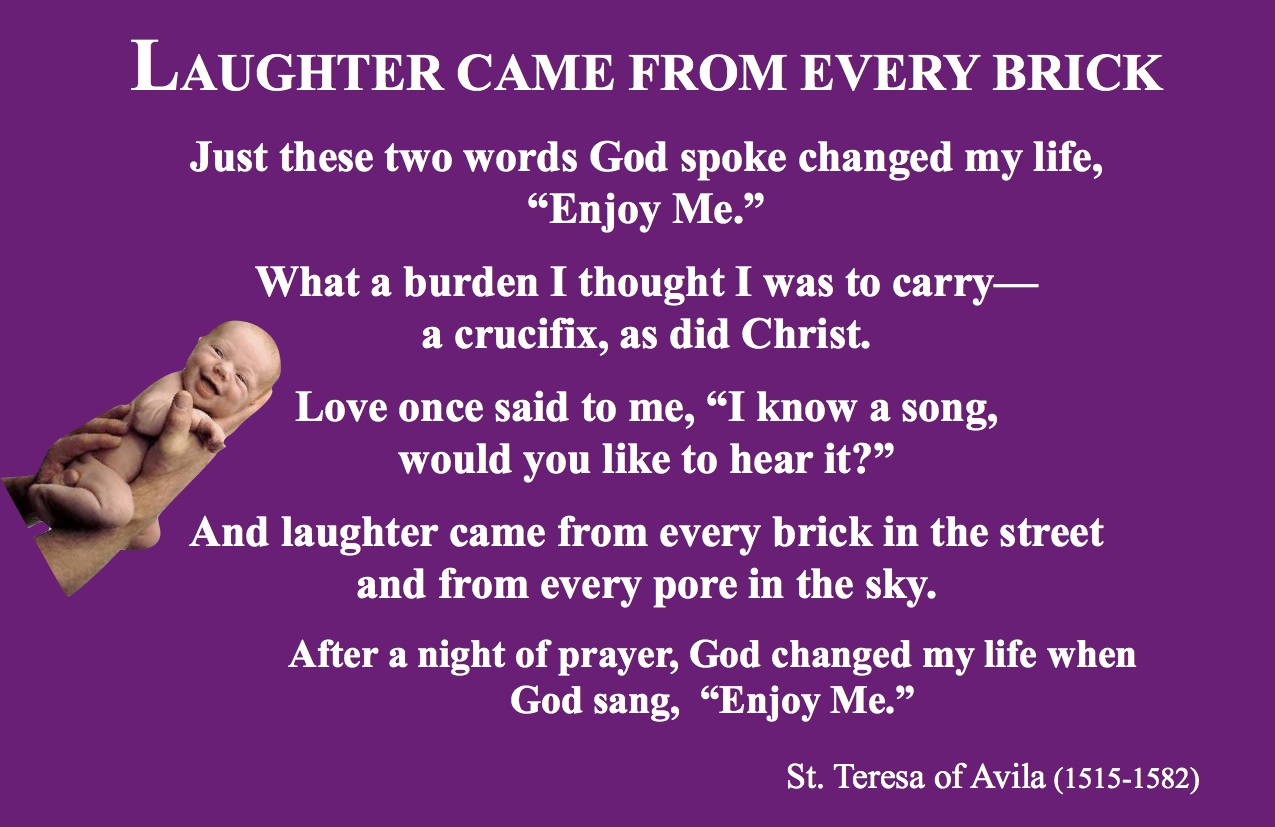
Laughter St Teresa

Traditionally the season of Lent is a mournful time filled with calls to repentance and self-examination as we follow Jesus into the wilderness to be tempted and then on that long march to Jerusalem where the powers that be will have their wicked way with him. Our liturgies take a mournful tone as we lament our woeful human existence, confess our sinfulness, and hear exultations to take up our crosses so that we too can follow Jesus to the bitter end. Over and over again we are asked to remember that we are in bondage to sin and cannot free ourselves, as we gaze upon the cross remembering that Jesus our savior bled and died as a result of our wicked sinfulness.

Lent is a strange season that harkens back to a forgotten era. Unlike so many of the seasons of the church year it’s not exactly a season that attracts people to church. Not many of you got out of bed this morning and said, “Yippy it’s the first day of Lent. Oh goodie!  We get to be reminded that we are sinful, that life is miserable and unless I’m willing to take up my cross and follow Jesus all the way to Golgotha, there’s precious little hope cause we’re all going to die and when the time comes we want Jesus to remember us.”

Now I know that there are some people who just love Lent and I must confess that I like the quieter, more somber tone that our liturgies take. I actually enjoy the opportunity to slow things done and be more reflective in our worship together. I savor the silences and the opportunities to be more contemplative. I love the colour purple with all its vibrant hues and the best part of all is that the beginning of Lent means that spring is just around the corner. What I don’t like about Lent are the signs, symbols, hymns and stories that make it so easy for us to fall back into the 11th century.

It is so easy for us to lean not on the ever-lasting arms of Jesus but on the scales of St. Anslem and find ourselves not looking forward to the promise of resurrection and the gifts of eternal life, but rather dreading judgment day knowing that the scales of justice must be balanced and fearing the moment of truth when our sins are piled onto the scale and knowing that our only hope for reconciliation with our Maker is that Jesus is sitting on the other end of the scale.

“Woe is me.  Woe is me for I am sinful. My sins are too numerous to count. There are all the things I have done and all the things I have left undone. Thank God Jesus died for me. Somebody had to pay the price for my sinfulness. Jesus died for a reason, and you and I dear sisters and brothers are that reason. A blood sacrifice had to be paid. God’s justice demanded it and Jesus paid the price with his very own blood.   Jesus took our place up there on that cross and the least you and I can do to say thank-you is to spend some time shouldering our own crosses as we retrace Jesus steps to Jerusalem.”

The season of Lent with all of its liturgical trappings makes it so easy to fall back upon St. Anslem’s theory of atonement.  St Anslem the 11th century English monk, a legal scholar who came up with the theory about why Jesus died on the cross known as substitutionary satisfaction. Jesus stood in on our behalf to satisfy the debt that had to be paid.

St Anslem’s theory may have satisfied the minds of worshippers in the 11th century but a lot has changed in the last ten centuries. Take for example the sixteenth century — Martin Luther a name near and dear to the hearts of Lutherans everywhere.   Good old Martin Luther was so obsessed with his own sinfulness that he spent many a long night agonizing over those things that he had done and left undone that he often found himself flagellating of an evening. You don’t hear much about flagellation these days; at least not in church. But flagellation was all the rage among the religious of Martin’s day. 

Why Marty would whip himself into a positive frenzy just thinking about his sinfulness; and I do mean whip himself. Flagellation is the fine art of punishing oneself for ones’ sins by stripping down to the waist and whipping one’s back to the point of drawing blood so that you could bleed just like your Saviour bleed for you before he was led through the streets of Jerusalem on his way to Golgotha. Martin became so obsessed with his own sinful nature that his own priest feared for his life. Father Staupitz, the priest to whom Martin was constantly confessing his sins to is said to have become so frustrated with Martin’s obsession with trivial sin. I mean how much can a faith monk, living in a monetary have to confess. Legend has it that Staupitz grew weary of Martin’s confession of every trivial sin, that in desperation he once told Luther to go and sin boldly, perhaps hoping that Luther would at least have something to actually flagellate for.

Happily for Christendom, Martin Luther eventually came to the realization that far from being a harsh judge of our sinfulness, God is actually a gracious God and thus the Luther’s theology of Grace gave birth to the Reformation. No longer did the faithful have to worry about balancing the scales with acts of piety because God’s grace is sufficient. God in Christ freely forgives us all our sins, not because of any merit we might gain from acts of piety but simply because in Christ, God took on human form and travelled to the cross and paid the ultimate price. Thanks to Luther we all know that we are justified by faith through grace.  We are made righteous in the eyes of God through Christ and there is nothing that we can say or do about it. Continue reading

Evolution – There’s No Going Back: an Ash Wednesday Homily

purple light 2

Here’s an Ash Wednesday homily for the 21st century!

We’ve all been there. Driving down the road – distracted by thoughts of this and that, when all of a sudden it happens, a car comes at you out of no where and you slam on the breaks or you quickly swerve to avoid a disaster. You could have been killed. You could have killed someone. Your life or someone else’s life could have been radically changed in an instant. As you pull back into traffic you are ever so conscious of the weight of you foot on the accelerator and you swear that you’ve got to be more careful.  You begin to scold yourself.  What were you thinking? Why weren’t you paying attention? Wake-up you could have been killed.

Welcome to Ash Wednesday. What have you been thinking? Why weren’t you paying attention? Wake-up — you are going to die!!!  Ash Wednesday is your mid-winter wake-up call. Some of you may not need the wake-up call. Some of you know all too well that death is all around us. Some of you have lost someone dear to you. Some of you have felt that fear in the pit of your belly when the doctor suggests a particular test. Traditional Ash Wednesday worship would require us to focus on the brevity of life and remember that none of us will get out of this life alive.  Our ancestors in the faith, entered into a morose season of Lent by via the awesome reminder that they came from dust and soon they shall return to the dust. Continue reading

Beyond the Veil – a story for Transfiguration Sunday

buterfliesReadings:  Exodus 34:29-34 and Luke 9:28-36 Listen to the sermon here


What the World Needs Now is Love! 1Corinthians 13:1-13

Mr Happy ManThe Epistle Reading (Second Reading) for this coming Sunday is 1 Corinthians 13:1-13. Most of us have heard this reading over and over again at weddings as if it were some sort of recipe for happiness between lovers. So often we hear it as an impossible recipe and cast it aside as something nice but unattainable. What would happen if we could hear this passage not as a prescriptive recipe but as a descriptive revelation of the LOVE that is God. Couple this revelation with the knowledge that God dwells in, with, through, and beyond us and it becomes a description of the possibilities for each of us being LOVE in the world. The knowledge that LOVE dwells in us might just open us to being the love that the world so desperately needs. 

91 year-old, Johnny Barnes is a Bermuda native who embodies the LOVE that dwells in him. How might we embody the LOVE that dwells in us? What does, would, could, will the embodiment of LOVE look like in you?

Act As If… a sermon on Luke 4 by Bishop Gene Robinson

eye of the stormThe Rt. Rev. Gene Robinson understands what it means to be threatened because of the Gospel he embodies. While reflecting threatening reaction of those who heard Jesus’ first sermon as it is recorded in Luke 4, Bishop Robinson challenges us all to stand on the clifftop with the courage of Jesus. Well worth a listen to all those who are preparing to preach on this text on Sunday.

TODAY!!! – a reflection on Luke 4:14-21

Luke 4Today, rather than a traditional sermon, we engaged in a reflection on what is known as Jesus’ first sermon from Luke 4:14-21…a bible study of sorts. The Acclamation sung before the reading is “God of My Childhood” by Miriam Therese Winter Listen to the reflection here

A Storyteller’s Storyteller: Joan Chittister

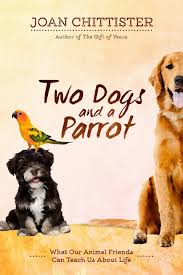
Two dogs & parrotAs storytellers go, Joan Chittister is one of the best! That she is also an extraordinary theologian who has an uncanny ability to communicate wisdom in ways that both enlighten and enchant her audiences is a wonder to behold. Here Sister Joan weaves two tales from one of her latest books “Two Dogs and a Parrot.” While I am throughly enjoying the book, I dearly wish that I could watch and listen to her embody more of these stories as only she can. Enjoy!


Spinning Wheel – A Sermon on Luke 4:14-21 for Epiphany 3C

Blood Sweat & Tears

This sermon explores the need to set the captives free. It was inspired by a Globe and Mail article written by David Clayton Thomas, former lead singer of Blood, Sweat & Tears and dedicated to the memory of an old friend who did not “go naturally” and will never be forgotten! You can listen to the sermon here to get you in the mood, watch the video of Blood, Sweat & Tears below

The year was 1969. I was just twelve years old and my family had only recently moved to Ladner, a small village south of Vancouver. I was the new kid in a tightly knit grade seven class. I remember being angry, a lot. Being twelve is tough, but being twelve and new in town; well that’s a kind of hell I wouldn’t wish on anyone. There were only two places I felt safe: One was my bedroom where I could escape into my books or listen to music. The other place was music class. We had a really cool, young teacher, she must have been fresh out of teachers’ college, because she had all these new ideas about something she called music appreciation. The songs we sang in Miss Conroy’s class were songs off the radio. Some days she’d let us put our heads down on our desks and she’d just play music and all we had to do was appreciate it. Not all of the music was stuff we’d heard on the radio, sometimes Miss Conroy would sneak in some jazz; not any kind of jazz I’d ever heard before, improvisational jazz; it was so cool to my twelve year-old ears that I gave Miss Conroy a pass when she would slip into teacher mode and put some classical music on the record player.

One day, Miss Conroy announced that we’d been listening to her music long enough; it was time we began to listen to our music. Miss Conroy explained that she was going to divide us into pairs and each pair would have to work together to select a piece of music to bring to class and share it. We would have to explain to the class, why the piece that we choose was worth paying attention to. Now even though there were all sorts of pieces of music that I thought would be great for this assignment, I began to panic. Who on earth would want to work with me on such a project? The thought of being teamed up with anyone of my classmates struck fear into my heart. I didn’t have any real friends in this class and as the new kid I knew that nobody would want to be stuck with me. Vision’s of being left out, all alone without a partner began to overwhelm me, as Mrs. Conroy announced that we would be drawing names out of a hat in order to determine who our partners would be. When my turn came to pull a partner’s name out of the hat, I didn’t even know what to hope for. I didn’t know people well enough to want anyone in particular to be my partner, there was only one person in the whole class that I knew that I knew well enough to know that I didn’t want to be my partner. I, like all my classmates was positively terrified of, for the sake of this sermon I’m going to call him Kenny. Kenney sure wasn’t twelve; he was a few years older than the rest of us. He was a big guy; dark hair, good looking, and unlike the other adolescent boys in the class, Kenny had already started shaving. Once during the lunch hour I witnessed Kenny bullying a younger boy into eating an apple core that had been discarded a few days earlier. The kid ate the rotting core rather than face whatever it was Kenny was threatening him with. Kenny was big, tough and loud. Most of us were frightened of Kenny and because kids are cruel, behind his back we diagnosed him as crazy. But there was something about Kenny, maybe it was his good looks, maybe it was the buckskin fringe jacket that he sported, or maybe it was just his wildness that made him the talk of the jittering boy-crazed girls in the class. So, I was more than a bit upset when of all people, I pulled Kenny’s name out of the hat. What piece of music could the two of us possibly have in common and how was I even going to talk to him? Miss Conroy slipped perilously into my bad books on the day she forced me into the company of the dreaded Kenny.

Ours was an uneasy partnership. There was precious little conversation involved. Kenny picked the piece of music. Kenny told me what I was going to tell the class about our piece of music. Fortunately, I actually knew and liked the piece that Kenny had chosen. It had been a big hit the previous summer and I owned a copy of the record. The only problem was that my copy was a 45. Kenny insisted that we just had to use the version that was on the album; not the version that they played on the radio off the 45. The version on the album included the trumpet solo that never made it onto the 45. It would have made the song too long for the hit parade! And that’s how I ended up in front of my classmates, standing beside a boy, who though handsome and tough had suddenly become monosyllabic as I struggle to explain why our choice of Blood, Sweat and Tears, Spinning Wheel, was music well worth appreciating.

What goes up must come down

spinning wheel got to go round

Talking about your troubles it’s a crying sin

Ride a painted pony

Let the spinning wheel spin

You got no money, and you, you got no home

Spinning wheel, spinning all alone

Talking about your troubles and you,

you never learn

Ride a painted pony

let the spinning wheel turn.

Did you find a directing sign

on the straight and narrow highway?

Would you mind a reflecting sign

Just let it shine within your mind

And show you the colours that are real

Someone is waiting just for you

spinning wheel is spinning true

Drop all your troubles, by the river side

Catch a painted pony

On the spinning wheel ride

Someone is waiting just for you

spinning wheel is spinning true

Drop all your troubles, by the river side

Ride a painted pony

Let the spinning wheel fly.

They just don’t write songs like that anymore. Kenny was right, the trumpet solo, is a must. Blood, Sweat and Tears had the best horn section. They could take a mediocre song and turn it into something special:  “Spinning Wheel,” “You’ve Made Me So Very Happy,” “God Bless the Child,” “Hidey Ho, Hidey Hi,” “And When I Die.” Thanks to Kenny, I bought every LP that Blood, Sweat and Tears ever recorded.

So, what has any of this got to do with this morning’s Gospel reading? Well the words that the writer of the Gospel of Luke puts into the mouth of Jesus of Nazareth have been spinning round in my head all week long. I keep hearing Jesus quote the words of the prophet Isaiah. “The Spirit of our God is upon me: because the Most High has anointed me to bring Good News to those who are poor. God has sent me to proclaim liberty to those held captive, recovery of sight to those who are blind, and release to those in prison—to proclaim the year of God’s favour.” The year of God’s favour is the prophet Isaiah’s way of describing the year of Jubilee. Written into the Jewish law was a provision meant to address the systemic injustices that creep into the law as time goes by. It is said that every 50 years a Jubilee would be declared. Continue reading