Far too many preachers stumble into the celebration of Easter without doing our homework. Resurrection is a central tenant of the Christian faith and Easter is the primary celebration of resurrection and yet, too many of us fail to open ourselves to current scholarship surrounding the doctrine of resurrection. Questions about the nature of the resurrection ought to send us back to the words of the Apostle Paul. Bernard Brandon Scott is a charter member of the Jesus Seminar. His book “The Trouble with Resurrection” is a must read for those who preach during the Easter Season.
If you are planning to write a sermon or listen to a sermon this Easter, this video provides essential background information about the words of the Apostle Paul on the nature of the resurrection which may surprise you. Scott’s treatment of 1 Cor. 15 provides a new understanding of resurrection which is compelling as well as liberating.
Once again the story of the Mary who anointed Jesus comes to us when St. Patrick’s Day is just around the corner. So I’m reposting this sermon I preached three years ago because the memory of preaching with a Guinness glass still makes me chuckle. The best way to fully appreciate this sermon is to pour yourself a glass of your favourite tipple, sit back, listen and enjoy a laugh. For those colleagues who are busy searching for sermon ideas for this coming Sunday you can read my attempt to write with a Belfast accent below…you’ll probably need a tipple of some-at to get tru it! Cheers!
Readings: Numbers 27: 1-11; Acts 13:44-51; John 12:1-8
St. Patrick’s Day doesn’t often fall on a Sunday, but as our congregation’s Annual Meeting would begin immediately following our worship service, I decided to be somewhat playful and irreverent with a sermon designed encourage folk to think beyond words on a page. The first reading brought the wonderful story of the Daughters of Zelophehad to church and as this reading does not appear in the Revised Common Lectionary it was fun to play with these feisty women. The reading from the book of Acts is actually the prescribed reading for the commemoration of St. Patrick and the Gospel text is prescribed for Lent 5C. The Guinness was just for fun! Enjoy.
Listen to the sermon
It’s not every year that St. Patrick’s Day falls on a Sunday. “An so,” and so, that’s a very Irish expression. At least it is in some parts of Ireland. You’ll hear someone use that wee phrase, usually at the end of a sentence. An so…Sometimes they follow it with iy….and so, iy. But not from the part of Ireland that my people are from, sure the never said that. An so… What was I sayin? Sure it’s not every year that St. Paddie’s Day falls on a Sunday. And I don’t think it will every happen again that you’ll get all three lined up together like this, St. Paddie’s Day, Sunday and Holy Cross’ Annual Meeting. And so…. So, let me be tellin ye…Such a grand and glorious day as this, calls for a sermon like no other, an so…
I brought props. Sure St. Paddie had his shamrocks and faith and begorra…an so…I have a book….A book called, “How the Irish Saved Civilization: The Untold Story of Ireland’s Heroic Role from the Fall of Rome to the Rise of Medieval Europe.” By none other than Thomas Cahill, himself. Faith and begorra…did ya ever in all your life hear such a ting as dat??? But that’s not all, I’ve sumtin else…
Take a look at that there??? Sure there’s nothing better on a St. Paddie’s morning than a glass of Guinness….an so… Well you’ll notice that this here particular glass of Guinness, well she’s as empty as Paddie’s pig on market day… An so…for the rest of this wee sermon you just think of me as the preacher who had we tipple before she set about tellin ya what’s what. My glass might be empty, but my heart is full… Full a the devil some may say…or full a the love a Jesus if the truth be told…an so… Where was I? Yeah, sure it’s St. Patrick’s Day and all the world is Irish if only until ya fill there glass. And then faith and begorra…that’s when the truth comes out. That’s when you find out who really saved the world. Now like any good Irish story, we’re gonna wander a bit…so falla me, for like my dear old Nannie used to say, you’d better falla me cause I’m right behind ya. That’s right falla me I’m right behind ya. But that should be no trouble for you lot, cause ya haven’t touched a drop. Yet. And a drop is all you’ll be gettin for have ya seen the size of those Jeesus jiggers; Why you wouldn’t quench the thirst of the devil’s flees with the wee titch of wine they give ya in dose wee glasses. An so…the Irish and those that want to be Irish well this is a big day indeed. An so… I want to tell us all, exactly how the Irish saved civilization, an, an, I’m gonna tell the truth about St. Patrick himself…an, an, while I’m at it, I wanna take to use about those Daughters of Zolophehad, now there were a bunch of girls if you know what I mean…and speaking about a bunch a girls, while I’m at it I wanna tell ya all about those Marys…Faith and begorra, who’d be havin it?
Sure there’s Mary de Mother of Jesus, and then there’s Mary Jesus’ best friend, you know the girl from over Bethany way…and then there’s that lovely Mary, you know the lovely girl from over there in Magdela who everyone is after confusing with dat other woman, the one the call, Mary who really wasn’t Mary at’al, at’al, at’al… Sure wasn’t she after being healed, her being a sinner from the city and all…Sure there’s more Mary’s in this story, than I have time to be tellin ya about. So, we’ll just leave Mary the mother of Jesus out of it, cause she’s got nothing to do with this really. Unless of course, I loose me, way…and then begorra, I be Jesus, Mary and Joseph, this and Jesus Mary and Joseph that…an so… Were was I ??? I was needin a wee drink that’s where I was….Continue reading →
I got my very first job when I was just ten years old. Our neighbours were going away on holiday and they needed someone to take care of their cat. Now I have never been a cat person. In fact, if the truth be known, I’ve always been sort of afraid of cats. When I was little I was terrified of them. But as I grew I learned to control my fears and these days I just tend to avoid cats. I don’t really know why, they just give me the creeps. Back when I was ten, cats still had the power to make me very nervous. But our neighbours tempted me with the promise of a dollar a day for ten days. All I had to do was go into their house each day and feed their cat. There was no litter tray to deal with because back then people still had those little trap doors and the cat could go outside whenever it needed to. So, I signed on and each and every day for ten days I mustered up all my courage and I went into the neighbours’ house and I opened a tin of cat food and I filled a dish with water. I did it as quickly and as quietly as I could and in ten days not once did I ever run into that cat. When the neighbours came home they were so delighted with the good job that I had done that they actually gave me a whole dollar as a bonus. Eleven whole dollars, I was wealthy beyond my wildest dreams. I knew exactly just what I was going to do with that money. You see, Christmas was just a few days away and for the first time in my life I had money to buy Christmas presents! My parents insisted that there was no need for me to buy Christmas presents and they suggested that I should save my money. But I just had to buy presents. To this day I can still remember the joy of hoisting my hard earned cash onto the drugstore counter to purchase my carefully selected merchandise. I can still remember those two amazing gift sets. The first one was for my Dad. It was manufactured by the Old Spice Company and inside it had a soap on a rope, and a two bottles. One of the bottles contained after-shave and the other something called men’s cologne. I didn’t know what cologne was so I had to ask the saleswoman who explained that it’s what they call perfume for men, and I knew that my Dad just had to have some of that. Now the second gift set was a real bargain it was made by Yardly. I wasn’t fooled by all those tiny bottles of perfume that were so much more expensive. No, I picked the gift set that had the biggest bottle of perfume. It also had a big container of something that looked like talcum powder but the container said it was actually dusting powder and it came with a little puffy yellow thing for dusting the powder all over your body. I knew that my Mom would just love this. Together the two gift sets cost a just few pennies less than eleven dollars. I don’t think that I have never enjoyed Christmas quite the way I enjoyed that one.
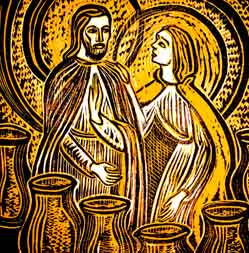
There is something about giving the most extravagant gift that you can afford that brings a special kind of joy to a celebration. Why that Christmas the people that I loved the most in the whole world may have stunk to high heaven, but I dare say my extravagant gift brought them great joy. Maybe that’s why I love this particular gospel story. There’s just something about the outrageous extravagance of Mary’s gift to Jesus that just makes me want to cast caution to the wind and be as extravagant as I can be. A version of this story is told in all four of the gospels. The story is told differently in each of the gospels, sometimes the anointer is Mary of Magdala, sometimes Mary of Bethany and sometimes the women is unnamed, one gospel writer has the woman anoint Jesus head while another account has her anoint his feet. But however the story is told, the act is outrageously extravagant.
The story is so remarkable that each of the Gospel writers include it in their proclamation. So what was it about this event that caused it to be told over and over again and why did they tell it the way in which they told it? The only way to get close to an answer is to fully engage ourselves in the story itself. The writer of the Gospel of John wrote his account at the end of the first century, some 60 to seventy years after the event. By this point the story would have been told over and over again, and you know what happens when people tell a story over and over again…It takes on a life of its own. So, for a short time, I want you to set aside your historical hats and simply walk with me into the story to see what we can learn about how people in the year 99 might have heard this story.Continue reading →
Kester Brewin certainly has a different take on the story of the prodigal! Pirate Theology is not a homiletical method that I’ve ever employed. But then pirates tend to work for themselves. Brewin’s playful pirate theology encourages us to leave our places of comfort in order to view a familiar story as a tragedy in order to grasp what he calls “radical theology” in which we take responsibility for who we are rather than defer to “the Big Other”.
Brewin is a founding member of Vaux-London, a collective of artists and faithful urban dwellers that served as an early model of fresh expressions of church in the UK.
Kester teaches Mathematics in London and works as a consultant for the BBC, as well as writing for the national educational press. He is also an acclaimed poet and has been described by Brian McLaren as ‘one of the leading public theologians for a new generation of thoughtful Christians.’
Among the teachings of Jesus, the parables of the lost and found are so well known, so familiar that we are in peril of failing to hear the foolishness they advocate. Although only a few of us have had the opportunity to tend a flock of sheep, most of us at one time or another have been responsible for the welfare of a flock. And whether that flock be sheep or co-workers, clients, customers, students, friends, or children none but the foolish among us would leave 99 to the perils and dangers of the wilderness in order to go looking for one idiot who’d been stupid enough to get themselves lost. We may not keep our coins at home, but I daresay that most of us have felt the sting of loosing a drachma or two or three in this recession. Only a fool would waste a moment searching for our losses when our portfolio’s are so full. I dare say that if we managed to find or recoup our loss, we’re hardly likely to invite the neighbourhood to a party that would in all likelihood eat up more than we had found. Parents, and all of us have been parented, so we know the wisdom of parents not rewarding bad behaviour. Most of us are law-abiding. We all want what is best for our own parents, and so I don’t think any but the foolish among us would consider celebrating the return of someone who has hurt our parents in the past.
These parables of the lost and found are outrageous. None of us would get very fare in life if we lived by these teachings. It is better to put the welfare of the many above the needs of one. It is pointless to cry over spilt milk. Sometimes its better to cut your losses and move on. The best accountants learn quickly to write off losses that would be too time consuming and costly to recoup. Children need to learn that they can’t always get what they want; that there are consequences to their actions, that dues must be paid, that we need to ask for forgiveness and make amends for our crimes, that rules need to be followed, and laws cannot be broken. That doing the right thing will be rewarded. And yet along comes Jesus, spouting such foolishness that even we who are predisposed to agree with him, even we can sympathize with the self-righteous and wonder how anyone could be expected to live like this. Continue reading →
Genesis 15:1-12,17-18 –Musing About Genesis Bloody Carcasses
From time to time, the prescribed readings from the Common Lectionary fill me with dread and despair.Something about those bloodied, split, rotting carcasses that sealed the deal between God and Abraham makes me wonder about the nature of the god we have projected into the heavens and ask: Have we evolved or has God? The story of God’s promises to the “Chosen People” portrays God as a churlish player in humanity’s game of tribal rivalry. While I’d rather not preach on the text from Genesis this Sunday, I know full well that simply reading this text during worship without elaboration, will if folk are paying attention, leave a distasteful oder in the sanctuary that will surely spoil our appetite for our common meal of body and blood disguised as bread and wine.
The readings for this coming Sunday have me thinking about tribalism. There’s always more than one way to look at things. Tribalism has served us well. New people to meet can be exciting or it can be frightening. Taking comfort with your own people is wonderful, but taking too much pride in your own kind is dangerous. One minute you’re cheering for your team the next minute you’re hurling insults at the other guy and one too many insults and the next thing you know you’re at war. A little tribalism is a good thing, but how much tribalism is too much? Tribalism is a basic human survival instinct. Tribalism is lodged deep within our psyches and has been from the very beginning of time. Tribal is part of our primordial selves. Tapping into this basic human instinct can mean the difference between survival and death.
Tribal thinking exists on almost every level of human life, from the international to the local. Attack a human on any level and that human will resort to instinctive behaviour. When threatened humans have two basic instincts, fight or flight and the choice between the two often comes down to tribalism. If you have enough people to back you, you’ll probably choose to fight. Not enough people and you’ll probably choose flight.
Human kind has evolved a great deal over the centuries but we haven’t evolved very far from our basic instincts. You don’t have to scratch a fan too deeply to find the primitive tribal mentality. Tribalism is seen in the way we portray our rivals. I once heard a Kiwi say, “I root for two teams, New Zealand and whoever is playing Australia.” Sporting competition is all well and good, but when tribalism is carried to its worst possible conclusion, wars beak out. Tribal feeling is then exacerbated in times of war, and tribal propaganda is used to dehumanize our enemies to make it easier to hate or kill without any qualms of conscience. We don’t kill human beings in war; our victims are not someone’s child, spouse, or parent. NO, one kills either, the Huns, the Krauts, the Japs, the Nips, the VC, the insurgents, the fanatics or the terrorists.
There is within us all a basic, dominant, intrinsic fear of those tribes different from our own, a predisposition to be on guard against them, to reject them, to attack and even to kill them. This tribal tradition arises out of our deep-seated survival mentality and it feeds something at the heart of our insecure humanity. We are tribal people to our core. Far more than we will consciously admit, the religions of the world including Christianity rise out of and undergird our tribal thinking.Continue reading →
Reflecting upon the more-than-literal meanings in today’s reading from the Gospel according to John tells the story of the wedding at Cana I was prompted to ask some questions about the eucharist’s ability to continue to nourish us. These questions prompted me to dispense with my usual practice of preaching from a manuscript. Inspired by John Shelby Spong’s work in “The Fourth Gospel: Tales of a Jewish Mystic” to see the characters in this story as symbols of entities much bigger than they first appear, I have begun to see that just as the early followers of Jesus found themselves in a time of transition that gave birth to new practices, we 21st century followers of Jesus find ourselves in the midst of transitions that have the potential to give birth to new ways of being in the world. As always I am indebted to Jack Spong, who has visited Holy Cross three times to share his work with eager learners. Indeed, in the Preface of “The Fourth Gospel” Jack thanks Holy Cross for being a place where his book “first found public expression. Jack’s insights continue to challenge us. You can listen to this morning’s reflection here and Jack lecturing on the symbolism of the characters of the Mother of Jesus and the Disciple who Jesus loved here. This morning’s reflection begins a congregational conversation on our worship together.
Reflections on the Eucharist: Epiphany 2C, John 2:1-11:
The gospel according to John is my favourite of all the gospels. Maybe it’s my Irish heritage but I just love a good story and the more outrageous the better. The Irish have never been known to let the facts get in the way of a good story, and neither did the writer of the Gospel we can John. This gospel was the last of the four gospels to be written and it nearly didn’t make it into the biblical cannon because the religious powers that be cited all sorts of problems with this particular portrait of Jesus. Not the least of which are all the signs and wonders that Jesus commands in this gospel. So, just for the record, let me say that I don’t believe that this particular story happened exactly the way it was written. I don’t believe that the man Jesus of Nazareth had the ability to instantaneously change water into wine. I do believe that getting hung up on whether or not Jesus could actually work miracles is to miss the point of this story all together.
This morning rather than go into a long and drawn out explanation of the historical critical method of studying the scriptures in order to explain why the writer of the gospel of John wrote this particular story and speculate upon the particular theological points the author was trying to make to his second century audience, I would like to set the history aside for a moment and look at what the author might have been trying to inspire in the people who would hear and read his or her story about the Wedding at Cana. To do that I want to get to the heart of this story to explore what it might be like for the people who actually encountered the Man Jesus of Nazareth. I mean on the surface of it this story is about a kind of intoxication that happened to people who come into the presence of this strange man from Nazareth. The best way I know of interpreting a story is to lay down another story right beside it and let one story interpret another.
Once upon a time, I remember it was a damp and dreary day in Vancouver that stood out from all the other damp and dreary days. It was in the middle of February; it had been overcast or raining for weeks and weeks and weeks. I was riding on the bus to work. It was the same bus that I had been riding on for two years. Every weekday morning I would commute by bus from the suburbs to the heart of the city. Every morning at six-fifteen, I would stand with the same people at the same bus stop and get on the same bus, which carried all the same people to their same jobs. On a good day the trip would usually take 45 minutes. Nobody ever spoke on that bus. Occasionally people would nod or smile at the all too familiar faces of their travelling companions, but conversation would be reserved for sunny days, when people could only manage a word or two. It was like there was this unwritten rule that nobody had the energy or the inclination to break. We saw one another almost every day, and yet we knew absolutely nothing about one another and that was the way we were determined to keep it.
On this particular February morning in addition to being tired, I was also wet. The wind was really blowing and I had to rely on my hooded jacket to keep me dry. The bus was running late and the water was just beginning to seep threw my jacket. I sat in my usual seat on the bus and I was determined to ignore the damp and get in a short nap before we reached the city. I was just dozing off when the bus screeched to a halt. Several passengers climbed aboard. All but one of them, were recognizable. I’d seen them a hundred times before. But the young man, who loudly greeted the bus driver with a “Hello,” him I’d never seen before. He struggled to fold his broken umbrella as he stumbled to the rear of the bus. He sat opposite me, and proceeded to greet everyone around him. People weren’t sure how to take this. Some just nodded and then looked away. Others mumbled a greeting before fixing their gaze out the window. I smiled, nodded and then closed my eyes, determined to escape into sleep.
The young man, continued to fuss with his umbrella. He explained in a loud voice that the umbrella was a gift from his sister and he hoped that it wasn’t ruined. He asked the gentleman seated beside him if he could help him to fold it. The somewhat flustered gentleman proceeded to fold the umbrella without a word. When the task was completed the young man, thanked the gentleman and asked him what his name was. He said he wanted to be able to tell his sister, who the nice man was, that had helped him with his umbrella. Without revealing his name the gentleman assured the young man that it wasn’t necessary to thank him. The young man on the other hand, proceeded to break all the rules, and said that his name was Michael and he told us all that he had never ridden on this bus before. He usually had to get a bus that went to the city in the afternoon and then he would get a ride home after dinner with his sister. But on this day, he would begin to work full days at his job. So he had to catch the bus in the dark. He went on to tell us that the bus we were riding in was much nicer than the one he usually caught. He decided that this bus must be a new bus, and weren’t we lucky to get to ride on a new bus. Then Michael took off his hat, held it out in front of him so we could all see it, and declared that he was the luckiest person in the world because his mother had bought him this wonderful hat that kept his head dry.
Michael went on to tell us all sorts of details about his life. At first people managed to listen, without responding. But as Michael went on describing his wonderful life, people found that in spite of themselves they were drawn into the conversation. As we approached the tunnel, that normally causes traffic to back up in rush hour, it was clear that there must have been some sort of accident in the tunnel. It would be a long wait. There would be no escaping Michael’s enthusiasm. Before long we all knew that Michael worked in the mailroom of a securities company. He assured us that this security company was a safe place to work, because they didn’t take care of the safety of people, but just took care of pieces of paper that were called stocks and bonds. Michael told us just how much he loved his job. Having a job was the best thing. Before he had the job he didn’t have any money to help his parents. But now he had enough money to help his parents and lots left over. Michael told us that he was really lucky because he worked with really nice people who took good care of him and let him do all kinds of fun jobs.Continue reading →
There’s a definition of what it means to be a priest that has always daunted me. A priest it has been said is “a keeper of the mysteries; a keeper of the sacred mysteries of our faith. People often confuse the idea of mystery with the idea of secret. But I can assure you that as a keeper of the mysteries of the faith it is neither my job nor any other priest’s job to keep the mysteries of our faith a secret. Yes, as an ordained pastor, one of my responsibilities is to be a keeper of the mysteries of our faith by ensuring that the communities that I serve hold those mysteries sacred. It is my job to hold the mysteries in such reverence that we all remember that the reality that we call God works in with and through those mysteries. Baptism is considered to be one of the mysteries of our faith. Baptism is a sacrament of the church and by definition a sacrament takes ordinary stuff – water – mixes that ordinary stuff with the Word and in the combination of water and the Word you have a tangible means of God’s grace. God’s grace is revealed in the sacrament of Baptism by the act of our gathering together and mixing the stuff of the earth with the Word. We have only two sacraments in the Lutheran church Baptism and Eucharist, and both of those things are sacraments because we gather together take ordinary stuff – bread and wine, or water and mix it with the Word of Jesus the Christ and in the water, the bread and the wine the means of God’s grace is made visible to us.
So, there you have it the technical definition of the sacraments, the mysteries of Baptism and Communion, in which the reality that we call God works in, with, through and under. But like all technical definitions of mysteries, these definitions fail to capture the essence of the mystery that likes at their very heart, the mystery of the reality that we call God. As a keeper of the mysteries, one would think that a priest, a pastor ought to be able to reveal, by way of definition something of the nature of the reality of the Divine.
The truth is I have no real definition to offer you of this reality that we call God. I read once, I wish I could remember where the wisdom of a priest far more skilled than I who declared that he’d given up trying to explain God to anyone because in the end, he said, “I cannot lead you to God, anymore than anyone can lead a fish to water.” The most important thing I learned in seminary is that “I don’t know is an answer.” The truth is the more we learn the more we know that we don’t know. But this unknowing can be so unsatisfying, precisely because we believe that God is the one in whom we live and breath and have our being, we want to know the very nature of the One who is the ultimate Reality. Now, if these words haven’t already become so vague that the veil of unknowing has begun to make any tangible means of God’s grace seem invisible and so beyond our grasp, let me leave the theology behind and tell you a story. Because one thing I do know for sure is that the shortest distance between the questions of what it means to be human and understanding our humanity is a story.
It happened on Thursday night. All week long I’ve been thinking about what I would say about the Baptism of Jesus and I wasn’t getting very far. It’s been a busy week, with lots of things to do as programs around here gear up again after the lull of the holidays. After teaching Confirmation on Thursday, I got home at about 9:30. The house was empty because Carol was off visiting the grandchildren for a few days. It had been a long day, and I quickly got into my pajamas, switched on the fireplace, and settled into my recliner in front of the television. The PVR was full of shows for me to watch and the opening scenes of Gray’s Anatomy dragged me into the complications of lives I would never have to minister to and I began to relax. The drama of medical emergencies mixed with the complications of various love affairs pulled me into a world where there was absolutely nothing expected of me and I was loving it right up until the moment that the telephone rang. Modern technology means that the name of the person calling usually appears on right there on the TV screen so that I can decide whether or not I’m going to answer the call. When the phone rang I expected it to be Carol calling to say goodnight, so I’d already pushed the pause button, expecting that after a quick goodnight I could get back to my shows. Buy the time I realized that there was no name on the TV screen but only a phone number, it was too late and I was already saying hello.
The caller was someone I’d heard from only once before. They were already halfway through a very nasty tale of woe when I realized that they were asking me to come out. It was a call for help. It was a call that I had every right not to respond to. I mean the caller wasn’t even a member of this congregation. It was late. I was already in my pajamas. It was dark outside.
I was annoyed. I mean really. Couldn’t this person have called me before I left Newmarket? What gave them the right to think that I would come out so late, in the dark, for someone I’d only met once before? The audacity. The sheer audacity of such a request was enough to make you scream. Give me a break. I listened to the caller’s plight with precious little sympathy. I asked her to hold on for a moment so that I could try to think of a way to help. What I really meant was: is there anyone in Newmarket that I can disturb at this time of night and ask them to go over and help. Some of you have offered to help in this way in the past. You know who you are and you can be sure that your names went through my mind as I tried to avoid leaving the comfort of my warm snug. It was only the thought of how annoyed I was to be disturbed at such a late hour that kept me from disturbing one of you. So I told the caller to hold on and I would be there in about half an hour.
I was cursing to bet the band as I went upstairs to get dressed. The air was positively blue. I was angry. I was going out, on what in my mind was the middle of the night, it was ridiculous. Hell, it was dangerous. It was dark. Yeah we were going to meet in a public place. But why the expletive, curse, fill in the blank your self, why the ………blanket blank, should I? I certainly wasn’t going out of love for my neighbour. I was ticked. I was going because it’s my job to go. Sure I knew that I had every right to refuse to go. But if I didn’t go, my shows would be ruined. How could I possible sit there and enjoy my shows when I knew that someone needed my help? Forget the shows, if I didn’t go, I knew darn well I wouldn’t get any sleep.Continue reading →
Ruminating over this Sunday’s prescribed reading from Job 38, my mind harkens back to 2012, when I had the privilege of attending a series of lectures given by the great Phyllis Tickle who described the current reformation that the church is experiencing as part of a cultural phenomenon that happens about every 500 years, which she calls “The Great Emergence”. When asked what skills religious leaders will need to navigate the information age, Tickle insisted that the best advice we could give to anyone considering a religious vocation was that they should study physics. Inwardly I groaned, remembering my feeble attempts to come to grips with the most rudimentary theories of quantum physics. But I also nodded in agreement, knowing that so many of our religious narratives strive to make meaning of the cosmos as it was perceived by ancient minds. When our ancestors looked into the heavens they had no way of knowing the wonders of the cosmos that we are beginning to discover. While physicists can ignore theology, theologians who ignore physics will find themselves stuck atop Job’s dung-heap impotently shaking their fists at the Divine. Perhaps Tickle is correct and the clerics of the future will out of necessity need to be physicists. Theoretical physicist Michio Kaku speculates that the universe is “a symphony of strings” and the “mind of God would be cosmic music resonating through eleven dimensional hyper-space”. If you have the courage to climb down from the dung-heap, take a look at Michio Kaku’s “The Universe in a Nutshell”. If the Divine bollocking that Job endured makes you wonder if ignorance might just be bliss, then take a peek at “Is God a Mathematician?” or “The Mind of God”. Who knows, maybe if a few more of us dare to dwell in the questions we might just come up with imaginative narratives to help us fathom what it means to be human.
Leaving Behind the Miraculous Jesus to Welcome the Human Jesus
The celebration of Jesus’ Ascension is a church festival that I have always chosen to ignore. The ancient tradition that has Jesus floating up into the clouds stretches the credibility of the church to such an extent that I’ve always assumed that the less said about the Ascension the better. But I was challenged by a parishioner to try to make some sense out of the Ascension story so that 21st century Christians would not have to check their brains at the door should they happen upon a congregation that still celebrated the day. What follows is a transcript of my attempt to leave behind the miraculous Jesus in order to be better able to welcome the human Jesus down from the clouds. I am indebted to Bishop John Shelby Spong together with Clay Nelson, formerly of St Matthew-in-the-city and now a minister at Auckland Unitarians, for their liberating insights.
Traditionally, on the 40th day after Easter, the church celebrates the feast of the Ascension. But because so few people in the 21st century are willing to come to church during the week, the Ascension is celebrated by the church on the first Sunday after the feast of the Ascension. Since I have been your pastor we have not celebrated Ascension Sunday. But as this particular Ascension Sunday follows so closely after Jack Spong’s visit with us, I thought that it was about time that rather than avoid the Ascension, I’d like to try to confront it.
Jack has been telling his anti-Ascension story for quite a few years now. Just in case you’ve never heard it or have forgotten it, let me remind you. It seems that Jack was speaking with Carl Sagan, the world-renowned astronomer and astrophysicist. Jack says that Carl Sagan once told him “if Jesus literally ascended into the sky and traveled at the speed of light, then he hasn’t yet escaped our galaxy.”
With that said, let me just say, that the Ascension never actually happened. It is not an historical event. If a tourist with a video camera had been there in Bethany they would have recorded absolutely nothing.
I know what the Nicene Creed says, “Jesus ascended into heaven and is seated at the right hand of the Father.” But like the members of the early church, I do not have a literal understanding of the scriptures. And so, as I do not understand the Bible literally, neither do I understand the Nicene Creed to be a literal interpretation of the faith. Like all creeds the Nicene, Apostles and Athanasian creeds are snapshots of theology as it was at a particular time in history.
We would do well to remember that the Creeds were developed to answer questions about the faith in a time when people understood the cosmos to be comprised of a flat earth, where God resides above in the heavens and located beneath the earth were the pits of hell. I know that the universe is infinite. I also know about gravity. I also know that it is highly unlikely that Jesus had helium flowing through his veins. I’ve flown around the world, and I can tell you that there is no heaven above the clouds. So, I can say with confidence that: The very present Jesus of resurrection faith did not literally elevate into heaven while his disciples looked on.
The writer of the Gospel according to Luke and the Book of Acts are one and the same person. The same writer wrote the Gospel according to Luke to tell the story of the life of Jesus and the Book of Acts to tell the story of the Holy Spirit at work in the followers of Jesus. Although we don’t know who the author was, we do know that he was not an historian. Neither Luke nor Acts are historical accounts. They are both addressed to a character named Theopholus. Theopholus is Greek for lover of God. The books are addressed to the lovers of God, that’s you and me and the author makes it clear that he has written these books so that we, the lovers of God, can believe and have faith. The books were written somewhere near the end of the first century. Somewhere between 50 to 60 years after the death of Jesus. Perhaps between 80 and 95 of this Common Era.
The important question for most biblical scholars is not whether the Ascension actually happened but rather, what did the Ascension mean to the author in his context. And to that question we might add a more pressing question: Given what the Ascension meant in the first century, does it continue to have any relevance for those of us who live in the 21st century?
I believe that the followers of Jesus experiences of Jesus the man were so overwhelming that they saw in him the human face of God. I also believe that in very powerful ways the followers of Jesus continued to experience Jesus presence.
Those powerful experiences of Jesus after his death were so intense that they defied description. Given that Jesus was now dead and gone, yet his presence still seemed to be with them, the followers of Jesus used the Hebrew story of Elijah and Elisha to construct a belief about the Spirit of Jesus continuing to be powerfully among them.
By the time the writer of Luke and Acts got around to writing these stories down, there were different versions of the story being passed around in the early church. The writer of Luke/Acts paints a picture of a re-formed bodily Jesus going up into the heavens in the Ascension and a windy, fiery Spirit coming down at Pentecost. The writer uses powerful familiar Hebrew images to portray the experiences of Jesus’ followers after his death.
In order for us to move beyond the literal and beyond the historical and even beyond the metaphorical meaning to arrive at the meaning that the story of the Ascension can have for us today in this time and in this place, I’d like to tell you two stories that I heard about from a preacher who serves an Anglican parish in Auckland, New Zealand. Clay Nelson is a friend of Jack Spong who tells great stories. The first story is an actual, literal, historically accurate Ascension story followed by a metaphorical Ascension story.
The literal historical Ascension story took place in 1982. But it the story that actually began some twenty years earlier when Larry Walters was just 13 years old and he saw weather balloons hanging from the ceiling of an Army & Navy surplus store. It was then that Larry knew that some day he would be carried up to the heavens by balloons. Sure enough when he was 33 years old, on July 2nd 1982, Larry Walters tied 42 helium-filled balloons to a lawn chair in the backyard of his girlfriend’s house in San Pedro, California. With the help of his friends, Larry secured himself into the lawn chair that was anchored to the bumper of a friend’s car, by two nylon tethers. Larry packed several sandwiches and a six-pack of Miller Lite and loaded his pellet gun so that he could pop a few balloons when he was ready to come down. His goal was to sail across the desert and hopefully make it to the Rocky Mountains in a few days.
But things didn’t quite work out for Larry. When he cut the cord anchoring the lawn chair the second one snapped, launching Larry into the skies above Los Angeles. Instead of leveling off at about 30 feet as he’d planned, Larry rose to 16,000 feet and at that height Larry couldn’t risk shooting any of the balloons. So he stayed up there drifting cold and frightened for more than 14 hours when he found himself in the primary flight approach corridor for LAX.
Legend has it that a Pan Am pilot was the first to spot Larry and quickly radioed the tower telling them that he’d just passed a guy in a lawn chair with a gun. The Federal Aviation Administration was not amused. Larry started shooting out the balloons to start his descent but accidentally dropped the gun. After drifting for a couple of hours he eventually landed in a Long Beach neighbourhood entangled in some power lines. Larry survived without any serious injuries.
Now that is an historically accurate ascension story. It’s a funny story and a true story, but it is not a life changing story. But Larry did inspire a wonderful Australian movie, called Danny Deckchair, which is untrue, is in fact full of truth. Now when a New Zealander recommends an Australian movie, I take notice, so yesterday I watched Danny Deckchair and I do believe that it is a modern metaphorical interpretation of the Ascension.
The movie’s hero, Danny, is a bored labourer who drives a cement mixer. Danny is an unlikely Christ figure whose story is similar to Larry’s. Danny ascends from his backyard in Sydney during a barbecue and lands less than gracefully in a small town in the Australian outback. By this act of departure and arrival everything changes not only for Danny, but also for those he left behind and those he meets in the outback. Danny’s unique departure inspires those at home to take risks of their own: to live life more boldly, to act on their dreams, to become all they can be.
In acting out his dream, Danny finds new confidence and becomes the source of inspiration and affirmation for the townsfolk in the outback who used to see themselves as backwater hicks, but now see the importance of their actions in the life of their town. Everyone is transformed by Danny’s ascension. New Life and love accompany his resurrection.
The writer of Luke/Acts two versions of Jesus’ Ascension are not true like Larry’s lift off but are true like Danny Deckchair. While the event certainly did not happen in a literal way, the story does attempt to capture the quality of a real man whose coming and going in their lives changed them forever. The writer of Luke/Acts Ascension story is not so miraculous after all. The Ascension story is about the joy the disciples felt about the ongoing ever so real presence of Jesus after his death. The God they saw in Jesus they found in themselves. In Jesus’ departure they discovered that they could love as wastefully as he did. They could live abundantly as Jesus did. They could heal and reconcile just as Jesus did. With Jesus pointing the way they had found God and while Jesus was gone, the God that Jesus pointed to was everywhere, even in them.
If we are to move beyond the literal, beyond the historical, beyond the metaphorical to the life-changing meaning of the stories that have been handed down to us, we may just have to give up our tenacious hold upon the notion of Jesus as some sort of miracle worker who defies the laws of gravity, and time and space.
If we are to engage the stories about Jesus in a way that allows those stories to intersect with our lives we will have to embrace Jesus’ humanity. My Kiwi colleague Clay Nelson puts it like this: “If your faith is sustained by a miraculous understanding of Jesus that has to ignore what you know about the real world, then let me ask you: Is it a faith that can sustain you in the real world? Eventually this world of advancing scientific knowledge, that no longer requires a personal God to create, heal and sustain life will make the God we have had irrelevant, if it hasn’t already. I think God would rather be dead than irrelevant. And if God is irrelevant, Jesus, who has been portrayed by the author of Luke/Acts and the church as the incarnation of this God, will suffer the same fate. If he hasn’t already.”
Nelson reminds us that Jesus was human and the human Jesus does not suffer the fate of an irrelevant god..“The human Jesus, instead of only showing us God in all God’s glory, also shows us in all of ours. This Jesus becomes a window through which we can glimpse the mystery of love and life and being we are all called into. This Jesus through his radical love of even his enemies invites us into that mystery that surrounds us and is part of our very being. This Jesus becomes the doorway through which I’m willing to walk into that mystery. For this mystery, I am willing to die to have new life. Mystery makes sense to me, the miraculous doesn’t. The mysterious Jesus inspires me and calls me to new levels of being. The miraculous Jesus helps me as much as telling a child that Santa comes down chimneys. The mysterious Jesus sustains my faith. The miraculous Jesus impedes my faith.”
Like my Kiwi colleague Clay Nelson, I no longer need to believe in a miraculous Jesus in order to experience the mysterious Christ who lives and breathes in with and through Christ’s body here and now.
The writer of Luke/Acts is preparing his audience of God lovers for the arrival on the scene of the very Spirit of God that lived and breathed in with and through Jesus.
So, as we approach the celebration of Pentecost, may you find in these stories handed down to us by our ancestors in the faith an inkling of the powerful presence that Jesus’ first followers experienced after Jesus had left them.
May the joy they felt at the realization that the God they saw in Jesus they now found in themselves. May the realizations that those first followers experienced in Jesus’ departure, when they discovered they could love as extravagantly as Jesus did, that they could live as abundantly as Jesus did. That they could bring about healing and reconciliation just as Jesus did.
May these realizations live and breath and have their being in you. May you know the joy of seeing Jesus point the way, the joy of finding God, may you know the God Christ points to who is everywhere, even in you. May you love as extravagantly as Jesus loved. May you live as abundantly as Jesus lived. May you be Christ’s Body here and now, in this place in this time!
Tomorrow is St. Patrick’s Day and I was asked about the sermon I preached two years ago when the celebration fell upon a Sunday. The person who asked about the sermon remembered laughing a lot during its delivery and encouraged me to re-post it. So, pour yourself a glass of your favourite tipple, sit back and enjoy a laugh.
Readings: Numbers 27: 1-11; Acts 13:44-51; John 12:1-8
St. Patrick’s Day doesn’t often fall on a Sunday, but as our congregation’s Annual Meeting would begin immediately following our worship service, I decided to be somewhat playful and irreverent with a sermon designed encourage folk to think beyond words on a page. The first reading brought the wonderful story of the Daughters of Zelophehad to church and as this reading does not appear in the Revised Common Lectionary it was fun to play with these feisty women. The reading from the book of Acts is actually the prescribed reading for the commemoration of St. Patrick and the Gospel text is prescribed for Lent 5C. The Guinness was just for fun! Enjoy.
Far too many preachers stumble into the celebration of Easter without doing our homework. Resurrection is a central tenant of the Christian faith and Easter is the primary celebration of resurrection and yet, too many of us fail to open ourselves to current scholarship surrounding the doctrine of resurrection. Questions about the nature of the resurrection ought to send us back to the words of the Apostle Paul. Bernard Brandon Scott is a charter member of the Jesus Seminar. His book “The Trouble with Resurrection” is a must read for those who preach during the Easter Season.
If you are planning to write a sermon or listen to a sermon this Easter, this video provides essential background information about the words of the Apostle Paul on the nature of the resurrection which may surprise you. Scott’s treatment of 1 Cor. 15 provides a new understanding of resurrection which is compelling as well as liberating.
In the midst of teaching an adult education class on evil from the perspective of progressive Christianity, I was contacted by Dr. Cynthia Moe-Lobeda who had come across this website and wondered if I would be interested in her new book. What followed has been a splendid introduction to the work of a progressive christian ethicist who, despite the fact that she just happens to be Lutheran, I have failed to discover before now! That our little class just happens to be struggling with the problems of systemic evil and looking for signs of hope in the midst of our entanglement with institutions and structures which bind us up in evil that is hurting, oppressing, and condemning whole populations to poverty, prompted me to latch on to Dr. Moe-Lobeda’s invitation to take a look at her new book, if only for the resonance of the title Resisting Structural Evil: Love as Ecological-Economic Vocationwith our current struggles.
Dr. Moe-Lobeda’s resume includes her work as Wismer Professor of Gender and Diversity Studies at Seattle University where she teaches Christian ethics and lectures and consults international on climate justice, economic globalization, white privilege, moral agency, Earth ethics, and being public church.
Resisting Structural Evil is a must read for those of us who are seeking ways to live in a world where we benefit from systems beyond our control which oppress and abuse whole populations and threaten entire ecosystems. Confronting the evil in which we are all implicated is a task so daunting that many of us are loath to engage the powers of evil lest we be overwhelmed by the multitude of problems in the world. Dr. Moe-Lobeda’s work provides a framework for a spirituality which can nurture and sustain us as we embrace our call to resist evil. After reading her excellent articulation of the moral crisis, enriched by Moe-Lobeda’s ability to embody ethics with stories that resonate with our deep hunger for justice, structural evils are unmasked with an eye to countering hopelessness. Sowing seeds of hope with a spirituality of love that is capable of engaging both Mystery and reality is not for the feint of heart. Yet, Moe-Lobeda’s carefully laid out, totally approachable, framework for the kind of morality capable of responding to the vision of justice which permeates her work, provides the reader with the courage to see new ways of being Love in the world!
Our little class has already benefited from Dr. Cynthia Moe-Lobeda’s invitation to resist structural evil. We began by devoting ourselves to unpacking the wisdom is the lecture she gave to the Common Good Cafe at University Temple United Methodist Church in Seattle, WA. entitled A Spirituality of Resistance. The talk provides a wonderful overview of Dr. Moe-Lobeda’s important work. Watch the video and see for yourself. Then, order her book! I know that we will be spending more time working with her book as we digest the rich nourishment of her wisdom!
Since 911, the rhetoric has been dialled up to piercing levels when it comes to the relationship between religion and violence. The constant noise has numbed us to the realities of history as many of us accept the judgments of the endless cacophony of popular voices proclaiming that violence is a natural consequence of religion. Karen Armstrong’s meticulous research challenges the popular doctrine of both atheists, theists, and all those who would lay claim to the notion that religion is responsible for violence, terrorism, and war. Armstrong surveys a wide sweep of history, beginning 3000 years before the Common Era with the kind of vigour that has lead readers of her previous epics to trust her conclusions. Adept as Armstrong is when it comes to revealing her encyclopedic knowledge of world religions, Fields of Blood is a must read for all those who work in the field of religion as well as an enlightening read for all those who find themselves on the receiving end of modern pundits of both the religious and political varieties.
In the video below, Karen Armstrong provides an overview of her work which will no doubt compel you to add Fields of Blood to your reading list. Filmed at Chautauqua in August of 2014.
A sermon for the Third Sunday after Epiphany. Our readings included Ecclesiastes 3:1-13, “A Blessing for New Beginnings” by John Donohue and Mark 1:14-20. Listen to the sermon here
As I prepare the liturgy for the Third Sunday in Advent, various interpretations and musical settings of the Magnificat litter my office. Over and over again, the words placed on the lips of the young child Mary who was “great with child,” a child in whom our hopes and dreams for a new kin-dom of justice are embodied, sing in my imagination. In these past few days, I have observed my Canadian sisters and brothers as we look with horror and sadness as news of what look to us like travesties of justice steam across the border. As Canadians we comfort ourselves with the delusion that the kind of racism which results in what appears to be a systemic contempt for the lives of young black men does not exist here in Canada. We shake our heads in disbelief as grand-juries refuse to indite police officers in Ferguson and New York trusting that our own justice system would do a better job of seeking justice. Some of us go as far as offering up a prayer of sorts giving thanks that we live up here and not down there. Up here we believe that we are above the kind of racism that results in systemic contempt for the lives of so many simply because of the colour of their skin.
Mary’s song echoes in my brain and the tears begin to flow; tears of solidarity with the grieving, angry, laments being sounded by our American cousins as they cry out for justice, longing for the powerful to be brought down from their thrones and the lifting up of the lowly. Feeling my own anger and frustration at the callus disregard for the lives of Michael Brown, Eric Garner, and little Tamir Rice, shot and killed by police who failed to determine that the gun Tamir was holding was a toy, I can’t help but wonder, “How long, O Lord.”
No sooner than my lament leaves my lips, I comfort myself with the thought that I don’t live down there in the U.S., and like so many Canadians, I am more than willing to leave the fate of my American cousins in God’s hands, for there is nothing I can do; thank God. I can happily go about my day, smug in my country’s belief that we are not like “them.” So, with Mary “My soul magnifies the Lord, and my spirit rejoices in God my Saviour,” as images of Canadians, black, white, brown, and yellow dance in my head as equal before the law. Even as I sing to myself my favourite rendition of the Magnificat, images begin to creep into my head; images that cause the tears to return, images of stolen sisters, and the “Highway of Tears” bridges the gap between my delusions and reality.Continue reading →

















 pastordawn