I’m busy preparing the liturgy for this coming Sunday when Peter Rollins will be our guest preacher. It’s an interesting challenge considering the season. Easter is a time when we practice certainty with our shouts of “Christ is risen! Christ is risen indeed! Alleluia!”, so everything I’ve heard and read of Rollins’ work is calling me into the darkness of unknowing. Part of me wishes we’d booked Peter’s weekend visit with us during the season of Lent or maybe even this past weekend when terrified followers of the Way huddled in an upper room in fear for their lives could have set the tone for our worship together. But part of me is relishing Peter’s serious challenges to the church that Peter clearly expresses during the interview in the video below. For those of you who live in Southern Ontario, consider joining us this weekend! For details click here
Speaking on March 17, 2013 at All Saints’ Episcopal Church in Pasadena, Marcus Borg responds to the question about the relevance of Jesus using three words that frame the book he is currently writing: “Memories, Conversions, and Convictions.” Enjoy!
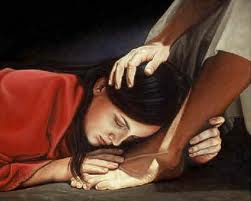
On Sunday, in churches all over Christendom, worshippers will hear the gospel story of Doubting Thomas. The story of Doubting Thomas is prescribed gospel reading every year for the Sunday after Easter. I’ve never understood why Thomas should hold such a prominent place in our lectionary: I mean, when the chips were down, and Jesus could have used their support, Thomas and the guys deserted Jesus; they left him alone and spread out across the city to hide from the Romans and the religious authorities.According to the Gospels, it was the two Marys, together with the other women who had financially supported Jesus’ ministry, who stuck by him to the bitter end. Also according to the gospels, it was Mary, the one they call Magdala who brought back the news that Jesus was not dead, but had risen. But despite the fact that Mary Magdalene was the one chosen to be the Apostle to the Apostles, (the word apostle comes from the Greek for “the one sent”) our lectionary quickly moves on from the empty tomb to the upper room so that we can all once again explore the story of good old, doubting Thomas.
So here, let me honour Mary the Apostle to the Apostles with this my imaginary account of Mary’s story.
Shalom. I greet you in the name of our risen Christ. My name is Mary. You may know me as Mary Magdalene. I am not from around here. I come from a good family in Magdala. Magdala is a wealthy city on the Sea of Galilee, just south of Capernaum. My family made a lot of money in the fishing industry in Magdala. While I was growing up I lacked nothing. But I was not happy. I was sick. I would sit around the house moping and complaining and make everyone miserable. I was so distraught. Often I was so upset that I pulled out my own hair.
Sometimes I would be so excited that people couldn’t stop me from talking. I ran up all sorts of bills in the market place which my parents had to pay. I was always cooking up some mad scheme or other. I would rant and rave at the slightest provocation. From time to time I would become ill and stay in bed for weeks on end. I knew something was terribly wrong and nothing seemed to ease my anxieties. I was a prisoner inside my own mind. Then I met Jesus. He was teaching outside of the synagogue. At first, I just stood back in the crowd and listened as he spoke about a new world which God intended to create. It would be a world where the sick are healed and prisoners are set free. I wanted to taste this freedom which Jesus spoke about. I wanted to ask him so many questions. But the crowd pressed in upon him demanding that he tell them more and I was pushed farther away from him. In despair, I turned to leave. Continue reading →
Reposted from last year – Sermon for the Second Sunday of Easter April 15 2012
This Sunday I tried something new: introducing a video clip into the sermon! You can view the video within the written text of the sermon below or listen to the audio version provided. I am indebted to the work of James Rowe Adams for much of the New Testament Scholarship in this sermon.
The Scripture texts were John chapter 20:19-31 and Acts 4:32-35
Christ is Risen! Christ is Risen indeed! Alleluia!
So, Christ is Risen! So What???
What can it possibly mean to you and to me, that a rag-tag bunch of Jesus’ followers gathered together in an upper-room and talked about their experiences of Jesus and decided that not even death could extinguish the life that they experienced in Jesus? What difference does it make to you or to I that Christ is risen?
The truth is that it can make absolutely no difference what so ever. Now there are a whole lot of people who will tell you that the important thing about resurrection is that you believe it. Those same folks absolutely love the story of doubting Thomas. And so every year on the second Sunday of Easter we read the story of doubting Thomas as a kind of inoculation against Thomas’ disease.
I sometimes think that the designers of the lectionary were trying to build up our resistance to doubt. Having problems believing in resurrection, well don’t do what Thomas did, don’t doubt, because you’ll be proven wrong. Jesus is alive, the wounds in his hands proved that to Doubting Thomas, so have no doubt about it the resurrection happened! Believe in the resurrection!
The trouble with believing in stuff is that it belief can make absolutely no difference what so ever. I can believe in justice for all, but unless I’m prepared to seek justice, to be fair, or to resist injustice, it makes absolutely no difference what so ever. You can shout, “Christ is risen!” all you want but unless you are willing to live it, the resurrection means very little at all.
In order to live the resurrection you have to begin practicing resurrection. In order to practice something, you have to know what it looks like, what it sounds like, or what it feels like.
I’ve been trying to figure out how to show you what resurrection looks like in the flesh. Then I remembered a video that’s been doing the rounds on the internet, so I want you to watch this modern miracle of resurrection.
WATCH THE VIDEO CLIP FROM: Alive Inside
Christ is Risen! Christ is Risen indeed! Alleluia!
2000 years ago a bunch of rag-tag Jesus followers were huddled together in fear. Their beloved leader had been brutally executed by the powers that be and they were terrified that they would be next. Paralyzed by their fear, hiding behind a locked door, something happened that gave them the strength to burst forth from their own tomb and change the world.
Ever since they began to practice resurrection, people have been trying to figure out exactly what happened; what could have changed these bumbling, terrified, betrayers, abandoners, who seemed to be always getting things wrong, into a bunch of leaders who began a movement that spread through out the Empire within their own life-times and then based on the power of their witness, spread throughout the world and continues to nourish and sustain millions of people from generation to generation?
Now there are those that insist that it was the power of Jesus having been physically resuscitated from the dead that motivated his followers to change their lives and the lives of millions who have come after them. But we live in the 21st century and we have access to all sorts of information that the generations who have gone before us did not. Most of us, myself included, are not swayed by arguments about a physical resuscitation of Jesus’ body. But I can tell you without a doubt that I do believe in resurrection and I know that Christ is risen and I also know that the same power that the early followers of Jesus used to change the world is available to you and to me. And now more than ever the world needs us to start using that power. It’s long past time for us to start practicing resurrection.
So, if they weren’t talking about a physical resuscitation when they spoke of Jesus’ resurrection, what did the early followers of Jesus actually mean when they spoke of Jesus having been raised from the dead? During the first century many Jews had adopted a vision of the future that dealt with the prevailing question of the day: “How could a just God allow his people to suffer endlessly at the hands of their enemies?” Or as Dom Crossan puts it: When was God going to clean up the world so that justice could prevail? Continue reading →
I am indebted to John Claypool’s sermon from back in 1997 for the story of Eugene O’Neill’s play “Lazarus Laughs” and to Henri Nouwen’s “Our Greatest Gift: A Meditation on Dying and Caring” for the “Parable of the Twins”.
Preparing sermons this Holy Week and wrestling with texts and doctrines, I have had as my companion Michael Morwood’s new book “It’s Time: Challenges to the Doctrine of the Faith”. Written from the perspective of a former Roman Catholic priest, Morewood’s insights transcend the denominational divide and speak directly to the need for new articulations of the faith. I have been gleaming all sorts of insights that are helping me to proclaim the Gospel in a world where knowledge about the magnificence of creation is expanding at a phenomenal pace. Imagine my delight this morning, when a posting by the author himself alerted me to a brief speech he gave on Good Friday that outlines his hopes for the church of tomorrow. Enjoy!
Michael Morwood is an Australian who is currently the theologian in residence at the Kirkridge Retreat Center, at Bangor, Pennsylvania.
Listen to the full worship service here – Special thanks to the Rev.Susan J. Thompson for her leadership. As always our worship was empowered by the magnificence of our gifted musician Marney Curran. Special thanks to Gary Curran for his solo.
Download the worship bulletin here(3 pages, print double-sided and fold into a booklet)
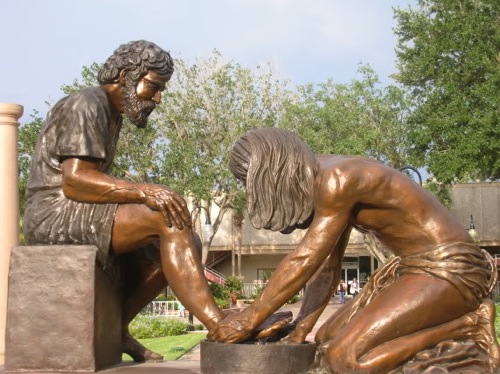
Our worship at Holy Cross was lead by Pastor Tom Doherty and The Rev. Susan J. Thompson as we partook of two suppers interwoven to provide nourishment to our bodies and souls. After hearing the story of Jesus washing the disciples’ feet, our hands were tenderly washed and dried for us as we continued in the Word. After enjoying of a plethora of soups, Pastor Tom’s homily ask, “Is this all a big hoax?”
I post this sermon, which I preached last Easter Sunday, touched by the memories it evokes. Resurrection came to my Gran this past summer. Her 100 years were and are a blessing to her family and friends. She comes to me often in so many ways; this sermon is but one.
Tredegar, Wales the village where Nellie was born in 1911
Sisters and brothers in Christ, today we gather to celebrate the greatest story ever told! Christ is risen! Christ is risen indeed! Alleluia! Christ is risen in you and in me. And because Christ is risen, I can welcome each of you to your very own resurrection!!! Christ is risen in you and in me! Alleluia!!!
It is the greatest story ever told. Like all the best stories ever told it does not answer all our questions. Poet Mary Oliver insists that, “There are many stories more beautiful than answers.” The bible is full of great stories. The sacred scriptures contain responses to some of humanity’s greatest questions. The stories in the scriptures provide us with responses to some of our deepest longings, but those responses do not come in the form of answers. The Bible is full of stories that touch the deepest mysteries of life. The ancients knew that eternal truths are best communicated through stories, and so we plumb the depths of the scriptures’ parables, myths and similes to discover our reality. The story that bursts forth on this Easter Sunday is the greatest story ever told. It is a story told in response to our deepest reality and our darkest fear: death. Continue reading →
A Good Friday Sermon preached at Holy Cross Lutheran Church in 2012
The memory of it still haunts me to this day. I was 18 years old. Some friends of mine from church convinced me to go to a big youth gathering. I don’t remember who sponsored the gathering, I do remember that most of the Lutheran youth groups in the greater Vancouver area were in attendance and various Lutheran pastors were involved in the leadership. At some point near the beginning of the event we were each given a small nail, divided into groups and asked to line up behind one of the three wooden crosses that were laying in the hall. We were then given our instructions. We were about to hear a dramatic reading of the Gospel According to John’s account of the crucifixion. When the reading was over we would be invited to proceed to the cross nearest us, knell down, take a hammer, and drive our nail into the cross. With each blow upon the nail we were asked to remember our own responsibility for the death of Jesus. We were asked to remember that it was we who had crucified Jesus, for we were the guilty sinners for whom Jesus died. It was a powerful, gut wrenching experience that still haunts me to this day.
I wasn’t the only young person who wept buckets that day. I immersed myself into the ritual act as I recounted inwardly the list of my own sins. Together with my friends, we left that hall believing that Jesus died because of us. We left judged, convicted, guilty, tormented, anguished, and full of hope, for we knew that Jesus had died to save us from our sinfulness. Like so many who have gone before us and like so many who will gather on this Good Friday, we left that hall believing that God sent Jesus to die for us; to pay the price for our sin. Continue reading →
Re-posted from last year:On Maundy Thursday, followers of Jesus will gather together to remember what we have been told about the night before Jesus died. In our community we will begin with a ritualized washing of hands, then dine over a simple meal of soup, wine and bread. Over the meal we will talk together about the events of Jesus’ life, paying special attention to what we have been told about the Last Supper and Jesus’ betrayal. As the meal and the conversation comes to a close, we will take bread, give thanks bless it and give it to one another saying, “The bread of Christ given for you.” Then we will take a glass of wine give thanks and pass it to one another saying, “Christ poured out for you.” Then we will strip our sanctuary in preparation for what the morrow brings.
In this post I have included a copy of the worship bulletin for this liturgy of suppers. It can be downloaded here. to be printed double-sided
21st century minds often find it difficult to reconcile the gospel accounts of this evening with. So, in place of the homily, we will discuss our struggles to understand the events of this evening in light of all that we have learned together.
For those of you who have asked, a copy of a previous Maundy Thursday homily is included here. This homily was preached in 2007 and while I am tempted to make some changes to it in light my own struggles to come to terms with the gospel accounts, I offer it unaltered, trusting that others may see in it the early stirrings of my own desire to discover a more progressive Christianity. At the time I had just completed reading Marcus Borg and John Dominic Crossan’s “The Last Week” and John Shelby Spong’s “Jesus for the Non-Religious” and their work permeates the homily.
Maundy Thursday 2007:
It’s a strange night. For several decades after the Resurrection, Jesus’ followers were known as the People of the Way, or the Followers of the Way. Almost 2000 years separate the first followers of Jesus from 21st century Christians.
I wonder if the early People of the Way would have as much difficulty recognizing modern Christians as Jesus’ followers as we modern Christians have understanding the practices of the People of the Way.
The People of the Way understood Jesus to be the embodiment of what can be seen of God. Jesus shows us who God is and Jesus shared with his followers his vision of God’s justice. Continue reading →
In our parish on Palm Sunday, our liturgy stays with the commemoration of Jesus’ entry into Jerusalem. Trusting that our members will join us on Good Friday, we have not adopted the practice of rushing to the Passion of Christ. This allows us time to linger over our Hosannas.
Our worship began outside with the reading of Luke 19:28-4, followed by a procession of palm waving, hosanna cheering congregation. This year I changed the first reading to the story of Jacob’s wounding during a wrestling match with God in Genesis 32:22-31, followed by an feminist interpretation of Psalm 118, and the Gospel text John 12:12-15.
I am indebted to Michael Morewood’s book “Is Jesus God” for the inspiration behind this sermon and to John Dominic Crossan and Marcus Borg’s “The Last Week” for the historical details.
“THERE ONCE WAS A MAN WHO suffered from various illnesses for a very long time. This man had seen countless doctors who over the years had performed countless tests on him and had prescribed lots of medicine. But, the man’s condition did not improve. This man even tried home remedies to make himself feel better. He drank herbal teas, and took mega-doses of vitamins along with his prescriptions. But still he did not feel any better. Then one day the man heard about a doctor who was said to be an outstanding diagnostician. So the man called the doctor to make an appointment. And even though the doctor was booked for months in advance the man was delighted when the receptionist managed to fit him in. As the date of his appointment drew near the man was excited by the prospect of finally getting to the bottom of his problem. At last, he would find out just what was wrong with him and in no time he was sure that this brilliant doctor whose praises were sung by one and all, this doctor would be able to cure him. The day of the appointment arrived. After the doctor had thoroughly examined the man and had reviewed his tests, she sat down with him and she said, “My friend, you are not a healthy man. But you can be well again if you will only follow my advice. What you need to do is lose about sixty pounds, get involved in a regular program of exercise, and eat more grain, fruit, and vegetables. You don’t need to take any more of the medicine that has been prescribed for you and you don’t need all those vitamin pills.” When the man heard this, he was indignant. He demanded that the doctor prescribe some new medicine for him, possibly some experimental drug not yet on the market, which would cure his illness. The doctor smiled patiently and repeated her advice. “You don’t need medicine,” she said. “You need to change your lifestyle.” The man simply cursed the doctor and stomped out of the office. For the rest of his sickly life, he told everyone that she was a quack who didn’t deserve to be called a doctor.
ONCE THERE WAS A WOMAN WHO was in serious trouble with the law. This woman had run up all sorts of debts, and in desperation she had embezzled some money from the company where she worked. The Company found out and was now pressing charges against her. The woman was beside herself with worry. She didn’t know where to turn until a friend of hers told her of an outstanding defense attorney who seldom lost a case. The woman called the lawyer immediately, and he agreed to see her. She was delighted and relieved. “At last,” she said to herself, “I have a lawyer who will get all these charges dropped. Then I’ll be able to get on with my life.” But when she saw the attorney and explained her situation to him, he shook his head and said, “What you did was wrong, and you may have to spend some time in prison. After you’re released, you’ll need to get into an ongoing program to pay off your debts. You’ll need to get a steady job and repay the company the money that you stole. If you do all this, you may be able to get your life back together again. The woman was outraged at the attorney. She expressed her dismay in no uncertain terms, “I don’t need you to give me a lecture, I need you to defend me against these charges and get them dropped. And with that she dismissed the lawyer, bad mouthed him all over town and resumed her search for an attorney who would do for her just exactly what she wanted. Continue reading →
Philip Clayton is the Dean of Claremont School of Theology and Provost of Claremont Lincoln University. He also holds the Ingraham Chair at CST. Clayton earned a joint PhD in Religious Studies and Philosophy from Yale University and has held visiting appointments at Harvard University, the University of Cambridge, and the University of Munich. He has published over 20 books, the latest of which “Transforming Christian Theology: For Church and Society” is a must read for anyone presuming to do theology in public. The book is close to a definition of “progressive Christianity” as you are likely to find.
Readings: Numbers 27: 1-11; Acts 13:44-51; John 12:1-8
St. Patrick’s Day doesn’t often fall on a Sunday, but as our congregation’s Annual Meeting would begin immediately following our worship service, I decided to be somewhat playful and irreverent with a sermon designed encourage folk to think beyond words on a page. The first reading brought the wonderful story of the Daughters of Zelophehad to church and as this reading does not appear in the Revised Common Lectionary it was fun to play with these feisty woman. The reading from the book of Acts is actually the prescribed reading for the commemoration of St. Patrick and the Gospel text is prescribed for Lent 5C. The Guinness was just for fun! Enjoy.
I got my very first job when I was just ten years old. Our neighbours were going away on holiday and they needed someone to take care of their cat. Now I have never been a cat person. In fact, if the truth be known, I’ve always been sort of afraid of cats. When I was little I was terrified of them. But as I grew I learned to control my fears and these days I just tend to avoid cats. I don’t really know why, they just give me the creeps. Back when I was ten, cats still had the power to make me very nervous. But our neighbours tempted me with the promise of a dollar a day for ten days. All I had to do was go into their house each day and feed their cat. There was no litter tray to deal with because back then people still had those little trap doors and the cat could go outside whenever it needed to. So, I signed on and each and every day for ten days I mustered up all my courage and I went into the neighbours’ house and I opened a tin of cat food and I filled a dish with water. I did it as quickly and as quietly as I could and in ten days not once did I ever run into that cat. When the neighbours came home they were so delighted with the good job that I had done that they actually gave me a whole dollar as a bonus. Eleven whole dollars, I was wealthy beyond my wildest dreams. I knew exactly just what I was going to do with that money. You see, Christmas was just a few days away and for the first time in my life I had money to buy Christmas presents! My parents insisted that there was no need for me to buy Christmas presents and they suggested that I should save my money. But I just had to buy presents. To this day I can still remember the joy of hoisting my hard earned cash onto the drugstore counter to purchase my carefully selected merchandise. I can still remember those two amazing gift sets. The first one was for my Dad. It was manufactured by the Old Spice Company and inside it had a soap on a rope, and a two bottles. One of the bottles contained after-shave and the other something called men’s cologne. I didn’t know what cologne was so I had to ask the saleswoman who explained that it’s what they call perfume for men, and I knew that my Dad just had to have some of that. Now the second gift set was a real bargain it was made by Yardly. I wasn’t fooled by all those tiny bottles of perfume that were so much more expensive. No, I picked the gift set that had the biggest bottle of perfume. It also had a big container of something that looked like talcum powder but the container said it was actually dusting powder and it came with a little puffy yellow thing for dusting the powder all over your body. I knew that my Mom would just love this. Together the two gift sets cost a just few pennies less than eleven dollars. I don’t think that I have never enjoyed Christmas quite the way I enjoyed that one. Continue reading →
Yesterday’s post in which I mentioned panentheism certainly prompted some interesting questions from various readers. So, even though I’ve written, preached and posted about panentheism many times, I thought I’d provide a fuller explanation of what I mean when I use the this word which I believe provides a way of articulating our reality that is both helpful and hopeful.
Let me begin by saying, that panentheism is, in and of itself, an evolving term. The term can be found in the works of German philosopher G.W.F. Hegel, process theologian Alfred North Whithead, and more recently in the work of Juergen Moltmann, Matthew Fox, Philip Clayton and Marcus Borg. The word itself is made up for three Greek words: pan = all, en = within, theism = god. Panentheism is used to describe God as ONE who is in everything. Panentheism (unlike pantheism) does not stop with the notion that God is in everything, but goes on to posit that everything is God. God is in the universe and God transcends the universe. God is greater than the sum total of the universe. But the universe cannot be separated from God. We are in God and God is in us. God breathes in, with, and through us.
The term panentheism is proving helpful to Christians in the 21st century who are working to articulate our faith in light of all that we are learning about the universe. It is also invaluable to those of us who have a deep reverence for creation and are seeking ways to live in harmony with creation by treading lightly upon the earth. Panentheism is also a concept present in many faiths and provides us with a common way of speaking together about our Creator. But like all language the term fails to fully capture the nature of the Divine. It is merely a tool to help us think beyond the idols we have created to function as objects of our worship.
The Apostle Paul insisted that God is “the One in whom we live and breath and move and have our being.” (Acts 17:28) As we look towards the heavens, we see an ever expanding new story of who we are. Just as Paul struggled to find ways to articulate the nature of the Divine to his contemporaries, Christians continue in every age to find ways to articulate the nature of the Divine to each new generation. We do not abandon the wisdom that has been offered by those who have gone before us. But we cannot ignore the wisdom that is being revealed to us here and now in our time and place within the communion of saints.
Below is a video that I have shown to Confirmation students (ages 12-15) as we begin to explore the great religious questions that have inspired wisdom seekers from the beginning of human consciousness: Who am I? What am I? Where do I come from? Why am I here? Where am I going? etc. The responses of young people inspire me! I cannot wait to see what they will reveal to us about the nature of our reality! As you watch this video, I offer you a benediction. It is a blessing that I have adapted with permission from the work of John Shelby Spong.
God is the source of life, so worship God by living,
God is the source of love, so worship God by loving.
God is the ground of being, so worship God by having the courage
to be more fully human; the embodiment of the Divine.

 I’m busy preparing the liturgy for this coming Sunday when Peter Rollins will be our guest preacher. It’s an interesting challenge considering the season. Easter is a time when we practice certainty with our shouts of “Christ is risen! Christ is risen indeed! Alleluia!”, so everything I’ve heard and read of Rollins’ work is calling me into the darkness of unknowing. Part of me wishes we’d booked Peter’s weekend visit with us during the season of Lent or maybe even this past weekend when terrified followers of the Way huddled in an upper room in fear for their lives could have set the tone for our worship together. But part of me is relishing Peter’s serious challenges to the church that Peter clearly expresses during the interview in the video below. For those of you who live in Southern Ontario, consider joining us this weekend! For details click here











 pastordawn