Unknown's avatar

About Rev. Dawn Hutchings

Retired progressive Lutheran Pastor. Exploring the DIVINE MYSTERY that some call, "GOD," hoping to learn about the LOVE which is BEYOND the BEYOND and BEYOND that also.

I AM WHO I AM – a sermon for the first Sunday in Advent – Mark 13:24-37

On this first Sunday in Advent we embarked on a pilgrimage into MYSTERY. Our first reading was The Star Within: a creation story by Dr. Paula Lehman & Rev. Sarah Griffith, followed  by a musical video reflection My Soul by Peter Mayer which you can watch  HERE Our Gospel reading was from Mark 13:24-37

Listen to the sermon here

“But in those days, after that time of distress, the sun will be darkened, the moon will lose its brightness, the stars will fall from the sky and the powers in the heavens will be shaken.”

The anonymous gospel storyteller that we call Mark leaves us with so many questions. But then, the anonymous gospel storyteller that we call Mark lived in a community that asked so very many questions; questions, questions, and more questions. So, many questions without answers, living in a mystery, surrounded by mystery, heading into mystery, living lives characterized by mystery. Confronted and confounded by the reality that Jesus was gone. Rome was still in power. The people continued to suffer. Justice had been denied. Horrific violence was the order of the day. When was God going to do something? When would injustice end? How would it end? Was Jesus wrong? Is Jesus Way of non-violent resistance to injustice wrong? Will the rich and powerful always win? Will justice always be denied?

Left without answers, the anonymous gospel storyteller that we call Mark, offers us stories, parables, symbols, and metaphors. Stories, parables, symbols, and metaphors continue to be the offerings of Advent as we confront the mysteries of our lives. In the words of the song we just heard:

“There are a hundred billion snowflakes swirling in the cosmic storm. And each one is a galaxy, a billion stars or more.  And each star is a million earths, a giant fiery sun High up in some sky, maybe shining on some one”

Stars and Snowflakes continue to swirl in and around us like questions about the mysteries that swirled in and around our ancestors.

Who AM I?

What Am I?

Where did I come from?

Who made me?

I AM…

Why Am I?

Where AM I going?

I AM.

Like Moses at the burning bush the answers we receive to our burning questions remain:

I AM WHO I AM

YAHWEH

I AM IS the MYSTERY

I AM WHO I AM is the answer our ancestors passed on to us.

I AM IS the MYSTERY that lies at the very core of our being.

I AM, the name given to the MYSTERY that is our SOURCE.

Could this really be the answer?

Or are these words, I AM WHO I AM, the source of our questions, questions that bring us back to MYSTERY.

Confronted and confounded by the MYSTERY we call God, like the anonymous gospel storyteller that we call Mark, I too can only offer stories, parables, symbols, and metaphors. But then, Advent is the season for stories, parables, symbols, and metaphors. So, let me offer you a story. It’s a story I’ve told you many times. But then Advent is the season for telling stories we’ve all heard so often that we sometimes forget that they are but stories, parables, symbols, and metaphors.

I first heard this from a very wise seminary professor and since then I’ve heard Marcus Borg and Parker Palmer tell it. I’m not sure that this story actually happened, but I am sure that it is absolutely true! It’s a story about a three-year-old girl who was the only child in her family.  Her mom is pregnant, and this three-year-old girl is very excited about having a baby in the house.  The day comes when the mother-to-be goes into labour, and the mom and dad go off to the hospital.  A couple of days later they come home with a new baby brother.  And the little girl is just delighted. But after they’ve been home for a couple of hours, the little girl tells her parents that she wants to be with the baby in the baby’s room, alone, by themselves, with the door shut.  She’s absolutely insistent about the door being shut.  It kind of gives her folks the willies, you know?  They know she’s a good little girl, but they’ve heard about sibling rivalry and they’re not sure about what they should do. Then they remember that they’ve recently installed an intercom system in preparation for the arrival of the new baby, and they realize that they can let their little girl do this, and if they hear the slightest weird thing happening, they can be in there in a flash. So, they let their little girl go into the room. They close the door behind her. They race to the listening post. They hear her footsteps move across the room. They imagine her now standing over the baby’s crib, and then they hear her say to her two-day-old baby brother, “Tell me about God. I’ve almost forgotten.”

Who AM I?

Why AM I?

What AM I?

How will this all end?

What will become of me?

What will become of my loved ones?

Where have they gone?

Where AM I going?

I AM WHO I AM…the answer to the MYSTERY handed down from generation to generation.

Who AM I?

I AM…is the answer…

Like all answers this answer creates more questions???

The MYSTERY that lies at the very core of reality is the very MYSTERY of which I AM an intricate part.

Where do I come from?

Stars, dust, dust to dust, ashes, to ashes… I AM …living dying, born again, therein lies the MYSTERY that I AM.

Who made me?

That I AM points me toward the MYSTERY of my beginning and beyond my ending to the MYSTERY that I will become.

Why AM I?

I AM – I AM – the wonder of our being ought to stop us in our tracks, stun us into silence, awestruck by the beauty of our breath, the MYSTERY of our SPIRIT…

Questioning our BEING, wondering, touching, reaching for answers…

Like the song says:

And deep inside a snowflake, I am floating quietly

I am infinitesimal, impossible to see

Sitting in my tiny kitchen in my tiny home

Staring out my window at a universe of snow

But my soul is so much bigger than the very tiny me

It reaches out into the snowstorm like a net into the sea

Out to all the lovely places where my body cannot go

I touch that beauty and embrace it in the bosom of my soul

And so brief and fleeting is this tiny life of mine

Like a single quarter note in the march of time

But my soul is like the music, it goes back to ancient days

Back before it wore a human face, long before it bore my name

Because my soul is so much older than the evanescent me

It can describe the dawn of time like a childhood memory

It is a spark that was begotten of the darkness long ago

What my body has forgotten, I remember in my soul

So we live this life together, my giant soul and tiny me

One resembling forever, one like smoke upon the breeze

One the deep abiding ocean, one a sudden flashing wave

And counting galaxies like snowflakes, I would swear we were the same

Oh my soul belongs to beauty, takes me up to lofty heights

Teaches sacred stories to me, sanctifies my tiny life

Lays a bridge across the ages, melts the boundaries of my bones

Paints a bold eternal face on this passing moment, oh my soul

Who AM I?

Stardust, ashes and snowflakes

I AM WHO I AM,

We ARE…

We are ONE…

The MYSTERY of our BEING is the I AM of which we ARE…

As to why or where we are going, or why or where they have all gone???

We are ONE…

And this, dear friends, is the miracle of the MYSTERY that we ARE.

For in the words of Julian of Norwich, “We are not just made by God, we are made of God.”

YAHWEH, I AM WHO I AM…and so dear friends are you, stardust and snowflakes, for we are ONE, made of the very MYSTERY that we call GOD.

WE ARE!

WE are so much more than the very tiny

Me, the very tiny you, for WE ARE!

Let the MYSTERY of that we call God, enfold you in the LOVE that IS God.

EMMANUEL – God IS with US. Now and always. Amen


WAKE UP for CHRIST’s SAKE! – sermon for Advent 1B

purple universeOn this first Sunday in Advent we awakened ourselves to the cosmic contours of the darkness. Our first reading was The Star Within: a creation story by Dr. Paula Lehman & Rev. Sarah Griffith, followed  by a musical video reflection My Soul by Peter Mayer which you can watch  HERE Our Gospel reading was from Mark 13:24-37. Listen to the sermon here


As we embark on the journey of Advent, I need to take a poll, and there’s not much time left, so, we’ll conduct this particular poll by a show of hands. Before you answer this question, would you please close your eyes. Now, for the sake of this poll, I’m not going to continue until everyone has their eyes closed. Notice the darkness, the blackness that enfolds you. Now, I’d like you to remember the carefully and respond as honestly as possible: By a show of hands, when you were a child, how many of you were afraid of the dark? Pease answer as honestly as you can. Don’t worry about anyone knowing that you were afraid of the dark, I’m the only one who has their eyes open and I’m clergy, so I’m bound by the confidentiality of my profession and the privacy act, not to tell anyone.
Ok, those of you who were afraid of the dark when you were a child, you can put your hands down, but keep your eyes closed. Now, those of you who weren’t afraid of the dark when you were a child, please raise your hands. Ok, everyone keep your eyes closed. One more time, I need you to notice the darkness. Now, keep your eyes closed, do not open your eyes until I tell you to and listen carefully to the Gospel according to Mark:
Jesus said: “In those days, after that suffering, the sun will be darkened, and the moon will not give its light, and the stars will be falling from heaven, and the powers in the heavens will be shaken. Then they will see ‘the Son-of-Man coming in clouds’ with great power and glory. Then the Son-of-Man will send out the angels, and gather his elect from the four winds, from the ends of the earth to the ends of heaven. From the fig tree learn its lesson:  as soon as its branch becomes tender and puts forth its leaves, you know that summer is near. So also, when you see these things taking place, you know that he is near, at the very gates. Truly I tell you, this generation will not pass away until all these things have taken place. Heaven and earth will pass away, but my words will not pass away.
But about that day or hour no one knows, neither the angels in heaven, nor the Son, but only the Father. Beware, keep alert; for you do not know when the time will come.
It is like someone going on a journey, who leaving home and putting the slaves in charge of their own work, commands the doorkeeper to be on the watch. Therefore, keep awake—for you do know when the lord of the house will come, in the evening, or at midnight, or at crockcrow, or at dawn, or else, coming suddenly, the lord may find you asleep.
And what I say to you I say to all:  Keep awake.” The Gospel of Christ.
All right, everybody, WAKE-UP! I mean it! Wake up! There is darkness all around us!!!
Danger everywhere you look. I need you all to WAKE-UP FOR CHRIST’S SAKE!!!!
Don’t sit down! Are you crazy. Who sits down in the midst of darkness? If you sit down, you’re likely to fall back to sleep! I need you to keep awake! Keep awake—for you do know when the lord of the house will come, in the evening, or at midnight, or at crockcrow, or at dawn, or else, coming suddenly, the lord may find you asleep. And what I say to you I say to all:  Keep awake.
KEEP AWAKE FOR CHIRST’S SAKE! This is the Gospel of Christ! Keep awake!
The good news is that there are those among us who have never been afraid of the dark. All right, if you promise to Keep AWAKE, you may open your eyes and sit down.
Welcome to the season of Advent. While the world is busy scurrying about preparing for the arrival of Santa Claus, we here inside the walls of the church are embarking on a journey into the darkness. Out there, t’is the season to be jolly! It is the season of good cheer, so everyone is busy getting all the stuff they need to be cheerful. There are decorations to be hung, lists to be made, presents to be bought, special food to be acquired, more presents to be bought, special drinks to be stockpiled, more presents to be bought, people to visit, more presents to buy, carols to be sung, parties to go to, people to visit, gifts to give, fun to be had as our world prepares for the arrival of  the baby Jesus or Santa Claus depending on your particular point of view. But in here, inside the walls of the church, the Body of Christ, it is my job to tell you all to wait. Advent the season when the church does it’s level best to hold off our culture’s rush toward a happy, jolly, Christmas each year!!! Advent the season of the church year, when those of us who seek to follow the teachings of Jesus of Nazareth are invited to prepare ourselves not for the birth of a baby, but rather to prepare ourselves to give birth to Christ again and again and again.
Birth and darkness are intimately related to one another. Gestation takes place in the darkness; the seeds need the darkness of the earth, humans the darkness of the womb. Movements and revolutions are created in the darkness. The darkness of poverty and despair, the darkness of injustice and war, the darkness of danger and death germinate the seeds of movements and revolutions.
Beware! Be very aware! I am not inviting you into the darkness that is conducive to a winter’s nap. The darkness that I am inviting you into in this season of Advent, is a very dangerous darkness, the kind of darkness that requires you to KEEP AWAKE! WE ALL KNOW THIS DARKNESS WELL! We more than any of those who have gone before us are all too familiar with the darkness. We have more information about the darkness then generations of humans have ever had. At our very finger-tips we have devices which will bring word of the darkness to us 24 hours a day. In our living rooms, in our automobiles, even in the shopping malls, we can hear tell of the dangers of the darkness. Our earth is suffering under the weight of our filth. Continue reading

Pregnant with Possibility: Advent 1B sermon Mark 13:24-37


This sermon for the first Sunday of Advent was inspired by a sermon written by Ian Lawton entitled “The Mother of All Virgin Births” in which I was captivated by his use of the phrase “pregnant with possibility.” I read Lawton’s sermon after first reading John Dominic Crossan and Marcus Borg’s book “The First Christmas” in anticipation of Dom Crossan’s first visit to our congregation (2008). I was so eager to prepare the congregation for Dom’s historical approach to Christmas that  I fear the sermon is overflowing, perhaps a little too pregnant with details.  Luckily, the congregation was treated to the wonders of Dom Crossan’s brilliance for several days and learned well from the master about the delights of historical details. I post the sermon here, trusting that some of the details may be enlightening as we once again prepare ourselves for the Season of Advent.

Let me tell you a story from down-under; an Australian story that was doing the rounds a few years ago. Like all stories it may never have actually happened, but it is absolutely true because it happen again and again, in various and myriad ways. This story happened a while ago in Brisbane, Australia…

“The story begins in the dark. A university student named John was on the side of the road hitch hiking on a very dark night and in the midst of a storm. The night was rolling on and no car went by. The storm was so strong John could hardly see a few feet ahead of him. Suddenly he saw a car slowly coming towards him and slowly it stopped. John was desperate for shelter and without thinking about it; he got in the car and closed the door.

It took only a moment for John to realize that there was nobody behind the wheel and the engine wasn’t on! But the car started moving slowly. John looked at the road and saw a curve approaching. John was so scared, that he started to pray, begging for his life. Then, just before he hit the curve, a hand appeared through the window and turned the wheel. John, paralyzed with terror, watched how the hand repeatedly came through the window but never harmed him. Eventually, John saw the lights of a pub down the road and so gathering his strength, he jumped out of the car and ran into the pub.  Wet and out of breath, he rushed inside and started telling everybody about the horrible experience he had just had. A silence enveloped the pub when everybody realized he was crying and he wasn’t drunk.  Suddenly two other people walked into the pub.    They, like John, were also wet and out of breath. They looked around and saw John sobbing at the bar, one of the men said to the other, ‘Look, Bruce, there’s that idiot that got into the car while we were pushing it.’

Spiritual Philosopher, Ian Lawton insists, “There is always more to life than meets the eye. There is more to life than what our sight is able to see. Our eyes don’t simply pick up information relayed from an outside world and relay it to our brains. Information relayed from the outside through the eye accounts for only 20 percent of what we use to create a perception. At least 80 percent of what the brain works with is information already in the brain. We only use a small fraction of our brainpower. We very rarely exercise the full potential of our physical strength. We rarely access all that is available to our senses. We rarely maximize the potential of our mind, body and spirit in harmony. There is always more to life than meets the eye.” Continue reading

Reign of Christ Sunday – sermons

I usually struggle with this archaic feast day for nothing about the teachings of Jesus remotely suggests that the title “KING” would have appealed to him. The Church on the other hand, was only too willing to claim the title for their founder. So whether it’s “Christ the King Sunday” or “Reign of Christ Sunday” or “Cosmic Christ Sunday”, to me it is simply the last Sunday of the church year and I can’t wait for Advent. Fortunately, I had the presence of mind to book a vacation, so I don’t have to preach this Sunday. Here are a few links to some efforts I have made in the past. Enjoy!

Ruled By a Power Greater Than Fear

Home in the Love We Call God

Jesus Remember Me When You Come Into Your Kin-dom

Quest for the Cosmic Christ

Preparing to Preach or Not to Preach on Reign of Christ Sunday

For our American Cousins – Thanksgiving resources

At the request of several of our American cousins, here are a few resources for Thanksgiving.  Thanksgiving celebrations invite us to remember not just our blessings, but the Source of All that IS.


Follow the links to sermons:

To Whom Shall We Go to Say Thank-you After We have Moved Beyond Personifying God

The Blessing of Michael’s Story

Reckless Generosity a sermon with a Monty Python flair!

Who IS God? – Not One, Not Two – inspired by Garrison Keillor & Joan Chittister

Brussel Sprouts, Ebola, and Thanksgiving – seeking the ONE who IS


So What Does the Label “Progressive Christian” Mean? – a sermon

This sermon is a reflection upon the proposed Vision for Holy Cross Lutheran Church:  Holy Cross will strive to be an inclusive, compassionate, justice-seeking community that provides opportunities to explore and engage Progressive Christianity.” The sermon reflects on the nature of the label “progressive”.

There is no written manuscript, just a few notes that can be viewed HERE        

Our readings included: Micah 6:8, 1 John 4:7-8 and Acts 17:22-28

You can view the video below or listen to the full audio version HERE  

For Christ’s Sake! It’s Not About God! – a sermon on the Parable of the Talents, Matthew 25: 14-30

RiskThere’s a story that pastors like to tell. I think I first heard it when I was in seminary. It’s the story about a preacher who was leading a children’s sermon. This preacher told the children all about how squirrels gather nuts and hide them away for the winter. He explained to the children how important it was for the squirrels to store up nuts while they were available so that they’d have something to eat when the cold weather arrived. When he was finished, the preacher asked the children if they knew what his lesson about the squirrels was. One small child raised her hand, and she said, “I know, I know, it’s all about God.” The preacher was a little surprised, because he wasn’t talking about God at all, so he asked the little girl why she thought the lesson was about God, and she said, “because you’re the pastor and it’s always about God.”

Unfortunately, many of us have the same reaction when we hear Jesus’ parable of the talents. After all, it’s a story from the Bible, and Jesus told it, so the master handing out the talents must represent God. The only problem is, the master in Jesus’ parable is a real jerk! The kind of jerk, I for one, wouldn’t waste my time trying to worship.

The story says that the man gave the talents, which represent a huge amount of money, to his slaves. If the master in the story is God, then God must be very greedy indeed; expecting massive financial returns, without even bothering to communicate that expectation to the slaves. Fortunately for the first two slaves, they manage to double the master’s investment and the third slave managed to keep the master’s initial investment intact but couldn’t quite manage to earn any interest at all. Now, even given, the precious little I know about the stock market, I’d say the master had nothing at all to complain about. The master entrusted all he had to slaves, and they might have lost a great deal of money on their investments, but they managed to make their master richer than the master had a right to expect.

Let’s do the math. A talent represents about 15 years salary. Most scholars suggest you use a figure of $50,000 per year–times 15, that’s $750,000.00 per talent. So to the first slave the master gave 5 talents, that would be about three million seven hundred and fifty thousand dollars toady. To the second slave, the master gave two talents, that’s about a million and a half dollars today. To the third slave, the master gave, one talent; and that’s about $750,000.00.

According to the story this master had quite the reputation; upon the master’s return the third slave explains why he was so cautious with the master’s money. “Sir, I knew that you were a harsh man, reaping where you did not sow, and gathering where you did not scatter seed; so I was afraid, and I went and hid your talent in the ground.” According to the master’s reputation he is a thief who isn’t above taking what doesn’t belong to him. The third slave was prudent with the master’s money and did what was considered appropriate in the ancient world were banking methods were crude at best, and many people buried treasure for safekeeping; The third slave didn’t loose so much as a penny of the master’s money, and despite the fact that two of the his slaves have just returned to him an additional 7 talents, that’s a whopping great profit of about 5 and a quarter million dollars. Just imagine, that three of us managed to make our boss 5 and a quarter million dollars on an initial investment of 6 million dollars, that’s a return of 75%, well I don’t know where you do your investing but 75% profit is nothing to sneeze about. But instead of rewarding the trio, this master doesn’t deny his own reputation for reaping where he doesn’t sow, and he takes the talent from the fearful salve and gives it to the one who already has ten talents, and then declares that: “to all those who have, more will be given, and they will have an abundance; but from those who have nothing, even what they have will be taken away.” As for the fearful slave who played it safe, the master calls him worthless and orders that he be “thrown into the outer darkness, where there will be weeping and gnashing of teeth.

If this were all about God, then to say that God is harsh would be an understatement indeed. If this were all about God, then why in the world would anybody love God? For who can love such a cruel master? But more importantly, if this cruel master is God, then Jesus’ is describing a god that cannot be compared to the God Jesus boldly calls ABBA. For Jesus’ Abba would never be so greedy as to steal from another’s labour, nor would Jesus’ Abba take from the one who has the least, nor threaten to cast out the least of Jesus’ brothers for the crime of taking care of the gift that was given to him. Such a view of God is inconsistent with all that Jesus’ taught about Bod. So just because Jesus told a story, it doesn’t mean the main character in the story is necessarily God. Continue reading

Don’t you dare slam the door on my face, just because I went to get gas, because you kept me waiting! – a sermon Matthew 25:1-13

audio version here

“Wisdom, Sophia is bright, and does not grow dim, by those who love her she is readily seen, and found by those who look for her. Quick to anticipate those who desire her, she makes herself known to them. Watch for her early and you will have no trouble; you will find her sitting at your gates. Even to think about her is understanding fully grown; be on the alert for her and anxiety will quickly leave you. She herself walks about looking for those who are worthy of her and graciously shows herself to them as they go, in every thought of theirs come to meet them.” (Wisdom of Solomon 6:17-18)

“Sophia, if you are there, show yourself.” This has been my mantra as I have tried to sort out the meaning of this strange tale about ten bridesmaids. I must confess that the impish Sophia, whose playful nature inspired our forbearers to sing, dance, laugh, and play, might just be behind the creators of the lectionary’s decision to put today’s readings together. That these readings should appear, on this Sunday when I am supposed to be inspiring you to set out on the third installment of our Visioning Process, has caused me no end of consternation and grief.

Have you heard the one about the ten bridesmaids and the very late bridegroom? Well if you have heard it, can you please remind me of the punch-line, because I don’t see the point of this so-called parable. Ten bridesmaids were waiting for a bridegroom! Five of the bridesmaids were wise and five of the bridesmaids were foolish; all of them, the wise and the foolish fall asleep. Suddenly, they are awakened by a shout, “the bridegroom is almost here, come out and meet him.” The wise bridesmaids had brought along some extra oil for their lamps, the foolish bridesmaids had not.  The wise bridesmaids aren’t very nice and refuse to lend any of their oil to the foolish bridesmaids, so the fools have to go off to the store to get some more oil. Long before the bridegroom arrived all ten of the bridesmaids fell asleep.  Turns out the bridegroom doesn’t know five of the bridesmaids so he shuts the door and says: “Truly I tell you, I do not know you.  Keep awake therefore, for you know neither the day nor the hour.” 

Ha, ha, ha, very funny…. I simply don’t get it. For years and years, generation upon generation, people have been telling this one, and leaving people hanging with this confusing story with a warning about the need to be prepared. Ha, ha, too bad, so sad, you’re not prepared. You don’t get to come into the party! Many of us have been hanging around the church for so long, that we’ve heard this story explained by preachers who are determined to convince us that the bridegroom is actually Jesus and that we, the people of the church are the bridesmaids who must keep awake, because we don’t know when Christ is coming back. The end is near!!! So, be prepared. Continue reading

Lest We Forget – A Peace Remembered

The young woman can still remember one particular Remembrance Day when her words and actions did nothing more than offend someone she loved very much. It was the one and only argument she ever had with her Grandmother and it happened over Remembrance Day. At the time, she was living in London. She remembers thinking that Londoners take Remembrance Day very seriously indeed. More so, she thought, than in her native Canada. She wondered if the blitz had something to do with it.

While most of the poppies people wore were red, she began to see white poppies appear on the lapels of more than just a few people.  She read in the newspaper that those who were committed to peace and believed that for the most part, Remembrance Day only serves to glorify war were donning white poppies.  You could pretty well draw a dividing line between the generations using the colors of poppies as your guide. Young people, who had never experienced war tended to wear white poppies, while those who were older and who had memories of war, tended to wear red poppies. In many homes poppies in and of themselves managed to start wars. 

The idealistic young woman was just twenty and her commitment to peace determined her choice. She was wearing a white poppy the day she traveled up to the Midlands to visit her Grandmother. It was the day before Remembrance Day when she arrived on her Grandmother’s doorstep. She’d forgotten all about the white poppy that adorned her lapel. She couldn’t help thinking that there was something odd about the reception she received from Grandmother. It wasn’t exactly what you would call warm. Her Grandmother was upset about something. But the young woman couldn’t quite figure out what, because her Grandmother appeared to be giving her the silent treatment. She just served dinner and listened quietly as the young woman chatted on about her week in London. Continue reading

Some Virgins and a Rabbi meet Sophia: a sermon on the Parable of the Ten Bridesmaids and Sophia

SophiaDoveChaliceHranaJantoWisdom of Solomon 6:12-16 and Matthew 25:1-13 – Here’s a sermon that I preached several years ago when this coming Sunday’s readings prompted me to use/borrow/steal from the book “Wisdom’s Feast: Sophia in Study and Celebration”, by Susan Cady, Marian Ronan, Hal Taussig (Harper and Row, 1986). 

The parable of the ten, what??? Bridesmaids??? Really, ten bridesmaids, it sounds like the set up for some elaborate joke. Ten bridesmaids were waiting for a bridegroom, they waited so long that they fell asleep! I don’t know, you fill in the rest! I’ve never been much good at telling jokes, I’m more of a storyteller. Part of the fun of a story is the journey itself, but when you tell a joke you have to worry about punch lines. I tend to forget punch lines, or if I do remember them, I usually manage to mess them up and loose the laugh. So, there were these ten bridesmaids waiting for a bridegroom. Five of the bridesmaids were wise and five of the bridesmaids were foolish. The wise bridesmaids brought along some extra oil for their lamps, the foolish bridesmaids did not. Long before the bridegroom arrived all ten of the bridesmaids fell asleep. Yada yada yada!

A little detail here, a little detail there and lo and behold we’re at the punch line. Turns out the bridegroom doesn’t know five of the bridesmaids so he shuts the door and says: “Truly I tell you, I do not know you. Keep awake therefore, for you know neither the day nor the hour.” Ha, ha, ha, very funny…. I simply don’t get it. For years and years, generation upon generation, people have been telling this one, and leaving people hanging with that punch line. Ha, ha, too bad, so sad, you just don’t get it. You don’t get to come into the party!

Okay, I know this is a parable and that means that like all parables there’s a trick of some sort that we have to work out. So, for generations preachers have been unraveling this one and the usual explanation goes something like this….“Keep awake! Don’t fall asleep! And for heaven’s sake be prepared! Cause if your not, Christ will bar the door and you won’t get into heaven! So, Keep awake, for you know neither the day nor the hour. Christ could come back at any moment and if your not ready! That’s it! Boom! Christ will deny you, the door will be shut and you’re not getting in. Oh and by the way, your going to burn in hell for all eternity. So, remember keep awake, be afraid be very afraid. Cause your gonna die! And if you haven’t brought along some extra oil for your lamp, well it ain’t gonna be pretty!” Continue reading

Islam 101 – session 3

Adult Education at Holy Cross Lutheran Church


Before we begin the Living the Questions series “The Jesus Fatwah” we are familiarizing ourselves with the basics of Islam.  Join us on Sunday mornings at 9:15am. 


All Saints’ Sermon: Pastor Carla Blakley – Guest Preacher

Pastor Carla Blakley, the Community Relations Director for Canadian Lutheran World Relief (CLWR) was our Guest Preacher on All Saints’ Sunday and preached a powerful sermon on Matthew 5:1-12. 

“Makarios” – Blessed, Happy, Fortunate, EVOLVED – a sermon for All Saints’ Sunday

All Saints’ Sunday readings:  Contemporary reading:  “A Return to Love: Reflections on the Principles of a Course in Miracles” by Marianne Williamson, Gospel:  MATTHEW 5:1-12 – extensive quote within the sermon from evolutionary scientist Stephen Jay Gould – the hymn sung before the gospel is “I Am the Dream” words: S. Curtis Tufts, Music: Rick Gunn

Listen to the sermon here

Our Gospel reading has often been called the Beatitudes. It is traditional to read the Beatitudes on All Saints’. Some years we read the eight Beatitudes as they have been passed down to us from the anonymous gospel storyteller known as Matthew, who sets Jesus’ sermon on the mount.  But this year is the year of Luke, so we read this anonymous storyteller’s version of the Beauties which appear in Jesus’ sermon on the Plain.  But whether it’s the sermon on the mount or the sermon on the plain what has been passed down to us is a description of the important characteristics of those who are blessed. There are all sorts of ways to interpret the word “makarios” which was translated into Latin as “beatus” the word for “blessed,” “happy, or “fortunate.” Today, I’d like to offer you another way of interpreting the Greek word “makarios”. “makarios” contains the Greek word “karios” Some of you will recognize the word “karios”,

here in Canada the mainline churches work together within the organization that bears the name “karios”. Karios is the organization through which we work together to achieve justice in Canada and in the world.  The name Karios was chosen because it is one of the Greek words for “time”, a special kind of time, the opportune time, or the supreme moment. Karios is used in the scriptures to mean that time when all is well, when people are making the best use of their time, when there is harmony or peace among people, or peace with God. Karios can also be used to describe the time when it is clear that the Divine has somehow visible right here and right now. Karios is sacred time. “Makarios” is related to Karios because a person who achieved “makarios” was said to be a person who had moved beyond the constraints of time and space. Continue reading

All Saints – Giving thanks for the Divine in One-another!

All Saints’ Day is a day for remembering.  The word saint simply means “holy”. In the New Testament, all those who believe and were baptized were referred to as saints. It wasn’t until round about the third century that the church began using the word saint to refer to those who had been martyred for the faith. Over time these martyred saints were held up for veneration and people used to pray to them to intercede on their behalf. I’m not going to go into all of the institutional abuses that led Martin Luther and the later reformers to abolish the veneration of the saints. Except to say, that while the Reformation put an end to the veneration of the saints in the protestant churches, it did not abolish the concept of sainthood.

Within the mainline protestant denominations, we use the term in much the same way as it was used in the New Testament to describe the faithful. We talk about the communion of saints to describe all the faithful who have gone before us who now rest in God, together with all the living who walk in faith. So today as we celebrate the saints, we give thanks for all the faithful those living and those who have gone before us.

Today, I remember and rejoice as I give thanks and praise to God for the witness of St. Joyce of Belfast. St. Joyce who in her own way taught her children to love God and to pray always. And so today, I give thanks and praise to God for the life and witness of St. Joyce of Belfast, my Mom, who was the first to teach me the Lord’s Prayer, and who puts flesh on Christ’s command that we love our neighbours as we love ourselves.

Today I remember and give thanks for the life and witness of St. John of Wales, whose life in the church as a choir-boy was followed by long years of self-exile and whose keen wit and lack of patience with hypocrisy instilled in me a desire for honesty and integrity in the articulation and living of the faith. I give thanks for St. John, my Dad, whose open heart has stretched his discerning mind and enabled many to see the humour in this God-given life we live.

Today, I remember and rejoice as I give thanks and praise to God for the witness of St. Valerie of Ladner. St. Valerie so loved and feared God that she dared to reach out and invite a wayward soul to come and worship God. St. Valerie sang God’s praise, rejoiced in the communion of saints and helped a young friend find a home in God’s holy church. And so toady, I give thanks and praise to God for the life and witness of St. Valerie, my high school friend, who was the first to invite me to come and worship God.

Today, I remember and rejoice as I give thanks and praise to God for the witness of St. Wilton of Lunenburg. St. Wilton loved God all the days of his life and served God with gladness and distinction. St. Wilton went far beyond his call as pastor, he opened up the scriptures to those who eagerly sought the truth of God’s Word with love and dedication and he went on to inspire a diligence to scholarship that nurtured the faith of so many young people. And so today, I give thanks and praise to God for the life and witness of St. Wilton, my first pastor, who taught me to be uncompromising in my study of the scriptures, and steadfast in my love for God. Continue reading

Echoing the Divine Plea: “I Lay Before You Life and Death. Choose Life!” a Reformation Sermon

Listen to the sermon Here

As you can see and hear, our granddaughters are spending the weekend with us. As many of you know, because you have experienced it yourselves, when little children come into your life, they completely change your perspective. For the past several weeks, my focus and indeed, our focus together has been upon our Visioning Process as we try to envision the kind of church we here at Holy Cross want to be over the course of the next five years. There have been many questions and conversations about who and what we are together as a congregation and where and how we want to engage our talents and resources; questions and conversations about what it means to be a congregation in the 21st century and how we might respond to the circumstances in which we find ourselves. What do we have to offer? How can we play to our strengths? How might we make a difference in and with the various communities that we currently serve? How can we do more? What is the more that we can and should be doing? What are we as a congregation being called to be and do? What is the importance of our Lutheran heritage? What does our reputation for being a “progressive church” mean to us, to the communities that we serve, and to the future we see for ourselves? How can we stay relevant in a world where the church is continually being judged as irrelevant? How will we choose what is most important? Which needs or whose needs can and must we meet, and which needs, or whose needs must we say no to because we can’t possibly hope to meet everyone’s needs? Where will the energy, time, and resources come from so that we can fully live into all that we envision for ourselves?

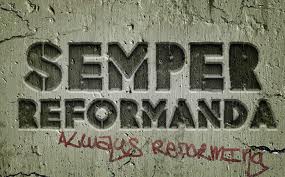
Semper Reformanda, Always Reforming can and is so very exhausting. But Semper Reformanda, Always Reforming is also challenging, invigorating, and vital! So, “here I stand” on this Reformation Sunday, charged with the responsibility to proclaim the Gospel, the Good News in ways that will challenge us all to be bold, to be the Church that Martin Luther set loose on the world 500 years ago.  So, since our Visioning Session last Sunday, I’ve been all up in my head trying to figure out exactly what I could possibly preach to you that would help us to break the log-jam in which we find ourselves as we try to figure out where we are going and what we are called to do. I’ve been reading and studying, going over and over where we’ve been, what we’ve been doing, and what we have been considering and my mind has been full of questions and concerns, and hopes, and dreams. That is until Friday evening when the little girls arrived. Suddenly, I was jolted out of my head and into the fierce immediacy of now! Now Gran? Gran, can we? Gran, can you get me? Gran, I want!!! Gran, NOW!!! Followed by me, saying, In a minute. Just a minute. Wait, I’m coming. Look out! You’re going to hurt yourself. Stop that please! Wait, hold-on, maybe, let me see, I don’t know, maybe, let’s wait and see, OK, Yea, OK, I said, “NO”. What, leave her alone. Don’t do that! Do this! Please. Please Gran. Can we Gran, can we? Playing with and responding to the needs of a 4-year-old and a 2-year-old has shifted my focus.  It’s exhausting and it’s liberating and there’s nothing quite like little ones to get you out of your head and into your heart.

So, today, despite all the grand and glorious questions that are swimming around in my head as we approach the 500th anniversary of the Reformation and regardless of all our concerns about our future together as a congregation, one question looms very large in my mind and perhaps more importantly, in my heart. Today, my response to Martin Luther’s challenge to the church to be “Semper Reformanda!” – “Always Reforming” comes from my heart’s concern for my grandchildren. Looking toward the future of these little people, I cannot help but wonder what kind of church they will encounter as they grow into all that they have been created to be. Will they encounter an irrelevant, out of touch, Church, that is in so much denial about the realities of existence, that fails to respond to our changing understanding of what it means to be human, a church that holds tightly to ideas, doctrines and dogmas of a bygone era and cannot respond to the needs of the poor, the hungry, or the powerless? Or will they encounter a Church that has died a slow, agonizing death? Or maybe they will meet a living, thriving, vibrant Church that is relevant, responsive, and vital? Continue reading

What if we won’t ever really understand Jesus’ life, death, and resurrection until we understand that God is dead? – a Reformation Sermon

Listen to the sermon here

All over the world, Lutheran churches celebrate the earth-shattering events that were set in motion on October 31st 1517, when a Roman Catholic priest named Martin Luther nailed his 95 Theses to the door of the church in Wittenberg. Luther challenged the most powerful institution that his world had ever known. Luther shook the very foundations upon which the reality of his fellow humans was based. The power of the Holy Roman Catholic Church rested upon an interpretation of reality that envisioned a God who sits in judgement upon a throne in the heavens, a God who commanded a quid pro quo relationship with HIS subjects; a God whose determination to tip the scales of justice was so precise that he sent HIS only Son to die as a sacrifice for the sins of humanity, a God who used the sacrifice of that Son to somehow atone for the sins of every man, woman, and child who ever lived; saving them from the wrath of this God who had no other choice but to condemn sinners to eternal torment in the fires of hell, a God who established the church on earth to oversee the administration of the atoning power of Jesus death upon the cross, a church so powerful that they could sell you a piece of paper called an indulgence that would whisk you or your loved one out of the pits of Hell and up, up, up into the willowing, billowing, soft, gentle fluffy whiteness of Heaven, so that you could spend all of eternity basking in the Glory of your Father in heaven’s presence. These indulgences were more valuable than gold and it’s no wonder that the Church was able to sell them like hot-cakes, pardon the pun, and yes, I’m been sarcastic in my telling of this tale. Yes, history is more complicated than I’m telling it right here and right now, because I’m trying to make a point. The selling of indulgences was just the tip of the iceberg when it comes to the abuses the church on earth and in heaven. Continue reading

Reformation Sunday Resources

Preparing for Reformation Sunday? Some of these posts might be useful:

Here We Stand, For We Can Do No Other

Luther, Spong, Fox, and Holy Cross

Enough with “A Mighty Fortress” Already! Sing a New Song!

95 Theses for the Twenty-first Century

Freedom from What?  All this Reforming is Wearing Me Out!

What Darwin Never Knew

A Reformation Day Nailing to the Internet – John Shelby Spong

A Prayer for Reformation – Thomas Berry

Glimpses of the MYSTERY we call GOD – Exodus 33

Listen to the sermon here

About ten days ago, I traveled up to Owen Sound for the funeral of a young colleague who died in a tragic motorcycle accident. During the two-and-a-half hour drive I couldn’t help wondering what life is all about. The stunning reality of the death of someone so young reminds us how very fragile life is. As I drove north the weather began to turn. So, by the time I reached Blue Mountain the wind was really howling. Driving along the shores of Lake Huron I could see waves rising. I’d been driving for over an hour, so I decided to pull over and take a walk before the rain began. Staring out over Nottawasaga Bay toward the vast grey horizon, I felt very small and insignificant. My mind wandered as my face was pelted by the sand that was kicked up by the wind. The sensation of the sand hitting my face awaked me to the reality that we are dust and to dust we shall return.

As my mind wandered, I caught sight of a small tuft of tall grass bent over by the force of the wind and sand. The long, tall grass shared my feeling of fragility as it was laid almost parallel to the beach by the strength of the wind. I thought about the Ruach, the wind, breath or Spirit of God, the power and majesty of the Ruach as it blows where it wills. Pelted by the wind, the sand, and the reality of death, the fragility of my own being struck me to my core as a deep, loud, “No!” rose up from my inner being. It was as much a plea to the Ruach as it was a staunch denial of the reality of fragility of life. “NO!” I shouted into the horizon. But the Ruach, the wind and the sand threw my “NO” back in my face as my tears mixed with the rain that began to fall.

The wind must have changed direction because when I looked back at the tuft of fragile grass it was standing tall even as the rain’s intensity increased. I took a long, deep, intake of breath. It was as if the very Ruach of God entered my being. I wiped the tears and the rain from my face, straightened my spine and walked back to the car ready to face the reality of our mortality, strengthened by the knowledge that I had encountered MYSTERY; the MYSTERY that is the source of All.

The Bible is full of stories that touch the deepest MYSTERY of life. The ancients knew that eternal truths are best communicated through stories, and so we plumb the depths of the scriptures’ parables, myths, and similes to discover our reality. Memories, stories, imaginings, myths, wonderings, and glimpses are the stuff of truth.  We human creatures just can’t help wondering. How did we get here?  Who made us? Why were we made? Why are we here? Where are we going? We humans can’t seem to help wondering, what’s it all about? From days of old, we’ve been sitting around campfires weaving tales about how we came to be, and what it’s all about; speculating on the nature of our creator.  Story after story has been told; stories that weave in and out between our experiences and our wonderings, what’s real, what’s not, what’s true and what are imaginings. The best stories, the ones that captured our imagination and stimulated our wonderings, those stories were told over and over again. Handed down from one generation to the next. Some stories so profound that they just had to be written down. Elevated to the realm of the sacred these wonderings, took on the quality of myth. Sacred truth, so precious that over the years some have sought to defend these stories with their very lives. Others have built their world around these sacred truths, found their identities between the lines of their imaginings. Still others have feared the very wonderings that birthed these sacred truths. So afraid have they become that they’ve tried to insist that these sacred truths aren’t even ours, but rather the divine ramblings of our God. Whispered into the ears of scribes who jotted them down word for word, in the Kings English no less, holding between their lines not only sacred truths, but perfectly preserved history. So treasured are these sacred truths that some even claim that between their lines lie the for-telling of our future. So treasured are these sacred truths that the questioning of even the slightest detail has the power to set one tribe or nation against another. Continue reading

Glimpses of God’s Backside – Exodus 33:12-23

glimpseYAHWEH said to Moses: “See, there is a place by me where you shall stand on the rock; and while my glory passes by I will put you in a cleft of the rock, and I will cover you with my hand until I have passed by; then I will take away my hand, and you shall see my back; but my face shall not be seen.”

Memories, stories, imaginings, myths, wonderings, and glimpses are the stuff of truth. Even though I was only a child, I have very vivid memories of my very first trip on an airplane. We lived in Belfast, Northern Ireland and we were moving to Canada. I was terrified and fascinated all at the same time. I don’t know where I heard them first, but words like “frozen,” “north,” “wolves,” “igloos”, and “Eskimos” filled my imagination. I have a vague memory of being told that there wouldn’t be any Eskimos where we were going.

I remember the excitement and the fear about flying up in the sky, higher than the clouds. We’d be so high that we’d be able to look down at the clouds. I just couldn’t wait. I was going up, up into heaven. Visions of angels sitting on clouds, maybe, just maybe I’d catch a glimpse of Jesus playing with all the little children. I never dreamed that I’d see God. God would be clothed in a cloud and if God peaked out I’d hide. I didn’t want to see God. God was way too scary. I wanted to stay well clear of God. God was a scary guy, so scary that you’d probably drop down dead if you saw God. Maybe I shouldn’t look down on the clouds, just incase I caught a glimpse of God, because then I’d never make it back down from heaven. And then, I’d never get to see the Eskimos that I just knew were waiting for me down in Canada!

It wasn’t easy being up there in the sky for the very first time. I couldn’t take my eyes off that little porthole. Even though I knew somewhere deep down inside that I wasn’t really looking out at heaven, I just couldn’t help wondering what was really out there. I remember thinking that maybe just maybe there were angels dancing on those clouds, invisible angels, cause I knew that you became invisible when you died. God was pretty much invisible most of the time.      Continue reading

Wailing and Gnashing of Teeth: Is this the Gospel of Christ? – Matthew 22:1-14

Listen to the sermon here

Then Jesus spoke to them again in parables. He said,  “The kindom of heaven is like this: there was a ruler who prepared a feast for the wedding of the family’s heir; but when the ruler sent out workers to summon the invited guests, they wouldn’t come. The ruler sent other workers, telling them to say to the guests, ‘I have prepared this feast for you. My oxen and fattened cattle have been slaughtered, and everything is ready; come to the wedding.’  But they took no notice; one went off to his farm, another to her business, and the rest seized the workers, attacked them brutally and killed them. The ruler was furious and dispatched troops who destroyed those murderers and burned their town. Then the ruler said to the workers, ‘The wedding feast is ready, but the guests I invited don’t deserve the honour. Go out to the crossroads in the town and invite everyone you can find.’  The workers went out into the streets and collected everyone they met, good and bad alike, until the hall was filled with guests. The ruler, however, came in to see the company at table and noticed one guest who was not dressed for a wedding. ‘My friend,’ said the ruler, ‘why are you here without a wedding garment?’ But the guest was silent. Then the ruler said to the attendants, ‘Bind this guest hand and foot, and throw the individual out into the darkness, where there will be wailing and gnashing of teeth.’   “Many are called, but few are chosen.” Matthew 22:1-14

Is this the Gospel of Christ? In Lutheran, Anglican, United, Roman Catholic and other mainline denominations this text will be read and in those congregations the preacher will conclude the reading with a proclamation declaring that this is, “The Gospel of Christ!” or “The Gospel of the Lord!” to which the people will declare “Praise to you O Christ!” But I ask you: “Is this the Gospel of Christ?” “Wailing and gnashing of teeth.”  Is this the Gospel of Christ?

I must confess that when I realized that this text is the one assigned for this, the very Sunday when we are about to begin our “visioning process,” my heart sank. This gospel reading comes around every three years and I’ve always managed to be on vacation when that happens, so I’ve never actually had to preach this particular gospel text.  I was sorely tempted to change our gospel reading to something more in keeping with the task that lies before us this afternoon. This text is hardly conducive to creating a new 21st century vision of what our church might become.  “Bind this guest hand and foot, and throw the individual out into the darkness, where there will be wailing and gnashing of teeth. Many are called but few are chosen.”

Throw him out into the darkness for the crime of being badly dressed? What kind of vision is this for us, here, today? Are we not a progressive congregation? Do we not pride ourselves on being an inclusive community?  “Many are called but few are chosen.” Is this the “Gospel of Christ?” “Praise to you O Christ!” I don’t think so. Continue reading