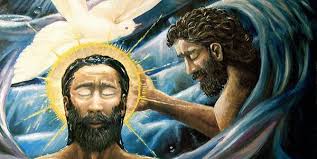
Surely, we can learn to tell our stories, to enact our rituals, and to be LOVE to one another in ways that transcend, religions, cultures, and old hatreds? – a sermon on the Baptism of Jesus

Baptism of Jesus – Mark 1:4-11  audio only

Welcome to a new beginning. The celebration of the Baptism of Jesus begins the church lectionary’s focus upon the Gospel according to the anonymous gospel-storyteller that we call Mark. For the balance of the church year most of our gospel readings will come from the oldest gospel in the New Testament, from storyteller that we call Mark. Written before the development of the nativity myths, this gospel begins with the story of Jesus baptism by the prophet known as John the Baptist. As the oldest account of Jesus’ baptism, written sometime after the year 70, some 40 plus years after the execution of Jesus of Nazareth, this story gives us particular insights into the ways in which the legacy of Jesus was experienced by the early followers of the teachings of Jesus.  In those early years of the followers of the Way, Jesus’ life and teachings not only ushered in a new way of being in the world, they also provided a new way of understanding the Divine.

Jesus of Nazareth was a Jew. Raised in the ways of first century Jewish people, Jesus would have been taught to relate to the Source of All Being, the One we call God, as a far off distant, super-natural being.  This is the kind of understanding of Divinity that is reflected in John the Baptizer’s proclamation of a baptism of repentance for the forgiveness of sins. However, this is not the understanding of Divinity that the anonymous gospel-storyteller that we call Mark portrays in his depiction of Jesus’ baptism. Most of us have heard the stories of Jesus’ baptism so many times that we tend to miss the radical nature of Jesus’ baptism. Once we let go of the notion that this is some sort of historical account of Jesus baptism, we can begin to understand how the gospel-storyteller understands the significance of Jesus’ life and teachings.

“Immediately upon coming out of the water, Jesus saw the heavens opening and the Spirit descending on him like a dove. Then a voice came from the heavens: “You are my Beloved, my Own. On you my favor rests.” The intimacy portrayed in this story, defies what would have been, for the story-teller and the story-teller’s community, the accepted understanding of the nature of the Divine. The God depicted in this story is radically intimate. Jesus’ relationship to the Source of All Being, is one of intimacy. You can almost hear the Creator of All that Is, declare, lovingly, “That’s my boy! He brings me such pleasure.” At that time, the prevailing understanding of God, of YAHWEH, as KING of KINGS, LORD of LORDS, is expanded to what will eventually be taught by Jesus as Abba, or Daddy. Jesus’ teachings move beyond the hoped for super-natural, super-hero God, that the persecuted Hebrew people longed for and point instead to a God who is known in the intimacy of LOVE. Within the Jewish tradition there was and is a great diversity of depictions of the Creator of All that IS. Sadly, so many of those depictions of Divinity had been reduced to an understanding of God as a super-natural-male-being. The feminine attributes of the Divine that are depicted in the Hebrew Scriptures were largely forgotten. Gone too were the depictions of the Divine as something other than a super-natural being.  It was as if, over time, the understandings of the Power that lies at the very heart of reality were reduced to the projections of human desires to be saved from the trials and tribulations of this life. Continue reading

Sermons on the Baptism of Jesus

Wear Your Baptism in Ways that Others Might See a Visible Means of Grace in You

Recognizing the Sacred In and Beyond the Stories We Tell: the Baptism of Jesus 

The Things We Do For Jesus! 

A Progressive Christian Wades Into the Waters of Baptism

Baptism: A Mystery of the Faith

Beloved, Lover, and LOVE Itself

Wear Your Baptism in Ways that Others Might See a Visible Means of Grace in You – a sermon on Baptism

img_6946

Listen to the sermon here

How many of you know what this is? Where I come from it is often referred to as a dog-collar and the folks who wear them are called God-Bothers. Back when I first started seminary, I resolved that I wouldn’t wear a clerical shirt and collar. I didn’t like the idea of being set apart from others. I really didn’t want to be seen as one of those holier-than-thou types, who took themselves so seriously. Learning the history of clerical garb didn’t help me to warm up to the idea of wearing them. Apparently, back in the middle ages fashion dictated that educated professionals wear black. Also, during the middle ages, long before shirts had collars it was all the rage to let your white undergarments show around your neck. This was the precursor to shirt-collars. Apparently during the reformation, this trend fell out of fashion but clergy, who couldn’t afford to keep up with fashion continued to wear black shirts with their white under-garment showing.      

Over time, the church does what the church often does and applied a liturgical meaning to explain what is already happening. So, the church began to explain clerical attire theologically. If you google it, you will discover that, pastors are just like everyone else, they are in bondage to sin and cannot free themselves. So, they wear a black shirt to signify their sinfulness, but they wear a white collar to signify that the words they speak are not their own, but God’s words, because you see the collar covers the pastors voice-box to signify that we speak the Word of God. Now the presumption that I or anyone else speaks on behalf of God is rather daunting to say the least and did nothing to encourage me to wear a clerical collar, nor did the obscure explanation of the tab collar, which insists that this little white notch is placed strategically over the Adam’s apple to cover over the reminder of Adam’s sin. Not having an Adam’s apple, myself, I wasn’t much taken with the idea of wearing special clothing to set me apart. But when I first became a pastor, I was insecure and believe it or not I didn’t want to rock the boat. So, I ever so hesitatingly began wearing a clerical collar. I was uncomfortable wearing the collar, so I decided that I would only wear it on Sundays, or to protest marches, and sometimes when I was visiting people in the hospital, because in hospitals, wearing a collar makes it easier to gain access to patients.

Well one day, I needed some candles and so I dashed into the Zellers over the road to quickly grab a couple. I was having difficulty finding just the right candles when a store clerk came up to me and asked me if I would come with her. I figured that I’d been lingering over the candles for so long that she must have mistaken me for a shoplifter, but as we hurried along, she explained to me that there was a man in housewares who was abusing his wife and child. I’d forgotten that I was wearing a collar, but the reality of what this clerk was asking me to do choked me into realizing that the collar had led her to believe that I could actually do something. Not knowing what she expected me to do, I told her to call 911. She assured me that they had already called, but that in the meantime perhaps I could help. We stopped just before the aisle where the abuse was taking place. The store clerk whispered that, “they are just over there.”  As she pointed, I realized that she wanted me to go on alone. So, not knowing what to expect, I took a deep breath and walked in on a scene that was way beyond my abilities. A big burly guy was twisting the arm of a woman while a little girl of about 4 or 5 stood crying. The man was yelling obscenities when I interrupted him. When he looked at me, I saw the fear in his eyes as he immediately let go of the woman who fell to the floor. The little girl ran to her mother. I expected the man to turn on me, but instead he just stared at me, as he began to cry, “I’m sorry pastor, forgive me.” It wasn’t I who stood before him, but the church, his church, the church that had taught him right from wrong. The collar I wore made the church visible to him and made it impossible for him to forget who he was. As a child of God, he couldn’t continue what he was doing. As a child of God, he knew in his bones that he was wrong. He wept until the police arrived. From that day on, I’ve known the power of the collar to make the church visible in the world and so I wear it a lot more often than I’d ever expected I would. Continue reading

So, what is it that we are longing for when we say to a fellow creature, “Happy New Year”??? a sermon Luke 2:22-40

Well, congratulations we made it! When 2017 began, there were a great many people who wondered if the man who was waiting to be sworn in to the most powerful office in the world would take us down a path of mutual self-destruction. While it has been an amazing year, our worst fears have not come to fruition. 2017 may go down in history as the year that a narcissist drove us all to distraction, but the doomsayers’ predictions that, “the end is nigh” have not come to pass. I suspect that pessimists of all sorts have been predicting the end of the world since the world began. So, on this the last day of this very strange year, we greet one another in the same way as our ancestors greeted one another: “Happy New Year!” and even as we bid one another a Happy New Year, we know that the forecast for the coming year looks bleak.

There is little doubt that 2018 will see the continuation of the abuse of our planet. We humans will go on burning the stuff that we know full well is causing climate change that will have catastrophic effects on the environment. Species will continue to become extinct. Peace in the Middle East is more elusive than ever. Most of us aren’t expecting a lull in terrorism anytime soon. The mess in Syria will continue to be a mess from which refugees will continue to flee. The flow of refugees will continue to expose the racist underbelly of far too many cultures.

The madman in North Korea and the narcissist in Washington will continue to taunt and threaten one another, while the world wrings its hands. Nationalism and tribalism isn’t going away in the New Year. Indeed, we all know that the most powerful office on the planet is in the hands of a man whose ignorance knows no bounds. The prognosticators, the talking heads, the prophets of our day are warning of a new and frightening Cold War that will continue to threaten our way of life. The poor are still with us. Despite all our technological advances, despite our proven ability to feed everyone on the planet three times over, men, women, and children continue to starve to death in all sorts of places all over the planet. We also know that basic human rights that we take for granted like clean drinking water are denied to far too many communities in this country, a land that actually contains one quarter of the world’s fresh water. We know that the rich keep getting richer, the poor are getting poorer and the middle-class is disappearing, and we know that money can’t buy us happiness. Yet, in the midst of all these obstacles we continue to bid one another a Happy New Year. Even though we know that the folks we are wishing a Happy New Year will continue to face not only these obstacles but the realities that illness and death will no doubt touch their lives in some way or another, precisely because illness and death are part of life. Continue reading

Incarnation Changes Everything – a sermon for the first Sunday after Christmas – Luke 2:8-20

God In US pastorDawnI have tried to locate the source of the parable told in this sermon about the encounter between the little boy and the old woman. But despite the many authors who claim it as their own, I suspect that its origins go back farther than I have been able to trace. The Readings for this first Sunday after Christmas offer us the parable of the Presentation of in the Temple: Psalm 42:1-3, Galatians 4:4-7, Luke 2:8-20

You can listen to the sermon here

The nativity stories about the birth of Jesus of Nazareth are parables carefully crafted by the Gospel storytellers to make us think. This morning we have another parable that is also carefully crafted to make us think. The question 21st century readers of this parable may well ask is, “What is it that the gospel storytellers want us to think about this parable often referred to as the “Presentation of Jesus”?

One ancient way of discovering meaning in a parable is to tell the parable alongside another story and allow the second story to interpret the first. So, let me tell you a story about a little boy who wanted to meet God. The little boy knew it was a very long trip to where God Gives, so he packed his suitcase with some tubes of Smarties and some cans of Coke and he set off on his quest to meet God. When the little boy had gone half a mile or so, he met an old woman. She was sitting in the park just staring at some pigeons. The boy sat down next to the old woman and he opened up his suitcase. The little boy was about to take a drink from one of his cans of Coke when he noticed that the old lady looked hungry. So, he offered her some of his smarties. The old woman gratefully accepted the smarties and smiled at the little boy. Her smile lit up her whole face. I was so lovely, the boy wanted to see her smile again, so he offered her a drink of Coke. Once again, the old woman smiled at him and the little boy was delighted! They sat there all afternoon eating and smiling, but they never said a world. As it grew dark, the boy realized how tired he was and he bot up to leave, but before he’d gone more than just a few steps, he turned around, and ran back to the old woman and gave her a big hug. The old woman gave him her biggest smile ever. When the little boy opened the door to his own house a sort time later, his mother was surprised by the look of pure joy on his face. She asked him, “What did you do today that made you so happy?”          The little boy declared, “I had lunch with God.” And before his mother could respond, he added, “You know what? She’s got the most beautiful smile I’ve ever seen!”

Meanwhile, the old woman, also radiant with joy, returned to her home. Her son was stunned by the look of peace on his mother’s face and he asked, “Mother, what did you do today that made you so happy?” The old woman replied, “I ate Smarties in the park with God.” And before her son could respond, she added, “You know, God’s much younger than I expected.”

Our expectations have been groomed to point us up, up and away, out there, far beyond the everyday clatter of our lives. Sometimes, we expect that just for a moment the sacred will pierce our reality. At other times, when we are in need, we summon up the sacred in the guise of a god all dressed up in majesty, strength, wisdom, authority, and immense power, yet gentle, loving, and attentive to our every need. Continue reading

The Messiah Is Among Us!

Christ is born in youDuring these twelve days of Christmas we celebrate the birth of the Messiah. Messiah, is a word the ancient Hebrews used to describe the anointed one. The one whom God would send to change the world. In Greek the word for Messiah is Christ.

My thoughts swirl around a poem written by the unknown writer of the Gospel of John in which the birth of the Christ is describe as the WORD. It’s a mysterious cosmic poem that moves our minds away from the mundane everyday ordinary stuff of life to the extra-ordinary mysteries of creation, which when you think about it is what every birth does.

Just holding a newborn in your arms and before long you’ll find yourself pondering the mysteries of this life. Who are we and where do we come from?  Why are we here? What does it all mean? These are all perfectly wonderful questions and speculating upon the many possible answers to those questions is a fascinating process. But in the end, our words will always fail us when it comes to answers. As we are speculating about the birth of this beautiful little baby, the baby is alive and among us, and needs to be fed and changed, nurtured, guided and protected. Continue reading

Every Christmas is a Thin Place – Christmas Eve sermon

Christmas, every Christmas is a Thin Place. According to the Irish, a Thin Place is a place where the boundaries between heaven and earth fall away. Every Christmas is a Thin Place where the boundaries between our everyday existence and the reality that we are all part of something so much bigger than ourselves, well these boundaries fade away at Christmas.  Thin Places are those precious moments in time when the sacred can be seen in the everyday stuff of life. Christmas with its powerful parables, myths, metaphors, and symbols acts as a giant welcoming Thin Place were the boundaries and veils fall away and we are able to recognize the sacred in ourselves, in one another, and in the world around us. I could go on and on about the power of Thin Places to open us to the reality of the LOVE that we call God. But rather than try to explain how the Christmas stories, parables, myths, metaphors, and symbols create thin places, let me tell you a story designed to create a thin place where together we can see the veil between the scared and the everyday fade away.

It was the day before the day before Christmas and Angela had just about finished decorating her band new swanky apartment on the West-side. Everything was just perfect; each of the decorations had been chosen with such care. Just like all the furniture in her apartment each and every one of the Christmas decorations was brand spanking new. In a couple of hours Angela expected that her apartment would be full of guests. Her guests had been as carefully chosen as each of the items that adorned her apartment. It was all designed to show everyone how very well Angela was doing.

This Christmas, unlike so many other Christmases that Angela had endured, this Christmas everything was going to be perfect. Angela planned to lavishly entertain her guests. The evening’s entertainment was guaranteed to get Angela’s Christmas off to the best of starts. At least here in her lovely new home, Angela would be in control. Unlike the chaos of her family’s Christmas gatherings. All her life, Angela had endured the trials and tribulations of her family’s dysfunctional yuletide gatherings; gatherings that always ended up with various family members arguing over some perceived slight. Tonight, things would be different. Tonight, Angela hadn’t invited a single member of her outrageous family to come and dine. Tonight, Angela’s guests were made up of the great and the good, new friends and work colleagues; people Angela could count on to behave admirably. Tonight, everything would be perfect.
All she needed to do to finish off the room, was to assemble the new nativity set that she had just purchased upon her beautiful fireplace mantle. She hadn’t planned to purchase a nativity set, but when she saw the hand-carved, olive- wood nativity set in the window of the swanky gift shop, she just knew that it was perfect.
Continue reading

A Newborn Baby Positively Oozes with the Aura of the MYSTERY that Lies at the Very Core of Reality – a Christmas Eve sermon

Sermon preached on the morning of Christmas Eve – Luke 2:1-20

Listen to the audio only version sermon here

Every Christmas, the parables, myths, stories, metaphors, and symbols that proclaim the birth of God among us do more than recount the birth of a baby in an ancient faraway land. Every Christmas, these parables, myths, stories, metaphors, and symbols proclaim the birth of hope in us; hope not just that some far off supernatural being is going to come and save us from the worst of who we are, but hope that the Source of ALL, the Creator of Universes, the ONE Who IS, WAS, and Every More Shall BE, the ONE in Whom we LIVE and MOVE and Have our Being, this ONE who lies at the very heart of reality, is born over and over again to live and breathe in, with, through, and beyond us. The words just don’t do this reality justice, so we resort to the power of these parables, myths, stories, metaphors, and symbols, to move us beyond words so that we might approach the truth of our humanity. It has been said that the shortest distance between humanity and the truth is a story. So, is it any wonder that we approach this sacred celebration of who and what we are, by telling stories.

Together, at Christmas, we participate in the birth of a child. We see in the image of a new born baby swaddled in our hopes and dreams.  All our longings for LOVE and peace rest in the images that live and breathe in this story that has been handed down to us. It is a story we know so well and yet, it is a story that we have barely begun to understand. Like all stories, we can simply listen to it, or read it, and respond with little more than a nostalgic nod to simpler times when we hoped that someone or something out there, or up there, would come and save us from ourselves, our warring madness, and selfish greed, or we can open ourselves to the transformative power that some stories have and we can boldly dare to participate in the story, engage it, wrestle with it, and make it our own. If we let it, this story can open us to that which lives and breathes beyond the words of the story. The characters in this story can live and breathe and have their being in us.

Sadly, we all too often get bogged down in the words themselves, measuring them and testing them as we try to pinpoint the origins of the words and miss all together the many truths that this story can convey.  Some folks never get past arguing about the history. They just can’t seem to understand the power of myth to convey truth. The ancient scribes, who passed this story on to us, knew well the wisdom using mythology to convey truth. So, on this Christmas Eve, in the presence of one another, let us seek the wisdom of the ages remembering that wisdom is a precarious treasure; a treasure that has the ability to enrich our lives. At the heart of this story is a newborn baby. Each and every one of us is wise enough to know that there is nothing like a newborn baby to help you get to the very heart of reality. For who among us can hold a newborn in our arms and not wonder? Awe and wonder is the place where wisdom begins. A newborn baby positively oozes with the aura of the mystery that lies at the very core of reality. Who is this little creature? Where did it come from? How did get here? Who created it? What is it? What is life? What is it all about? Continue reading

“God Steps Down Amid Sexual Assault Allegations” an Advent sermon on Luke 1

Listen to the Audio only here

There is a meme doing the rounds on the internet that points an accusing finger at today’s readings: It’s a joke of sorts, that begins with the headline: “God Steps Down Amid Sexual Assault Allegations” The joke continues: “God the Father, Creator of Heaven and Earth will be stepping down as Supreme Lord of the Universe amid allegations of sexual assault from Mary, the mother of his son. In a guest column of the Jerusalem Times, Mary detailed God’s grooming tactics, exploitation of power dynamics, and physical coercion that ultimately resulted in the birth of their son, Jesus.”

There is another meme that’s been going around the church for centuries. Listen, I think you may know it:  “I believe in God, the Father almighty, creator of heaven and earth. I believe in Jesus Christ, God’s only Son, our Lord, who was conceived by the Holy Spirit, (wait for it….) born of the virgin Mary, … The Apostles’ Creed…As a progressive Christian congregation…we no longer recite the Apostles’ Creed in worship… Nor do we recite the Nicene Creed…

“We believe in one Lord, Jesus Christ, the only Son of God, eternally begotten of the Father, God from God, Light from Light, true God from true God, begotten, not made, of one Being with the Father; through him all things were made. For us and for our salvation he came down from heaven, was incarnate of the Holy Spirit and the virgin Mary and became truly human.”

In the Evangelical Lutheran Book of Worship and even in the old green Lutheran Book of Worship, the creeds are what is a “may rubric”. Open up your hymnals to page 104

“The Nicene Creed or the Apostles Creed may be spoken” The word “may” indicates that the creeds don’t have to be recited, but that they “may be spoken.”  The creeds take us back centuries to a time when various factions in the church couldn’t stop arguing about the nature of Jesus’ humanity. These arguments lead to battles in which hundreds and indeed thousands and thousands of people were killed. Historically, the creeds functioned as a kind of laying down of the law, this is what you shall, no “may” about it this with what you “shall” believe. Most Lutheran churches continue to recite the creeds in worship, even though they are a “may rubric”. So, I wasn’t surprised last week, when I attended an ordination service in which our Bishop Michael presided, that I found myself being asked to recite the words of the Apostles’ creed. Nor was I surprised as the congregation around me dutifully recited the words of the Apostles’ creed, that I couldn’t for the life of me, no matter how much I would like to have simply played ball, I just couldn’t bring myself to say the words of the Apostles’ Creed as an act of worship.  There’s just something about Mary that trips me up every time I try to say the words, for I do not believe that Jesus was born of a virgin.

Jesus’ mother may have been many things, but I do not believe that Jesus’ mother was a virgin. You see, I’ve been to seminary and I have studied the Hebrew Scriptures and the New Testament and I know that the very best New Testament scholars in the world teach us that our English translations of the Gospels are based on the anonymous gospel storytellers’ incorrect translation of the Hebrew text found in the book of the Prophet Isaiah’s words “Behold the Lord Himself will give you a sign, a Virgin shall conceive and she shall call his name Immanuel.”

 The Hebrew word which some men chose to translate as “virgin” is more accurately translated as “young woman” or “young maiden” There is a Hebrew word for “virgin” but that word for “virgin” does not appear in the Hebrew text. Over the centuries the anonymous gospel storytellers’ inaccurate translation has been repeated so many times that Mary’s virginity is now considered “gospel” — pardon the pun. Continue reading

Preparing to encounter eternity – a sermon for the Second Sunday of Advent

The memories described in this sermon were provoked by the writings of Thomas Moore. I am indebted to Moore’s chapter on “The Christmas Tree” in his book “The Soul of Christmas” for opening me to some of the realities of our tree rituals. Dr. Seuss provided the Whos from down in Whoville.  you can listen to the audio here or watch the video below

PREPARE THE WAY FOR OUR GOD! Become the Prophet Crying FOR the Wilderness! – a sermon preached on the Second Sunday of Advent when John the Baptist Cries

BCsunsetI didn’t know it at the time, but I actually met John the Baptist when I was fifteen years old. She didn’t look much like you’d imagine John the Baptist would look, but she had that same crazy intensity, that same focus on the fact that we’d better change our ways, we’d better repent, and start doing things differently or we’d be in real serious trouble. Lola was my friend Valerie’s mother and she simply couldn’t stop going on and on about the environment and how we were destroy the earth. At the time, I remember thinking she was a bit of a nut-case and on more than one occasion I wished she’d just shut up about it. I was just a kid, and the earth was just something I took for granted.  The earth was just there to provide for our needs. I couldn’t believe how much Lola went on and on about all the stuff we humans were doing to destroy the earth. I just wished she’d leave us along to get on with things, I couldn’t abide her incessant nonsense about how we were going to destroy the planet.  All her feeble little attempts to be kind to the earth, made me seriously question her sanity.

I tolerated Lola not just because she was my friend’s mother, but I didn’t really understand her until one day when the three of us were travelling together. We were coming home from church. I had only been going to church for a few months.  I was trying hard to understand this whole God thing. So, I went to church a lot.  My friend Valerie had persuaded me to start going to church with her and family had become like my second family as they supported me during my first attempts to explore the mysterious world into which I had begun to feel pulled. As we drove home from church, I was feeling a little glum. Try as I might, I couldn’t really understand this church thing; all that singing and praying didn’t really help me to feel closer to God. Mostly I just liked how people at church treated each other.  I liked how they went out of their way to help me feel at home. Whether or not God was there, well I really wasn’t sure. 

Anyway, we were driving along the road.  It was a partly over-cast day on the west coast of British Columbia, just a few clouds.  You could see the mountains off in the distance. We were chatting back and forth when all of a sudden Lola pulled the car over to the far side of the road, switched off the engine and got out.  Valerie followed her mother out of the car, so I figured I had better do the same.  Val and her mother scampered down from the road and onto the beach.  When they reached the water’s edge, they stopped and just looked off into the distance.  Apart from a tanker-ship making its way across the horizon, I couldn’t see much of anything. Lola had the most amazing expression on her face.  She positively glowed with happiness.  Valerie wore a similar expression.  I must have looked somewhat puzzled because Val smiled at me and said,  “Isn’t it the most beautiful thing you have ever seen?”  This only confused me more.  What were they looking at that had made them stop the car, scamper down the bank and stand there at the water’s edge on a cold autumn evening? 

Maybe my parents were right, these religious types are a little bit weird.  Happy, glowing, smiling people make me nervous. There they stood grinning from ear to ear.  What were they on?  And then, I saw it.  For the first time in my life, I saw it.  It had been there before.  But I had never really seen it before. The sky was amazing.  The colours were overwhelming.  It almost didn’t look real.  It looked like someone must have painted it that way.  It was magnificent, a work of art,  the most beautiful thing I have ever seen!

If you’ve never seen a late October, Pacific Coast Sunset before, you’ve missed one of the great wonders of the world. Neither Emily Carr’s paintings nor picture perfect post cards do a western sunset justice. Believe it or not, even though I had been living on the west coast for about four years, at that point I had never before really noticed just how beautiful a sunset could be.  No one in my experience had ever taken the time to stop and look at one. No one had ever pointed one out to me before.  I would never have dreamed of stopping a car and getting out to watch as the sun put on a show while setting. So I stood there. Overwhelmed by it all.  Amazed at just how beautiful it was. Wondering just who or what could be responsible for such a spectacular thing as this.  Before long my thoughts drifted to the Creator. Suddenly this God, that I had been trying so hard to fathom, was there. Right there.  Not just in the magnificence of the sunset, but right there on the beach.  At that moment, I was just as sure of God’s presence as I was of my own. I remember an overpowering feeling  of gratitude, gratitude for God’s presence, gratitude, because for the first time in all my life I was at home.  I knew that I was home. Home, not because of the place; home not because of the beauty of the sunset, but home because of God’s presence.  That longing that I had always felt; that longing that I have always labelled as homesickness, that over-powering longing was gone.  In that glorious moment, the presence of God, filled my longing and I was at home.

I’m sure that each of you could tell of a similar experience. So many of us have been blessed by the presence of God in creation. So many of us have had our longing for God filled by the wonder and majesty of creation. I suspect that our love of creation comes as a direct result of our relatedness to creation. For like creation and everything in creation we share a common Creator. My own love affair with creation kicked into high gear on the beach gazing at the magnificence of the setting sun and it has grown in intensity over the years. This past summer, Carol and I drove out to Vancouver and I have to say, if you want to renew your love for creation, drive across this magnificent country of ours.

You’ll find yourself absolutely besotted with creation as you fall in love all over again. By the time we reached my beloved Rocky Mountains, it was like some star-crossed lover, who simply couldn’t help herself from bubbling over with excitement. Not even the first rainy day of our trip could dampen my excitement as we drove south from Jasper toward the Columbia Ice fields. I couldn’t wait to gaze upon the grandeur of the glacier that I remembered from so many visits over the years. The rain was falling quite heavily as we pulled into the massive parking lot perfectly situated across from the ice-field. As we climbed the steps toward the viewing station, I couldn’t see much because I’d pulled my hood up over my head to protect me from the rain. When I reached the top and looked across the highway, it took my breath away, the mass of ice that was frozen in my memory, was gone.

I’m not sure if the drops of water falling down my cheeks were raindrops or teardrops, as I stood there frozen by a strange mixture of fear and sadness. In the decades that have passed since I first began to visit the ice-fields back in the 1970’s the ice has been receding at a rate of between 10 and 15 centimeters per decade. 120 centimeters may not seem like a great distance, but couple that with a decrease in the thickness of the ice and it is positively shocking to see the amount of ice that has vanished from view.

jokulsarlon-glacier-lakeTake a look at the iceberg that I asked Andrew to hang. This photograph was taken in a place I visited long ago. It’s a place were icebergs are born. I ended up there back in the days when I was in the travel business and ended up on a cheap Air Iceland flight that was delayed for a week in Reykjavík for a week. Back then Iceland’s airline must have had only two airplanes and when one of them suffered mechanical difficulties you literally had to wait around for them to fix it. It’s one of the reasons that flights were so cheap on Air Iceland.  You simply never knew how long your stopover in Iceland might be. I was trapped there for a week and during that time we decided to explore some of the most amazing geological sites that the earth has to offer. We travelled about 400 kilometers outside of Reykavik to the Jokulsarlon Lagoon; the birthplace of glaciers. It was in this strange lagoon, under an eerie twilight that lasted for the entire duration of my stay in Iceland, that I stud on the hull of a small tourist vessel, staring up at a magnificent glacier. I have no words to describe my terror. Continue reading

Advent Blue

When we leave behind our personifications of the Deity, we can’t help but rekindle our love of God in whom all of creation rests. Recognizing the Earth as sacred and moving toward an understanding of the Earth as a beautiful part of the Body of God is vital to our being in God. Peter Mayer’s hymn to our Blue Boat Home puts a whole new hue in my perception of Advent Blue! I suspect the Welsh tune HYFRYDOL might also have something to do with my appreciation of this splendid addition to my Advent tradition! Enjoy

WAKE UP for CHRIST’s SAKE! – sermon for Advent 1B

purple universeOn this first Sunday in Advent we awakened ourselves to the cosmic contours of the darkness. Our first reading was The Star Within: a creation story by Dr. Paula Lehman & Rev. Sarah Griffith, followed  by a musical video reflection My Soul by Peter Mayer which you can watch  HERE Our Gospel reading was from Mark 13:24-37. Listen to the sermon here


As we embark on the journey of Advent, I need to take a poll, and there’s not much time left, so, we’ll conduct this particular poll by a show of hands. Before you answer this question, would you please close your eyes. Now, for the sake of this poll, I’m not going to continue until everyone has their eyes closed. Notice the darkness, the blackness that enfolds you. Now, I’d like you to remember the carefully and respond as honestly as possible: By a show of hands, when you were a child, how many of you were afraid of the dark? Pease answer as honestly as you can. Don’t worry about anyone knowing that you were afraid of the dark, I’m the only one who has their eyes open and I’m clergy, so I’m bound by the confidentiality of my profession and the privacy act, not to tell anyone.
Ok, those of you who were afraid of the dark when you were a child, you can put your hands down, but keep your eyes closed. Now, those of you who weren’t afraid of the dark when you were a child, please raise your hands. Ok, everyone keep your eyes closed. One more time, I need you to notice the darkness. Now, keep your eyes closed, do not open your eyes until I tell you to and listen carefully to the Gospel according to Mark:
Jesus said: “In those days, after that suffering, the sun will be darkened, and the moon will not give its light, and the stars will be falling from heaven, and the powers in the heavens will be shaken. Then they will see ‘the Son-of-Man coming in clouds’ with great power and glory. Then the Son-of-Man will send out the angels, and gather his elect from the four winds, from the ends of the earth to the ends of heaven. From the fig tree learn its lesson:  as soon as its branch becomes tender and puts forth its leaves, you know that summer is near. So also, when you see these things taking place, you know that he is near, at the very gates. Truly I tell you, this generation will not pass away until all these things have taken place. Heaven and earth will pass away, but my words will not pass away.
But about that day or hour no one knows, neither the angels in heaven, nor the Son, but only the Father. Beware, keep alert; for you do not know when the time will come.
It is like someone going on a journey, who leaving home and putting the slaves in charge of their own work, commands the doorkeeper to be on the watch. Therefore, keep awake—for you do know when the lord of the house will come, in the evening, or at midnight, or at crockcrow, or at dawn, or else, coming suddenly, the lord may find you asleep.
And what I say to you I say to all:  Keep awake.” The Gospel of Christ.
All right, everybody, WAKE-UP! I mean it! Wake up! There is darkness all around us!!!
Danger everywhere you look. I need you all to WAKE-UP FOR CHRIST’S SAKE!!!!
Don’t sit down! Are you crazy. Who sits down in the midst of darkness? If you sit down, you’re likely to fall back to sleep! I need you to keep awake! Keep awake—for you do know when the lord of the house will come, in the evening, or at midnight, or at crockcrow, or at dawn, or else, coming suddenly, the lord may find you asleep. And what I say to you I say to all:  Keep awake.
KEEP AWAKE FOR CHIRST’S SAKE! This is the Gospel of Christ! Keep awake!
The good news is that there are those among us who have never been afraid of the dark. All right, if you promise to Keep AWAKE, you may open your eyes and sit down.
Welcome to the season of Advent. While the world is busy scurrying about preparing for the arrival of Santa Claus, we here inside the walls of the church are embarking on a journey into the darkness. Out there, t’is the season to be jolly! It is the season of good cheer, so everyone is busy getting all the stuff they need to be cheerful. There are decorations to be hung, lists to be made, presents to be bought, special food to be acquired, more presents to be bought, special drinks to be stockpiled, more presents to be bought, people to visit, more presents to buy, carols to be sung, parties to go to, people to visit, gifts to give, fun to be had as our world prepares for the arrival of  the baby Jesus or Santa Claus depending on your particular point of view. But in here, inside the walls of the church, the Body of Christ, it is my job to tell you all to wait. Advent the season when the church does it’s level best to hold off our culture’s rush toward a happy, jolly, Christmas each year!!! Advent the season of the church year, when those of us who seek to follow the teachings of Jesus of Nazareth are invited to prepare ourselves not for the birth of a baby, but rather to prepare ourselves to give birth to Christ again and again and again.
Birth and darkness are intimately related to one another. Gestation takes place in the darkness; the seeds need the darkness of the earth, humans the darkness of the womb. Movements and revolutions are created in the darkness. The darkness of poverty and despair, the darkness of injustice and war, the darkness of danger and death germinate the seeds of movements and revolutions.
Beware! Be very aware! I am not inviting you into the darkness that is conducive to a winter’s nap. The darkness that I am inviting you into in this season of Advent, is a very dangerous darkness, the kind of darkness that requires you to KEEP AWAKE! WE ALL KNOW THIS DARKNESS WELL! We more than any of those who have gone before us are all too familiar with the darkness. We have more information about the darkness then generations of humans have ever had. At our very finger-tips we have devices which will bring word of the darkness to us 24 hours a day. In our living rooms, in our automobiles, even in the shopping malls, we can hear tell of the dangers of the darkness. Our earth is suffering under the weight of our filth. Continue reading

Pregnant with Possibility: Advent 1B sermon Mark 13:24-37


This sermon for the first Sunday of Advent was inspired by a sermon written by Ian Lawton entitled “The Mother of All Virgin Births” in which I was captivated by his use of the phrase “pregnant with possibility.” I read Lawton’s sermon after first reading John Dominic Crossan and Marcus Borg’s book “The First Christmas” in anticipation of Dom Crossan’s first visit to our congregation (2008). I was so eager to prepare the congregation for Dom’s historical approach to Christmas that  I fear the sermon is overflowing, perhaps a little too pregnant with details.  Luckily, the congregation was treated to the wonders of Dom Crossan’s brilliance for several days and learned well from the master about the delights of historical details. I post the sermon here, trusting that some of the details may be enlightening as we once again prepare ourselves for the Season of Advent.

Let me tell you a story from down-under; an Australian story that was doing the rounds a few years ago. Like all stories it may never have actually happened, but it is absolutely true because it happen again and again, in various and myriad ways. This story happened a while ago in Brisbane, Australia…

“The story begins in the dark. A university student named John was on the side of the road hitch hiking on a very dark night and in the midst of a storm. The night was rolling on and no car went by. The storm was so strong John could hardly see a few feet ahead of him. Suddenly he saw a car slowly coming towards him and slowly it stopped. John was desperate for shelter and without thinking about it; he got in the car and closed the door.

It took only a moment for John to realize that there was nobody behind the wheel and the engine wasn’t on! But the car started moving slowly. John looked at the road and saw a curve approaching. John was so scared, that he started to pray, begging for his life. Then, just before he hit the curve, a hand appeared through the window and turned the wheel. John, paralyzed with terror, watched how the hand repeatedly came through the window but never harmed him. Eventually, John saw the lights of a pub down the road and so gathering his strength, he jumped out of the car and ran into the pub.  Wet and out of breath, he rushed inside and started telling everybody about the horrible experience he had just had. A silence enveloped the pub when everybody realized he was crying and he wasn’t drunk.  Suddenly two other people walked into the pub.    They, like John, were also wet and out of breath. They looked around and saw John sobbing at the bar, one of the men said to the other, ‘Look, Bruce, there’s that idiot that got into the car while we were pushing it.’

Spiritual Philosopher, Ian Lawton insists, “There is always more to life than meets the eye. There is more to life than what our sight is able to see. Our eyes don’t simply pick up information relayed from an outside world and relay it to our brains. Information relayed from the outside through the eye accounts for only 20 percent of what we use to create a perception. At least 80 percent of what the brain works with is information already in the brain. We only use a small fraction of our brainpower. We very rarely exercise the full potential of our physical strength. We rarely access all that is available to our senses. We rarely maximize the potential of our mind, body and spirit in harmony. There is always more to life than meets the eye.” Continue reading

Reign of Christ Sunday – sermons

I usually struggle with this archaic feast day for nothing about the teachings of Jesus remotely suggests that the title “KING” would have appealed to him. The Church on the other hand, was only too willing to claim the title for their founder. So whether it’s “Christ the King Sunday” or “Reign of Christ Sunday” or “Cosmic Christ Sunday”, to me it is simply the last Sunday of the church year and I can’t wait for Advent. Fortunately, I had the presence of mind to book a vacation, so I don’t have to preach this Sunday. Here are a few links to some efforts I have made in the past. Enjoy!

Ruled By a Power Greater Than Fear

Home in the Love We Call God

Jesus Remember Me When You Come Into Your Kin-dom

Quest for the Cosmic Christ

Preparing to Preach or Not to Preach on Reign of Christ Sunday

For our American Cousins – Thanksgiving resources

At the request of several of our American cousins, here are a few resources for Thanksgiving.  Thanksgiving celebrations invite us to remember not just our blessings, but the Source of All that IS.


Follow the links to sermons:

To Whom Shall We Go to Say Thank-you After We have Moved Beyond Personifying God

The Blessing of Michael’s Story

Reckless Generosity a sermon with a Monty Python flair!

Who IS God? – Not One, Not Two – inspired by Garrison Keillor & Joan Chittister

Brussel Sprouts, Ebola, and Thanksgiving – seeking the ONE who IS


Don’t you dare slam the door on my face, just because I went to get gas, because you kept me waiting! – a sermon Matthew 25:1-13

audio version here

“Wisdom, Sophia is bright, and does not grow dim, by those who love her she is readily seen, and found by those who look for her. Quick to anticipate those who desire her, she makes herself known to them. Watch for her early and you will have no trouble; you will find her sitting at your gates. Even to think about her is understanding fully grown; be on the alert for her and anxiety will quickly leave you. She herself walks about looking for those who are worthy of her and graciously shows herself to them as they go, in every thought of theirs come to meet them.” (Wisdom of Solomon 6:17-18)

“Sophia, if you are there, show yourself.” This has been my mantra as I have tried to sort out the meaning of this strange tale about ten bridesmaids. I must confess that the impish Sophia, whose playful nature inspired our forbearers to sing, dance, laugh, and play, might just be behind the creators of the lectionary’s decision to put today’s readings together. That these readings should appear, on this Sunday when I am supposed to be inspiring you to set out on the third installment of our Visioning Process, has caused me no end of consternation and grief.

Have you heard the one about the ten bridesmaids and the very late bridegroom? Well if you have heard it, can you please remind me of the punch-line, because I don’t see the point of this so-called parable. Ten bridesmaids were waiting for a bridegroom! Five of the bridesmaids were wise and five of the bridesmaids were foolish; all of them, the wise and the foolish fall asleep. Suddenly, they are awakened by a shout, “the bridegroom is almost here, come out and meet him.” The wise bridesmaids had brought along some extra oil for their lamps, the foolish bridesmaids had not.  The wise bridesmaids aren’t very nice and refuse to lend any of their oil to the foolish bridesmaids, so the fools have to go off to the store to get some more oil. Long before the bridegroom arrived all ten of the bridesmaids fell asleep.  Turns out the bridegroom doesn’t know five of the bridesmaids so he shuts the door and says: “Truly I tell you, I do not know you.  Keep awake therefore, for you know neither the day nor the hour.” 

Ha, ha, ha, very funny…. I simply don’t get it. For years and years, generation upon generation, people have been telling this one, and leaving people hanging with this confusing story with a warning about the need to be prepared. Ha, ha, too bad, so sad, you’re not prepared. You don’t get to come into the party! Many of us have been hanging around the church for so long, that we’ve heard this story explained by preachers who are determined to convince us that the bridegroom is actually Jesus and that we, the people of the church are the bridesmaids who must keep awake, because we don’t know when Christ is coming back. The end is near!!! So, be prepared. Continue reading

Islam 101 – session 3

Adult Education at Holy Cross Lutheran Church

Before we begin the Living the Questions series “The Jesus Fatwah” we are familiarizing ourselves with the basics of Islam.  Join us on Sunday mornings at 9:15am. 


All Saints’ Sermon: Pastor Carla Blakley – Guest Preacher

Pastor Carla Blakley, the Community Relations Director for Canadian Lutheran World Relief (CLWR) was our Guest Preacher on All Saints’ Sunday and preached a powerful sermon on Matthew 5:1-12. 

“Makarios” – Blessed, Happy, Fortunate, EVOLVED – a sermon for All Saints’ Sunday

All Saints’ Sunday readings:  Contemporary reading:  “A Return to Love: Reflections on the Principles of a Course in Miracles” by Marianne Williamson, Gospel:  MATTHEW 5:1-12 – extensive quote within the sermon from evolutionary scientist Stephen Jay Gould – the hymn sung before the gospel is “I Am the Dream” words: S. Curtis Tufts, Music: Rick Gunn

Listen to the sermon here

Our Gospel reading has often been called the Beatitudes. It is traditional to read the Beatitudes on All Saints’. Some years we read the eight Beatitudes as they have been passed down to us from the anonymous gospel storyteller known as Matthew, who sets Jesus’ sermon on the mount.  But this year is the year of Luke, so we read this anonymous storyteller’s version of the Beauties which appear in Jesus’ sermon on the Plain.  But whether it’s the sermon on the mount or the sermon on the plain what has been passed down to us is a description of the important characteristics of those who are blessed. There are all sorts of ways to interpret the word “makarios” which was translated into Latin as “beatus” the word for “blessed,” “happy, or “fortunate.” Today, I’d like to offer you another way of interpreting the Greek word “makarios”. “makarios” contains the Greek word “karios” Some of you will recognize the word “karios”,

here in Canada the mainline churches work together within the organization that bears the name “karios”. Karios is the organization through which we work together to achieve justice in Canada and in the world.  The name Karios was chosen because it is one of the Greek words for “time”, a special kind of time, the opportune time, or the supreme moment. Karios is used in the scriptures to mean that time when all is well, when people are making the best use of their time, when there is harmony or peace among people, or peace with God. Karios can also be used to describe the time when it is clear that the Divine has somehow visible right here and right now. Karios is sacred time. “Makarios” is related to Karios because a person who achieved “makarios” was said to be a person who had moved beyond the constraints of time and space. Continue reading