The Raising of LOVE: the “more-than-literal” meaning of the Raising of Tabitha – a sermon on Acts 9:36-41

dorcas

“Can the ways in which we tell the stories of resurrection transform us into followers of Jesus who embody a way of being in the world that can nourish, ground, and sustain the kind of peace that the world yearns for?”  I preached this sermon on the raising of Tabitha years ago, as an attempt to convey the academic essay of New Testament scholar Rick Strelan into the form of a sermon. I believe that it is vital for preachers to convey the wealth of insights that are bandied about in the halls of academia, so that congregations can let go of so many interpretations of scripture that insult their intelligence, so that we can  begin to explore the “more-than-literal meaning” (Marcus Borg) of biblical texts. Rick Strelan’s essay appeared in “Biblical Theology Bulletin, May 1, 2009, under the title “Tabitha: the gazelle of Joppa”. 

Yesterday, I went for a walk. As I was walking along, minding my own business, a bright light appeared in the sky. The light nearly blinded me and so it took a while for me to figure out what was happening. Suddenly, it was so clear that the light was actually coming from a very large spaceship. I could scarcely believe by eyes. I stood frozen to the spot as the space ship landed in the middle of the road. You’ll never believe what happened after it landed. A couple of little green creatures with giant eyes gout out, took my picture, and then got back in the spaceship and flew off into the farthest reaches of space.

You don’t believe me, do you? You think that I’m making a joke of some sort, or maybe I’ve been working too hard and I’ve finally lost the plot. I know there’s probably nothing that I can say that would convince you that little green men have photographed me. Quite frankly that’s a relief because if you’ll believe that, you’d probably believe anything.

I do find it interesting that you won’t allow yourself to believe that I encountered aliens from another planet, and yet, you’ll suspend your disbelief when I tell you a story from the Bible. Or will you? Take our first lesson from the book of Acts.    The miraculous story of how the Apostle Peter raised a disciple named Tabitha from the dead. You all know that when someone is dead, that’s it they are dead. You can pray over them all you want, but they’re never going to sit up, let alone stand up like Tabitha. There’s about as much chance of a person standing up after they’ve actually been dead as there is little green men from outer space landing on the street outside this church. The story of the raising of Tabitha is one of those stories that we wouldn’t believe for a second if it weren’t in the Bible. I suspect that when it comes to stories from the Bible, most of us don’t really believe that they happened exactly the way the Bible says they happened. Or do we?Now maybe you’re the generous type and so you say, “Don’t be too hasty, it could happen if the person wasn’t really dead.”  I mean, maybe Tabitha’s friends got it wrong and she just appeared to be dead. The story says that Tabitha died, then her friends washed her body and laid her out in an upper room. Then, since Lydda was near Joppa, the disciples sent two couriers to Peter, who was in Lydda and they asked Peter to head back to Lydda, which was about 10 miles away. That’s a 20 mile round trip on foot with a walking speed of about 3 miles per hour it would take at least 7 hours. She was definitely dead. According to the story Peter sends everyone out of the room, knelt down and prayed and then said, “Tabitha, stand up!”  and she did just that.

The story of the raising of Tabitha is one of those stories that we wouldn’t believe for a second if it weren’t in the Bible. I suspect that when it comes to stories from the Bible, most of us don’t really believe that they happened exactly the way the Bible says they happened. Or do we? Continue reading

Sometimes I wonder if our liturgical utterances of resurrection are in danger of becoming the last gasps of a Church that is all but dead. – a sermon for the Third Sunday of Easter

grave-clothesAre we who gather in churches on a Sunday morning members of a church that is the living body of the risen Christ or are we mourners at the funeral of a religion that died in the last century because it did not have the stamina for the 21st century? As we continue to ask, “Can the ways in which we tell the stories of resurrection transform us into followers of Jesus who embody a way of being in the world that can nourish, ground, and sustain the kind of peace that the world years for?” we cannot ignore the tattered grave-clothes that litter the empty tomb the church is becoming. The tattered, raggedy, remains of original sin, virgin birth, theories of atonement that cast God as judge and executioner, physical resuscitation of a corpse, individual salvation, triumphalism, violence, greed, misogyny, doctrines, and dogma are the discarded grave-clothes that litter the empty tomb.

The resurrection stories of John 21 and Acts 9 were our readings today.

You can listen to the sermon here

Resurrection: “Believe Whatever You Want About What Happened. Now Can We Talk About What This Story Means”

borg & Holt

Recorded February 7, 2013: Marcus Borg and Charles Holt discuss Jesus’ resurrection. During this Season of Easter conversations about the meaning of resurrection are crucial to help us move beyond carefully constructed doctrines which we were once instructed to “believe”. At Holy Cross we are exploring the question: “Can the ways in which we tell the stories of resurrection transform us into followers of Jesus who embody a way of being in the world that can nourish, ground, and sustain the kind of peace that the world yearns for?” Marcus Borg and Charles Holt’s conversation contributes so much to this broader conversation. 

Can the ways in which we tell the stories of resurrection transform us into followers of Jesus who embody a way of being in the world that can nourish, ground, and sustain the kind of peace that the world yearns for?

resurrectionA sermon for the
Second Sunday of Easter

Our first reading was the traditional gospel story for the Second Sunday of Easter in which we heard the story of Doubting Thomas for John 20:19-31. This was followed by a video in which Richard Holloway retells the story of Peter’s denial and the encounter between the resurrected Jesus and Peter. You can view the video here . This was followed by the gospel reading from John 21:15-20 You can listen to the sermon here

“Forgive and Forget: What a load of bollocks!” – a sermon on John 21:1-19

Practicing Resurrection pastordawnOur first reading was the traditional gospel story for the Second Sunday of Easter in which we heard the story of Doubting Thomas for John 20:19-31. This was followed by a video in which Richard Holloway retells the story of Peter’s denial and the encounter between the resurrected Jesus and Peter. You can view the video here . This was followed by the gospel reading from John 21:15-20 You can listen to the sermon here

It has been said that, “The shortest between a human being and truth is a story.” It has also been said that the greatest story ever told is the story of resurrection. Like all really good stories, the story of resurrection has been told over and over again as storytellers attempt to convey the truth. We have heard Easter’s story of resurrection so many times that you would think the truth of resurrection would be obvious to us all and yet we struggle to find truth in Easter’s familiar story. Some of us have been shaped by this particular story. Some of us have built our lives around the truth that others have reported to us about this story. Some of us have rejected this story and filed it with all the other idle tales in which we can find no truth. Some of us have moved on from this story convinced that there is no longer any truth to be found. Some of us love to hear this story because it takes us back to familiar truths that inspire a nostalgic sense of well-being. Some of us, are determined to wrestle with this story until it releases all the truth that it harbors in, with, and between the lines which call us toward a new way of being that we long to embrace.

I myself, I am a wrestler. Like Jacob of old, I wrestle with this familiar story determined to get from this ancient tale not just truth but an inkling of the Divine who dwells in, with, through, and beyond all of our stories. The gospel storyteller who we know as John tells Easter’s resurrection story in a particular way, determined to reveal the truth that dwells in him and among the people with whom he dwelled. One of the things that we 21st century truth-seekers are particular fond of is deconstructing stories. We love to take stories apart. Dissecting every line. Examining each and every detail, each and every word so as not to miss a single nuance of the author’s intent. We are also skilled in the imperfect art of attempting to place stories back into their historical context so that we can establish exactly what was going on in the first century lives of the story-teller and his listeners. We look to the historical context in the hope that we can determine the original meaning of the story. Convinced that history can tell us what the story-teller cannot we wrestle with the facts, as best as we can determine them, so that we can be sure that the truth we thought we knew is more than just the summation of our mistaken interpretations.

Together, we have wrestled with Easter’s story of resurrection and together, I must say that we are pretty good wrestlers. We have deconstructed this story, we have applied the historical-critical method, we have approached it from all sorts of angles and employed the best 21st century scholars to aid us in our struggle to wrestle the truth from the piles and piles of dogma, which have been heaped upon it. But this morning, I’d like to approach Easter’s story of resurrection from the perspective, not of wrestlers determined to find the truth, but rather as people touched by the story itself. But even though we are not going to wrestle, like Jacob of old, we run the risk of being touched and even wounded by the truth as the Divine One is revealed and we are compelled by our wounds to walk in a different way. Continue reading

Words Will Always Fail Us – A Resurrection Story – John 20:1-18

Christ Is Risen in Us pastordawn

You can listen to the story here

The doctor who signed her death certificate and I crossed paths in the driveway. We recognized one another from the few times that our visits to the house had coincided. I hadn’t been a pastor for more than about a year and I remember thinking the first time I’d seen the doctor arrive with her medical bag, “at least she has some real pain medication in there.” All I had in my bag was a bible and my tiny, little communion kit. Just some old wine and a few stale wafers. I envied the doctor with her knowledge, her pills, her medicine and her skills. The doctor sighed, “Oh thank-God you’re here! They’re a real mess in there.” As I stood there, wondering what to say to that, I remember wishing the doctor had something in her bag of tricks that could give me the courage to enter the house, I felt like a fool. What was I suppose to do?

This wasn’t my first visit. A parishioner had called me just a few months earlier, “Could I go and visit a friend of hers who was dying; cancer it won’t be long now. She iss being cared for at home; she wants to die at home. She used to go to church and now as the end draws near she wants to reconnect.” Would I please go and see her.”

I knew I was out of my depth from the moment I hung up the phone. I thought this is it. This is the real stuff of being a pastor. This is where they discover that I don’t have what it takes to do this job. Leading worship, preaching, and teaching is one thing, this,

this is something entirely different. But the parishioner was insistent, her friend, let’s call her Anna, her friend Anna, you’ll never guess she was once a Lutheran; yes she went to Sunday School, Confirmation, had her kids baptized and even taught Sunday School. But since they moved to Newmarket they had fallen out of the habit of going to church. There wasn’t a Lutheran church in Newmarket when they first moved here some ten or was it twenty years ago.  “Anyway Pastor, she really needs to get close to God right now, so I told her you would come; you will go and see her won’t you, I know she’s not a member, but she really needs to get things in order before she goes.”

Standing there in the driveway feeling like a fool, I said good-bye to the doctor and tried to get myself to go inside.The black van in the driveway signaled the presence of the funeral home; there to collect the body. Her husband welcomed me at the door, fell into my arms and said only, “It is almost finished, they’ll be gone soon.” Continue reading

Good Friday Sermons

Good Friday 2016Holy Week marks a sharp uptick in visitors to this blog. From comments, messages, and emails I hear from fellow preachers who, like me, are daunted by the task of preparing the Good Friday sermon. That task is even more daunting for those of us who serve progressive communities. My fellow progressive-christian-preachers tell me of the dearth of progressive-christian Good Friday sermons to be found on the internet and encourage me to re-post my own attempts to rise to the occasion. So, here are the links to some of the Good Friday sermons I have preached over the years of my journey with the progressive community which I serve. The people Holy Cross Lutheran Church has over the years provided an invigorating space for me to pursue my questions. They have also provided the resources which make this blog possible. So, if you find the work posted here  of value to you and your community, please consider supporting this ministry of Holy Cross. I rarely solicit donations. But Holy Cross is a small community that continues to give to others in so many ways and your encouragement is greatly appreciated!!! (Holy Cross Lutheran Church, 1035 Wayne Dr., Newmarket, On. L3Y 1N3)

Follow the links to Good Friday sermons and feel free to use/adapt/repost

2015 Not Salvation! Solidarity and Transformation click here

2014 God Is Dead? click here

2013 Giving Up the Theories of Atonement in Order to Move Toward an Evolutionary Understanding of Jesus. click here

2012 Good Friday Rituals or Crimes Against Divinity? click here

Good Friday: Not Salvation! Solidarity and Transformation

Listen to a version of this here:

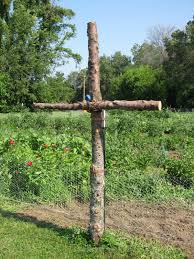
rough crossAccording to the American novelist, Joyce Carol Oates: “Homo sapiens is the species that invents symbols in which to invest passion and authority, then forgets that symbols are inventions.” Following last year’s Maundy Thursday worship, I received a very rude reminder of our all too human habit of investing passion and authority in invented symbols. Our efforts to remember the life and death of Jesus of Nazareth are bolstered year after year, decade after decade, century after century by the symbols we followers of the Way have invented and invested with passion and authority. So, after our regular Maundy Thursday ritual of removing invented symbols from the sanctuary, I went looking for our own sacred Good Friday symbol. Each Maundy Thursday, we followers of the Way get together to remember Jesus by focusing upon the symbols which represent to us the events of the night before Jesus died, when he gathered his followers together to eat the Passover meal. At that supper Jesus took bread, gave thanks and broke it and the rest as they say is history. Our Maundy Thursday Eucharist is packed with symbols, from the hand-basins in which we ritually wash one another to remember Jesus washing of his followers feet, bread and wine which we ritually consume as Christ given and poured out for us, to the ritual stripping of the sanctuary of all of the symbols in which we have invested passion and authority, in our efforts to re-member Jesus.

The rituals of Maundy Thursday prepare us for the rituals of Good Friday and so after our worship, I went downstairs to venture into the cupboard under the stairs to retrieve the stark symbols of this congregation’s Good Friday rituals. It is the same every year, a rough-hewn cross, fashioned out of the trunk of a Christmas tree that once adorned this sanctuary. A Christmas tree – evergreen, a symbol in which we invest our passion for everlasting life, stripped of it’s branches so that only the trunk remains and then cut so that the top section can be lashed with twin to the main section to fashion a cross of sorts. A rough-hewn cross in which we invest our passion for what we have come to call the passion of Christ. Each year, once the sanctuary is stripped of  all the symbols which we have invented to facilitate our ritual remembering, I journey down beneath the stairs to retrieve our rough-hewn cross to facilitate our Good Friday remembering. This year, I had designed our remembering ritual, so that we could pay particular attention to our rough-hewn cross. This sermon was built around an exercise of re-membering which I hoped would help us to participate in the very act for which symbols are invented. Symbols are created to point beyond themselves, to direct our focus to that which lies beyond the symbol. This year, my Lenten sermons had focused on a definition of Divinity which describes God as beyond the beyond and beyond that also. So, this Good Friday sermon was written to use our rough-hewn cross to examine the work of the cross in the lives of the followers of Jesus, so that we might see beyond the symbol to the One who is beyond the beyond and beyond that also. I planned to place the rough-hewn cross here on the floor of the sanctuary, right in the middle of our circle so that as the Gospel according to John’s symbolic narrative, which has become known as the Passion Narrative, was read you could gaze upon our rough hewn cross and as my sermon began I would literally and figuratively take apart our invented symbol so that we might peer beyond it. I planned to sit here in the midst of you and unlash the vine that held our rough-hewn cross together and as I untied the vine, I would do my level best to untie the bonds that our religious tradition have placed upon the symbol of the cross and perhaps encourage you to question the passion and authority which is all too often invested in this invent symbol of the life, death, and resurrection of Jesus of Nazareth. Then with dramatic flare, I planned to put it back together again. As I used the old Christmas tree trunk to pull together our history and tradition, and the withered vine to lash our troubled attempts to remember back into the form of the cross in the hope that we might see the cross from the perspective of the 21st century followers of the way which on this day of days we struggle to be. Continue reading

PREPARING TO PREACH ON GOOD FRIDAY. Searching beyond the talk of sacrifice to see the Good News.

The Church’s Good Friday obsession with talk of  “sacrifice for sin” has been breed into the bones of this particular preacher.  I have been trained to speak the language of the Church.  I know full well the many doctrines of atonement that have been proposed to explain the reasons Jesus died upon a cross.  I’ve been studying the historical context and the theological consequences of Jesus’ death for more years than I care to admit.   Yet every year, I find myself wanting to book a vacation or call in sick so that I can avoid the awesome task of preaching on Good Friday.

I put off tackling the Good Friday texts as long as I dare.  Then I pick up my copy of “The Last Week” by John Dominic Crossan and Marcus Borg, together with my copies of John Shelby Spong’s “Resurrection: Myth or Reality” and “Jesus for the Non Religious” as well as Marcus Borg’s final book “Convictions” and Dom Crossan’s “How to Read the Bible and Still Be Christian” and James Carroll’s  “Christ Actually: the Son of God for the Secular Age” spend days in pursuit of a sermon.

What follows is not the sermon I will preach on Good Friday, but rather, the notes I made a few years ago to remind myself not to fall into the trap of talking about the events surrounding Jesus’ death in the way I was trained to speak of those events.  I offer up my notes hoping that those who are engaged in the struggle of grappling with how to talk about the cross in the 21st century might find some solace in a fellow struggler’s ruminations.  For those of you who don’t have to come up with a sermon for Good Friday, I offer these notes as my humble attempt to see beyond the rhetoric about the cross to the Good News. As always I am indebted to the progressive scholars for their invaluable resources. However, in the end, the only way to discover the sermon is to wander into the darkness, trusting that the hours of preparation will allow you to let go, breathe, and trust the One who lives in, with, through, and beyond you. 

There are many ways in which our focus upon the cross is disturbing.   Not the least of which is the way in which we as Christians tend to talk about the crucifixion as Jesus’ passion.  I have always thought it a tragedy that we should describe the events of Jesus’ crucifixion as Jesus’ passion. I’ve always understood talk of an individual’s passion to be concern with those things that people lived for. And so to insist that Jesus’ lived to die a horrible death might sooth those who seek to turn Jesus into some sort of preordained blood sacrifice.

But for those of us who look to Jesus in search of the face of God, such talk seems is indeed a crime against divinity. For what kind of petty, sadistic god would engineer the birth of, foster the life of, and then engineer the death of a beloved child. Surely such a god is no more than a wicked illusion of our own making. I wonder what Jesus himself would make of the god we have created. I wonder what Jesus himself would make of our Good Friday commemorations? I suspect that if Jesus is anything like the accounts of his life suggest, he would be mortified, and I mean that literally…I think that Jesus would be mortified …mortified ie shamed to death…of what has become of his life’s passion; for if Jesus’ was passionate about anything, he was passionate about life. Jesus declared, “I have come so that you may have life and live it abundantly.” Jesus’ passion was about living. Living fully, abundantly.  Continue reading

Hosanna! Hosanna! Hosanna! Yada, Yada, Yada, we’ve heard it all before…a sermon for Palm Sunday

on a donkeyOur worship began outside in the bright sunshine of the first morning of springtime, where we spoke of the reenactment of one of the two parades that took place in Jerusalem nearly 2000 years ago. Embracing Jesus’ political act of performance art we processed into the sanctuary waving our palm branches and shouting our hosannas. Rather than the familiar Palm Sunday readings our worship included the story from Genesis chapter 32 which tells of Jacob wrestling with God, Psalm 118, and John 12:12-15. you can read them here and listen to the sermon here

Approaching the Resurrection – What Did Paul Actually Say?

trouble with resurrection

Far too many preachers stumble into the celebration of Easter without doing our homework. Resurrection is a central tenant of the Christian faith and Easter is the primary celebration of resurrection and yet, too many of us fail to open ourselves to current scholarship surrounding the doctrine of resurrection. Questions about the nature of the resurrection ought to send us back to the words of the Apostle Paul. Bernard Brandon Scott is a charter member of the Jesus Seminar. His book “The Trouble with Resurrection” is a must read for those who preach during the Easter Season.

If you are planning to write a sermon or listen to a sermon this Easter, this video provides essential background information about the words of the Apostle Paul on the nature of the resurrection which may surprise you. Scott’s treatment of 1 Cor. 15 provides a new understanding of resurrection which is compelling as well as liberating.


Something About Mary’s Extravagance: a sermon for Lent 5C

anoint 2

Readings: Deuteronomy 15:7-15 and John 12:1-8

Listen to the sermon here

“I Am Woman” – Angry on this International Women’s Day

International Women's DayIn 1972, I was fifteen years old and the number one song on the radio was “I Am Woman” by Helen Reddy. We sang it with such power and conviction because “I Am Woman” had become our anthem; the anthem for a generation of women. So, we sang determined to blaze trails for ourselves that would ensure that women all over the world would be counted as equal. The year that I graduated from high school (1975) the United Nations declared as “The Year of the Woman” and they chose our anthem, “I Am Woman” as the theme song and once again “I Am Woman” rose to the top of the charts.

As I grew into my womanhood  and explored the contours of feminism my sisters were “Doin It In the Streets,” marching for equality, demanding equal rights, and yes, we burned our bras. In the midst of the battle for equal rights for women and girls, the advertising industry announced proudly, “You’ve come a long way baby!” as they rolled out a cigarette designed just for woman (Virginia Slims); packaged and marketed just for women. “You’ve come a long way baby, so stop all your hooting and a hollerin. Settle down, it’ll happen! Don’t shout! Don’t be so angry you feminists! You don’t need to be a feminist. If you want to get ahead, just play the game.”  So, I bought a power suit and I learned to do it better, and smarter, and faster than the men did it. So that I could make half as much as the men did.

Later, much later, when I realized that the business that I was in wasn’t making me happy and I discovered my true vocation, I knew that if I was gong to be taken seriously as a “woman pastor” I would have to study very, very, hard. So, I read more books than my male classmates did, went to more lectures, took more classes, earned more credits, explored more possibilities and managed to graduate from seminary at the top of my class. When I graduated from seminary in 1998, my bishop out in British Columbia, told me that although there were vacancies in his Synod, “none of those vacancies would translate into a call for a woman.” The rest as they say, is history, not her-story, but his-story.

B.C.’s loss was my gain and thanks to the good folks of Holy Cross, I was called to the best place in the world and in the past sixteen years we have come a long way baby. So maybe there’s no need to write about International Women’s Day. After all, we’ve been there, most of us have bought the T-shirt all of the women in my life are strong and invincible and all of the men of are feminists. We’ve come a long way baby. So, let’s just cheer Jesus on as he turns the tables over in the Temple. It is tempting to give Women’s Day a miss. I have come a long way. Baby! But I am white and I am wealthy. I am a person of privilege; the privilege of my race and the privilege of my class, mean that I can say I’ve come a long way baby and mean it. But the world that I live in may be bought and paid for by the blood, and sweat, and tears, of the countless women who continue to suffer in the oppressive systems and structures that enslave more than half of the world’s population. Our wealth, class, and race, may insulate us from the pain of our sisters, but even we can fall victim to violence and economic hardships that generations of discrimination have enshrined in our society. Those of us who enjoy the privileges that enable us to insulate ourselves from the harsh reality of economic abuse are just moments away from the dangers of physical violence, domestic abuse, sexual assault, and poverty in our old-age. There are lots and lots of reasons not to bother preaching to the converted about International Women’s Day. Sadly, there are millions and millions of reasons to preach loudly, long, and passionately about the plight of women in the world.

Equal pay for equal work, most of us agree, a few continue to hesitate, despite the fact that there are countless economic studies that demonstrate the equal pay for equal work is good for men as well as women. In 2015, the United Nations communique declared that at the current rate it will take seventy years for women to reach pay equity and that includes Canada, the United States and Europe; seventy years!  Continue reading

God Finds Expression In, With, Through, and Beyond Us – a sermon for Lent 3C

Love Julian copy

Reading Luke 13:1-9 – listen to the sermon here

The Fox is in the Henhouse – a sermon for Lent 2C – Luke 13:31-35

foxPope

Our Lenten journey continues even as the news of the day challenges us. Listen to the sermon here

Fasting from “fast”! – a sermon for the first Sunday in Lent

Lenten Worship 2016

The Feast of Saint Valentine and the First Sunday in Lent all on the same day. Our Readings included 1 Corinthians 13; 1 John 4:7-8; John 15:8-16. Listen to the sermon here

Evolution – There’s No Going Back: an Ash Wednesday Homily

purple light 2

Here’s an Ash Wednesday homily for the 21st century!

We’ve all been there. Driving down the road – distracted by thoughts of this and that, when all of a sudden it happens, a car comes at you out of no where and you slam on the breaks or you quickly swerve to avoid a disaster. You could have been killed. You could have killed someone. Your life or someone else’s life could have been radically changed in an instant. As you pull back into traffic you are ever so conscious of the weight of you foot on the accelerator and you swear that you’ve got to be more careful.  You begin to scold yourself.  What were you thinking? Why weren’t you paying attention? Wake-up you could have been killed.

Welcome to Ash Wednesday. What have you been thinking? Why weren’t you paying attention? Wake-up — you are going to die!!!  Ash Wednesday is your mid-winter wake-up call. Some of you may not need the wake-up call. Some of you know all too well that death is all around us. Some of you have lost someone dear to you. Some of you have felt that fear in the pit of your belly when the doctor suggests a particular test. Traditional Ash Wednesday worship would require us to focus on the brevity of life and remember that none of us will get out of this life alive.  Our ancestors in the faith, entered into a morose season of Lent by via the awesome reminder that they came from dust and soon they shall return to the dust. Continue reading

LOVE that IS God: a sermon on 1 Corinthians 13

LOVE in the World?A sermon for Epiphany 4C – listen to the sermon here

TODAY!!! – a reflection on Luke 4:14-21

Luke 4Today, rather than a traditional sermon, we engaged in a reflection on what is known as Jesus’ first sermon from Luke 4:14-21…a bible study of sorts. The Acclamation sung before the reading is “God of My Childhood” by Miriam Therese Winter Listen to the reflection here

A Storyteller’s Storyteller: Joan Chittister

Two dogs & parrotAs storytellers go, Joan Chittister is one of the best! That she is also an extraordinary theologian who has an uncanny ability to communicate wisdom in ways that both enlighten and enchant her audiences is a wonder to behold. Here Sister Joan weaves two tales from one of her latest books “Two Dogs and a Parrot.” While I am throughly enjoying the book, I dearly wish that I could watch and listen to her embody more of these stories as only she can. Enjoy!