Finding God in the Depths of Silence: Richard Rohr

rohrSpeaking in May of 2013 at the Festival of Faiths, Richard Rohr shares his perspective on silences as the only thing broad and deep enough ot hold all of the contradictions and paradoxes of Full Reality and our own reality, too. 99.9% of the known universe is silent,, and it is in this space that the force fields of life and compassion dwell and expand. Rohr insists that we too can live in this silent expanse!

Richard Rohr is a Franciscan teacher, author and founder of the Center for Action and Contemplation. 

Questions that Arise from Being Human – Richard Holloway

human consciousnessRegular visitors to this blog will not be surprised to read that Richard Holloway has become one of my favourite theologians. I have blogged about his writings several times. In this video Holloway moves beyond spiritual autobiography and into the realm of evolutionary theology to explore the big questions about what it means to be human. 

Preparing to Preach on Prayer: 21st Century Questions – There’s an App for that!

prayer appAs I continue to work on this Sunday’s sermon, (see earlier posts here … here …and here), Jesus’ teaching on prayer in the gospel reading Luke 11:1-13 leaves me wondering what an enlightened 21st humanoid is supposed to do with Jesus 1st century ideas???

Cast you minds back to another time and place and tell what the numbers 33, 45, and 78 have in common??? Vinyl Records anyone? When I was a kid music came from a portable RCA record player. The sound quality wasn’t all that great, but somehow we didn’t seem to care. Later when I was a teenager, my parents got a fancy state of the art Phillips stereo cabinet and suddenly sound seemed to be coming from booth ends of the room. I never did understand how those old record players managed to pick up sound from the grooves in the vinyl to45 produce music. I still remember my father’s first reel-to-reel tape recorder, and then there were the eight-tracks, followed by cassettes, followed by CD’s.  I can remember these things, but I have no idea how they made music. It doesn’t matter how many times people try to explain it to me, I still think it’s a miracle that such beautiful sounds can come out of machines.

These days I don’t use records, tapes or CDs to listen to music. My music is stored in “the cloud” and when I want to hear I song I make sweeping motions on my iphone screen and presto, I can make music fill the room. I don’t know what the cloud is. I asked the personal assistant on my iPhone, her name is Siri and she told me she was sorry but she couldn’t tell me because Steve told her not to tell anyone. Some people think the cloud is located in a 225-acre facility that Apple built in North Carolina. Continue reading

Preparing to Preach on Prayer: To Whom Shall We Go?

PanentheismAs I continue to work on this Sunday’s sermon, (see earlier posts here and here) Jesus’ teaching on prayer in the gospel text Luke 11:1-13 begs the question: “To Whom Shall We Go?” Liberated from perceptions that reduce images of God to those of a cosmic superhero who abides up or out there ready to manipulate events here in the world at the request of those who pray, the activity of prayer takes on a whole new meaning and shape. Our images of who, where and what God is will direct our prayers in ways that impact our expectations of prayer. Who do we pray to and what we expect of the One who hears our prayers will shape how and why we pray.

Before we can even begin to understand what so much of the Christian tradition means when it talks about praying to God, we need to take a step back and look at what we mean when we say the word “god.” Throughout the Jewish and Christian traditions you can trace two very distinct ways of understanding and talking about God. Continue reading

Jesus’ Teaching on Prayer

teach us to prayThis Sunday’s gospel text (Luke11:1-13) will no doubt send preachers scurrying to review what we might say with regard to prayer. In this splendid little video Laurence Freeman reviews Jesus’ teaching and points to prayer as Jesus’ focus. Well worth watching before you begin to write or indeed listen to Sunday’s sermon.

Dom Laurence Freeman OSB is a monk of the Olivetan Benedictine Congregation of Monte Oliveto Maggiore and Director of The World Community for Christian Meditation. Fr Laurence was born in England in 1951 where he was educated by the Benedictines and studied English Literature at Oxford University.

Before entering monastic life he had experience with the United Nations, banking and journalism. In the monastery his spiritual teacher was John Main with whom he studied and whom he helped in the establishment of the first Christian Meditation Centre in London.

Preparing to Preach on Prayer: Shush!

BATH QOLIn this coming Sunday’s gospel reading Luke 11:1-13, Jesus’ disciples ask him to teach them to pray. As a pastor I have been asked to teach people to pray. Each time I have been asked to teach someone to pray I have cringed inside because I do not feel up to the task. For some reason the old hymn “I Come to the Garden Alone” keeps playing in my mind. I keep telling it to, “Shush!” so that I might hear the “bath qol” but the daughter of a sound eludes me. Below is a portion of a sermon I preached a couple of years ago on the subject of prayer. If nothing else, it reminds me to shush!

I began this sermon by asking the congregation to sing from memory the old hymn: I Come to the Garden Along. Feel free to sing it to yourself!

I think my earliest memory of prayer is a distant memory I have of skipping along the sidewalk chanting a familiar refrain: “Don’t step on a crack or you’ll break your mother’s back.” Most of us can remember a moment from our childhood when a superstition was instilled in us that caused us to perform some ritual in order to placate the unseen power that could determine our fate. Whether it was avoiding cracks, or walking under ladders or black cats, we were trained from an early age to believe that there were powers out there that could determine our future.   Continue reading

Basileia of God: A Kin-dom

basileiaβασιλεία, “basileia” the Greek feminine noun for sovereignty is traditionally translated into english as “kingdom.” Both the greek and english words were generated by kyirarchal world views. Kyiarchal is a word coined by Elisabeth Schussler Fiorenza to replace the term patriarchy. Kyriarchy emphasizes”the rule of the emperor/master/lord/father/husband of his subordinates.” Fiorenza argues for a different understanding of patriarchy, “one which does not limit it to the sex/gender system but conceptualizes it in terms of interlocking structures of domination, i.e., elite male, relations of ruling.” The kyriarchal translation of “basileia” as “kingdom” fails to capture the literal meaning this word which is after all is said and done the feminine plural of majesty. I have often joked that it is more accurately translated as “queendom”. Over the years I have often used words like “reign” “dominion” or “empire” in place of kingdom. These days, I have come to appreciate “kin-dom” as a better approximation of the meaning of basileia.  With that in mind, I offer Laurence Freeman’s explanation of  basileia. 

What is Meditation?

Be still and knowThis week I have been preparing to preach on the story in the Gospel According to Luke about Jesus’ encounter with Martha and Mary and I’ve been exploring the tradition of the contemplative life as well as the modern fascination with the many types of meditation. So much of the popular offerings that seek to define meditation seem to cater to our culture’s desire to consume what we like from a particular discipline while failing to appreciate the discipline part of that which we seek.  In the course of my research I came across this splendid little video in which Laurence Freeman offerers, from a Christian perspective, his introduction to meditation.

The Fundamentalist Within Us – John Philip Newell

moon like consciousness

“Life does not exist in fixed categories. It is ever changing.” We are living in an age of enormous change. If we are one we are going to have to radically change.


The Evolution of Religion, Society and Consciousness: Reflections Inspired by Teilhard de Chardin – Ursula King

3 TeilhardWhile on sabbatical last summer, I took on the daunting task of reading Teilhard de Chardin. (sabbatical post on Chardin) I did so because so many of the progressive Christian scholars that I admire and have learned so much from, site Teilhard de Chardin and I thought that it was long past time for me to become familiar with these important primary texts. Well my ambition far outweighed my capacity for understanding and I found myself weighed down in Chardin’s seminal work The Phenomenon of Man. I was hopelessly lost until I discovered the work of the renowned Teilhard de Chardin scholar Ursula King. (King pointed me in the direction of a superior translation of Chardin’s work by Sarah Appleton-Weber: The Human Phenomenon). 

In this video, Ursula King explores the impact of the discovery of evolution has and is having on religion, society and consciousness.  As an expert on de Chardin, King brings a unique perspective to the emergence of synergies between various ways of knowing. (the interview by Krista Trippett mentioned in the video can be found here)

Martha and Mary – Active and Contemplative

last supper women

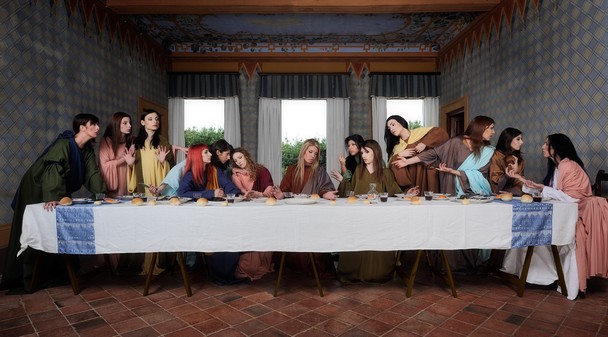
Father Laurence falls into the age-old trap of seeing a kitchen where there isn’t one in the text and interprets the many tasks that Martha is distracted by as domestic chores. (see my previous post for a full explanation of the Greek diakonia which does not refer to domestic service but to eucharistic service and the proclamation of the word). Nevertheless, his articulation of the need for balance between the active and contemplative lifestyles is well put. I suspect that my own sermon this week will follow his lead and examine the difficulty some of us have finding time to tend to our need for contemplation when we are distracted by our many tasks in the church.

Dom Laurence Freeman OSB is a monk of the Olivetan Benedictine Congregation of Monte Oliveto Maggiore and Director of The World Community for Christian Meditation. Fr Laurence was born in England in 1951 where he was educated by the Benedictines and studied English Literature at Oxford University.

Before entering monastic life he had experience with the United Nations, banking and journalism. In the monastery his spiritual teacher was John Main with whom he studied and whom he helped in the establishment of the first Christian Meditation Centre in London.

“Martha, Martha, Martha!” – Preparing to preach on an all too familiar text!

From an Academic Paper to a Sermon

martha 2I am usually on vacation at this time of the year. So, I have only had one opportunity to opportunity to preach on this coming Sunday’s gospel text (Luke 10:38-42). The story of Jesus’ sojourn at the home of Mary and Martha is such a familiar text, which over the years has been used and abused by preachers to inflict such harm on their listeners. During my seminary years, this text awakened the feminist in me in ways that I am still unpacking. So, in preparation to write only my second sermon on this text, I went back to my seminary years to uncover an academic treatment of this text that I included in my Masters Comprehensive paper in 1998. Reading the paper took me back to a time when I seriously doubted my call to ordained ministry. Back then I was unsure about my ability to tolerate the institutional church or indeed whether or not the institutional church would be able to tolerate me. I am happy to report that there are pockets of the institutional church were feminists can thrive and I have been blessed to be called to serve in one of those pockets. 

The only time I preached on this text was in 2004 and so I post both the academic paper and the sermon based on the paper as a resources for those of you who will take up the text this week. I have not edited the sermon, despite my inclination to do so. Old sermons provide a snapshot of old preachers. Like most snapshots, I’m not altogether happy with the picture of myself. The good news is that this week I have the opportunity to create another snapshot.

You can read the academic paper here   and   the sermon here

Faith and Doubt: “a whisper will be heard” – Richard Holloway

hollowayI have just completed reading Richard Holloway’s “Leaving Alexandria: A Memoir of Faith and Doubt”.  As someone who struggles to stay in the institutional church, I can hear the whispers of which this former Primate of the Scottish Episcopal Church writes. leaving alexandria

After a lifetime in the church, Holloway continues to respond to whispers, “The thing that keeps me religious is the possibility that there might be an ultimate purpose to the universe and it might, as certain rumours suggest in sacred texts, be unconditional love. And it seems to me to live as if that might be the case is not a bad way go be going; especially if it makes us kind to one another.” 

Richard Holloway’s vision of the church he longs for is a vision I too long for. As he ponders the question “Am I still a Christian?” Holloway insists,  “God has always been elusive in me. He’s always felt like an absence that felt like a presence. I was tantalized by God, that resonant absence again. The God that I was being told about, the God who was punishing my gay friends, the God who denounced me was cruel I and I couldn’t be part of that. And yet I am still tugged by the longing that had gotten me into this, the possibility of transcendence, that there is meaning and that the meaning might be a great pity, not a cruelty, but an absolute compassion, an absolute unconditional love, a love like the father of the prodigal in Luke’s great parable who runs to meet his broken son and doesn’t condemn and doesn’t even wait  for the confession before embracing him, and bringing him home. There is that God. That’s the God of Jesus….So I’m kind of in and yet out of the Christian Church. I want it to continue. But I want it humbled. I don’t want it cruel and bullying. I want it modest and serving. I want it to feel broken like the broken Jesus and not trying to sort people into very precise understandings of humanity. I want it to accept the totality of broken humanity. Most of us are broken in one way or another and we struggle with our own meaning, with our own integrity, and our own sinfulness. And the thing I found in Jesus and the thing you can still find in some churches is an understanding of that. ‘Come onto me all ye who travail and heavy laden and I will give you rest.’   So, I’m back. But I can’t proclaim. I can’t evangelize. I can’t say what this is the truth. I don’t know what the absolute truth is. But I still catch a glimpse of the tiny figure of Jesus on a distant seashore kindling a fire, a fire of compassion and kindness. And I’ve become increasingly allergic to religious certainties. They seem to me only to crucify people…”

For those of us who remain and for those who have joined the church alumni, Holloway’s story is a compelling whisper that speaks with the very compassion for which he and we long for. He may no longer be a bishop in the institution, but he remains a shepherd to those who long to catch a glimpse of the tiny figure of Jesus who continues to call the religious out from under the tables that clutter our temples.

Open Hands – Pentecost 4C Sermon

open handsI am indebted to Dr. Martha Ellen Stortz for the metaphor of open hands.

Listen to the sermon here

“Isness is God” – Meister Eckhart

Isness IS God Eckhart Fox Pastor Dawn

Back in the 19th century, Rudolf Otto described the Holy One that we encounter as: “mysterium, tremendum et fascinans.” “Mysterium” captures the indescribable nature of the Holy. “Tremendum” …we get our word tremble from this; and in the presence of the Holy we tremble because the Holy is so far beyond our abilities to cope with. And yet we are “facinans,” fascinated to the point where we long to return over and over again into the presence of the Holy. Sadly, the image of God that has been created for us by religion can’t possibly contain all that the Holy IS.  images

In his book  “Insurrection” Peter Rollins insists that, for a multitude of reasons we are all too willing to settle for what Bonheoffer called the God of Religion. For Bonheoffer, the Church approached God as a “deus ex machina.” God was merely an idea clumsily dropped into our world in order to fulfill a task. God was introduced into the world on our terms in order to resolve a problem rather than expressing a lived reality. The result is a God who simply justifies our beliefs and helps us sleep comfortable at night. God is brought into the picture only when we face a problem of some kind that doesn’t lend itself to solution by other means. This “deus ex machina” falls far short of the God we meet in the Thin Places of our lives; those places or events in which we encounter the Divine. Only by letting go of the god we have created for ourselves can we begin to describe the encounter with the ONE who IS. 


Mary and Elizabeth: Visitation or Escape?

rape victimsMay 31st is the day the Church commemorates “The Visitation” the story of Mary’s visit to Elizabeth  as it is recorded in the Gospel According to Luke 1:39-56. Since reading Jane Schalberg’s “The Illegitimacy of Jesus”, I can’t help but wonder if Mary’s visited her cousin Elizabeth or escaped to her cousin Elizabeth seeking protection for the crime of being raped in a culture that all too often blamed the victim.  Historians estimate that Mary may have been all of twelve years old when she became pregnant. There is ample evidence in the New Testament accounts of Mary’s story that suggest that she may indeed have been raped.  So rather than sweep the possibility under the rug, on this the Feast of the Visitation, I’m reposting a sermon I preached a few years ago during Advent.  I do so because women young and old continue to be raped and to this day, are forced to flee from the accusations and persecutions of cultures that continue to blame the victim. What follows is a written approximation of the sermon which in addition to Jane Schalberg is also indebted to John Shelby Spong’s “Born of a Woman” and “Jesus for the Non Religious” along with John Dominic Crossan and Marcus Borg’s “The First Christmas”.

Sadly, one doesn’t have to travel too far into the past to arrive at the time when women’s voices were not heard. Indeed, in the Lutheran church, it was only a few short decades ago.  For most of us that time is within our own lifetime. For generations, men have told our sacred stories. Men have decided which stories made it into the canon of Sacred Scriptures. Men have interpreted the stories that were allowed to be told. Men have translated, taught, and commented upon those stories from pulpits, in universities, in seminaries, in commentaries and in the public square. Continue reading

Does Science Reveal that Death is No Less Sacred than Life? – Michael Dowd

evolutionary christianityEvolutionary Christian, Michael Dowd suggests that we are in the early states of what he calls an “evidential reformation” that is where our best map of what is real and what is important doesn’t come from the church hierarchy or the Bible but with scientific evidence.  In this video Dowd looks to Big History, Human Nature, and Death and Chaos from an “evidential standpoint” to offer an “Inspiring Vision of the Future” and “enrich our communion with reality”.

For more on Michael Dowd follow this link

The Church is Like a Desert in an Oasis: Peter Rollins

Crucified Identities Peter Rollins PastorDawn

The Athanasian Creed and an Unholy Trinity – A sermon for Trinity Sunday

Beyond the Beyond - Dawn Hutchings

I don’t remember the first time I ever saw him. I was barely 18 months old when my brother Alan arrived. Despite the fact that he ruined my gig as an only child, Alan and I grew close over the years. We moved around a lot so we became one another’s best friends. But we went our separate ways when we became teenagers. When I tell the stories, I say that we went our separate ways because Alan became preoccupied with sports.  I suspect that when Alan tells the stories, he says that we went our separate ways because I became preoccupied with the church. Either way you tell it, family and friends used to say that it was hard to believe that we grew up in the same household. Alan developed a reputation for been a bit of a redneck. I developed a reputation for being a bit of a radical. Alan drove four-wheel-drives and went hunting. I drove old beat up cars and lived at an ecumenical retreat centre.  Alan learned a trade, settled down and raised a family. I travelled the world and didn’t get around to figuring out what I was going to be when I grew up, I went back to school at the age of 30.

Alan and I didn’t get around to understanding one another until we were in our mid-40’s. When I grew to appreciate the gentle man that he has become and Alan began to respect the person I’ve become. We still love to talk politics, but these days we tend to agree more than we disagree, I’m not sure who mellowed, the redneck or the radical. We don’t talk much about religion, though. Growing up, Alan would claim to be an atheist, and scoffed at my involvement with the church. These days, Alan, calls suggests he is an agnostic, and although he’s come to respect my life in the church, he still scoffs at the hypocrisy of the church.

I still remember the very first time that I saw Manjit. Her face was the colour of pure milk chocolate. Her jet-black hair was long and wavy. She sat at the very back of the classroom. When the teacher introduced me to Manjit, her toothy grin welcomed me. We were twelve years old. I was the new kid in town and Manjit was the only East Indian in the class. We were to share a double-desk for the remainder of the school year. I remember my first trip to Manjit’s home. A science project needed our attention. I can still smell the aroma of Manjit’s home where exotic curries released their pungency into the air. Over several meals at Manjit’s, I learned to like my food hot and spicy. Manjit’s mother would blend her own spices and she never forgot to send a package or two of her specially blended curries home with me.

Manjit is a gentle soul who introduced me to the wonders of her faith. Manjit is a Hindu. Manjit never tried to encourage me to become a Hindu.  Although over the years she would remind me of the Hindu saying that admonishes Hindus to be better Hindus, Muslims to be better Muslims, Jews to be better Jews, Buddhists to be better Buddhists, and Christians to be better Christians.  Manjit grew into a kind and gentle woman. She works as a social worker in Vancouver’s rough east-end neighborhoods. The last time I saw Manjit she was patiently guiding the students of a confirmation class that I taught, around her Temple. Later that evening Manjit and I talked a long time about Jesus. Manjit told me that she’d always been fascinated with Jesus’ teachings and that she had no problem believing that Jesus is God, but then she explained that Hindus have a thousand god’s.

I can still remember the very first time that Henry walked into my office. A long black beard together with the yarmulke that he wore on his head gave Henry away. So, from the very beginning I knew that Henry was Jewish. But it took a few years of working together before I discovered that in addition to being a graphic artist, Henry is also a rabbi. Henry became a dear friend of mine and over the years he shared so much of his wisdom with me. Many a night Henry and I sat up to the wee hours discussing the Scriptures. Henry even arranged for me to study Hebrew at his Yeshiva. I learned a great deal from Henry. We often talked about Jesus. We rarely agreed about Jesus, but we often talked about him.

Alan, Manjit and Henry, some would call them an unholy Trinity. But to me they are, each of them, sacred. Trinity Sunday is my least favorite Sunday of the Church year. It’s the only festival of the church year that is designed to celebrate not God, nor Jesus, not even the Holy Spirit, but rather a doctrine of the church. The notion that God is One in Three; a doctrine that was created by theologians to explain the inexpressible, a doctrine the church “fathers” began to cast in stone in the words of the Apostle’s, Nicene and Athanasian Creeds.  Three Creeds that make up an unholy trinity in and of themselves. Three Creeds that the Lutheran Church continues to hold as articles of the faith. Three Creeds that continue to hold sway in our church.Three Creeds that in my humble opinion make up an unholy trinity. Three Creeds upon which the doctrine of the Trinity rests.

The Apostles’ and Nicene creeds are familiar to most people who’ve spent time in the churches of Christendom. But it’s the 3rd creed of this unholy Trinity that makes Trinity Sunday my least favorite Sunday of the Church year and for me calls into question the entire doctrine of the Trinity. I still remember the first time I actually heard the third creed. I was about 20. I’d been attending church for about five years and I’d already learned to recite the Apostles creed which we used almost every Sunday and the Nicene Creed which we used on the high holy days like Easter, Pentecost and Christmas. But somehow in those five years I never came across the Athanasian Creed. I must have missed a few Trinity Sundays because in the Lutheran Church tradition dictates that on Trinity Sunday the Athanasian Creed be used. So, on this particular Sunday after the Hymn of the Day the pastor instructed us to turn to page 54 in our Lutheran Book of Worship.    Continue reading

“Trinity: Image of the Community that is God” Desmond Tutu

Trinity Desmond Tutu - Dawn Hutchings

Tutu: “Isn’t it wonderful that we have this Doctrine of the Trinity that speaks of God as a fellowship, a community. And so, you have this wonderful image of the community that is God, the Trinity. So that, all eternity the One who is called Father pours out all of God’s being into the Son….and the Son returning from all eternity this love and you have this movement between the two that is so tremendous that it is God the Holy Spirit.”

Today in a ceremony in London’s Guildhall, Desmond Tutu will receive the Templeton Prize in recognition of his lifelong work in advancing spiritual principles of love and forgiveness. This video was made to commemorate the honour.