“You Brood of Vipers!” How Dare You? – Matthew 3:1-13 – Advent Two

You brood of vipers! How Dare you? How dare you continue to Santa-fy the incarnation of Christ? John the Baptist is our annual reminder of that darkness is all around us. Sadly, despite this annual reminder, we are all too willing to glorify this terrifying messenger as we relegate his apocalyptic warnings about the catastrophic events that are happening all around us. Repent! the very word itself means “turn around.” Repent! Turn around! Stop focusing on your efforts to Santa-fy the coming of Christ. Repent and see that John the Baptist’s warnings continue to cry out to us from the wilderness to warn us of the fires that threaten to burn. You brood of vipers! Behold! A prophet cries in the wilderness!  This is what she looks like…

Watch Greta Thunberg’s warning. (see the video above)

Every Advent, John the Baptist’s warnings are served up on a silver platter as we remember the darkness of his wilderness. After John came the ONE in whom the LOVE that is DIVINITY was embodied. Jesus of Nazareth embodied LOVE. In Jesus we can see a new way of being in the world which promises to user in the Reign of LOVE. Not the heart and flowers kind of love, but rather, the LOVE that is the source of reality itself. The kind of LOVE that is capable of changing the world, the LOVE that is willing to sacrifice and to suffer for the all of Creation. The LOVE that is the ONE we call God.

The Reign of LOVE is calling upon each of us to embody LOVE as Jesus embodied LOVE. John the Baptist described the realities of his day accurately, but John was so wrong about what the Reign of God would look like. John envisioned the wrath of God. But the ONE who IS God did not come dressed in wrath to inflict punishment, doom, and destruction. The ONE who IS God came as LOVE.  In Jesus we can see that LOVE – dressed in human flesh, a baby yes, a baby subject to all the perils and dangers of life in the world; but also, as a fully-grown human being. A human being that embodied the LOVE that IS God in ways that offered us a glimpse of a new way of being in the world. Continue reading

Not Even Jesus of Nazareth Can Contain ALL that Christ IS – Second Sunday of Advent

You can view this sermon as it was preached at Holy Cross in Newmarket here

By now most of us are well on our way to “Preparing the Way.” Unlike John the Baptist’s plaintive cry to clear a straight path, fill every valley, and level every mountain, our preparations find us harkening back to the Christmases of our childhood, so that we might capture the love and joy that we imagine awaits us if only we prepare to do Christmas, the way it was done way back when. Right about now, in gatherings all over the place people are telling stories about how it was “way back when.”  You know, “way back when” people knew just how to prepare the way for Christmas. I remember way back when I was just a little girl, you know long, long, ago, way back when Christmas celebrations were so different. Way back when I was a child, we didn’t hang fancy, specially dedicated stockings on the chimney with care, in hopes that St. Nicholas soon would be there. No, way back when, people didn’t have the money to waste on special, fancy, Christmas stockings that were only used once a year.  Way back when, we just went into our sock draw and pulled out the largest sock we could find, and we hung it up, in the hope that if we’d been good, our stockings would be filled with treats, instead of the dreaded lump of coal that our parents had been threatening us with for weeks. Come Christmas morning, way back when, we were happy when our sock was filled not with stocking-stuffers like we have these days, but with the same thing we got every Christmas in our stockings, an apple, an orange, a few toffee’s and a couple of coins.

You see way back when, fruit was seasonal and fresh apples and oranges were a real treat. These days we can haul crates of tiny delectable oranges from the grocery store all year long. But, way back when, oranges at Christmas time, they were a real treat. I never did like oranges very much, so I would always try to trade my orange with my brother so that I could have two apples instead. You see, way back when, children were easier to please and Christmas was different.

Which leads me to another story. I don’t remember when or where I first heard this story about way back when, World War II had just ended, and refugees were loaded into camps until the world could figure out what to do with the millions of displaced people. Back then, refugee camps were filled to overflowing with children who’d lost their families during the war. Apparently, there was this little boy in a camp in France, we’ll call him Andre. Andre couldn’t have been more than about seven years old and he could barely remember the family he lost almost three years before the war ended. He’d been living in the refugee camp, more of an orphanage really, for almost a year.

The camp was run by a few nuns who never could scrap together enough money to feed the children properly. But they did their best, and the children were, after all was said and done, lucky to be alive. The children hardly noticed that Christmas was approaching until one of the nuns announced that a neighbour had promised to come by on Christmas Eve to drop off a sack of oranges. Andre had only a vague memory of an orange. The year before a stranger had shared an orange with him and he remembered the taste of the three tiny sections of his share of the orange that oozed precious juice down his half-starved throat. Andre spent the days leading up to Christmas Eve dreaming of having a whole orange of his very own. He thought about the smell of the orange, dreamed of peeling the orange, and carefully considered whether or not to devour each and every section of the orange all at once or whether he should divide it and save a section or two for Christmas morning. Continue reading

PREPARE THE WAY FOR OUR GOD! Become the Prophet Crying FOR the Wilderness! – a sermon preached on the Second Sunday of Advent when John the Baptist Cries

BCsunsetReading over sermons I have preached about John the Baptist crying in the wilderness, I came across this “cry for the wilderness” that I preached six years ago. Sadly, the wilderness has an even greater need today for prophets who are willing to cry out on its behalf! I offer my plaintiff cry here to inspire my colleagues as they prepare to prepare the way on this coming Sunday.

I didn’t know it at the time, but I actually met John the Baptist when I was fifteen years old. She didn’t look much like you’d imagine John the Baptist would look, but she had that same crazy intensity, that same focus on the fact that we’d better change our ways, we’d better repent, and start doing things differently or we’d be in real serious trouble. Lola was my friend Valerie’s mother and she simply couldn’t stop going on and on about the environment and how we were destroy the earth. At the time, I remember thinking she was a bit of a nut-case and on more than one occasion I wished she’d just shut up about it. I was just a kid, and the earth was just something I took for granted.  The earth was just there to provide for our needs. I couldn’t believe how much Lola went on and on about all the stuff we humans were doing to destroy the earth. I just wished she’d leave us along to get on with things, I couldn’t abide her incessant nonsense about how we were going to destroy the planet.  All her feeble little attempts to be kind to the earth, made me seriously question her sanity.

I tolerated Lola not just because she was my friend’s mother, but I didn’t really understand her until one day when the three of us were travelling together. We were coming home from church. I had only been going to church for a few months.  I was trying hard to understand this whole God thing. So, I went to church a lot.  My friend Valerie had persuaded me to start going to church with her and family had become like my second family as they supported me during my first attempts to explore the mysterious world into which I had begun to feel pulled. As we drove home from church, I was feeling a little glum. Try as I might, I couldn’t really understand this church thing; all that singing and praying didn’t really help me to feel closer to God. Mostly I just liked how people at church treated each other.  I liked how they went out of their way to help me feel at home. Whether or not God was there, well I really wasn’t sure. 

Anyway, we were driving along the road.  It was a partly over-cast day on the west coast of British Columbia, just a few clouds.  You could see the mountains off in the distance. We were chatting back and forth when all of a sudden Lola pulled the car over to the far side of the road, switched off the engine and got out.  Valerie followed her mother out of the car, so I figured I had better do the same.  Val and her mother scampered down from the road and onto the beach.  When they reached the water’s edge, they stopped and just looked off into the distance.  Apart from a tanker-ship making its way across the horizon, I couldn’t see much of anything. Lola had the most amazing expression on her face.  She positively glowed with happiness.  Valerie wore a similar expression.  I must have looked somewhat puzzled because Val smiled at me and said,  “Isn’t it the most beautiful thing you have ever seen?”  This only confused me more.  What were they looking at that had made them stop the car, scamper down the bank and stand there at the water’s edge on a cold autumn evening? 

Maybe my parents were right, these religious types are a little bit weird.  Happy, glowing, smiling people make me nervous. There they stood grinning from ear to ear.  What were they on?  And then, I saw it.  For the first time in my life, I saw it.  It had been there before.  But I had never really seen it before. The sky was amazing.  The colours were overwhelming.  It almost didn’t look real.  It looked like someone must have painted it that way.  It was magnificent, a work of art,  the most beautiful thing I have ever seen!

If you’ve never seen a late October, Pacific Coast Sunset before, you’ve missed one of the great wonders of the world. Neither Emily Carr’s paintings nor picture perfect post cards do a western sunset justice. Believe it or not, even though I had been living on the west coast for about four years, at that point I had never before really noticed just how beautiful a sunset could be.  No one in my experience had ever taken the time to stop and look at one. No one had ever pointed one out to me before.  I would never have dreamed of stopping a car and getting out to watch as the sun put on a show while setting. So I stood there. Overwhelmed by it all.  Amazed at just how beautiful it was. Wondering just who or what could be responsible for such a spectacular thing as this.  Before long my thoughts drifted to the Creator. Suddenly this God, that I had been trying so hard to fathom, was there. Right there.  Not just in the magnificence of the sunset, but right there on the beach.  At that moment, I was just as sure of God’s presence as I was of my own. I remember an overpowering feeling  of gratitude, gratitude for God’s presence, gratitude, because for the first time in all my life I was at home.  I knew that I was home. Home, not because of the place; home not because of the beauty of the sunset, but home because of God’s presence.  That longing that I had always felt; that longing that I have always labelled as homesickness, that over-powering longing was gone.  In that glorious moment, the presence of God, filled my longing and I was at home.

I’m sure that each of you could tell of a similar experience. So many of us have been blessed by the presence of God in creation. So many of us have had our longing for God filled by the wonder and majesty of creation. I suspect that our love of creation comes as a direct result of our relatedness to creation. For like creation and everything in creation we share a common Creator. My own love affair with creation kicked into high gear on the beach gazing at the magnificence of the setting sun and it has grown in intensity over the years. This past summer, Carol and I drove out to Vancouver and I have to say, if you want to renew your love for creation, drive across this magnificent country of ours.

You’ll find yourself absolutely besotted with creation as you fall in love all over again. By the time we reached my beloved Rocky Mountains, it was like some star-crossed lover, who simply couldn’t help herself from bubbling over with excitement. Not even the first rainy day of our trip could dampen my excitement as we drove south from Jasper toward the Columbia Ice fields. I couldn’t wait to gaze upon the grandeur of the glacier that I remembered from so many visits over the years. The rain was falling quite heavily as we pulled into the massive parking lot perfectly situated across from the ice-field. As we climbed the steps toward the viewing station, I couldn’t see much because I’d pulled my hood up over my head to protect me from the rain. When I reached the top and looked across the highway, it took my breath away, the mass of ice that was frozen in my memory, was gone.

I’m not sure if the drops of water falling down my cheeks were raindrops or teardrops, as I stood there frozen by a strange mixture of fear and sadness. In the decades that have passed since I first began to visit the ice-fields back in the 1970’s the ice has been receding at a rate of between 10 and 15 centimeters per decade. 120 centimeters may not seem like a great distance, but couple that with a decrease in the thickness of the ice and it is positively shocking to see the amount of ice that has vanished from view.

jokulsarlon-glacier-lakeTake a look at the iceberg that I asked Andrew to hang. This photograph was taken in a place I visited long ago. It’s a place were icebergs are born. I ended up there back in the days when I was in the travel business and ended up on a cheap Air Iceland flight that was delayed for a week in Reykjavík for a week. Back then Iceland’s airline must have had only two airplanes and when one of them suffered mechanical difficulties you literally had to wait around for them to fix it. It’s one of the reasons that flights were so cheap on Air Iceland.  You simply never knew how long your stopover in Iceland might be. I was trapped there for a week and during that time we decided to explore some of the most amazing geological sites that the earth has to offer. We travelled about 400 kilometers outside of Reykavik to the Jokulsarlon Lagoon; the birthplace of glaciers. It was in this strange lagoon, under an eerie twilight that lasted for the entire duration of my stay in Iceland, that I stud on the hull of a small tourist vessel, staring up at a magnificent glacier. I have no words to describe my terror. Continue reading

Four ForeMothers: A Transformational Parable – Matthew 1:1-17

Reading:                    Matthew 1:1-17

This is the family record of Jesus the Christ, descendant of David, descendant of Abraham; Abraham begot Isaac; Isaac begot Jacob; Jacob begot Judah and his sisters and brothers; Tamar and Judah begot Perez and Zerah; Perez begot Hezron; Hezron begon Ram; Ram begot Amminadab; Amminadab begot Nahshon; Nahshon begot Salmon;  Rahab and Salmon begot Boaz;  Ruth and Boaz begot Obed; Obed begot Jesse; and Jesse begot David, the ruler. Bathsheba—who had been the wife of Uriah—and David begot Solomon; Solomon begot Rehoboam; Rehoboam begot Abijah; Abijah begot Asa; Asa begot Jehoshaphat; Jehoshaphat begot Joram; Joram begot Uzziah; Uzziah begot Jotham; Jotham begot Ahaz; Ahaz begot Hezekiah; Hezekiah begot Manasseh; Manasseh begot Amon; Amon begot Josiah; Josiah begot Jeconiah and his sisters and brothers at the time of the Babylonian captivity. After the Babylonian captivity, Jeconiah begot Shealtiel; Shealtiel begot Zerubbabel; Zerubbabel begot Abiud; Abiud begot Eliakim; Eliakim begot Azor; Azor begot Zadok; Zadok begot Achim; Achim begot Eliud; Eliud begot Eleazar; Eleazar begot Mattan; Mattan begot Jacob: Jacob begot Joseph, the husband of Mary. And from her Jesus was born. thus there were fourteen generations from Abraham to David, fourteen generations from David to the Babylonian captivity, and fourteen generations from the Babylonian captivity to the Messiah.

Reflection:     Transformational Parables Gestating Within:

Wow! That was a whole lot of begetting to get through! Fourteen generations plus fourteen generations, plus fourteen generations plus that makes 42 generations. Now you might just think that the anonymous gospel storyteller that we call Matthew has provided us with a genealogy of Jesus. But I really don’t think so. If these first 17 verses are anything to go by the storyteller either doesn’t care very much about providing an accurate record or he is simply a very poor genealogist. The stories in the Hebrew Scriptures provide us with the names from the generations that Matthew left out. Either Matthew missed them by mistake or Matthew didn’t see the value of recording all the names. I suspect these seventeen verses are something more significant than a mere genealogy.

I suspect these seventeen verses are in and of themselves a parable. A parable is a story which communicates meaning. I believe that the first 17 verses of the Gospel according to Matthew is but the first of a series of parables which the storyteller uses to communicate the meaning of Jesus birth.

All too often we ignore the first 17 verses of Matthew, because we see them as little more than a boring recitation of a bunch of names, a genealogy to be gotten through (pardon the pun); a long intro if you will, before the real action begins. If we look closely, we will see the skillful way in which the storyteller prepares us for the scandal of Jesus’ birth. Quite unusually, this ancient genealogy contains the names of four women. There were lots and lots of women in the course of 42 generations, that the storyteller could have mentioned. But the anonymous gospel storyteller who we call Matthew choose to mention only five women. Five very particular women.

The first of the forefathers mentioned is not, surprisingly, Abraham. Our storyteller could have mentioned Abraham’s wife Sarah but instead choose to ignore Sarah, and tell us instead about Isaac, Jacob, and Judah before mentioning the first of the four foremothers. Our storyteller never mentions Sarah, or Rebekah, or Rachel, or Shelah, before he offers up Tamar for our consideration. Our storyteller declines to mention several more of Jesus’ foremothers before offering us Jesus’ foremother Rahab. And you guessed it, our storyteller fails to mention other foremothers before offing us Ruth, and then again Bathsheba.

What meaning is our storyteller trying to convey with this parable designed to prepare us for the story of Jesus birth? Like all good parables we must delve deeply into the stories behind the story, to discover the power of the parable to transform our understanding of the meaning of Jesus’ birth.

            Sung Response:  Prepare the Way of God

           Reading from Genesis 38:6-11

Judah found a spouse named Tamar for Er, his firstborn.  However, Judah’s firstborn Er was corrupt in YAHWEH’s sight, so YAHWEH caused Er’s death. Then Judah told Onan, “You must sleep with your brother’s wife to fulfill the duty of a brother-in-law to her.  You must raise the offspring of your brother.” Onan knew the offspring would not be his, so whenever he would lie with her, he would ejaculate on the ground to avoid begetting an offspring for his dead brother.  But Onan did was bad in YAHWAH’s sight, so YAHWEH took away Onan’s life too.

  Reflection:     Tamar

The mention of the name Tamar to a Jewish audience at the end of the first century, would have had the effect, I believe our storyteller was after. Tamar is a widow, who must sleep with her dead husband’s brother in order to produce a male heir. Tamar is widowed again when her brother-in-law refuses to play along and dumps his seed on the floor so that Tamar will not become pregnant. This story is rarely told on a Sunday morning. Continue reading

What Needs to Die So that Christ May Be Born In You? a sermon for Advent 1A

window4This sermon was preached at Holy Cross Lutheran November 28, 2010, sadly racism continues to live on in ways that threaten so many lives and the question of this sermon seems even more urgent today. The readings included Isaiah 2:1-5, “Amazing Peace” by Maya Angelou, and Matthew 24:36-44, during the sermon I read from the Qur’an Sura 19:1-30 which you can find by following the link in the body of the sermon.

While I was studying for an undergraduate degree in Religious Studies at the University of British Columbia, I worked as a volunteer women’s center. Because I was studying the religions of the world, women who were being persecuted as a result of religious belief were often referred to me.

I’d been working with a young woman who was being abused by her father and brothers because they felt that she was adopting Canadian ways and thereby abandoning Islam.  I remember visiting her in the hospital emergency room after her brothers had beaten her nearly to death. She told me that the last thing her brother said to her before tossing her out of the back of a van, was that she should consider herself lucky that they had talked their father into letting them beat her, instead of doing what he had ordered in the first place which was to kill her. I sat at her bedside wondering how a brother could do such a thing to his sister. I decided that they must be religious fanatics and I wondered how any religion could drive a father to seek the death of his own daughter.

The next morning I didn’t feel much like going to my Religious Studies Methodology Seminar. The Seminar was comprised of 7 students from various faith traditions along with 4 atheists and 3 agnostics. Together we studied the various methods of studying religion. We were about to embark on the phenomenological approach to the study of religion. “The Phenomenology of Religion” is a fancy academic way of describing the study of actual religious experiences of the divine. As we stumbled to our seats the professor announced that he would be dividing us into groups of two and he wanted us to learn all that we could about our partner’s religious experience. We would have two weeks to come up with a 1,000 words describing on the phenomenology of our partner’s religious life. I was paired with an Imam who was studying Western approaches to religion prior to taking up a position in a local mosque. Ibrahim was a recent immigrant from Pakistan. But he might as well have been from Mars as far as I was concerned. On that day of all days, Muslim men were not exactly my favorite characters. Continue reading

Christ is a Cosmic Event!

She had no family. She lived alone. For the purposes of this sermon I will call her Sophia. Sophia is the Greek word for wisdom and Sophia certainly revealed wisdom to me. I became her pastor in a round-about-way. Sophia knew somebody who used to be a member here and when the doctors told her that she was dying Sophia’s friend thought she ought to have a pastor.  So, I was summoned to Sophia’s bedside. I was new at this pastor stuff and I was afraid.  I had been told that Sophia only had a few weeks before the cancer would take her. To be present to a stranger when they are so close to death is a daunting task. No time for gentle hello’s, or warming up to one another, just a long, painful and sometimes awkward good-bye.

I went to Sophia’s bedside every day. Some days, when she was able, the questions just tumbled out of her. She wanted to know what I believed. No pat answers or trite platitudes if you please, just the facts. I liked her no-nonsense approach even though I knew that the meager facts that I possessed might not sustain us on our journey.

It didn’t take me long to figure out that Sophia had spent a great deal of time in the church. Her parents saw to it that she was raised in the church, but a lifetime of tragedy and heartache had led her far away from the faith she’d grown up with. But as death drew near, she longed for the certainty of her youth. She’d like to believe. It would be nice to think that there would be a place for her, not exactly heaven per se but someplace heavenly, perhaps like Paris in the springtime. Sophia so loved Paris in the springtime, if only heaven were full of cafés, or patisseries where she could while away the hours talking with others who appreciate the finer things of life.  Life? Sophia spoke the word “Life?” as if it were a question. Life?: Would there be life beyond death? She’d like to believe so. Continue reading

Reign of Christ Sunday – sermons

I usually struggle with this archaic feast day for nothing about the teachings of Jesus remotely suggests that the title “KING” would have appealed to him. The Church on the other hand, was only too willing to claim the title for their founder. So whether it’s “Christ the King Sunday” or “Reign of Christ Sunday” or “Cosmic Christ Sunday”, to me it is simply the last Sunday of the church year and I can’t wait for Advent.  Here are a few links to some efforts I have made in the past. Enjoy!

Christ is a Cosmic Event!

Ruled By a Power Greater Than Fear

Home in the Love We Call God

Jesus Remember Me When You Come Into Your Kin-dom

Quest for the Cosmic Christ

Preparing to Preach or Not to Preach on Reign of Christ Sunday

Our Temples Lie in Ruins: Luke 21:5-19

“O God we call, O God we call, from deep inside we yearn, from deep inside we yearn, from deep inside we yearn for you.” The first time I sang Linnea Good’s plaintive song, was back in my seminary days back in the late 90’s. It is difficult to believe that I’ve been singing that song in various settings for almost a quarter of a century. A lot has changed since the longing of that tune first matched my own deep longing for God. I have changed, the world has changed, even my own longing has changed. Yes, I still long for God, but the god I long for is so much more than the god of my yesterdays. The intensity of my longing has deepened as the immensity of my own unknowing has been revealed.

The god of my childhood fell away long ago. I stopped longing long ago for the benevolent Father-god. He was replaced with longings for the theological images of a church struggling to survive in the modern world with a more sophisticated and gracious version of a super-hero; a shero if you will. My cravings to see feminine images of the DIVINE have deepened into longings that seem to transcend images altogether as my questions about the nature of the REALITY that lies at the very core of ALL that IS tear at the very fabric of my ability to comprehend the MYSTERY who is the LOVE that for millennia we have called “God.”

O God we call, from deep inside we yearn to capture you in words and images so that we can pin you down, explain you, and contain you in temples we erect to worship you without ever knowing the sheer magnitude of our unknowing. There are days when it feels that all the familiar trappings of what it means to be a person of faith lie in ruins before the onslaught of my questions. Like the communities that generated the writings in the New Testament, I too can see that the Temple lies in ruins. Temples fall, and when they fall the faithful often wander around the ruins longing for better days, when everything seemed so clear.

The community to whom the writer of the Gospel according to Luke wrote his gospel, knew the despair that comes when what you once held dear fails to explain the reality in which you find yourself. Written some ten to twenty years after the Romans destroyed the Temple in Jerusalem, the gospel-writers audience found themselves searching for answers. Who was this Jesus that we believed to be the Messiah, the new King David, sent to save us from our oppressors? Why did he die? Are the rumors that he lives on true? What about those who believe he will return? Who was Jesus, what did he teach, why did God let him die? Who will save us from the Romans? Why did God allow the Temple to be destroyed? Did Jesus know this would happen? What does it mean? How are we supposed to live our lives now? The Romans are killing hundreds and hundreds of us? What happens to our loved ones when they die? What will happen to us when we die? Where is God in all of this? The Temple, everything we knew and held dear lies in ruins. What are we to do? Come back to us Jesus. Come back and save us from all of this.

They’d built their hopes and dreams around the temple and the image of Jesus as the Messiah, their saviour, themselves as the Chosen ones and God as their liberator, vindicator, the rock upon which they could stand. But the Temple lay in ruins…

What happens when the images and idols we choose to worship fail to capture the full meaning of the One we long for? When our Temples fall. When the Church fails. When theologies are too limiting. When answers seem hollow or absurd. When new realities present themselves. When wisdom opens us up to new possibilities. When our questions go unanswered. Temples fall, idols are smashed, and images, ideas and theologies disappoint.

There are days, when it feels like the questions and the mysteries are just too much to bear and I miss that old gentleman up there in the heavens and I’m tempted to just lean into that old time religion and summon up the far-away-god in the sky and have him solve all our woes. And then I remember Jesus.

It’s Jesus that keeps me in what’s left of the church. In Jesus, I’ve met a human being who knew what it was to wander around in the questions; a Jewish rabbi, a teacher, skilled in the art of answering a question with a question. Jesus who cried out for justice and empowered the marginalized. Jesus who embraced his own humanity and lived fully, loved recklessly and gave himself fully to life, it’s Jesus whose ability to be all that he was created be that keeps me in the faith. Jesus who challenged the status quo of the religious authorities and insisted that we and God are ONE. Jesus who put people ahead of the law. Jesus who called and empowered people to resist injustice and yet refused to take up arms even though hundreds and perhaps thousands would have followed him all the way to Rome to fight if he’d only asked them to. Jesus who loved so fully that he refused to back down even though he knew that in all likelihood it would get him killed. Jesus who insisted that heaven is here on earth. Jesus who declared that the reign of God has begun. Jesus who reduced it all down to love, love of God and love of our neighbour as we love ourselves. Jesus who insisted that our minds be part of any relationship. Jesus the rule-breaker and party-goer, the one they called a drunkard and a glutton. Jesus who lived so fully and loved so greatly that in him we can still see the face of God the source of ALL that IS and all that ever shall be living not only in Jesus but in with and through all those who love as extravagantly as Jesus loved. Jesus whose life and witness was so powerful that when he died that horrible crushing death, it was as if the very curtain in the Temple was torn in two and the holy of holies was revealed for what it was, not nearly holy enough to contain the Source of our Being.

The Temple was too small, God was not there. Like the smallness of the temple our images, theologies, doctrines and dogmas, are too small, to contain the ONE who IS the very SOURCE of our being. The religious trappings are just that, trappings, they cannot contain the DIVINE ONE who lies at the heart of reality. Our images and idols have been smashed by our questions, and we can wander around in the ruins as they decay, or we can look for the ONE who lives and breathes in, with, and through us in the faces of those around us; the ONE who lies beyond us in universes that stretch beyond our comprehension. We can let the dead bury the dead, or we can seek the DIVINE One in the LOVE that is God embodied in the hearts and minds of those we love and who love us. Continue reading

Shusssh…Peace…Shalom…Shusssh… Oh No! the apocalypse is here in this Sunday’s Gospel Reading from Luke 21:5-19

The end is nearI was twenty years old, young and adventurous, with a rail pass in my hand, a back pack slung over my shoulders and several hundred dollars worth of American Express Travellers cheques in my pocket, when I boarded a train in Zurich, Switzerland, bound for Athens, Greece.

I was tired.  Several months of backpacking in Northern Europe had left me weary.  In just five days my rail-pass would expire, so I decided to head for Greece, where the living is easy, where the warm sun, blue skies and equally blue waters held the promise of rest and relaxation.

As the train made its way through the Alps, I remembered a similar trip which I had made the year before and I tried to calculate whether my remaining funds would allow me to return to the village of Hannia on the island of Crete.  I knew that in Crete I could find work.  I planned to mix a lot of rest and relaxation with just a little work and try to live out the winter on the Mediterranean.

As the train rattled through Austria toward what was then Yugoslavia it began to get dark. I was disappointed that my journey through Yugoslavia would be completed in darkness.  I remembered my previous journey, by car, through Yugoslavia and how at the time, I had marvelled at the diversity of this strange little country.  I remembered men and women driving oxen as they ploughed their fields in much the same way as there ancestors had done.  I also remembered my surprise at entering the ultra modern city of Belgrade; the showcase of Tito’s communist regime. I fell asleep pondering the sharp differences between the lives of the poor people in the villages who appeared to live without any modern conveniences at all and the lives of those who inhabited the city of Belgrade with its towering skyscrapers and streets filled with automobiles.  Several centuries seemed to co-exist in Yugoslavia.

I was awakened by the sound of people shuffling to find their papers as the train conductor instructed us to get our passports and visas ready for customs inspection.  When the Yugoslavian custom officials, with their rifles over their shoulders boarded our train they were preceded by men guided by vicious looking German shepherds.  Even though I knew that I had all the right papers and that my back pack contained nothing more offensive than some dirty laundry, the sight of the dogs, guns and uniformed officials struck fear into my heart.  I nervously handed over my precious passport to an official who looked younger than my twenty years.  He carefully read over the visa which I had obtained in Zurich the day before; a visa that I could not read because it was written in an unfamiliar language and an unfamiliar alphabet. Continue reading

Peace Sunday Sermon: Micah 4:1-4; Luke 6:27-37; John 14:23-27

Once upon a time, there lived a very wise Queen who ruled over a very large powerful country. The wise Queen was always doing things to teach her people to live in peace. One day the wise Queen announced that there would be a contest to see who could create the most beautiful painting that portrayed peace. Many great painters from all over the world sent the Queen their paintings. One of the many paintings was a masterpiece which depicted a magnificent calm lake, perfectly mirroring peacefully towering snow-capped mountains. Above the mountains was a clear blue sky with just a few fluffy clouds. The picture was perfect. Almost everyone who saw the painting was convinced that it was the best portrayal of peace and it was sure to be chosen by the wise Queen as the winner.

However, when the Queen announced the winner, everyone was shocked. The painting which won the prize had mountains too, but they were rugged and bare. The sky looked very angry, and lightening streaked through the ominous clouds. This scene did not look at all peaceful. It looked like the artist had made a mistake and painted a viscous storm instead of peace. But if anyone bothered to look closely at the painting, they would see a tiny bush growing in the cracks of the rugged mountain rock. In the bush a mother bird had built her nest. In the midst of the rush of an angry storm, the bird sat calmly on her nest. The wise Queen understood that peace is born in places where you would least expect it. Peace is born in the midst of all the chaos. Peace calms the troubled heart. Peace, real peace is a state of mind, a way of being that breaks out in the midst of turmoil. A mother bird’s calm, despite her chaotic, dangerous surroundings is the embodiment of peace.  Calmly, lovingly, caring for those around us in the midst of chaotic, tumultuous, times, despite the danger, or the apparent hopelessness, to love without fear is a way of being in the world that breaks out in the strangest of places.

Peace is a way of being in a world that appears to be bereft of the possibility of peace. “Peace I leave with you; my peace I give to you; but the kind of peace I give you is not like the world’s peace. Do not let your hearts be distressed; do not be fearful.” If you listen to the news or tune into the media you will hear of wars and rumours of wars.

Tomorrow, we will commemorate Remembrance Day and although our tone may be somber, our laments quickly fade into images of glory and celebration not of peace but of violence. Our moments of silence will linger for but a moment before the violence begins to move our hearts and minds towards what our chaotic world makes us believe is the inevitable and once again, the violence will rage. Continue reading

“Makarios” – Blessed, Happy, Fortunate, EVOLVED – a sermon for All Saints’ Sunday

Listen to the sermon here

Our Gospel reading has often been called the Beatitudes. It is traditional to read the Beatitudes on All Saints’. Some years we read the eight Beatitudes as they have been passed down to us from the anonymous gospel storyteller known as Matthew, who sets Jesus’ sermon on the mount.  But this year is the year of Luke, so we read this anonymous storyteller’s version of the Beauties which appear in Jesus’ sermon on the Plain.  But whether it’s the sermon on the mount or the sermon on the plain what has been passed down to us is a description of the important characteristics of those who are blessed. There are all sorts of ways to interpret the word “makarios” which was translated into Latin as “beatus” the word for “blessed,” “happy, or “fortunate.” Today, I’d like to offer you another way of interpreting the Greek word “makarios”. “makarios” contains the Greek word “karios” Some of you will recognize the word “karios”,

here in Canada the mainline churches work together within the organization that bears the name “karios”. Karios is the organization through which we work together to achieve justice in Canada and in the world.  The name Karios was chosen because it is one of the Greek words for “time”, a special kind of time, the opportune time, or the supreme moment. Karios is used in the scriptures to mean that time when all is well, when people are making the best use of their time, when there is harmony or peace among people, or peace with God. Karios can also be used to describe the time when it is clear that the Divine has somehow visible right here and right now. Karios is sacred time. “Makarios” is related to Karios because a person who achieved “makarios” was said to be a person who had moved beyond the constraints of time and space. Continue reading

Reformation Sunday Resources

semper reformanda

Preparing for Reformation Sunday? Some of these posts might be useful:

”The Truth Will Set You Free. But First It Will Piss You Off!”

Echoing the Divine Plea: “I Lay Before You Life and Death. Choose Life!”

What if we won’t ever really understand Jesus’ life, death, and resurrection until we understand that God is dead?

Enough with “A Mighty Fortress” Already! Sing a New Song!

95 Theses for the Twenty-first Century

Freedom from What?  All this Reforming is Wearing Me Out!

What Darwin Never Knew

A Reformation Day Nailing to the Internet – John Shelby Spong

A Prayer for Reformation – Thomas Berry

“The Truth Will Set You Free, But First It Will Piss You Off!” – a Reformation Sermon – John 8:31-36

“You will know the truth and the truth will set you free.” Let me take a moment to face the truth about who we are as Lutherans. The truth is that from the beginning Lutherans have participated in hate-filled tribalism that gives rise to anti-Semitism. The irony of attempting to commemorate the Reformation on the day after the slaughter of Jewish sisters and brothers cannot be ignored. Sadly, our church’s tragic participation in anti-Semitism goes all the way back to Martin Luther himself. Luther’s anti-Semitic rants provided the theological grounding that empowered Nazi’s to fan the flames of the Holocaust. It took until 1983 for the Lutheran World Federation to confess and repent Luther’s words.

Let me read from our sister church, the ELCA’s Declaration to the Jewish Community:

“In the long history of Christianity there exists no more tragic development than the treatment accorded the Jewish people on the part of Christian believers. Very few Christian communities of faith were able to escape the contagion of anti-Judaism and its modern successor, anti-Semitism. Lutherans belonging to the Lutheran World Federation and the Evangelical Lutheran Church in America feel a special burden in this regard because of certain elements in the legacy of the reformer Martin Luther and the catastrophes, including the Holocaust of the twentieth century, suffered by Jews in places where the Lutheran churches were strongly represented.

The Lutheran communion of faith is linked by name and heritage to the memory of Martin Luther, teacher and reformer. Honoring his name in our own, we recall his bold stand for truth, his earthy and sublime words of wisdom, and above all his witness to God’s saving Word. Luther proclaimed a gospel for people as we really are, bidding us to trust a grace sufficient to reach our deepest shames and address the most tragic truths.

In the spirit of that truth-telling, we who bear his name and heritage must with pain acknowledge also Luther’s anti-Judaic diatribes and the violent recommendations of his later writings against the Jews. As did many of Luther’s own companions in the sixteenth century, we reject this violent invective, and yet more do we express our deep and abiding sorrow over its tragic effects on subsequent generations. In concert with the Lutheran World Federation, we particularly deplore the appropriation of Luther’s words by modern anti-Semites for the teaching of hatred toward Judaism or toward the Jewish people in our day.

Grieving the complicity of our own tradition within this history of hatred, moreover, we express our urgent desire to live out our faith in Jesus Christ with love and respect for the Jewish people. We recognize in anti-Semitism a contradiction and an affront to the Gospel, a violation of our hope and calling, and we pledge this church to oppose the deadly working of such bigotry, both within our own circles and in the society around us. Finally, we pray for the continued blessing of the Blessed One upon the increasing cooperation and understanding between Lutheran Christians and the Jewish community.”

Semper Reformanda, means always reforming, or keep on reforming, or always reform. I don’t know about you, but after some of the horrendous events this week, I’m almost too tired for any more reforming. Between the Make America Great Again bomber, the white supremist, anti-Semite shooter, the defunding of Ontario colleges, and the abandonment of protections designed to ensure workers at the low end of the pay scale, see not only a dollar an hour raise but more than just a few paid sick days, I’m tried. I don’t even have it in me to pay attention to the worst humanitarian crisis in human history, so please don’t show me any of those horrendous pictures of starving children in Yemen, and whatever you do, please don’t remind me of the genocide of Rohingyan people Between the orange yahoo south of the boarder and our own moronic blowhard at Queen’s Park, I’m so very tired of bad news.  Don’t get me wrong, I want to save the world, I just can’t seem to face the world right now. I am in bondage to compassion fatigue and I cannot free myself. I can’t even begin to live up to the standards I set for myself. The onslaught of news that comes flooding in at a fevered pace, has left me longing to just hide away, curl up into a ball and forget that I ever believed that I had a role to play in making the world a better place.

When I was too young to know any better, I fell in love with an image of myself that I’ve been failing to live up to year after year, decade after decade. The truth about who and what I am is far from the ideal image of the person I long to be. The gap between our ideal self and our real self is a truth most of us would prefer to deny. The truth that we are far from the perfect ideal person that on our good days we aspire too, is tough to swallow. As relatively healthy human beings most of us recognize that we are missing the mark. Missing the mark is how the word sin is defined in the Hebrew Scriptures. We can try to put our faith in ideals, or rules or as the Apostle Paul and Martin Luther would say we try to put our faith “in the Law.” But ideals, or rules, or Law cannot save us from the reality that we are incomplete beings, ever-evolving beings, beings still hoping to become all that we can be. Continue reading

Persistent Woman: Mother Earth – Luke 18:1-8, Genesis 32:22-31

Our worship took a different form as we listened to the cries of Mother Earth using some clips from the documentary Anthropocene: The Human Epoch. Turns out that Mother Earth is a persistent woman which we discovered when we wrestled with the SACRED ONE.  Two reflections instead of a sermon. You can follow along with the bulletin found here

Reflection: Luke 18:1-8

When we expand our image of the DIVINE MYSTERY that we call “God”, God becomes so much more than a far off distant super-hero, waiting around to grant our wishes. Everything is in God and God is in everything. But God is more than the sum of everything. It hurts our brain to imagine the infinite vastness of the MYSTERY and so we create stories to help us to know aspects of the DIVINE.

Jesus told a parable that has become known as the “Parable of the Unjust Judge”. The parable is actually about a “Persistent Woman.” As we listen to the parable I’d like you to imagine this persistent women is the personification of our Mother the Earth and the unjust judge, well that’s you and I, we are the unjust judge.

Reflection:  Genesis 32:22-31

When we expand our image of the DIVINE MYSTERY that we call “God”, God becomes so much more than a far off distant super-hero, waiting around to grant our wishes. Everything is in God and God is in everything. But God is more than the sum of everything. It hurts our brain to imagine the infinite vastness of the MYSTERY and so we create stories to help us to know aspects of the DIVINE.

Some say that Jacob wrestled with an angel; an angel is the word that means a messenger from God. Some say that Jacob wrestled not with an angel, a mere messenger from God, but with God herself. Some say, the Earth is in God and God is in the Earth. Some say, that the Earth is God’s body. Surely, we can all agree that the Earth is sacred.

The sacred Earth is crying out to us. Each one of us must wrestle with this sacred messenger; with the DIVINE ONE of which we are also a part. Wrestling with the sacred is never easy. Not everyone is up to the task. Many will simply roll over in the night, hoping that the sacred messengers, or the DIVINE ONE herself, will simply go away and leave us alone. Some will no doubt find themselves overwhelmed by the messenger, overwhelmed by the immensity of the task of wrestling with such an infinite complexity. Others will resign themselves to their apparent insignificance and accept the paralysis which comes in the darkness.

I’m reminded of a story about Martin Luther who when asked what he would do if word came from an angel, a messenger from God that the world was about to end. Legend has it that Luther insisted that if he was convinced that the world was about to come to an end that he would plant a tree.

Plant a tree. Such defiance, such hope, such faith in the future, gifts such as these are what every wrestler needs so that they may engage the DIVINE.

Wrestling with the sacred will exhaust us, frustrate us, wear us out and maybe even leave us wounded. The reality of this sacred wrestling is that it will forever change us.

May you be blessed in the darkness by Messengers to wrestle with.

May the wounds of the struggle change you in ways you can scarcely begin to imagine.

Like our ancestor Jacob, may you see the face of God and live.

May we all see the DIVINE ONE, in the sacredness of the Earth, and live together in the shalom, the peace that comes when all God’s creatures hobble away from their careless ways of being, forever changed by the blessing of our LOVER, BELOVED, and LOVE HERSELF. Amen.

This Persistent Woman Is Wearing Me Out – a sermon on Genesis 32 and Luke 18:1-8

wrestlingBefore I read our Gospel text I took a few moments to reflect upon the story from the Torah that was our First Reading (Gen.32).  I showed the short film below which was created by Jewish scholars to help rabbis teach the stories of the Torah to young children. I use this video to teach the stories of the Torah to our Confirmation students. I think it is important for those of us who follow the teaching of the Rabbi Jesus, to pay attention to the way in which the stories that spoke to Jesus continue to speak to Jewish people here and now. Watch the video and then listen to the sermon here 

Our Gospel reading comes to us from a story told by an anonymous writer named Luke, who tells a parable that he attributes to the Rabbi Jesus: According to Luke: “Jesus told the disciples a parable on the necessity of praying always and not losing heart. “Once there was a judge in a certain city who feared no one—not even God. A woman in that city who had been widowed kept coming to the judge and saying, ‘Give me legal protection from my opponent.’ For a time the judge refused but finally the judge thought, ‘I care little for God or people, but this woman won’t leave me alone. I’d better give her the protection she seeks or she’ll keep coming and wear me out!’” Jesus said, “Listen to what this corrupt judge is saying. Won’t God then do justice to the chosen who call out day and night? Will God delay long over them? I tell you, God will give them swift justice. But when the Promised One comes, will faith be found anywhere on earth?”

I too have met this tiresome, troublesome, annoyingly, persistent widow who constantly cries out for justice. This woman won’t leave me alone. I must confess that I would rather not have this woman clamouring at my door! Each and every time I encounter this woman, she goes on and on, she wears me out! I cannot go anywhere without seeing this woman. She is everywhere. Pointing to her oppressor and demanding justice. She is on the radio in my car as I go about my business. She is on my computer screen as I try to keep up with the news of the day. She is in my living room as I try to relax flipping channels seeking respite from her persistent cries for justice. She appears in my facbook feed, and tweets at me from my phone, I cannot escape her cries for justice. I am sick and tired of this annoying woman. I cannot escape her shouts for justice.
I’m not sure that anything at all can be done to secure justice for this annoying woman. Too much time has passed. There are no witnesses. Boys will be boys. She needs to forgive, forget and move on. Why doesn’t she just leave me alone. There’s nothing that I can do for her. There’s nothing I want to do for her.
I have my own troubles. People to see, places to go, things to do. If only she’d leave me alone. Her persistent cries for justice have begun to haunt me and not even sleep gives me respite from her persistent cries for justice. If only she’d stop going on and on and on and on about her oppressor, about the injustice that has been perpetrated against her.
Maybe if she would just shut up about it, I wouldn’t have to wrestle with her in the night. Round and round we go, pinning one another down, she demanding justice, me pleading for peace. This wrestling over things beyond my control is wearing me down. I’m starting to wonder who this woman thinks she is. Hell, I’m beginning to wonder who I think this woman is. In the darkness of the night I sometimes wonder if this persistent, complaining woman, is just some trumped up version of myself. In her eyes, I sometimes think I see a glimmer of something far too familiar, something ugly, fearsome, unpleasant, and lurking in my own memories. In the wee hours before dawn, I think I can actually see myself in her.
But no, I’m not going there. We are not going there. Women all over the world don’t want to go there. Defenseless, innocent, naive children all over the world we dare not see them in the face of this persistent woman.
And then, just when I think that I have her pinned down and I’m about to wrestle something anything out of this insane encounter, the light begins to dawn on me, as I realize that there in the face of this persistent woman is the ONE in whom we all live and breathe and have our being; the ONE whose name eludes us.
I awaken to the realization that this place where we have all been, this place where we cannot escape is indeed Peniel, for here and now, in the face of this persistent woman, in the face of every persistent woman, indeed in the face of every persistent man, woman, and child, crying out for justice we have seen God face to face. It isn’t always pretty, it isn’t always what we want to see or where we want to see it, but it is the face of the ONE that we call God; the face of God shouting, crying, pleading, for justice.
Wrestling with the persistent, pleading, ones who continue to demand justice from me, I rise wounded from Peniel – the place where I know that I have seen God face to face, and yet my life has been spared. Limping away, forever changed, knowing that the wound that changes the way I walk in this world is the blessing given to me by those who have the courage to cry out for justice. Transformed by this wound I begin to see that I am at one and the same time both the judge who has the power to create justice and the one who cries out for justice.
In this Peniel, is  where ever and when ever we have the courage to look into the face of another and see the face of God, and our lives have been preserved. We cannot walk away from an encounter such as this without responding to the ONE in whom we see the face of God, with justice. Whether our role in this life long wrestling match is that of the judge or the seeker of justice, may we see God face to face.

Whose Persistence? Preparing to Preach on the Parable of the Pleading Widow

pleading widowLooking back on a sermon I preached twelve years ago on this week’s readings from Genesis 32:22-31 and Luke 18:1-8, I am struck by how much my own images of the DIVINE ONE we call “God” have changed and yet remain oddly similar. The intervening years have afforded me the opportunities to begin to leave behind notions of an anthropomorphic God who intervenes in our lives. As I have embraced the writings of progressive and evolutionary theologians, I have struggled to understand and articulate DIVINITY’s nature from the perspective of panentheism (everything is in God). There are those who suggest that this is a departure from the Christian tradition. Yet looking back, I am beginning to see this movement as a natural progression of the tradition. Indeed, so much of what I have always loved about Lutheran theology has freed me to explore this path. So, I offer this old sermon as a snapshot of my own pathway toward new visions of the Divine. I trust that my early efforts to move beyond the notion of God as the “unjust judge” will move some to begin to see God in, with, and through all those who persistently plead for justice. 

What little I know about the art of wrestling I learned from my brother Alan. He and I are just eighteen months apart in age and together we participated in many a wrestling match. All too often one or the other of us would be bothering the other and before we knew it we were rolling around on the floor wrestling. I’ll have you know that up until the age of about twelve I was quite a good wrestler. Up to that point I usually managed to hold my brother to the ground and with my knees firmly pinning his arms I would be able to get my brother to agree to my point of view. But my brother’s adolescent growth spurt put an end to my winning streak. Just as soon as my brother was big enough to pin me to the ground I decided to stop bothering him. Bothering my brother became dangerous and I had to give it up in order to save my dignity. Continue reading

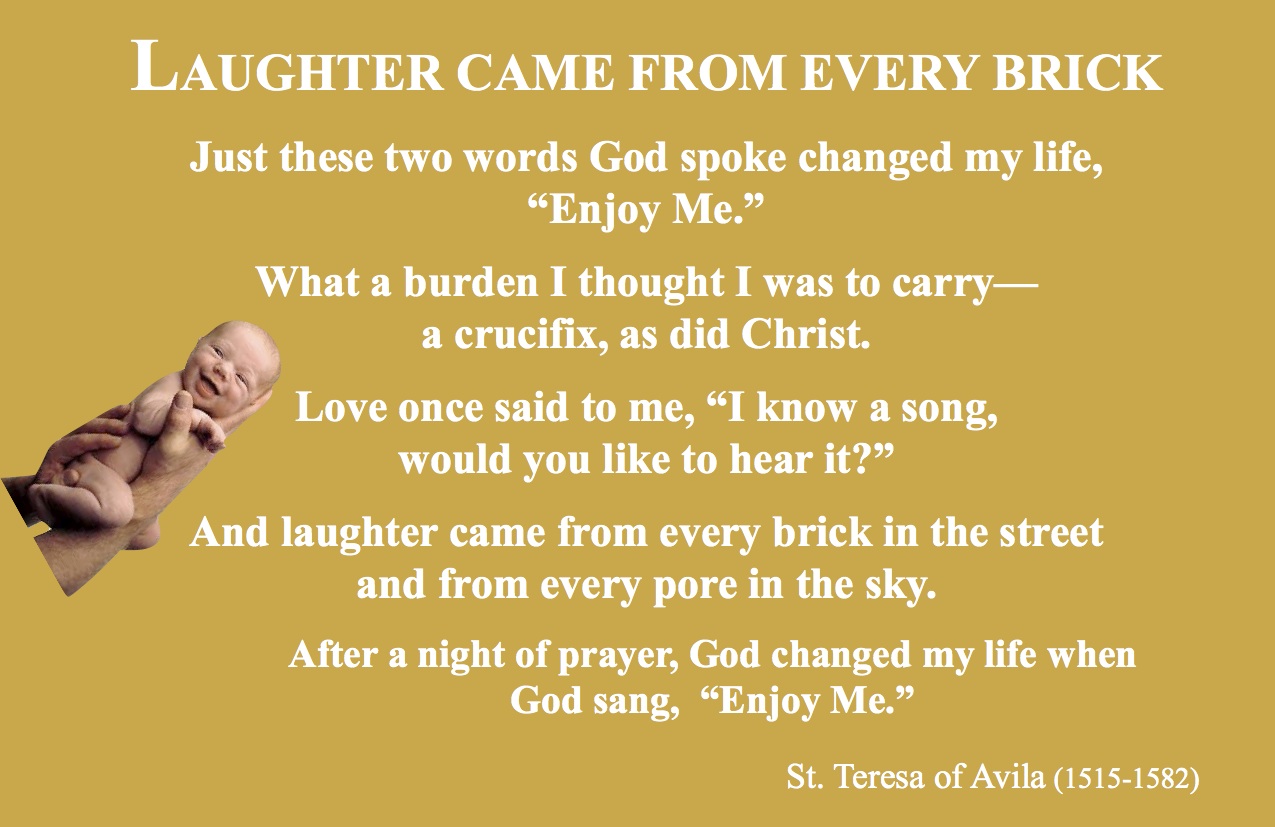
Today We Celebrate the Life and Witness of St. Teresa of Avila

An excerpt from “Love Poems From God” by Daniel Ladinsky,

(Penguin Compass, London: 2002)

(1515-1582)  “Teresa was born in Avila, a beautiful high mountain village of Spain.  She was one of thirteen children, three girls and ten boys, in a wealthy family.  The Spain in which Teresa grew up was permeated with 700 years of Arabian culture; the eradication of Arab power was followed by one of Spain’s darkest periods, the insanity of the Inquisitions, which, in the fourteenth century, along with other grievous deeds, forced mass conversions of Jews to Christianity.”

“Teresa was her father’s favourite child, and the most spirited.  Her mother died during childbirth when Teresa was thirteen, after which she had little supervision.  It is believed she had a lover at the age of fifteen, which caused her father to send her to a convent boarding school, only to see her return home two years later because of poor health.  When she was twenty-one, Teresa ran away from home to join a convent.  At that time many convents were more like hotels for women, allowing them a great deal more independence than they would be allowed at home, though after two years at the convent Teresa had a near-death experience that changed her life.  A spiritual awakening began in which she cultivated a system of meditation that sought quieting the mind to such an extent that God could then be heard speaking.  Over the next twenty years she experienced many mystical states but not until she was fifty did she begin the most far-reaching aspects of her life’s work.” Continue reading

To Whom Shall We Go to Say Thank-you? – Thanksgiving Sunday sermons

Thankyou autumn

Follow the links for previous sermons:

Reckless Generosity a sermon with a Monty Python flair!

Who IS God? – Not One, Not Two – inspired by Garrison Keillor & Joan Chittister

The Blessing of Michael’s Story – a Thanksgiving

Brussel Sprouts, Ebola, and Thanksgiving – seeking the ONE who IS

To Whom Shall We Go to Say Thank-you

After You Move Beyond Personifying God?

Over the course of the past nine years a group of little people have come into my life. Lovely little people who call me Gran. There are seven of them and participating in their little lives is a source of such great joy. Each stage of their development is a wonder to behold. I particularly enjoy watching their parents as they attempt to teach these little darlings the things that they need to know about being human. One of the first things that we teach little humans is the fine art of saying thank-you. It takes a fair amount of repetition to teach a child to say thank-you. Over and over again, after giving them exactly what they want, we ask, “Can you say thank-you?” and the little darlings repeat the words “Thank-you.” Sometimes all we have to do is ask the question: “What do you say?” in order to hear the words “Thank-you” uttered in such a delightful way as to inspire us to praise them as such good little girls and boys.

Expressing gratitude is a skill that all tiny little people must learn in order to develop into well-rounded human beings. Indeed, scientists insist that being grateful is a prerequisite of happiness. Happy humans it seems, are humans who embody gratitude. But there is more to gratitude than simply saying thank-you. I remember learning that gratitude includes more than simply expressing our thanks. It happened when I was about sixteen and actually noticed the beauty of a sunset and for the first time I realized that I was part of something so much bigger than myself. I know I must have seen the sunset before, but this time I actually saw the sun set. We were driving down the road, my friend Valerie and I were riding in a car driven by her mother, Lola. It was a partly over-cast day on the west coast of British Columbia.  Just a few clouds.  You could see the mountains off in the distance. We were chatting back and forth when all of a sudden, Lola pulled the car over to the far side of the road, switched off the engine and got out. Valerie followed her mother out of the car, so I figured I had better do the same. Val and her mother scampered down from the road and onto the beach. When they reached the water’s edge, they stopped and  just looked off into the distance. Apart from a tanker-ship making its way across the horizon, I couldn’t see much of anything. Lola had the most amazing expression on her face. She positively glowed with happiness. Valerie wore a similar expression. I must have looked somewhat puzzled because Val smiled at me and said “Isn’t it the most beautiful thing you have ever seen?” This only confused me more. What were they looking at that had made them stop the car, scamper down the bank and stand there at the water’s edge on a cold autumn evening. 

These happy, glowing, smiling people made me nervous. There they stood grinning from ear to ear.  What were they on? And then, I saw it. For the first time in my life, I saw it.  It had been there before. But I had never really seen it before. The sky was amazing.  The colours were overwhelming. It almost didn’t look real. It looked like someone must have painted it that way. It was magnificent. A work of art. The most beautiful thing I have ever seen. If you’ve never seen a late October, Pacific Coast Sunset before, you’ve missed one of the great wonders of the world. Neither Emily Carr’s paintings nor picture perfect post cards do a western sunset justice.          

Believe it or not, even though I had been living on the west coast for about four years, at that point I had never before really noticed just how beautiful a sunset could be. No one in my experience had ever taken the time to stop and look at one. No one had ever pointed one out to me before. I would never have dreamed of stopping a car and getting out to watch as the sun put on a show while setting. So, I stood there.  Overwhelmed by it all. Amazed at just how beautiful it was. Wondering just who or what could be responsible for such a spectacular thing as this. Before long my thoughts drifted to the Creator. Actually noticing a magnificent sunset was the beginning of a journey beyond myself as the reality that I am part of something so much bigger than myself continues to permeate my being.

Back then, I expressed my gratitude by very much the same way as my grandchildren are being taught to express their gratitude, simply by saying “Thank-you”. The object of the Thank-you being God. At the time, God was an old bloke up there in the sky somewhere. As my images of God changed over the years, my Thank-you’s continued to be expressed to my ever-changing images of God. But I must confess, that it was a whole lot easier to say thank-you to God when God was some big guy up there, out there somewhere? It was so much easier when I thought of God as “Father” or even as “Mother” to express my gratitude by simply mimicking the behaviour that I’d been taught as a child, “Can you say “Thank-you” Oh yes indeed I can say thank-you. “God is great, God is God, let us thank him for our food. By his hand we must be fed, Give us Lord Our Daily Bread.” Continue reading

Faith: A little dab’ll do ya! – Luke 17:5-10 – World Communion Sunday

Today all over the world, churches of all sorts of denominations will gather to celebrate communion. World Communion Sunday is an opportunity to embrace the embodiment of the infinite variety that exists in within the communities of our fellow Followers of the Way.  Today, we uphold the reality that no matter how communion is celebrated we Followers of the Way are all companions. For to be a companion is to literally share bread together. The word companion is made up of two Latin words, “com which means “with or together” and “panis” which means “bread”. To break bread together is to be a companion.

Humans began engaging in the sacred act of breaking bread together generations before Jesus embraced the sacred act of sharing a meal together to strengthen the bonds of companionship among his followers.

How many of you remember the very first time you participated in the companionship of communion? I suspect that for many of us are of an age where we can remember when are communion practices were less inclusive than they are today.  For several generations many mainline denominations tried to limit communion to those who had been “properly” instructed in the “meaning” of communion. In Lutheran churches children often had to wait until after they were Confirmed in order to be welcomed at the table. Back then, Communion wasn’t so much celebrated as it was endured as a sort of ritual reward for penance. Fortunately, we have come a long way from the somber communion rites of the past. But, I suspect that many of us still carry the residue of less than life-affirming theologies that taught us to view Communion as a sort of ritual that needs to be endured as a way to remember a “blood sacrifice”, a kind of quid pro quo for our sinfulness.

I can still remember my very first communion. It was, for all sorts of reasons, a life changing experience. Fortunately, for me my first Communion was free from the trappings of penitence. There was little or no thought of a blood sacrifice for sin. You see, my first Communion happened by way of what some would call an oversite or an accident, but I think of as a grace-filled DIVINE blessing.

As I’ve told you before, I did not grow up in the Church. My family’s experiences in Belfast had shown us the worst that the Church can offer and so, my brother and I were never encouraged to go anywhere near a Church of any kind. We were baptized as infants as a kind of insurance policy and I never darkened the doorway of a church until I was fifteen years old. I was an incredibly lonely teenager. I had spent my childhood moving from place to place, country to country, school to school; always on the move. I learned very early not to make friends with people because if you make friends it is so much more painful when you have to move away.

Longing and loneliness were predominant emotions that characterized the deep homesickness of my younger self.  Looking back to my younger self, I can see a little girl who was homesick for a home she never really knew because when you move about as much as we did, no place ever feels like home. Eventually all you can feel is this deep longing for something you cannot quite name. So, one day, at the tender age of fifteen, a new acquaintance that I was tempted to turn into a friendship, invited me to come to church with her. Continue reading

St. Francis – More than a bird-bath!

The Season of Creation concludes with the celebration of the life of St. Francis – Matthew 6:25-29