
National Indigenous Anglican Bishop Mark MacDonald will speak at Holy Cross in Newmarket this Friday and Saturday
Image
Reply

to listen to the audio only click here
There’s a preacher whose work I admire. His name is Salvatore Sapienza. Sal comes from New York city; Sal would say it differently – “New York.” Speaking with his New York drawl, Sal expresses the vine metaphor in a unique way. Sal says, “Jesus said, youz are the branches and I am da-vine.” Sal goes on to say that, the word divine is ‘of the vine”. Divine is another word for the MYSTERY we call God. Of the vine, vine from the Latin for wine – wine the fruit of the vine.
Wine is something that is intimately intertwined with the stories of Jesus life. According to the anonymous-gospel-storyteller that we call John, Jesus’ very first miracle was turning water into wine. In the story Jesus takes something ordinary and transforms it into something extraordinary. Most of us are very familiar with wine’s ability to transform us. The ancient Romans had a saying, “in vinio vertais” in wine there is truth. From the other anonymous-gospel-story-tellers we also have the story of Jesus last meal, during which Jesus takes wine, gives thanks and shares the wine with his friends saying, “drink this all of you, this wine is my blood…to remember me” When we remember that meal it is as if the wine we drink together is the promise that Jesus’ life force, the life that flowed through Jesus, flows through us in the sharing of the wine. In Jesus’ we see the energy, the flow of the life force that emanates from the MYSTERY, from the LOVE, that we call God. In the sharing of the wine, we too are in the flow, we too are connected to the flow that is the Divine.
The anonymous-gospel-story-teller that we call John creates for us a metaphor drawn from the life experience of his people.We are the branches, intimately intertwined with one another, we are all connected to one another, and what flows through the Divine, flows through us. In his teachings and with his life, Jesus said, God is in me, and I am in you, we are all in each other, we are all ONE. Youz are the branches, I am Da-vine. Such a beautiful metaphor; metaphor something that carries us beyond the words to a reality that is beyond words. The storyteller uses the metaphor of the vine to carry us beyond the image of the vine to the reality that is beyond words, the reality that we call Divine and the fruit of the vine flows through us to be the DIVINE in the world or as we say here “to be LOVE in the world”.
“Those who live in me and I in them will bear abundant fruit, for apart from me you can do nothing.” Wait, what? “Those who don’t live in me are like withered, rejected branches, to be picked up and thrown on the fire and burned.”
That’s the thing with metaphors. Metaphors can carry us beyond the words and images to a reality that is beyond words and images. Metaphors can also entrap us because we are prone to stretching metaphors beyond their ability to carry us. Metaphors often fail when they are delivered to folks who do not share the experiences of the creators of those metaphors. Vino veritas works, because we share the experience of seeing truth revealed when the wine is flowing. But when the anonymous-gospel-storyteller stretches his metaphor to say, “If you live on in me, and my words live on in you, ask whatever you want and it will be done for you.” the metaphor begins to fail, because not all of us share the experiences of asking and receiving whatever we want. And thus, the storyteller’s conclusion, “My Abba will be glorified if you bear much fruit and thus prove to be my disciples” fails to convince us.
Today’s first reading from the first letter of John often fails to convince us for a different reason. Scholars believe that the First Letter of John and the Gospel of John were written by the same anonymous-storyteller, we don’t know his name, but the church has traditionally called this anonymous-storyteller John. Scholars tell us that both the gospel of John and the First Letter of John were written sometime between 90-110, some 60 to 80 years after Jesus of Nazareth walked the earth. Scholars do not believe that this story-teller was an eyewitness to the life and teachings of Jesus, but rather that he experienced the life and teachings of Jesus through the stories that were handed down through the community in which he lived; a community that was suffering under the persecution of the Roman Empire as well as the persecution of their neighbours because they had chosen to follow the teachings of Jesus. In the midst of a very violent, dangerous existence our story-teller writes a letter to his community in which he insists: “Beloved, let us love one another because love is of God; everyone who loves is begotten of God and has knowledge of God. Those who do not love have known nothing of God, for God is Love.”
If only he had stopped there. But he continues, “God’s love was revealed in our midst in this way: “by sending the Only Begotten into the world, that we might have faith through the Anointed One. Love, then, consists in this: not that we have loved God, but that God has loved us and has sent the Only Begotten to be an offering for our sins.”
The life and teachings of Jesus and the death of Jesus are all about love; the love that Jesus had for his neighbours and the love that Jesus had for his enemies. Jesus lived a life that embodied neighbour love and extended the definition of neighbour to include those on the margins. Jesus critiqued his own culture and the culture of his people’s oppressors based on the love of neighbour. When the religious authorities and the forces of Empire teamed up to persecute Jesus and his neighbours, Jesus refused to take up arms against his enemies choosing instead to insist that only by loving our enemies can we hope to find peace. Jesus proclaimed that peace could only be achieved through justice; justice based on love of neighbours and love of enemies.
Violence is a violation of love and will never lead to peace. Jesus chose to embody love precisely because he understood God as love. Jesus’ embodiment of LOVE was so powerful, that in Jesus, people were able to see and experience God. The Jesus experience was so powerful, so life-changing that not even the death of Jesus could kill the experience of LOVE that his followers encountered in the life of Jesus.
Writing some 60 to 80 years after the brutal Roman execution of Jesus, the Jesus experience continued to speak powerfully to the followers of Jesus who continued to share that experience with others. That they chose to tell the story of Jesus life and death in ways that would have resonated with the people of their time should come as no surprise to us. Sacrifice, booth animal and human were part and parcel of the religious traditions of the Hellenistic world in which the followers of Jesus lived. That the followers of Jesus tried to make sense out of Jesus execution as a common criminal, in terms of cultic sacrifice is not surprising. That all these centuries later we continue to try to make sense out of Jesus execution as a common criminal, in terms of cultic sacrifice is astounding. That we all too often focus on cultic sacrifice at the expense of love, is in and of itself criminal.
Every day we are learning so much about what it means to be human, about the expansive cosmos in which we live, and about the very nature of reality. We are uniquely placed to explore what lies beyond the comprehension of those who have gone before us in faith. The dimensions and the power of love deserve more than the speculations of our past or the sentimental, self-serving notions of our present age.
LOVE, the LOVE that is God, deserves our attention in the here and now. Beloved, let us love one another because love is of God. If we have any hope of learning to love our neighbours and our enemies we will need to understand more fully the magnitude of the LOVE that is God so that we might begin to truly embody that LOVE. This will require that we step up and pay attention to how we arrived at a place where love can be wrapped up in guilt and confused with human sacrifice, so that we can shake off our childish notions and grow into all that we are created to be.
LOVE Beyond measure. Beyond words, beyond race, beyond religion, beyond tribe, beyond fear, beyond time, beyond sentimentality, beyond borders, beyond reason, beyond emotion, beyond imagining. Love, beyond the beyond and beyond that also. So, let the metaphor carry us beyond the words and images, let it carry us to the reality that is the LOVE that we call the Divine.
Jesus said, youz are the branches and I am da-vine.” Let us be of the vine, for we are intertwined one with another, all wound up in da-vine, for we are ONE with the DIVINE. Let the fruit of the vine flow through us so that we can be the DIVINE in the world or as we say here and now, “to be LOVE in the world”.

This sermon was preached in 2015 upon my return from Belfast. I went off script for this one. So, the manuscript does not adequately reflect what was actually preached. But you can read the notes here The audio is much better!!! I went off on a tangent using Robin Meyers’ observation that our historical creeds reduce Jesus life to a comma!
I post this on the morning of my return from another trip to Belfast, where I once again worshipped in St. Anne’s Cathedral. This time I managed to stay to the end of the service. My wife’s moderating presence may have something to do with this???
Listen to the sermon here
 What follows is a sermon I preached on the 5th Sunday of Easter 2003. In the 18 years since I preached this sermon, the Evangelical Lutheran Church in Canada has come a long way. The debate about the full inclusion of LGBTQ folk in the full life of the church has been resolved and we can truly say: “All are welcome!” But rule changes don’t always change practices. Sadly, there are still places in our church were not everyone is welcome. So, I offer this sermon to cybersapce as both a reminder of where we have been and how far we need to travel. Shalom.
Earlier this week, I was talking with a few of my colleagues and as Lutheran Pastors are wont to do, our conversation drifted toward the lessons prescribed for this Sunday. As we kicked around ideas, most of us agreed that it is difficult to preach on familiar passages.
Most of you have heard a great many sermons on today’s gospel lesson, and so the challenge for preachers to bring some new insights is made all the more difficult. So, we joked about just how many ways a preacher can twist and turn those vines until they finally snap off, dry up and rot.
Today’s epistle lesson isn’t much easier. Preachers are always preaching about love; often we’re preaching to the choir, because most of you already know that God is LOVE and that in loving we encounter God. Coming up with a new and interesting angle on the second lesson isn’t easy. So, I suggested to my colleagues that this Sunday rather than preaching one more time about love, why not preach on the first lesson. Why not preach on the story of the Apostle Philip’s encounter with the Ethiopian on the road to Gaza? Well it might surprise you to know that no matter how challenging they thought it would be to come up with one more sermon about love, not one of my colleagues thought that it would be a good idea to preach about the goings on in the desert between Philip and that Ethiopian. One of my colleagues even went so far as to say that you would have to be either very brave or very foolish to even try it.
Now I have a confession to make, at the time I had no idea what it was in this particular passage that would make my colleagues so averse to preaching on it. I have to admit that I don’t really remember ever paying all that much attention to this particular story. I have certainly never before studied it in any great detail, but my colleagues’ aversion to this text, made me curious enough to hit the books just as soon as I got home. Despite the fact that this text shows up every three years in our lectionary, try as I might, I wasn’t able to find a reference to a single published sermon on this particular text. It seems that many of the great preachers left this one alone.
It didn’t take me long to figure out just why this text is so daunting and why my colleagues are not alone in giving it such a wide berth. Now I don’t claim to be particularly brave, but I’ve already preached on today’s other readings. Besides it’s a long weekend and I figured that a lot of people would be away and I could sneak this one in. So this fool is about to rush in, where many have feared to tread.
Our story begins when an angel directs the apostle Philip to go south on the road from Jerusalem to Gaza. On this road in the desert Philip meets an Ethiopian eunuch. Now I don’t know about you, but this strikes me as a really odd way to introduce someone; no name, just an Ethiopian eunuch. The author must have thought it was important because he tells us not once but five times that the Ethiopian was a eunuch. I know what an Ethiopian is. Philip has encountered a black African man in the desert. Now that in and of it’s self is pretty remarkable. You will see later that this black man was the first missionary to Africa. But surely this can’t be the reason why so many preachers shy away from this text. So what exactly is a eunuch? According to the most current scholarship, in the first century a eunuch is one of two things. A eunuch could have been a man who had been castrated. Now for those of you who didn’t grow up on a farm to castrate means to remove a male’s testicles. So, this particular Ethiopian could have been a castrated male, or he could have been a male who wasn’t like most males. According to the scholars, men who showed a preference for other men or displayed little or no interest in women, or who were in anyway effeminate, in the first century these men were called eunuchs. Continue reading
 My most memorable journey on the road to Emmaus was taken behind the wheel of a 1981 Oldsmobile, Cutlass, Brougham. I loved that car. It was a thing of beauty. It was a gift from my home congregation so that I could travel back and forth across the country to and from seminary. Despite its propensity to guzzle gas it was the perfect combination of power and elegance. It had the most amazingly plush interior with every imaginable power amenity of its day. It handled like a dream and even though I loved driving that car, neither it nor I faired well on our journey on the road to Emmaus. Five weeks into my Clinical training at the Grand River Hospital and I’d just completed one of the toughest weeks of my life when I set off for Emmaus. Clinical Pastoral Education is what the Church calls it but seminary students have other names for it, like boot camp, torture or hell. Twelve weeks of on the job training in a busy hospital combined with daily psychotherapy, group sessions, and sleep deprivation. It’s all designed to help seminarians put two years of academic study into practice before sending them off on a yearlong internship. Ask most pastors about their Clinical Pastoral Education and they’re likely to sit you down and tell you story after story about how intense an experience it was. Many of my colleagues will tell you that it almost broke them into little pieces, or that it almost destroyed their faith, or that they didn’t think they’d survive, or how they never thought that it was possible to be that scared or insecure for that many hours every day. Boot camp, torture, or hell, it all depended on whether or not you were able to get any sleep or if the demons you faced on the wards managed to destroy whatever self-confidence you might be able to muster.
The week before I set off on the road to Emmaus, wasn’t as bad as all that. I felt like I was just beginning to get the hang of things. I thought that the worst might be over. I’d managed to conquer my fear of being called Chaplain and being expected to help people who were sick, in pain, in distress, or dying. Why that week I’d even managed to help one or two of my patients. Those nagging doubts that haunted me during the first month of Clinical training were beginning to fade. It was becoming easier to believe that God was there in the midst of all the turmoil. I thought that maybe just maybe I could do the job and the terror wasn’t quite so intense when my pager went off. I remember saying to a colleague that maybe we’d be able to get through our Clinical training without coming up against the inevitable crisis of the faith that so many of our fellow students had warned us about. I wasn’t even nervous about having pulled the short straw for the long-weekend shift. 72 hours as the on-call emergency chaplain for the entire hospital. I felt like I was ready; that with God’s help, I could face anything that came my way.
I wasn’t particularly nervous when my pager went off and I calmly dialed the operator who announced that there’d been an MVA and six patients were on route; two of them were vital signs absent. MVA – Multiple vehicle accident. Vital signs absent = that usually means dead, but only a doctor can actually pronounce death so patients without vital signs are transported to the hospital before being pronounced dead. Continue reading
 Looking ahead to Doubting Thomas’ annual appearance, I am reminded that resurrection is not about belief. Resurrection is a way of being in the world. Over the years I have tried serval different approaches to encourage the practice of resurrection. click on the titles below to see
 Our first reading was the traditional gospel story for the Second Sunday of Easter in which we heard the story of Doubting Thomas for John 20:19-31. This was followed by a video in which Richard Holloway retells the story of Peter’s denial and the encounter between the resurrected Jesus and Peter. You can view the video here . This was followed by the gospel reading from John 21:15-20
Listen to the sermon here
It has been said that, “The shortest between a human being and truth is a story.” It has also been said that the greatest story ever told is the story of resurrection. Like all really good stories, the story of resurrection has been told over and over again as storytellers attempt to convey the truth. We have heard Easter’s story of resurrection so many times that you would think the truth of resurrection would be obvious to us all. Yet, we struggle to find truth in Easter’s familiar story. Some of us have been shaped by this particular story. Some of us have built our lives around the truth that others have reported to us about this story. Some of us have rejected this story and filed it with all the other idle tales in which we can find no truth. Some of us have moved on from this story convinced that there is no longer any truth to be found. Some of us love to hear this story because it takes us back to familiar truths that inspire a nostalgic sense of well-being. Some of us, are determined to wrestle with this story until it releases all the truth that it harbours in, with, and between the lines which calls us toward a new way of being that we long to embrace. I myself, I am a wrestler. Like Jacob of old, I wrestle with this familiar story determined to get from this ancient tale not just truth but an inkling of the Divine who dwells in, with, through, and beyond all of our stories.
The gospel storyteller who we know as John tells Easter’s resurrection story in a particular way, determined to reveal the truth that dwells in him and among the people with whom he dwelled. One of the things that we 21stcentury truth-seekers are particularly fond of is deconstructing stories. We love to take stories apart, dissecting every line, examining each and every detail, each and every word so as not to miss a single nuance of the author’s intent. We are also skilled in the imperfect art of attempting to place stories back into their historical context so that we can establish exactly what was going on in the first century lives of the story-teller and his listeners. We look to the historical context in the hope that we can determine the original meaning of the story. Convinced that history can tell us what the story-teller cannot, we wrestle with the facts, as best as we can determine them, so that we can be sure that the truth we thought we knew is more than just the summation of our mistaken interpretations.
Together, we have wrestled with Easter’s story of resurrection and together, I must say that we are pretty good wrestlers. We have deconstructed this story, we have applied the historical-critical method, we have approached it from all sorts of angles and employed the best 21stcentury scholars to aid us in our struggle to wrestle the truth from the piles and piles of dogma, which have been heaped upon it. But this morning, I’d like to approach Easter’s story of resurrection from the perspective, not of wrestlers determined to find the truth, but rather as people touched by the story itself. But even though we are not going to wrestle, like Jacob of old, we run the risk of being touched and even wounded by the truth as the Divine One is revealed and we are compelled by our wounds to walk in a different way. Continue reading
A couple of kids were taken to church on Easter Sunday by their grandmother. These kids hadn’t been to church since their grandmother took them to the Christmas pageant. Angie was six years old, and her brother Joel was four. Joel giggled, sang and talked out loud. Finally, his big sister had had enough. “You’re not supposed to talk out loud in church.” “Why? Who’s going to stop me?” Joel asked. Angie pointed to the back of the church and said, “See those two men standing by the door? They’re hushers.”
Little bobby and his family travelled a long way to have Easter Sunday lunch at his grandmother’s house. Everyone was seated around the table as the food was being served. When Bobby received his plate, he started eating right away. His Father tried to stop him: ‘Bobby, wait until we say grace,’ ‘I don’t have to,’ the five-year-old replied. “OH yes you do Bobby!” his Father shouted, ‘We always say a prayer before eating at our house.’ ‘That’s at our house,’ Bobby explained, ‘but this is Grandma’s house, and she knows how to cook.’
A new pastor was visiting in the homes of her parishioners. At one house it seemed obvious that someone was at home, but no answer came to his repeated knocks at the door. Therefore, he took out a business card and wrote ‘Revelation 3:20’ on the back of it and stuck it in the door. When the offering was processed the following Sunday, he found that his card had been returned. Added to it was this cryptic message, ‘Genesis 3:10…’ Reaching for his Bible to check out the citation, he broke up in gales of laughter…Revelation 3:20 begins: ‘Behold, I stand at the door and knock.’ Genesis 3:10 reads, ‘I heard your voice in the garden and I was afraid for I was naked.’
A Baptist pastor was in the middle of the children’s sermon. The pastor, asked the children if they knew what the resurrection was. Now, I know that you have to ask questions during children’s sermons, but I also know from bitter experience that asking children questions in front of a congregation is not only tricky, it can be downright dangerous. When this pastor asked the children if they knew what the resurrection was, a little boy raised his hand……..The pastor called on him and the little boy said, “I know that if you have a resurrection that lasts more than four hours you are supposed to call the doctor.”
I have a confession to make: I seriously considered just standing up here on this glorious Easter morning and simply telling you joke after joke and trying my best to make you laugh. There’s this ancient tradition of telling jokes at Easter. Legend has it that joke telling at Easter became a popular way of imitating God’s ability to get the last laugh on the power that tried to destroy Jesus. I mean, it’s April Fools’ Day, after all, and even if my joke-telling makes a fool out of me, at least my playing the fool is in keeping with the day!
But, even though it is tempting to play the fool and just keep telling you jokes, I suspect that there might be one or two of you who expect me to talk more seriously about resurrection. By now, I hope that most of you already know that I don’t believe that resurrection is about the physical resuscitation of a corpse. I’ve preached on and on about how I take the Apostle Paul seriously when he says that talk of a physical resurrection is stupid. That’s 1stCorinthians chapter 15 – which you are all capable of reading for yourselves if you don’t believe me. Resurrection is about something so much more miraculous than the resuscitation of a corpse. So, let’s leave theology and doctrine for another day. Don’t worry, Easter lasts for 50 days. So, there will be plenty of opportunities for us to explore the theological implications of resurrection. Today, on this glorious Easter morning, let’s do what our ancestors were so good at doing when it comes to Easter, let’s not try to explain resurrection, instead let me tell you a story about resurrection. Continue reading
 Holy Week marks a sharp uptick in visitors to this blog. From comments, messages, and emails I hear from fellow preachers who, like me, are daunted by the task of preparing the Good Friday sermon. That task is even more daunting for those of us who serve progressive communities. My fellow progressive-christian-preachers tell me of the dearth of progressive-christian Good Friday sermons to be found on the internet and encourage me to re-post my own attempts to rise to the occasion. So, here are the links to some of the Good Friday sermons I have preached over the years of my journey with the progressive community which I serve. The people Holy Cross Lutheran Church has over the years provided an invigorating space for me to pursue my questions. They have also provided the resources which make this blog possible. So, if you find the work posted here of value to you and your community, please consider supporting this ministry of Holy Cross. I rarely solicit donations. But Holy Cross is a small community that continues to give to others in so many ways and your encouragement is greatly appreciated!!! (Holy Cross Lutheran Church, 1035 Wayne Dr., Newmarket, On. L3Y 1N3)
Follow the links to Good Friday sermons and feel free to use/adapt/repost
Preparing to Preach on Good Friday click here

Trading Our Palm Branches for Tomahawk Missiles or White Helmets?
Hosanna! Hosana! Hosana! Yada, Yada, we’ve heard it all before…
On Palm Sunday, An Inconvenient Messiah Parades Into our Midst
Jesus Sets Us Free to Save Ourselves
Jesus is still up there on that ass making a mockery of our hopes for a Messiah!
A reading from 1st Corinthians chapter 13: “When I was a child, I used to speak like a child, think like a child, reason like a child. But when I became an adult, I put childish ways aside. Now we see things imperfectly, like puzzling reflections in a mirror, but then we will see everything with perfect clarity. All that I know now is partial and incomplete, but then I will know everything completely, just as God now knows me completely.

REPENT God Loses His Home
Repent: Metanoia: “to think new thoughts” Let us repent, metanoia – Let us think new thoughts.
The Bible was written by men who believed that they lived in a three-tiered universe. The Earth was flat. The flat Earth was surrounded by the waters. The flat earth was supported over the waters on pillars. Above the sky were the Heavens. One of the authors of the Book of Genesis described creation like this : “And God said, ‘Let there be a firmament in the midst of the waters, and let it divide the waters from the waters.’ And God made the firmament and divided the waters which were under the firmament from the waters which were above the firmament: and it was so. And God called the firmament Heaven.”
The Earth, the Heavens, and the seas.Now even though the ancient Greek mathematician Pythagoras proposed that the Earth was round in the 6th century before the common era. It wasn’t until the 15th century that the flatness of the Earth was seriously challenged by the likes of Columbus.
I don’t know about you but for most of my life I have been taught that the place to learn about God is the Bible. Certainly, in the church the Bible is considered to be the supreme authority of the nature of God. For the most part, the Bible points to the Heavens above the firmament as the home of God.
In his new book, Unbelievable, our friend, Jack Spong writes: “The laws by which the world operates have not changed since the dawn of time, but the way human beings explain and understand those laws has changed dramatically over the centuries of human history.” Jack has a way of reminding us of the obvious. None of us believe that we live in a three-tiered universe. Unlike our ancestors who succeeded the writers of the bible and went on to develop the theology of the church, we don’t believe that the round earth is the center of the universe. The writers of our creeds firmly established that God lived in heaven. “For us and for our salvation He came down from heaven…”
Most of us have travelled far above the Earth, we have sailed through the clouds and we know that there is no heaven up there. As far back as the sixteenth century, a Polish monk named Nicolaus Copernicus calculated that the Earth is not the center of a three-tiered universe. In the 17th century, Galileo Galilei a personal friend of the Pope, published a paper demonstrating that the sun could not possible revolve around the earth. This despite the fact that the biblical author of the book of Joshua wrote that God stopped the rotation of the sun around the earth in order to provide Joshua with an extended period of daylight in which to kill his enemies. It took the Church until 1991 to concede that Galileo and not the writer of Joshua was right and that the Earth did indeed revolve around the Sun. Continue reading
 International Women’s Day has been celebrated since 1911. It is also known as the United Nations Day for Women’s Rights and International Peace. Women have come a long way since 1911. Sadly, we must all confess that women have a long way to go before we achieve our vision of a world in which all people have equal access to opportunity. There is much for us to celebrate on this particular International Women’s Day and there is also much to lament. In our world the phrase “war on women” is bandied about by the media and each time I hear it anger rises in me and it is all I can do to stop myself from screaming. In our own country we have watched the steady erosion of hard one gains as our federal government continues to cut funding to women’s organizations and continues to refuse to launch a federal inquiry into the disappearance of far too many of our aboriginal sisters. Any serious reflection on the plight of women in the world makes my blood boil and I can’t help but wonder why we don’t just follow Jesus’ example because maybe if we turn over a few more tables in the halls of power we might be able to draw some serious attention to the abuses perpetrated upon women for the sake of maintaining the status quo.
The story of Jesus turning over the tables of the moneychangers in the temple has always intrigued me. The idea that Jesus could have become so angry with religious authorities for cooperating with the violent and oppressive, Roman Imperial system that he would create such a scene in the Temple is so far from the image of Jesus as the meek and mild long-haired peace-nick that we’ve all come to take for granted.
For generations, biblical commentators have gone to great pains to ensure that any hint of Jesus humanity is scrubbed clean from interpretations of this story. Anger is a perfectly normal human emotion. Jesus was a human being and therefore he was subject to normal human emotions. But the institutional church frowns upon anger. Indeed, in many places one can still find anger listed as one of the seven deadly sins. “ira” which can be translated as anger or wrath made the list of seven deadly sins. This list is often attributed to the early Christians. Indeed, there are those who would argue that these sins are biblical. However, they are actually the work of a 4th century monk named Evagirus Ponticus, whose nickname was Evagrius the Solitary. He spent most of his adult life living as a hermit in the desert. I suspect that if a modern psychologist were to take a brief look of Evagrius’ personal biography they could very quickly make a diagnosis of clinical depression. Evagrius himself prescribed tears as the pathway to God and was known to have spent days at a time alone and weeping profusely. He is best known for his writings on the various forms of temptation, which the institutional church latched onto with a vengeance. His original list included eight deadly sins. But the church erased “sadness” from the list and elevated the seven deadly sins to the category of mortal sins. Mortal sins were those sins that actually placed one’s soul in danger of eternal damnation. Continue reading
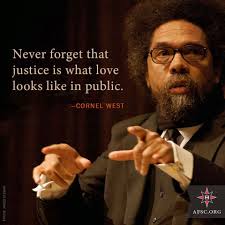
 Lent 2B – Mark 8:31-38 this sermon is inspired by my study of the work of Dr. Cornel West. His words flow through the lines of this sermon and his prophetic imagination provides the hope-filled vision of LOVE parading around the world as justice.
The anonymous gospel storyteller that we call Mark, wants us to know that: “Jesus began to teach them that the Promised One, the Messiah, the Chosen One, the one the oppressed people of Israel had been longing for, waiting for, expecting, hoping for, the Promised One, had to suffer much, be rejected by the elders, chief priests, and religious scholars, be put to death, and rise again three days later.” Furthermore, the gospel storyteller makes it absolutely clear, “if you, wish to come after me, you must deny your very self, you must pick up your cross and follow in my footsteps.” Those of us who have the audacity to call ourselves Christian, those of us who seek to follow Jesus, must deny our very selves, we must pick up our cross, and we must follow in the footsteps, of Jesus. Follow in the footsteps of the ONE who is understands that he must suffer much, be rejected by the elders, the pillars of society, the powerful religious leaders and the scholars, follow in the footsteps of the One who understood that rejection meant that he would have to be put to death, and rise again. Quick change the channel. There must be something better on offer than this.
Change the channel, I can’t stand to watch this one again. I’ve seen it before. The hero, the beloved, the freedom fighter, justice seeker, peace maker, that one, the one we’re all rooting for, our saviour, suffers and dies. Change the channel, I’m not up for this. Don’t give me Jesus. I don’t want Jesus. I don’t want anybody telling me that suffering and death are the inevitable; especially my suffering, and my death. Change the channel. There must be something better out there.
I don’t want to know. Distract me. Distract me from the pain and the suffering. Change the channel. Find me something more interesting, more uplifting, more hopeful, more cheerful. Continue reading
On Ash Wednesday, this week, we began the season of Lent. Traditionally the Lent is a season for contemplation, repentance, confession, and self-denial designed to prepare us for Holy Week. 40 days, not counting Sundays because all Sundays are a celebration of resurrection, 40 days leading up to our commemoration of Jesus’ death and the celebration of Christ’s resurrection. 40 days inspired by the stories recounted by the gospel storytellers known as Mark, Matthew and Luke about Jesus’ journey into the wilderness, which of course are patterned after the story in the Hebrew Scriptures about Moses spending 40 nights on Mt Sinai, or the 40 days and nights it rained in the story of Noah and the flood, or the 40 years the Hebrew people spent wandering in the desert.
The gospel-storytellers cast Jesus out into the desert where he encounters Satan, the personification of evil. The first Sunday in Lent always includes a reading from one of these three gospel-storytellers about Jesus’ encounter…..this year our lectionary follows Mark, which you heard as our first reading. I’ve chosen the version out of Matthew for our gospel reading because it expands further on Jesus encounter with the personification of evil.
For several weeks now, our Adult Study Class has been ReThinking the concept of Evil; that is we have been looking at evil in light of all the ReThinking of Christianity that we have been doing for the past several years. How does our evolving Christian theology change the way we think of evil? Once you move beyond the doctrine of Original Sin and the Fall from grace as the prevailing explanation for the existence of evil in the world, from whence cometh the problem of evil. So, in preparation for those classes I’ve had the privilege of delving into the subject of evil. I’ve spent weeks, no months now, but it feels like years now, researching the topic of evil. I get all the fun jobs around here.
Turns out most of us don’t really believe in Satan. Sure, the guy still haunts the deepest darkest recesses of our psyche’s – both our personal psyche and our collective psyche. But when push comes to shove, we’ve confined Satan to the pits of hell, which of course we all know doesn’t exist anywhere but in our collective imaginations. What we have here in this morning’s story, is metaphor heaped upon metaphor. Metaphors are those things we use when we don’t really have words to adequately describe particular phenomenon. Meta which means beyond and phor which means words, metaphor means beyond words and that works both ways. Metaphors describe those things that are beyond words and when looking at metaphors we are supposed to look beyond the words of the metaphor itself. Satan is used to describe that which is beyond words and we need to look beyond the word Satan itself to understand the metaphor of Jesus encounter with Satan.
The gospel-storytellers place the story of Jesus temptation in the wilderness immediately following his baptism. Baptism was and is a public act; a sort of declaration of intent to be a certain kind of person. Jesus is about to step into his life as a public teacher. Jesus is baptized by John the Baptist who preached a baptism of repentance; repentance means to turn around, to turn from the direction you’ve been going, to turn around toward God so that you might live in God, recognizing that God lives in you. No sooner does Jesus engage in this public act which sets him up as a committed follower of YAHWEH in a world where committed followers of YAHWEH where hanging on crosses all over the place; no sooner does Jesus set himself up against the powers-that-be than he is driving by the Spirit into the wilderness where the personification of evil, Satan himself pays Jesus a visit for the sole purpose of enticing Jesus to follow Satan and not YAHWEH. Isn’t that always the way? Each and every time we resolve to follow one path, someone or something comes along and entices us to follow another. When that someone is the personification of Evil himself, well who else would be up to the task of tempting Jesus other than Satan himself. The gospel-storytellers are setting up a battle of cosmic proportions between good and evil. Our very lives write large upon the canvass of the heavens themselves, cause you know the big guy up in the sky and all the heavenly host will be watching this one; just as they tune in each and every time we are come face to face with the choice between good and evil. What better way to begin a season, which encourages contemplation, repentance, and confession? Continue reading
 A sermon preached on Lent 1B 2012 which began a journey into the wilderness with the Mystics. St Teresa of Avila and my granddaughter’s laughter inspired this sermon.
I find myself wishing that we were entering some other season of the church year. Traditionally the season of Lent is a mournful time filled with calls to repentance and self-examination as we follow Jesus into the wilderness to be tempted and then on that long march to Jerusalem where the powers that be will have their wicked way with him. Our liturgies take a mournful tone as we lament our woeful human existence, confess our sinfulness, and hear exultations to take up our crosses so that we too can follow Jesus to the bitter end. Over and over again we are asked to remember that we are in bondage to sin and cannot free ourselves, as we gaze upon the cross remembering that Jesus our savior bled and died as a result of our wicked sinfulness.
Lent is a strange season that harkens back to a forgotten era. Unlike so many of the seasons of the church year it’s not exactly a season that attracts people to church. Not many of you got out of bed this morning and said, “Yippy it’s the first Sunday of Lent. OH goodie! We get to be reminded that we are sinful, that life is miserable and unless I’m willing to take up my cross and follow Jesus all the way to Golgotha, there’s precious little hope cause we’re all going to die and when the time comes we want Jesus to remember us.”
Now I know that there are some people who just love Lent. And I must confess that I like the quieter, more somber tone that our liturgies take. I actually enjoy the opportunity to slow things done and be more reflective in our worship together. I savor the silences and the opportunities to be more contemplative. I love the colour purple with all its vibrant hues and the best part of all is that the beginning of Lent means that spring is just around the corner. What I don’t like about Lent are the signs, symbols, hymns and stories that make it so easy for us to fall back into the 11th century.
It is so easy for us to lean not on the ever-lasting arms of Jesus but on the scales of St. Anslem and find ourselves not looking forward to the promise of resurrection and the gifts of eternal life, but rather dreading judgment day knowing that the scales of justice must be balanced and fearing the moment of truth when our sins are piled onto the scale and knowing that our only hope for reconciliation with our Maker is that Jesus is sitting on the other end of the scale. Woe is me. Woe is me. For I am sinful. My sins are too numerous to count. There’s all the things I have done and all the things I have left undone. Thank God Jesus died for me. Somebody had to pay the price for my sinfulness. Jesus died for a reason, and you and I dear sisters and brothers are that reason. A blood sacrifice had to be paid. God’s justice demanded it and Jesus paid the price with his very own blood. Jesus took our place up there on that cross and the least you and I can do to say thank-you is to spend some time shouldering our own crosses as we retrace Jesus steps to Jerusalem. Continue reading
Audio only version here
Are you all ready for Valentine’s Day? I am. I have to be ready because this year Valentine’s Day falls on Ash Wednesday. There are all sorts of other things vying for my attention on Ash Wednesday. So, my love and I will celebrate Valentine’s Day on Tuesday. Shrove Tuesday, and pancakes lends itself more easily to being transformed into Valentine’s Day than Ash Wednesday does with talk about remembering that we are dust and to dust we shall return.
My preparations for Valentine’s Day have me thinking about love songs. A few years back, when Peter Rollins was here, he suggested that we needed to employ more love songs in worship. I think that’s why every time I tried to write today’s sermon, I’ve been plagued by an ear worm. I haven’t been able to get this song out of my head, so rather than fight it any longer, I want to share my ear worm with you. It’s an old song, an “Old Fashioned LOVE Song,” that I first heard playing on the radio, back in 1975. Anybody remember the group Three Dog Night? Listen to my ear worm: Just an Old Fashioned Love Song.
That old fashioned love song was playing in my head every time I tried to climb up onto the mountaintop with Jesus. Each time I ventured into the anonymous gospel storyteller that we call Mark’s vision of Jesus on the mountaintop, I heard the electric guitars of Three Dog Night. Those old cords summoned up the year 1975, the year that I graduated from high school. I was just 17 years old. I had precious little idea who I was when I was 17, I knew even less about what love is, but I sure thought I knew who Jesus was. I was hopelessly in love with Jesus. And even though I can’t carry a tune, I sang all sorts of love songs to Jesus. One of those love songs, I bet you all remember.
Now that’s what I call an old-fashioned love song. I can’t tell you how often I sang this love song to my beloved Jesus. Nor can I tell you how much my beloved Jesus has changed over the years. That naïve 17-year-old girl who sang it way back when, well she may not have known who she was, but she was absolutely sure who Jesus was. But the Jesus that she was so sure that she knew is a far cry from the Jesus she knows today. I think have a better idea about who I am today, and I suspect that I have a much better idea about who Jesus is. But I know that who I am today, is not who I will be in the years to come and I trust that who Jesus is will continue to change. Lovers always do. Think about the one with whom you share the deepest of intimacies. Think about how it was when you first became intimate with one another. Now think about the intimacy you share today. That quality of the intimacy has changed. As love grows deeper, fuller, we are blessed with new ways of seeing, of knowing, of touching, of loving. Continue reading


Readings include 2 Kings 2:1-14; Mark 9:2-10
Listen to the sermon here
When I was a kid the scepter of nuclear annihilation hung over the world’s psyche. Children were not immune to the images of mushroom clouds rising in the distance that held the power to destroy entire populations. I can still remember classroom drills in which we were instructed in the fine art of what to do if a nuclear missile was on its way. We practiced hiding under our desks. Our desks were supposed to protect us from a nuclear blast. It sounds funny now. But I remember the day that I put two and two together. We were watching a film of a nuclear test out in the desert of Nevada which showed dummies being blown away by the nuclear blast; dummies that were miles away from ground zero. It was then that I realized that our teachers were lying to us and that if the big one came our way we would all be blown to smithereens. If we got lucky and ground zero was just far enough away, we would all suffer the effects of radiation sickness. Images of rotting flesh on the bodies of victims of Hiroshima and Nagasaki haunted me and my fear spawned cries of outrage which developed into anger; anger that was embodied in my politics.
I was a very angry teenager. At the time, I believed that my anger was the result of the state of the world and I resolved to change the world. Ah the innocence of youth. It has taken decades and a whole lot of therapy for me to understand that my anger came from a deeper and darker place that rivaled the world’s warring madness. I was in fact a very lonely teenager. We moved around a lot. Every year of my life there had been a new school to contend with. Friendships were fleeting at best. The pain of moving from place to place left me longing for something I didn’t even know how to describe, and that pain came out as anger; anger which I directed at every adult who crossed my path, especially if that adult was in a position of authority. It didn’t take me very long to learn that anger isn’t exactly socially acceptable. So, I tried my best to bottle it all up. Until the day, I discovered what a lot of young people discover: the love affair between anger and politics. So, I took up the cause of my day and became an angry protester who actively fought the proliferation of nuclear weapons.
I was 13 in 1970 when Greenpeace was founded in Vancouver and I was there in the Pacific Coliseum at their very first fundraiser. My parents knew nothing about it. My friends and I hitchhiked into the big city to join all those who were protesting the nuclear tests that the Americans were carrying out on the Island of Amchitka. Joni Mitchell, James Taylor and Phil Ochs headlined the concert that launched Greenpeace onto the world stage. So, inspired were we that we spent most of the following year organizing a student strike.
In 1971 at the tender age of 14, I was on the organizing committee of the very first High School strike in Canadian history. We managed to convince over 9,000 high school kids from all over the Greater Vancouver Area to walk out of their classrooms and march down to the American Consulate and demand that they put an end to the nuclear testing on Amchitka.
Those were the days my friends. We were going to change the world. Stop the bomb and put an end to the war in Vietnam. Feed the hungry, end racism. What do we want? Peace! When do we want it? Now!
Peace now! Was our rallying cry. Looking back, I realize that I wouldn’t have recognized peace if it broke out in front of me. There was so little peace in my life at home. As for the life inside of me, well that was so full of turmoil that peace would probably have driven me to madness. The only thing stopping me from going insane was my focused anger at the injustices in the world. As long as I could rage against the world, I didn’t have to listen to the demons that were raging inside of me.
Then one day, I started hanging out with a gang. I haven’t got time to go into the details of my involvement with this gang; suffice it to say, if I knew what this gang was all about I would never have gotten involved with them. The kids in this particular gang all had one thing in common; the Lutheran church. These kids were part of a Lutheran Youth Group. This gang managed to convince me to run away with them. They were going on something I’ve never heard of before; a retreat. A weekend at a place called Camp Luther. Somehow, I found myself with a gang of young, socially aware, politically astute kids who wanted to change the world. Continue reading
 Listen to the sermon here
Monday, Tuesday, Wednesday, and Thursday of this week, I found myself studying the transfiguration of Jesus. So much has been written and said about this strange little story given to us by the early followers of Jesus. I was planning to do what I’ve done here on many Transfiguration Sundays and preach to you about the power of myth to open us to new ways of understanding who and what Jesus embodies. Then two things happened on Thursday that transfigured my own images of the transfiguration of Jesus.
Where once my images were shaped by the mythological language used by the crafters of the story of Jesus’ transfiguration, the experiences I had on Thursday have transfigured Jesus in ways that reveal the glory of God beyond the pages of scripture and into the realms of the cosmos and beyond. The first thing that happened on Thursday, happened not just to me but to the whole world.
You see on Thursday, NASA, announced, and I quote: “the discovery of seven worlds orbiting a small, cool star some 40 light-years away, all of them in the ballpark of our home planet in terms of their heft (mass) and size (diameter). Three of the planets reside in the “habitable zone” around their star, TRAPPIST-1, where calculations suggest that conditions might be right for liquid water to exist on their surfaces—though follow-up observations are needed to be sure. All seven are early ambassadors of a new generation of planet-hunting targets.”
NASA’s announcement was accompanied by an artist’s rendition of what has taken place. Watch for yourselves…
As I struggled to wrap my brain around the reality of what has been discovered, our little grand-daughters came for a sleepover.Audrey is three and Evelyn is two and together they are a force to be reckoned with. I’d almost forgotten all about Trappist 1 when I found myself leaning over little Evelyn’s travel cot as she began to sing. It took a moment or two before I recognized her tentative little voice attempt to capture the tune. It didn’t take too long for me to join her: “Twinkle, Twinkle, little star how I wonder what you are. Up above the sky so high, Like a diamond in the sky. Twinkle, twinkle, little star, how I wonder what you are. In a darkened room, I stroked my granddaughter’s cheek and I was transported to a long-ago darkness that still overwhelms me. The memory of a long-ago night, far, far, far, away, in an alpine meadow at the foot of the Black Tusk mountain, near Whistler. After a long day’s hike up the Black Tusk trail, we’d camped out in Taylor Meadows, a spectacular spot located more than 7,000 feet above sea-level. Twinkle, twinkle, little star, evoked an intense memory of staring into the night sky, mesmerized by the sight of more than my mind could comprehend.
Darkness, darkness, like you never experience near the city. Darkness so deep and so vast. Darkness full of twinkling lights. Twinkle, twinkle, little star. How I wonder what you are. Vast, immensities, stretching, beyond, the beyond, and beyond that also. 40 light years from here. Continue reading
 Readings included: Psalm 111 and Mark 1:25-28, prior to the sermon we viewed the video The Awe Factor of God which can be viewed here
Listen to the sermon here
Years ago, when I was a student at the University of British Columbia, I worked the afternoon shift at the Royal Bank of Canada’s Vancouver Clearing Room. Back then, I’m talking the early nineties here, so not the distant past except if we are talking about technology. Back then, at the end of each banking day, so after 3 o’clock banks used to have people check every single transaction that had been made by hand. Every check, deposit slip, and withdrawal, was recorded on a small piece of paper and at the end of each day all those pieces of paper would be collected and sent to the central clearing room. The room in which I worked housed several hundred machines which looked like big desks, which. were actually giant calculators. These calculating desks, sat empty during the day, but come 4:00pm they would be staffed with people eagerly waiting for their branch bags to arrive; these operators of which I was one, were called proofers. Each of those operators, knew that the clearing house had until 11 pm to balance the daily transactions of the entire province of British Columbia.
I didn’t last more than a few months as a proofer. I was plucked from my proofing machine by management and assigned the task of wandering around being useful. Technically I became a runner. It was may job to run around and collect the proofed bundles, and make sure that they appropriate balanced calculation tape was attached. Management also made it very clear to me, that a major part of my job was to be a kind of helper, who would scan the proof floor for confused proofers and quickly offer my help. You see when people are working under pressure to balance transactions and they get stuck because something doesn’t quite balance they can spend an inordinate amount of time stuck on just a handful of transactions trying to force them to balance. Management knew this, and they also knew that sometimes all it takes is a second pair of eyes to spot the mistake and voila, the problem is solved, and the proofer can move on and the giant national proofing machine can be fed, and the books can be closed by mid-night. You see in the grand scheme of things; the bank could not close the national books until the clock stuck mid-night in Vancouver. That’s a lot of pressure. Bonuses were at stake. So, handful of us who functioned as runners, were under a great deal of pressure to make sure than no single transaction slowed down the whole process. We all wanted to be out of there and on our way shortly after midnight, no one could leave until everyone could leave, and bonuses were at stake. Those of us who were runners wielded a great deal of authority. We could sign off on a forced balance. We could decide that a transaction was simply going to take too long to balance and so with the stroke of our pen, small amounts could be forced to balance. We runners with our red pen wielded a great deal of authority. But we knew that our authority was limited by the number of forced transactions we authorized in a given week. Most of us would rather eat our red pens than force balance a transaction. Reputations were at stake. In the course of a month I would rarely force more than one or two transactions. I was good at my job. And because bonuses were at stake, operators would often call upon me when they got stuck.
I loved that job. After a long day of lectures at the university, that job was such a fun departure from thinking. I was one of the happiest runners in the clearing room. During my last few months on the job, the word got out that I was quitting to go to seminary so that I could study to become a pastor. It kind of freaked people out. The proofers began to watch their language around me. One night when things were going particularly badly, and it looked like we weren’t going to make our deadline, one bad transaction kept leading to another. Problems spread from proofer to proofer like a disease. Proofers were making all sorts of dumb mistakes and we were all losing patience with one another. It was looking like we’d be there until the wee hours of the morning. So, the language got pretty vivid. After solving one particularly difficult branch’s problems, I remember a proofer shouting out, “Hey Hutchings, I don’t what the blanket blank, you think your doing quitting on us to go to seminary. You’re going to hate seminary. There won’t be enough to keep you busy. They have all the answers in that place and all the answers are the same. Jesus is the blankety blank answer to every blankety blank question.” This, somehow lead to most of the proofing floor laughing hysterically, which lead to something I never in my wildest dreams imagined happening in that of all places. Hysterical laugher dissolved into a chorus of “Jesus Loves me this I know for the bible tells me so.” What the blankety blank?
There was nothing left but for me to join in the singing. We didn’t make our deadline that night. But we had the best sing song ever, later in the after-hours nightclub down the street from the bank, and I never did make it to any of my classes the next morning.
Jesus is the answer. Jesus speaks with authority. Let’s all just sing a few choruses of “Jesus loves me” and forget about this sermon. Jesus is the answer.
“They were all amazed, and they kept on asking one another. What is this? A new teaching—with authority! Jesus commands even the unclean spirits, and they obey him.” At once his fame began to spread.” What the blankety blank? If Jesus is the answer to every question, what’s the point? Let’s just balance our transactions and get out of here. “Jesus loves me this I know for the Bible tells me so.” As a called and ordained minister of the church of Christ and by Christ’s authority I declare onto you that Jesus is the answer. I have the collar, I’m wearing the stole. I have the title. I have the call. I am a Master of Divinity! Jesus is the answer to every question. Go home and enjoy the super bowl. I have the authority to declare that all our transactions have been balanced, even if we have to force balance a few of those transactions, 12 noon is approaching, and we want to be out of here shortly, so we can enjoy the afternoon. Continue reading
 pastordawn