Before becoming a poet, Baraka Kanaan was a University Professor, his work was in re-articulating the Christ Figure. He studied dozens of translations, but came upon an Aramaic text & paraphrased what Jesus said in ‘The Sermon on the Mount’ from the book of Matthew; chapters 5,6, & 7. Here is a brief exploration of the purest essence of that message, made into modern day English, & escorted musically by the rare & exotic hijaz hang instrument. Delivered live at the Temple of Peace in Haiku, Maui… on Yom Kippur, or the Day of Forgiveness.
Category Archives: Home
Tickled By the Racy Svetlana; Otherwise Known as the Woman Evangelist Who Rocked Jesus’ World! – a sermon on John 4:1-42
For those of you who may be using the Narrative Gospel reading this coming Sunday, here’s a sermon that was inspired by Teresa of Avila’s image of being tickled by God.
There’s a commercial currently running on the TV and each time it comes on, I can’t help myself, it makes me smile and if I let myself, it makes me laugh. It’s a collection of scenes in which lovely little babies laugh. They laugh and they laugh and they laugh and before you know it you’re hooked and you just can’t help yourself you are laughing too. Laughter is a great tonic! Laughter is good for the soul! And yet, for some unknown reason we tend to exclude laughter from our religious life. Religion is serious business and so we don’t laugh much in worship. There’s a quote from St. Teresa of Avila that served as a warning sign for me as I was preparing this sermon. “NOT YET TICKLED” writes St. Teresa, “How did those priests ever get so serious and preach all that gloom? I don’t think God tickled them yet. Beloved—hurry.” The thought of being tickled by God is delightfully refreshing.
I must confess that I don’t spend much time laughing with God. Listen to this quote from the writings of St. Teresa: “Just these two words God spoke changed my life, “Enjoy Me.” “What a burden I thought I was to carry—a crucifix, as did Christ. “Love” which is Teresa’s name for God. “Love once said to me, ‘I know a song would you like to hear it?’ And laughter came from every brick in the street and from every pore in the sky. After a night of prayer, God changed my life when God sang, “Enjoy Me.” Enjoy Me. What a different place the world would be if we could only hear God beseeching us, “Enjoy Me.”
We are a serious lot we Christians. Duty, responsibility, guilt, and consternation have left us precious little time to “Enjoy!” We’ve got things to do, stuff to learn, values to instill and standards to uphold, so we’ve put enjoyment on the back-burner. After all, God is far too high and mighty to be trifling with, we daren’t laugh in the presence of our God. And yet, God continues to tickle us. Over and over again, with the most absurd wonders, and we can’t help ourselves, but smile. Creation is so full of laughs. Life is so funny! And church, I mean, whenever I think of the ridiculous things we get up to in church, well its enough to make you laugh until you cry. So to those of you who insist upon personifying our Creator, don’t you try to tell me that the Creator of all that is or ever shall be, the one who is responsible for creating humour itself, doesn’t just roar with laughter at the stuff that we get up to. So, isn’t it just possible that when it comes to laughing babies, God has plenty of scope for delighting in us? Surely, laughter is one of the most sublime forms of prayer? We ought to lighten up and enjoy our time with God. Cause lord knows, serious people are all well and good but who wants to spend time with a bunch of folks who can’t enjoy a joke.
So with that said, let’s turn to this mornings Gospel reading. This story is a real tickler! But in order to get the jokes, you’ve got to know some of the stuff the insiders knew. It’s a bit like trying to understand British humour, sometimes you don’t quite get the joke, if you don’t know something about life in Britain. The Gospel of John is full of stories that play on the local humour of Palestine in the first century. This story, about the Woman at the Well is full of double en-ton-dras. Indeed, this story is so outrageous that when the powers that be were sitting around deciding which books would make it into the New Testament, The Gospel of John almost didn’t make the cut. This story was far too racy and I mean racy in both senses of the word, this story was about race and it was far too risqué for the likeings of the religious authorities who were functioning as the thought police for the early church. So, sit back and allow yourselves to be tickled as I let you in on the jokes. Continue reading
The Beatitudes and the Power of One: a sermon for Epiphany 4A – Matthew 5:1-12
Most us us have heard the words from Matthew 5, known as the Beatitudes, so many times that we can recite them from memory. Indeed, the Beatitudes are at the very core of our Christian tradition. But there is a danger in our familiarity with these words because it allows us to distance ourselves from them as we relegate them to some idealized notion of some unattainable goal.
I have studied these words many times and I do not believe that Jesus intended these words to become a prescription for how to be a better Christian. So, I won’t be encouraging anyone to be poor in spirit, to mourn, or to be meek in the hope that they might gain the kindom of heaven, or be comforted, or inherit the earth. While hungering and thirsting for righteousness is in and of itself a good thing, along with being merciful, pure of heart, and peace-making, all of which I heartily encourage. However, these attributes or beatitudes are not a prescription for holiness or wholeness.
So, if Jesus wasn’t prescribing the beatitudes from atop the mountain, what was he doing? Well, there’s an old storytellers’ ploy that I’d suggest in order to better understand Jesus words. The ploy doesn’t have a name, but most of us are very familiar with the trick. It’s the one where you tell an unfamiliar story alongside of a very familiar story in the hope that the unfamiliar story will help to shed some new light on the words of the familiar story. The unfamiliar story is taken from Bryce Courtenay’s autobiographical novel “The Power of One.” * The Power of One was are into a movie about twenty years ago, so the story may be somewhat familiar. Continue reading
Interview with Parker Palmer – The United Church Observer
Baptism of Jesus
Join us tomorrow as we celebrate the Baptism of Jesus. Everyone is welcome!
See you at 10:45am at Holy Cross Lutheran Church
Our Hymn of the Day will be Marty Haugen’s Song Over the Waters
Epiphany: Evolution is Shedding New Light on Our Lives – Joan Chittister
Thanks to science and all we have learned about creation, we are beginning to develop new images of the ultimate reality we call God. New images of God challenge the patriarchal misogyny of religious traditions. When it comes to re-imagining the faith, Sister Joan Chittister paints a picture of God as One Who Summons from among us – Emmanuel. The Summoning One calls and encourages us toward a world of equals. “Evolution is shedding new light on our lives.”
YOU are the Light of the World: an Epiphany sermon
Maybe it’s because I’ve directed too many Christmas pageants, but when I hear the story of the Magi visiting the baby Jesus, I don’t think of three kings at all. No visions of regal visitors decked out in their finest riding atop camels guided by a star for me. Just memories of little boys, decked out in colourful shiny robes that threaten to trip them up, giggling and roughhousing, with their cardboard crowns askew. Of all the little boy kings that I’ve tried to corral one of them stands out from all the rest. Perhaps I remember him so well because he was so little that we couldn’t have him knell at the manger for fear that he would disappear into the hay and our audience would only see two Wise Guys paying homage. Or maybe it was the speed with which he dashed in and out of the gang of shepherds who threatened to trip him up with their crooks. But I really think it was the ingenious way he solved the problem of his lost gold, that makes little, for the purposes of this sermon let’s call him Jay, stand out from all the other little boy kings.
Little Jay’s mother, like all the mothers of all the kings, was responsible for creating a facsimile of the gift her wise son would bestow on the baby Jesus. Unlike some of the feeble efforts that I’ve seen over the years, Jay’s gift of gold was a cut above the rest. Inside an elaborately carved box that his Dad had picked up on his travels to the Middle East, Jay’s mother had placed upon a bed of statin a carefully created block of wood wrapped in golden gift paper. It positively sparkled. It must have impressed Jay, because he was forever opening up his box to show his fellow cast-members his treasure. During the dress rehearsal, Jay’s performance was perfect. Jay positively perfected the art of gazing up at the makeshift star that hung above the altar just east of our makeshift manger. When he arrived at the place where the newborn baby Jesus, who just happened to be a little girl that year, Jay strode right up to her mother Mary and opened the box containing his treasure and proudly announced his gift of gold for the new born king. They, whoever they are, say that if the rehearsal doesn’t go well then the performance will be wonderful. So, I was more than a little worried when our dress rehearsal went off so splendidly because that could mean only one thing, and I wasn’t looking forward to a performance where things went wrong. Sure enough, unbeknownst to me, on the morning of his big performance, somewhere between his home and church, Jay lost his golden treasure. All he had was an empty box when he showed up at his father’s pew wailing because all was lost. Jay had no gold to give to the baby Jesus.
This story reminds me of a story that Joan Chittister tells that I’ve told you before but like all good stories it is worth telling over and over again. It’s the story of a Sufi master who was found scratching through the sand in the middle of the road. “What are you doing?” some pilgrims asked the Sufi as they passed. The old Sufi looked up and said, “I’m looking for my treasure. I’ve lost it.” the old man said. So the pilgrims, good people all dropped to their knees to help. They sifted sand. They dug under stones. They sweat under the waxing midday sun. Until, finally, hungry, soaking wet and exhausted, one of the travellers asked of the Sufi, “Sufi, are you sure you lost your treasure here?” And the old man said, “Oh, no. No, I didn’t loose my treasure here, I lost it over there on the other side of those mountains.” Continue reading
Staring Out My Window at a Universe of Ice
My Soul by Peter Mayer enlivens my pensive thoughts this crisp winter evening.
The Nativity: A Parable So Simple a Child Can Understand It! – a sermon for Advent 4a
Historian and spiritual philosopher, Ian Lawton describes the dilemma of those of us who seek to put a “little reason into the season” this way: “Picture the scene. Mary and Joseph are huddled together in a manger surrounded by farm animals. Joseph is drifting in and out of various dreams. Angels fly in and out of the manger singing songs and bringing earth-shattering messages. Three eastern kings gather around Mary and Joseph with gifts. Out of the window a large star can be seen in the day sky. Two sheep sit beneath the window having a conversation. One says to the other, “I don’t know why you’re being so stubborn. Let me go through this one more time. The virgin is having a baby. They’re naming him Jesus because of a dream. Angels told them that their baby would become the saviour of all humanity. Kings travelled hundreds of miles to find the place of birth like a needle in a haystack because they were led by a giant star moving through the day sky. Now which part of this are you having trouble believing?” The Christmas story is fantastic in the literal sense of the word. It is mostly fantasy. Which parts of it do you have trouble believing?
You’re in good company. This story is as unlikely as talking sheep. The laws of nature tell us that sheep don’t talk, virgins don’t have babies, stars don’t travel across the day sky and then hang like a blip over one home and angels don’t sing choruses. Even if a reliable source suggested that something happened that broke the laws of nature, you would demand evidence and there is little evidence for the details of the Christmas story outside of the Bible which has contradictory details. All in all, the Christmas story is highly unlikely. But don’t let details get in the way of a good holiday story, right? If you’re like me, you’re torn between the desire to be true to your common sense that is skeptical and your heart that just wants to let the story be a good story. The good news is that you can have both. You can question the literal account of the story AND you can enjoy the timeless message of the story. You can put a little reason into the season, and still take a yuletide joyride of inspired meaning. The Christmas story is mostly myth, but the message is real and powerful.”
Since the end of the first century, some 1900 years now, the Christmas story has been told. Lately the church has become a little embarrassed by the way in which this story has been told. All sorts of experts have weighed in to tell us that it could never have happened the way we all remember it. Biblical scholars, historians, theologians, bishops, pastors, professors even scientists have cast doubt on the details of the story of the nativity. But even though we know how impossible some of the details may be we cling to this power of the story. Despite the wisdom of the experts, regardless of our doubts this story still has the power to stop us in our tracks. No other story or image is more recognizable to people the world over than the Nativity scene of the birth of Jesus. The images of an angel announcing the birth, a virgin responding in faith, a carpenter leading a woman on a donkey to a stable in Bethlehem, cumulating with Mary and Joseph gazing fondly at the baby Jesus, while the shepherds look on and the heavenly host sing their praises, these images are crystal clear to all of us. The story is part of us; it’s in our bones. Every year this story causes our lives to shift from the routine of winter, to marveling at the wonder of it all, as we enter into a sacred time, where families are drawn together, and strangers greet one another with kindness and from near and far the hope of peace on earth is a dream shared by us all.
Now, I know that somewhere in the deepest darkest recesses of our being, or for some of us, just beneath the surface of this dream, the wisdom of the experts causes a shiver to run across our spines as we wonder how the hope for peace on earth can possibly lie with such an unbelievable story. That shiver used to haunt me, until the day I recognized the power of the truth that lies in the story of the birth of Christ. It happened a few years back, when my youngest niece Sheri Lynn was about three years old. I have three nieces and over the years I’ve gained a bit of a reputation as their eccentric auntie. I can’t help myself, my love of stories and books just oozed over into my role as their auntie. And so to mark every occasion in their little lives their dear old Auntie Dawn showered them with books. Before every birthday, every Easter, and every Christmas every special occasion I could be found in the children’s section of the bookstore, scouring the shelves to find the perfect book that told the perfect story. My family used to tease me mercilessly and insist that I ought to get those little girls something they could play with. But only books were good enough for my nieces. So, you can just imagine the collection of books they have that tell the story of the Nativity. My family are not churchgoers, so on Christmas Eve I used to go to the Midnight service before heading over to my brother’s house to spend the night. Well the year that Sheri Lynn was just three, I arrived at my brother’s house at about 1:30 in the morning. My brother and his wife, my parents and my nieces were all safely tucked up in bed. On the dining room table were the remains of the milk and eating the cookies that had been left for some other visitor. I poked my head into the room where my youngest niece was sleeping. Little Sheri was snorting as little ones do when they sleep. In the glow of her nightlight I could see a rather unusual gathering on the floor by the foot of her bed. Standing upright on the floor was a large picture book opened to show a picture of an empty stable above which a star hung in the night sky. Beside the book was a doll’s cradle; inside the cradle was a naked doll covered only in a tea-towel. Sitting proudly with their legs sprayed out as if they were doing the splits were what could only be Mary and Joseph even tough they looked a lot like Barbie and Ken. Surrounding this scene were all sorts of little people, some smurfs, a few princesses all, no doubt, standing in for shepherds and angels. The most wonderful part was that all of God’s animals were there, not just the donkey, the sheep and the cattle, but giraffes, zebras, horses, pigs, lions, tigers, turtles, alligators, elephants, hippos, bears and even an alligator and a snake. It was just as the prophet Isaiah had foretold a peaceable kingdom were all the animals lived in peace together and where the lion would eat straw with the ox and the wolf and the lamb would lie down together. The great thing about toddlers playing with animals is that in their minds all of the animals can play together. Sheri Lynn knew that the giraffe eats leaves because I saw her holding it up to the Christmas tree so that it could feast. She knew that the horse and the cow and the sheep and the chickens lived over at the Fisher Price farm and that some of the other animals lived aboard Noah’s ark, and that snakes and alligators could be very scary indeed, but on this night all the animals played together, and all of them gathered together at the baby’s cradle to love and to warm and to care for the child, who lay naked and vulnerable before them. Sheri Lynn had created an image of the Nativity story; an image whose details weren’t exactly correct, but an image that told the truth about all our longings during this most holy season. Continue reading
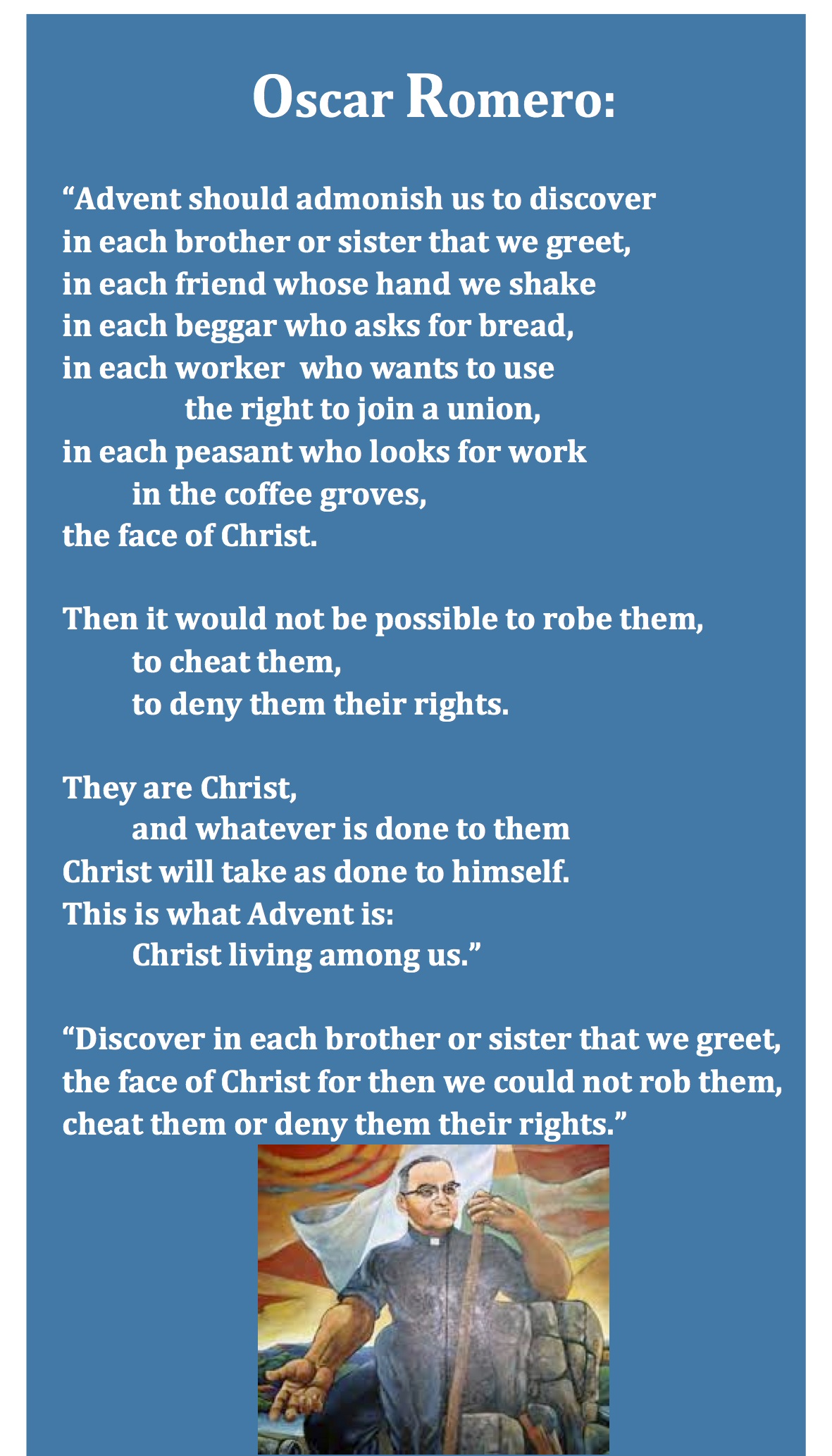
Discovering the Face of Christ
As our Advent waiting continues we hear the cries of John the Baptist who calls to us from the wilderness; a herald preparing the way for Christ. Calling the people to repent, to turn around, to remember who they are and whose they are, heralds are often unwelcome guests in the houses and halls of power. Today, the words of a modern John the Baptist calls out on behalf of the poor and the oppressed. Like the herald of old, Oscar Romero was not welcomed by the rich and the powerful. His words call us to see the face of Christ in the faces of our sisters and brothers. As we hustle and bustle searching for bargains to bestow upon our loved ones, we would do well to remember those who pay the price for our good deals.
You can learn more about the life and witness of Romero from this excellent film
Keep Watch: John the Baptist, Like Christ Has Many Disguises!
There was a young woman who lived in an apartment, in a very rough neighbourhood. It was the east end of a very large city. Many of the people who lived in this neighbourhood got by on welfare, others earned their living any way they could. The young woman moved into the apartment because it was close to the office where she worked, the rent was cheap and quite frankly she was young and foolish. She ignored all the warnings of her family and friends and moved into the apartment convinced that she could handle anything that came her way.
Her neighbourhood contained the most unsavoury of characters. The office where she worked was just down the street from her apartment and every morning as she walked to work she would meet some of her neighbours returning home from an evening of plying their trade on the streets and in the alleys. Each morning, she would be met at the entrance to her office by an old man named Ed.
Ed had been living on the streets for years. He was very hairy, very dirty, and he tended to rant and rave a lot. Ed was a wild man. He slept on the doorstep of the young woman’s office because it was somewhat protected from the winter weather. Even though Ed made the young woman nervous, she got used to seeing him in her way.
Ed always gave the young woman a warm welcome when she arrived. He knew that when she got inside, she would brew fresh coffee. He used to tease her that, she was a sucker for a sad face as he waited patiently for her to bring him a cup of coffee. They never talked much, though. Ed would just rant and rave about the injustices of the world. The young woman never found out how Ed ended up on the streets. She didn’t know how he spent his days. Continue reading
Stellarella It’s Saturday – A Book for “Progressive Little Thinkers”
The newly published, “Stellarella It’s Saturday”, story by Deborah W. Dykes, illustrated by Christina Mattison Ebert-Klaven comes with ringing endorsements from John Dominic Crossan and Joan Chittister. With progressives of this calibre singing its praises pre-publication, I ordered several copies sight-unseen for the little ones in my life and I haven’t been disappointed. It is a rare think to find God imagined as a woman!!! So, imagine my delight when I discovered that the shero Stellarella is portrayed as a strong, intelligent, brave little girl! This little book would be a valuable addition to any child’s library. Enjoy!
Baraka: Breath of Life
Baraka means blessing in several languages. Here in the language of film are a multitude of blessings. I first saw this film back in the 90’s on the big screen. It was a powerful experience. I’m delighted to have re-discovered this work of art. Enjoy!
PubNight at Holy Cross’ Beyond Church Pub
The Science of Happiness – An Experiment in Gratitude
LOV Ministries at Holy Cross
In response to the needs of our neighbours, Holy Cross Lutheran Church’s Global Justice Team created the Lutheran Outreach Volunteers Program otherwise known as LOV Ministries. LOV volunteers currently provide grocery vouchers to those who need help making ends meet. LOV Ministries supports the work of the Street Outreach Van which provides assistance to those living on the streets of York Region. Funds raised by the Super Awesome Amazing Race will be used to support these vital programs. So, signup to participate in the fun or pledge your support now! For more information email: contact@holycrosslutheran.ca
EVENING PRAYER – Hildegard von Bingen
Evening Prayer Liturgy with text and music inspired by Hildegard von Bingen (developed at Holy Cross Lutheran Church)
Evening Prayer Service Bulletin which is to be printed double-sided
Evening Prayer Audio – the silences are intentional. Enjoy!
Hildegard von Bingen – Woman of Vision – Feast Day September 17
Herald of the Divine Feminine, reformer of the church and green prophet! September 17th is the feast day of the Christian mystic Hildegard von Bingen, a woman of great vision, a woman centuries ahead of her time. During her 81 years Hildegard’s talents as an artist, musician, poet, healer and theologian allowed her to produce a wealth of resources for the church which ought not to be ignored. And yet the Roman Catholic Church only got around to officially canonizing this giant of the church this past year.
In 2009, German filmmaker Margarethe von Trotta wrote and directed the movie “Vision”. The DVD version is available from Amazon and I highly recommend it!!!
Matthew Fox’s new book “Hildegard of Bingen a Saint for Our Times, Unleashing Her Power in the 21st Century” will be released next month and I am eagerly awaiting my copy. You can listen to an interview of Matthew Fox on the subject of his new book here. Fox describes Hildegard as a Trojan horse whose teachings he hopes will shake up the vatican.
At Holy Cross we have developed an Evening Prayer Service inspired by the work of Hildegard. The worship bulletin and an audio recording of the service are linked below. Enjoy the video of contralto Karen Clark who preforms Hildegard’s antiphon “O Virtus Sapientie”
Evening Prayer Service Bulletin which is to be printed double-sided
Evening Prayer Audio – the silences are intentional. Enjoy!
Struggling to Comprehend the Worst Humanitarian Crisis in Twenty Years???
For three years the news media has issued reports of the civil war in Syria. An humanitarian crisis is measured in numbers and the latest reports insist that 100,000 lives have been lost and to date two-million Syrians have fled their homeland. UN figures report that over half of these refugees are children. This morning’s reports herald the deaths of between 500 and 1400 victims of a chemical attack. Our American cousins are debating their response. The world seems helpless to stem the tide of devastation as tribalism shakes the foundations of a nation that has been at the heart of civilization for centuries.
As world-leaders, politicians, and pundits insist upon action, most of us are left wondering not only what action, but what are they fighting about??? Sadly, too many pundits are willing to urge us to rush in, to do who knows what, before we even know what or why. I find myself so disheartened by my own lack of knowledge, that my eyes tend to glaze over at the reports of atrocities, as I quickly move on to something, anything else. It has taken the suspected use of chemical weapons to shake me from my own complacency and motivate me to educate myself on the history of Syria. If you find yourself wondering where to begin, I encourage you to take the time to watch this excellent BBC video on the History of Syria.
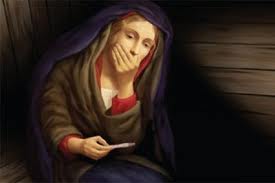
Commemoration of Saint Mary: Was Mary a Virgin or Was Mary Raped?
I’m on vacation so I don’t get to preach this coming Sunday. But if I did, I suspect that I would move the Commemoration of St. Mary to Sunday and take the opportunity to explore the life and witness of this amazing woman. Today the Church celebrates the feast of St. Mary the Mother of Jesus or as it is still called in the Roman Catholic Church The Feast of the Assumption of St. Mary into Heaven. This enigmatic woman has remained in the shadows for centuries. All too often the epithet “virgin” has been applied to the young woman who fell pregnant so long ago. So on this festival day I this re-post this sermon which I preached a couple of years ago in which I asked some questions about Mary. At the time I was reading Jane Schalberg’s “The Illegitimacy of Jesus”, John Shelby Spong’s “Born of a Woman” and “Jesus for the Non Religious” along with John Dominic Crossan and Marcus Borg’s “The First Christmas” and this sermon is laced with their scholarship. As always the written text is but a reflection of the sermon preached on the Fourth Sunday of Advent 2009.
Sadly, one doesn’t have to travel too far into the past to arrive at the time when women’s voices were not heard. Indeed, in the Lutheran church, it was only a few short decades ago. For most of us that time is within our own lifetime. For generations, men have told our sacred stories. Men have decided which stories made it into the canon of Sacred Scriptures. Men have interpreted the stories that were allowed to be told. Men have translated, taught, and commented upon those stories from pulpits, in universities, in seminaries, in commentaries and in the public square. Continue reading