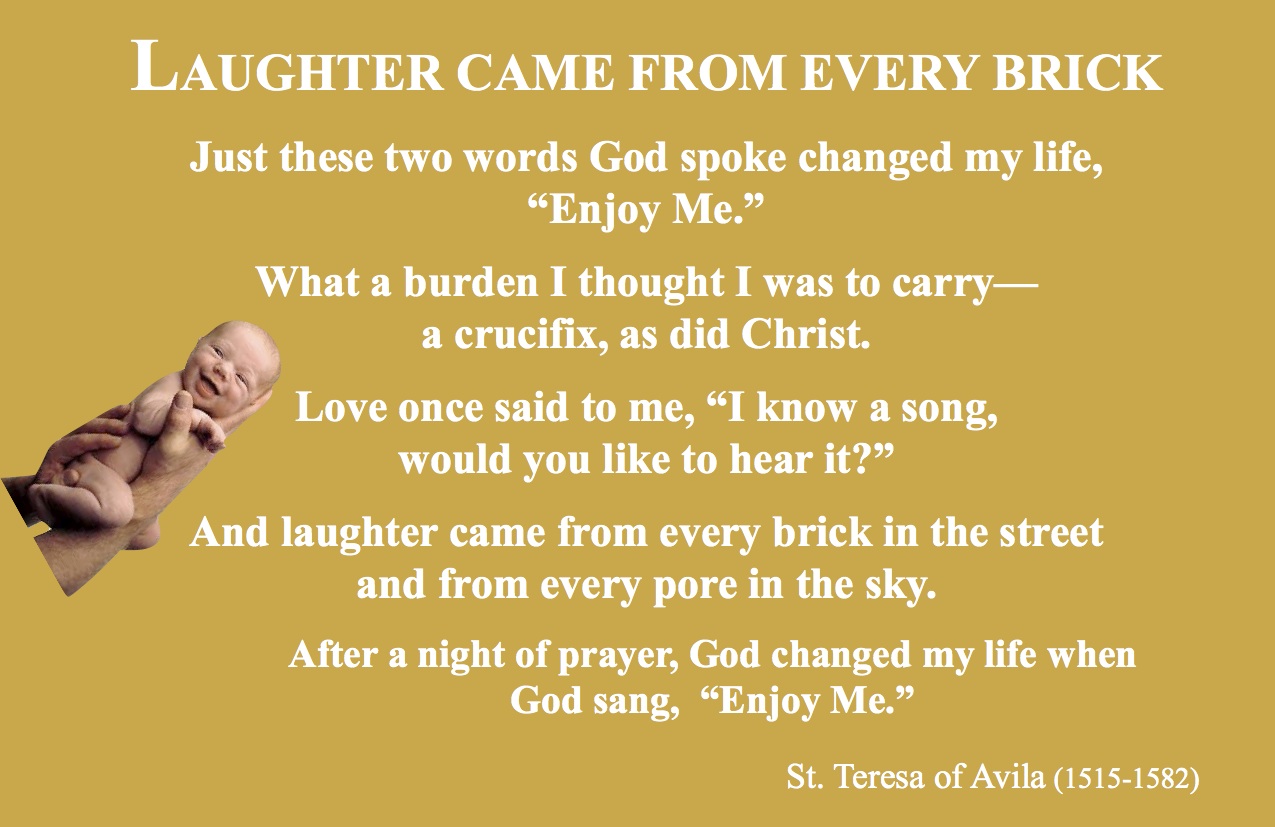
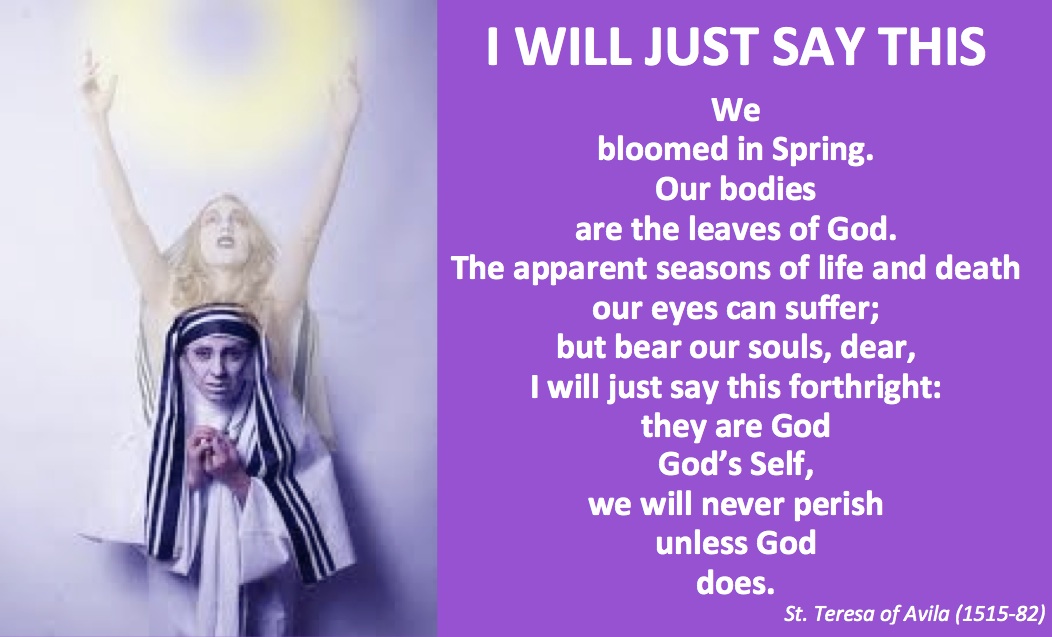
Today We Celebrate the Life and Witness of St. Teresa of Avila

An excerpt from “Love Poems From God” by Daniel Ladinsky,

(Penguin Compass, London: 2002)

(1515-1582)  “Teresa was born in Avila, a beautiful high mountain village of Spain.  She was one of thirteen children, three girls and ten boys, in a wealthy family.  The Spain in which Teresa grew up was permeated with 700 years of Arabian culture; the eradication of Arab power was followed by one of Spain’s darkest periods, the insanity of the Inquisitions, which, in the fourteenth century, along with other grievous deeds, forced mass conversions of Jews to Christianity.”

“Teresa was her father’s favourite child, and the most spirited.  Her mother died during childbirth when Teresa was thirteen, after which she had little supervision.  It is believed she had a lover at the age of fifteen, which caused her father to send her to a convent boarding school, only to see her return home two years later because of poor health.  When she was twenty-one, Teresa ran away from home to join a convent.  At that time many convents were more like hotels for women, allowing them a great deal more independence than they would be allowed at home, though after two years at the convent Teresa had a near-death experience that changed her life.  A spiritual awakening began in which she cultivated a system of meditation that sought quieting the mind to such an extent that God could then be heard speaking.  Over the next twenty years she experienced many mystical states but not until she was fifty did she begin the most far-reaching aspects of her life’s work.”

St. Teresa of Avila “had a great desire for learning and when the Inquisition, in 1559, forbade women to read, Teresa turned to God and asked God to teach her soul about divine love.  She then began to write completely out of her own experience.   Many of her poems are, in fact, intimate accounts of her communion with God. 

The Church’s persecution of Teresa had not waned when she passed away and was buried in Alba de Tormes in 1582.  A year after her death some of her disciples, feeling that she might have wished to be buried in Avila, had her body exhumed.  When her body was found to be perfectly intact and emitting a wonderful fragrance, her sainthood was formally decreed, allowing the publication and preservation of some of her works.

Most of what we see today of Teresa’s work is probably reined way back, for her writings fell into the hands and under the control of the very forces that had so opposed her throughout her life.”

“Teresa of Avila is undoubtedly the most influential saint in the Western world, and she has made great contributions to spiritual literature and poetry.  She was a woman of tremendous courage who is rightfully credited with the remarkable political and religious reform achieved against the strongest—and most insidious—chauvinistic forces.”

“A realistic picture of Teresa’s life did not even reach the English-reading general public until the 1960s.  She was known to have had a remarkable quick wit and a stunning, even provocative, sense of humour, as well as a great physical beauty.  Her complete works include seven books, four hundred and fifty letters, and assorted poetry.  Her writings are considered masterpieces of mystical prose and verse. She personally founded seventeen Carmelite convents and two monasteries, despite enormous opposition from the Church and other men in power.”

Ubuntu: Compassion brought into colourful practice.

go be love

“I must never allow my neighbour to go hungry while I’ve got a little food in my house…We as human beings must sustain each other even during times of greatest peril.”  Let our Thanksgiving become compassion and let us bring our compassion into colourful practice!

THANKSGIVING: Not One, Not Two

I AM the bread of lifeA sermon on Deuteronomy 26:1-11 and John 6:25-35 inspired by Garrison Keillor and Joan Chittister; two of the best storytellers I know.

Listen to the sermon:

Critical Thinking and Faith: Phyllis Tickle

critical thinkingPhyllis Tickle is a treasure!!! Let her no-nonsense, down-to-earth, humorous  way of articulating what should be obvious provide encouragement to the timid who sit quietly hoping that someone else will question the dogmas and doctrines that dull our senses. Let herrethinking questions inspire more questions and let set aside our carefully held notions of reality and embrace the awe and majesty of the Mystery we call God. 

The Future of the Church: Phyllis Tickle, Brian McLaren and David Lose

future churchA conversation with Phyllis Tickle, Brian McLaren, and David Lose recorded Oct. 7, 2013, and hosted by Luther Seminary, St. Paul, Minn., during the Celebration of Biblical Preaching.

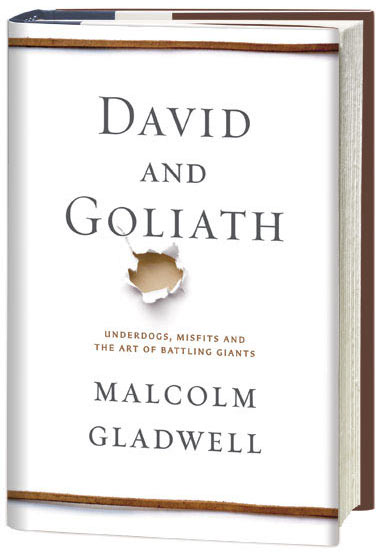
David and Goliath: Underdogs, Misfits and the Art of Battling Giants by Malcolm Gladwell

gladwellDavid and Goliath like you’ve never heard this story before! I have enjoyed Malcolm Gladwell’s writing ever since a wise seminary professor put a copy of The Tipping Point on my personal reading list. In addition to gobbling up each of his books, I savour his articles in The New Yorker. Gladwell’s mind works in ways that delight, challenge, encourage and confound. Gladwell is for this preacher/storyteller an inspiration! Gladwell is a storyteller’s storyteller.

david&goliathGladwell’s latest book David and Goliath demonstrates his considerable abilities when it comes to using stories to challenge long-held assumptions. While the book shatters assumptions about underdogs, assumptions and seemingly lost causes. Whether you agree or disagree with Gladwell’s assertions, you’ll find yourself thinking or re-thinking your own biases. It’s a positively splendid read. 

Of his own work Gladwell writes: “I write in the genre of what might be calledgladwell books “intellectual adventure stories.” Books like David and Goliath combine narratives and ideas from academic research in an attempt to get people to look at the world a little differently. I have always tried to be honest about the shortcomings of this approach. Stories necessarily involve ambiguity and contradiction. They do not always capture the full range of human experience. Their conclusions can seem simplified or idiosyncratic. But at the same time stories have extraordinary advantages. They can reach large numbers of people and move them and serve as the vehicle for powerful insights.”

Gladwell is a Canadian journalist, raised in the Mennonite tradition. In an article in the Huffington Post, Gladwell discusses his return to religion. here

To wet your appetite or just for sheer entertainment value, watch this TED talk in which Gladwell demonstrates his considerable storytelling/preaching abilities while covering the first part of his book. 

Reckless Generosity – a Sermon for Thanksgiving

Gratitude Generosity

When I was a kid, the adults in my life were very fond of telling me how grateful I ought to be because things were so much harder back when they were kids. I’m sure most of us can remember being told by our elders just how tough times were when they were back in the day. My parents, grandparents, aunts and uncles and just about every adult I knew must have grown up poor. Why if I had a nickel for every time I heard someone say,  “When I was a kid we were so poor that…..” well I’d have a whole lot of nickels.

Today, when I hear the words, “We were so poor that…”  I brace myself for an outrageous claim like…. We were so poor that we couldn’t afford Kraft Dinner. Kraft Dinner, you were lucky, we were so poor that we couldn’t afford dinner,  all we had was a cup of cold tea without milk or sugar. Cup of Tea, we were so poor that we only had filthy cracked teacups. Filthy cracked teacups, that’s nothing we were so poor that we couldn’t afford teacups, we used to have to drink our tea out of a rolled up newspaper.  That’s nothing we were so poor that all we could we couldn’t afford newspapers so we had to suck our tea from a damp cloth.

Someone always chimes in with, “Well we might have been poor, but you know we were happy in those days. That’s right money can’t buy happiness. We used to live in a tiny house, with holes in the roof.  “House?  You were the lucky ones we were so poor that we had to live in one room, all 126 of us, with no furniture.  Half the floor was missing; we were all huddled together in one corner for fear of falling!  Ha!  You were lucky to have a room! We used to have to live in a corridor! Ohhh we were so poor we used to dream of living in a corridor! A corridor would have been a palace to us. We used to live in an old water tank on a rubbish tip. We were woken up every morning by having a load of rotting fish dumped all over us!!!   Rubbish tip, you were lucky, we were so poor that we lived in a hole in the ground covered by a piece of tarp, but it was a palace to us…especially after we were evicted from our hole in the ground and we had to go live in a lake. Lake, you were lucky to have a lake, there were a 160 of us living in a small cardboard box in the middle of the road. Cardboard, we were so poor we lived for three months in a brown paper back in a septic tank.  We used to have to get up at six o’clock in the morning, clean the bag, eat a crust of stale bread, go to work down in the mines for 14 hours a day, week in week out.  We had to get up out of that cardboard box at three o’clock in the morning and lick the road clean with our tongues.    In case you didn’t recognize it, that was my interpretation of a classic Monty Python sketch, simply called the “We were so poor sketch”. (watch the video below) Continue reading

THINKING About GOD??? Philip Clayton

philip claytonOur Adult Study is currently being inspired by the new study program Painting the Stars (Living the Questions). Philip Clayton is one of the contributors to the program. Clayton is the Dean of Claremont School of Theology (Phd.  Yale – philosophy and religion) who is seeking the development of “a constructive Christian theology in dialogue with metaphysics, modern philosophy, and science.” Here are two short videos that provide an introduction to Clayton’s ideas. 

Painting the Stars

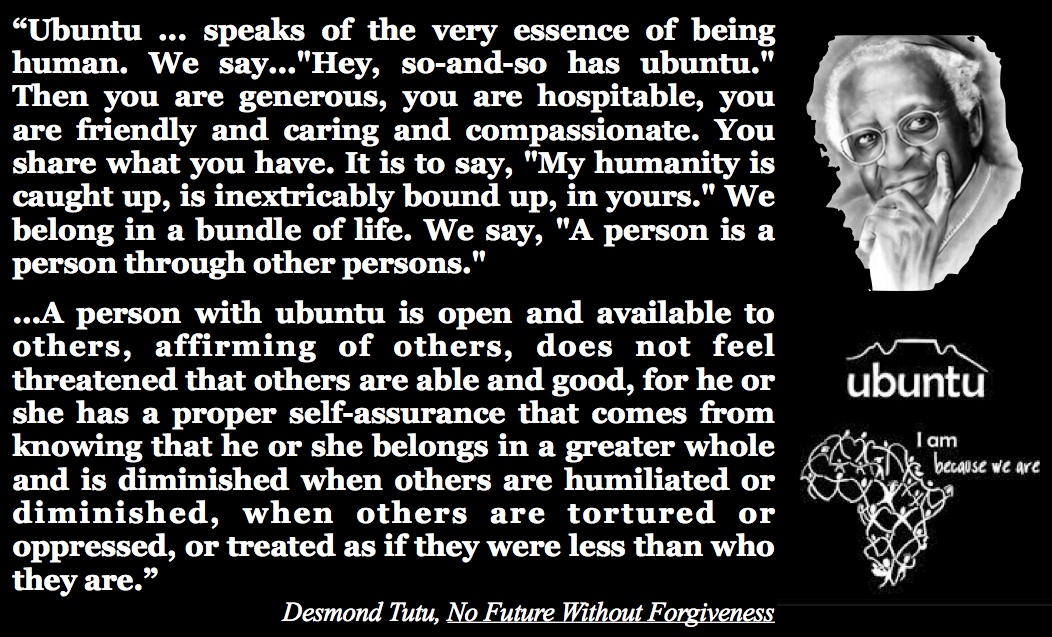
Ubuntu: A Person Is A Person Through Other Persons

Ubuntu -- pastordawn.com

colemansSermon for the Twentieth Sunday after Pentecost:

Luke 17:5-10 – October 6, 2013

Jesus’ Parable of the Mustard Seed

I am indebted to Peter Rollins for his modern parable “Finding Faith” found in his book The Orthodox Heretic

Listen to the sermon here: 

Watch Desmond Tutu describes Ubuntu

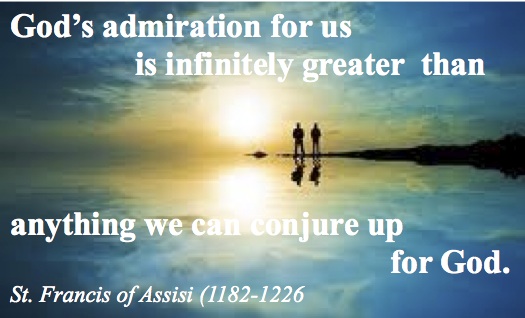
God’s Admiration for Us

God's Admiration for us copyGOD WOULD KNEEL DOWN – St. Francis
I think God might be a little prejudiced.
For once God asked me to join God on a walk
through this world,
and we gazed into every heart on this earth,
and I noticed God lingered a bit longer
before any face that was
weeping,
and before any eyes that were
laughing.
And sometimes when we passed
a soul in worship
God too would kneel
down.
I have Come to learn:  God
adores God’s
creation.
St. Francis of Assisi  from “Love Poems from God” 

“I don’t even like religious people.” – Bishop John Shelby Spong

jack spongBishop Spong is not exactly enamoured of religion and or religiosity.  Speaking at the Seattle Rotary Club on August 28th 2013, Jack Spong tackles a number of subjects as only Jack can, including his friendship with Desmond Tutu, his belief that the Gay Marriage debate in North America is over, his latest book, number 24, The Fourth Gospel: Tales of a Jewish Mystic, and of course why “Christianity must change or die!”  As he often does, Jack reminds us that “Jesus didn’t come to make us religious, but to make us whole, so that we may live life abundantly.” Enjoy!!!

Hell Is Here On Earth – a sermon for Pentecost 19C on Luke 16:19-31

1 percentI will be preaching on St. Michael and All Angels this coming Sunday. But for those of you who are working on the Parable of Lazarus and the Rich Man, here’s a copy of a sermon I preached a few years ago.

I moved out of my parent’s house when I was quite young and like most young people I didn’t have much money so I lived in some pretty weird places. I once shared a house with a bunch of people that I met working in the travel industry. I didn’t know them very well when I first moved in but as the months dragged on, I got to know some of them better than I would have liked. There were five of us living in a four-bedroom house about a block from Spanish Banks in Vancouver. The house’s proximity to the beach made up for some of my roommates’ shortcomings and the rent was cheap.  So, even though I didn’t like the idea, I didn’t kick up much of a fuss when one of my roommates brought home a puppy.

Now there are those people who would argue that all puppies are cute, I just don’t happen to be one of them. Besides this thing was a Doberman and I don’t care if it was cute, I don’t like Dobermans. I was trying to convince my roommate David that he couldn’t possibly keep a Doberman in our house, when two of my other roommates showed up and quickly became besotted with the creature. One of my roommates when so far as to insist that the puppy was the cutest thing she had ever seen and that we simply had to keep it. While she was hugging and kissing the puppy, David got quite annoyed and pulled the puppy away from her and insisted that this dog was not going to be a pet. He declared that we needed this dog to grow up and be a guard dog, and if that was going to happen then we needed to start treating this dog as we meant to continue.

I had no intention of sharing a house with a Doberman, let a lone a guy who wanted to have one as a guard dog, so I started looking for another place to live. Before I moved out of that house, I had the unfortunate opportunity to watch David as he tried to train his puppy. First of all, David had to give the dog a name and it had to be a name that would instill fear into people, so that’s how the puppy ended up with a name like Vader as in Darth Vader.  None of us were supposed to cuddle the dog or pat the dog or play with the dog. That was just fine with me. But one of our roommates, Ellen was forever getting into trouble for treating the puppy like a baby. So, David insisted that Vader be chained up outside. A few months after I moved out of the house, I went back to visit and discovered that even Ellen was afraid to go into the backyard because Vader was actually turning into a viscous guard dog. She told me that David had been leaving Vader chained up for longer and longer periods of time and no one in the house would dare to go out into the back yard to feed Vader. I found out from the others that even though they’d tried to get David to pay more attention to Vader, he insisted that it there was nothing wrong with the way he was treating Vader. For months David left Vader chained in the backyard for days at a time and as the dog got bigger and bigger, the three roommates that were left in the house with David became more and more afraid of the dog and eventually they had to insist that David move out.  A few months later, I heard that David and Vader had parted ways. It seems that Vader had taken a chunk out of David’s arm and David had to have the poor creature put down. For some reason Jesus’ parable about Lazarus reminded me of Vader the Doberman. Continue reading

Introducing “Painting the Stars” Contributors: Bruce Sanguin

bruce sanguin

This coming Sunday, we at Holy Cross will begin the new Living the Questions interactive DVD adult education program Painting the Stars. Throughout this week I will be posting introductions to the various contributors to the program. So, if you are anywhere near Newmarket this Sunday consider joining us as we explore the dynamic relationship between science and faith!

One of the primary contributors to the program is Canadian Bruce Sanguin. Until recently, Evolutionary Christian Bruce Sanguin was the minister at the Canadian Memorial United Church in Vancouver. This summer Sanguin left parish ministry to pursue his writing and expanding his speaking career.

Bruce has  written several books that have to inspired my own worship planning. Two of his books are of particular value to any pastor who seeks to plan worship without slipping into the trap of words that re-inscribe old theological patterns:  Darwin, Divinity and the Dance of the Cosmos: An Ecological Christianity and If Darwin Prayed: Prayers for Evolutionary Mystics. Sanguin’s latest book The Advance of Love: Reading the Bible with an Evolutionary Heart explores the relationship between science and faith to shed light on biblical texts.

This video in which Bruce is interviewed by fellow evolutionary Andrew Cohen will wet your appetite for Bruce’s work while giving you an interesting look into evolutionary Christianity.   Enjoy!

Through the Lens of Grace Held Firmly in 21st Century Frames

lens of grace

Homecoming Sermon September 22, 2013

Creation IV – Proverbs 8:22-31, Colossians 1:15-20, John 6:41-51

Companion from the Latin “com pinionem” for “with bread” or “bread fellow”

“Pagan from the Latin for ‘earth lover'” – Diarmuid O’Murchu

earth loverFor those of us following the lectionary for the Season of Creation, Diarmuid O’Murchu’s reminder that the word “pagan” comes from the Latin for “lover of the earth” functions as a call for Christians to embrace Creation! O’Murchu is an evolutionary theologian whose work is breaking new ground as he reconnects 21st century Christians to the riches within the tradition and moves beyond the confines of church doctrine toward a holistic understanding of what it means to be human which offers hope for living together in the “companionship of empowerment”.

To Be Home – Reverence for the Divine Presence Dwelling Within

To Be Home

“Painting the Stars” begins at Holy Cross Sunday Sept. 29

painting the stars flyer

Wrestling With the Almighty: Locating Our Very Selves in the Sacred Story

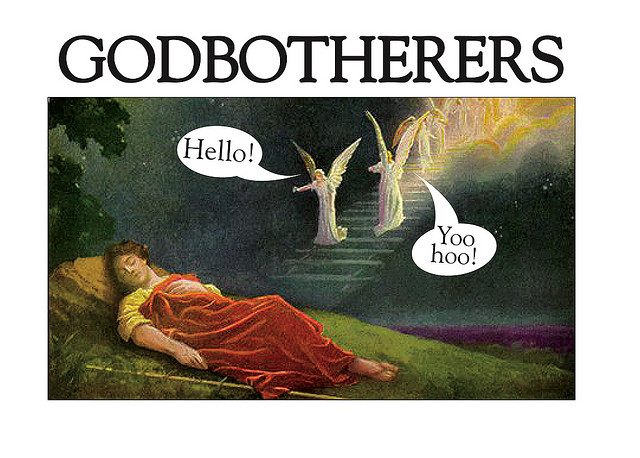
Godbotherers

After a long summer vacation, I returned to work this week. Getting back into the pulpit is a daunting task as I struggle to find just the right words for this Homecoming Sunday. Unable to settle upon which of the many possible readings on which to preach, I was struck by the possibilities of the Narrative Lectionary. Some musings:

You may not be able to tell from looking at me. But let me assure you that you are looking at someone who used to be a champion wrestler. Believe it or not, my wrestling skills actually helped me rise to the level of a world champion wrestler. Well, perhaps I should qualify that statement. When I was an amateur wrestler, I was a world-class champion wrestler. But like so many athletes, when my status changed from amateur to professional, I lost my championship status and although I still qualify as a professional wrestler, and I like to see myself as a champion, I’m no longer what you would call world-class.

Like many professional wrestlers my career began when I was but a child. Growing up I had a very clear advantage as I developed my wrestling skills. You see having a brother who was just 18 months younger than me meant that I had ample opportunities to hone my wrestling skills. My brother and I were always at it. I’ve got to say that even though we shared the same weight class for most of our childhood, when it came to world class wrestling holds, I had him beat. I had this wicked arm-hold sleeper, and that together with my full Nelson followed by a knee-arm press, was guaranteed to have my brother screaming uncle and agreeing to be my obedient servant until in no time at all. For years I reigned as the champion of our little world! I was unbeatable. My brother didn’t stand a chance. My reign as world champion would have continued if it weren’t for the abrupt ending of my amateur status.

One morning when I was about 13 and my brother was 9 and a half, we were going at it,  and to his credit my bother had me in an ingenious hold. Somehow, he’d managed to secure me with what we professional wrestlers call an arm bar. That’s where you’re opponent wrenches your arm behind your back and applies just enough pressure to cause pain, but not enough to break anything. But just when Alan was approaching the point of no return, I managed with a feat of superhuman strength to rise up, twist around and swing for all I was worth and connect with what I though must be my brothers chest. I expected that such a thrust would have released my arm from Alan’s iron grip. But he still had me. I was about to hit him again, when for no apparent reason Alan released me from his grip. In an instant I wiggled free, spun around and connected with what I figured would be a fatal blow. Just before my blow connected with it’s victim, I realized that I was doomed.

Continue reading

The Friendship of Science and Religion

image“I also think we need to maintain distinctions – the doctrine of creation is different than scientific cosmology and we should resist the temptation, which sometime scientists give into, to try to assimilate the concepts of theology and the concepts of science.” (Pocklinghorne)

Years ago, while visiting Cambridge, I happened upon a lecture being given by John Pocklinghorne. Since then, I have felt compelled to read his work in an attempt to wrap my non-scientific mind around the complex relationship between science and religion. Pocklinghorne’s description of the relationship as one of friendship helped me to see beyond the all too often enforced boundaries between these two ways of seeking understanding reality.

Liberal Perspectives on Christianity

imageOver and over again, in conversations with people who have long since left the institution of church behind I hear: “Why don’t clergy pass on what they learned at seminary?” The plea usually comes after I’ve articulated Christianity in a way that makes sense to a 21st century mind.  Below are a series of snippets of Church of England clergy articulating what they call “liberal” perspectives of Christianity. I am all too aware of the multitude of reasons/excuses that prevent some clergy from articulating Christianity the way it is taught in the academy, but I can’t help believing that there is a great hunger out there for the kind of theology that does not require church-goers to check their brains at the door!