Embracing Limitations to Drive Creativity – Phil Hansen

phil hansen2

I’m getting ready for five weeks of vacation. So, I’m sorting out things in my office and I discovered a plethora of Sharpies. Which reminded me of this story that I’ve been meaning to post.

Phil Hansen is an artist who moves beyond limitations to explore the margins of what’s possible. His incredible sensitivity flows through his work in ways that capture the imagination and inspire compassion. I find myself sharpielooking at Sharpies in a whole new way as I discover the world of pointillism (Google it. You know you want to). Hansen is also a gifted speaker whose personal story is capable of transforming limitations beyond the notion of challenges toward an appreciation for ingenuity. Enjoy!

By now, I’m sure you’re intrigued, to say the least. This next video’s visual beauty speaks volumes alongside of Hansen’s clear, concise, and charming story. It is best viewed with a Sharpie at the ready so that you can try your hand at kickstarting your creativity!

I’m a Doubter Not a Believer – Preparing to Preach on FAITH

Preaching on Luke 12:32-40 and Hebrews 11:1-16

doubters welcome“Do not be afraid, little flock, for it is your Abba’s good pleasure to give you the kin-dom” So begins the gospel reading for this coming Sunday. But I am afraid and my fear is not about the the thief who this text insists may break into my house or that the Human One is coming at some unexpected hour. No my fear is wrapped up in my desire to pay little or no attention to the second reading prescribed for this Sunday from the letter to the Hebrews:

“Faith is the reality of all that is hoped for; faith is the proof of all that is unseen. Because of faith, our ancestors were approved b God. By faith, we understand the world was created by the word from God, and that what is visible came into being through the invisible…..”

Do I have faith? Do any of us have faith? For that matter: What is faith? According to Hebrews faith “is the reality of all that is hoped for; faith is the proof of all that is unseen.” Faith is the stuff that makes it possible for us to hear Jesus words: “Do not be afraid, little flock, for it is your Abba’s good pleasure to give you the kin-dom.”  Faith is the stuff that makes it possible for us to believe. So I wonder: Do I have faith? Do I have the faith that makes it possible for me to believe? Do you? Do any of us?

I write this as one who finds it difficult and sometimes even impossible to believe much of anything. I am a doubter by nature. Doubting is part of who I am. I know that there are those who are more inclined to believe and I am envious of believers. I envy those who are sure and are able to find comfort in the Scriptures. For a very long time I was ashamed of my inability to believe. I often sat in church and wondered if I might just be a hypocrite. I wondered if someone who had as many doubts as I have belongs in the church. And so, I tried to conquer my doubts by studying the Scriptures. Continue reading

Hosea: the Coronation Street of Ancient Israel

A Sermon on the Book of the Prophet Hosea

Coronation StI am indebted to Bishop John Shelby Spong for his insights into the Book of the Prophet Hosea. Without Jack’s thoughtful portrayal of Gomer, I would not have recognized her as the Leanne Battersby of her time. Also, thanks to Marcus Borg for his definition of the verb “believe”!

Listen to the sermon:

For those unfamiliar with Corrie, here’s a sample of the first 50 years:

The Steadfast LOVE that GOD IS: a sermon for Hosea 11:1-11

God's Admiration for us copyHere’s a sermon I preached a few years ago on this Sunday’s reading from the Book of the Prophet Hosea. Just as the people of Israel’s images of God changed over time, my own images of the Divine have changed since I preached this sermon. However, I still resonate with ways in which the Book of Hosea seeks to broaden the reader’s understanding of God away from traditional notions of anger and wrath toward images of steadfast love, for I too have had to broaden my own understanding of the Divine many times over the years. I suspect that I am only just beginning to imagine the contours of the steadfast Love that God Is.

Tommy was one of those kids that, no matter how hard he tried, he just couldn’t stay out of trouble. I was never quite sure whether or not Tommy was rotten or whether trouble just followed him wherever he went. Whatever the reason, Tommy managed to live up to the reputation of the typical middle child. His older brother seemed to be perfect in every way, the model child and his younger sister was the cute and adorable baby of the family, leaving the field wide open for Tommy to become the black sheep of the family. And as black sheep go, Tommy was a doosey.  Tommy was also the son of my friends and so even though, I would have rather not have been part of this kid’s life, the fact that he was the Karen’s beloved son, meant that I had to learn to deal with him.

I can still remember an afternoon, long ago, when Tommy was barely three years old. A bunch of us had gathered to celebrate Karen’s birthday.  Tommy was in a foul mood.  I decided that he just didn’t like the fact that on this particular day he wasn’t the center of attention.  He seemed to do whatever he could to upset his mother. 

Her patience with him was beginning to get on my nerves and I was relieved when Karen announced that it was time for Tommy to take his nap. After a very long and loud temper tantrum, Tommy was eventually quiet in his room; a little too quiet, it seems. It wasn’t until I got into my car to leave and happened to glance up toward Tommy’s bedroom window that I realized just why he had been so quiet. Hanging outside of Tommy’s bedroom window was the evidence of this little boy’s stubborn streak. Somehow, to this day I still don’t know how he managed to do it, but somehow little Tommy had managed to stuff the mattress from his bed out the window.

On the lawn below the window were Tommy’s pillows, sheets, stuffed animals and quilt. Three quarters of the mattress hung below the window and I am sure that given enough time Tommy would have managed to push the remainder of his bed out onto the front lawn. I dashed back into the house, grabbed Karen and headed up to his room. When we got there we discovered dear sweet little Tommy, shaking the contents of a big container of baby powder all over his room. Tommy’s himself was covered in talcum and when he caught sight of his mother and I he gave us a wicked little grin and said, “I don’t need to take any more naps!”

Driving home that day, I gave Tommy a nickname.  It’s a name that I have never uttered in his mother’s presence, but a name that has stuck with me.  On that day, the dear sweet little son of one of my dearest friends was forever labeled, Tommy the Terrible; TT for short.

Now the exploits of a cute three-year-old are one thing, and we can all laugh at the site of a mischievous little boy, who manages to out fox his mother.  But TT’s activities went far beyond the laughable exploits of a mischievous little boy. It didn’t take Tommy very long to become skilled in the art of tormenting adults. His mischievous behavior gave way to rudeness, disobedience, cheating, and more often than not down right meanness.  Of all the adults who were subjected to the torments that Tommy dished out, none suffered more than his mother did. No matter how hard she tried, Karen could never get Tommy to behave himself.  Nor was Karen ever able to understand why Tommy did the things he did. Tommy had everything a boy could ever want or need. He had two parents who loved him dearly.  He had a wonderful older brother and a delightful little sister.  He lived in a beautiful house by the ocean.  He attended the best school in the area. He had more toys than he could ever find the time to play with. There were lots of great kids living in the neighborhood to play with and all sorts of interesting and interested adults in his life.  Tommy was a bright and intelligent kid who had everything going for him. There was no earthly reason that this child should behave so badly. Karen has never been able to explain why she has two perfectly wonderful children and one child who has been breaking her heart since he was old enough to speak. Continue reading

Preparing to Preach on Prayer: Shush!

BATH QOLIn this coming Sunday’s gospel reading Luke 11:1-13, Jesus’ disciples ask him to teach them to pray. As a pastor I have been asked to teach people to pray. Each time I have been asked to teach someone to pray I have cringed inside because I do not feel up to the task. For some reason the old hymn “I Come to the Garden Alone” keeps playing in my mind. I keep telling it to, “Shush!” so that I might hear the “bath qol” but the daughter of a sound eludes me. Below is a portion of a sermon I preached a couple of years ago on the subject of prayer. If nothing else, it reminds me to shush!

I began this sermon by asking the congregation to sing from memory the old hymn: I Come to the Garden Along. Feel free to sing it to yourself!

I think my earliest memory of prayer is a distant memory I have of skipping along the sidewalk chanting a familiar refrain: “Don’t step on a crack or you’ll break your mother’s back.” Most of us can remember a moment from our childhood when a superstition was instilled in us that caused us to perform some ritual in order to placate the unseen power that could determine our fate. Whether it was avoiding cracks, or walking under ladders or black cats, we were trained from an early age to believe that there were powers out there that could determine our future.   Continue reading

Feast Day of St. Mary of Magdala: the Apostle to the Apostles

THE RESURRECTION OF MARY – An Idle Tale

Mary-Magdalene egg

To commemorate this festival day, I repost this not-so-long-ago encounter with a visiting New Testament scholar to entice you to follow Mary out of her tomb and beyond the streets to her place at the head of the fledgling community that became the church: 

He just said it for the third time! “Harlots!” He keeps calling them “harlots”, while I rack my brains to come up with one harlot. Then he points to the text and his charges become clearer, he says, “she is a “prostitute!”

My carefully reigned in anger is unleashed. “Where?  Where?  Where? Show me where it says this woman is a prostitute!”

As he refers to the Gospel text and insists that, “It is there, right there in the text”,

I want to scream, I want to cry, I want to wipe the bemused expression from his face. I want to rub his nose in the damned text. Instead, I begin the uneasy process of reigning in my anger. I slow my speech, I try to erase the tremor from my voice and I ask him to, “Show me, show me where it says this woman is a prostitute.”

He consults his text and says, “a woman in the city who was a sinner.”

“A sinner not a prostitute.”  I respond.

He insists, “Yes a prostitute.”

“Where?” I ask.

Again he insists, “A woman who was a sinner.”

I demanded to know, “Where does it say she was a prostitute?”

He insists, “The author means that she was a prostitute.”

I lose control, “How do you know?  What words does the author use to say that his woman was a prostitute? Show me in the text where it says she was a prostitute?”

He still doesn’t get it, “What do you mean? It is clear that this woman was a prostitute.”

Once again I push, “Show me.  Show me where?”

He continues to say, “She was a woman from the city who was a sinner.”

I know that the text says that, so I implore him to tell me, “The Greek… What does the Greek say?”

He replies, “amartolos”.

I push, “Does that mean prostitute?” We both know that it does not.

He replies, “Sinner. But the context clearly shows that she was a prostitute.”

Still pushing I ask him to “Show me.  Show me how the narrative says this woman was a prostitute. Show me where it says her sins were sexual.             Show me where it says so in the narrative.”

He says, “It’s clear.”

Clearly we disagree, so I try again, “Clear to you.  Show me. Show me!”

As he fumbles through the pages, I offer him a way out, “Okay.  Even if I concede the point that her sins were sexual, show me where it says that these sexual sins were nothing more than lust or adultery, show me where it says that she was a prostitute.  Show me!”

He couldn’t show me.  It’s simply not there.

Nowhere in the New Testament does it ever say in Greek or in English that Mary of Magdala is a prostitute.  But over and over again scholars, theologians, popes, preachers, and dramatists, have continued to cast Mary of Magdala as a prostitute.  

In the years that have transpired since than day in seminary, when a visiting New Testament scholar insisted that “the context clearly shows that she was a prostitute,” I’ve delighted in being able to participate in the phenomenon of Mary’s resurrection as the first Apostle. Continue reading

Three Queens, the Birth of Laughter, and the Non-Existent Kitchen – a sermon for Pentecost 9C

three queens

Scripture Readings:  Genesis 18:1-15 and Luke 10:38-42

Worship Bulletin pdf here (to be printed double-sided and folded into a booklet)

Listen to the sermon here

Martha and Mary – Active and Contemplative

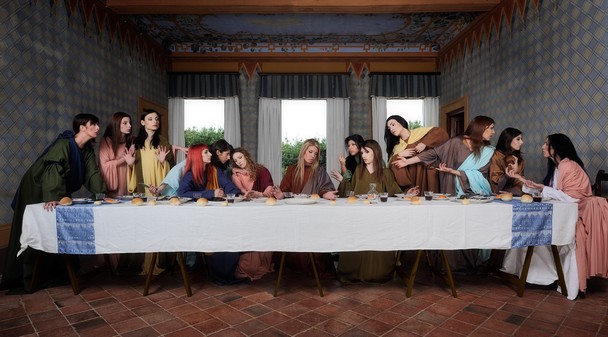
last supper women

Father Laurence falls into the age-old trap of seeing a kitchen where there isn’t one in the text and interprets the many tasks that Martha is distracted by as domestic chores. (see my previous post for a full explanation of the Greek diakonia which does not refer to domestic service but to eucharistic service and the proclamation of the word). Nevertheless, his articulation of the need for balance between the active and contemplative lifestyles is well put. I suspect that my own sermon this week will follow his lead and examine the difficulty some of us have finding time to tend to our need for contemplation when we are distracted by our many tasks in the church.

Dom Laurence Freeman OSB is a monk of the Olivetan Benedictine Congregation of Monte Oliveto Maggiore and Director of The World Community for Christian Meditation. Fr Laurence was born in England in 1951 where he was educated by the Benedictines and studied English Literature at Oxford University.

Before entering monastic life he had experience with the United Nations, banking and journalism. In the monastery his spiritual teacher was John Main with whom he studied and whom he helped in the establishment of the first Christian Meditation Centre in London.

Strange Fruit, Blood on the Leaves: Continuing Lament

o-MARTIN-LUTHER-KING-HOODIE-facebookI have always despised the word closure. While I recognize that there are moments when the quest for closure is appropriate, the word itself has evolved into the kind of jargon that is dismissed as psychobabble as the populace concludes that each and every tragedy  can be cured/dismissed/completed if just as soon as the victims find closure. The demands for closure work well in our 24-hour-news-cycle world, as we seek to tie our reactions into a neat little emotional bow. Rend your garments if you must, just make sure your ready to appear buttoned down and ready to move on at the top of the hour. Gnashing of teeth will be tolerated but for a moment. Smile and tell us all about how you achieved closure so that we can dust ourselves off and be about our business.

We have forgotten the ancient art of lament. We have little time for the practices that express our outrage, give voice to our grief, or enact our horror; practices which move us beyond the mere words of closure; practices that in and of themselves provide a strange balm to sooth our grief. 

Today, I have no words with which to confront the horror of injustice, only my continued lament for the racism that infects the darkness of our existence. So, while the media broadcasts their ongoing quest for closure, my cries of lament are driven deeper into my soul by song. 

Imagining Fred Phelps as the Good Samaritan – Sermon Luke 10:25-37

love-your-neighbor-as-yourselfPentecost 8C – Sunday July 14 2013

Listen to the sermon here

Imagination as the Path of the Spirit: John O’Donohue

unseen life O'DonohueT’is a glorious summer weekend and so it is a perfect time to get yourself an ice cold glass of your favourite beverage, find some shade and sit back and listen to the wisdom of one of my favourite humanoids John 0″Donohue. I have been eating up his writings for the past few months and delighting in his Irish lilting way with words. From Anam Cara, to Beauty, through Eternal Echos and now lingering over Benedictus I have come to love this kindred spirit! Sláinte!

Thoughts on Messiaen’s End of Time: The Nevertheless of Faith – Richard Holloway

Olivier+Messiaen+3Music opens us to all that lies within ourselves. I have always been fascinated by the powers of music in ritual. Of late I have been exploring the transformative powers of lament; a worship form that has fallen out of use. Alerted by a colleague to the music of Olivier Messiaen, I was immediately both disturbed and intrigued by his brilliant musical exploration of evil. I was relieved to find this video of Scottish theologian Richard Holloway’s thoughts on Messiaen’s Quartet for the End of Time. Haunting, severe, beautiful, unnerving, and sublime the piece echo’s the horror perpetrated in the camps while shouting what Holloway calls the “nevertheless of faith”. 

Playing All the Roles on the Road to Jericho

samaritan

Preaching ideas for this week’s sermon on Luke 10:25-37

I was just 10 years old when the Gideon Society came into my classroom to present us with small pocket editions of The New Testament and Psalms. I was in grade five when this little book was given to me. Its imitation leather has held up well over the years. After I carefully wrote my name on the presentation page, I tucked it into my school bag. Several weeks later, a thunderstorm knocked out the electricity and I was caught without a book to read, so I dug out this little red book from my school bag. By candlelight, I read the Gospel of Matthew. Over the course of the next two weeks, I read Mark, Luke and John. I stopped reading somewhere in the book of Acts.

Over the course of the next few years, in the privacy of my room, I would return to this little red book and escape into the desert towns where Jesus travelled. In those days I didn’t know what a parable was, but I loved the stories that Jesus told. The stories that Jesus told have a timeless quality to them. The parables that Jesus told defy simple explanations. Each of the parables is layered with meaning. The varied meanings of each parable can take a lifetime to uncover as the stories weave in and out of our own lives. The parable about the Good Samaritan is probably one of the most familiar of all of Jesus’ parables.

I believe that the timeless quality of this story comes as a result of the way in which the reader or the hearer can identify with all of the characters in the story. While most of us would like to see ourselves as good Samaritans, I dare say that over the years each of us have managed to play all of the roles in this story.

Over the years I have often played the role of the lawyer, trying to get Jesus to explain the secrets of life as over and over again I have questioned and questioned what I must do to inherit eternal life. Continue reading

Religion As A Work of Art – Richard Holloway

prodigalIf religion is to move beyond the supernatural, we must begin to see religion as a work of art. Richard Holloway, the former Primate of the Scottish Episcopal Church points to the power of story to explore human discontent as we crawl toward a better humanity. 

Only in Canada Eh? – Canayjuns, Injuns, Paula Deen, the N-Word, and Racism – a sermon for Canada Sunday

children's futureI am indebted to Father Jim O’Shea for his article in the Huffpost and to Robert LoveLace for his parable about Chickens which appeared in The Rabble.

Listen to the sermon here

The Stories We Tell Children???

jesus sunbeam“Thine is the glory risen concrete son!” When she was just a little girl these were the words she heard the adults in her life singing about the baby Jesus. Not having any idea what concrete was, she just sang these words assuming that they said all that needed to be said about the character of the little baby whose arrival meant presents for everyone.

On this long weekend, memories of childhood celebrations remind me that the stories we tell our children are not always heard exactly as we intend. When I was a little girl, I remember enthusiastically singing “God Save the Queen” and wondering exactly where “reignoverus” was and why we wanted to send the nice lady, who wore such pretty hats, there. It was a particularly mortifying disappointment to discover that what I was meant to be singing on behalf of the nice lady was to “send her victorious long to reign over us” as I implored God to save her. To this day, I cannot sing Her Majesty’s anthem without chuckling as I muse about what has now become the mythical land of reignoverus. While chuckling is a rather pleasant residue, I can’t help wondering what dangerous, frightening or perhaps scarring residues will remain as a result of the stories we currently tell our children. 

I have often been cajoled, bribed, guilted or shamed into including children’s sermons/talks/times during Sunday morning worship services. While I understand the impulse to find ways to include children in worship, I have never been convinced that stories told during these moments accomplish anything more than the placation the guilt we feel for our unreasonable expectations. The best we can hope for our good intentions is that in the years to come they will provide a few chuckles as the children we once corralled at the front of our sanctuaries look back bemused at our efforts to include them in worship.

Dave Allen, an Irish comedian whose television program I was not allowed to watch when I was a child, but whose humour I learned to enjoy as a teen-ager, provides a window into a world we would do well to remember. 

A Way to Understand the Resurrection – Richard Holloway

Peter Callesen's Papercut Resurrection

Peter Callesen’s Papercut Resurrection

Richard Holloway, the former Primate of the Scottish Episcopal Church, interprets the story of the resurrection not as an historical tale, but as our own story. Holloway has written of his longing for a humbled and broken church. His own humility and brokenness shines through this video as Holloway embodies his own longing.

Faith and Doubt: “a whisper will be heard” – Richard Holloway

hollowayI have just completed reading Richard Holloway’s “Leaving Alexandria: A Memoir of Faith and Doubt”.  As someone who struggles to stay in the institutional church, I can hear the whispers of which this former Primate of the Scottish Episcopal Church writes. leaving alexandria

After a lifetime in the church, Holloway continues to respond to whispers, “The thing that keeps me religious is the possibility that there might be an ultimate purpose to the universe and it might, as certain rumours suggest in sacred texts, be unconditional love. And it seems to me to live as if that might be the case is not a bad way go be going; especially if it makes us kind to one another.” 

Richard Holloway’s vision of the church he longs for is a vision I too long for. As he ponders the question “Am I still a Christian?” Holloway insists,  “God has always been elusive in me. He’s always felt like an absence that felt like a presence. I was tantalized by God, that resonant absence again. The God that I was being told about, the God who was punishing my gay friends, the God who denounced me was cruel I and I couldn’t be part of that. And yet I am still tugged by the longing that had gotten me into this, the possibility of transcendence, that there is meaning and that the meaning might be a great pity, not a cruelty, but an absolute compassion, an absolute unconditional love, a love like the father of the prodigal in Luke’s great parable who runs to meet his broken son and doesn’t condemn and doesn’t even wait  for the confession before embracing him, and bringing him home. There is that God. That’s the God of Jesus….So I’m kind of in and yet out of the Christian Church. I want it to continue. But I want it humbled. I don’t want it cruel and bullying. I want it modest and serving. I want it to feel broken like the broken Jesus and not trying to sort people into very precise understandings of humanity. I want it to accept the totality of broken humanity. Most of us are broken in one way or another and we struggle with our own meaning, with our own integrity, and our own sinfulness. And the thing I found in Jesus and the thing you can still find in some churches is an understanding of that. ‘Come onto me all ye who travail and heavy laden and I will give you rest.’   So, I’m back. But I can’t proclaim. I can’t evangelize. I can’t say what this is the truth. I don’t know what the absolute truth is. But I still catch a glimpse of the tiny figure of Jesus on a distant seashore kindling a fire, a fire of compassion and kindness. And I’ve become increasingly allergic to religious certainties. They seem to me only to crucify people…”

For those of us who remain and for those who have joined the church alumni, Holloway’s story is a compelling whisper that speaks with the very compassion for which he and we long for. He may no longer be a bishop in the institution, but he remains a shepherd to those who long to catch a glimpse of the tiny figure of Jesus who continues to call the religious out from under the tables that clutter our temples.

Demons or Baggage: Stop and Listen – a sermon for Pentecost 5C: Luke 8:26-39

voice withinBobby wasn’t like any other 10-year-old boy. Bobby had the face of an angel but the temperament of a devil. Bobby was a beautiful child. His blond hair and blue eyes together with his alabaster skin, pointed toward his Scandinavian heritage.  At first sight, Bobby appeared to be the kind of child that any congregation would be proud to count as a member. But, Bobby’s physical appearance was deceiving and Bobby’s presence in church was not welcome. Bobby didn’t go down to Sunday school classes with the other children.  The Sunday school teachers had tried to include Bobby, but after several parents threatened to withdraw their children, they asked Bobby’s parents not to send Bobby anymore. So Bobby stayed in the sanctuary with the adults. Most of the adult members tried to tolerate Bobby’s presence but for some, Bobby’s presence was simply unnerving. Bobby is autistic. Sitting and behaving in church was impossible for him. As long as we were singing hymns, Bobby was happy.  He would catch the rhythms of the music and rock back and forth and sing. He never sang the same words as the rest of the congregation.  But it was clear from his movements and the sounds that emanated from his lips that Bobby was singing. The trouble was that Bobby never stopped singing when we did. When his parents would attempt to put an end to Bobby’s song, he would flail about and sometime throw himself on the floor.

Now there are some churches where flailing about and throwing one’s self to the floor would be interpreted as a sign that the Holy Spirit was at work. But in this little Lutheran church, the reaction of the worshippers to Bobby’s outbursts made it clear that they feared that Bobby was possessed by spirits of the evil variety. Oh, they would never have come out and said that Bobby was possessed by demons, they just acted as if he were. Bobby’s favorite part of the service was communion.  I think that he enjoyed the opportunity to walk up to the front of the church and kneel at the altar.  When the Pastor would place a communion wafer in his hands, Bobby would giggle with glee.  Bobby never ate the communion wafer; he would just hold it up to the light and smile. The communion wine was another thing altogether. Sometimes Bobby’s mother would try to help him drink from the common cup.  Sometimes Bobby would dunk his wafer into the intinction cup and slop wine everywhere.  At other times Bobby would be so preoccupied with his wafer that he just let the cup pass him by. On a good day Bobby’s behavior only made people uncomfortable. On a bad day, Bobby’s behavior embarrassed some, offended others, and sometimes outraged many.

I remember being summoned to an extra-ordinary council meeting. The meeting had been called to deal with the complaints and concerns of several long time members of the congregation that had decided that Bobby’s presence could now longer be tolerated at worship. The people who were complaining were not bad people.  They were fine upstanding members of the congregation who found themselves unable to deal with Bobby’s presence in their midst. During the meeting we agonized over what to do.  Continue reading

In the Sweet By and By, I’ll Fly Away!

Metaphor - pastordawnThird Sunday after Pentecost

June 9, 2013 – Readings: 1 Kings 17:17-24 and Luke 7:11-17

Listen to the sermon here