God Beyond Our Personifications, Images, and Idols: a sermon for the Third Sunday of Advent

Christ Sophia pastorDawnLuke 1:47-55, Meditations with Meister Eckhart, John 1:6-8, 19-28
View the readings Readings: here

O Holy Darkness, Loving Womb, O Come, Christ Sophia, Midwife Divine Now Calls Us and O Child Within The Christmas Scene

Listen to the sermon here


Make Straight the Way for Our God: a sermon for the Third Sunday of Advent, John 1:6-8, 19-28

europcarThis sermon was preached on Advent 3B 2011 at Holy Cross Lutheran Church.

When John the Baptist cried out from the wilderness to the world with his infamous exhortation to “Make straight the way of the Lord” he never could have imagined the highways and the byways that we 21st century preparers of the way encounter. These days the ways in which we travel are far from straight.

The day after I married the love of my life, Carol and I travelled to England to enjoy our honeymoon. The flight over the Atlantic had been packed, so even though we were dead tired when we boarded, it had been impossible to sleep. The days before the overnight flight had been filled with wedding celebrations, visits with family, that included conversations into the wee hours, followed by early morning trips to the airport as family members returned to their far flung homes.

I was exhausted as I tried to make my way through the construction site that is now Gatwick Airport. Dragging luggage past temporary signs designed to make do until the completed new Gatwick is unveiled just in time for the 2012 Olympics. Tired and confused we made our way past a shed, to the edifice that housed the car rental offices. While I secretly hoped that the perturbed looking woman behind the desk, would announce that they’d lost our reservation. Suddenly, the idea that anyone would entrust me with a vehicle in my brain-dead state, terrified me.

The very idea that I would be set loose behind the wheel of a right-hand drive car struck fear into my heart. Surely the United Kingdom of Great Britain & Northern Ireland had in place some laws designed to protect the British people. One look at my zoombizized persona, should have been enough to warn the purveyor of rental agreements, that I was not to be trusted with a vehicle designed to be driven on the left side of the road. But rather than, deny me access to such a dangerous weapon in my weakened condition, all this representative of Eurocar wanted to know was weather or not I carried adequate insurance. Sensing a way out, I suggested that the insurance coverage that came with my credit card might not be up to the task. A little too gleefully, I thought, the woman ensconced safely behind a desk, explained that they had just the right insurance for me. It seems that I would be on the hook for 12,000 pounds should I happen to total the car they were going to lend me. But for just 13 pounds a day, I could bring what was left of the car back on the hook of a tow truck if need be and I was covered.

It seems that nothing was going to deter this company from setting me loose on an unsuspecting British nation. So, as she handed over the keys, I bid a fond farewell to my mother, who sat waiting for my exhausted 78-year-old father, who was busy securing his own vehicle. I told myself that if Dad could do this, surely I could. So, Carol and I headed out to the parking lot to pick up our almost new, Voxhaul, Astra. It was beautiful and under normal circumstances I would have been delighted with this speedy little machine. But as I approached the driver’s door, I begin to tremble. It had been more than 20 years since I drove a car from that particular vantage point. It was cold and damp, so it took a while to get my GPS installed on the windscreen, and when I punched in the address of the hotel down in Bournmouth, I was relieved to see that the journey should only take about an hour and 40 minutes. I wanted nothing more than a clean bed upon which to lay my weary head. I warned my lovely bride Carol that we’d better find a place where I could get some caffeine or this might prove to be a disastrous trip. Continue reading

Shady Ladies, Forgotten Stories, and Images of God: Casualties of Our Advent Lectionary

women Matthew1

In the preface to her beautiful children’s book, “But God Remembered: Stores of Women from Creation to the Promised Land” Jewish writer Sandy Eisenberg Saso tells this revealing story:

“Before God created man and woman, God wanted to create Memory and Forgetfulness. But the angels protested.
The angel of Song said, ‘Do not create Forgetfulness. People will forget the songs of their ancestors.’
The Angel of Stories said, ‘If you create Forgetfulness, man and woman will forget many good stories.’ The Angel of Names said, ‘Forget songs? Forget stories? They will not even remember each other’s names.’
God listened to the complaints of the angels. And God asked the angels what kinds of things they remembered.
At first, the angels remembered what it was like before the world was formed. Then as the angels talked about the time before time existed, they recalled moments when they did not always agree.
One angel yelled at another, ‘I remember when your fiery sword burned the hem of my robe!’
‘And I remember when you knocked me down and tore a hole in my wing,’ screamed another.
As the angels remembered everything that ever happened, their voices grew louder and louder and louder until the heavens thundered.
God said, ‘FORGET IT!’
And there was Forgetfulness.
All at once the angels forgot why they were angry at each other and their voices became angelic again. And God saw that it was good.
God said, “There are some things people will need to forget.’
The angels objected. ‘People will forget what they should remember.’
God said, ‘I will remember all the important things. I will plant the seeds of remembrance in the soul of My people.’
And so it was that over time people forgot many of the songs, stories and names of their ancestors.
But God remembered.”

As we approach the Third Sunday of Advent, I can’t help wondering why the creators of the Revised Common Lectionary (RCL: the list of prescribed readings for Sunday worship) have failed to remember the stories and names of our foremothers? John the Baptist will strut across the stage again in this Sunday in churches all over the planet. The followers of the RCL will not hear the names of Tamar, Rahab, Ruth, or Bathsheba; no, even Mary is only suggested as an optional replacement for the reading of the Psalm! Unless worship planners are prepared to tinker with the lectionary Elizabeth and Mary will have to cede the stage to John the Baptist. So, all you worship planners and preachers out there, I say to you, “TINKER AWAY! TELL THE STORIES!” Continue reading

The de Chardin Project: a theatrical triumph!

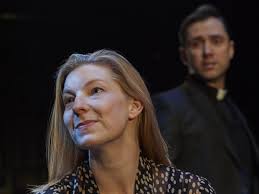
de chardin projectYesterday, I enjoyed an expansive evening at Toronto’s Theatre Passe Muraille as playwright Adam Seybold’s “The De Chardin Project” brought one of my theological heros to vivid life. Before my very eyes, Pierre Teilhard de Chardin gave new meaning to “forever!” Seybold’s bravery in taking on the complex work of Teilhard is matched by his sensitivity for the life and ideas of the man whose thinking continues to impress those who seek ways of expressing the complicated marriage of theology and science. In ninety short minutes Seybold’s script propelled us to the sun and back over and over again as the talents of Maeve Beaty and Cyrus Lane breathed life in to the divine/human love affair that is life

After years of pouring over Teihard’s work, I can empathize with the challenges of bringing his genius to a wider audience. The combination of talents that have come together in this production to stretch the audience’s perspective beyond the limits of tired arguments has succeeded in creating an experience which far exceeded my expectations. When I entered the theatre, I was sceptical. I wondered what would become of the ideas that I treasure. But it only took a few moments for Seybold’s words to woo me and before I knew it, Cyrus Lane’s tortured and dying Teilhard had me opening myself to a series of transformative moments, the like of which I’ve not enjoyed in the theatre for a long time. With Maev Beaty’s steady hand as our guide, Teihard’s questions took us on an adventure worthy of our deepest wonderings. Beaty’s moving ability to transform herself was aided by the subtle and sometimes startling staging. Director Alan Dilworth managed to not only direct his actors but his audience as well as we transcended the stage up, up, up, to the sun and back again into the deep interior of our being to capture precious grains of sand.

If you live in the Greater Toronto Area, whether you’ve read Teihard or never heard of him before, this play is a must see. The run ends December 14. So don’t delay. After the adventure of The De Chardin Project the expansion of my ideas about reality, like forever, is just beginning as Maev Beaty’s passionate “Yes” echoes throughout my being!

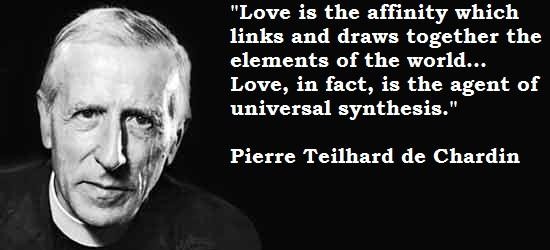
Teilhard Love

WAKE UP for CHRIST’s SAKE! – sermon for Advent 1B

purple universeOn this the first Sunday in Advent we awakened ourselves to the cosmic contours of the darkness. Our first reading was The Star Within: a creation story by Dr. Paula Lehman & Rev. Sarah Griffith, followed by a musical video reflection My Soul by Peter Mayer which you can watch below. Our Gospel reading was from Mark 13:24-37. Listen to the sermon here


Gazing Into the Vast Empty Darkness Reveals the Sacred Dimensions of the Cosmos

During the season of Advent, dwelling in the darkness becomes part of our discipline of waiting. Darkness is so revealing.

Pregnant with Possibility: Advent 1B sermon Mark 13:24-37

Advent pregnant2014 pastordawnThis sermon for the first Sunday of Advent was inspired by a sermon written by Ian Lawton entitled “The Mother of All Virgin Births” in which I was captivated by his use of the phrase “pregnant with possibility.” I read Lawton’s sermon after first reading John Dominic Crossan and Marcus Borg’s book “The First Christmas” in anticipation of Dom Crossan’s first visit to our congregation (2008). I was so eager to prepare the congregation for Dom’s historical approach to Christmas that  I fear the sermon is overflowing, perhaps a little too pregnant with details.  Luckily, the congregation was treated to the wonders of Dom Crossan’s brilliance for several days and learned well from the master about the delights of historical details. I post the sermon here, trusting that some of the details may be enlightening as we once again prepare ourselves for the Season of Advent.

Let me tell you a story from down-under; an Australian story that was doing the rounds a few years ago. Like all stories it may never have actually happened, but it is absolutely true because it happen again and again, in various and myriad ways. This story happened a while ago in Brisbane, Australia…

“The story begins in the dark. A university student named John was on the side of the road hitch hiking on a very dark night and in the midst of a storm. The night was rolling on and no car went by. The storm was so strong John could hardly see a few feet ahead of him. Suddenly he saw a car slowly coming towards him and slowly it stopped. John was desperate for shelter and without thinking about it; he got in the car and closed the door.

It took only a moment for John to realize that there was nobody behind the wheel and the engine wasn’t on! But the car started moving slowly. John looked at the road and saw a curve approaching. John was so scared, that he started to pray, begging for his life. Then, just before he hit the curve, a hand appeared through the window and turned the wheel. John, paralyzed with terror, watched how the hand repeatedly came through the window but never harmed him. Eventually, John saw the lights of a pub down the road and so gathering his strength, he jumped out of the car and ran into the pub.  Wet and out of breath, he rushed inside and started telling everybody about the horrible experience he had just had. A silence enveloped the pub when everybody realized he was crying and he wasn’t drunk.  Suddenly two other people walked into the pub.    They, like John, were also wet and out of breath. They looked around and saw John sobbing at the bar, one of the men said to the other, ‘Look, Bruce, there’s that idiot that got into the car while we were pushing it.’

Spiritual Philosopher, Ian Lawton insists, “There is always more to life than meets the eye. There is more to life than what our sight is able to see. Our eyes don’t simply pick up information relayed from an outside world and relay it to our brains. Information relayed from the outside through the eye accounts for only 20 percent of what we use to create a perception. At least 80 percent of what the brain works with is information already in the brain. We only use a small fraction of our brainpower. We very rarely exercise the full potential of our physical strength. We rarely access all that is available to our senses. We rarely maximize the potential of our mind, body and spirit in harmony. There is always more to life than meets the eye.” Continue reading

Preparing to Preach or Not to Preach on Reign of Christ Sunday

cosmic christI usually have the presence of mind to book my vacation or some sort of continuing education event that takes me far away from the pulpit on Reign of Christ Sunday. Formerly known as “Christ the King Sunday” an attempt to move beyond exclusively male imagery for Christ (in whom there is no east nor west, male nor female) some church-folk have attempted to change the name of this festival to Reign of Christ Sunday. But merely changing the title fails to get  beyond the struggles I have with this festival of the church year!!!!

Born in an age that was birthing fascist regimes, this particular festival of the church clings to it’s christian imperialist past. Instituted in 1925, by Pope Pius XI,  (you can read the full proclamation here) the festival was designed to remind the world that Christ is the King of the World. The irony of proclaiming Christ as “King” when the life of Jesus of Nazareth positively denies “kingliness” seems lost on the church. The appropriateness of asserting Christ over the religions of the world lacks the kind of humility embodied by Jesus of Nazareth. So, this year I am not prepared to celebrate Christ the King or the Reign of Christ Sunday. Instead, we will take a leaf out of Matthew Fox’s book and craft our worship around the theme of the Quest for the Cosmic Christ.

Cosmic ChristYears ago, long before I ventured to seminary, Matthew Fox’s book Original Blessing opened me to the wonders of Creation Spirituality. So, I eagerly worked my way through his book The Coming of the Cosmic Christ. I confess that my first reading of Fox’s tome left me in the dust of my own lack of understanding of traditional Christology. But even back then, without the benefit of theological training, I sensed something of the MYSTERY that I had always trust Christ to BE. I have returned to Fox’s work many times over the years and over and over again I have discovered a WISDOM that moves me beyond the limitations of the historical Jesus toward a more holistic vision of Christ which like Fox I believe has the potent ion to move us to a more wholistic relationship with Creation. I trust that the WISDOM of the Cosmic Christ will lead us into the Season of Advent so that we can be about the work of birthing the Cosmic Christ.

For Christ’s Sake! It’s Not About God! – a sermon on the Parable of the Talents, Matthew 25: 14-30

RiskThere’s a story that pastors like to tell. I think I first heard it when I was in seminary. It’s the story about a preacher who was leading a children’s sermon. This preacher told the children all about how squirrels gather nuts and hide them away for the winter. He explained to the children how important it was for the squirrels to store up nuts while they were available so that they’d have something to eat when the cold weather arrived. When he was finished, the preacher asked the children if they knew what his lesson about the squirrels was. One small child raised her hand, and she said, “I know, I know, it’s all about God.” The preacher was a little surprised, because he wasn’t talking about God at all, so he asked the little girl why she thought the lesson was about God, and she said, “because you’re the pastor and it’s always about God.”

Unfortunately, many of us have the same reaction when we hear Jesus’ parable of the talents. After all, it’s a story from the Bible, and Jesus told it, so the master handing out the talents must represent God. The only problem is, the master in Jesus’ parable is a real jerk! The kind of jerk, I for one, wouldn’t waste my time trying to worship.

The story says that the man gave the talents, which represent a huge amount of money, to his slaves. If the master in the story is God, then God must be very greedy indeed; expecting massive financial returns, without even bothering to communicate that expectation to the slaves. Fortunately for the first two slaves, they manage to double the master’s investment and the third slave managed to keep the master’s initial investment intact but couldn’t quite manage to earn any interest at all. Now, even given, the precious little I know about the stock market, I’d say the master had nothing at all to complain about. The master entrusted all he had to slaves, and they might have lost a great deal of money on their investments, but they managed to make their master richer than the master had a right to expect.

Let’s do the math. A talent represents about 15 years salary. Most scholars suggest you use a figure of $50,000 per year–times 15, that’s $750,000.00 per talent. So to the first slave the master gave 5 talents, that would be about three million seven hundred and fifty thousand dollars toady. To the second slave, the master gave two talents, that’s about a million and a half dollars today. To the third slave, the master gave, one talent; and that’s about $750,000.00.

According to the story this master had quite the reputation; upon the master’s return the third slave explains why he was so cautious with the master’s money. “Sir, I knew that you were a harsh man, reaping where you did not sow, and gathering where you did not scatter seed; so I was afraid, and I went and hid your talent in the ground.” According to the master’s reputation he is a thief who isn’t above taking what doesn’t belong to him. The third slave was prudent with the master’s money and did what was considered appropriate in the ancient world were banking methods were crude at best, and many people buried treasure for safekeeping; The third slave didn’t loose so much as a penny of the master’s money, and despite the fact that two of the his slaves have just returned to him an additional 7 talents, that’s a whopping great profit of about 5 and a quarter million dollars. Just imagine, that three of us managed to make our boss 5 and a quarter million dollars on an initial investment of 6 million dollars, that’s a return of 75%, well I don’t know where you do your investing but 75% profit is nothing to sneeze about. But instead of rewarding the trio, this master doesn’t deny his own reputation for reaping where he doesn’t sow, and he takes the talent from the fearful salve and gives it to the one who already has ten talents, and then declares that: “to all those who have, more will be given, and they will have an abundance; but from those who have nothing, even what they have will be taken away.” As for the fearful slave who played it safe, the master calls him worthless and orders that he be “thrown into the outer darkness, where there will be weeping and gnashing of teeth.

If this were all about God, then to say that God is harsh would be an understatement indeed. If this were all about God, then why in the world would anybody love God? For who can love such a cruel master? But more importantly, if this cruel master is God, then Jesus’ is describing a god that cannot be compared to the God Jesus boldly calls ABBA. For Jesus’ Abba would never be so greedy as to steal from another’s labour, nor would Jesus’ Abba take from the one who has the least, nor threaten to cast out the least of Jesus’ brothers for the crime of taking care of the gift that was given to him. Such a view of God is inconsistent with all that Jesus’ taught about Bod. So just because Jesus told a story, it doesn’t mean the main character in the story is necessarily God. Continue reading

Lest We Forget – A Peace Remembered

The young woman can still remember one particular Remembrance Day when her words and actions did nothing more than offend someone she loved very much. It was the one and only argument she ever had with her Grandmother and it happened over Remembrance Day. At the time, she was living in London. She remembers thinking that Londoners take Remembrance Day very seriously indeed. More so, she thought, than in her native Canada. She wondered if the blitz had something to do with it.

While most of the poppies people wore were red, she began to see white poppies appear on the lapels of more than just a few people.  She read in the newspaper that those who were committed to peace and believed that for the most part, Remembrance Day only serves to glorify war were donning white poppies.  You could pretty well draw a dividing line between the generations using the colors of poppies as your guide. Young people, who had never experienced war tended to wear white poppies, while those who were older and who had memories of war, tended to wear red poppies. In many homes poppies in and of themselves managed to start wars. 

The idealistic young woman was just twenty and her commitment to peace determined her choice. She was wearing a white poppy the day she traveled up to the Midlands to visit her Grandmother. It was the day before Remembrance Day when she arrived on her Grandmother’s doorstep. She’d forgotten all about the white poppy that adorned her lapel. She couldn’t help thinking that there was something odd about the reception she received from Grandmother. It wasn’t exactly what you would call warm. Her Grandmother was upset about something. But the young woman couldn’t quite figure out what, because her Grandmother appeared to be giving her the silent treatment. She just served dinner and listened quietly as the young woman chatted on about her week in London.

After dinner, the young woman suggested that they pop down to the pub for a chat with her Grandmother’s neighbors. Usually, her Grandmother would have jumped at the chance to show her granddaughter off to her friends. But she seemed more than a little reluctant on this occasion. She so rarely refused her granddaughter anything, but it still took a great deal of cajoling before the young woman managed to talk her Grandmother into venturing out into the world.    As they were putting on their coats to leave, the Grandmother asked her granddaughter to remove the white poppy from her coat.

The young woman looked at her Grandmother’s red poppy and refused. She began to lecture in that pompous way that only young people who don’t know any better can about the horrors of war and the need to stand up for peace.     Her Grandmother insisted that she could stand up anywhere that she wanted to for peace but not in her local, not in front of her friends, not tonight. And then their battle began in earnest. They started calmly, but firmly arguing over the damn poppies. Before long, they were shouting and eventually the Grandmother, stormed out of the house and went to the pub without her granddaughter.

The young woman discretely went to bed before her Grandmother came home.  Each woman slept fitfully, bemoaning the fact that they had declared their own kind of war.   

Early the next morning the young woman rose quietly, hoping to dash off to London before her Grandmother awoke. She was just about to make a clean get away, when her Grandmother came into the living room. She was carrying a uniform. A uniform the young woman had never seen before; a uniform that stopped the young woman cold in her tracks.

Over breakfast the old woman explained that during the Second World War, she had joined the Women’s Auxiliary Air Force. The men were all off fighting and so the government had consented to letting women do their bit. Her job in the WAAFs was carried out on the home front. Every evening after she had fed her kids supper, she would send them off to the air-raid shelter with a neighbour, then she would put on her uniform and head off to the hills over Birmingham, where she would “man” an anti-aircraft gun.

After telling the young woman stories that she had rarely told anyone before, the old woman invited granddaughter to come her to British Legion later that morning. Awed by all she had been told, the young woman changed her plans and agreed to meet her Grandmother down at the Legion hall in about an hour.

On her way to the Legion hall, the young woman bought a red poppy and timidly pinned it to her lapel. When she finally caught up with her Grandmother, the old woman couldn’t help but smile when she saw the red poppy pinned to her beloved granddaughter’s lapel.

The young woman couldn’t manage a smile. Not threw her tears. The young woman was overcome by the sight of the white poppy that was pinned to her Grandmother’s lapel. 

The two women fell into one another’s arms and for a moment, just a moment the two held one another other in the presence of a peace beyond words; a peace which surpasses all our understanding. The peace that only love can achieve. The peace that the world is dying to experience. 

As the last post was trumpeted on that cold November 11th, separated by generations, perspectives, opinions, and commitments, two women stood united in love as they remembered. Together they stood hoping against hope for peace.


           

Jesus and ISIS – adult education class 2

Jesus & ISIS

Listen to the class here

Walter Wink video shown during the class:

What Is the Purpose of My Life? – Sister Joan Chittister

sage-ing“What do you do?” not “What is your job?”  Pushing us to move beyond limiting our understanding of who we are. At 78, Sister Joan Chittister continues to be an inspiration to those of us who seek to know the purpose of our creation. To those of us who are nearing or have reached retirement, Sister Joan insists that there is so much for us to do in the world. “If you want to know if your work on earth is done, if you are still alive it is not done!” There is vital work that needs doing and you have the wisdom and skills necessary to be vital. Recorded on October 12, 2014 at Christ Church Charlotte’s Faith Forum. 

Resources for All Saints’ Sunday

all saints sunday

Preparing for All Saints’ Sunday? These posts may be helpful.

Telling Our Stories of the Saints in Our Lives

All Saints – Giving Thanks for the Divine in One-another


Jesus and ISIS – adult education class

This past Sunday, while studying the prayer attributed to Jesus, various questions arose about “forgiving those who trespass against us” which led to a conversation about loving our neighbours. One question in particular: “How can we love ISIS?” revealed how many of us are wrestling with the question of violence. As a class we decided to change the Adult Education schedule so that we might spend more time talking together about questions arising as a result of Canada’s involvement in the current struggle with ISIS. None of us could have imagined the tragic events of this week. As we struggle to come to terms with the violence which has been perpetrated in Canada, the loss of innocent victims, and the loss of innocence our nation is grappling with, it seems even more important for us to gather as a community to think, pray, respond, and support one another.

So, this Sunday our Adult Education class began to consider questions concerning the challenging teachings of Jesus and our responses to violence, especially in regard to the struggle against ISIS. Below is an audio recording of the conversation and a copy of the Keynote presentation used during the class. Our conversation continues next Sunday Nov. 2nd. 

Reformation Postings: Luther, Spong, Fox, and Holy Cross – a Reformation Sunday Sermon

95This Reformation Sunday sermon looks at postings from Martin Luther, John Shelby Spong, Matthew Fox and Holy Cross Lutheran Church in Newmarket in the hope of string up the Spirit for Reformation today!  The written manuscript is a facsimile of the sermon that was preached on Reformation Sunday 2013, which you can listen to here

Semper Reformanda – Always Reforming: On October 31st 1522, Martin Luther nailed his 95 Thesis to the door of the cathedral in Wittenburg and the church has been Semper Reformanda – ing ever since.

Luther’s 95 Theses famously itemized the wrongs and the abuses of the church of his day and insisted that change was long overdue. Luther’s list included many theses opposed to the churches selling of indulgences:

41 Papal indulgences must be preached with caution, lest people erroneously think that they are preferable to other good works of love.

42 Christians are to be taught that the pope does not intend that the buying of indulgences should in any way be compared with works of mercy.

43 Christians are to be taught that he who gives to the poor or lends to the needy does a better deed than he who buys indulgences.

But even though Luther railed against the church’s selling of indulgences, he did approve of using threats of hell.

4  Christians should be exhorted to be diligent in following Christ, their Head, through penalties, death and hell.

5  And thus be confident of entering into heaven through many tribulations rather than through the false security of peace

Luther posted his 95 Theses on the door of the Cathedral, and the newfangled invention of the Printing Press ensured that his protests were reproduced for all of Europe to read. Just before the turn of the last century, in 1998 to be exact, the Right Reverend John Shelby Spong, the Bishop of Newark published his own protestations. Bishop Spong, looked around at the state of the church and decided that it was time for a new reformation. Using the newfangled invention of our time, Jack posted his Twelve Theses with these words:

“Martin Luther ignited the Reformation of the 16th century by nailing to the door of the church in Wittenberg in 1517 the 95 Theses that he wished to debate. I will publish this challenge to Christianity in The Voice. I will post my theses on the Internet and send copies with invitations to debate them to the recognized Christian leaders of the world. My theses are far smaller in number than were those of Martin Luther, but they are far more threatening theologically. Continue reading

Glimpses of God’s Backside – Exodus 33:12-23

glimpseYAHWEH said to Moses: “See, there is a place by me where you shall stand on the rock; and while my glory passes by I will put you in a cleft of the rock, and I will cover you with my hand until I have passed by; then I will take away my hand, and you shall see my back; but my face shall not be seen.”

Memories, stories, imaginings, myths, wonderings, and glimpses are the stuff of truth. Even though I was only a child, I have very vivid memories of my very first trip on an airplane. We lived in Belfast, Northern Ireland and we were moving to Canada. I was terrified and fascinated all at the same time. I don’t know where I heard them first, but words like “frozen,” “north,” “wolves,” “igloos”, and “Eskimos” filled my imagination. I have a vague memory of being told that there wouldn’t be any Eskimos where we were going.

I remember the excitement and the fear about flying up in the sky, higher than the clouds. We’d be so high that we’d be able to look down at the clouds. I just couldn’t wait. I was going up, up into heaven. Visions of angels sitting on clouds, maybe, just maybe I’d catch a glimpse of Jesus playing with all the little children. I never dreamed that I’d see God. God would be clothed in a cloud and if God peaked out I’d hide. I didn’t want to see God. God was way too scary. I wanted to stay well clear of God. God was a scary guy, so scary that you’d probably drop down dead if you saw God. Maybe I shouldn’t look down on the clouds, just incase I caught a glimpse of God, because then I’d never make it back down from heaven. And then, I’d never get to see the Eskimos that I just knew were waiting for me down in Canada!

It wasn’t easy being up there in the sky for the very first time. I couldn’t take my eyes off that little porthole. Even though I knew somewhere deep down inside that I wasn’t really looking out at heaven, I just couldn’t help wondering what was really out there. I remember thinking that maybe just maybe there were angels dancing on those clouds, invisible angels, cause I knew that you became invisible when you died. God was pretty much invisible most of the time.      Continue reading

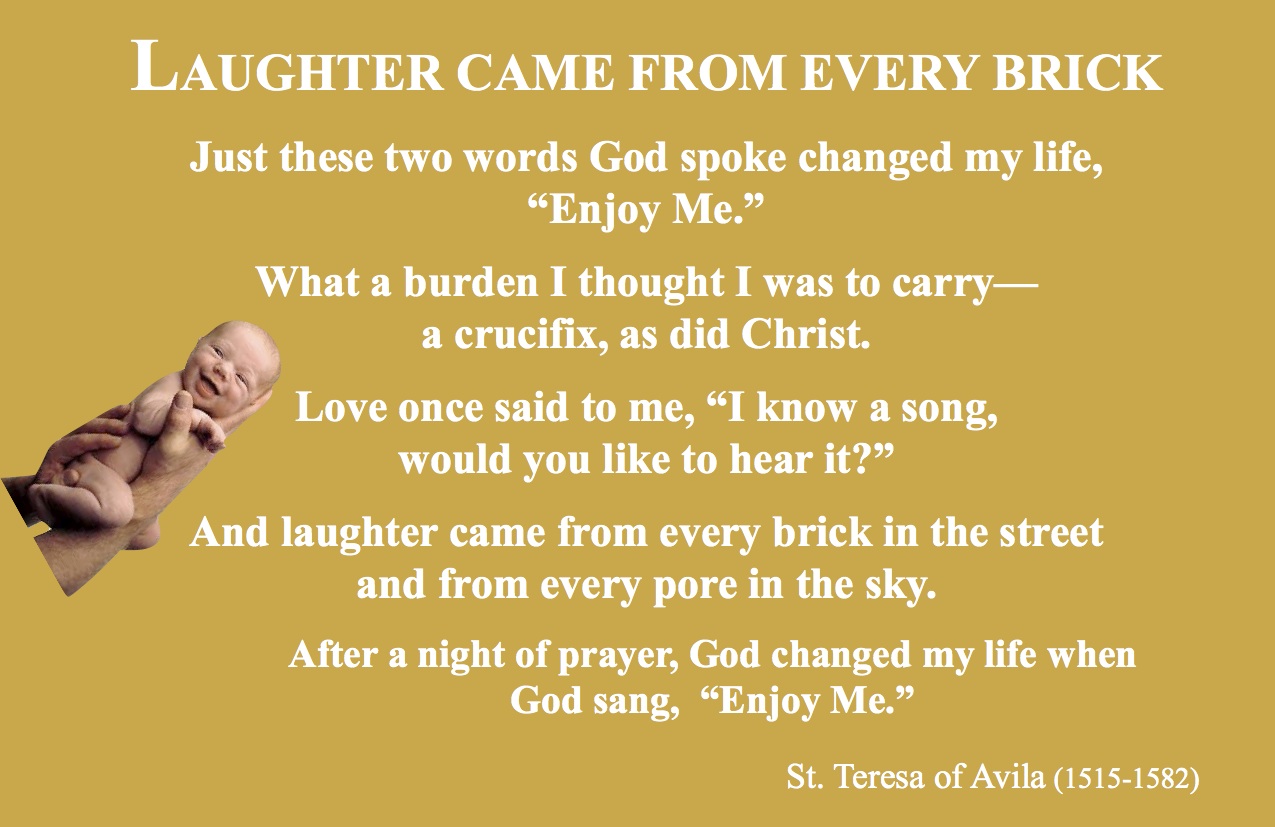
Today We Celebrate the Life and Witness of St. Teresa of Avila

An excerpt from “Love Poems From God” by Daniel Ladinsky,

(Penguin Compass, London: 2002)

(1515-1582)  “Teresa was born in Avila, a beautiful high mountain village of Spain.  She was one of thirteen children, three girls and ten boys, in a wealthy family.  The Spain in which Teresa grew up was permeated with 700 years of Arabian culture; the eradication of Arab power was followed by one of Spain’s darkest periods, the insanity of the Inquisitions, which, in the fourteenth century, along with other grievous deeds, forced mass conversions of Jews to Christianity.”

“Teresa was her father’s favourite child, and the most spirited.  Her mother died during childbirth when Teresa was thirteen, after which she had little supervision.  It is believed she had a lover at the age of fifteen, which caused her father to send her to a convent boarding school, only to see her return home two years later because of poor health.  When she was twenty-one, Teresa ran away from home to join a convent.  At that time many convents were more like hotels for women, allowing them a great deal more independence than they would be allowed at home, though after two years at the convent Teresa had a near-death experience that changed her life.  A spiritual awakening began in which she cultivated a system of meditation that sought quieting the mind to such an extent that God could then be heard speaking.  Over the next twenty years she experienced many mystical states but not until she was fifty did she begin the most far-reaching aspects of her life’s work.” Continue reading

The Science of Happiness – An Experiment in Gratitude

thanksgiving canada

Your Mom and Dad were right when they taught you that “thank-you” is a magic word. Science now confirms what we learned at our parents’ knees all those years ago.

Happy Thanksgiving!

Big Bang, Darwin, and Evolutionary Images of Divinity

Benediction LightIn the words of our ancestors as they grappled to tell the story of the Divine Mystery we call God, it is written. “Then God spoke all these words, and said, “I AM YAHWEH who brought you out of the land of Egypt, out of the house of bondage. Do not worship any gods except me! Do not make for yourselves any carved mage or likeness of anything in heaven above or on the earth beneath or in the waters of the earth, and do not bow down to them or serve them! For I, YAHWEH, am a jealous God.” (Exodus 20:1-5)

Joan Chittister, a Roman Catholic nun and brilliant theologian, tells a story about a little girl named Katie who was a second-grader in one of the schools of Chittister’s community. One Friday during art class as the teacher roamed the aisles checking progress, she stopped at Katie’s desk and asked, “Well, Katie, what are you drawing?” “I am drawing a picture of God,” Katie said proudly. “Katie,” the teacher answered, “you can’t draw a picture of God. Nobody knows what God looks like.” Katie said, “They will when I’m finished.”

I never was much good at drawing, but like little Katie I to have tried my hand at creating an image of God. For me my image making really took off when I wasn’t much older than little Katie. I must have been about nine or ten years old when my dreams came true one Christmas morning and I became the proud owner of a microscope. At the time I was convinced that my microscope was the most sophisticated tool ever designed. It came in it’s own wooden box and I distinctly remember the metal clasp on that box had a small clasped that was designed to allow a pad lock to slip through so that the box could be safely secured from less sophisticated explorers like my little brother from opening it to reveal the splendor of a tool that could turn its owner into a scientist. Along with my microscope came a box of small glass slides, an eyedropper and a sample jar. My father explained to me that we could go to a local pond to collect our samples. Dad assured me that a small jar of pond-water would contain enough samples to keep me busy for days. Dad was absolutely correct and I spent many an afternoon squinting into my microscope, painstakingly adjusting the focus so that I could get just the right magnification to see the wonders of a miniature world of creatures I had never before even dreamed existed. I was an explorer of pond scum. I was a scientist, enthralled by the tiny little world, wondering in amazement a splendor of creation. I marveled at the tiny creatures that swam franticly in and out of my view. I sometimes pretended that I was their Queen and who with godlike powers could scoop them up out of their native pond home and deliver them to my royal laboratory and command them to dance for me. And dance they would, providing hours and hours of entertainment for me and in return I lavished such care and attention on their little world. Sadly, for reasons beyond my control, their little lives always came to an end after just a few days as the pond water became even too rancid for my little subjects. But I was a benevolent monarch and rather than flush their little worlds down the toilet, I would always travel back to the pond from which they came and with great dignity and more than a little ceremony dump the foul smelling evidence of their watery demise back into the waters of their birth. I remember thinking that God too must be just as dignified when He, back then it was definitely He, attended our funerals, for God had been watching over us in much the same way as I watched my little creatures. Continue reading

Teach Us to Pray – a recording of our second class

Below you will find a recording of our second class. The video of the Keynote presentation includes the Youtube video featuring Marcus Borg that was shown during the class together with an audio recording of the class (the audio is stilted in places but if you wait but a moment it will sync with the presentation). Or, below the video you will find an audio recording of the class.

The third class in this series is on Sunday Oct. 19 and will be posted on Oct. 21

Audio recording of the class: