A Little Self-Involved? Try Looking Outward! – a sermon for Lent 2A, John 3:1-17

Trinity copyWhen I was just a kid, I had what can best be described as an adolescent crush on a teacher. Looking back on it now, I’d have to say that I fell head over heels in love with my teacher. It was the kind of love that only a 13 year-old girl could have; so intense and all consuming. I came to believe that this teacher was the wisest, kindest, most interesting person in all the world. This teacher knew more than anyone else, especially my parents. This teacher was cooler, funnier, more daring and definitely more in tune with my life than anyone I had ever met. I was convinced that if I could only be just like this teacher would mean that I too would be cooler, funnier, more daring and definitely more in tune with life. So, like most adolescent girls who are suffering from a crush I became obsessed with this teacher. I was young and I was in love, and like most thirteen year-old’s the I was convinced that the world revolved around me, so I set about pursuing my passion. This teacher taught English, so naturally, I decided that when I grew up I too would teach English. This teacher loved poetry, so I too became passionate about poetry.

One day this teacher announced that we could gain extra-credit if we wanted to enter a local poetry writing contest; and even though I was pretty sure that year I’d be getting a mark that would be somewhat better than an A, I began to write poetry. I was very serious about my poetry writing.  I carried a pad of paper with me everywhere I went, and I began to ruminate about my life. I don’t remember any of those early attempts to wax poetical, but I do remember that each and every one of those poems was about me; me and my life, me and my unrequited love, me and my passion, me and the horrible way that no one paid much attention to me. Me, Me, Me, Me, it was all about me.

As the time drew near for us to submit our poetry to the competition, my teacher announced that there would be a special class after school, so that those of us who were planning to enter the competition could get some feedback on our efforts. So, by the end of the week, I would have to choose one of my great works for feedback. I spent hours pouring over one poem in particular. Tinkering with the words, trying to get things just right. I was so very proud of the final draft. I’d carefully copied it out on to a crisp piece of foolscap. Arranged the letters in the middle of the page so that they looked just so. I could hardly wait for school to be over so that I could rush to see what comments my beloved teacher had placed in the margin. There were barely a handful of us who stayed after school.

Looking back on that scene, we were a nerdy little crew. I was positively breathless as my teacher handed my offering back to me. To this day, I can’t remember a single line of my great work, but I can tell you word for ward what was scribbled in red in the margin of the ever so white foolscap. “A little self-involved, try looking outward.” I was devastated. How could anyone be so cruel? I’d poured my heart out only to have it stomped on by the indifference of truth. Continue reading

The Inner Landscape: John O’Donohue

Blessing for Love pastordawnFollowers of this blog know that John O’Donohue is one of my favourite sages. I am indebted to a follower of the blog for sending me this podcast of Krista Tripett’s interview of John O’Donohue recorded shortly before his death in 2008. O’Donohue’s words continue to open my soul.

Treat yourself to a listen:

We Don’t Know What We Don’t Know: a sermon for Lent 1A

Lent 1A Mar 9 2014 Teresa Sky's Sheets

Readings from Teresa of Avila can be found in the Worship Bulletin here

Listen to the sermon 

Stardust: a Lenten Devotion

Stardust We pastordawnI have a condition common among members of the clergy this week: black thumb. It lingers long after Wednesday’s ashes have been smeared on the heads of our parishioners. Thoughts of mortality and eternity haunt the pores beneath my thumbnail. The knowledge that we are dust and to dust we shall return continues to delight me. 

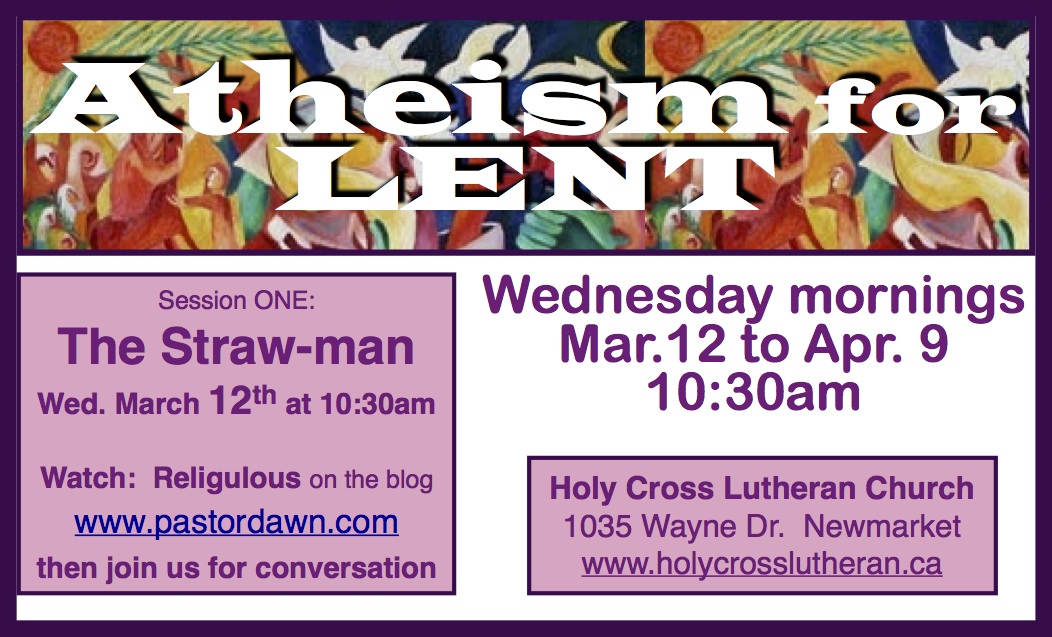
Atheism for Lent begins: at Holy Cross Lutheran Church Wednesday March 12 at 10:30am

AFL Strawman

For details of the program click here

Awe and Wonder: A Lenten Practice

AWE copySo many of our Lenten practices revolve around theories of atonement that cast the HOLY ONE as a participant in a grand bargain that saw Jesus of Nazareth die as a sacrifice for sin. For those of us who have left behind theories of atonement that set Jesus up as  payment for our sin, Lent can seem a very lonely place. While many churches busy themselves with rituals that encourage repentance from the perspective of confessing our unworthiness to a grand-inquistor deity,  it is tempting to give up the season of Lent all together. But with the explosion of information about the nature, beauty and complexity of the cosmos, perhaps we can achieve the humility that the ritual of confession offers in ways that do not require us to adopt the attitude that human’s are unworthy creatures in need of a god who would demand satisfaction at the expense of a blood sacrifice. 

Each time I look up into a starlit sky I am overcome with a sense of awe and wonder that is in and of itself a prayer that inspires humility in me. A sense of awe and wonder at that which is beyond ourselves is the beginning of a prayer that always leads me to a sense of ONENESS with all that IS. 

This morning, my Lenten devotion came to me in the form of this splendid video The Overview, which describes the awe and wonder of those who have had the privilege of looking at the earth from the perspective of space. They describe their awe and wonder, their prayer if you will, as the “overview effect”. The overview effect serves to connect these space travellers to the earth itself and moves them to the kind of humility that helps me to realize that awe and wonder can serve as nourishment for my own Lenten journey.

As we gaze in awe at our marvellous planet perhaps we can be moved to tread more lightly upon her. Perhaps awestruck by the beauty and wonder of creation, we can look to all the inhabitants of the earth and see that they too are fearfully and wonderfully made. I trust that a humility based not on a belief that we are wicked, unworthy creatures, but rather on a experience of awe and wonder, will lead us on a Lenten journey to a place where we will have the courage to gaze upon the cross and see beyond the violence to the hope of resurrection.

Lent: Letting Go of our Tightly Held Piety to See Our Need of Confession

JOHN OF THE CROSS as
Little Crystal was only two and a half years old when she got hopelessly stuck.
 And when she got stuck she did what all small children do, when they have gotten themselves into a situation that the can’t get out of, little Crystal cried for help. She went into her mother’s study, holding in one hand a family treasure and her other hand couldn’t be seen.  Crystal cried out, “Mommy I’m stuck”. Her unseen hand was stuck inside her great-grandmother’s vase.  The precious vase had been handed down from her great-grandmother to her grandmother, to her mother. Crystal had always been told that one day the magnificent vase would be hers.

Crystal’s mother tried to move quickly without panicking. She scooped the vase and her little girl up into her arms and carried them to the kitchen sink. She used warm soapy water to try to loosen the toddler’s hand, which was stuck all right. When soap didn’t work she reached for the butter. While greasing her child’s wrist like a cake pan, she asked the obvious “mother question.” “How in the world did you do this, child?” Crystal carefully explained that she had dropped candy down into the vase to see if she could still see it when it was at the very bottom. But she couldn’t see it, so she reached in for her candy and that’s when she got stuck and she couldn’t get her hand back out.

Well, as time passed, the situation became more and more serious. Crystal’s mother called for re-enforcements. She phoned her own mother and told her to get there as fast as she could. A neighbour suggested Vaseline. The apartment manager got out some WD40. Still no luck.  It began to seem like the only way to get Crystal’s hand out was to break the family heirloom.

When Grandma finally arrived, both Crystal and her mother were almost hysterical. They were both more than a little relieved to have Grandma’s calming presence. Grandma sat little Crystal on her knee. 

Crystal was very upset and still very stuck. Grandma took a good look at the vase that used to sit on her mother’s kitchen table all those years ago.  She looked at the miserable look on her grand-daughter’s face, and she said, “Crystal, sweetheart.  Your mommy told me that you reached into the vase for candy.  Is that right?”

Crystal was a little breathless from all the crying she had been doing and all she could manage was a whimpered, “Mmm hummm.” “Honey, tell grandma the truth now. Do you still have a hold of that candy?” “Mmm humm”.  Crystal sobbed. Then Grandma rubbed little Crystal’s back, held her close and gentle, but firmly said: “Let it go, child.  Let it go.” Sure enough, the vase slipped off as smooth as silk. (I have searched for the source of this story, without success. I first heard it at a retreat on the West Coast a lifetime ago)

In this fast paced world of ours, I often find myself in little Crystal’s predicament.  Surrounded by a treasured family heirloom, desperately clinging to a treasure.  My predicament often makes it difficult for me to appreciate the beauty of the heirloom. Letting go isn’t as simple as it sounds. But sometimes letting go is the only way to preserve the integrity of the heirloom. When I think about the church’s practice of public confession, I can see how desperately I have been holding on to candies that no longer satisfy my need for forgiveness.  Continue reading

Ash Wednesday: Embracing Mortality

Ash Wed. 2014 MortalityView the Ash Wednesday Worship Bulletin here

Ash Wednesday Readings here

Listen to the Ash Wednesday Homily:  


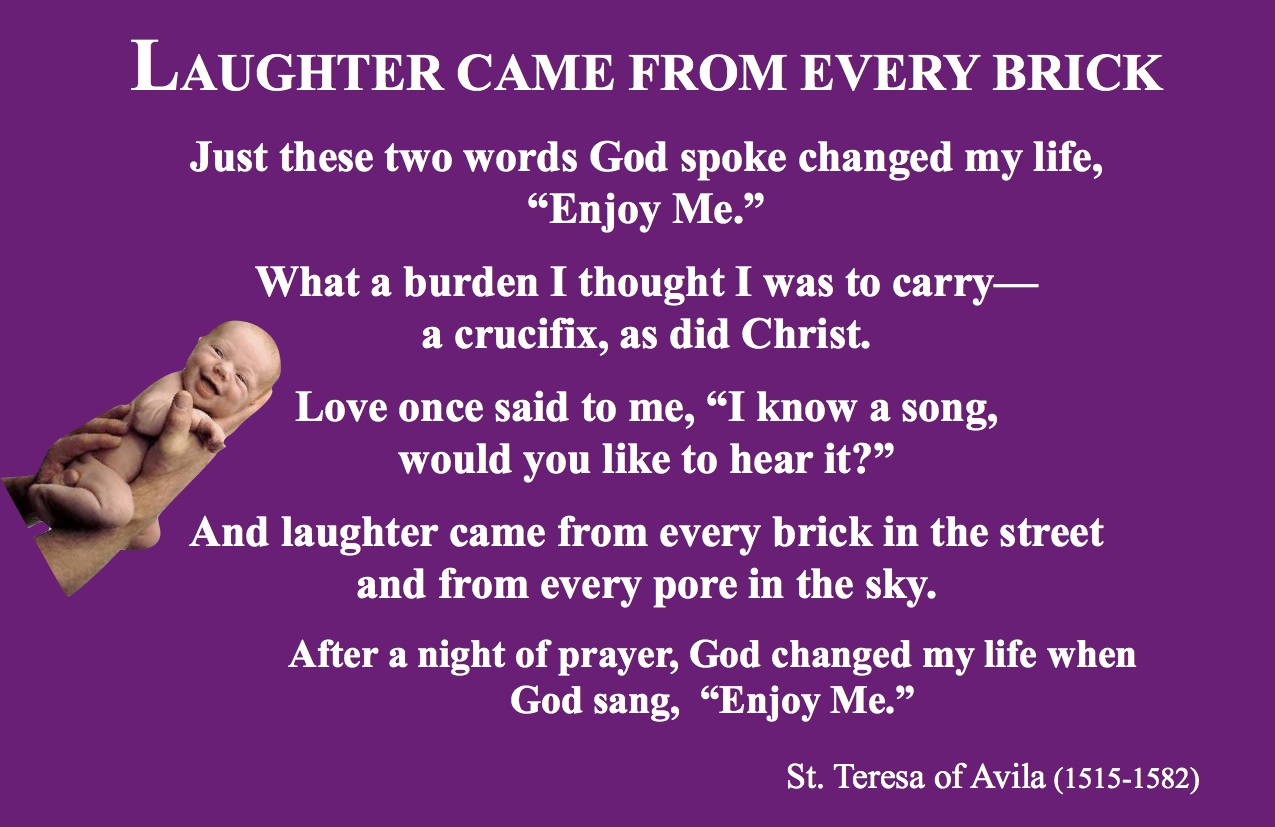
Giving Up Theories of Atonement for Lent in Favour of Listening for God’s Laughter

Laughter St Teresa

Traditionally the season of Lent is a mournful time filled with calls to repentance and self-examination as we follow Jesus into the wilderness to be tempted and then on that long march to Jerusalem where the powers that be will have their wicked way with him. Our liturgies take a mournful tone as we lament our woeful human existence, confess our sinfulness, and hear exultations to take up our crosses so that we too can follow Jesus to the bitter end. Over and over again we are asked to remember that we are in bondage to sin and cannot free ourselves, as we gaze upon the cross remembering that Jesus our savior bled and died as a result of our wicked sinfulness.

Lent is a strange season that harkens back to a forgotten era. Unlike so many of the seasons of the church year it’s not exactly a season that attracts people to church. Not many of you got out of bed this morning and said, “Yippy it’s the first day of Lent. Oh goodie!  We get to be reminded that we are sinful, that life is miserable and unless I’m willing to take up my cross and follow Jesus all the way to Golgotha, there’s precious little hope cause we’re all going to die and when the time comes we want Jesus to remember us.”

Now I know that there are some people who just love Lent and I must confess that I like the quieter, more somber tone that our liturgies take. I actually enjoy the opportunity to slow things done and be more reflective in our worship together. I savor the silences and the opportunities to be more contemplative. I love the colour purple with all its vibrant hues and the best part of all is that the beginning of Lent means that spring is just around the corner. What I don’t like about Lent are the signs, symbols, hymns and stories that make it so easy for us to fall back into the 11th century. Continue reading

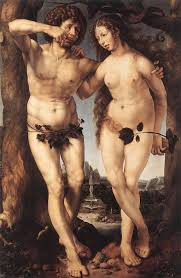
What a Joke: These Stories Never Actually Happened! – a sermon for the First Sunday in Lent – Genesis 2:15-17; 3:1-7, Matthew 4:1-11

Eve & AdamI am indebted to the exegetical work of John Holbert for the insights into Hebrew humour!

Each year as Lent approaches, I find myself flirting with the idea of giving up Lent for Lent. Lent is just too much work. For centuries, during Lent the church has emphasized so many concepts that seem alien to the 21st century mind. Each year during Lent preachers are required to undertake the unenviable task of unpacking unpopular, seemingly antiquated concepts in an effort to encourage the contemporary churchgoer to entertain the equally antiquated rituals of Lent. I mean Christmas and Easter might attract a few more people to our sanctuary, but how do you attract people with talk about repentance or fasting? Just look at our readings for this morning. Temptation is the order for toady. Eve and Adam succumbing to temptation, the Apostle Paul prattling on, heaping condemnation upon the first parents for having given in to temptation, and then Jesus himself resisting temptation from non-other than the Devil. Not exactly cheery stuff designed to bring comfort on a cold damp winter morning, where apart from the time change, there are very few signs of a longed for spring.

But Lent has arrived and so we must tuck into this dish of temptation hoping that it will reveal some hint of the promise of what lays beyond our long Lenten journey as we travel toward Easter’s resurrection joy. But these are not easy readings to unpack.

I could begin by warning against taking these texts literally. But you have heard warnings against taking the text literally and I know that you understand that the story about Eve and Adam is just a story. It never really happened. Most of you, even though you might be tempted to think that Jesus literally went out into the wilderness and was tempted by the Devil, most of you have long since realized that the Devil doesn’t actually exist. If you’re still tempted to believe that this story actually happened, well, the fact that in the story itself, Jesus goes out into the desert all by himself ought to at least make you pause to ask, who wrote this story down, if there was nobody there but Jesus and the Devil?

These stories are just that, they are stories. In the words of Marcus Borg, “The events in these stories never actually happened. But the events in these stories are always happening.” Let me say that again, lest there be any doubt: They never actually happened, but they are always happening. That’s what makes these stories such great stories. The stuff in these stories is always happening over and over again. Temptation is the stuff of our lives. Each and every one of us, each and every day struggles with temptation, each and every one of us and all of us together as humanity. This grand human experiment that we are caught up in requires that we all struggle with temptation. Continue reading

Shrove Tuesday – Such Frivolity!

ShroveTuesdaylrShrove-Tuesday, at whose entrance in the morning all the whole kingdom is inquiet, but by that time the clocke strikes eleven, which (by the help of a knavish sexton) is commonly before nine, then there is a bell rung, cal’d the Pancake-bell, the sound whereof makes thousands of people distracted, and forgetful either of manners or humanitie; then there is a thing called wheaten floure, which the cookes do mingle with water, eggs, spice, and other tragical, magical inchantments, and then they put it by little and little into a frying pan of boiling suet, where it makes a confused dismal hissing, (like the Lernean Snakes in the reeds of Acheron, Stix, or Phlegeton) until at last, by the skill of the Cooke, it is transformed into the forme of a Flip-Jack, cal’d a Pancake, which ominous incantation the ignorant people doe devoure very greedily.  John Taylor, English poet (August 24, 1580 – 1654)

Shrove comes from the old English word shrive = to shrive is to be absolvedshrove following confession.  Those who have received absolution are the shriven.  The priest who dose the shriving is the shriver. The shriven would feast using up all the foods that were avoided during Lent.

The practice of feasting is not complete without revelry and merrymaking. Many of the rules of acceptable behaviour are  set aside so as to ensure that a “wild time” is had by all:

  • Men dressed as women and women dressed as men (Prussia 15th century)
  • Football was played with wild abandon in the streets to ensure that windows were broken and gardens disturbed
  • Dancing in long meandering lines through the streets was encouraged
  • Church clipping:  clasping hands and surrounding the church
  • Jokes were told
  • Magic usually forbidden was preformed
  • Skipping (usually forbidden) was encouraged with up to ten people skipping together using the same rope (considered scandalous at other times of the year)
  • Fortune telling was allowed
  • Dancing was encouraged on church property!
  • Children were encouraged to mock their elders!
  • Tricks were played on members of the clergy.
  • Clergy decked in all their finery engaged in races.
  • Little boys and girls went from house to house knocking on doors and then running away.
  • Water was poured over the heads of officials.
  • Unspeakable things were done to chickens.
  • Eggs were tossed.

Pagan Roots:  the grand battle between Winter and Spring

  • Masks were worn to scare Winter away
  • the pancake is the symbol of the sun
  • music and revelry frightens Winter and Welcomes Spring
  • Church bells were rung at odd times to confuse Winter
  • Skipping made the earth more fertile
  • Boys and girls were encouraged to sneak away together so that matches might become inevitable.
  • Sledding down snowy slopes on Shrove Tuesday encourages the land to be fertile.

Did you know?

  • The faithful once believed that it was advantageous to hang one’s laundry out on Shrove Tuesday because chances were that the laundress having just received absolution, hanging laundry in a town full of folks who had just received absolution was sure to mean that the whites would dry whiter than white!
  • Certain works were forbidden on Shrove Tuesday: mending, sewing, hair combing, rope twisting and grindstone milling. Disobeying these bans will bring about summer storms, winds will rip off roofs, chicken will scratch in gardens, meat will have worms and fingers will swell.
  • Carnival = fare well to carni = meat

I Refuse to Take on Any Lenten Disciplines!

JOHN OF THE CROSS wordsIn the midst of this brutally cold winter I can find no signs that spring is around the corner. To say that it is cold outside is an understatement of epic proportions. Regardless of the challenges of this wild winter, I cannot simply retreat to the warmth of the fireside. I have places to go and people to see. By the time the driveway is shovelled, the ice is scraped, the windshield juice is topped up in my car and all the extra time it takes to navigate the roads in this weather, I can barely complete the regular tasks this busy modern life of ours demands, let alone feel guilty because I’m not adopting some contemplative spiritual exercises that harken back to a simpler time! I heard someone say, “If you are currently not experiencing any stress in your life, you should immediately lie down because it appears that you may be dead.” So, please don’t ask me to take on any Lenten disciplines!

I have also heard it said,  that in Canada the most common response to the question “How are you doing?” is the word “Busy!”. Canadians and I suspect Americans, Europeans, and most inhabitants of the so-called First World, seem to feel the need to justify our existance by assuring others that we are leading busy lives. While I am absolutely convinced that lives lived in the twenty-first century are busier than the lives of our ancestors, I’m not so sure that being busy is something we ought to be proud of.

Growing up, I remember all sorts of predictions about how life in our immediate future would be filled with so much leisure time as a direct result of the technology that would be at our fingertips. But as technology advances, our ability to work wherever and whenever the need arises has severely curtailed our leisure time. Our lives are busy and we have forgotten what it means to be human beings because most of us have become human doers. We have forgotten how to simply be.

I find it reassuring, comforting even, that our ancestors understood  our Creator as YAHWEH, which translated can be understood as “I AM WHO I AM or I SHALL BE WHO I SHALL BE. That the name of God should be understood as the verb “to be” helps me to understand myself as one who is created in the image of the great I AM and not the great I DO. I am a human being not a human doer! What I need from a season like Lent is not a prescription for more things to do. But rather, the encouragement to simply be. 

Might I suggest that we can begin this encouragement to simply be by simply greeting people with a simple word of peace. If such a greeting seems awkward to you then perhaps simply asking people how they “are” rather than how they are “doing” will suffice. Such a subtle change may not be enough for some people to refrain from telling you what or how they are “doing” and you may find them insisting that they are indeed “busy”. But a little gentle persistence may enable some to respond about their very being. Reminding one another that we are beings and not just doers might lead us toward some peace. Shalom, As-salam alaykum, Peace dear beings, Peace…..

Canadian Lutheran World Relief Sunday: sermon

CLWR SUNDAYListen to Pastor Tom Doherty’s sermon here

John Dear: Following Jesus in Our Culture of Death – A MUST WATCH VIDEO FOR ALL WHO ATTEMPT TO FOLLOW JESUS

john dear

John Dear is a Jesuit priest who is living into Jesus’ call to be a non-violent activist peace-makers. In this video he presents a radical retelling of the Gospel that will change the way you hear all too familiar stories about Jesus. This is perhaps the most exciting interpretation of the life of JesusLazarus come forth that I have ever heard! It will challenge everything you thought you knew about who Jesus was and is. Father John’s gentle style may deceive you into thinking he is just an idealist. But hear him out and I’m convinced you too will be challenged to re-think so many of the stories told about Jesus in the New Testament. I know I will never again hear or preach about the raising of Lazarus without referencing Father John’s insights. A word of caution: you cannot un-hear this passionate call to peacemaking and it will in all likelihood lead you into some dangerous place where you are compelled to deny our culture of death and take up the mantle of peacemaking.

Faithfulness to the Opportunities and Talents We Have Been Given: Parker Palmer

Over the years, I have learn so much from Parker Palmer. In this video Palmer warns of the perils of using effectiveness as our only measure and insists that by asking ourselves the question: “Am I being faithful to the opportunities and talents we have been given?” allows us to see beyond our obsession with numbers, results and immediate effects so that we can be about the work of love, justice, and peace.

[vimeo 35028736 w=600&h=338]

We Are ONE: an Ash Wednesday Homily

To help remind us that we are stardust, begin with this video: The Call of the Pleiades – Gerald Jay Markoe

When I was a Child, I was afraid of the dark.

When I was a child I was afraid to venture forth from the familiar.

When I was a child I was afraid of loosing people I loved.

When I was young I would look into the night sky afraid that I’d never be able to understand it all.

When I was young, I would look up at the stars afraid that God was just a figment of our wishful imaginations.

When I was young, a pastor smeared ashes upon my forehead and I was afraid because I thought I might die in bondage to sin.

When I was young, I heard the words “remember that you are dust and to dust you shall return” and I was afraid because I knew that I was nothing more than a worthless sinner.

When I was young, I caught sight of my face in the mirror and I was afraid because the ashen cross on my forehead reminded me that soon I would be dead and to dust I would return.

When I first became a pastor, I mixed the ashes and the oil together and I was afraid that the power of the ritual would remind us that we are dust and to dust we shall return and I was afraid because I loved you and couldn’t bear to loose you.

When the years passed, and ashen crosses became routine, I began to fear that the power of the ritual would fail to remind us that we are dust and to dust we shall return.

When I first became a theologian, I was afraid because I feared that our confessions convicted us of crimes too horrendous to be our own.

When my questions drove me into the wilderness of doubt, I was afraid that the MYSTERY would overwhelm me and even more afraid that in the wilderness I would find no MYSTERY at all.

When I first opened myself to the wilderness that surrounds us, I began to see my fears and I was afraid that I was not worthy of the MYSTERY for which I longed.

When I awakened from my fears, my eyes were clouded by sleepy dust; that strange dried mucus that forms as our tears harden beneath squinting lids that are determined to hide from us the Light we both long for and fear.

When I began to clear the dust from my eyes, it took time before I found the courage to gaze into the night skies to see the millions of bright lights that beckoned me to open myself to the ONE who is MYSTERY.

When I began to feel the embrace of REALITY, I was afraid because I knew that I too am fearfully and wonderfully made capable of reaching out beyond myself to the MYSTERY we call God.

When I began to trust that I too AM the result of the initial bursts of creative energy that brought the universe to birth, I saw in the night skies the light from the dying stars whose dust contains the stuff of life.

When I see the light shining in the darkness, I am beginning to know that we share the light’s energy. The Being that flowed through our ancestors lives and breathes in us.

When I begin to understand that the elements that make up my being are the elements born of stardust, I know that my own molecules have known unimaginable joy, outrageous pain, indescribable beauty, unspeakable suffering, as we journey from dust to dust.

When I consider that we are all One, you and I and the MYSTERY who creates, nourishes and sustains us, we are ONE.   I hear the words that Jesus spoke over and over again: do not be afraid, have no fear, fear not, for I and ABBA are ONE and where once I saw only wormwood and gall, I am beginning to see life and beauty, and love and eternity as we move from stardust, to dust.

To claim that we are stardust is to trust that we are connected to all that is, all that has ever been, and all that shall ever be.

 We are not small. We are not insignificant. We are not just dust. We are intimately ONE with the Source of Being, ONE with Christ, ONE with the Spirit that breathes in all of us; ONE with another, for we are LOVE, and LIGHT, LIFE and DEATH, I and THOU.

Now when I mix the oil and ashes, I sprinkle a few sparkles to remind us that we are not just dust, but stardust, intimately, intricately, interconnected.

 Now the darkness reveals the MYSTERY, the ULTIMATE REALITY, the ONE we call GOD, the ONE who gently beckons us forth into the light of life and the joy of living, trusting that here and now eternity is ours to embrace.

When I was a child, I was afraid of the dark.

I have lived too long under the condemnation constructed by stories that no longer inspire life.

In the starlight, the darkness gives way to eternity.

New stories are born; stories that share the truth of love and life, here and now.

I AM dust, the stuff that stars are made of.

I AM ONE with the LIGHT of LIGHTS, the Source of All Being.

Dust I AM and to dust I shall return; into the MYSTERY; the MYSTERY Who beckons us forth into life, beyond death, asking only that we have no fear, for we were made to embrace eternity.

Remember that we are dust and to dust we shall return.

For we are divine, One with GOD, now and always. Amen

Evolution – There’s No Going Back: an Ash Wednesday Homily

purple light 2

Here’s an Ash Wednesday homily for the 21st century!

We’ve all been there. Driving down the road – distracted by thoughts of this and that, when all of a sudden it happens, a car comes at you out of no where and you slam on the breaks or you quickly swerve to avoid a disaster. You could have been killed. You could have killed someone. Your life or someone else’s life could have been radically changed in an instant. As you pull back into traffic you are ever so conscious of the weight of you foot on the accelerator and you swear that you’ve got to be more careful.  You begin to scold yourself.  What were you thinking? Why weren’t you paying attention? Wake-up you could have been killed.

Welcome to Ash Wednesday. What have you been thinking? Why weren’t you paying attention? Wake-up — you are going to die!!!  Ash Wednesday is your mid-winter wake-up call. Some of you may not need the wake-up call. Some of you know all too well that death is all around us. Some of you have lost someone dear to you. Some of you have felt that fear in the pit of your belly when the doctor suggests a particular test. Traditional Ash Wednesday worship would require us to focus on the brevity of life and remember that none of us will get out of this life alive.  Our ancestors in the faith, entered into a morose season of Lent by via the awesome reminder that they came from dust and soon they shall return to the dust. Continue reading

Ash Wednesday – Stardust

purple universe“Remember that you are dust and to dust you shall return.” are the words that are spoken during Ash Wednesday’s Imposition of Ashes. I have always thought of the dust of the earth, funerals, and death during this age-old ritual. But last year during our worship, we added a new reading to our Ash Wednesday Liturgy. This new creation story embraces a perspective on reality that is all together different than that of our ancestors in the faith. This new perspective turned my thoughts toward life and eternity.

More and more I have come to believe that unless our worship together can embrace reality as it is viewed in the 21st century, we will fail in our efforts to make worship relevant in the 21st century.   

The Star Within

a creation story by Dr. Paula Lehman & Rev. Sarah Griffith

In the beginning, the energy of silence rested over an infinite horizon of pure nothingness.

The silence lasted for billions of years, stretching across aeons that the human mind cannot even remotely comprehend.

 Out of the silence arose the first ripples of sound, vibrations of pure energy that ruptured the tranquil stillness as a single point of raw potential, bearing all matter, all dimension, all energy, and all time: exploding like a massive fireball.

It was the greatest explosion of all time!

An irruption of infinite energy danced into being. It had a wild and joyful freedom about it, and like a dance it was richly endowed with coherence, elegance, and creativity.

The universe continued to expand and cool until the first atoms came into being. The force of gravity joined the cosmic dance; atoms clustered into primordial galaxies.

Giant clouds of hydrogen and helium gases gathered into condensed masses, giving birth to stars!

Generations of stars were born and died, born and died, and then our own star system, the solar system, was formed from a huge cloud of interstellar dust, enriched by the gifts of all those ancestral stars.

Planet Earth condensed out of a cloud that was rich in a diversity of elements.

Each atom of carbon, oxygen, silicon, calcium, and sodium had been given during the explosive death of ancient stars. These elements, this stuff of stars, included all the chemical elements necessary for the evolution of carbon-based life.

With the appearance of the first bacteria, the cosmic dance reached a more complex level of integration.

Molecules clustered together to form living cells!

Later came the algae, and then fish began to inhabit the waters!

Thence the journey of life on land and in the sky.

Insects, amphibians, birds, reptiles, and mammals: all flourished and diversified and elaborated the themes of life. And now it is our time, too.

This is our story.

The story of our beginning, our cosmology.

And so we commence our Lenten Journey this night – this Ash Wednesday, with open hearts in the midst of our Creator.

As we partake in our daily things of life may we see them as sacred.

May we be empowered to perform simple acts of concern and love, and real works of reform and renewal.

Let us love deeply the earth which gives us
 air to breathe, water to drink, and food to sustain us.

May we remember that life is begotten from stardust, radiant in light and heat.

We are all one – all of creation, all that now live, 
all that have ever lived.

Remember we are stardust, and to stardust we return.

Remember we are part of the great mystery.

Remember we are stardust and to stardust we return!


Transfiguration: Just An Old-Fashioned Love Song

Truly Madly DeeplyThe mythical stories of Jesus’ transfiguration remind me of old-fashioned love songs. You know the kind of songs that were playing on the radio when you first met, and when you hear them, you are instantly taken back to the days when you first fell in love.  My wife Carol and I we have a love song and whenever our song comes on the radio, well, I swoon. “Truly, Madly, Deeply” by a group called Savage Garden; it doesn’t matter where or when, but if “Truly, Madly, Deeply” begins to play, well we are transported back to those early days. The words of the chorus are particularly appropriate for Transfiguration: “I wanna stand with you on a mountain, I wanna bathe with you in the sea.” Now I won’t go on because the lyrics of this particular love song are embarrassing. But I wanna talk to you about love songs and more particularly about standing on a mountain. How many of you have been to a mountaintop? I’ve been to the mountaintop! It’s so beautiful up there on top of the mountain. You can see forever up there. You can breathe deeply and feel the very Spirit of God breathing in you. It all makes sense up there on the mountaintop! It is so beautiful that you just never want to leave. There is nothing quite like being on top of the world.

I still remember some of my first mountaintop experiences in church. I didn’t begin to attend church until I was fifteen. So, it took me a while to get to the top of the mountain but I can still remember exactly what it felt like. Those trips up to the top of the mountain, the way I felt up there in the clouds, well it’s those mountaintop experiences that kept me coming to the church. It’s the Jesus that I met all those years ago that made me stay. The Jesus that I met all those years ago was simply amazing. I fell in love with Jesus and that love took me to great heights.  The church I attended back then, was a lot like this place. The congregation was small and they loved to sing and they could certainly sing! All our trips up to the mountaintop began with a song. Singing those songs together lifted us up to the mountain and opened us up in ways that let us see Jesus. “And we walked with him and we talked with him, and he told us we were his own and the joy we shared as we tarried there, none other has ever known.” When that congregation sang they could take me to places I’d never dreamed. I knew that there in the midst of all that singing that, “Just as I am without one plea,” “God’s Amazing Grace would save a wretch like me,” and I learned from all that singing, “What a friend we have in Jesus, all our sins and grief to bear,” as each Sunday we washed ourselves “in the blood of the Lamb.”

I didn’t know it then, because I was in the fresh flush of my love affair with Jesus, but those old songs, those old songs molded and shaped me in the faith. I don’t remember the words of the sermons I heard, but I can remember each and every word of those old hymns that we sang. Today, I must confess that as a preacher it saddens me to say it, but it is most certainly true, that people don’t go home humming the sermon. No, no matter how eloquent the preacher, the people will always go home humming they hymns and not the sermon. Those mountaintop experiences that I remember from my early days in the church, each and every single one of those mountaintop experiences were punctuated by hymns. Those old hymns molded and shaped me in the faith. Those old hymns taught me the faith of the generations that went before me, they nurtured my developing faith, and in so very many ways they came to define my faith. Continue reading

You Have the Power to Transfigure the Face of God

mushroom Cloud

Three years ago, the Strange History of Transfiguration Sunday inspired this sermon. I offer it here because the words of Desmond Tutu speak volumes as I work on this year’s Transfiguration sermon.

When our images of God are tied to the idol of a supernatural sky-dweller who has the power to solve all our problems, despair is sure to follow as our super-hero fails time after time to impress us.

When I was a very little girl, I was absolutely convinced that I had the power to change the mind of God! Confident that I held such power, I never missed an opportunity to exercise it. Now, I’ll grant you that like most children, I was also convinced that the universe itself actually revolved around me, so believing that I was powerful enough to change God’s mind, wasn’t exactly much of a stretch. In fact, when I was a child, it wasn’t all that difficult to change God’s mind. For instance, I could stop God from breaking my mother’s back simply by leaping over a crack in the pavement. “Don’t step on a crack and break your mothers back.” Now, in my young mind the only one powerful enough to crush my mother’s powerful spine, must be God. I also knew that God wasn’t particularly fond of ladders, and that if I refrained from walking under them, God would smile upon me. Continue reading