God Is Dead? – Good Friday Sermon April 18, 2014

time-is-god-deadThis Good Friday sermon (preached 2014) was born of the theological struggles our congregations has engaged in over the past few years. It mirrors our theological journey. This year members and friends of our congregation engaged in an “Atheism for Lent” study and so the sermon begins with a parable from an atheist critique of Christianity. I am grateful to the members and friends of Holy Cross Lutheran Church for the courage and wisdom they have shared with one another as together we seek to know the unknowable. You can listen to the audio of the sermon or read the manuscript.

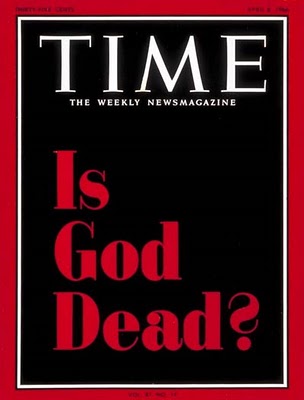
Jesus of Nazareth taught using parables. So, in the shadows of the horrors of the cross, let us turn to a parable; not one of Jesus’ parables, but a modern parable. This parable was first told in 1887. It was reprinted in 1969, in the Time Magazine that bore the iconic “Is God Dead?” cover.

“Have you not heard of that madman who lit a lantern in the bright morning hours, ran to the market-place, and cried incessantly: “I am looking for God! I am looking for God!” As many of those who did not believe in God were standing together there, he excited considerable laughter. Have you lost him, then? said one. Did he lose his way like a child? said another. Or is he hiding? Is he afraid of us? Has he gone on a voyage? or emigrated? Thus they shouted and laughed.

The madman sprang into their midst and pierced them with his glances. “Where has God gone?” he cried. “I shall tell you. We have killed him – you and I. We are his murderers. But how have we done this? How were we able to drink up the sea? Who gave us the sponge to wipe away the entire horizon? What did we do when we unchained the earth from its sun? Whither is it moving now? Whither are we moving now? Away from all suns? Are we not perpetually falling? Backward, sideward, forward, in all directions? Is there any up or down left? Are we not straying as through an infinite nothing? Do we not feel the breath of empty space? Has it not become colder? Is it not more and more night coming on all the time? Must not lanterns be lit in the morning? Do we not hear anything yet of the noise of the gravediggers who are burying God? Do we not smell anything yet of God’s decomposition? Gods too decompose. God is dead. God remains dead. And we have killed him. How shall we, murderers of all murderers, console ourselves?  That which was the holiest and mightiest of all that the world has yet possessed has bled to death under our knives. Who will wipe this blood off us? With what water could we purify ourselves? What festivals of atonement, what sacred games shall we need to invent? Is not the greatness of this deed too great for us? Must we not ourselves become gods simply to be worthy of it?  There has never been a greater deed; and whosoever shall be born after us – for the sake of this deed he shall be part of a higher history than all history hitherto.”

Here the madman fell silent and again regarded his listeners; and they too were silent and stared at him in astonishment. At last he threw his lantern to the ground, and it broke and went out. “I have come too early,” he said then; “my time has not come yet. The tremendous event is still on its way, still travelling – it has not yet reached the ears of men. Lightning and thunder require time, the light of the stars requires time, deeds require time even after they are done, before they can be seen and heard. This deed is still more distant from them than the distant stars – and yet they have done it themselves.”

It has been further related that on that same day the madman entered various churches and there sang a requiem. Led out and quietened, he is said to have retorted each time: “what are these churches now if they are not the tombs and sepulchres of God?”

This parable first printed in 1882, is known as The Parable of the Mad Man.” It was written by Friderich Nietzsche. One of the characteristics of a parable is that it surprises us with a truth that we already know. God is dead and we have killed him! Continue reading

Preparing for Maundy Thursday: When you don’t believe that Jesus was a sacrifice for sin!

MAUNDY THURSDAY SERMONS:

Click here for Two Suppers – Maundy Thursday- A Strange Night

Click here for Scuffed Up Reddish Pumps

Click here for Is This A Big Hoax?

I was asked by a colleague: “So, if you do not believe that Jesus died for your sins, then why bother celebrating the events of Holy Week?” Behind this question lies the assumption that the only way to understand Jesus’ death is to frame it within the context of the theology of “penal sacrificial atonement” ie “we are judged to be sinful creatures, punishment is required, God sends Jesus to pay the price for our sin”. That Anslem’s theory of sacrificial atonement was formulated in the 11th century and continues to hold sway in the minds of so many followers of Christ is a testament to the power of our liturgies and hymns to form our theology.  However, Anslem’s theory is not they only faithful way to understand Jesus’ death. 

When one seriously engages the question, “What kind of god would demand a blood sacrifice?” the answers often render God impotent at best and at worst cruel and vindictive. I have often said that atonement theories leave God looking like a cosmic son of #%#%# ! Progressive Christian theologians are opening up new ways of understanding the death and resurrection of Jesus that empower the faithful to see new possibilities.

To my colleague, who fears that I am leading the faithful astray, and to those who find little comfort in the theories of an 11th century monastic, I offer the following:

Jesus said, “I give you a new commandment: Love one another. And you’re to love one another the way I have loved you. This is how all will know that you’re my disciples: that you truly love one another.”

That we should love one another is not a new commandment. There have been many before Jesus and many who came after Jesus who have commanded, advised, encouraged, implored, and even begged us to, “love one another.” What is new about Jesus commandment is that we are to love one another the way that Jesus loved. Which begs the question:  How exactly did Jesus love?

I believe that Jesus loved in ways that I am only beginning to understand. I believe that Jesus was so open to the power of the LOVE that is God; that Jesus was able to live his life fully without fear.

I believe that Jesus wanted more than anything else for his followers to be so open to the power of LOVE that is God so that they too would live their lives fully without fear.

I believe that that’s what Jesus meant when he said, “I have come that you might have life and live it abundantly.”

I believe that Jesus lived life abundantly and that means that he loved abundantly and without fear.

Jesus was so open to the power of LOVE that is God that Jesus would not let the powers of darkness stop him from loving and living fully.

The kind of LOVE that Jesus embodied and taught has no boundaries.  No darkness, no power, no fear, not even death can limit the power of LOVE.

For if LOVE is limited by death, then love will always be qualified and quantified.

That Jesus was willing to LOVE without boundaries, came at great cost to himself.

But Jesus was willing to pay that price in order to show  others the way.

The way to LOVE without limit, without fear, without boundaries.

LOVE without boundaries is abundant life.

That Jesus’ LOVE endured the worst that the world could send his way, that Jesus’ LOVE was for all the world, dead and buried, and yet bursts free from the grave, bears witness to the power of LOVE.

That Jesus LOVE could not be destroyed, not even by the thing we fear the most, death itself, saves us from the need to fear death.

Jesus has shown us the way.

We can live abundantly lives that are free from the fear of death. Because Jesus has shown us the way we are free to live fully, to love extravagantly and be all that we were created to be.

LOVE shines in the darkness and darkness shall not overcome LOVE.

If Jesus, life, death, and resurrection teach us anything, surely they teach us not to be afraid.

Not to be afraid of the darkness.

Not to be afraid of living fully.

Not to be afraid of loving extravagantly.

Not to be afraid of the powers of evil.

Not to be afraid of the power of death.

LOVE will endure.

All will be well.

Jesus can’t save us from life.

There is evil to contend with.

There will be darkness and there will be death.

Jesus couldn’t save himself and he cannot save us from life. Darkness and death are part of life.  Each of us must walk into the darkness that lies before us.  We can beg God to take the cup from us!  But the darkness will still come.  And there will be days when the darkness will triumph.  There are good Fridays too many to mention out there.  We can shout all we want for Jesus to save us, but in the end we too will have to take up our cross and find a way to follow Jesus into the darkness and beyond, trusting that even though it feels for all the world that God has forsaken us, we will make it beyond the darkness.

The cross will not look the same for each of us. But there will be crosses to bear. Jesus has showed us the way. If we are to follow Jesus, then we must love one another they way that Jesus loved.  It is the way beyond the darkness. Do not be afraid of evil, of death, or of the darkness. Follow Jesus who by love frees us from the power of darkness to hold us captive to our fears so that we can have life and live it abundantly.

How exactly did Jesus love?

Without limit.

What did Jesus save us from?

Our fears.

On Palm Sunday, An Inconvenient Messiah Parades Into Our Midst

palm sundayI wrote this sermon years ago, when I’d first given up theologies which required a subscription to the notion that humans fell from grace and need a Messiah to save them. It’s funny how we cling to ideas about what it means to be human as if centuries of human evolution have no bearing on who and what we are. The illustrations in this story come from an old shoebox of clippings; they do not cite the source, but the name Ed Riegert is scribbled in the margins. Ed was my homiletics professor. He used to encourage us to keep a file of stories that we might tell. That old shoebox has long since been replaced by a hard-drive. But the shoebox still draws me back from time to time. This sermon was a first attempt to move beyond notions of atonement that paint a picture of humanity I no longer cling to. Perhaps it will be helpful to those who are beginning open themselves to a new understanding of who Jesus is.

For previous Palm Sunday sermons click here, here, or here

There was once a man who suffered from various illnesses for a very long time. This man had seen countless doctors who over the years had performed countless tests on him and had prescribed lots of medicine. But, the man’s condition did not improve. This man even tried home remedies to make himself feel better. He drank herbal teas, and took mega-doses of vitamins along with his prescriptions. But still he did not feel any better. Then one day the man heard about a doctor who was said to be an outstanding diagnostician. So the man called the doctor to make an appointment and even though the doctor was booked for months in advance the man was delighted when the receptionist managed to fit him in. As the date of his appointment drew near the man was excited by the prospect of finally getting to the bottom of his problem. At last, he would find out just what was wrong with him and in no time he was sure that this brilliant doctor whose praises were sung by one and all, this doctor would be able to cure him. The day of the appointment arrived. After the doctor had thoroughly examined the man and had reviewed his tests, she sat down with him and she said, “My friend, you are not a healthy man. But you can be well again if you will only follow my advice. What you need to do is lose about sixty pounds, get involved in a regular program of exercise, and eat more grain, fruit, and vegetables. You don’t need to take any more of the medicine that has been prescribed for you and you don’t need all those vitamin pills.” When the man heard this, he was indignant. He demanded that the doctor prescribe some new medicine for him, possibly some experimental drug not yet on the market, which would cure his illness. The doctor smiled patiently and repeated her advice. “You don’t need medicine,” she said. “You need to change your lifestyle.” The man simply cursed the doctor and stomped out of the office. For the rest of his sickly life, he told everyone that she was a quack who didn’t deserve to be called a doctor. Continue reading

Jesus Sets Us Free to Save Ourselves: a sermon for Palm Sunday – Matthew 21:1-11

palm brsIn our parish, on Palm Sunday our liturgy stays with the commemoration of Jesus’ entry into Jerusalem. Trusting that our members will join us on Good Friday, we have not adopted the practice of rushing to the Passion of Christ. This allows us time to linger over our Hosannas. Our worship began outside with the reading of Matthew 21:1-11, followed by a procession of palm waving, hosanna cheering congregation. This year I changed the first reading to the story of Jacob’s wounding during a wrestling match with God in Genesis 32:22-31, followed by an feminist interpretation of Psalm 118, and the Gospel text John 12:12-15. I am indebted to Michael Morewood’s book “Is Jesus God” for the inspiration behind this sermon and to John Dominic Crossan and Marcus Borg’s “The Last Week” for the historical details. 

For previous Palm Sunday sermons click here, here, here, or here

Hosanna! Hosanna! Hosanna! Save us! Save us! Save us! Save us from who? Save us from what? Save us for what? What is all the shouting about?

Two millennia ago, on the outskirts of Jerusalem, when Jesus mounted that donkey it was pretty clear who needed saving from who; it was clear what they needed saving from and it was fairly clear what people longed to be saved for. The people longed for freedom: freedom from the brutality of their Roman rulers, freedom from the ravages of poverty, freedom from the strict oppression of their religious authorities, and freedom from the fear of illness and death. Life among the conquered peoples of first century Palestine was cruel, oppressive, impoverished and filled with fear and suspicion. Whatever hope of deliverance there was all too often false hope. Among the oppressed there are always calls for revolution and the conquered people of first century Palestine had seen more than their fair share of wanna-be saviours.  Some of their young people had fallen prey to the incitement of the Zealots and in youthful, exuberant, impatience had taken up arms against their Roman oppressors. Some of their neighbours had betrayed their own people and taken up whatever crumbs the Romans were offering, sold their souls and become collaborators, lining their own pockets at the expense of their own people. But far too many people had given up and given in, settling for whatever life they could eke out under the cruel regime hoping against hope, that someday, someone, somehow would come along and save them from the horrors of life. And so, they longed for the good old days; The days when their people and not the Romans dominated the land, the days when one of their own was king. But not just any king, they wanted a king like David; a king who would ride at the head of their army full of pride and power and conquer all their enemies. The elders, the wise ones, pointed to the past and heralded David as a Messiah; an anointed one; anointed by God to lead the people. How they longed for such a messiah to rise up among them and lead them; lead them to victory against all their foes and save them from their miserable existence. One by one, they’d hear these wanna-be messiahs, these trumped up saviours, call the people to rise up. But they knew, with each successive saviour, there was no hope that they could triumph over the mighty Roman army and so over and over again, they hunkered down, waiting and watching, longing and hoping for the one who could save them. Continue reading

Too Often Christianity’s Cross-Eyed Perspective Distorts the Good News that God is LOVE: a sermon for the Second Sunday of Lent – Mark 8:27-38

fish necklacesThat I should serve as the pastor of a church called Holy Cross is ironic. You see for years and years, before I ever dreamed of being the pastor of a church named Holy Cross, I’ve been trying to figure out how crosses became so popular. Personally, I can’t abide crosses! I hate them! I can’t abide the glorification of an instrument of torture and death! I have never understood why crosses are worn as jewelry! People would never dream of wearing an electric chair around their neck. I cannot for the life of me, imagine that any of Jesus’ followers would have ever considered wearing the symbol of Roman tyranny and persecution around their necks.

The early followers of the way; the first Christians used the fish as the symbol of their faith. For a very long time, I used to wear a simple fish necklace that a little girl made for me. Just before I went to seminary, my friend gave me a slightly more elaborate necklace with even more fish on it. Before I was ordained, I insisted that I’d never wear a cross. But then as an ordination gift my wife Carol had her son design a cross that is made up of fish and I must admit that it’s difficult to see this fish cross as an instrument of torture. But then I read a passage like the Gospel text from Mark 8:27-38 and once again the cross becomes a symbol of torture. In this text, the gospel-storyteller we call Mark has Jesus insist that, “If any want to become my followers let them deny themselves and take up their cross an follow me.” All I can say is “Woa, wait just a minute Jesus. Take up my cross and follow you. Wait a minute; I know where you’re going. You’re on your way to Jerusalem and I know exactly what’s going to happen when you get there. You are going to stir things up, get yourself into trouble, upset the powers that be and the next thing you know they are going to nail you to the cross and you are going to suffer and die. If I pick up my cross and follow Jesus, I’m going to end up right there with Jesus, hanging from my cross, suffering and dying and for what? What’s it all about Jesus? Why are you so hell-bent on getting yourself crucified and why do you want me to join you?” Continue reading

Liturgies for Lenten Evening Prayer Inspired by the Mystics

I have been asked to re-post our Lenten Evening Prayer liturgies in one convenient spot. These have been used several times at Holy Cross, so you can listen to the audio recordings or check out the worship bulletins.

Liturgical texts and readings taken from the writings of the mystics.

Intended for use during the season of Lent.

EVENING PRAYER:  JULIAN OF NORWICH

Click here to download the Worship Bulletin which is to be printed double-sided

Click here to listen to the Worship Service

EVENING PRAYER:  THOMAS AQUINAS

2 Evening Prayer Lent which is to be printed double-sided

EP 2 Thomas Aquinas — the silences are intentional

LENTEN EVENING PRAYER: MECHTHILD OF MAGDEBURG

Evening Prayer Service Bulletin which is to be printed double-sided.

Evening Prayer Service audio – the silences are intentional – enjoy them.

LENTEN EVENING PRAYER: FRANCIS OF ASSISI

Evening Prayer Service Bulletin which is to be printed double-sided

Evening Prayer Audio – the silences are intentional.  Enjoy!

LENTEN EVENING PRAYER: HILDEGARD VON BINGEN

Evening Prayer Service Bulletin which is to be printed double-sided

Evening Prayer Audio – the silences are intentional.  Enjoy!

Parables Ancient and Modern: Lenten Evening Prayer with readings from the Orthodox Heretic

Orthodox HereticA series of Lenten Evening Prayer Services which use readings from the Parables of Jesus together with readings from Peter Rollins’ “The Orthodox Heretic and Other Impossible Tales.” Prayers are drawn from the writings of the Christian Mystics. Each service includes the worship bulletin as well as an audio recording of the service at Holy Cross Lutheran Church. 

One:  NO CONVICTION

A Copy of the worship bulletin can be found here – it is designed to be printed double-sided and folded into a booklet.

Listen to the worship service here (service begins at the 48 sec. mark)

Peter Rollins reads NO CONVICTION

Two:  Translating the Word

A copy of the worship bulletin can be found here – it is designed to be printed double-sided and folded into a booklet.

Listen to the worship service here

 Three: Great Misfortune

Evening Prayer a copy of the worship bulletin can be found here – it is designed to be printed double-sided and folded into a booklet.

Listen to the worship service here

Four: The Book of Love

 Evening Prayer a copy of the worship bulletin can be found here – it is designed to be printed double-sided and folded into a booklet.

Listen to the worship service here

Five: Betrayal

Evening Prayer a copy of the worship bulletin can be found here – it is designed to be printed double-sided and folded into a booklet.

Listen to the worship service here

Since You Asked: I Refuse to Take on Any Lenten Disciplines!

JOHN OF THE CROSS wordsIn the midst of this brutally cold winter I can find no signs that spring is around the corner. To say that it is cold outside is an understatement of epic proportions. Regardless of the challenges of this wild winter, I cannot simply retreat to the warmth of the fireside. I have places to go and people to see. By the time the driveway is shovelled, the ice is scraped, the windshield juice is topped up in my car and all the extra time it takes to navigate the roads in this weather, I can barely complete the regular tasks this busy modern life of ours demands, let alone feel guilty because I’m not adopting some contemplative spiritual exercises that harken back to a simpler time! I heard someone say, “If you are currently not experiencing any stress in your life, you should immediately lie down because it appears that you may be dead.” So, please don’t ask me to take on any Lenten disciplines!

I have also heard it said,  that in Canada the most common response to the question “How are you doing?” is the word “Busy!”. Canadians and I suspect Americans, Europeans, and most inhabitants of the so-called First World, seem to feel the need to justify our existance by assuring others that we are leading busy lives. While I am absolutely convinced that lives lived in the twenty-first century are busier than the lives of our ancestors, I’m not so sure that being busy is something we ought to be proud of.

Growing up, I remember all sorts of predictions about how life in our immediate future would be filled with so much leisure time as a direct result of the technology that would be at our fingertips. But as technology advances, our ability to work wherever and whenever the need arises has severely curtailed our leisure time. Our lives are busy and we have forgotten what it means to be human beings because most of us have become human doers. We have forgotten how to simply be.

I find it reassuring, comforting even, that our ancestors understood  our Creator as YAHWEH, which translated can be understood as “I AM WHO I AM or I SHALL BE WHO I SHALL BE. That the name of God should be understood as the verb “to be” helps me to understand myself as one who is created in the image of the great I AM and not the great I DO. I am a human being not a human doer! What I need from a season like Lent is not a prescription for more things to do. But rather, the encouragement to simply be. 

Might I suggest that we can begin this encouragement to simply be by simply greeting people with a simple word of peace. If such a greeting seems awkward to you then perhaps simply asking people how they “are” rather than how they are “doing” will suffice. Such a subtle change may not be enough for some people to refrain from telling you what or how they are “doing” and you may find them insisting that they are indeed “busy”. But a little gentle persistence may enable some to respond about their very being. Reminding one another that we are beings and not just doers might lead us toward some peace. Shalom, As-salam alaykum, Peace dear beings, Peace…..

Embracing Mortality: a reflection for Ash Wednesday

Ash Wed. 2014 MortalityReadings for Ash Wednesday click here

Bulletin for Ash Wednesday click here

You can listen to the sermon here

On Ash Wednesday we are invited to begin a journey into the mystery of our existence. Since the days long ago when the first of our kind gathered together around under the starlit sky, humans have gazed upon the stars and offered up their questions, longing to know who and what we are, where we come from, why we are here, are we alone in the universe, who made us, why are we here, and perhaps most daunting of all our questions: what will become of us. Tonight, an answer of sorts is offered. Dust.

From dust we came and to dust we shall return. Among all the creatures that inhabit creation, we humans are unique in that we alone are conscious of our own mortality. We know that we are made up of the stuff of the earth; that we sprang forth out of the dirt, the dust of the earth, the same dust that was once the stuff that stars are made of. Out of that dust we are made and when our life on this earth is over, we shall return to that dust. We are after all is said and done, mortal. The life that we know will one day end and the stuff that we are made of will be returned to the earth. We hope that out of our remains new life will spring forth and for some of us this is enough; to be part of the endless cycle of life.

For others of us, the recycling of our remains is not enough. Remembering that we are dust and to dust we shall return strikes us as bleak, and we long to be more than just the sum of our parts. We long to be more than just the stuff that is housed in our bodies. We want more than just this present incarnation of dust. We fear the inevitable decomposition of who we know ourselves to be. We can’t help wondering what lies beyond the dust that we are. Most of the time, we can keep our fears under control as the demands of our bodies to be fed, watered, and amused keep us busily scurrying to and fro, this way and that, with precious little time to spare. Day after day we avoid the questions our mortality stirs in us. From time to time, we catch sight of our aging selves in mirrors that reflect the passing of years as we journey closer to our own earthly demise. Sometimes a nagging pain, a frightening diagnosis, a sudden impact, the death of a friend, or a night like tonight reminds us that we are dust and to dust we shall return and we are forced to deny the reality of our eventual demise because it is just to frightening to contemplate; or to embrace the reality of our dustiness trusting that the Love that lies at the heart of all that is will not abandon us to the abyss of nothingness. Continue reading

LOVE Transforms: a sermon for Transfiguration Sunday

transformation

Readings include 2 Kings 2:1-14; Mark 9:2-10, Romans 8

Listen to the sermon here

The Challenges of Jesus, Confronting Evil, and ISIS – a sermon for Epiphany 5B – Mark 1:29-39

Canada ISISReadings included Mark 1:29-39: Jesus raises up Peter’s Mother-in-law, and Aleksandr Solzhenitsyn, “The Gulag Archipelago 1918-1956”

“If only it were all so simple! If only there were evil people somewhere insidiously committing evil deeds, and it were necessary only to separate them from the rest of us and destroy them. But the line dividing good and evil cuts through the heart of every human being. And who is willing to destroy a piece of his own heart?”

listen to the sermon here

https://pastordawn.com/wp-content/uploads/2015/02/epiphany_5b-feb8-2015.m4a

What the Blankety Blank? A New Authority??? a sermon for Epiphany 4B; Mark 1: 21-28

Blankety blankReadings included: Psalm 111 and Mark 1:25-28, prior to the sermon we viewed the video The Awe Factor of God which can be viewed here

Listen to the sermon here


Appealing to Young People Will NOT Save the Church! Changing National Demographics Tell Us that Youth are Not the Future of Christianity.

Blessing for New Beginnings O'Donohue pastordawn

A sermon for the Third Sunday after Epiphany. Our readings included Ecclesiastes 3:1-13, “A Blessing for New Beginnings” by John Donohue and Mark 1:14-20. Listen to the sermon here


Let Freedom Ring Through You!

Martin Luther King2

Today as our neighbours to the south celebrate the life of the Rev. Dr. King, I offer this sermon (John 1:29-42) preached last year at Holy Cross when our worship service celebrated the life and witness of Dr. King. You can listen to the audio which  includes the Acclamation, sermon and a stirring rendition of the Hymn Lift Every Voice and Sing:

Listen to the sermon below or click here:

https://pastordawn.com/wp-content/uploads/2014/01/epiphany_2a-mlk.m4a

“Darkness cannot drive out darkness; only light can do that.

Hate cannot drive out hate; only love can do that.”

During the struggle to open the Evangelical Lutheran Church in Canada to the full participation of gay, lesbian, bisexual, and transgendered people, there were some very dark days. As many of you know, during my first years in ministry, it was not a struggle that I did not want any part of.  I was for all intents and purposes living in the closet, even if it was the most transparent of closets, the walls of that closet made it very clear to me that my job would be at risk if I spoke publicly about who I am. So, in the early years, I was determined to keep my mouth shut about my own sexuality and fight the good fight from the relative safety of the background. Then by virtue of my office, I was asked to speak publicly at a forum being held by York region, mental health professionals who were gathering resources to support GLBT youth. The organizers of the forum knew that many young people suffered as a result of their family’s involvement in churches that propagated hatred toward gays and lesbians and they wanted me to speak directly to these issues so that mental health professionals might be equipped to begin to counter some of the religious propaganda that was damaging so many young people.

A few days after I spoke at this public forum a note was hand delivered to the mailbox at the parsonage. The note contained two quotes from the book of Leviticus: “Thou shalt not lie with mankind, as with womankind it is abomination” and “If a man also lie with mankind, as he lieth with a woman, both of them have committed an abomination: they shall surely be put to death; their blood shall be upon them.”

I was shaken by the quotes and even more shaken by the fact that they were hand delivered to my home. I tried to shake off my fear by telling myself that the note represented the ravings of a fool. But when I shared the note with members of the church council, I was reminded that in my world these words represented Bible quotes but in the real world they actually constituted a death threat. Continue reading

Prayer – Epiphany Sermon Series – 1: Daughter of a Sound

PrayerSermon series pastorDawnThree years ago, I reluctantly gave in to requests to preach on the subject of prayer and I devoted my sermons during the season of Epiphany to the subject of prayer.  I have been asked to re-post those sermons. In the course of three years, my theology has continued to evolve. However, I have resisted the temptation to edit the sermons and so the manuscripts are what they are, an exploration of sorts. Here’s the first. I shall repost the seven sermons in the series over the course of the Season of Epiphany.

Prayer #1 – Bath Qol – The Daughter of a Sound – preached on Baptism of Jesus Sunday 2012

Mark 1:4-11

And so John the Baptizer appeared in the desert, proclaiming a baptism of repentance for the forgiveness of sins. The whole Judean countryside and all the people of Jerusalem went out to John and were baptized by him in the Jordan River as they confessed their sins. John was clothed in camels’ hair and wore a leather belt around his waist, and he ate nothing but grasshoppers and wild honey.

In the course of his preaching, John said, ‘One more powerful than I is to come after me. I am not fit to stoop and untie his sandal strips. I have baptized you with water, but the One to come will baptize you in the Holy Spirit. It was then that Jesus came from Nazareth in Galilee and was baptized in the Jordan River by John. Immediately upon coming out of the water, Jesus saw the heavens opening and the Spirit descending on him like a dove. Then a voice came from the heavens: “You are my Beloved, my Own. On you my favor rests.”

I began the sermon by asking the congregation to sing a cappella from memory the familiar hymn: I Come to the Garden.

I come to the garden alone,

while the dew is still on the Roses;

And the voice I hear,

falling on my ear the Son of God discloses.

And he walks with me, and he talks with me,

and he tells me I am his own,

And the joy we share as we tarry there,

Non other has ever known.

He speaks and the sound of his voice

Is so sweet the birds hush their singing;

And the melody that he gave to me

Within my heart is ringing,

And he walks with me, and he talks with me,

and he tells me I am his own,

And the joy we share as we tarry there,

Non other has ever known.

I’d stay in the garden with him,

Though the night around me be falling;

But he bids me go;

Through the voice of woe

His voice to me is calling.

And he walks with me, and he talks with me,

and he tells me I am his own,

And the joy we share as we tarry there,

Non other has ever known.

The season of Epiphany begins and ends with stories of Jesus’ hearing the voice of God. In this morning’s story of Jesus’ baptism, Jesus hears the voice of God as a dove descends from the clouds. On the last Sunday of Epiphany, we will hear the story of Jesus’ transfiguration on the mountaintop when the voice of God is heard speaking from out of a cloud. Both times the voice will say essentially the same thing: “This is my beloved”

The word Epiphany is a Greek word which means “manifestation or revelation” of the divine. Over the years, the word epiphany has been used to describe those “a ha” moments in which something quite obvious is revealed. The phrase, “I saw the light” springs to mind whenever I think of the word Epiphany. I’d like to say that I associate that particular phrase with the word epiphany because, in the season of Epiphany is the season when plunged into the darkness of winter the church celebrates light. But the truth is the word epiphany makes me think of cartoons I watched as a child, when a light bulb would appear over the head of a character when the cartoon character had a bright idea. When that light-bulbs appear in cartoons, it’s a sure sign that the character is headed for trouble, because bright ideas often get us into trouble. So, you’d think I would have known better when, earlier this week a light-bulb went off and I had a bright idea that during the season of epiphany I should begin a sermon series on the subject of prayer. I mean, what better season than the season of epiphany to tackle a subject that people have been asking me to address for months now.

Ever since we set off on this grand journey of re-thinking our theology, trying to understand Christianity in the 21st century, the issue of prayer has been lurking in the background, almost haunting us. As we’ve explored ancient and mystic, understandings of the reality that we call God our cherished notions of God as a grand puppeteer in the sky who intervenes from above to change the course of history, have been challenged. As we’ve come to understand God as more than our images of God could ever even begin to capture, we have explored the possibility that God is more immediately present in with and through us. As we begin to see God’s work in the world grounded in the world, there are moments when I really miss that grand puppeteer in the sky.

It is certainly easier to talk about prayer if your talking about appealing to an other-worldly creature to fulfill your longing for a divine parent to solve all our problems. Because seriously folks, when you give up the idol that we’ve created of a god who controls all things from up in heaven, a god who listens to our prayers and then decides what is and isn’t good for us, and answers those prayers according to some grand plan he devised eons ago, in which all we are required to do is believe that whatever happens its God’s will, and we shouldn’t question but simply believe because in the end all will be revealed, well when you give up that particular image of God, the question that haunts me, and judging by the questions and comments I’ve heard from a good many of you is,

Who or what do we pray to know?
Should we pray, and how should we pray?
And more importantly who or what will answer those prayers?

Continue reading

Recognizing the Sacred: the Baptism of Jesus, Mark 1:4-11

baptism 33

Listen to the sermon here

A Progressive Christian Wades into the Waters of Baptism

baptism 33A sermon for the celebration of the Baptism of Jesus  Mark 1:4-11 

Listen to the sermon here

Wading into the waters of baptism is no simple matter for a progressive Christian. Once you leave the myth of perfection in some distant garden back there in the mists of time, reject the notion of humanity’s fall from grace as a result of original sin, and give up worshipping the sadistic image of a god who demands a blood sacrifice, it’s difficult to navigate the waters of baptism without spouting notions that the institutional church condemns as heresy. But today is the day when the church celebrates the baptism of Jesus and the stories about the baptism of Jesus that have been handed down to us by our ancestors suggest that on this day of all days, we should have the courage to follow Jesus into the river of life even if it does challenge some of our long held assumptions about what it means to be a child of God.

I venture into these troubled waters as someone who treasures the sacrament of baptism. Long before I ever entertained the idea that I might one day respond to the call to become a baptizer, I became a lover of this particular sacrament of the church. I am now, and I have always been one of those people who find it almost impossible not to shed a tear or two at baptisms. The beauty of all that hope and expectation all wrapped up in the guise of a tiny little human has a way of generating in me a watery contribution as my tears join the sprinkling to wet the babies head. When the baptized is an adult my tears flow even more bountifully. Let’s face it folks these days the reality is that infant baptisms are rare enough. Adult baptisms, especially in mainline churches are so rare that the nostalgia alone is enough to send us into spasms of uncontrollable weeping for seer joy at the thought that it is even remotely possible that someone has been able to see beyond the church’s doctrine long enough to embrace the amazing possibilities of the sacrament to provide any benefit in this the twenty-first century.

When we look back to the stories told in the synoptic gospels about the baptism of Jesus we are sometimes so distracted by the opening of the heavens, the descent of the dove and the voice of God declaring Jesus to be the beloved, that we miss an important detail of the way in which the early followers of the Way chose to tell the story of Jesus public coming out party. New Testament scholars remind us that the stories told by the writers of the gospels were written at the end of the first century; a time when it would have been clear to all those who had ears to hear, that by going down to the river Jordan to be baptized by John would have stirred up the political and religious waters. John the Baptist was a revolutionary who made no bones about the fact that the religious authorities and the political rulers were leading the people down the wrong path. John’s shouting in the wilderness was his way of warning the people to repent; to literally turn around and follow a different path. John was doing far more than ranting when he condemned the religious authorities as a brood of vipers; he was calling on the people to reject the teachings of the authorities. John’s insistence on repentance was a call to revolution, a revolution designed to overthrow  the status quo. John was out there in the wilderness because it wasn’t safe for him to spout his own particular brand of incendiary fire and brimstone rhetoric within earshot of the authorities. By going down to the River Jordon and submitting to John’s baptism of repentance Jesus was choosing to identify himself with a political revolutionary.

That the writers of the gospels chose to tell there story in ways that see the God of Israel give Jesus a shout out, and the very spirit of God descending like a dove onto the shoulders of Jesus, turns John’s baptism of repentance into a kind of passing of the torch from one revolutionary to the next. Yet, despite the gospel-writers having cast Jesus into the role of revolutionary torchbearer none of the gospel writers shows Jesus following the ways of his predecessor John. There is no record of Jesus calling people to repent nor is there any record of Jesus ever having baptized anyone. All we have is Jesus “Great Commission” which if New Testament scholars are to be believed, Jesus probably never even said, “go therefore and baptize them in the name of the Father and of the Son and of the Holy Spirit.” Yes, it’s true, most preachers, dare I say modern-day baptizers, learned in seminary that rather than being an instruction given by Jesus the Great Commission was actually added to the story by the early followers of Jesus. But I digress, the point I’d like to emphasize about Jesus’ trip down to the waters of the Jordan, is that by choosing to publicly submit to John’s baptism, Jesus was making an important statement about his own public ministry. For just like John, Jesus intended to challenge the religious and political authorities. Continue reading

Wisdom Seeks Wisdom – an Epiphany sermon for the Second Sunday of Christmas – Matthew 2:1-12


Thomas 70 pastordawn

The readings included John 1:1-9; the Gospel of Thomas 70, and Matthew 2:1-12

You can listen to the sermon here


A Blessing for the New Year (John O’Donohue)

The art of blessing is often neglected. The birth of a New Year calls forth the desire in us to bestow a blessing upon those we love. Several years ago, John O”Donohue, one of my favorite Irish poet’s created a New Year’s blessing for his mother entitled Beannacht-for Josie. It is a blessing of superior quality. And so, on this New Year’s Eve, may you all receive this beannacht with my added blessing for a peace-filled New Year in which the God in whom all of creation is held, might find full expression in your miraculous life! 

Beannacht John O'Donohue pastorDawn.pages

Don’t Forget the Mystery of Our Faith – an Epiphany sermon

Thomas 70 pastordawnA sermon preached on the Second Sunday after Christmas – the readings for this sermon include: John 1:1-9, The Gospel of Thomas 70; Matthew 2:1-12. You can listen to the sermon here

Two cars were waiting at a stoplight.  The light turned green, but the man didn’t notice it.  A woman in the car behind him was watching traffic pass around them. The woman began pounding on her steering wheel and yelling at the man to move.  The man didn’t move. The woman started to go ballistic inside her car; she ranted and raved at the man, pounding on her steering wheel. The light turned yellow. The woman began to blow her car horn; she flipped off the man, and screamed curses at him. The man, hearing the commotion, looked up, saw the yellow light and accelerated through the intersection just as the light turned red. The woman was beside herself, screaming in frustration because she missed her chance to get through the intersection. As she is still in mid-rant she hears a tap on her window and looks up into the barrel of a gun held by a very serious looking policeman. The policeman tells her to shut off her car while keeping both hands in sight.  She complies, speechless at what is happening. After she shuts off the engine, the policeman orders her to exit her car with her hands up.  She gets out of the car and he orders her to turn and place her hands on her car. She turns, places her hands on the car roof and quickly is cuffed and hustled into the patrol car.  She is too bewildered by the chain of events to ask any questions and is driven to the police station where she is fingerprinted, photographed, searched, booked, and placed in a cell.

After a couple of hours, a policeman approaches the cell and opens the door for her.  She is escorted back to the booking desk where the original officer is waiting with her personal effects.  He hands her the bag containing her things, and says, “I’m really sorry for this mistake.  But you see, I pulled up behind your car while you were blowing your horn, flipping that guy off, and cussing a blue streak at the car in front of you, and then I noticed the  “What Would Jesus Do” and “Follow Me to Sunday School” bumper stickers, and the chrome plated Christian fish emblem on the trunk, so naturally I assumed that you had stolen the car.”

We can scoff at this, but I must tell you that one of the things I had to learn when I first began to wear a clergy collar was that I could no longer give people the finger when I was driving. If you give people the finger when you are driving, it’s not you giving that person the finger but the whole of Christian Church; people will use your outburst to condemn the hypocrisy of the entire church.

During Advent we used a question from Meister Eckhart not once but twice during each of our worship services: “What good is it to me if Mary gave birth to Christ twenty centuries ago and I don’t give birth to Christ in my person and my culture and my times?” And now, in this the last day of Christmas, I find myself wondering what it actually means for Christ to be born in me or in you. Continue reading