We Are ONE: Deep Within the MYSTERY We Call GOD

we-are-oneReadings: Ephesians 4:1-6; 1Corinthians 12:12-27; Acts 17:22-29

Between the readings we were treated to a performance of Neil Bertram’s  “Theory of Relativity” performed by Amelia DePiero, Rachel Miller, Linda Condy, Gary Curran, and Kyle Merrithew, accompanied by Marney Curran. This dynamic piece set the tone for the sermon’s exploration of MYSTERY.

Listen to the sermon Here

Theory of Relativity by Neil Bertram – lyrics

“There is one body and one Spirit,” “The body is one,” “God is the One who gives everyone life, breath-everything.” These words attributed to the Apostle Paul in the New Testament echo an even more ancient notion of Oneness. For thousands and thousands of years, in various cultures and religions, humans have shared an intuitive sense of oneness. Indeed, it could be said that this innate notion that our individual stories are part of something bigger than ourselves lives in each one of us.

My own relationship with this idea of “Oneness” with all that is and ever shall be dates back not to the bible, but rather to some old Trixie Belden mysteries. As a little girl, I remember devouring Trixie Belden mysteries. Trixie Belden, Nancy Drew, and even the Hardy Boys gave way to Agatha Christie mysteries, followed by Sir Arthur Conan Doyle’s Sherlock Holmes mysteries, giving way to John la Carre mysteries of international intrigue. You just can’t beat a good P.D. James murder mystery.  These days I don’t have a lot of time for mystery novels so I satisfy my lust for mystery with great British TV dramas. American TV mysteries tend to be too easy to solve. Nobody does murder like the Brits, so whether it’s Midsummer Murders, Broadchurch, Inspector Morse, Wallander, or the latest incarnation of Sherlock, count me in. I like nothing better than a TV mystery that you can’t figure out until the last few minutes of the show when all is revealed. Clever, ingenious, solutions, to devious mysteries that keep you guessing, lead you up various garden paths, and delight you with one wrong turn after another, only to dumbfound you with the final reveal; now that’s entertainment. Continue reading

The Power of Love: a sermon for Epiphany 7A – Matthew 5:38-48

love enemies erlander

This sermon is a departure from my usual style; a teaching sermon, working without a manuscript. Using Keynote various images where projected to assist in setting the context for Jesus teaching on non-violent resistance. My a reflection on the creative and transformational power of love explores the tactics of empires that dehumanize enemies. The two video presentations in the Keynote point to the power of seeing the humanity of our enemies. The audio of the sermon is included below as is the Keynote that accompanied it.

The ideas in this teaching sermon were developed into a sermon on the text that was preached on Remembrance Day and can be read here

Listen to the teaching sermon: 

vimeo 9761188 w=600&h=337]

[vimeo 64250360 w=600&h=337]

We Have Enemies, And So, We Pray: a sermon for Epiphany 7A on Matthew 5:38-48

NowSince I was thirteen years old, I have borne the mark of my enemy. It’s faded quite a bit over the years, but if I look carefully I can still make out the marks left behind by, let’s call her, Betty Cherie’s teeth.  Way back in the eighth grade Betty Cherie and I fell afoul of one another. I don’t really remember what it was that started the whole thing.  It was one of those grudges that only thirteen-year-old girls can hold onto with any kind of tenacity. All I can remember is that Betty Cherie and I hated each other and the whole school knew it.

One afternoon our rivalry reached the point of war. I still cringe when I remember it. After all I was thirteen and I should have known better. I’d like to say that she started it. But, I honestly don’t remember how we got ourselves to the point were we were to meet each other in the playground to fight it out. Our adolescent duel took place in full view of the student body. We met at high noon, out behind the portables, out of sight from the teachers. It began with two sworn enemies pushing each other around. There was some hair pulling, I think I even got in a punch or two before she bit me. Continue reading

D.I.V.O.R.C.E. – Tammy Wynette and googling biblical texts? – a sermon for Epiphany 6A

Aquinas purposeReadings included: Deuteronomy 30:15-20, Thomas Aquinas’ “Otherwise the Darkness’ (pictured above) and from the Sermon on the Mount: Matthew 5:21-37 

Listen to the sermon:  

I must confess to you all, right here and right now, that I thought I was so clever a few weeks ago when I decided in my ever so finite wisdom that we should spend the season of Epiphany delving into Jesus’ Sermon on the Mount. Sure, Jesus never actually preached the Sermon on the Mount, but it does represent a first century distillation of the teachings of Jesus. Whoever it was who wrote the Gospel according to Matthew put together a compilation of Jesus greatest hits and the Sermon on the Mount represents the teaching that Jesus died for. The Sermon on the Mount is the very heart of who Jesus of Nazareth was and so those of us who seek to follow Jesus in the 21st century ought to at the very least know what’s in these passages of scripture. So, I told you all that we’d take advantage of this unusually long Epiphany season to work our way through Jesus’ Sermon on the Mount. Apart from the Beatitudes which function as the introduction of the sermon, these passages of scripture rarely come up in our three-year lectionary cycle of gospel readings. I thought I was so smart when I came up with this idea. For the most part, I’ve enjoyed the challenge of the past five weeks of preaching on Jesus’ teachings. Well, Monday morning I got my comeuppance. Clearly, I’d forgotten all about today’s reading when I came up with this ingenious plan. Mondays are my day off, but sometimes I sneak into my office just to get the wheels in motion. I did a double take when I read these verses. I didn’t come out of my office for a couple of hours.

What was I thinking? But I told myself not to panic. If I stayed calm, I’d find a way through this mess. So, I picked some lovely hymns, thinking if nothing else Marney could lead us in some beautiful singing and you might forgive me for dragging us all into the hell fire and damnation that I was pretty sure these texts were going to take us to.

Tuesday morning, I thought I’d better check hat other preachers have said about these texts. Well, apart from some pretty conservative preachers, it was pretty slim pickings. Liberal and progressive preachers tend to leave these texts alone; most of the commentaries lead you back to the first reading from Deuteronomy and suggest sermons on the value of choosing life.  Most Lutheran resources suggest the preacher fall upon God’s grace as the only solution; and Lord knows a few years ago, I might have taken that option…back when I still believed that we were all fallen sinners in need of God’s unmerited grace to save us from the punishment due to us under the law. But I’ve moved so far away from the doctrines of original sin and atonement theories that this particular option although appealing would sound somewhat hallow coming from me. So, even though I suspected that in the end, I’d fall back on grace, it couldn’t be the kind of grace that gets handed out by some super gracious, super-natural being up there in the sky. So, I began wondering what a progressive does with this text once we’ve located grace not in the hands of a super-natural being, but as a quality that permeates creation. Well it was clear that most of the progressives I was consulting just avoided the problem of these texts altogether. So, I consulted a few of my progressive colleagues around the world to see if they could help. But most of them had seen this one coming and had opted for the second option for the gospel reading for this the sixth Sunday after the Epiphany and they are preaching on  a relatively tricky piece from the Gospel according to John and have enough problems of their own. One colleague, who no longer uses the prescribed readings, just laughed at me for not seeing this text coming while there was till time to do something about it. Needless to say, I didn’t get much sleep on Tuesday night. Visions of the fires of Gehenna danced through my head as I argued with Jesus. By Wednesday, I was feeling desperate. Continue reading

Jesus, Gandhi, and MLK – A Very Salty Trio: a sermon for Epiphany 5A

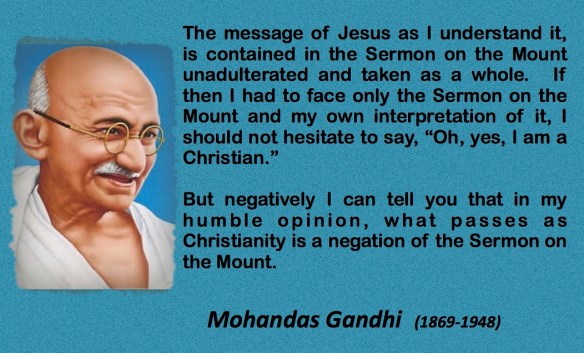
Gandhi on Sermon on the Mt copy

Rereading this sermon from 2014, I am struck by the power of Jesus, Gandhi, and MLK’s saltiness to address our current need for seasoning! In the wake of the tragedy at the Islamic Cultural Centre in Quebec City and 45’s racist travel ban, we must heed Jesus call to be salt! Sunday’s readings included Matthew 5:1-12, “What Jesus Means to Me by Mahatma Gandhi (found here) and Matthew 5:13-16. The full text of the Sermon by Dr. Martin Luther King Jr. can be found here. 

Listen to the sermon here:

Like most people my age, I remember the days when families had only one television set and when I was just a kid, it was a black and white television. When I was eleven or twelve, we got one of those new-fangled colour TV sets. Back then kids functioned as remote controls; Mom and Dad decided what we watched. How else would I have seen all those grainy black and white documentaries? My parents were hooked on history and as a result my brother and I were introduced to some pretty incredible characters by way of those old grainy black and white films Many of the documentaries were about the majesty of the British Empire that dominated much of the world in those old grainy days. I can still remember being impressed by a little man, wearing what looked like a diaper and causing quite a commotion wandering around Britain and talking about home rule. I remember how excited my father was when the film showed this little fellow Gandhi talking to some striking Welsh miners, encouraging them in their fight against the mine-owners. It was the beginning of a long love affair with a giant of a man.

Back then, I loved reading biographies so the next time I was in the library I picked up three biographies about Gandhi and I’ve continued to read and watch whatever I can get my hands on about the life and teachings of Mohandis K. Gandhi. It was reading about Gandhi that caused me to take my first serious look at Jesus’ Sermon on the Mount. Up until then, I didn’t know much about the teachings of Jesus. We didn’t go to church, so what I knew about Jesus I’d picked up by osmosis; growing up in a Christian culture meant, I knew who Jesus was, but very little of what he taught. But reading about Gandhi, I discovered just how much of an influence Jesus had been on Gandhi’s philosophy of non-violence. I knew that Gandhi’s methods had brought the British Empire to its knees, so I began to wonder about Jesus’ methods. You’ve got to remember when I was a kid, the Vietnam war was raging and the world was under constant threat of mutual annihilation as the American and Soviet empires threatened to blow us all into oblivion. Non-violence was more than just an intriguing idea; back then non-violence sounded like a life-line.

And so it was, that my interest in the life and teachings of a non-violent revolutionary from India, sent me scurrying to find the little Bible that I’d received as a gift from the Gideons when I was in grade five so that I could read Jesus’ sermon on the mount. I’d read that Gandhi had said that, if all he knew of Christianity was the Sermon on the Mount he himself would be a Christian. I had been told that we were Christians, but other than Christmas and Easter, I had no real evidence of my Christianity.

It has been said that Gandhi read both the Sermon on the Mount and Chapter Two of the Bhagavad Gita every day. He is reported to have said that “Much of what passes for Christianity today is a negation of the sermon on the Mount.” Gandhi asked, “Isn’t it is more important to do what Jesus wants us to do than to call him “Lord, Lord?”

As a faithful Hindu, Gandhi was unwilling to accept Christian dogma, but in Jesus, Gandhi recognized a great prophet; a prophet who pointed beyond himself to a world in which non-violence was more than just a dream, non-violence was necessary in order that men and women could live together in peace in order that they might live in union with God. In the teachings of Jesus, Gandhi discovered something that those of us who claim to be followers of Jesus so often miss or deny. The church, the very institution that Jesus’ teachings gave rise to, has for centuries left the salt out of Jesus’ teachings and offered up a flavorless dogmatic dish aimed at pleasing the palates of the powers of Empire to which it has been tied for centuries. As a result, the followers of Jesus all too often forget Jesus call to be the salt of the earth. Sometimes it takes a stranger to remind us of the treasures we possess. Continue reading

The Beatitudes and the Power of One: a sermon for Epiphany 4A – Matthew 5:1-12

sad EckhartMost us us have heard the words from Matthew 5, known as the Beatitudes, so many times that we can recite them from memory. Indeed, the Beatitudes are at the very core of our Christian tradition. But there is a danger in our familiarity with these words because it allows us to distance ourselves from them as we relegate them to some idealized notion of some unattainable goal.

I have studied these words many times and I do not believe that Jesus intended these words to become a prescription for how to be a better Christian. So, I won’t be encouraging anyone to be poor in spirit, to mourn, or to be meek in the hope that they might gain the kindom of heaven, or be comforted, or inherit the earth. While hungering and thirsting for righteousness is in and of itself a good thing, along with being merciful, pure of heart, and peace-making, all of which I heartily encourage. However, these attributes or beatitudes are not a prescription for holiness or wholeness.

So, if Jesus wasn’t prescribing the beatitudes from atop the mountain, what was he doing? Well, there’s an old storytellers’ ploy that I’d suggest in order to better understand Jesus words. The ploy doesn’t have a name, but most of us are very familiar with the trick. It’s the one where you tell an unfamiliar story alongside of a very familiar story in the hope that the unfamiliar story will help to shed some new light on the words of the familiar story. The unfamiliar story is taken from Bryce Courtenay’s autobiographical novel “The Power of One.” The Power of One was are into a movie about twenty years ago, so the story may be somewhat familiar. Continue reading

Following Prostitutes and Christ – a sermon for Epiphany 3A – Matthew 4:12-23

Vancouver's east endWhen I was in my early twenties, I grew weary of sharing space and I decided that I wanted an apartment all to myself, despite the fact that I couldn’t really afford an apartment all to myself. But I was determined and that’s how I ended up living in a very rough neighborhood in the east end of Vancouver. My parents weren’t’ very happy about the neighbourhood and worried about the unsavory characters that lived in the run-down building where I found a spacious one bedroom apartment that I could just about afford. The apartment was just a couple of blocks away from the office where I worked, so I was able to walk to work. I ignored all the warnings of my family and friends and I convinced myself that I could handle anything that came my way.

In my heart of hearts I was rather pleased to be living in such a poor rough and tumble neighbourhood. I was young and foolish and the neighbourhood was exciting. Every Sunday I would make the trip back to my home church in the suburbs. Sometimes I would make a second trip out during the week to attend a Bible study. Like so many young people, I was harsh in my criticisms of the elaborate life-styles of my elders. At bible studies, I was always bringing up the plight of the poor and the oppressed and challenging people to do something. Various members of my own family often accused me of being a bleeding heart liberal. I wore their criticism with a certain amount of pride, convinced that I was living out my beliefs.

Although I walked to work each day, I didn’t know any of my neighbours, until one morning I was surprised by a knock on my apartment door. I wondered how anyone would get past the lock on the front door. So, I peered through the peephole and was relieved when I saw a young woman at my door. I unbolted the door and in swept Brenda. Brenda was all smiles and laughter as she explained that she and her roommates were out of coffee and she wondered if I might be able to lend them some coffee.  When I explained that I had just used up the last of my coffee making my own morning brew, Brenda told me not to worry, she and her roommates would be happy to join me. When Brenda returned, she introduced her roommates, Janice and Sue and we all sat down together for our morning coffee. Continue reading

It’s not about a messiah, it is about each one of us working together to overcome the things that separate us! – a sermon on the birthday of The Rev. Dr. Martin Luther King

king-copy

First Lesson: “I Have Been to the Mountaintop” – Martin Luther King – here

Second Lesson:  From “Love Your Enemies” – Martin Luther King- here

Gospel – John 1:29-42

Listen to the sermon here

Let Freedom Ring Through You! Celebrate the life and witness of the Rev. Dr. Martin Luther King, Jr.

Martin Luther King2

Monday is Martin Luther King Day, Friday our American neighbours will inaugurate the man who will occupy the most powerful office on the planet. In many ways, this new president appears to represent so much of what Dr. King struggled to overcome. So this year, it seems more important than ever to lift every voice and sing the praise of all those who bear witness to the kind of justice that Jesus of Nazareth embodied. 

Epiphany 2A; John 1:29-42 Jan.19, 2014.  A sermon in celebration of the life and witness of the Rev. Dr. Martin Luther King, Jr.

The audio includes the Acclamation, sermon and Hymn of the Day:

Listen to the sermon:

https://pastordawn.com/wp-content/uploads/2014/01/epiphany_2a-mlk.m4a

“Darkness cannot drive out darkness; only light can do that. Hate cannot drive out hate; only love can do that.” During the struggle to open the Evangelical Lutheran Church in Canada to the full participation of gay, lesbian, bisexual, and transgendered people, there were some very dark days. As many of you know, during my first years in ministry, it was a struggle that I did not want any part of.  I was for all intents and purposes living in the closet, even if it was the most transparent of closets, the walls of that closet made it very clear to me that my job would be at risk if I spoke publicly about who I am. So, in the early years, I was determined to keep my mouth shut about my own sexuality and fight the good fight from the relative safety of the background. Then, by virtue of my office, I was asked to speak publicly at a forum being held by York region, mental health professionals who were gathering resources to support GLBT youth. The organizers of the forum knew that many young people suffered because of their family’s involvement in churches that propagated hatred toward gays and lesbians and they wanted me to speak directly to these issues so that mental health professionals might be equipped to begin to counter some of the religious propaganda that was damaging so many young people. A few days after I spoke at this public forum a note was hand delivered to the mailbox at the parsonage. The note contained two quotes from the book of Leviticus: “Thou shalt not lie with mankind, as with womankind it is abomination” and “If a man also lie with mankind, as he lieth with a woman, both of them have committed an abomination: they shall surely be put to death; their blood shall be upon them.”

I was shaken by the quotes and even more shaken by the fact that they were hand delivered to my home. I tried to shake off my fear by telling myself that the note represented the ravings of a fool. But when I shared the note with members of the church council, I was reminded that in my world these words represented Bible quotes but in the real world they constituted a death threat.

I confess that at the moment, I realized that violence might actually be a consequence of my speech, I beat a hasty retreat back into my closet. I was determined to stay within the relative safety of the cozy, obscure little world in which Lutheran pastors usually live out our ministries. But calls kept coming in for help. So, I ventured out of the closet and mail continued to come in spouting hatred and suggesting violence as a very real possibility. There were some very dark days and even darker nights and from time to time I was sorely tempted to return in kind some of the hatred that was coming my way. One of you, I don’t know who, although I do have my suspicions placed a note in my church mailbox, right over there. The note contained these words of Dr. Martin Luther King, Jr. “Darkness cannot drive out darkness; only light can do that. Hate cannot drive out hate; only love can do that.” Let me just tell you, that those words stopped me on more than one occasion from lashing out in anger and on several occasions those words helped me to remember that I am called to love; love not only when it is easy or convenient, but to love in the face of hatred.

Now our struggle was not nearly as difficult as the struggles of others. I would not for a moment even begin to suggest that we have tasted the kind of hatred or been subjected to the kind of violence that was faced by the freedom fighters who achieved so much under the leadership of Dr. Martin Luther King. I do however know very clearly that we drew our inspiration from their struggles. The life and witness of the Reverend Dr. Martin Luther King, Jr. inspired and continues to inspire millions of people to seek justice, to stand up for freedom and to love in the face of hate.  Dr. King is more than just an inspiration to justice seekers and peacemakers, he is an example of what it means to impact the evolution of our species.  Humans are better beings as a result of the many ways in which Dr. King changed the way we interact with one another. Creation is not the same as a result of the life and witness of Dr. King. Continue reading

Jesus, the Lamb of God Who Takes Away the Sin of the World? It ain’t necessarily so! (a sermon for Epiphany 2A – John 1:29-42)

Lamb of GodI am indebted to John Shelby Spong for giving me the words to articulate my own objections to the label attached to Jesus by a late first century writer also known as John. Most if not all of this sermon is derived from Jack Spong’s work. For more details I would refer you to Jesus for the Non-Religious and The Fourth Gospel: Tales of a Jewish Mystic. We at Holy Cross were privileged to have Jack speak to us about both of these books. In fact a year before it was published, Holy Cross was the test audience for the material in The Fourth Gospel: Tales of a Jewish Mystic. This sermon ought to have all sorts of footnotes, but I trust you will forgive me for simply confessing that I can no longer tell were Jack leaves off and I begin. Suffice it to say that this sermon is my feeble attempt to put Jack’s work into the form of a sermon.

When I turn the gospel according to John and read about John the Baptist pointing to Jesus, saying:  “Here is the Lamb of God who takes away the sin of the world!”  I want to scream,  “NO!” I have come to believe that our images of God are far too narrow. As far as I’m concerned most of our ideas about God fall far short of every even beginning to describe who God might be. One thing I’m absolutely certain of is if we can imagine ourselves being more loving, more gracious, or more merciful that our theology suggests that God is, then we had better go back to the drawing-board and think again. The ways in which we have traditionally interpreted the life, death and resurrection of Jesus the Christ, paint a picture of a God who is far less loving, gracious or merciful than you or I. Nobody in this room, would demand a blood sacrifice of a lamb, let alone the blood sacrifice of their own child. So, the image of God that is based on this kind of theology must be judged as inadequate to the task of evening beginning to provide us with a glimpse of who our God is.

As we go back to the drawing-board, we ought to take a long hard look at how we arrived at this image in the first place. Thank goodness for the work of our friend Jack Spong who has enabled us to see beyond the literal to the more-than-literal meanings of the various ways in which the followers of Jesus have understood the life and teachings of Jesus. During the years that followed the crucifixion, Jesus’ followers were left wondering what it was all about. How could someone in whom they had seen the fullness of God, be taken from them in such a horrendous way? How could their God allow it?   What were they to do? Over the years that followed, Jesus’ followers looked back at the life, death, and resurrection of Christ through the lens of their own religious experiences. Jesus’ followers were primarily Jewish and so it didn’t take long for the familiar Jewish symbol of the Lamb of God to be applied to Jesus as a way of making some sense out of his death.  Today most Christians associate the symbol of the Lamb of God with the Jewish celebration of Passover.  While the Gospel narratives do indeed locate the time of Jesus death during the celebration of the Passover, and there is indeed a sacrificial lamb involved in the Passover, the actual phrase “the Lamb of God” comes not from the religious rites of Passover, but rather the religious rites of Yom Kippur: The Day of Atonement.  Phrases like “the Lamb of God”, “died for our sins” and “washed in the blood of the lamb” can all be found in the religious rites of Yom Kippur.  Continue reading

A Progressive Christian Wades into the Waters of Baptism

baptism 33A sermon for the celebration of the Baptism of Jesus – Matthew 3:13-17

Listen to the sermon here

Wading into the waters of baptism is no simple matter for a progressive Christian. Once you leave the myth of perfection in some distant garden back there in the mists of time, reject the notion of humanity’s fall from grace as a result of original sin, and give up worshipping the sadistic image of a god who demands a blood sacrifice, it’s difficult to navigate the waters of baptism without spouting notions that the institutional church condemns as heresy. But today is the day when the church celebrates the baptism of Jesus and the stories about the baptism of Jesus that have been handed down to us by our ancestors suggest that on this day of all days, we should have the courage to follow Jesus into the river of life even if it does challenge some of our long held assumptions about what it means to be a child of God.

I venture into these troubled waters as someone who treasures the sacrament of baptism. Long before I ever entertained the idea that I might one day respond to the call to become a baptizer, I became a lover of this particular sacrament of the church. I am now, and I have always been one of those people who find it almost impossible not to shed a tear or two at baptisms. The beauty of all that hope and expectation all wrapped up in the guise of a tiny little human has a way of generating in me a watery contribution as my tears join the sprinkling to wet the babies head. When the baptized is an adult my tears flow even more bountifully. Let’s face it folks these days the reality is that infant baptisms are rare enough. Adult baptisms, especially in mainline churches are so rare that the nostalgia alone is enough to send us into spasms of uncontrollable weeping for seer joy at the thought that it is even remotely possible that someone has been able to see beyond the church’s doctrine long enough to embrace the amazing possibilities of the sacrament to provide any benefit in this the twenty-first century.

When we look back to the stories told in the synoptic gospels about the baptism of Jesus we are sometimes so distracted by the opening of the heavens, the descent of the dove and the voice of God declaring Jesus to be the beloved, that we miss an important detail of the way in which the early followers of the Way chose to tell the story of Jesus public coming out party. New Testament scholars remind us that the stories told by the writers of the gospels were written at the end of the first century; a time when it would have been clear to all those who had ears to hear, that by going down to the river Jordan to be baptized by John would have stirred up the political and religious waters. John the Baptist was a revolutionary who made no bones about the fact that the religious authorities and the political rulers were leading the people down the wrong path. John’s shouting in the wilderness was his way of warning the people to repent; to literally turn around and follow a different path. John was doing far more than ranting when he condemned the religious authorities as a brood of vipers; he was calling on the people to reject the teachings of the authorities. John’s insistence on repentance was a call to revolution, a revolution designed to overthrow  the status quo. John was out there in the wilderness because it wasn’t safe for him to spout his own particular brand of incendiary fire and brimstone rhetoric within earshot of the authorities. By going down to the River Jordon and submitting to John’s baptism of repentance Jesus was choosing to identify himself with a political revolutionary.

That the writers of the gospels chose to tell there story in ways that see the God of Israel give Jesus a shout out, and the very spirit of God descending like a dove onto the shoulders of Jesus, turns John’s baptism of repentance into a kind of passing of the torch from one revolutionary to the next. Yet, despite the gospel-writers having cast Jesus into the role of revolutionary torchbearer none of the gospel writers shows Jesus following the ways of his predecessor John. There is no record of Jesus calling people to repent nor is there any record of Jesus ever having baptized anyone. All we have is Jesus “Great Commission” which if New Testament scholars are to be believed, Jesus probably never even said, “go therefore and baptize them in the name of the Father and of the Son and of the Holy Spirit.” Yes, it’s true, most preachers, dare I say modern-day baptizers, learned in seminary that rather than being an instruction given by Jesus the Great Commission was actually added to the story by the early followers of Jesus. But I digress, the point I’d like to emphasize about Jesus’ trip down to the waters of the Jordan, is that by choosing to publicly submit to John’s baptism, Jesus was making an important statement about his own public ministry. For just like John, Jesus intended to challenge the religious and political authorities.

That the gospel writers have Jesus head off into the wilderness to find his own way prepares us to follow Jesus down a completely different path than the one his predecessor John pointed toward.

So on a day, when the church looks back upon the baptism of Jesus, surely we can take courage from Jesus’ example of wandering off into the wilderness to find our own way of challenging the religious authorities of our day. Continue reading

A Blessing for the New Year (John O’Donohue)

The art of blessing is often neglected. The birth of a New Year calls forth the desire in us to bestow a blessing upon those we love. Several years ago, John O”Donohue, one of my favorite Irish poet’s created a New Year’s blessing for his mother entitled Beannacht-for Josie. It is a blessing of superior quality. And so, on this New Year’s Eve, may you all receive this beannacht with my added blessing for a peace-filled New Year in which the God in whom all of creation is held, might find full expression in your miraculous life! 

Beannacht John O'Donohue pastorDawn.pages

Christ is Born In You – Christmas Eve sermon

christmas-eve-2016Merry Christmas one and ALL!!! Here’s the Christmas Eve sermon based on the Gospel readings from Luke 1:26-38; 1:39-55; 2:1-20. I cannot remember where I first heard the story I tell in the sermon. I suspect it is from some sermon I heard long ago because the outline is on a fading piece of foolscap in my barely legible handwriting. I did a quick search and could only discover the was a version of the story in a sermon by Janis B. Scott who does not site her source. My retelling/elaboration of the story is, I hope, a reflection of the MYSTERY that is once again born on this holy night.

Listen to the sermon here

The Birth of Jesus Is Not Very Original, Just a Birth Story Fit For An Ancient Hero

star-eastSome have said that the birth of Jesus is the most amazing birth story ever told. Jesus birth narrative heralded the arrival of a child who was praised as the Son of God, the Saviour of the World who was said to be the personification of peace on earth; God incarnate; fully divine and fully human. Not everyone agrees that this is the most amazing birth story ever told. Indeed, the story of Jesus birth can’t even claim to be unique.  Some claim that Jesus’ birth story is just one of a long line of birth stories. Jesus’ birth story, some claim, is only considered to be unique because it’s our story; a story we tell over and over at the expense of other birth stories that are just as great. Well it’s really not all that difficult to Google  “greatest birth story ever told”, select one or two of the greats and put them together to expose Jesus’ birth story as one in a line of ancient birth stories. Allow me to demonstrate.

Among the ancients, some insisted that the story Alexander the Great’s birth was weladat-alexander-mathaf-beirut
the greatest story every told. Alexander the Great’s birth story is truly one of the greats. He was, after all the, son of a Queen and a god and a king. His mother, Olympias was a Queen, betrothed to Philip of Macedonia. The night before they were married, Queen Olympias dreamed that a thunderbolt fell upon her body, which kindled a great fire, whose divided flames dispersed themselves all around her, and then as if by magic they were extinguished. Philip dreamed that he sealed up his Queen’s lady parts with a seal, which bore the impression of a lion. The high priests who interpreted the dream warned Philip not to even entertain the idea of consummating the marriage because one wouldn’t go to the trouble of sealing up something that was empty. So Queen Olympias must already be with child, who would undoubtedly be a boy with the courage of a lion. If that wasn’t enough to put Philip off he found a serpent lying beside Queen Olympias as se slept, which was said to have abated his passion. Later the oracle of Apollo at Delphi went on to explain that this was no ordinary serpent, no this was the incarnation of the God Zeus. The day that Alexander the Great was born, one of the Seven Wonders of the World burnt to the ground. The temple of the goddess Artemis in Ephesus was the home of the Goddess Artemis who was said to have been attending to the birth of Alexander at the time. Alexander the Great was heralded as the Son of God and Saviour of the World and as one of the greatest warriors the world has ever known, he went on to conquer a good portion of the planet. Continue reading

Like All Myths, the Stories of Jesus’ Birth are True for Myths Only Become Untrue When they are Presented as Facts – a sermon for the Fourth Sunday in Advent

refugee-nativity-erbile

Readings from the first chapter of Luke included the stories of the Angel Gabriel’s Annunciation to Mary, Mary’s Visitation to Elizabeth and Mary’s radical song – The Magnificat.   Listen to the sermon here

Sermons for the Fourth Sunday in Advent

women Matthew1

On the Fourth Sunday of Advent we try to reach beyond the lectionary to the folks who won’t make it to church on Christmas Eve or on Christmas morning by forgoing the prescribed readings in favour of reading the entire Birth Narrative.

Click on these links to find  sermons I have preached on Advent 4

Keeping Christmas Well: a Christmas Resurrection Story

The Greatest Birth Story Ever???

The Nativity: A Parable So Simple a Child Can Understand It!

Mary and Elizabeth: Visitation or Escape 

Fear Not for the Progressive Grinch Who Stole Christmas Does Indeed Have a Heart

“The Force Be With You” or “Live Long and Prosper”


“The Force Be With You” or “Live Long and Prosper”

A sermon for the Fourth Sunday of Advent – Luke 1

Recognizing that many do not make it to church on Christmas Eve or Christmas morning, we usually read the entire birth narrative on the Fourth Sunday of Advent. This weekend’s release of Star Wars: Rouge One makes this sermon particularly appropiate. 

star-trek-vs-star-wars

The quotes in this sermon are from Steven Pinker’s book “The Better Angels of Our Nature” and Joseph Holub’s “Fear Not” The Acclamation sung, on the audio recording, prior to the sermon is “The Magnificat” from Holden Evening Prayer, by Marty Haugen, featuring Gary Curran and Linda Condy:   Listen to the sermon here

This week as millions of people flock to theatres all over the world to see the latest Star Wars epic (Rogue One), I am reminded of the old joke: you know you might be Lutheran if, when you hear: “The force be with you.” you must fight the urge to say, “And also with you.” While I confess that I have not yet seen the new Star Wars movie, and my memories of the original Star Wars movie are decades old, my social media feeds have been filled with allusions to “The Force”. Over the course of the past few days, I’ve read more than a few articles from would be theologians, which insist that “The Force” of Star Wars is akin to the way many progressive Christians describe our understanding of God. While it is true that may of us who have long since given up images of God the portray the super-natural being who lives off in a galaxy far, far, away, who from time to time meddles in the affairs of earthlings, and many of us have indeed have embraced notions of God that reflect early Christian teachings about the One in whom we live and move and  have our being.

The panentheistic view of God as the one who both lies at the very heart of reality and permeates reality so that God is in all and yet more that all, the one who lives and breathes, in, with, through, and beyond us, may on the surface bear a slight resemblance to “The Force” I can assure you that God is so very much more than the limited notions of “The Force”.

Right about now, I expect that some of you are wondering, why on earth I am rambling on about a childish science fiction movie just days before Christmas when I have all the ramifications of the greatest story every told from which to draw a sermon on this the fourth Sunday of Advent. Well bear with me for a bit, and if we are lucky and the force is with me, I try to explain just how Mary’s response to an angelic annunciation relates to our cultures fascination with “the force” and maybe just maybe assure you of the Good News that the God in whom we live and move and have our being is so much more of a force than the force that would be Jedi warriors all over the planet are embracing. The little that I do know about George Lucas’ force is that it inhabits a dualistic universe that is divided into to camps. On one side, we have “The Empire”, the dark evil side represented by the Sith, on the other side, the good side, the Rebellion, represented by the Jedi. The Force, is the name given to the collection of the energies of all living things that are fed into one Cosmic Force. The Force that is available to both Jedi Rebellion and the Empire of the Sith because The Force has two sides. The Force is neither malevolent or benevolent, neither good nor evil it has a bad side involving hate and fear, and it has a good side, involving love, charity, fairness and hope. The Force can be used for good or for evil. The Force is if you will, humanity write large, or the human psyche deified. The Force is nothing more than our collective strengths and weaknesses writ large.

Continue reading

Joseph and the Shady Ladies: The Revealing Story of Emmanuel – Matthew 1:18-24

emmanuel with us

A sermon for the Third Sunday of Advent: all around us the world is hustling and bustling toward Christmas. With less and less time devoted to the telling of the Christmas story, perhaps we in the Church might consider changing the lectionary so as to provide more opportunities to engage the birth narrative in Matthew. Advent 3 is a perfect opportunity to substitute two readings into the lectionary. Here’s what happened when we tried this:

Readings Matthew 1:1-17 and Matthew 1:18-24

Listen to the sermon here

It has been said that the shortest distance between humanity and the truth is a story.[1] I would add that,  the truth we find in a story teaches about our humanity. So, as we seek to embrace our humanity we would do well to pay close attention to the stories we tell. The unknown writer of the Gospel according to Matthew had a great story to tell and in order to get to the truth of who and what the man Jesus was, he chose a particular way to tell the story so that all those who heard the story would know the truth of who Jesus is in the grand scheme of humanity’s story. Sadly over the centuries that have elapsed since this story was first told have seen the tellers and listeners of this story haggle over the truth. Some have forgotten the power of story to bridge the gap between humanity and truth, and they have insisted that the truth will be found in the absolute accuracy of each and every detail.  Fortunately, many more have remembered that stories are just that, they are stories and while we know that events did not actually happen in they way they are told, they happen just that way all the time.

So, as we begin in the beginning of the Gospel, the Good News according to Matthew, let me remind you that we know that the story of Jesus birth did not happen the way it is told in the story, and we know that birth is always happening this way. For the writer of the Gospel according to Matthew was a skilled storyteller and he wrapped the story of Jesus of Nazareth in the stories of his ancestors. Written in the style of his own ancestors the gospel-writer begins his story, with the same words that every one of his listeners would have remembered from the sacred book of Genesis which begins, “In the beginning”. A sort of once upon a time, if you will, the gospel-writer begins with, the genesis of Jesus the Messiah and then proceeds to connect Jesus to the ancestors of the Jewish faith, will making sure that the truth of Jesus’ connection to those outside the faith will also be made clear.

The gospel-writer’s inclusion of the women who Bishop John Shelby has dubbed the “shady ladies” would have alerted Jewish listeners that Jesus is a different kind of Messiah; a Messiah who will transcend race, creed, or clan. Rahab, who was a Canaanite; a foreigner, was known as the mother of Israel for saving Joshua in Canaan, just happened to run a brothel there. Tamar, also a foreigner, was married to Judah’s son who according to Genesis is killed by God, and as was the custom his younger brother married her to ensure that his older brother’s name would be carried on. When that son dies, Tamar is left a childless widow, a fate worse than death in a patriarchal culture.  Tamar is known for impersonating a prostitute to trick Judah into knowing her, in the biblical sense of the verb to know, so that her father-in-law could impregnate her. Continue reading

Dorothy Day: I will never call you a saint!

DorothyDay poor Jesus in DisguiseDorothy Day is a shero of mine! But I will never call her a saint! The tradition of commemorating saints on the day of their death makes today a day for celebrating Dorothy Day! But, Dorothy Day objected, “Don’t call me a saint! I don’t want to be dismissed so easily!”

Dorothy Day died in 1980, at the age of 83. She was one of the greatest religious figures of the century, and one of the most paradoxical. She was a Catholic and she was an anarchist. She condemned poverty and she advocated against it. She founded the Catholic Worker, a loose aggregation of ”houses of hospitality,” communal farms, newspapers and round-table discussions for ”further clarification of thought” — and called her memoirs ”The Long Loneliness.” The movement was wary of authority, yet revered her as its leader.Dorothy actions

When she died, a multitude came down to the old dwelling off the Bowery to pay their respects, the way people had come to Catholic Worker houses for soup ever since the Depression. There were Catholic Workers, social workers, migrant workers, the unemployed; addicts, alcoholics, anarchists; Protestants, Jews and agnostics; the devout and the strident and the curious, there to see what a saint looked like. 

On this day, I celebrate the life and witness of Dorothy Day a shero, a Christian mystic with all the attributes of a saint!

REPENT! TURN AROUND! REPENT! Become the Prophet Crying For the Wilderness! – a sermon preached on the Second Sunday of Advent when John the Baptist Cries

BCsunsetI didn’t know it at the time, but I actually met John the Baptist when I was fifteen years old. She didn’t look much like you’d imagine John the Baptist would look, but she had that same crazy intensity, that same focus on the fact that we’d better change our ways, we’d better repent, and start doing things differently or we’d be in real serious trouble. Lola was my friend Valerie’s mother and she simply couldn’t stop going on and on about the environment and how we were destroy the earth. At the time, I remember thinking she was a bit of a nut-case and on more than one occasion I wished she’d just shut up about it. I was just a kid, and the earth was just something I took for granted.  The earth was just there to provide for our needs. I couldn’t believe how much Lola went on and on about all the stuff we humans were doing to destroy the earth. I just wished she’d leave us along to get on with things, I couldn’t abide her incessant nonsense about how we were going to destroy the planet.  All her feeble little attempts to be kind to the earth, made me seriously question her sanity.

I tolerated Lola not just because she was my friend’s mother, but I didn’t really understand her until one day when the three of us were travelling together. We were coming home from church. I had only been going to church for a few months.  I was trying hard to understand this whole God thing. So, I went to church a lot.  My friend Valerie had persuaded me to start going to church with her and family had become like my second family as they supported me during my first attempts to explore the mysterious world into which I had begun to feel pulled. As we drove home from church, I was feeling a little glum. Try as I might, I couldn’t really understand this church thing; all that singing and praying didn’t really help me to feel closer to God. Mostly I just liked how people at church treated each other.  I liked how they went out of their way to help me feel at home. Whether or not God was there, well I really wasn’t sure. 

Anyway, we were driving along the road.  It was a partly over-cast day on the west coast of British Columbia, just a few clouds.  You could see the mountains off in the distance. We were chatting back and forth when all of a sudden Lola pulled the car over to the far side of the road, switched off the engine and got out.  Valerie followed her mother out of the car, so I figured I had better do the same.  Val and her mother scampered down from the road and onto the beach.  When they reached the water’s edge, they stopped and just looked off into the distance.  Apart from a tanker-ship making its way across the horizon, I couldn’t see much of anything. Lola had the most amazing expression on her face.  She positively glowed with happiness.  Valerie wore a similar expression.  I must have looked somewhat puzzled because Val smiled at me and said,  “Isn’t it the most beautiful thing you have ever seen?”  This only confused me more.  What were they looking at that had made them stop the car, scamper down the bank and stand there at the water’s edge on a cold autumn evening?  Continue reading