This year’s Maundy Thursday commemoration at Holy Cross included: hand washing, soup supper, eucharist, intimacy and this story from the Reverend Susan J. Thompson who, along with Pastor Tom Doherty presided over our worship.
It was a dark and . . . windy night. The swinging doors into the sanctuary were banging, the tree branches scraping against the stained glass windows, and casting eerie shadows.
It was then my colleague and I decided to make the place a little cosier for our Maunday Thursday service. We scrambled around the balcony storage and found all our Christmas tea lights and holders, and both of us had plenty of candles in our studies. We placed all of them around the chancel, and on the window sills where the shape-dancing trees seemed a little less intimidating in the warm candle glow.
In a kitchen to the right , Session members were preparing warm scented water and gathering the tubs in which to immerse people’s feet. The towels were at the ready. All we needed now was the chalice and plate for the elements, so I raced downstairs to the cupboard.
I was stopped in my tracks by a pounding on the door. My heart sank as I went to it, for there was (let’s call her Louise) a client of our food bank. I opened the door, exchanged pleasantries, and politely informed her that the food bank would be open next Tuesday.
“Oh, I don’t want food, she said”. Just a pair of shoes”.Continue reading →
This Good Friday sermon was born of the theological struggles our congregations has engaged in over the past few years. It mirrors our theological journey. This year members and friends of our congregation engaged in an “Atheism for Lent” study and so the sermon begins with a parable from an atheist critique of Christianity. I am grateful to the members and friends of Holy Cross Lutheran Church for the courage and wisdom they have shared with one another as together we seek to know the unknowable.You can listen to the audio of the sermon or read the manuscript.
Jesus of Nazareth taught using parables. So, in the shadows of the horrors of the cross, let us turn to a parable; not one of Jesus’ parables, but a modern parable. This parable was first told in 1887. It was reprinted in 1969, in the Time Magazine that bore the iconic “Is God Dead?” cover.
“Have you not heard of that madman who lit a lantern in the bright morning hours, ran to the market-place, and cried incessantly: “I am looking for God! I am looking for God!” As many of those who did not believe in God were standing together there, he excited considerable laughter. Have you lost him, then? said one. Did he lose his way like a child? said another. Or is he hiding? Is he afraid of us? Has he gone on a voyage? or emigrated? Thus they shouted and laughed.
The madman sprang into their midst and pierced them with his glances. “Where has God gone?” he cried. “I shall tell you. We have killed him – you and I. We are his murderers. But how have we done this? How were we able to drink up the sea? Who gave us the sponge to wipe away the entire horizon? What did we do when we unchained the earth from its sun? Whither is it moving now? Whither are we moving now? Away from all suns? Are we not perpetually falling? Backward, sideward, forward, in all directions? Is there any up or down left? Are we not straying as through an infinite nothing? Do we not feel the breath of empty space? Has it not become colder? Is it not more and more night coming on all the time? Must not lanterns be lit in the morning? Do we not hear anything yet of the noise of the gravediggers who are burying God? Do we not smell anything yet of God’s decomposition? Gods too decompose. God is dead. God remains dead. And we have killed him. How shall we, murderers of all murderers, console ourselves? That which was the holiest and mightiest of all that the world has yet possessed has bled to death under our knives. Who will wipe this blood off us? With what water could we purify ourselves? What festivals of atonement, what sacred games shall we need to invent? Is not the greatness of this deed too great for us? Must we not ourselves become gods simply to be worthy of it? There has never been a greater deed; and whosoever shall be born after us – for the sake of this deed he shall be part of a higher history than all history hitherto.”
Here the madman fell silent and again regarded his listeners; and they too were silent and stared at him in astonishment. At last he threw his lantern to the ground, and it broke and went out. “I have come too early,” he said then; “my time has not come yet. The tremendous event is still on its way, still travelling – it has not yet reached the ears of men. Lightning and thunder require time, the light of the stars requires time, deeds require time even after they are done, before they can be seen and heard. This deed is still more distant from them than the distant stars – and yet they have done it themselves.”
It has been further related that on that same day the madman entered various churches and there sang a requiem. Led out and quietened, he is said to have retorted each time: “what are these churches now if they are not the tombs and sepulchres of God?”
This parable first printed in 1882, is known as The Parable of the Mad Man.” It was written by Friderich Nietzsche. One of the characteristics of a parable is that it surprises us with a truth that we already know. God is dead and we have killed him!Continue reading →
I am indebted to Michael Morewood for the theological insights in his book“It’s Time: Challenges to the Doctrine of the Faith”for helping me to see beyond the idols in my head! This sermon was preached on Good Friday 2013 at Holy Cross Lutheran Church. Additional Good Friday sermons can be found here and here
The account of Jesus’ execution that we have just heard from the Gospel according to John lacks the rawness of the earlier accounts of Jesus death. The author of this account wrote at the turn of the first century, some seventy to eighty years after the Romans executed Jesus. That’s enough time for two, maybe three, or possibly even four generations to have pondered these events. The first account of these events, the Gospel According to Mark was written slightly earlier, sometime after the year 70. Most scholars date it between the years 70 and 85. That’s still 40 to 65 years after the execution; still time for one or two generations to have pondered these events. Perhaps it’s the closer proximity of the Gospel according to Mark that gives it much shaper raw feeling when it is read. Or maybe it’s the decision of translators down through the ages to preserve the intensity of Jesus’ cry from the cross in Aramaic. I don’t know about you, but I cannot begin to contemplate the events of this dreadful day without hearing the echoes of Jesus’ plaintive cry, in his mother tongue: “Eloi, eloi, lama sabachthani?”
“Eloi, eloi, lama sabachthani?” “My God, my God, Why have you forsaken me?” The rawness, the bitterness, the desperation of this horrendous moment, and all the horrendous moments that have transpired before or since are captured in Jesus plea, “My God, My God, Why have you forsaken me?” I have always imagined a dying Jesus gathering up what little strength he has to raise his head to the heavens and cry: “Eloi, eloi, lama sabachthani?” In most of the films depicting the crucifixion that I can remember seeing, Jesus looks up, up toward the heavens to utter this painful cry to God.Jesus’ question has haunted the followers of Jesus for centuries as Christians have struggled to understand how and why Jesus died.This question has left the followers of Jesus tied up in knots for nearly 21 centuries as our ancestors in the faith have struggled to offer up answers to the questions of the faithful. Why did Jesus have to die?
In pulpits all over the planet, preachers are struggling to help their listeners cope with the realities of the violence that murdered the One whom we seek to follow. I have spent most of my life, struggling to understand exactly why Jesus died and what Jesus’ death means for all the generations who have trusted and followed Jesus. I have studied the answers that have been offered by successive generations of Jesus’ followers. I can recite chapter and verse of the various theories that have been offered by the church to explain Jesus’ death as all part of God’s grand plan to reconcile humanity to God. I can tell you about the Apostle Paul, who looked back to the Book of Genesis to try to fathom a reason for it all and settled upon the story of Adam’s disobedience as the source of our sinfulness. I could talk for hours about the theologies that hang on that apple. I know far too much about the fall and original sin and the need for reconciliation. I could recount the various theories of how God went about settling the score; of making us one with God. The theologians called this process of reconciliation with God, atonement and then proceeded to develop all sorts of theories of atonement. Lutheran pastors are required to study them all; all the way from the moral authority and ransom theories to the favorite of the last few centuries aptly named the satisfaction theory. Continue reading →
A powerful series contemplating resurrection in ever deepening ways in order to explore what a risen christianity might look like in terms of its offering of healing and blessing for the earth. Created by John Philip Newell a poet, pastor and scholar who opens our eyes o a vision beyond doctrines and dogmas that fail to proclaim the wonders of the universe in which we live. “Christianity will rise again to the extent that we remember the sacredness of everything that has been born in the universe.”
A Good Friday Sermon preached at Holy Cross Lutheran Church in 2012
The memory of it still haunts me to this day. I was 18 years old. Some friends of mine from church convinced me to go to a big youth gathering. I don’t remember who sponsored the gathering, I do remember that most of the Lutheran youth groups in the greater Vancouver area were in attendance and various Lutheran pastors were involved in the leadership. At some point near the beginning of the event we were each given a small nail, divided into groups and asked to line up behind one of the three wooden crosses that were laying in the hall. We were then given our instructions. We were about to hear a dramatic reading of the Gospel According to John’s account of the crucifixion. When the reading was over we would be invited to proceed to the cross nearest us, knell down, take a hammer, and drive our nail into the cross. With each blow upon the nail we were asked to remember our own responsibility for the death of Jesus. We were asked to remember that it was we who had crucified Jesus, for we were the guilty sinners for whom Jesus died. It was a powerful, gut wrenching experience that still haunts me to this day.
I wasn’t the only young person who wept buckets that day. I immersed myself into the ritual act as I recounted inwardly the list of my own sins. Together with my friends, we left that hall believing that Jesus died because of us. We left judged, convicted, guilty, tormented, anguished, and full of hope, for we knew that Jesus had died to save us from our sinfulness. Like so many who have gone before us and like so many who will gather on this Good Friday, we left that hall believing that God sent Jesus to die for us; to pay the price for our sin. Continue reading →
I was asked by a colleague: “So, if you do not believe that Jesus died for your sins, then why bother celebrating the events of Holy Week?” Behind this question lies the assumption that the only way to understand Jesus’ death is to frame it within the context of the theology of “penal sacrificial atonement” ie “we are judged to be sinful creatures, punishment is required, God sends Jesus to pay the price for our sin”. That Anslem’s theory of sacrificial atonement was formulated in the 11th century and continues to hold sway in the minds of so many followers of Christ is a testament to the power of our liturgies and hymns to form our theology. However, Anslem’s theory is not they only faithful way to understand Jesus’ death.
When one seriously engages the question, “What kind of god would demand a blood sacrifice?” the answers often render God impotent at best and at worst cruel and vindictive. I have often said that atonement theories leave God looking like a cosmic son of #%#%# ! Progressive Christian theologians are opening up new ways of understanding the death and resurrection of Jesus that empower the faithful to see new possibilities.
To my colleague, who fears that I am leading the faithful astray, and to those who find little comfort in the theories of an 11th century monastic, I offer the following:
Jesus said, “I give you a new commandment: Love one another. And you’re to love one another the way I have loved you. This is how all will know that you’re my disciples: that you truly love one another.”
That we should love one another is not a new commandment. There have been many before Jesus and many who came after Jesus who have commanded, advised, encouraged, implored, and even begged us to, “love one another.” What is new about Jesus commandment is that we are to love one another the way that Jesus loved. Which begs the question: How exactly did Jesus love?
I believe that Jesus loved in ways that I am only beginning to understand. I believe that Jesus was so open to the power of the LOVE that is God; that Jesus was able to live his life fully without fear.
I believe that Jesus wanted more than anything else for his followers to be so open to the power of LOVE that is God so that they too would live their lives fully without fear.
I believe that that’s what Jesus meant when he said, “I have come that you might have life and live it abundantly.”
I believe that Jesus lived life abundantly and that means that he loved abundantly and without fear.
Jesus was so open to the power of LOVE that is God that Jesus would not let the powers of darkness stop him from loving and living fully.
The kind of LOVE that Jesus embodied and taught has no boundaries. No darkness, no power, no fear, not even death can limit the power of LOVE.
For if LOVE is limited by death, then love will always be qualified and quantified.
That Jesus was willing to LOVE without boundaries, came at great cost to himself.
But Jesus was willing to pay that price in order to show others the way.
The way to LOVE without limit, without fear, without boundaries.
LOVE without boundaries is abundant life.
That Jesus’ LOVE endured the worst that the world could send his way, that Jesus’ LOVE was for all the world, dead and buried, and yet bursts free from the grave, bears witness to the power of LOVE.
That Jesus LOVE could not be destroyed, not even by the thing we fear the most, death itself, saves us from the need to fear death.
Jesus has shown us the way.
We can live abundantly lives that are free from the fear of death. Because Jesus has shown us the way we are free to live fully, to love extravagantly and be all that we were created to be.
LOVE shines in the darkness and darkness shall not overcome LOVE.
If Jesus, life, death, and resurrection teach us anything, surely they teach us not to be afraid.
Not to be afraid of the darkness.
Not to be afraid of living fully.
Not to be afraid of loving extravagantly.
Not to be afraid of the powers of evil.
Not to be afraid of the power of death.
LOVE will endure.
All will be well.
Jesus can’t save us from life.
There is evil to contend with.
There will be darkness and there will be death.
Jesus couldn’t save himself and he cannot save us from life. Darkness and death are part of life. Each of us must walk into the darkness that lies before us. We can beg God to take the cup from us! But the darkness will still come. And there will be days when the darkness will triumph. There are good Fridays too many to mention out there. We can shout all we want for Jesus to save us, but in the end we too will have to take up our cross and find a way to follow Jesus into the darkness and beyond, trusting that even though it feels for all the world that God has forsaken us, we will make it beyond the darkness.
The cross will not look the same for each of us. But there will be crosses to bear. Jesus has showed us the way. If we are to follow Jesus, then we must love one another they way that Jesus loved. It is the way beyond the darkness. Do not be afraid of evil, of death, or of the darkness. Follow Jesus who by love frees us from the power of darkness to hold us captive to our fears so that we can have life and live it abundantly.
Reposted today as the Church commemorates the life and witness of Dietrich Bonhoeffer.
When I was just a teenager, I was introduced to the writings of Dietrich Bonhoeffer by a wise Lutheran Pastor. I remember devouring Bonhoeffer’s “Life Together” and “Letters and Papers from Prison”. To this day, I credit Bonhoeffer for making me a Lutheran. While a great deal of water has flowed under a good many bridges since I was first enamoured of Lutheran theology, to this day I am grateful to that wise old Lutheran pastor who gave me my first taste of Bonhoeffer. Of late, there has been much ado about a little phrase that has been extracted from Bonhoeffer’s work: “religionless Christianity”.
(click here for full quotations from Letter and Papers from Prison)
“It is not for us to prophecy the day when men will once more ask God that the world be changed and renewed. But when that day arrives there will be a new language, perhaps quite non-religious. But liberating and redeeming as was Jesus language. It’ll shock people. It’ll shock them by its power. It’ll be the language of a new truth proclaiming God’s peace with men.” Bonhoeffer: Agent of Grace
Tragically, Bonhoeffer was executed before he had the opportunity to expand on his idea of Christianity beyond religion. The phrase “religionless Christianity” has intrigued agnostics, atheists, humanists, liberal christians and progressive christians. Eric Metaxas, author of “Bonhoeffer” dismisses the idea that Bonhoeffer was anything but a serious, orthodox Lutheran pastor right up to the end.
Despite the historical evidence of Bonhoeffer’s religious orthodoxy, the notion of religionless Christianity will not die. Bishop John Shelby Spong is among those who have tried to build on Bonhoeffer’s phrase and his book “Jesus for the Non Religious” has certainly moved the conversation along among progressive christians.
The dream of religionless christianity has moved well beyond Bonhoeffer as twenty-first century christians wrestle with archaic images of God and move beyond the religious trappings of traditional christianity. The notion of moving beyond religion has always intrigued me. Years ago, while studying Hinduism my professor offered a definition of God from one of the Vedas: “God is beyond the beyond, and beyond that also”. As I continue to explore the life and teachings of the man none as Jesus of Nazareth it becomes more and more evident that such a definition is compatible with his portrait of God. Jesus of Nazareth attempted to move his co-religionists beyond their religious images of God. What might our images of God become if we move beyond the idols offered to us by the religion of Christianity? Might we move toward images of God that more closely resemble the teachings of Jesus by moving toward a religionless christianity?
Sometimes we can better reflect upon our own tradition from the perspective of another tradition. In the video below, twentieth century philosopher and theologian Alan Watts explores the concept of the Religion of No Religion.
“Beyond the Beyond and Beyond that also.” Letting go of our images is the gift of faith that moves us beyond religion. I can hear Jesus call us to let go!
In our parish, on Palm Sunday our liturgy stays with the commemoration of Jesus’ entry into Jerusalem. Trusting that our members will join us on Good Friday, we have not adopted the practice of rushing to the Passion of Christ. This allows us time to linger over our Hosannas. Our worship began outside with the reading of Matthew 21:1-11, followed by a procession of palm waving, hosanna cheering congregation. This year I changed the first reading to the story of Jacob’s wounding during a wrestling match with God in Genesis 32:22-31, followed by an feminist interpretation of Psalm 118, and the Gospel text John 12:12-15. I am indebted to Michael Morewood’s book “Is Jesus God” for the inspiration behind this sermon and to John Dominic Crossan and Marcus Borg’s “The Last Week” for the historical details.
For previous Palm Sunday sermons click here, here, or here
Hosanna! Hosanna! Hosanna! Save us! Save us! Save us! Save us from who? Save us from what? Save us for what? What is all the shouting about?
Two millennia ago, on the outskirts of Jerusalem, when Jesus mounted that donkey it was pretty clear who needed saving from who; it was clear what they needed saving from and it was fairly clear what people longed to be saved for. The people longed for freedom: freedom from the brutality of their Roman rulers, freedom from the ravages of poverty, freedom from the strict oppression of their religious authorities, and freedom from the fear of illness and death. Life among the conquered peoples of first century Palestine was cruel, oppressive, impoverished and filled with fear and suspicion. Whatever hope of deliverance there was all too often false hope. Among the oppressed there are always calls for revolution and the conquered people of first century Palestine had seen more than their fair share of wanna-be saviours. Some of their young people had fallen prey to the incitement of the Zealots and in youthful, exuberant, impatience had taken up arms against their Roman oppressors. Some of their neighbours had betrayed their own people and taken up whatever crumbs the Romans were offering, sold their souls and become collaborators, lining their own pockets at the expense of their own people. But far too many people had given up and given in, settling for whatever life they could eke out under the cruel regime hoping against hope, that someday, someone, somehow would come along and save them from the horrors of life. And so, they longed for the good old days; The days when their people and not the Romans dominated the land, the days when one of their own was king. But not just any king, they wanted a king like David; a king who would ride at the head of their army full of pride and power and conquer all their enemies. The elders, the wise ones, pointed to the past and heralded David as a Messiah; an anointed one; anointed by God to lead the people. How they longed for such a messiah to rise up among them and lead them; lead them to victory against all their foes and save them from their miserable existence. One by one, they’d hear these wanna-be messiahs, these trumped up saviours, call the people to rise up. But they knew, with each successive saviour, there was no hope that they could triumph over the mighty Roman army and so over and over again, they hunkered down, waiting and watching, longing and hoping for the one who could save them.Continue reading →
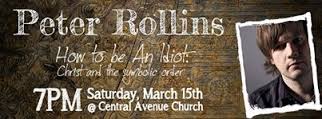
Recorded on March 15, 2014 – Those familiar with Pete Rollins work will recognize some familiar themes and stories at the beginning of this video which then moves into some interesting new ideas about “morons, idiots and imbeciles.” Rollins provocative ideas about the relationship of Christ to the symbolic order challenges us all to move beyond our moronic ideas and practices into the roll of idiots so that we might become imbeciles. Well worth a listen for those familiar with Rollins work and for those who have never encountered him before!!!
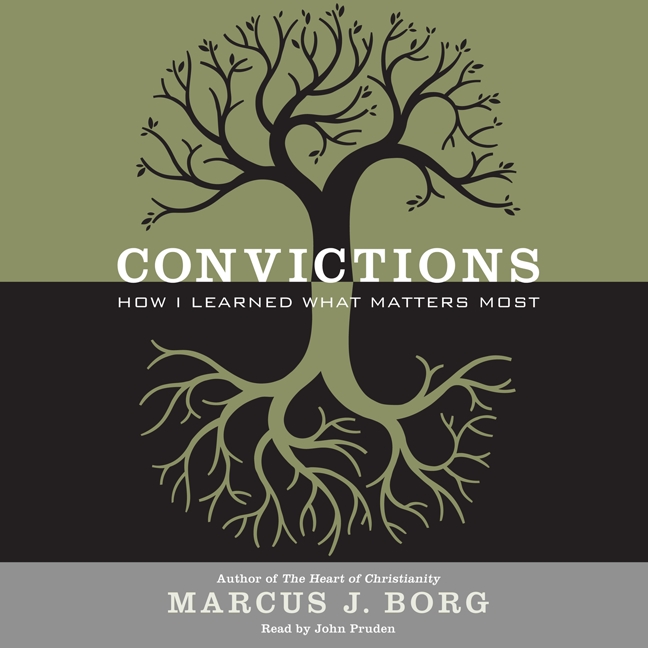
Recorded at the All Saints’ Pasadena Lent Event – March 24, 2014, In the third lecture in a series of lectures which function as a teaser for his forthcoming book: Convictions: How I Learned What Matters Most (due to be released in Canada on May 20/14), Marcus Borg turns to the biblical character Amos to express his own convictions about the lack of justice in all too many American expressions of Christianity.
Recorded at the All Saints’ Pasadena Lent Event – March 24, 2014, In the second lecture in a series of lectures which function as a teaser for his forthcoming book: Convictions: How I Learned What Matters Most (due to be released in Canada on May 20/14), Marcus Borg explores the nature of mysticism and mystical experiences and why they matter.
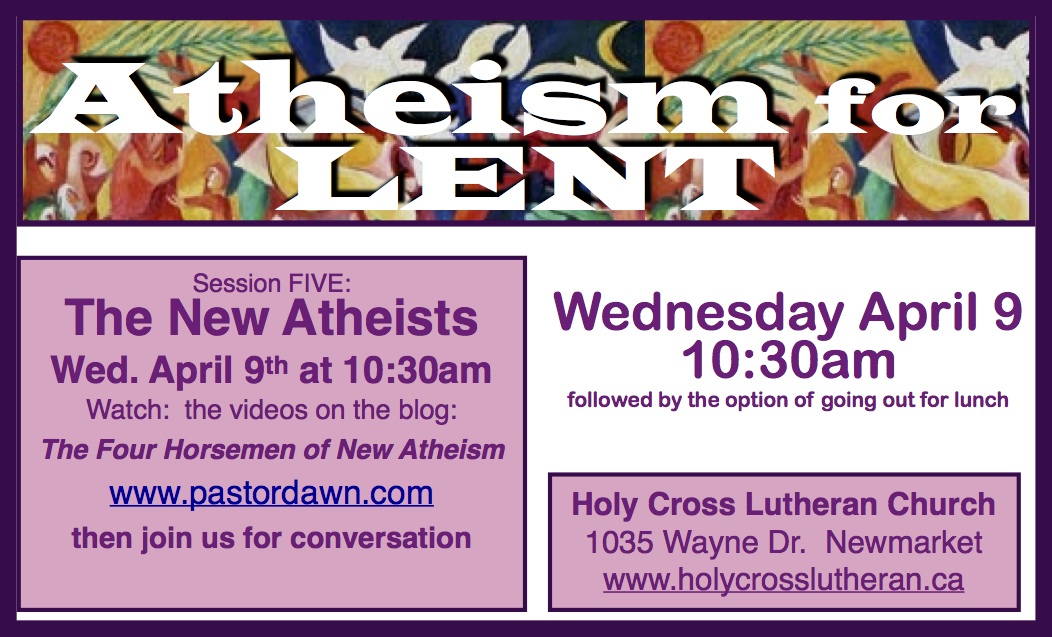
Our last class in the series will be an introduction to what has been dubbed New Atheism. We will explore the work of the 21st centuries New Atheists who have become famous or infamous for the careers they have carved out of their “unbelief.” The videos below “The Four Horsemen of New Atheism” provide an introduction for the class. The Four Horsemen include: Christopher Hitchens, Daniel Dennet, Richard Dawkins and Sam Harris.
Our fourth class explored the critique of religion found in the work of Sigmund Freud. Out of our conversation about Freud we began to look at Richard Dawkins’ “The God Delusion.” The video clips used during the class are included below along with the slides of the keynote presentation. Next week we will move on to the New Atheists’ critique of religion. Below, you can view a video of the Keynote/PowerPoint that was used during the class. A pdf of the class hand-out can be found here
As our understanding of what it means to be human changes, our theologies are changing in ways that embrace reality rather than try to deny the evidence that is revealing a whole new dynamic that is drawing us toward an appreciation of creation that is even more amazing than our ancestors could possibly have imagined. Some Christians are afraid of this ever evolving view of creation, while others of us are compelled to wander beyond the confines of our comfort-zones. My hope is that we will find ways of staying in relationship with one another.
We are really excited to begin selling tickets for Michael Morwood’s visit to Holy Cross May 2-4. Morwood has an uncanny ability to re- imagine and articulate christianity in ways that speak to those of us who embrace all that we are learning from science about the origins and nature of the cosmos. You can read more about Michael and sample videos here and here
“We know what we are. We know not what we may be.”William Shakespeare (1564-1618) Jason Silva is a performance philosopher and filmmaker whose work stimulates and challenges in the blink of an eye. Using the medium of short-film Silva posits questions and ideas that drive his viewers to the brink of possibility. Our quest to understand what it means to be human may be an eternal search, but Silva invites us on a detour of exploration which promises to stretch our understanding beyond the safety of the known toward the parameters of our reach and then back again to the deep limits of ourselves. In two short minutes Silva caused me to wonder: If we are to become the chief agents of of human evolution, will religion play a role? and, Will Christianity be able to re-articulate its narrative in time to be relevant to the discussion?.
Watch Richard Dawkins’ THE GOD DELUSION and then join us for conversation on Wednesday April 2, at 10:30 am when we will explore Sigmund Freud’s critique of religion.
Dr. Ilia Delio offers an integration of cosmology and theology which opens the way to a re-articulation of the Christ narrative that is lodged within the reality of our unfolding evolution. Her considerable ability to articulate a wholistic theology which has the potential to move Christianity into the twenty-first century is exciting!!! I am currently devouring her mind-blowing book, “Christ in Evolution” in preparation to spend a day soaking up her wisdom when she visits Guelph in April (for details click here). I hope to have the opportunity to read her latest book “The Unbearable Wholeness of Being: God, Evolution, and the Power of Love”, and revisit her earlier book, “The Emergent Christ: Exploring the Meaning of Catholic in an Evolutionary Universe” which introduced me to her exceptional mind. Her just published collection of essays,“From Teilhard to Omega: Co-creating an Unfinished Universe”awaits. I will endeavour to post more about her work in the weeks to come. But for now, the video of her lecture “Christ in Evolution” is an excellent introduction to her work. Dr. Delio is an exciting evolutionary theologian whose brilliance is tempered by her sense of humour and her ability to challenge her listeners to stretch ourselves beyond what we think we can possibly comprehend toward a new appreciation of our roles in the ongoing process of evolution. Splendid stuff!!!!

 This year’s Maundy Thursday commemoration at Holy Cross included: hand washing, soup supper, eucharist, intimacy and this story from the Reverend Susan J. Thompson who, along with Pastor Tom Doherty presided over our worship.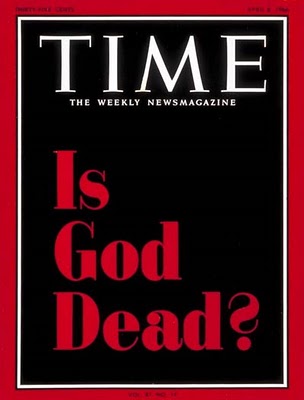






 pastordawn