Does Science Reveal that Death is No Less Sacred than Life? – Michael Dowd

evolutionary christianityEvolutionary Christian, Michael Dowd suggests that we are in the early states of what he calls an “evidential reformation” that is where our best map of what is real and what is important doesn’t come from the church hierarchy or the Bible but with scientific evidence.  In this video Dowd looks to Big History, Human Nature, and Death and Chaos from an “evidential standpoint” to offer an “Inspiring Vision of the Future” and “enrich our communion with reality”.
For more on Michael Dowd follow this link

The Athanasian Creed and an Unholy Trinity – A sermon for Trinity Sunday

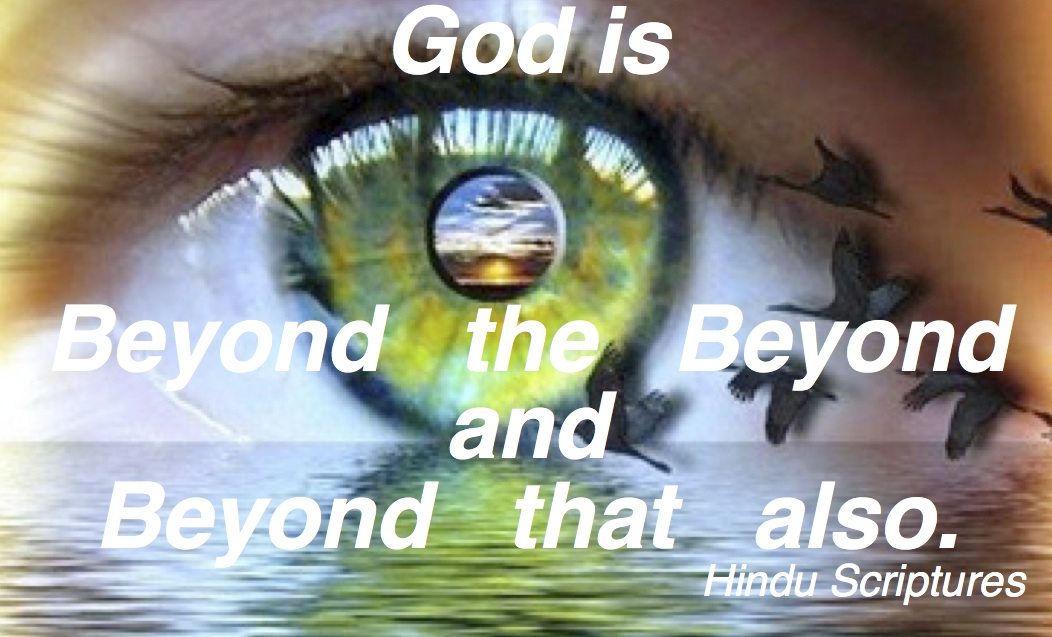
Beyond the Beyond - Dawn Hutchings

I don’t remember the first time I ever saw him. I was barely 18 months old when my brother Alan arrived. Despite the fact that he ruined my gig as an only child, Alan and I grew close over the years. We moved around a lot so we became one another’s best friends. But we went our separate ways when we became teenagers. When I tell the stories, I say that we went our separate ways because Alan became preoccupied with sports.  I suspect that when Alan tells the stories, he says that we went our separate ways because I became preoccupied with the church. Either way you tell it, family and friends used to say that it was hard to believe that we grew up in the same household. Alan developed a reputation for been a bit of a redneck. I developed a reputation for being a bit of a radical. Alan drove four-wheel-drives and went hunting. I drove old beat up cars and lived at an ecumenical retreat centre.  Alan learned a trade, settled down and raised a family. I travelled the world and didn’t get around to figuring out what I was going to be when I grew up, I went back to school at the age of 30.

Alan and I didn’t get around to understanding one another until we were in our mid-40’s. When I grew to appreciate the gentle man that he has become and Alan began to respect the person I’ve become. We still love to talk politics, but these days we tend to agree more than we disagree, I’m not sure who mellowed, the redneck or the radical. We don’t talk much about religion, though. Growing up, Alan would claim to be an atheist, and scoffed at my involvement with the church. These days, Alan, calls suggests he is an agnostic, and although he’s come to respect my life in the church, he still scoffs at the hypocrisy of the church.

I still remember the very first time that I saw Manjit. Her face was the colour of pure milk chocolate. Her jet-black hair was long and wavy. She sat at the very back of the classroom. When the teacher introduced me to Manjit, her toothy grin welcomed me. We were twelve years old. I was the new kid in town and Manjit was the only East Indian in the class. We were to share a double-desk for the remainder of the school year. I remember my first trip to Manjit’s home. A science project needed our attention. I can still smell the aroma of Manjit’s home where exotic curries released their pungency into the air. Over several meals at Manjit’s, I learned to like my food hot and spicy. Manjit’s mother would blend her own spices and she never forgot to send a package or two of her specially blended curries home with me.

Manjit is a gentle soul who introduced me to the wonders of her faith. Manjit is a Hindu. Manjit never tried to encourage me to become a Hindu.  Although over the years she would remind me of the Hindu saying that admonishes Hindus to be better Hindus, Muslims to be better Muslims, Jews to be better Jews, Buddhists to be better Buddhists, and Christians to be better Christians.  Manjit grew into a kind and gentle woman. She works as a social worker in Vancouver’s rough east-end neighborhoods. The last time I saw Manjit she was patiently guiding the students of a confirmation class that I taught, around her Temple. Later that evening Manjit and I talked a long time about Jesus. Manjit told me that she’d always been fascinated with Jesus’ teachings and that she had no problem believing that Jesus is God, but then she explained that Hindus have a thousand god’s.

I can still remember the very first time that Henry walked into my office. A long black beard together with the yarmulke that he wore on his head gave Henry away. So, from the very beginning I knew that Henry was Jewish. But it took a few years of working together before I discovered that in addition to being a graphic artist, Henry is also a rabbi. Henry became a dear friend of mine and over the years he shared so much of his wisdom with me. Many a night Henry and I sat up to the wee hours discussing the Scriptures. Henry even arranged for me to study Hebrew at his Yeshiva. I learned a great deal from Henry. We often talked about Jesus. We rarely agreed about Jesus, but we often talked about him.

Alan, Manjit and Henry, some would call them an unholy Trinity. But to me they are, each of them, sacred. Trinity Sunday is my least favorite Sunday of the Church year. It’s the only festival of the church year that is designed to celebrate not God, nor Jesus, not even the Holy Spirit, but rather a doctrine of the church. The notion that God is One in Three; a doctrine that was created by theologians to explain the inexpressible, a doctrine the church “fathers” began to cast in stone in the words of the Apostle’s, Nicene and Athanasian Creeds.  Three Creeds that make up an unholy trinity in and of themselves. Three Creeds that the Lutheran Church continues to hold as articles of the faith. Three Creeds that continue to hold sway in our church.Three Creeds that in my humble opinion make up an unholy trinity. Three Creeds upon which the doctrine of the Trinity rests.

The Apostles’ and Nicene creeds are familiar to most people who’ve spent time in the churches of Christendom. But it’s the 3rd creed of this unholy Trinity that makes Trinity Sunday my least favorite Sunday of the Church year and for me calls into question the entire doctrine of the Trinity. I still remember the first time I actually heard the third creed. I was about 20. I’d been attending church for about five years and I’d already learned to recite the Apostles creed which we used almost every Sunday and the Nicene Creed which we used on the high holy days like Easter, Pentecost and Christmas. But somehow in those five years I never came across the Athanasian Creed. I must have missed a few Trinity Sundays because in the Lutheran Church tradition dictates that on Trinity Sunday the Athanasian Creed be used. So, on this particular Sunday after the Hymn of the Day the pastor instructed us to turn to page 54 in our Lutheran Book of Worship.    Continue reading

Global Engagement, Chaos Theory, the Butterfly Effect and a New Pentecost

Expands God's Being

This sermon speaks to the experience of our Global Justice Team’s attempts to respond ethically to global injustice. We were guided by the Rev. Jonathan Schmidt of the Canadian Churches Forum for Global Ministries. John Philip Newell’s recent book New Harmony: The Spirit, The Earth, and The Human Soul provided new insights for the vision of a New Pentecost. The Gospel reading from Mark 2:1-12 replaced the regular Pentecost reading.

Readings can be found here

Listen to the sermon here the audio begins with the Acclamation Veni Sanctus Spiritus

God Is a River – Peter Mayer

riverPeter Mayer, one of my favourite folk singers, captures a hint of the essence of God when he sings. I have long since given up thinking of God as “My Rock and Salvation” and the image of God as a river in which I flow helps me to capture a hint of the ONE who is so much more than any of our images or metaphors can begin to capture.  

This morning I will lead our Adult Education Class in a conversation about “eternal life”. As our images of God expand to include all we are learning about the cosmos, this song connects me to the Source of Life. I can’t help wondering how far our conversation will take us. I suspect that new images will emerge. I hope that we can learn to live in the ambiguity of our questions. 

God’s Admiration for Us…

God's Admiration for us copy

Pentecost Tongues Aflame with the Prayer attributed to Jesus

flaming tonguesIt was the first prayer I ever learned. I suspect my Mother taught it to me, but I have no memory of ever learning it. It is part of who I am. I suspect that the origins of this prayer are as murky as my own memory of learning it. Many New Testament scholars have disputed the historicity of Jesus’ authorship of this prayer. While I agree that the prayer’s antecedents can be found in the Jewish tradition, I’ll leave those arguments to another post and turn my attention to the various interpretations of the prayer. All translations are in and of themselves translations. The festival of Pentecost with it’s images of speaking in tongues provides an excellent opportunity to explore some of the many interpretations of the prayer.

In the language of Aramaic, Jesus is said to have taught his followers the prayer we know as “The Lord’s Prayer.” It was then translated into Greek and recorded in the Gospels (Matt. 6:9-13; Luke 11:2-4).  Since then this prayer attributed to Jesus has been translated into hundred’s of languages. Most familiar to many of us are the English translations based on adaptations of the King James and NRSV versions of the Bible. The fact that language continues to change over time, means that the work of translation is never complete. Jesus’ prayer is alive and well in all the world and many translations embody the breath of life that this rich Word of God inspires.

For several years our Pentecost liturgy has included a cacophony of voices as our worshipping tongues pray this prayer using an interpretation of their choice. A selection of interpretations is printed in a folder and while the presider prays the prayer in Aramaic the congregation prays an interpretation. Follow this link for a copy of the interpretations (designed to be printed double-sided and folded together in a booklet) and enjoy the video which will give you an idea of how the Aramaic may have sounded.

This Pentecost practice moved our community beyond the “contemporary versus traditional” arguments over which translation of the “Lord’s Prayer” ought to be used in worship. We know have a plethora of choices!

Celebrating Pentecost in the 21st Century

pentecost celebrate 2Michael Morwood has the uncanny ability to articulate progressive Christianity in ways that enable worshippers to move beyond images and ideas that entrap us in ancient world views. I love his prayers and use them often in worship!

Adapted from “Praying a New Story” by Michael Morwood

The Celebration of Pentecost in the 21st century moves us beyond the story of Jesus ascending to “heaven” in order to send the Spirit upon us.  Pentecost is the wonderful story of God’s Spirit always present, always active in human development and given total and free expressing in human form by Jesus of Nazareth.

It is the amazing story of people coming to awareness through reflection on the life of Jesus that the same Spirit that moved in Jesus moved in them.  They realized it was no their responsibility to give witness to the Spirit in their lives as totally and as freely as Jesus had.

Pentecost is the wonderful good news that all people who live in love live in God and God lives in them. Pentecost presents a challenge to humanity:  What would life on earth be like if the actions of all people were motivated by their awareness of being “temples of God’s Spirit”?

by Michael Morwood

by Michael Morwood

Anam Cara, The Blessing of a Soul Friend

anam-cara-wall-plaque

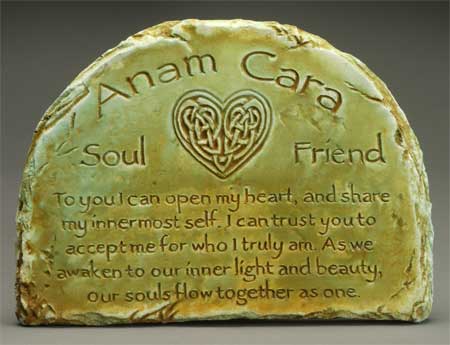
The sunshine of these May days have beaconed me outside into the newly awakened garden. My companion on these respites is John O’Donohue’s “Anam Cara: A Book of Celtic Wisdom.” Anam Cara is Irish Gaelic for “soul friend”. As the gentle breezes and the warm sunlight caress me, I am struck by the pleasure of knowing the Earth as my anam cara.

Nanny’s Mugs: The Agony of Dementia – A Sermon for Easter 5C

NANNY'S MUGSIn my kitchen there are some teacups that we call Nanny’s mugs. They are smaller and more delicate than all the other mugs in the cupboard. Whenever I drink tea from them, I think of my Grandmother. That first summer, I moved to Newmarket; some 3,000 miles from my home, my Grandmother decided that she was going to move in with me.  She lived with me in the parsonage for about 3 months.  It was an impulse decision on her part; a decision that I had very little say in. Nanny decided that I was the only one in the family she could trust and so she would move in with me. She was in her late eighties at the time. I didn’t fully understand her lack of faith in the other members of the family. I never dreamed that her suspicions about the relative trustworthiness of our relatives was the beginning of the end.  I loved my Nanny and I was determined to provide a home for her. I was delighted when she arrived. I was always delighted when my Nanny arrived. I remember as a child, I would long for Nanny to arrive.

Nanny was always full of fun and I have all sorts of wonderful memories of usImage 19 getting into trouble together.  Nanny was all of 5 feet tall, she was just a wee little woman, but there was more power and strength in that wee little woman from Belfast than in most of the women I’ve ever met in my life. She was kindness and fierceness all rolled up into a woman who loved nothing better than a good laugh. Nanny was born in Belfast the oldest of 14 children. When all three of her children ended up living in Canada, even though they were well into their sixties she and my Grandda immigrated to Canada to begin a new life in a new country. Immigrating at any age is an incredible undertaking, but immigrating in your 60’s takes guts. I was twelve years old when my Grandparents arrived in Vancouver. I watched my Grandda begin a new job and my Nanny try to make the best of life far away from everything that was familiar to her. Nanny’s homesickness was palpable. Continue reading

Each and Every Day Is Earth Day

every Earth copyOn this glorious morning the splendour of the Earth is intensified by the Sun’s light and I am reminded that for the inhabitants of this planet each and every day is Earth Day. Let us not forget the beauty that awaits us in the ordinary! It is this beauty that we hold in common which reveals the extra-ordinary splendour of the Earth. Breathe deep! Breathe deep the breath of God!

A Tough Week for the Planet: Earth Sunday Sermon

earth-day-2013On the heels of Peter Rollins visit to our congregation last weekend, this Earth Sunday sermon flows out of Peter’s work. You can listen to Peter’s sermon which is the jumping off point for this Earth Day sermon here

Listen to the Earth Day sermon here

Worship Bulletin here

The readings are here

The video of the excerpt from Chief Seattle’s Response is below


The Raising of LOVE: the “more-than-literal” meaning of the Raising of Tabitha – a sermon on Acts 9:36-41

dorcas

“Can the ways in which we tell the stories of resurrection transform us into followers of Jesus who embody a way of being in the world that can nourish, ground, and sustain the kind of peace that the world yearns for?”  I preached this sermon on the raising of Tabitha years ago, as an attempt to convey the academic essay of New Testament scholar Rick Strelan into the form of a sermon. I believe that it is vital for preachers to convey the wealth of insights that are bandied about in the halls of academia, so that congregations can let go of so many interpretations of scripture that insult their intelligence, so that we can  begin to explore the “more-than-literal meaning” (Marcus Borg) of biblical texts. Rick Strelan’s essay appeared in “Biblical Theology Bulletin, May 1, 2009, under the title “Tabitha: the gazelle of Joppa”. 

Yesterday, I went for a walk. As I was walking along, minding my own business, a bright light appeared in the sky. The light nearly blinded me and so it took a while for me to figure out what was happening. Suddenly, it was so clear that the light was actually coming from a very large spaceship. I could scarcely believe by eyes. I stood frozen to the spot as the space ship landed in the middle of the road. You’ll never believe what happened after it landed. A couple of little green creatures with giant eyes gout out, took my picture, and then got back in the spaceship and flew off into the farthest reaches of space.

You don’t believe me, do you? You think that I’m making a joke of some sort, or maybe I’ve been working too hard and I’ve finally lost the plot. I know there’s probably nothing that I can say that would convince you that little green men have photographed me. Quite frankly that’s a relief because if you’ll believe that, you’d probably believe anything.

I do find it interesting that you won’t allow yourself to believe that I encountered aliens from another planet, and yet, you’ll suspend your disbelief when I tell you a story from the Bible. Or will you? Take our first lesson from the book of Acts.    The miraculous story of how the Apostle Peter raised a disciple named Tabitha from the dead. You all know that when someone is dead, that’s it they are dead. You can pray over them all you want, but they’re never going to sit up, let alone stand up like Tabitha. There’s about as much chance of a person standing up after they’ve actually been dead as there is little green men from outer space landing on the street outside this church.The story of the raising of Tabitha is one of those stories that we wouldn’t believe for a second if it weren’t in the Bible. I suspect that when it comes to stories from the Bible, most of us don’t really believe that they happened exactly the way the Bible says they happened. Or do we?Now maybe you’re the generous type and so you say, “Don’t be too hasty, it could happen if the person wasn’t really dead.”  I mean, maybe Tabitha’s friends got it wrong and she just appeared to be dead. The story says that Tabitha died, then her friends washed her body and laid her out in an upper room. Then, since Lydda was near Joppa, the disciples sent two couriers to Peter, who was in Lydda and they asked Peter to head back to Lydda, which was about 10 miles away. That’s a 20 mile round trip on foot with a walking speed of about 3 miles per hour it would take at least 7 hours. She was definitely dead. According to the story Peter sends everyone out of the room, knelt down and prayed and then said, “Tabitha, stand up!”  and she did just that.

The story of the raising of Tabitha is one of those stories that we wouldn’t believe for a second if it weren’t in the Bible. I suspect that when it comes to stories from the Bible, most of us don’t really believe that they happened exactly the way the Bible says they happened. Or do we? Continue reading

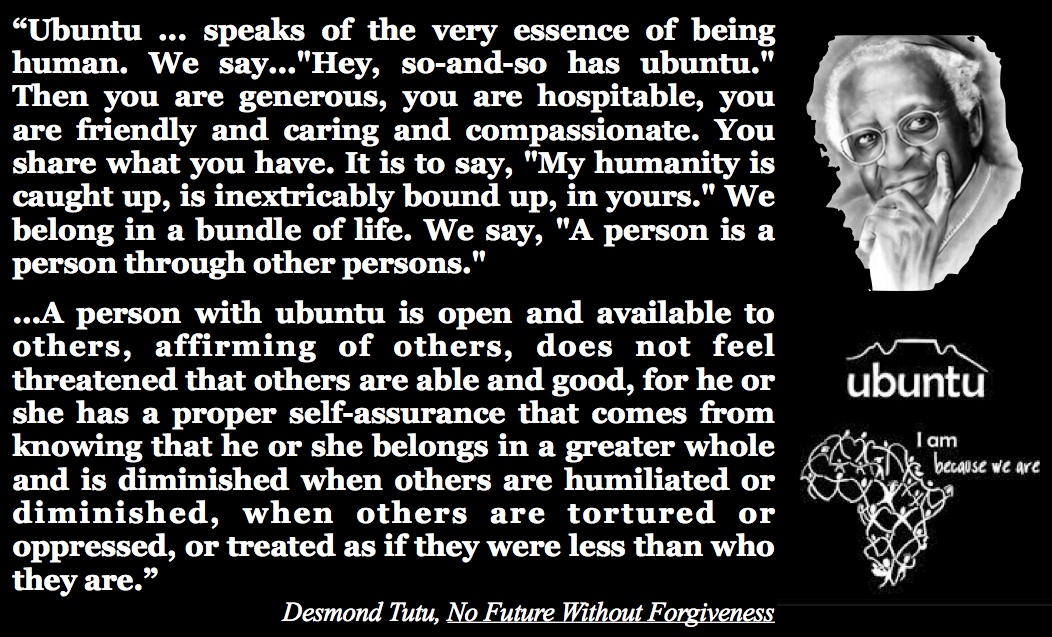
Ubuntu: I Am Because We Are: Desmond Tutu

Ubuntu -- pastordawn.com

Desmond Tutu, Peacemaker: A conversation with Desmond Tutu and John Allen. Recorded March 21, 2013 by Pepperdine University School of Law. This brilliant video provides an opportunity for Desmond Tutu and his Press Secretary John Allen to reflect upon the work of South Africa’s Truth and Reconciliation Commission. It is a marvellous testament to the potential for goodness that exists in humanity. Tutu’s use of the African word “ubuntu” to express his conviction that we cannot be fully human without other humans is wisdom born of human evolution witnessed up close and personal.

Religionless Christianity: Commemoration of Dietrich Bonhoeffer

Reposted today as the Church commemorates the life and witness of Dietrich Bonhoeffer.

When I was just a teenager, I was introduced to the writings of Dietrich Bonhoeffer by a wise Lutheran Pastor. I remember devouring Bonhoeffer’s “Life Together” and “Letters and Papers from Prison”. To this day, I credit Bonhoeffer for making me a Lutheran.  While a great deal of water has flowed under a good many bridges since I was first enamoured of Lutheran theology, to this day I am grateful to that wise old Lutheran pastor who gave me my first taste of Bonhoeffer.   Of late, there has been much ado about a little phrase that has been extracted from Bonhoeffer’s work: “religionless Christianity”.

(click here for full quotations from Letter and Papers from Prison)

“It is not for us to prophecy the day when men will once more ask God that the world be changed and renewed. But when that day arrives there will be a new language, perhaps quite non-religious. But liberating and redeeming as was Jesus language. It’ll shock people. It’ll shock them by its power. It’ll be the language of a new truth proclaiming God’s peace with men.”  Bonhoeffer: Agent of Grace

Tragically, Bonhoeffer was executed before he had the opportunity to expand on his idea of Christianity beyond religion.  The phrase “religionless Christianity” has intrigued agnostics, atheists, humanists, liberal christians and progressive christians.  Eric Metaxas, author of “Bonhoeffer” dismisses the idea that Bonhoeffer was anything but a serious, orthodox Lutheran pastor right up to the end.

Despite the historical evidence of Bonhoeffer’s religious orthodoxy, the notion of religionless Christianity will not die. Bishop John Shelby Spong is among those who have tried to build on Bonhoeffer’s phrase and his book “Jesus for the Non Religious” has certainly moved the conversation along among progressive christians.  

The dream of religionless christianity has moved well beyond Bonhoeffer as twenty-first century christians wrestle with archaic images of God and move beyond the religious trappings of traditional christianity. The notion of moving beyond religion has always intrigued me. Years ago, while studying Hinduism my professor offered a definition of God from one of the Vedas: “God is beyond the beyond, and beyond that also”.  As I continue to explore the life and teachings of the man none as Jesus of Nazareth it becomes more and more evident that such a definition is compatible with his portrait of God.  Jesus of Nazareth attempted to move his co-religionists beyond their religious images of God. What might our images of God become if we move beyond the idols offered to us by the religion of Christianity?   Might we move toward images of God that more closely resemble the teachings of Jesus by moving toward a religionless christianity?

Sometimes we can better reflect upon our own tradition from the perspective of another tradition. In the video below, twentieth century philosopher and theologian Alan Watts explores the concept of the Religion of No Religion. 

“Beyond the Beyond and Beyond that also.” Letting go of our images is the gift of faith that moves us beyond religion. I can hear Jesus call us to let go!

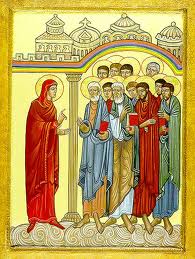
Apostle to the Apostles: Mary’s Story

a to aOn Sunday, in churches all over Christendom, worshippers will hear the gospel story of Doubting Thomas. The story of Doubting Thomas is prescribed gospel reading every year for the Sunday after Easter. I’ve never understood why Thomas should hold such a prominent place in our lectionary: I mean, when the chips were down, and Jesus could have used their support, Thomas and the guys deserted Jesus; they left him alone and spread out across the city to hide from the Romans and the religious authorities.According to the Gospels, it was the two Marys, together with the other women who had financially supported Jesus’ ministry, who stuck by him to the bitter end. Also according to the gospels, it was Mary, the one they call Magdala who brought back the news that Jesus was not dead, but had risen. But despite the fact that Mary Magdalene was the one chosen to be the Apostle to the Apostles, (the word apostle comes from the Greek for “the one sent”) our lectionary quickly moves on from the empty tomb to the upper room so that we can all once again explore the story of good old, doubting Thomas.

So here, let me honour Mary the Apostle to the Apostles with this my imaginary account of Mary’s story. 

Shalom.  I greet you in the name of our risen Christ. My name is Mary.  You may know me as Mary Magdalene. I am not from around here.  I come from a good family in Magdala.  Magdala is a wealthy city on the Sea of Galilee, just south of Capernaum. My family made a lot of money in the fishing industry in Magdala.  While I was growing up I lacked nothing.  But I was not happy.  I was sick.  I would sit around the house moping and complaining and make everyone miserable.  I was so distraught.  Often I was so upset that I pulled out my own hair.

Sometimes I would be so excited that people couldn’t stop me from talking.  I ran up all sorts of bills in the market place which my parents had to pay.  I was always cooking up some mad scheme or other.  I would rant and rave at the slightest provocation.  From time to time I would become ill and stay in bed for weeks on end.  I knew something was terribly wrong and nothing seemed to ease my anxieties. I was a prisoner inside my own mind. Then I met Jesus.  He was teaching outside of the synagogue.  At first, I just stood back in the crowd and listened as he spoke about a new world which God intended to create. It would be a world where the sick are healed and prisoners are set free. I wanted to taste this freedom which Jesus spoke about. I wanted to ask him so many questions.  But the crowd pressed in upon him demanding that he tell them more and I was pushed farther away from him. In despair, I turned to leave. Continue reading

“I Deny the Resurrection” – Peter Rollins

Looking forward to Peter Rollins visit April 12-14. Get your tickets now! More info click here

In the meantime enjoy Pete’s reflection on resurrection:

Yes, Yes, Yes, Yes, Yes, Laugh! – Easter Sunday Sermon

Christ is risen! Christ is Risen Indeed!Easter Roll away the stone

I am indebted to John Claypool’s sermon from back in 1997 for the story of Eugene O’Neill’s play “Lazarus Laughs” and to Henri Nouwen’s “Our Greatest Gift: A Meditation on Dying and Caring” for the “Parable of the Twins”. 

Listen to the Sermon here

Download the worship bulletin here

The Church of Tomorrow: Michael Morwood

it's time

Preparing sermons this Holy Week and wrestling with texts and doctrines, I have had as my companion Michael Morwood’s new book “It’s Time: Challenges to the Doctrine of the Faith”. Written from the perspective of a former Roman Catholic priest, Morewood’s insights transcend the denominational divide and speak directly to the need for new articulations of the faith. I have been gleaming all sorts of insights that are helping me to proclaim the Gospel in a world where knowledge about the magnificence of creation is expanding at a phenomenal pace. Imagine my delight this morning, when a posting by the author himself alerted me to a brief speech he gave on Good Friday that outlines his hopes for the church of tomorrow.  Enjoy!

Michael Morwood is an Australian who is currently the theologian in residence at the Kirkridge Retreat Center, at Bangor, Pennsylvania. 

The Echoes of Jesus’ Cry and Giving Up the Theories of Atonement: a Good Friday sermon

Crucifixion 3I am indebted to Michael Morewood for his theological insights in his newly released book “It’s Time: Challenges to the Doctrine of the Faith” for helping me to see beyond the idols in my head!

Listen to the sermon here

Listen to the full worship service here – Special thanks to the Rev.Susan J. Thompson for her leadership. As always our worship was empowered by the magnificence of our gifted musician Marney Curran. Special thanks to Gary Curran for his solo.

Download the worship bulletin here (3 pages, print double-sided and fold into a booklet)

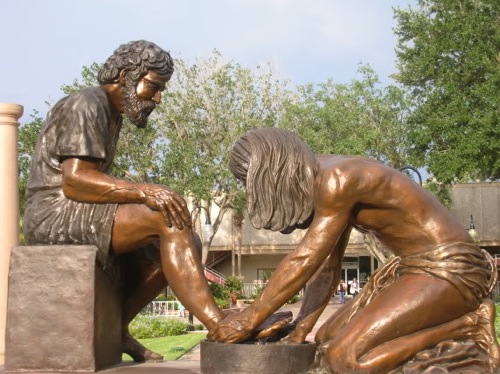
“Is this all a big hoax?” – Maundy Thursday Homily

foot washing bronzeOur worship at Holy Cross was lead by Pastor Tom Doherty and The Rev. Susan J. Thompson as we partook of two suppers interwoven to provide nourishment to our bodies and souls. After hearing the story of Jesus washing the disciples’ feet, our hands were tenderly washed and dried for us as we continued in the Word. After enjoying of a plethora of soups, Pastor Tom’s homily ask, “Is this all a big hoax?”

Listen to the Pastor Tom Doherty’s homily here

Download a copy of the worship bulletin here