Our Temples Lie in Ruins: Luke 21:5-19

“O God we call, O God we call, from deep inside we yearn, from deep inside we yearn, from deep inside we yearn for you.” The first time I sang Linnea Good’s plaintive song, was back in my seminary days back in the late 90’s. It is difficult to believe that I’ve been singing that song in various settings for almost a quarter of a century. A lot has changed since the longing of that tune first matched my own deep longing for God. I have changed, the world has changed, even my own longing has changed. Yes, I still long for God, but the god I long for is so much more than the god of my yesterdays. The intensity of my longing has deepened as the immensity of my own unknowing has been revealed.

The god of my childhood fell away long ago. I stopped longing long ago for the benevolent Father-god. He was replaced with longings for the theological images of a church struggling to survive in the modern world with a more sophisticated and gracious version of a super-hero; a shero if you will. My cravings to see feminine images of the DIVINE have deepened into longings that seem to transcend images altogether as my questions about the nature of the REALITY that lies at the very core of ALL that IS tear at the very fabric of my ability to comprehend the MYSTERY who is the LOVE that for millennia we have called “God.”

O God we call, from deep inside we yearn to capture you in words and images so that we can pin you down, explain you, and contain you in temples we erect to worship you without ever knowing the sheer magnitude of our unknowing. There are days when it feels that all the familiar trappings of what it means to be a person of faith lie in ruins before the onslaught of my questions. Like the communities that generated the writings in the New Testament, I too can see that the Temple lies in ruins. Temples fall, and when they fall the faithful often wander around the ruins longing for better days, when everything seemed so clear.

The community to whom the writer of the Gospel according to Luke wrote his gospel, knew the despair that comes when what you once held dear fails to explain the reality in which you find yourself. Written some ten to twenty years after the Romans destroyed the Temple in Jerusalem, the gospel-writers audience found themselves searching for answers. Who was this Jesus that we believed to be the Messiah, the new King David, sent to save us from our oppressors? Why did he die? Are the rumors that he lives on true? What about those who believe he will return? Who was Jesus, what did he teach, why did God let him die? Who will save us from the Romans? Why did God allow the Temple to be destroyed? Did Jesus know this would happen? What does it mean? How are we supposed to live our lives now? The Romans are killing hundreds and hundreds of us? What happens to our loved ones when they die? What will happen to us when we die? Where is God in all of this? The Temple, everything we knew and held dear lies in ruins. What are we to do? Come back to us Jesus. Come back and save us from all of this.

They’d built their hopes and dreams around the temple and the image of Jesus as the Messiah, their saviour, themselves as the Chosen ones and God as their liberator, vindicator, the rock upon which they could stand. But the Temple lay in ruins…

What happens when the images and idols we choose to worship fail to capture the full meaning of the One we long for? When our Temples fall. When the Church fails. When theologies are too limiting. When answers seem hollow or absurd. When new realities present themselves. When wisdom opens us up to new possibilities. When our questions go unanswered. Temples fall, idols are smashed, and images, ideas and theologies disappoint.

There are days, when it feels like the questions and the mysteries are just too much to bear and I miss that old gentleman up there in the heavens and I’m tempted to just lean into that old time religion and summon up the far-away-god in the sky and have him solve all our woes. And then I remember Jesus.

It’s Jesus that keeps me in what’s left of the church. In Jesus, I’ve met a human being who knew what it was to wander around in the questions; a Jewish rabbi, a teacher, skilled in the art of answering a question with a question. Jesus who cried out for justice and empowered the marginalized. Jesus who embraced his own humanity and lived fully, loved recklessly and gave himself fully to life, it’s Jesus whose ability to be all that he was created be that keeps me in the faith. Jesus who challenged the status quo of the religious authorities and insisted that we and God are ONE. Jesus who put people ahead of the law. Jesus who called and empowered people to resist injustice and yet refused to take up arms even though hundreds and perhaps thousands would have followed him all the way to Rome to fight if he’d only asked them to. Jesus who loved so fully that he refused to back down even though he knew that in all likelihood it would get him killed. Jesus who insisted that heaven is here on earth. Jesus who declared that the reign of God has begun. Jesus who reduced it all down to love, love of God and love of our neighbour as we love ourselves. Jesus who insisted that our minds be part of any relationship. Jesus the rule-breaker and party-goer, the one they called a drunkard and a glutton. Jesus who lived so fully and loved so greatly that in him we can still see the face of God the source of ALL that IS and all that ever shall be living not only in Jesus but in with and through all those who love as extravagantly as Jesus loved. Jesus whose life and witness was so powerful that when he died that horrible crushing death, it was as if the very curtain in the Temple was torn in two and the holy of holies was revealed for what it was, not nearly holy enough to contain the Source of our Being.

The Temple was too small, God was not there. Like the smallness of the temple our images, theologies, doctrines and dogmas, are too small, to contain the ONE who IS the very SOURCE of our being. The religious trappings are just that, trappings, they cannot contain the DIVINE ONE who lies at the heart of reality. Our images and idols have been smashed by our questions, and we can wander around in the ruins as they decay, or we can look for the ONE who lives and breathes in, with, and through us in the faces of those around us; the ONE who lies beyond us in universes that stretch beyond our comprehension. We can let the dead bury the dead, or we can seek the DIVINE One in the LOVE that is God embodied in the hearts and minds of those we love and who love us. Continue reading


Shusssh…Peace…Shalom…Shusssh… Oh No! the apocalypse is here in this Sunday’s Gospel Reading from Luke 21:5-19

The end is nearI was twenty years old, young and adventurous, with a rail pass in my hand, a back pack slung over my shoulders and several hundred dollars worth of American Express Travellers cheques in my pocket, when I boarded a train in Zurich, Switzerland, bound for Athens, Greece.

I was tired.  Several months of backpacking in Northern Europe had left me weary.  In just five days my rail-pass would expire, so I decided to head for Greece, where the living is easy, where the warm sun, blue skies and equally blue waters held the promise of rest and relaxation.

As the train made its way through the Alps, I remembered a similar trip which I had made the year before and I tried to calculate whether my remaining funds would allow me to return to the village of Hannia on the island of Crete.  I knew that in Crete I could find work.  I planned to mix a lot of rest and relaxation with just a little work and try to live out the winter on the Mediterranean.

As the train rattled through Austria toward what was then Yugoslavia it began to get dark. I was disappointed that my journey through Yugoslavia would be completed in darkness.  I remembered my previous journey, by car, through Yugoslavia and how at the time, I had marvelled at the diversity of this strange little country.  I remembered men and women driving oxen as they ploughed their fields in much the same way as there ancestors had done.  I also remembered my surprise at entering the ultra modern city of Belgrade; the showcase of Tito’s communist regime. I fell asleep pondering the sharp differences between the lives of the poor people in the villages who appeared to live without any modern conveniences at all and the lives of those who inhabited the city of Belgrade with its towering skyscrapers and streets filled with automobiles.  Several centuries seemed to co-exist in Yugoslavia.

I was awakened by the sound of people shuffling to find their papers as the train conductor instructed us to get our passports and visas ready for customs inspection.  When the Yugoslavian custom officials, with their rifles over their shoulders boarded our train they were preceded by men guided by vicious looking German shepherds.  Even though I knew that I had all the right papers and that my back pack contained nothing more offensive than some dirty laundry, the sight of the dogs, guns and uniformed officials struck fear into my heart.  I nervously handed over my precious passport to an official who looked younger than my twenty years.  He carefully read over the visa which I had obtained in Zurich the day before; a visa that I could not read because it was written in an unfamiliar language and an unfamiliar alphabet. Continue reading

Lest We Forget – A Peace Remembered

As Remembrance Day falls on a Monday this year, some congregations may choose to celebrate Remembrance or Peace Sunday. I was asked to re-post this story for those preparing to preach on peace.  For other sermons on the topic click here

The young woman can still remember one particular Remembrance Day when her words and actions did nothing more than offend someone she loved very much. It was the one and only argument she ever had with her Grandmother and it happened over Remembrance Day. At the time, she was living in London. She remembers thinking that Londoners take Remembrance Day very seriously indeed. More so, she thought, than in her native Canada. She wondered if the blitz had something to do with it.

While most of the poppies people wore were red, she began to see white poppies appear on the lapels of more than just a few people.  She read in the newspaper that those who were committed to peace and believed that for the most part, Remembrance Day only serves to glorify war were donning white poppies.  You could pretty well draw a dividing line between the generations using the colors of poppies as your guide. Young people, who had never experienced war tended to wear white poppies, while those who were older and who had memories of war, tended to wear red poppies. In many homes poppies in and of themselves managed to start wars. 

The idealistic young woman was just twenty and her commitment to peace determined her choice. She was wearing a white poppy the day she traveled up to the Midlands to visit her Grandmother. It was the day before Remembrance Day when she arrived on her Grandmother’s doorstep. She’d forgotten all about the white poppy that adorned her lapel. She couldn’t help thinking that there was something odd about the reception she received from Grandmother. It wasn’t exactly what you would call warm. Her Grandmother was upset about something. But the young woman couldn’t quite figure out what, because her Grandmother appeared to be giving her the silent treatment. She just served dinner and listened quietly as the young woman chatted on about her week in London. Continue reading

All Saints – Giving thanks for the DIVINE in ONE-another!

All Saints’ Day is a day for remembering.  The word saint simply means “holy”. In the New Testament, all those who believe and were baptized were referred to as saints. It wasn’t until round about the third century that the church began using the word saint to refer to those who had been martyred for the faith. Over time these martyred saints were held up for veneration and people used to pray to them to intercede on their behalf. I’m not going to go into all of the institutional abuses that led Martin Luther and the later reformers to abolish the veneration of the saints. Except to say, while the Reformation put an end to the veneration of the saints in the protestant churches, it did not abolish the concept of sainthood.

Within the mainline protestant denominations, we use the term in much the same way as it was used in the New Testament to describe the faithful. We talk about the communion of saints to describe all the faithful who have gone before us who now rest in God, together with all the living who walk in faith. So today as we celebrate the saints, we give thanks for all the faithful those living and those who have gone before us.

Today, I remember and rejoice as I give thanks and praise to God for the witness of St. Joyce of Belfast. St. Joyce who in her own way taught her children to love God and to pray always. And so today, I give thanks and praise to God for the life and witness of St. Joyce of Belfast, my Mom, who was the first to teach me the Lord’s Prayer, and who puts flesh on Christ’s command that we love our neighbours as we love ourselves.

Today I remember and give thanks for the life and witness of St. John of Wales, whose life in the church as a choir-boy was followed by long years of self-exile and whose keen wit and lack of patience with hypocrisy instilled in me a desire for honesty and integrity in the articulation and living of the faith. I give thanks for St. John, my Dad, whose open heart has stretched his discerning mind and enabled many to see the humour in this God-given life we live.

Today, I remember and rejoice as I give thanks and praise to God for the witness of St. Valerie of Ladner. St. Valerie so loved and feared God that she dared to reach out and invite a wayward soul to come and worship God. St. Valerie sang God’s praise, rejoiced in the communion of saints and helped a young friend find a home in God’s holy church. And so toady, I give thanks and praise to God for the life and witness of St. Valerie, my high school friend, who was the first to invite me to come and worship God.

Today, I remember and rejoice as I give thanks and praise to God for the witness of St. Wilton of Lunenburg. St. Wilton loved God all the days of his life and served God with gladness and distinction. St. Wilton went far beyond his call as pastor, he opened up the scriptures to those who eagerly sought the truth of God’s Word with love and dedication and he went on to inspire a diligence to scholarship that nurtured the faith of so many young people. And so today, I give thanks and praise to God for the life and witness of St. Wilton, my first pastor, who taught me to be uncompromising in my study of the scriptures, and steadfast in my love for God.

Today, I remember and rejoice as I give thanks and praise to God for the witness of St. Lola of Washington. St. Lola whose appreciation for God’s grace overflowed in her love for the world. St. Lola whose desire to share God’s grace and truth, led her to give of her time and talent to the care and redemption of so many young seekers. St. Lola whose love for God’s creation inspired her to teach so many of us to give thanks to God for all that God has made. And so today, I give thanks and praise to God for the life and witness of St. Lola, my mentor in the faith, who taught me to love as I have been loved.

Today, I remember and rejoice as I give thanks and praise to God for the life and witness of St. Fritz of Chicago. St. Fritz whose dedication to the Word of God was displayed in all he did. St. Fritz who opened so many minds to the beauty of God’s ways, who taught, inspired and entertained as he sought to reveal  the wonders of God’s unimaginable grace. St. Fritz who taught me that no question is unaskable for it is God who blessed us with minds and who bids us to use them in our love for God and for one another. And so today, I give thanks and praise to God for the witness of St. Fritz, my friend, who was the first to call me to the ordained ministry of Word and sacrament.

Today, I remember and rejoice as I give thanks and praise to God, for the life and witness of St.s Sharon and Irene of Pt. Roberts, St. Ellen of Lonsdale, St.s Jerry and Daniel of Minnesota, St. Nancy of Seattle, St. Anne of Vancouver, St. Donald of UBC, St.s  Carol, John, Eduard, and Donna of Waterloo, and for the great cloud of witness both living and dead who have testified to God’s love in my life.

Toady, I give thanks and praise to the SOURCE of ALL that IS for the cloud of witnesses who gather to worship the MYSTERY WHO IS and to love one another in the parish I serve. I give thanks for all the glorious saints of Holy Cross who have nourished, challenged and helped me to grow in LOVE.

Today, I encourage each and every one of you, to remember and rejoice, as you give thanks to the SOURCE of ALL for the great cloud of witnesses who have been a blessing to you; who have revealed the LOVE that IS God to you; who have taught you the Word, the story of LOVE in the world; who have loved you, nourished you, challenged you and inspired you to love God with all your heart, with all your soul and with all your mind and to love your neighbours as you love yourself.

Who are the saints in your life? Think about the saints who revealed the LOVE that IS God to you. Remember and rejoice for by their love, they taught you God’s Word, and taught you to celebrate the MYSTERY. Remember and rejoice in the saints of God, who are responsible for having passed the gifts of faith on to each of us. Saints who you may never read about in the church history books, but saints who by their life and witness managed to reveal a measure of God’s amazing grace to the world.

These saints of God who are so dear to us and the Body of  the LOVE that IS God, the hands of God, are ordinary folks who in the course of seeking to be faithful followers of LOVE, in striving to love God with all their heart, soul, and mind, touched our lives in ways that changed us and had a profound effect on who we are today.

Today is a day for remembering and rejoicing in the communion of saints. Today is a day for giving thanks to the MYSTERY we call God for their lives and for the witnesses they have been and are in our lives. But today is also a day for looking around us to discover our own place in the communion of the saints. Take just a moment to think about how people will remember and give thanks for your sainthood. Whose faith have you nourished? Whose faith will you nourish? How will you nourish people in the faith? How will you embody LOVE in the world? What role are you prepared to play in the Communion of Saints?

          The Reverend Dr. Otis Moss III says it well listen to St. Otis preach it!


“Makarios” – Blessed, Happy, Fortunate, EVOLVED – a sermon for All Saints’ Sunday

Listen to the sermon here

Our Gospel reading has often been called the Beatitudes. It is traditional to read the Beatitudes on All Saints’. Some years we read the eight Beatitudes as they have been passed down to us from the anonymous gospel storyteller known as Matthew, who sets Jesus’ sermon on the mount.  But this year is the year of Luke, so we read this anonymous storyteller’s version of the Beauties which appear in Jesus’ sermon on the Plain.  But whether it’s the sermon on the mount or the sermon on the plain what has been passed down to us is a description of the important characteristics of those who are blessed. There are all sorts of ways to interpret the word “makarios” which was translated into Latin as “beatus” the word for “blessed,” “happy, or “fortunate.” Today, I’d like to offer you another way of interpreting the Greek word “makarios”. “makarios” contains the Greek word “karios” Some of you will recognize the word “karios”,

here in Canada the mainline churches work together within the organization that bears the name “karios”. Karios is the organization through which we work together to achieve justice in Canada and in the world.  The name Karios was chosen because it is one of the Greek words for “time”, a special kind of time, the opportune time, or the supreme moment. Karios is used in the scriptures to mean that time when all is well, when people are making the best use of their time, when there is harmony or peace among people, or peace with God. Karios can also be used to describe the time when it is clear that the Divine has somehow visible right here and right now. Karios is sacred time. “Makarios” is related to Karios because a person who achieved “makarios” was said to be a person who had moved beyond the constraints of time and space. Continue reading

Always Reforming: Freedom and Loss

Jesus said: “If you continue in my word, you are truly my disciples: and you will know the truth, and the truth will set you free.”  Semper Reformanda – always reforming! Reformation has a great deal in common with freedom.  Whenever I hear that word “freedom” the lyrics of an old folk song pop into my head: “Freedom’s just another word for nothing left to lose.”

I suppose there is always a price to pay for freedom. A church that holds up the value of always reforming, is a church that will choose freedom over tradition.     Sometimes, choosing freedom over tradition can feel like losing; losing traditions that once seemed precious to us.  When it comes to worship the truth has set us free from all sorts of traditions that we once valued. Sometimes we discover that the traditions we once believed were so very important fall away.

What follows is a reflection on what we have lost and what we have found.

Reformation Sunday Resources

semper reformanda

Preparing for Reformation Sunday? Some of these posts might be useful:

”The Truth Will Set You Free. But First It Will Piss You Off!”

Echoing the Divine Plea: “I Lay Before You Life and Death. Choose Life!”

What if we won’t ever really understand Jesus’ life, death, and resurrection until we understand that God is dead?

Enough with “A Mighty Fortress” Already! Sing a New Song!

95 Theses for the Twenty-first Century

Freedom from What?  All this Reforming is Wearing Me Out!

What Darwin Never Knew

A Reformation Day Nailing to the Internet – John Shelby Spong

A Prayer for Reformation – Thomas Berry

“The Truth Will Set You Free, But First It Will Piss You Off!” – a Reformation Sermon – John 8:31-36

“You will know the truth and the truth will set you free.” Let me take a moment to face the truth about who we are as Lutherans. The truth is that from the beginning Lutherans have participated in hate-filled tribalism that gives rise to anti-Semitism. The irony of attempting to commemorate the Reformation on the day after the slaughter of Jewish sisters and brothers cannot be ignored. Sadly, our church’s tragic participation in anti-Semitism goes all the way back to Martin Luther himself. Luther’s anti-Semitic rants provided the theological grounding that empowered Nazi’s to fan the flames of the Holocaust. It took until 1983 for the Lutheran World Federation to confess and repent Luther’s words.

Let me read from our sister church, the ELCA’s Declaration to the Jewish Community:

“In the long history of Christianity there exists no more tragic development than the treatment accorded the Jewish people on the part of Christian believers. Very few Christian communities of faith were able to escape the contagion of anti-Judaism and its modern successor, anti-Semitism. Lutherans belonging to the Lutheran World Federation and the Evangelical Lutheran Church in America feel a special burden in this regard because of certain elements in the legacy of the reformer Martin Luther and the catastrophes, including the Holocaust of the twentieth century, suffered by Jews in places where the Lutheran churches were strongly represented.

The Lutheran communion of faith is linked by name and heritage to the memory of Martin Luther, teacher and reformer. Honoring his name in our own, we recall his bold stand for truth, his earthy and sublime words of wisdom, and above all his witness to God’s saving Word. Luther proclaimed a gospel for people as we really are, bidding us to trust a grace sufficient to reach our deepest shames and address the most tragic truths.

In the spirit of that truth-telling, we who bear his name and heritage must with pain acknowledge also Luther’s anti-Judaic diatribes and the violent recommendations of his later writings against the Jews. As did many of Luther’s own companions in the sixteenth century, we reject this violent invective, and yet more do we express our deep and abiding sorrow over its tragic effects on subsequent generations. In concert with the Lutheran World Federation, we particularly deplore the appropriation of Luther’s words by modern anti-Semites for the teaching of hatred toward Judaism or toward the Jewish people in our day.

Grieving the complicity of our own tradition within this history of hatred, moreover, we express our urgent desire to live out our faith in Jesus Christ with love and respect for the Jewish people. We recognize in anti-Semitism a contradiction and an affront to the Gospel, a violation of our hope and calling, and we pledge this church to oppose the deadly working of such bigotry, both within our own circles and in the society around us. Finally, we pray for the continued blessing of the Blessed One upon the increasing cooperation and understanding between Lutheran Christians and the Jewish community.”

Semper Reformanda, means always reforming, or keep on reforming, or always reform. I don’t know about you, but after some of the horrendous events this week, I’m almost too tired for any more reforming. Between the Make America Great Again bomber, the white supremist, anti-Semite shooter, the defunding of Ontario colleges, and the abandonment of protections designed to ensure workers at the low end of the pay scale, see not only a dollar an hour raise but more than just a few paid sick days, I’m tried. I don’t even have it in me to pay attention to the worst humanitarian crisis in human history, so please don’t show me any of those horrendous pictures of starving children in Yemen, and whatever you do, please don’t remind me of the genocide of Rohingyan people Between the orange yahoo south of the boarder and our own moronic blowhard at Queen’s Park, I’m so very tired of bad news.  Don’t get me wrong, I want to save the world, I just can’t seem to face the world right now. I am in bondage to compassion fatigue and I cannot free myself. I can’t even begin to live up to the standards I set for myself. The onslaught of news that comes flooding in at a fevered pace, has left me longing to just hide away, curl up into a ball and forget that I ever believed that I had a role to play in making the world a better place.

When I was too young to know any better, I fell in love with an image of myself that I’ve been failing to live up to year after year, decade after decade. The truth about who and what I am is far from the ideal image of the person I long to be. The gap between our ideal self and our real self is a truth most of us would prefer to deny. The truth that we are far from the perfect ideal person that on our good days we aspire too, is tough to swallow. As relatively healthy human beings most of us recognize that we are missing the mark. Missing the mark is how the word sin is defined in the Hebrew Scriptures. We can try to put our faith in ideals, or rules or as the Apostle Paul and Martin Luther would say we try to put our faith “in the Law.” But ideals, or rules, or Law cannot save us from the reality that we are incomplete beings, ever-evolving beings, beings still hoping to become all that we can be. Continue reading

Wrestling With the Almighty: Locating Our Very Selves in the Sacred Story – a sermon on Genesis 32:3-31

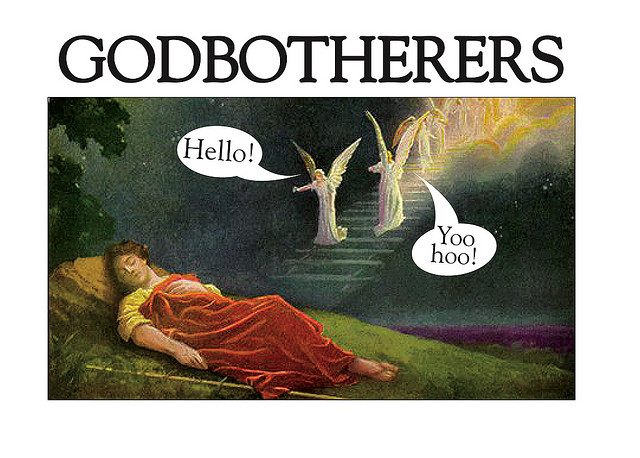
Godbotherers

For those of you preaching on the text from Genesis 32:3-31:

You may not be able to tell from looking at me. But let me assure you that you are looking at someone who used to be a champion wrestler. Believe it or not, my wrestling skills actually helped me rise to the level of a world champion wrestler. Well, perhaps I should qualify that statement. When I was an amateur wrestler, I was a world-class champion wrestler. But like so many athletes, when my status changed from amateur to professional, I lost my championship status and although I still qualify as a professional wrestler, and I like to see myself as a champion, I’m no longer what you would call world-class.

Like many professional wrestlers my career began when I was but a child. Growing up I had a very clear advantage as I developed my wrestling skills. You see having a brother who was just 18 months younger than me meant that I had ample opportunities to hone my wrestling skills. My brother and I were always at it. I’ve got to say that even though we shared the same weight class for most of our childhood, when it came to world class wrestling holds, I had him beat. I had this wicked arm-hold sleeper, and that together with my full Nelson followed by a knee-arm press, was guaranteed to have my brother screaming uncle and agreeing to be my obedient servant until in no time at all. For years I reigned as the champion of our little world! I was unbeatable. My brother didn’t stand a chance. My reign as world champion would have continued if it weren’t for the abrupt ending of my amateur status.

One morning when I was about 13 and my brother was 9 and a half, we were going at it,  and to his credit my bother had me in an ingenious hold. Somehow, he’d managed to secure me with what we professional wrestlers call an arm bar. That’s where you’re opponent wrenches your arm behind your back and applies just enough pressure to cause pain, but not enough to break anything. But just when Alan was approaching the point of no return, I managed with a feat of superhuman strength to rise up, twist around and swing for all I was worth and connect with what I though must be my brothers chest. I expected that such a thrust would have released my arm from Alan’s iron grip. But he still had me. I was about to hit him again, when for no apparent reason Alan released me from his grip. In an instant I wiggled free, spun around and connected with what I figured would be a fatal blow. Just before my blow connected with it’s victim, I realized that I was doomed.

Continue reading

Whose Persistence? Preparing to Preach on the Parable of the Pleading Widow

pleading widowLooking back on a sermon I preached twelve years ago on this week’s readings from Genesis 32:22-31 and Luke 18:1-8, I am struck by how much my own images of the DIVINE ONE we call “God” have changed and yet remain oddly similar. The intervening years have afforded me the opportunities to begin to leave behind notions of an anthropomorphic God who intervenes in our lives. As I have embraced the writings of progressive and evolutionary theologians, I have struggled to understand and articulate DIVINITY’s nature from the perspective of panentheism (everything is in God). There are those who suggest that this is a departure from the Christian tradition. Yet looking back, I am beginning to see this movement as a natural progression of the tradition. Indeed, so much of what I have always loved about Lutheran theology has freed me to explore this path. So, I offer this old sermon as a snapshot of my own pathway toward new visions of the Divine. I trust that my early efforts to move beyond the notion of God as the “unjust judge” will move some to begin to see God in, with, and through all those who persistently plead for justice. 

What little I know about the art of wrestling I learned from my brother Alan. He and I are just eighteen months apart in age and together we participated in many a wrestling match. All too often one or the other of us would be bothering the other and before we knew it we were rolling around on the floor wrestling. I’ll have you know that up until the age of about twelve I was quite a good wrestler. Up to that point I usually managed to hold my brother to the ground and with my knees firmly pinning his arms I would be able to get my brother to agree to my point of view. But my brother’s adolescent growth spurt put an end to my winning streak. Just as soon as my brother was big enough to pin me to the ground I decided to stop bothering him. Bothering my brother became dangerous and I had to give it up in order to save my dignity. Continue reading

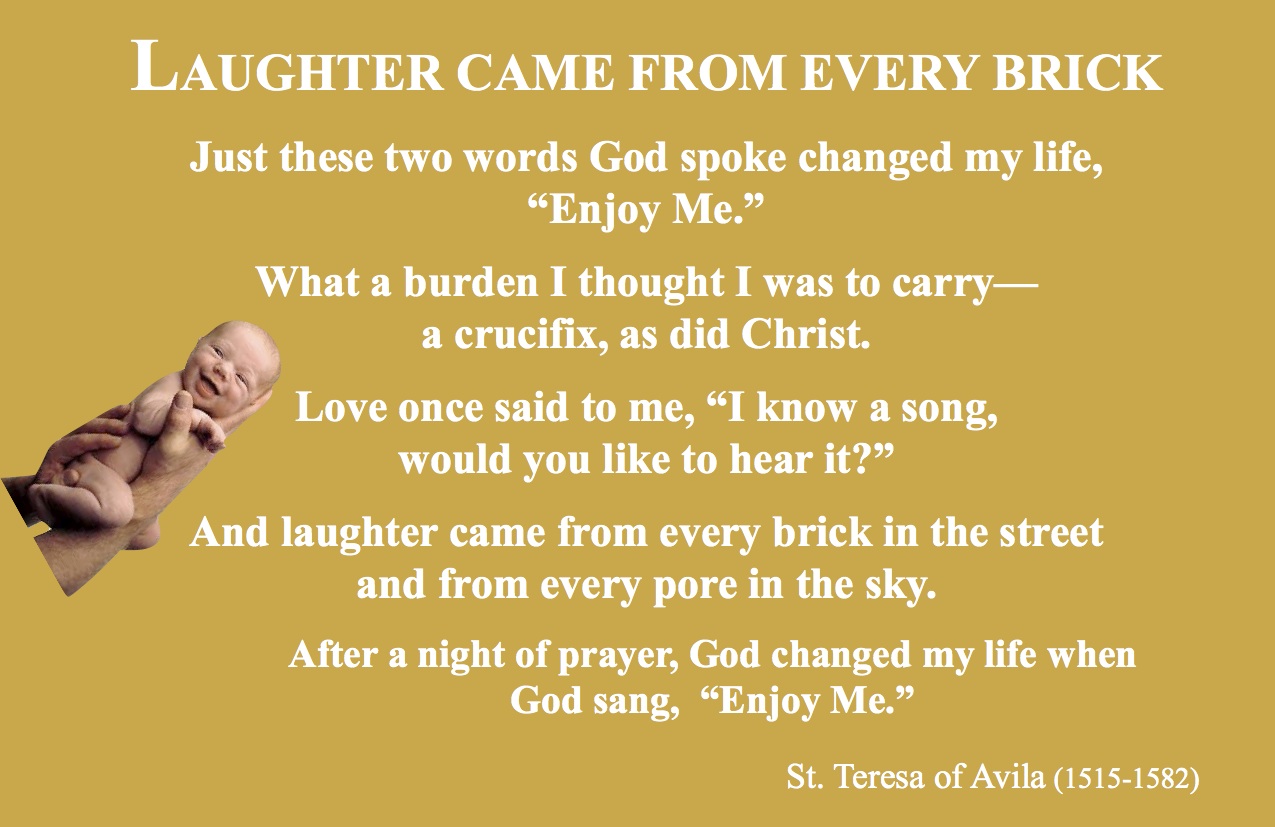
Today We Celebrate the Life and Witness of St. Teresa of Avila

An excerpt from “Love Poems From God” by Daniel Ladinsky,

(Penguin Compass, London: 2002)

(1515-1582)  “Teresa was born in Avila, a beautiful high mountain village of Spain.  She was one of thirteen children, three girls and ten boys, in a wealthy family.  The Spain in which Teresa grew up was permeated with 700 years of Arabian culture; the eradication of Arab power was followed by one of Spain’s darkest periods, the insanity of the Inquisitions, which, in the fourteenth century, along with other grievous deeds, forced mass conversions of Jews to Christianity.”

“Teresa was her father’s favourite child, and the most spirited.  Her mother died during childbirth when Teresa was thirteen, after which she had little supervision.  It is believed she had a lover at the age of fifteen, which caused her father to send her to a convent boarding school, only to see her return home two years later because of poor health.  When she was twenty-one, Teresa ran away from home to join a convent.  At that time many convents were more like hotels for women, allowing them a great deal more independence than they would be allowed at home, though after two years at the convent Teresa had a near-death experience that changed her life.  A spiritual awakening began in which she cultivated a system of meditation that sought quieting the mind to such an extent that God could then be heard speaking.  Over the next twenty years she experienced many mystical states but not until she was fifty did she begin the most far-reaching aspects of her life’s work.” Continue reading

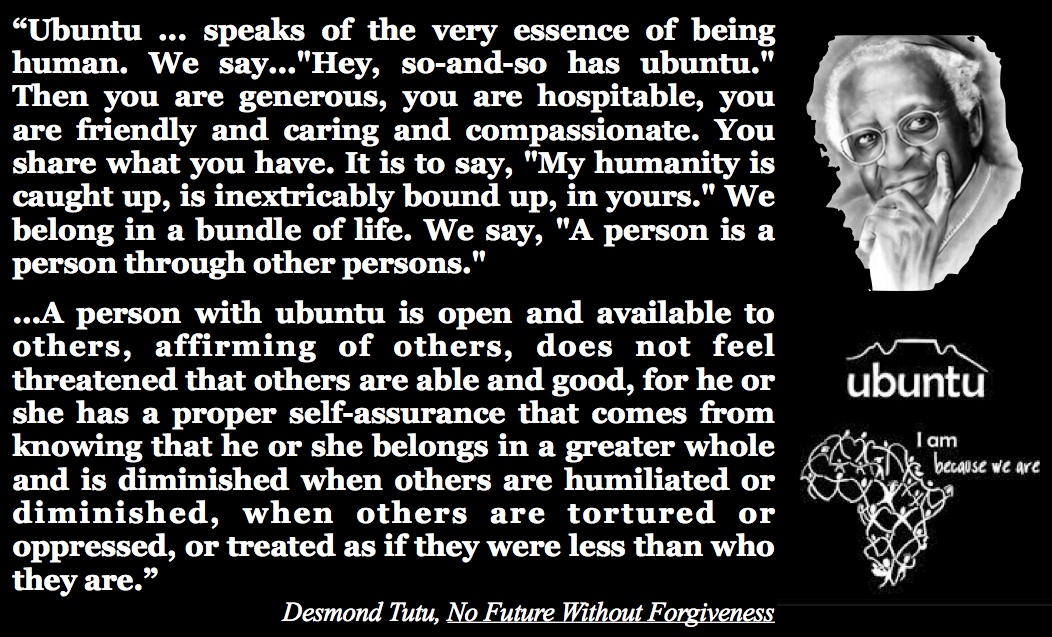
Ubuntu: A Person Is A Person Through Other Persons – Luke 17:5-10 – The Parable of the Mustard Seed

Ubuntu -- pastordawn.com

colemansListen to the sermon here: 

In his book, “The Orthodox Heretic”, Peter Rollins creates a parable which he calls “Finding Faith.”

According to Pete, “There was once a fiery preacher who possessed a powerful but unusual gift. He found that, from an early age, when he prayed for individuals, they would supernaturally lose all of their religious convictions. They would invariably lose all of their beliefs about the prophets, the sacred Scriptures, and even God. So the preacher learned not to pray for people but instead he limited himself to preaching inspiring sermons and doing good works. However, one day while travelling across the country, the preacher found himself in a conversation with a businessman who happened to be going in the same direction. The businessman was a very powerful and ruthless merchant banker, who was honored by his colleagues and respected by his adversaries. Their conversation began because the businessman, possessing a deep, abiding faith, had noticed the preacher reading from the Bible. He introduced himself to the preacher and they began to talk. As they chatted together this powerful man told the preacher all about his faith in God and his love of Christ. He spoke of how his work did not really define who he was but was simply what he had to do.

“The world of business is a cold one,” he confided to the preacher, “And in my line of work I find myself in situations that challenge my Christian convictions. But I try, as much as possible, to remain true to my faith. Indeed, I attend a local church every Sunday, participate in a prayer circle, engage in some your work and contribute to a weekly Bible study. These activities help to remind me of who I really am.’

After listening carefully to the businessman’s story, the preacher began to realize the purpose of his unseemly gift. So he turned to the businessman and said, ‘Would you allow me to pray a blessing onto your life?’

The businessman readily agreed, unaware of what would happen. Sure enough, after the preacher had muttered a simple prayer, the man opened his eyes in astonishment. ‘What a fool I have been for all these years!’ he proclaimed.  ‘It is clear to me now that there is no God above, who is looking out for me, and that there are no sacred texts to guide me, and there is no Spirit to inspire and protect me.’

As they parted company the businessman, still confused by what had taken place, returned home. But now that he no longer had any religious beliefs, he began to find it increasingly difficult to continue in his line of work. Faced with the fact that he was now just a hard-nosed businessman working in a corrupt system, rather than a man of God, he began to despise his work. Within months he had a breakdown, and soon afterward he gave up his line of work completely.

Feeling better about himself, he then went on to give to the poor all of the riches he had accumulated and he began to use his considerable managerial expertise to challenge the very system he once participated in, and to help those who had been oppressed by the system.

One day, many years later, he happened upon the preacher again while walking through town. He ran over, fell at the preacher’s feet, and began to weep with joy.

Eventually he looked up at the preacher and smiled, ‘thank you, my dear friend, for helping me to discover my faith.’”

In a parable handed down to us from our ancestors in the faith, Jesus’ disciples ask him to “increase their faith”. It is a request that I believe many of us can identify with for who among us has not at some point or other asked for the gift of more faith? If only we had more faith we would be able to believe and if we could believe we’d have the courage to  cope with whatever crisis is overwhelming us. If we could only believe, we’d be able to understand why, or how, this or that. If we could just believe strongly enough, we’d have the courage to risk, to speak out, to stand-up for, to open up to, to ask for, to go on, to do something. If only we could believe in God, believe in the life death and resurrection of Jesus, believe in the power of the Holy Spirit if only we could get it all straight in our heads we’d be able to tell all the world what it is we believe. In the meantime, we’ll just keep on struggling to believe.

For years, and years, I used to believe that what was necessary was to just believe. So, I struggled to understand what all those “I believe statements” that the church, the community of believers asks its followers to make.

“I believe in God the Father Almighty,

maker of heaven and earth and in Jesus Christ,

his only Son our Lord,

he was conceived by the power of the Holy Spirit

and born of the virgin Mary.

He suffered under Pontius Pilate,

Was crucified, died and was buried.

He descended into hell.

On the third day he rose again,

He ascended into heaven,

and is seated at the right hand of the Father.

He will come again to judge the living and the dead.

I believe in the Holy Spirit,

the holy catholic Church, the communion of saints,

the forgiveness of sins,

the resurrection of the body and the life everlasting. Amen.”

Over and over again, in liturgies, Sundays after Sunday, the church; the institution of the faith, offered me the opportunity to stand among the faithful to declare what it is that we believe. Whether it was the Apostles or the Nicene or heaven forbid the Athanasian creeds, the Church made it very clear exactly what it is that we are supposed to believe in order that we might number ourselves among the faithful. The very word “creed” itself, was handed down to us from our ancestors creed from the Latin “creedo” which translates into English as “I believe”. Continue reading

Hell Is Here On Earth – Luke 16:19-31

1 percentFor those of you who are working on the Parable of Lazarus and the Rich Man, here’s a copy of a sermon I preached a few years ago.

I moved out of my parent’s house when I was quite young and like most young people I didn’t have much money so I lived in some pretty weird places. I once shared a house with a bunch of people that I met working in the travel industry. I didn’t know them very well when I first moved in but as the months dragged on, I got to know some of them better than I would have liked. There were five of us living in a four-bedroom house about a block from Spanish Banks in Vancouver. The house’s proximity to the beach made up for some of my roommates’ shortcomings and the rent was cheap.  So, even though I didn’t like the idea, I didn’t kick up much of a fuss when one of my roommates brought home a puppy.

Now there are those people who would argue that all puppies are cute, I just don’t happen to be one of them. Besides this thing was a Doberman and I don’t care if it was cute, I don’t like Dobermans. I was trying to convince my roommate David that he couldn’t possibly keep a Doberman in our house, when two of my other roommates showed up and quickly became besotted with the creature. One of my roommates when so far as to insist that the puppy was the cutest thing she had ever seen and that we simply had to keep it. While she was hugging and kissing the puppy, David got quite annoyed and pulled the puppy away from her and insisted that this dog was not going to be a pet. He declared that we needed this dog to grow up and be a guard dog, and if that was going to happen then we needed to start treating this dog as we meant to continue.

I had no intention of sharing a house with a Doberman, let a lone a guy who wanted to have one as a guard dog, so I started looking for another place to live. Before I moved out of that house, I had the unfortunate opportunity to watch David as he tried to train his puppy. First of all, David had to give the dog a name and it had to be a name that would instill fear into people, so that’s how the puppy ended up with a name like Vader, as in Darth Vader.  None of us were supposed to cuddle the dog or pat the dog or play with the dog. That was just fine with me. But one of our roommates, Ellie was forever getting into trouble for treating the puppy like a baby. So, David insisted that Vader be chained up outside. A few months after I moved out of the house, I went back to visit and discovered that even Ellie was afraid to go into the backyard because Vader was actually turning into a viscous guard dog. She told me that David had been leaving Vader chained up for longer and longer periods of time and no one in the house would dare to go out into the back yard to feed Vader. I found out from the others that even though they’d tried to get David to pay more attention to Vader, he insisted that it there was nothing wrong with the way he was treating Vader. For months David left Vader chained in the backyard for days at a time and as the dog got bigger and bigger, the three roommates that were left in the house with David became more and more afraid of the dog and eventually they had to insist that David move out.  A few months later, I heard that David and Vader had parted ways. It seems that Vader had taken a chunk out of David’s arm and David had to have the poor creature put down. For some reason Jesus’ parable about Lazarus reminded me of Vader the Doberman. Continue reading

LOST: Done That! Been There! – Homecoming Sunday – Luke 15

They say, whoever they are, that “you can’t go home again.” You can’t go back to a place you once called home because in your absence that place will have changed. I remember, travelling across the world and needing desperately to return home. I’d been travelling for several months and I had intended to stay away for many more months. I was in England when doctors informed me that there was a tumor lodged between two of the bones in my foot that needed to be removed. I can still remember the doctor telling me that there was a distinct possibility that the tumor was a malignant cancer. Suddenly, home seemed like the only place in the world I wanted to be. Even though I was already in the city of my birth, I knew without a doubt that Birmingham was not my home. The only trouble was, that during my travels my parents had moved from the one town to another. Even though the place where my family was living was familiar to me, it was not the home which I had left behind. So, when I arrived at my parents’ new home, everything felt very different. Perhaps the most important change was in me. I was not the starry-eyed young woman that I once was. The future was suddenly very uncertain. Fears that I had never ever had to deal with, were suddenly part of who I had become. But I was home and even though home was the last place I expected to be, home was the only place I wanted to be. So, I set about trying to feel at home in what was for all intents and purposes a very different home than I had hoped to come home to.

When I think about Jesus’ parable of the lost on this Homecoming Sunday, I can’t help wondering how many of us here at Holy Cross feel like we have come home to a different church. Now, I know that many of us haven’t really been away but bear with me for a moment so that we can explore the contours of the metaphor of coming home. All of us carry with us, all sorts of images of what we want and need the church to be. Some of us long to return to an image of the church as it was at a particular time in our lives when we felt at home in the church. Some of us long to come home to a church that was full of particular people, or to a church that sang certain songs, or worshipped in certain ways, or comforted us with particular ideas, or inspired us with certain hopes. Others of us, long to come home to the church of our dreams, a church that never really was, but a church that we are convinced we would feel very at home in. You know the kind of church home I’m talking about, a place full of people who are exceptional, a place filled with inspirational activities, a church that accomplishes stuff, important stuff, vital stuff, a church that has absolutely no financial worries at all.

There’s an old gospel song that comes to mind:

There’s a church in the valley by the wildwood

No lovelier spot in the dale

No place is so dear to my childhood

As the little brown church in the vale

Whatever the contours of the church of your longing, I suspect that the most important ingredients that make up the church of your longing revolve around the people.  A church is not a church without the people and one thing I’ve learned about people, is that people are complex creatures. Take that lost child, the one who is known as the prodigal, no matter how you look at this parable, one thing is clear, the child that returned to his home, was not the same child that left his home.

Think about the other lost child, the one who can’t quite seem to share his father’s enthusiasm for his brother’s return. That lost child, is not the same person as the one who went out into the fields in the morning, the child who thought his future was secure, is no longer the same child as the one who returned to find his Dad throwing a lavish party for his wastrel of a brother, whom he believed he’d never have to contend with again.

Then there’s the Dad, who certainly isn’t the same person that he was before his youngest child left him behind. He’s not even the same person that his older child left that very morning. Nothing stays the same. We are all changing, all the time. Is it any wonder that it is so very easy to get lost? Looking in on this parable, I can see myself in each of these three lost souls. I’ve certainly messed up in ways that make me want to tell the younger child, “Been there. Done that. Bought the T-shirt.”

I’ve also lost people, for all sorts of reasons that have left me miserably longing for their return. So, I can see exactly why the lost father, who let’s face it played a pivotal role in both his children’s angst. I mean, that child would have never left if the Father hadn’t acted the way he did and as for the older child, well how could the Father forget about him? Why didn’t he even bother to invite his eldest child to the party? We’ve all messed up in our dealings with people, enough to cause us to lose them. We can all relate to the kind of longing for the lost that would cause us to throw a party if they ever returned. Continue reading

Jesus Was and Is an Absolute Fool – Luke 15

lost-and-foundI am indebted to two beloved seminary professors for the formation of this sermon: Dr. Donna L. Seamone and Dr. Ed Riegert. All preachers stand on the shoulders of those who have gone before us!!!

Jesus was and is an absolute fool! An absolute fool, I tell you! Among the teachings of Jesus, the parables of the lost and found are so well known, so familiar that we are in peril of failing to hear the foolishness they advocate.

Although only a few of us have had the opportunity to tend a flock of sheep, most of us at one time or another have been responsible for the welfare of a flock. Whether that flock be sheep or co-workers, clients, customers, students, friends, or children none but the foolish among us would leave 99 to the perils and dangers of the wilderness in order to go looking for one idiot who’d been stupid enough to get themselves lost.

We may not keep our coins at home, but I daresay that most of us have felt the sting of loosing a drachma or two or three in this recession. Only a fool would waste a moment searching for our losses when our portfolio’s are so full. I dare say that if we managed to find or recoup our loss, we’re hardly likely to invite the neighbourhood to a party that would in all likelihood eat up more than we had found. Continue reading

Jesus You’ve Got to be Kidding!!! – Luke 14:25-33

choose lifeI am indebted to Pastor Michael Rodgers for preaching a sermon long ago that stuck with me for decades. This sermon is inspired by his brilliant work! 

Jesus you’ve got to be kidding! “Whoever comes to me and does not hate father and mother, wife and children, brothers and sisters, yes and even life itself, cannot be my disciple?…None of you can become my disciple if you do not give up all your possessions?”

Hate your father; hate your mother; hate your wife; hate your children; hate your brothers; hate your sisters; hate even life itself and oh yes while you are at it, give up all you possessions and then, and only then will you be ready to take up your cross and follow Jesus. What is Jesus talking about? Has Jesus forgotten about the fourth commandment? Are we to forget about honouring our parents? Wasn’t it Jesus who said that we are to love our neighbours as we love ourselves? Didn’t Jesus try to talk people into loving their enemies?  Has Jesus forgotten that his Abba is LOVE itself? Why does Jesus rant and rave about hating our father’s, mothers, children, sisters, brothers and even life itself?

It is difficult to recognize the Jesus in this text. This is not the gentle Jesus of my childhood. This is not the happy Jesus who smiled out from the pictures in my illustrated Bible.This is not the Jesus that the rightwing conservative Christians point to when they harp on about family values. This is not the gentle Jesus we have come to expect. This Jesus sounds too harsh. This Jesus wants to turn us into religious fanatics who hate everybody and give up everything, even life itself.

For a few years now, there has stood on the shelf above my desk a quotation from Deuteronomy 30. I put it there so that these word’s of WISDOM might guide me in my decision making. According to the writers of Deuteronomy, our CREATOR says:  “I have set before you life and death, blessings and curses. Choose life so that you and your descendants may live”. Our CREATOR says “Choose life!” How do I reconcile this to the Gospel lesson in which Jesus  says whoever does not hate even life itself, cannot be a disciple of Jesus? Why was Jesus so harsh?  What is going on here? Continue reading

Entertaining Angels: Hebrews 13:1-3

Hebrews 13Readings:  Luke 14:1,7-14; Mechthild of Magdeburg’s “The Flowing Light of the Godhead”; Hebrews 13:1-3

Listen to the sermon here:

I am often reminded of the fact that one of the most basic parts of my job of being a pastor is pointing out the sacred. Most of what I do revolves around noticing when we are in the presence of the HOLY, the MYSTERY, the ONE who is so much more that we are, the LOVE that lies at the heart of all that IS. My job is to point to the sacred ONENESS, the LOVE that many call GOD and say “there,” or “here,” or “now,” “don’t miss IT.” All too often we find ourselves in the company of angels, messengers of the LOVE that IS God, and we don’t even notice it.
For the most part we humans can’t quite grasp the magnitude of the MYSTERY that lies at the very heart of reality and so we do what humans always do: we personify this ONEness, or we use symbols and metaphors to indicate the presence of the sacred in our midst, and we tell stories. Stories that include burning bushes, ladders into the sacred realm, shepherds, lost coins, all sorts of symbols and metaphors that point to the ONE who IS. We have told some of those stories so often that the REALITY of the MYSTERY that these stories were created to bring down to earth, seems ever so distant and far away, lost in the mists of time. The REALITY that so many call God has been cast out there far away beyond our reach. So, week after week, I try to bring the stories, symbols and metaphors a little closer to the world that we inhabit so that you might be able to see in your own stories the angels that you have entertained without even knowing it. 
In October of 1977, when I was twenty years old. I was young and adventurous. With a rail pass in my hand, a back pack slung over my shoulders and several hundred dollars worth of American Express Travellers cheques in my pocket, I boarded a train in Zurich, Switzerland, bound for Athens, Greece. I was tired. Several months of back-packing in Northern Europe had left me weary. In just five days my rail-pass would expire, so I decided to head for Greece, where the living is easy, where the warm sun, blue skies and equally blue waters held the promise of rest and relaxation.
As the train made its way through the Alps, I remembered a similar trip which I had made the year before and I tried to calculate whether my remaining funds would allow me to return to the village of Chania on the island of Crete. I knew that on Crete I could find work. So, I planned to mix a lot of rest and relaxation with just a little work and try to live out the winter on the Mediterranean. As the train rattled through Austria, towards what was then called Yugoslavia, it began to get dark. I was disappointed that my journey through Yugoslavia would be completed in darkness. I remembered my previous journey, by car, through Yugoslavia and how at the time, I had marvelled at the diversity of this strange little country. I remembered men and women driving oxen as they ploughed their fields in much the same way as their ancestors had done. I also remembered my surprise at entering the ultra modern city of Belgrade; the showcase of what was then Tito’s communist regime.I fell asleep pondering the sharp differences between the lives of the poor people in the villages who appeared to live without any modern conveniences at all and the lives of those who inhabited the city of Belgrade with its towering sky-scrapers and streets filled with automobiles. Several centuries seemed to co-exist in Yugoslavia.
I was awakened from my dreams by the sound of people shuffling to find their papers as the train conductor instructed us to get our passports and visas ready for customs inspection. When the Yugoslavian custom officials, with their rifles over their shoulders boarded our train they were preceded by men guided by vicious looking German shepherds. Even though I knew that I had all the right papers and that my back pack contained nothing more offensive than some dirty laundry, the sight of the dogs, guns, and uniformed officials struck fear into my heart. I nervously handed over my precious passport to an official who looked younger than my twenty years. He carefully read over the Visa which I had obtained in Zurich the day before; a visa that I could not read because it was written in an unfamiliar language and an unfamiliar alphabet.The young man handed my passport over to an older official and before I knew what was happening, I was being escorted off the train. I was shaking so badly that the young men on either side of me had to hold me up. I am not sure that my feet even touched the ground. After a long lonely wait in a drab windowless room, a woman entered. In broken English she told me that my visa was not in order. I gathered from what she was trying unsuccessfully to explain to me, that my passport contained the visa from my previous visit to Yugoslavia, but was missing an official exit stamp. She demanded to know why there was no exit stamp in my passport. Needless to say, I could not explain. I told her that I had only spent a little over a week in Yugoslavia the year before and then gone on to Greece. I told her that I didn’t know that an exit stamp was necessary and that I couldn’t understand why the Yugoslavian consulate would have issued my current visa if my paper work was not in order. She kept insisting that I needed an exit stamp. After several fruitless attempts to try and get her to tell me what I was supposed to do, I found myself in a small room. Its only window was reinforced with bars.
In the darkness of a Yugoslavian holding cell, I sat down and I began to cry. I cried like I have never cried before or since. I was terrified and my sobbing was uncontrollable. After a while I became conscious of a sound that did not come from me. “Susssssssssh.”
I realized that I was not alone in the darkness. Someone else was in the room with me. In the shadows, I could make out the shape of a woman. My sobbing began to subside as she continued, “Shussssssh.” The woman began to pace back and forth in our tiny room and gradually her shusssh turned into humming. She hummed unfamiliar tunes that somehow managed to calm me. Occasionally her humming would turn to singing. She sang softly and quietly and my sobbing began to ease.
In the shadows I could not tell how old she was. Her hair was long, dark and curly. She wore a plain cotton dress, ankle socks and a beaten up pair of shoes, whose laces flapped back and forth as she paced. It took only a few hours for my travelling companion to contact the British Embassy, sort out the mess and secure my freedom. The sunlight was just beginning to find its way into our room when my captor arrived to release me. As I left, I took a close look at my roommate. I smiled, hoping that she would understand my smile as gratitude for her kindness. Her tender sounds had calmed me and helped me through one of the darkest nights of my life. She returned my smile and added a wave of her own. Then the guard roughly escorted me out into the bright lights of the customs house.
Before I boarded a train that would take me safely out of Yugoslavia, I thought that perhaps I should try to help my roommate. Maybe I should try to find out why she was being detained. Perhaps I should try to help her get out. But this was not a place that welcomed questions and the warm sun of Greece beckoned me. And so, I boarded the train and I left. My few hours of captivity – I chalked up to just one more adventure on the road and I rarely thought of my room-mate again. Continue reading

The Guests Watched Jesus Closely: sermon – Luke 14:1, 7-14

humbleI have often heard Jesus’ teaching about who sits where at a wedding feast used to encourage a kind of humility that requires those who would follow Jesus to take a back seat or better still adopt a cloak of invisibility lest we be mistaken for the proud and self-righteous.  Canadians have a special affinity for this particular way of interpreting this text. It seems to me that the image of Canadian humility suggests that Canadian Christianity has had a huge impact upon our national psyche. I know that there are many who would insist that our humble national character is a direct result of living in the shadow of the Americans, whose national identity is anything but humble. I have to admit that the constant drumbeat of “We’re number one!”, “We’re number one!” coupled with a patriotism that champions the idea of American Exceptionalism which is the notion  that the United States alone has the right, whether by divine sanction or moral obligation, to bring civilization, or democracy, or liberty to the rest of the world, by violence if necessary. With such pride of place, you can be sure that each and every one of our American cousins is endowed with the confidence on knowing exactly where they belong at the head table. So, is it any wonder that living next-door to a nation that instills such patriotic ardor in its citizens, that we Canadians would find a more humble approach more appealing.

Don’t get me wrong; I know that stereotypes rarely express the full character of a nation and so, it would be a mistake to paint all Americans with the same brush. But I dare say that you’d be hard pressed to find a Canadian who would disagree that even the most enlightened of our American cousins who might be found from time to time to speak softly, doesn’t underneath it all carry a big stick. Where Bravado flows through our American cousin’s national character, most Canadians prefer a quieter, softer, gentler approach, lest we be confused with the worst of American stereotypes:  “the ugly American.” Continue reading

The Bent Over Woman – Luke 13:10-17

bentover woman1It was hot. Already the sun had parched the earth. The air was still. The ground beneath her feet radiated the heat. She was tired. Earlier she had thought about staying at home. Her weary body could use a rest. All week long she had toiled in the heat of the sun. On this Sabbath she longed to rest her crumpled, aching body. She tried to ignore the weakness she felt. She had suffered long and hard. She couldn’t even remember when or how she had become so weak. Over the years, her weakened spirit had left her body bent and crippled. The evidence of her heavy burdens could be seen in her crooked spine. She was ashamed of her appearance.

It had been eighteen long years since she had stood straight and tall. She vaguely remembered running when she was a child. She ran everywhere back then. She ran faster than anyone else in the town. She loved to run. Running made her feel free.

Her mother used to warn her not to run. Her mother tried to stop her. But she was so full of life. She wanted to see everything. She wanted to do everything. She wanted to go everywhere.

Her mother warned her not to be so curious. Her mother tried to keep her busy. Her mother tried to keep her out of trouble. But it was no use, no matter how many tasks her mother gave her; she always managed to find time to explore. She had so many questions. She wanted to know how things worked. Life was so very exciting. She dashed from one adventure to the next. She ran everywhere, everyday. Except of course on the Sabbath. On the Sabbath she walked. She walked with her family to the synagogue. She loved to go to the synagogue. As her father and brothers took their places at the feet of the rabbis, she sat quietly with her mother and sisters and the other women and girls in the back of the synagogue. She listened carefully as the men and boys talked.  Continue reading

Starry, Starry, Darkness: sermon for Pentecost 9C

van-gogh-vincent-starry-night-79005662Readings:  Genesis 15:1-6, Hebrews 11:1-16, Luke 12:32-40

Listen to a version of this sermon

‘Have no fear little flock. Have no fear little flock. It is your Abba’s good pleasure to give you the kin-dom.” Have no fear. Do not be afraid. But what is it that we are all afraid of? What fear is Jesus trying to sooth? What fear drives us? In the deepest darkest hours of the night, what are we afraid of? Does it all come down to the darkness in the end? Darkness in the end?
Darkness in the end? Have no fear. Do not be afraid. But how can I not be afraid? What if in the end it all comes down to darkness?
Have faith! Have faith. ”Faith is the reality of all that is hoped for; faith is the proof of all that is unseen.” Have no fear little flock. Do not be afraid. Have faith. But what is faith? The reality of all that is hoped for; faith is the proof of all that is unseen. I’d love to get me some of that. I’d love to have faith; faith that in the end all is not darkness. If I only had faith, I could believe that in the end I will not be left in the darkness of the abyss. If I only I had faith.
After this morning’s worship, I will begin five weeks of vacation. Five glorious weeks to do whatever I want, whenever I want to.I am richly blessed!!! Not only do I have five weeks stretching before me. My vacation begins at the peak of the Perseids. In fact the absolute best time to view the most spectacular meteor shower of the year will be tonight and tomorrow night. From about 10:30 to 4:30 am the universe will be putting on a show. It will start off slowly and then peek just before dawn and if you lie out under the sky, there’ll be more falling stars to wish upon than you’ll be able to count. I’ve spoken to you many times about my experiences out under the stars. I’ve been a fan of the Perseids ever since I was a teenager and felt the nearness of something so much bigger than myself under a starlight night. Stars have always given me the courage to peer into the darkness and trust that we are not alone. Stars in the night-sky and not doctrines or theologies or creeds or a list of things I ought to believe, but stars in the darkness of the night sky. Stars in the night sky take me back to all hope filled nights I’ve spent peering into the darkness for a trace of the ONE for whom my heart yearns. Stars in the night sky help me to see beyond the darkness. Stars in the night sky are best viewed far away from the lights of the city. In the city there is too much artificial light interfering with our view. In the city there is just too much of everything and there is good reason to be afraid.
I still remember my first trip to New York City. I was a young woman, and the hustle, and bustle, and reputation of New York City gave me so much to be afraid of. New York City is dirty and gritty. In an effort to escape the stickiness of the busy streets, I ducked into the Museum of Modern Art. Back then I didn’t have much of an appreciation for great art, but even so, I was left breathless when I turned a corner and was confronted by Van Gogh’s masterpiece, Starry Night. Vincent Van Gogh’s image of the night sky swirls across the canvas full of vitality and power that speaks of DIVINITY’s presence. The stars don’t just sparkle; they explode in radiance. Looking closer, I could see that the earth itself seems to respond to the movement in the heavens, forming its own living waves in the mountains and the rolling trees beneath them. In the sleepy village, the windows of the houses glow with the same light that illuminates the universe. The church steeple in the center seems to struggle to point to God, who is so alive in this scene. But the little church is dwarfed by the cypress trees at the left, which seem to capture the joy of the inhabited creation around them by erupting in a living flame of praise.
I spent a couple of hours standing and sitting in front of that masterpiece and that afternoon was just the beginning of my love affair with Vincent Van Gogh’s work. Over the years I have travelled to Amsterdam many times and spent hours in the Van Gogh museum gazing in wonder at the work of this master. If you have only ever seen a print of a Van Gogh then you have missed the wonder of the thousands and thousands of brush strokes that make up one of his masterpieces and you have missed the opportunity to be mesmerized by the wonders of the details imbedded in each painting. I have traipsed around Europe exploring the various museums that contain Van Goghs and I have often gone out of my way to catch a glimpse of a Van Gogh. I’ve seen hundreds of his masterpieces, but none can compare to the splendour of Starry Night.

Continue reading