 Listen to Pastor Tom Doherty’s sermon Dec. 29, 2013
Joy to the World???
Reply

Listen to Pastor Tom Doherty’s sermon Dec. 29, 2013
 While the world hurdles toward the New Year celebrations, we linger in the Twelve Days of Christmas. I do believe that the counting begins on the first day after Christmas; which means this is only the Third Day of Christmas. That means there is still time to enjoy the music of Christmas and so, I offer up one of my favourite singers: Odetta proclaiming the Good News in her own splendid style with Go Tell it on the Mountain.
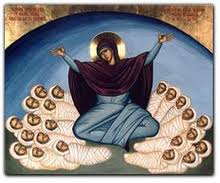 “A voice was heard in Ramah sobbing and lamenting loudly: it was Rachel weeping for her children; she refused to be consoled, for they were no more.” Matthew 2:18
Matthew 2:13-23 seems like such an offensive text to be reading so soon after Christmas. And yet, this gospel text, known as the “Slaughter of the Innocents” is indeed the prescribed lesson for the first Sunday of Christmas. Amid our celebrations, and in the midst of the gospel writer’s account of the birth of Christ, this horrendous story of the slaughter of innocents begs the question: WHY? It’s Christmas for heaven’s sake! My preaching professor, used to remind us of the first question that we should ask when we are preparing a sermon on a particular text. After reading the text over several times,we were encouraged us to ask the obvious question. “So What?”
So What? Well for this child of the sixties, only one Christmas song comes to mind when I read of the slaughter of the innocents, it’s the one Christmas song that asks the question: So What? We’ve just celebrated Christmas? So what does this mean? Please listen. “So this is Christmas?”
John Lennon was murdered on December 8, 1980. Shot by a deranged fan. And so is it any wonder, the melancholy why in which he sang this song, haunts our Christmases? So, what possible difference can Christmas make? We haven’t even had a chance to finish our celebrations and the news is far from good. Thousands continue to die in Sudan, Palestine is a mess. The people of the Philippians continue to suffer in the aftermath of disaster. Militants in Afghanistan are growing stronger despite the presence of foreign forces, violence and death are the order of the day in Syria where hundreds and thousands have been slaughtered. Millions have died in Darfur and still the world cannot find a solution so today thousands more will se-come to starvation and genocide. The war on Terror rages on as one side scores points on the other at the cost of human flesh and the word “drone” has taken on a horrific meaning. AID’s continues to ravage Africa and still we withhold the money and the medicines that could save millions. Hunger continues to claim the lives of the poor despite the fact that we have more than enough food to feed the world. Poverty continues to enslave millions the world over.
Rachel’s children—our children, yours and mine—born for love and mercy, die from neglect and ugliness and Rachel weeps bitterly. There’s a little book of prayers called: “Children’s Letters to God”. The prayers in that book have the power to make you smile and cry all at once. The very first letter to God in that book reads: “Dear God, in Sunday School they told us what you do. Who does it, God, when you are on vacation?” We may smile, but sometimes it feels as if for all intents and purposes, God is on vacation. For surely God would not stand idly by and allow so many innocents to perish?
Once we broaden our images of God; the source of our being, the One who dwells in us, we can begin to see that the place where we have traditionally located the Divine One changes from up there to in and around here and we can begin to seek God not out there but within and around us. If God is on vacation, it is because we are on vacation. For the Divine one works in, with and through us to sooth the pain caused by violence and greed.
So, let me assure you sisters and brothers, our God is not on vacation. Despite appearances to the contrary, our God is not absent, but God is surely weeping. For in Christ God showed us the way. The Christmas story insists that our God is in-fleshed and dwells among us. This changes everything. It’s not enough to pray with words expecting some far off deity to change the world. The changing of this world will happen when we begin to live into our full humanity and the sacred nature of our very being shines forth with LOVE. In, with and through us is how the LOVE we call God changes the world.. For we are God’s people on earth; Christ’s body on earth and it is through Christ’s body that God will save the innocents. There’s no time for us to waste feeling overwhelmed by the magnitude of the problems. It’s time for us to roll up our sleeves and get busy.
There’s a song that helps me to remember the hope born in Bethlehem. These Hands
And so this is Christmas… Rachel weeps. We’ve been on vacation long enough. Our God has taken on flesh and dwells among us! It’s time for the work of Christmas to begin again. We are God’s hands!
 During these twelve days of Christmas we celebrate the birth of the Messiah. Messiah, is a word the ancient Hebrews used to describe the anointed one. The one whom God would send to change the world. In Greek the word for Messiah is Christ.
On this Boxing Day, my thoughts swirl around a poem written by the unknown writer of the Gospel of John in which the birth of the Christ is describe as the WORD. It’s a mysterious cosmic poem that moves our minds away from the mundane everyday ordinary stuff of life to the extra-ordinary mysteries of creation, which when you think about it is what every birth does.
Just holding a newborn in your arms and before long you’ll find yourself pondering the mysteries of this life. Who are we and where do we come from? Why are we here? What does it all mean? These are all perfectly wonderful questions and speculating upon the many possible answers to those questions is a fascinating process. But in the end, our words will always fail us when it comes to answers. As we are speculating about the birth of this beautiful little baby, the baby is alive and among us, and needs to be fed and changed, nurtured, guided and protected.
Our speculations about the mysteries of creation are a little like our preparations for Christmas. All the preparations, the decorating, the shopping, the wrapping, the stuffing, the cooking, and the worrying, and in the end all our preparations aren’t really the point. The point is it’s Christmas day and the guests are here or we’ve arrived and the gathering is upon us, or not, and its up to us to welcome the Messiah, to celebrate Christmas.
The trouble is that sometimes, we are so preoccupied with the preparations, with the idea of getting it right that we forget the whole point of Christmas is the celebration itself; the gathering of the clan, the being with one another, the opportunity to be present to one another. It’s one of the reasons why I love the stories that the unknown writers of the gospels of Matthew and Luke put together. In those familiar tales we hear a story of a couple of parents who were not at all prepared to welcome a child into the world. It’s an earthy story that brings the pungent aroma of a animal dung right into our carefully decorated living-rooms. And the Messiah that we greet in the story found in Matthew has no halo hovering over his head. The writer of Matthew makes it very clear that the Messiah comes from a very dubious pedigree, numbering a prostitute, a product of incest, an adulteress and sexual trickster among his ancestors. The Messiah’s parents were an unwed teenage girl and an unspeaking father, who wasn’t a father, and the pair of them appear to be homeless and then on the run, seeking shelter wherever they can find it.
Our romantic notions of a pretty little stable will have to wait a thousand years for St Francis to pretty up and launch us on a quest for cattle lowing, shepherds kneeling and magi bowing. Our expectations of the Messiah have become so very highfalutin, so otherworldly that I wonder if we are really prepared to welcome the Messiah this very morning. We hardly know what to expect from the Messiah. Are you really ready to welcome the Messiah? What do you expect?
There’s an old Jewish story, I can’t remember where I first heard or read it. I suspect I might have learned it from Scott Peck? The story is now deep in my bones. It surfaces most Christmas mornings to remind me that Christ is born in us.
Once there was a monastery with a long history of commerce and a thriving spiritual community. But as time wore on, fewer and fewer villagers visited the hallowed halls. Fewer people turned to the monastery for advice. Even the sale of their famous wines began to dwindle. The abbot began to despair for his community. “What should they do?” he wondered.
They prayed daily for guidance, but the brothers only became more dispirited. The monastery itself reflected their mood, becoming shabby and untidy. At last the Abbot, hearing that a wise Jewish rabbi was visiting, swallowed his pride and went to visit the rabbi to ask his advice. The abbot and the rabbi visited for a long time.
They talked of their respective religions, and the fickleness of human nature. The abbot explained his problem to the rabbi and asked for advice, but the Jewish sage only shook his head and smiled.
As the abbot sadly departed, the rabbi suddenly rose and shouted after him, “Ah, but take heart my friend for the Messiah lives amongst you!” All the way home the abbot pondered the rabbi’s words, “The Messiah lives amongst you.” What could he mean? Did the Messiah live in the abbey? The abbot knew all the brothers very well. Could one of them really be the Messiah? Surely he, the abbot, was not the Messiah… Was it possible?”
Upon reaching the monastery the abbot confided the rabbi’s words to another brother, who told another brother, who was overheard telling another brother. Soon the whole abbey had heard the news. “The Messiah lives amongst us!” “Who do you suppose he could be?”
As each brother speculated on who the Messiah could be, his view of his brothers began to change. Brother Louis no longer appeared simple, but rather innocent. Brother Jacques was no longer uncompromising, but rather striving for spiritual perfection.
The brothers began to treat each other with greater respect and courtesy; after all, one never knew when he might be speaking to the Messiah. And, as each brother discovered that his own words were taken seriously, the thought that he might become the Messiah would cross his humble mind. He would square his shoulders and attend his work with greater care and start acting like a Messiah.
Soon the neighboring villages began to notice the change that had come over the monastery. The brothers seemed so happy. Villagers flocked to the monastery and were energized by the spirit of the Brothers. And so the spirit grew and the monastery flourished. As each new brother was welcomed, the question arose, “Could he be the Messiah?”
Apparently the monastery still prospers today and it is often whispered both within its walls and in the surrounding towns that the Messiah lives amongst them. As you celebrate Christmas this year, remember that the Messiah lives among you.
If you are waiting for perfection, Christmas is going to be a lonely and frustrating time. If you are waiting for some future time, the wonders of this moment will pass you by. If you are expecting salvation outside yourself, you might miss your own wisdom. If you hold your loved ones to impossible standards you just might miss the Messiah who sits right next to you. I know that you’ve worked hard, and made all kinds of preparations, but today is the day it’s time to greet the Messiah, now. Don’t miss a moment of it. Enjoy. The Messiah arrives in you and right next to you! Enjoy!
One of my favorite Christmas movies. Produced in England in 1952, there is no sentimentality here. The story is raw and engaging. Clergy will hear the echoes of their lives in the frustration and doubts expressed by the Parson who is brilliantly portrayed by Ralph Richardson. This movie was censored in the United States because too many of the characters do not believe in God and say so. The ending does not resolve their unbelief. It is a brilliant snapshot of another time that reminds us that the good old days never really where. I love this film’s honest unresolved angst. Enjoy!
 Listen to the Christmas Eve sermon
Christmas Eve sermons are a challenge for any preacher who takes the gathering of folk on a dark and holy night seriously. I am indebted to Marcus Borg, John Dominic Crossan, Parker Palmer, Michael Morwood, Matthew Fox, and Michael Dowd for much of the inspiration for this sermon.
John O’Donohue is a poet whose words open me to the Divine who lives and breaths in me. Here his poem “Beannacht” which translates as “blessing” is read as a prelude to a very ordinary rendition of O Holy Night; surely it is in the ordinary that we are met by the Divine. May each of you find your Beannacht in the ordinary stuff of this your Holy Night.
 Several years ago Lesley attended a small church in the suburbs. Every year toward the end of Advent the members of this church would create a living nativity. About a week before Christmas when most people were busy getting ready for the holiday they would conscript a few volunteers to begin the preparations for the living nativity. Out on the front lawn of the church, the volunteers would slap together a few boards in the shape of a stable. Costumes would be created out of old sheets and bathrobes so that children from the congregation could be dressed up as Mary and Joseph, shepherds, angels and wise folks. Then the children would be arranged in the make-shift stable so that people passing by in their cars would be reminded of what took place in Bethlehem on the first Christmas. The church was located at a fairly busy intersection and year after year, Lesley would marvel at the fact that the living nativity had never caused an accident, as drivers strained to see a motley band of children pushing and shoving each other inside what only remotely resembled a stable.
The living nativity was the brainchild of Deedee the dreaded church organist. Deedee was a rather severe woman, who always wanted everything to be done just so. Deedee worked hard to plan various grand events that she felt would benefit the congregation. But somehow, Deedee’s grand plans were always beyond the capabilities of the volunteers that she usually managed to conscript. Over the years, people in the congregation learned to hide whenever they saw Deedee coming toward them with her clipboard. If Deedee managed to corner you and your name got put onto her clipboard, you were sunk. Once your name was on the list, you were one of Deedee volunteers. Deedee’ s conscripts never really knew what it was they had volunteered for until they arrived for their first rehearsal. And by then it was too late, because Deedee had never been known to let a volunteer slip through her hands. Continue reading
Our worship service was cancelled at Holy Cross this morning. So, there is no recording of the sermon. Just this transcript of what I intended to preach. Transcripts never fully reflect a sermon; all the tangents that occur in the moment are missing from transcripts. So, this morning you will have to provide your own tangents. Enjoy!
The icy weather is playing havoc with the usual hustle and bustle of the season. Usually, the church’s season of Advent offers a sanctuary from the endless demands of preparation for the big day. Our Christmas traditions, if they are to be maintained, require a great deal in the way of preparation. But there’s one Christmas tradition that I’ve been enjoying since I was a child that requires little or no preparation save for the effort to carve out the time, when time seems to be in short supply. Somehow over the years, I’ve never missed the opportunity to watch the old black and white version of Dickens’ classic, A Christmas Carol. There is of course only one portrayal of Ebenezer Scrooge that will do.
 If it’s not Alistair Sim, it’s just not Scrooge. I usually wait until Christmas Eve to watch the movie. But this year I found the time to read the book and I’ve got to say, there is much in Dickens exploration of Christmas that I’ve been missing over the years.
In the words of Charles Dickens: Ebenezer Scrooge “was as cold and miserly a man as one could ever meet. “He was a tight-fisted hand at the grindstone, Scrooge! A squeezing, wrenching, grasping, scraping, clutching, covetous, old sinner! He carried his own low temperature always about with him; he iced his office in the dog-days; and didn’t thaw it one degree at Christmas.”
Ebenezer Scrooge’s transformation on Christmas Eve is nothing short of a miracle. Scrooge was a broken man. Broken, years before the story begins. The women he loved, Belle, broke her engagement to him one Christmas, she tells Ebenezer, “you fear the world too much. All your other hopes have merged into the hope of being beyond the chance of its sordid reproach. I have seen your nobler aspirations fall off one by one, until the mast passion, GAIN, engrosses you.”
Belle doesn’t tell us how this fear of the world developed. She doesn’t tell us what Scrooge’s nobler aspirations had been. We don’t know what made Belle fall in love with Scrooge in the first place—but we do know that whatever it is, it is gone now. As the Ghost of Christmas Past moves through Scrooge’s life we catch glimpses of what may have broken him – a distant father, the death of his much loved sister, his exposure to wealth in the first place – but we are never quite told what made Scrooge the man he is at the beginning of Dickens’ tale. All we know is that Scrooge is broken and greed and anger have possessed his very soul. Scrooge’s life was broken. While he had all of the wealth, and then some, that any person might need – he was miserable.
I used to think that A Christmas Carol was the story of Scrooge’s metamorphosis. The scene in the movie were Scrooge realizes that it is Christmas morning and that life doesn’t have to be the way it has always been and he does that wonderful dance and sings: “I don’t know anything! I never did know anything all on a Christmas morning!” I always thought of that wonderful dance as the culmination of Scrooge’s metamorphosis, like a butterfly bursting forth from a cocoon. But now I see it for what it really is. It is a dance of resurrection. For Scrooge was dead. Dead and gazing at his own tombstone, when suddenly, and suddenly for me always indicates the work of the Spirit, suddenly, Scrooge realizes that what he is seeing are only the shadows of things that might be. Suddenly, Scrooge knows “that men’s deeds foreshadow certain ends. But if the deeds be departed from surely the ends will change!” Scrooge is born again and is able to declare with confidence, “I’m not the man I was.” And so, the resurrected Scrooge becomes all that God intended him to be. Scrooge’s past didn’t go away—the hurtful Christmas memory of Belle ending their engagement, all of the ill-spent years somewhere between the party at Fezziwig’s and the visit of the spirits would still be a part of Scrooge’s life, resurrection doesn’t erase the past, but transforms the future, hope becomes part of the resurrected life! And so, Scrooge reborn, becomes “as good a friend, as good a master, and as good a man as the good old City ever knew…and it was always said of Scrooge “that he knew how to keep Christmas well!” Knew how to keep Christmas well. Keeping Christmas well is very different than celebrating Christmas. Keeping Christmas well is about resurrection; resurrection of our very selves. I always thought of that wonderful dance as the culmination of Scrooge’s metamorphosis, like a butterfly bursting forth from a cocoon. Keeping Christmas well is to forget what you have done for other people and to remember what other people have done for you. Keeping Christmas well is to see your neighbours as just as real as you are, and to try to look behind their faces to their hearts, hearts hungry for human connection, for dignity, for love and for joy. Keeping Christmas well is the realization that the only good reason for your existence is not what you are going to get out of life, but what you are going to give to life. Keeping Christmas well means closing your book of complaints against the management of the universe and looking around you for a place where you can accomplish some good. Keeping Christmas well is remembering the weakness and loneliness of people who are growing old; it means not worrying so much about how much your friends love you but asking yourself whether you love, honour and care for them enough; it means stepping down from your pedestal long enough to see that you are not the centre of the universe; it means bearing in mind the things that other people have to bear on their hearts; trying to understand what those who live in the same home with you really want, without waiting for them to tell you; it means burying your ugly, destructive and selfish motives and nurturing your nobler ones.
Keeping Christmas well includes the realization that your generation is not the last generation; that you have received an astonishing inheritance given by God, that your very next breath of life is pure gift; that all your various abilities and capacities were knit together in your mother’s womb and you had nothing to do with this original blessing, and that the bounty planet earth offers—its beauty and majesty – are both a wondrous blessing and an awesome responsibility; it’s the realization that you have duties to perform as citizens of a free nation in a dangerous world; that matters of war and peace are not just problems for others to solve; that much, if not most, of what goes on in the space around you depends upon your choices and your actions.
Keeping Christmas well is about being fully alive to all that life has to offer and being gracious in your responses to this amazing grace and living into all that God created you to be. When you keep Christmas well you are willing to believe that forgiveness is the doorway to a hope-filled future;
that mercy reflects God’s nature; and that love is the most powerful thing in the universes—stronger than hate, stronger than evil, stronger than death! Keeping Christmas well is living with the knowledge that there is nothing in heaven or on earth that can separate you from the love of God in Christ Jesus. e Scrooge’s metamorphous began, dancing and singing: “I don’t know anything, I never did know anything, all on a Christmas morning.” To keep Christmas well you must first realize that in the grand scheme of things you don’t know anything. For then, in humility, you can see the hope that lies in the manger. The hope of resurrection.
Scrooge knew how to keep Christmas well, may that be said of all of us. And as Tiny Tim said, “God bless us everyone!

As Christmas draws near, we turn to stories to express the inexpressible. Like the Gospel writers we are at a loss to explain the activity of our God in the world and so we too resort to story telling. Families gather and the reliable old stories are told. Each year new stories are added to our treasure troves as we seek to express the inexpressible and touch the hem of our God who is love. What better way to touch and be touched by God than to tell stories of God’s love in the world? We all have treasure troves of stories of Christ taking on flesh and dwelling among us. My story took place when I was a young woman determined that my first Christmas living out in the world would be the type of Christmas that dreams are made of.
It’s a story about the quest for the perfect Christmas. When I was growing up, I always wanted Christmas to be just so. But the reality of life with all its inherent dysfunctions coupled with financial limitations meant that we just couldn’t pull off the perfect Christmas. I used to comfort myself with the notion that when I grew up things would be different. When I grew up, I’d do things better. I’d save up my money so that no one would be disappointed and there’d be enough to ensure that the house would be filled with Christmas cheer! The decorations would be perfect and no family arguments or disappointments would be allowed to ruin my dream of the perfect Christmas. I knew that just as soon as I had my own place, I’d be able to pull off the kind of Christmas that would be so full of peace and harmony that the angels wouldn’t be able to keep from singing. Continue reading
I have been asked to post last year’s Christmas Eve sermon. You can listen to it or read a transcript. The progressive version of God Rest Ye Progressive Christians appears in the transcript. I searched without success for its source. If you know who wrote it please let me know.
Listen to the sermon
Last night, while suffering from a serious case of writers’ block, panic set in as I desperately struggled to figure out what to say to you all this evening. I’d spent most of the afternoon in my office, reading and re-reading chapters, articles and sermons, searching for a way to express the inexpressible. Christmas Eve is a challenge for a preacher. You all know the story so well that there’s nothing new that I can say. Then there’s the fact that many of you don’t make it to church all that often, so we preachers kinda want to make our Christmas Eve sermons something special, in the hope that we might just inspire you to come back some Sunday morning. Add to that the fact that we at Holy Cross fall in to a category of Christianity that has been called “progressive” which means that we’re pretty clear on the fact that the Christmas stories in the New Testament are full of metaphors and symbols that point to various truths about the nature of the MYSTERY we call God, as well as truths about ourselves and our life in the world.
As Progressive Christians living in the 21st century, we are fond of using the best scholarship available as we study the scriptures and so we know that the New Testament stories about the birth of Jesus are not actual historical accounts of the events of Jesus’ birth. So, last night as the panic began to get the better of me, I did what writers do when we are in the midst of a serious block, under the threat of a looming dead-line, I looked for a way to distract myself in the hope that if I gave my brain a rest, something might occur to me. Well by the time I made it back to my computer, I was determined that I’d throw caution to the wind and write a very informative, scholarly sermon which would give you all a progressive Christian view of the nativity. But you can all relax because, thanks to the arrival of an email, you have all been saved from Satan’s power. The email was from a colleague in Australia for whom the Christmas Eve deadline had already come and gone, so he was feeling more than a little smug about having finished his sermon. His message to me came in the lyric of a song, which I’d love to sing for you. But most of you know that with my singing voice it is better that I just read to you what he wrote:
Well after singing that over to myself, I shut down my computer and went to bed. I went to sleep longing for the good old simpler days, when my brother Alan and I could enjoy our very own Christmas Eve tradition of watching the old black and white version of A Christmas Carol; the one were Alistair Sim plays Scrooge. I told myself that if I just went to sleep, something would come to me and I’d wake up knowing just what to say to you all on this night of nights. So, I dozed off with Alistair Sim’s Scrooge dancing in my head and singing, “I don’t know anything. I never did know anything. But now I know that I don’t know. All on a Christmas morning.”
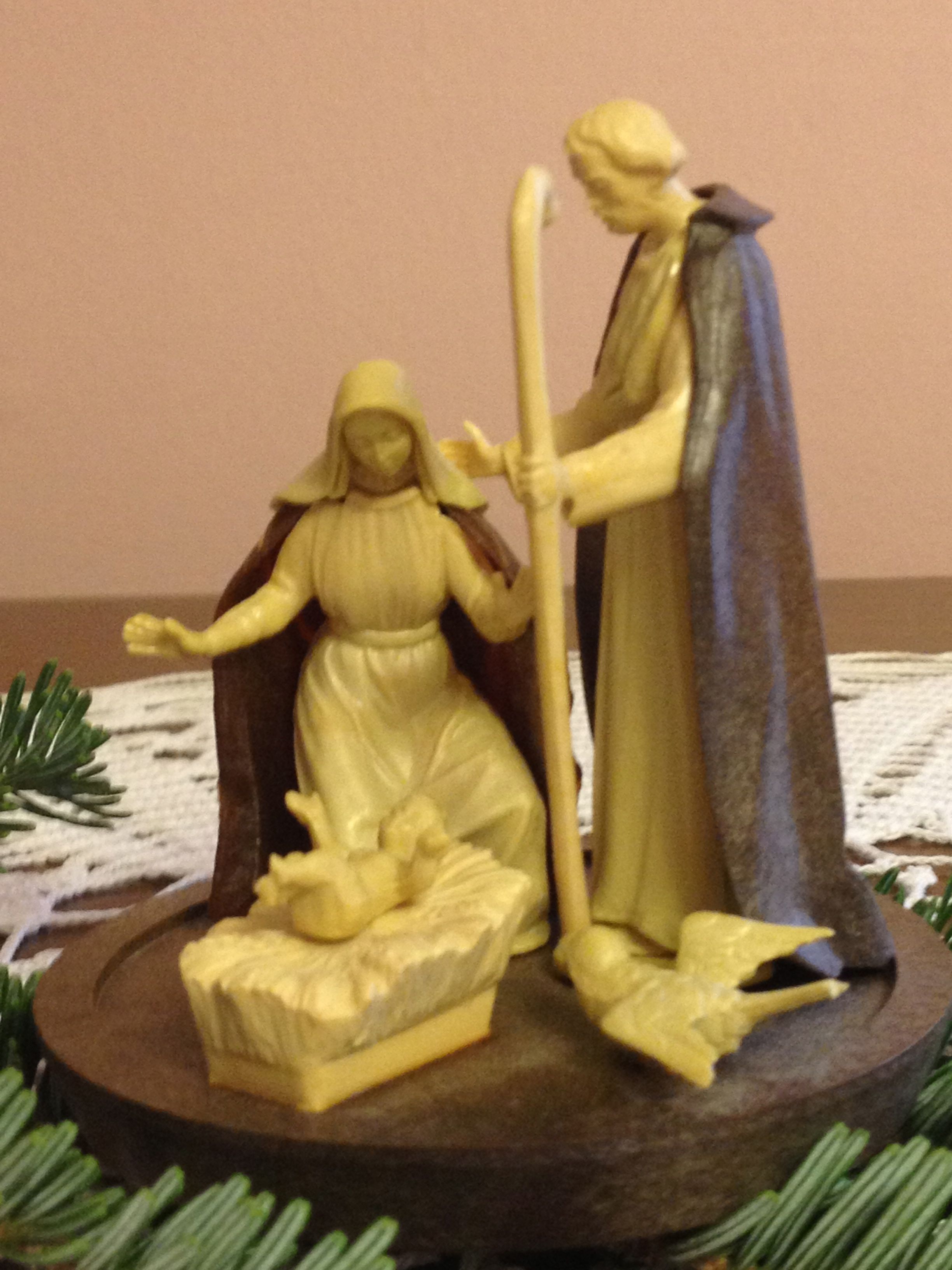 It may be small. It may just be a cheap imitation, but when I look at it I see all the hopes and dreams of all the years as they are told in the story of stories. No more ghosts visited me in the night, but just like Ebenezer Scrooge, I woke up knowing just what I had to do. You see Scrooge wasn’t the only movie that my brother and I used to watch. Alan was particularly fond of science-fiction movies. Sometimes, when he would manage to convince me to watch one of this movies with him, I would complain after just a few minutes in, that the premise was just too unbelievable; I mean really nothing like that could ever actually happen. Alan would remind me that you don’t have to believe them; you just have to watch them, go with the story, see where it takes you. When you really think about it, many of our best-loved stories never actually happened the way we tell them. Take Scrooge for example; does any one of us actually believe that Ebenezer was really visited by three ghosts? We know that it is a story that never actually happened the way it has been told to us; and yet it has the power to take us somewhere, to move us as we watch the incredible transformation of old Scrooge and we too are moved to keep Christmas well. Continue reading
 Historian and spiritual philosopher, Ian Lawton describes the dilemma of those of us who seek to put a “little reason into the season” this way: “Picture the scene. Mary and Joseph are huddled together in a manger surrounded by farm animals. Joseph is drifting in and out of various dreams. Angels fly in and out of the manger singing songs and bringing earth-shattering messages. Three eastern kings gather around Mary and Joseph with gifts. Out of the window a large star can be seen in the day sky. Two sheep sit beneath the window having a conversation. One says to the other, “I don’t know why you’re being so stubborn. Let me go through this one more time. The virgin is having a baby. They’re naming him Jesus because of a dream. Angels told them that their baby would become the saviour of all humanity. Kings travelled hundreds of miles to find the place of birth like a needle in a haystack because they were led by a giant star moving through the day sky. Now which part of this are you having trouble believing?” The Christmas story is fantastic in the literal sense of the word. It is mostly fantasy. Which parts of it do you have trouble believing?
You’re in good company. This story is as unlikely as talking sheep. The laws of nature tell us that sheep don’t talk, virgins don’t have babies, stars don’t travel across the day sky and then hang like a blip over one home and angels don’t sing choruses. Even if a reliable source suggested that something happened that broke the laws of nature, you would demand evidence and there is little evidence for the details of the Christmas story outside of the Bible which has contradictory details. All in all, the Christmas story is highly unlikely. But don’t let details get in the way of a good holiday story, right? If you’re like me, you’re torn between the desire to be true to your common sense that is skeptical and your heart that just wants to let the story be a good story. The good news is that you can have both. You can question the literal account of the story AND you can enjoy the timeless message of the story. You can put a little reason into the season, and still take a yuletide joyride of inspired meaning. The Christmas story is mostly myth, but the message is real and powerful.”
Since the end of the first century, some 1900 years now, the Christmas story has been told. Lately the church has become a little embarrassed by the way in which this story has been told. All sorts of experts have weighed in to tell us that it could never have happened the way we all remember it. Biblical scholars, historians, theologians, bishops, pastors, professors even scientists have cast doubt on the details of the story of the nativity. But even though we know how impossible some of the details may be we cling to this power of the story. Despite the wisdom of the experts, regardless of our doubts this story still has the power to stop us in our tracks. No other story or image is more recognizable to people the world over than the Nativity scene of the birth of Jesus. The images of an angel announcing the birth, a virgin responding in faith, a carpenter leading a woman on a donkey to a stable in Bethlehem, cumulating with Mary and Joseph gazing fondly at the baby Jesus, while the shepherds look on and the heavenly host sing their praises, these images are crystal clear to all of us. The story is part of us; it’s in our bones. Every year this story causes our lives to shift from the routine of winter, to marveling at the wonder of it all, as we enter into a sacred time, where families are drawn together, and strangers greet one another with kindness and from near and far the hope of peace on earth is a dream shared by us all.
Now, I know that somewhere in the deepest darkest recesses of our being, or for some of us, just beneath the surface of this dream, the wisdom of the experts causes a shiver to run across our spines as we wonder how the hope for peace on earth can possibly lie with such an unbelievable story. That shiver used to haunt me, until the day I recognized the power of the truth that lies in the story of the birth of Christ. It happened a few years back, when my youngest niece Sheri Lynn was about three years old. I have three nieces and over the years I’ve gained a bit of a reputation as their eccentric auntie. I can’t help myself, my love of stories and books just oozed over into my role as their auntie. And so to mark every occasion in their little lives their dear old Auntie Dawn showered them with books. Before every birthday, every Easter, and every Christmas every special occasion I could be found in the children’s section of the bookstore, scouring the shelves to find the perfect book that told the perfect story. My family used to tease me mercilessly and insist that I ought to get those little girls something they could play with. But only books were good enough for my nieces. So, you can just imagine the collection of books they have that tell the story of the Nativity. My family are not churchgoers, so on Christmas Eve I used to go to the Midnight service before heading over to my brother’s house to spend the night. Well the year that Sheri Lynn was just three, I arrived at my brother’s house at about 1:30 in the morning. My brother and his wife, my parents and my nieces were all safely tucked up in bed. On the dining room table were the remains of the milk and eating the cookies that had been left for some other visitor. I poked my head into the room where my youngest niece was sleeping. Little Sheri was snorting as little ones do when they sleep. In the glow of her nightlight I could see a rather unusual gathering on the floor by the foot of her bed. Standing upright on the floor was a large picture book opened to show a picture of an empty stable above which a star hung in the night sky. Beside the book was a doll’s cradle; inside the cradle was a naked doll covered only in a tea-towel. Sitting proudly with their legs sprayed out as if they were doing the splits were what could only be Mary and Joseph even tough they looked a lot like Barbie and Ken. Surrounding this scene were all sorts of little people, some smurfs, a few princesses all, no doubt, standing in for shepherds and angels. The most wonderful part was that all of God’s animals were there, not just the donkey, the sheep and the cattle, but giraffes, zebras, horses, pigs, lions, tigers, turtles, alligators, elephants, hippos, bears and even an alligator and a snake. It was just as the prophet Isaiah had foretold a peaceable kingdom were all the animals lived in peace together and where the lion would eat straw with the ox and the wolf and the lamb would lie down together. The great thing about toddlers playing with animals is that in their minds all of the animals can play together. Sheri Lynn knew that the giraffe eats leaves because I saw her holding it up to the Christmas tree so that it could feast. She knew that the horse and the cow and the sheep and the chickens lived over at the Fisher Price farm and that some of the other animals lived aboard Noah’s ark, and that snakes and alligators could be very scary indeed, but on this night all the animals played together, and all of them gathered together at the baby’s cradle to love and to warm and to care for the child, who lay naked and vulnerable before them. Sheri Lynn had created an image of the Nativity story; an image whose details weren’t exactly correct, but an image that told the truth about all our longings during this most holy season. Continue reading


“In Christ there is no Jew or Greek, slave or citizen, male or female. All are one in Christ.” (Galatians 3:28) There has been much ado in the media over ridiculous statements about Jesus’ race. There are those who insist, despite common sense and forensic archeology, that Jesus was a white man. Sadly, these simpletons are running the risk of missing the birth of Christ altogether. For in Christ there is a new creation. Neither black nor white, male nor female, these words fail to define us and so must slip away. Let it be so. Let it be so, soon!

As our Advent waiting continues we hear the cries of John the Baptist who calls to us from the wilderness; a herald preparing the way for Christ. Calling the people to repent, to turn around, to remember who they are and whose they are, heralds are often unwelcome guests in the houses and halls of power. Today, the words of a modern John the Baptist calls out on behalf of the poor and the oppressed. Like the herald of old, Oscar Romero was not welcomed by the rich and the powerful. His words call us to see the face of Christ in the faces of our sisters and brothers. As we hustle and bustle searching for bargains to bestow upon our loved ones, we would do well to remember those who pay the price for our good deals.
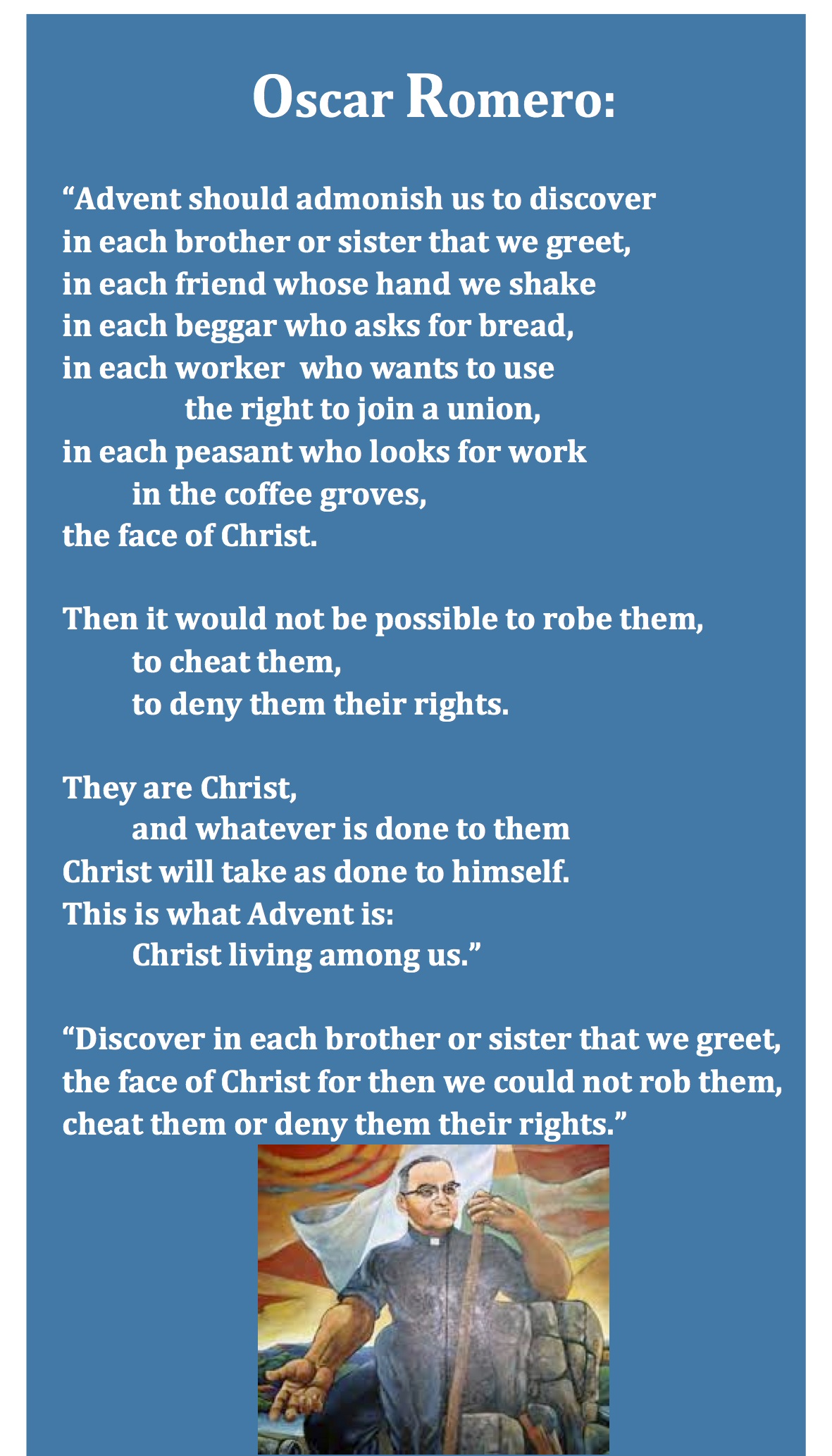
You can learn more about the life and witness of Romero from this excellent film

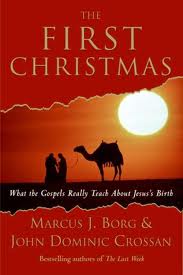 In 2008, our little congregation played host to John Dominic Crossan who has been acclaimed as world’s most famous New Testament scholar. Crossan’s visit to our congregation began with a public lecture based on his best-selling book The First Christmas in which he and Marcus Borg provide a splendid historical outline of the development of the birth narratives. I had the dubious honour of standing before his enlightened audience on Christmas Eve to preach in the great man’s wake. What follows is the Christmas Eve sermon I preached just three weeks after Dom’s illuminating visit.
Just a few weeks ago, this congregation was privileged to play host to a man who has the reputation of being the greatest New Testament scholar in the whole world. Dom, (we get to call him “Dom” now) wrote The First Christmas with Marcus Borg who is the guy who is heralded as the world’s leading expert on Jesus and Christianity in the 21st century. During his lecture, Dom provided us with all sorts of marvellous ways to understand the stories surrounding the birth of Jesus. Ever since that visit, there have been folks who listened very carefully to what Dom had to say and who have been positively gleeful when they’ve asked me what I’m going to do about preaching on Christmas Eve.
I mean what could I possibly say to you after so many of you have just finished hearing from the best in the business! And then there are those of you who bought the book and you’ve read what the experts have to say about the first Christmas. Some of you weren’t able to hide the smirks when you wondered out loud just exactly how I’d go about following the eminent Dr. John Dominic Crossan.
I don’t mind confessing that on several occasions since, I’ve woken up in the middle of the night and wondered what on earth I’d say to you this evening. Even those of you who didn’t manage to hear Dr. Crossan; you’ve probably seen him on TV this week on one of the dozen or so, documentaries on which he appears as the expert scholar who the media turns to in order to unravel the Mysteries of the Bible or to dig up the truth about Jesus. In this the age of information, you can simply go to YOUTUBE or to ITUNES U and download all sorts of podcasts where you’ll discover what pastors have been learning at seminaries for decades as the academic world has unlocked so many of the secrets of the ancient world in an effort to discover the real truth about what may or may not have happened so very long ago. Ever since: “The shepherds returned, glorifying and praising God for all they had heard and seen, as it had been told them.”
Since the end of the first century, some 1900 years now, the story of the nativity has been told. Lately the church has become a little embarrassed by the way in which this story has been told. All sorts of experts have weighed in to tell us that it could never have happened the way we all remember it. Biblical scholars, historians, theologians, bishops, pastors, professors even scientists have cast doubt on the details of the story of the nativity. But even though we know how impossible some of the details may be, we cling to this powerful story. Despite the wisdom of the experts, regardless of our doubts, this story still has the power to stop us in our tracks. No other story or image is more recognizable to people the world over than the Nativity scene of the birth of Jesus.
Tonight the images of a stable in Bethlehem, with Mary and Joseph gazing fondly at the baby Jesus, while the shepherds look on and the heavenly host sing their praises, these images are crystal clear to all of us. The story is part of us; it’s in our bones. And every year this story causes our lives to shift from the routine of winter, to the marvel of this night, when families are drawn together, and strangers greet one another with kindness and from near and far the hope of peace on earth is a dream shared by us all.
Now I know that somewhere in the deepest darkest recesses of our being, or for some of us, just beneath the surface of this dream, the wisdom of the experts causes a shiver to run across our spines as we wonder how the hope for peace on earth can possibly lie with such an unbelievable story. That shiver used to haunt me, until the day I recognized the power of the truth that lies in the story of the birth of Christ.
You see truth is an amazing reality. Truth is never simple. And yet truth is quite simple really. At least for those who have eyes to see and ears to hear. But before I tell you about the truth, let me do what I do every Christmas Eve, Let me tell you a story. It’s a true story about a story about a story.
You see, the easiest way I know to reveal the truth about a story is to tell a story that sheds light on a story. It’s the most ancient way to reveal the truth and it’s the way that Jesus used when he wanted to reveal the truth about the scriptures.
This story took place just about two weeks ago. Our Confirmation students had gathered together for our last class before the Christmas break. Their final assignment was due. Each of the students was required to tell a story that revealed something about the nature of God. They were asked to write a gospel according to them.
One by one they got up and from this very pulpit and they told their gospel stories. I asked one of the students for permission to re-tell their gospel story this evening. The student agreed on the condition that I not reveal to you who actually wrote the story. Which is perfect really because despite all our best efforts nobody can really say who actually wrote the four gospels attributed to Matthew, Mark, Luke and John. So, here I give you the gospel as it was told by one of Holy Cross’ confirmation students and recorded, after a fashion, by me.
It was a cold and snowy night in the town of Newmarket and a homeless couple wandered the streets of Davis and Yong searching for shelter and warmth. They were a strange looking couple; a man and a very, very, very, fat woman.
They were dirty and grubby and they wore layers and layers of clothes trying to  keep warm. They’d been wandering for a very long time and they were very, very, very hungry.
So they trudged up to Wendy’s, hoping to get a warm meal. But when they made their way up to the counter the guy behind the counter shouted at them and said, “Get outta here! We don’t serve fat people at Wendy’s!”
So the hungry couple headed over to Tim Horton’s, but the woman was so fat that she couldn’t fit through the door so the people told her to go away cause there was no room for fat people at Tim Hortons.
So, on they trudged up to MacDonalds and low and behold the fat woman made it through the door and the man managed to get the servers to provide them with a warm meal and just as they were settling into a booth, there appeared a great flood!
And the very, very, very, fat woman leaped up onto the table, right there in the middle of MacDonalds! And the woman began to scream and moan. Because she wasn’t just some fat homeless person, she was with child. And after a lot of screaming and moaning a baby was born in the city of Newmarket. And all the people rejoiced! For unto us a child was given, a child born in the poverty of MacDonalds. For if God came to earth today, God would come where we least expect God to be.
The Holy Gospel as it is told by a young person of this congregation. Thanks be to God.
So, if your struggling over some of the details of the nativity story, if the experts have left you perplexed, cynical or worried, do not be afraid, for I bring you tidings of great joy. The story is true, every last word of it is true. For just like Dom so wisely revealed to us, the story of the nativity is a parable and like all parable’s it represents a truth that cannot be fully expressed in words. Like all good parables the truth is not to be found in the details, but rather in the Spirit of God that breathes life into the parable. It’s a parable about so many things, but most of all it is a parable about peace on earth giving glory to God.
Now there are many down through the ages that have tried to weave stories of peace on earth, but none so everlasting as this. And yes some of us would have rather have had a road map or an expert to set us on the path to peace. But alas, all the experts have failed in their efforts to guide us. The truth that they impart has been rejected. So, once again we are left with this parable. A story so simple that even a child can understand it. A parable that depicts the truth that was experienced by those who walked and talked, loved and learned from Jesus. And the truth echoes through the centuries and the message is clear to everyone who has ears to hear.
“And suddenly there was with the angel a multitude of the heavenly host praising God and saying, “Glory to God in the highest heaven, and on earth peace, goodwill among all people.” And we are left wondering at the power of a love great enough to triumph over death and we claim a Christmas Truth greater than any of the tradition it inspires: the truth of the mystical longing of the creature for the creator—the finite for the infinite— the human for the divine. It’s a longing that transcends culture, religion, language and custom—a longing that is represented tonight for us in the baby in the manger—the sudden, amazing and incomprehensible gift of grace: a God who loved us enough to become one of us.
Yes, we embody the wonder of Christmas in the gifts given, the meals shared, the gathering of family and loved ones. But the greater wonder is that the God who is love incarnate comes down to be among us over and over again. Christ comes to show us how to share that love with a world in desperate need of it— to a world yearning for “peace on earth, good will among all people”.
That shalom—that peace—that unfamiliar hush is the peace on earth I’m praying for this Christmas— the shalom that doesn’t just mean the peace that comes when we’re no longer at war but the shalom that means that all human beings live together at peace with one another and with God, and in right relationship with all of the rest of God’s wondrous creation.
Shalom, the Hebrew word for what we might describe as “turning the human race into the human family” —the peace on earth that we, are called to be about as followers of Christ, not just at Christmas but all year long. The truth is that peace is the only way we can truly give Glory to God.
Peace is the only way to insure that every child born into this world will have an opportunity to play, to learn and to grow. To accomplish peace on earth we will all have to go out into this Christmas night and into this New Year and put our faith into action. That means prayers and protests; speaking up and stepping out; offering whenever and wherever possible the Good News of God’s shalom and realizing the truth of the angels chorus. For we are the followers of the one whose birth they herald. Howard Thurman, a fellow follower of Christ, put it best declaring that:
So, dear friends, rejoice and be glad, for unto us a child has been born, a child who is Christ our Saviour. May Christ lead each of us as we go forth to make peace on earth and good will to all. Amen.
 Some have said that the birth of Jesus is the most amazing birth story ever told. Jesus birth narrative heralded the arrival of a child who was praised as the Son of God, the Saviour of the World who was said to be the personification of peace on earth; God incarnate; fully divine and fully human. Not everyone agrees that this is the most amazing birth story ever told. Indeed, the story of Jesus birth can’t even claim to be unique. Some claim that Jesus’ birth story is just one of a long line of birth stories. Jesus’ birth story, some claim, is only considered to be unique because it’s our story; a story we tell over and over at the expense of other birth stories that are just as great. Well it’s really not all that difficult to Google “greatest birth story ever told”, select one or two of the greats and put them together to expose Jesus’ birth story as one in a line of ancient birth stories. Allow me to demonstrate.
Among the ancients, some insisted that the story Alexander the Great’s birth was  the greatest story every told. Alexander the Great’s birth story is truly one of the greats. He was, after all the, son of a Queen and a god and a king. His mother, Olympias was a Queen, betrothed to Philip of Macedonia. The night before they were married, Queen Olympias dreamed that a thunderbolt fell upon her body, which kindled a great fire, whose divided flames dispersed themselves all around her, and then as if by magic they were extinguished. Philip dreamed that he sealed up his Queen’s lady parts with a seal, which bore the impression of a lion. The high priests who interpreted the dream warned Philip not to even entertain the idea of consummating the marriage because one wouldn’t go to the trouble of sealing up something that was empty. So Queen Olympias must already be with child, who would undoubtedly be a boy with the courage of a lion. If that wasn’t enough to put Philip off he found a serpent lying beside Queen Olympias as se slept, which was said to have abated his passion. Later the oracle of Apollo at Delphi went on to explain that this was no ordinary serpent, no this was the incarnation of the God Zeus. The day that Alexander the Great was born, one of the Seven Wonders of the World burnt to the ground. The temple of the goddess Artemis in Ephesus was the home of the Goddess Artemis who was said to have been attending to the birth of Alexander at the time. Alexander the Great was heralded as the Son of God and Saviour of the World and as one of the greatest warriors the world has ever known, he went on to conquer a good portion of the planet. Continue reading
 pastordawn