The Power of Love Who Lives In Us: a Christmas Eve Sermon

cloth nativityA sermon preached on Christmas Eve 2011 at Holy Cross Lutheran Church.

It has been said that the shortest distance between humanity and the truth is a story.[1]  Tonight, as we celebrate the greatest story every told, we also celebrate our own stories. As families gather and festivities progress we will tell our stories to one another; stories that move us to a deeper understanding of who we are; stories that in their own way compliment the greatest story ever told. Every family has them, those little stories that we love to tell one another because they remind us of our deep connections to one another or reveal a truth we treasure in one another. Christmas is a time for stories old and new, stories grand and glorious, happy and sad stories that will cause us to remember, to laugh and to cry.

So, this evening, my story, like the story of Jesus birth, begins with the stories of two pregnant women. The Jesus’ story begins with the stories of Elizabeth and Mary, two cousins who were great with child. My story begins with the news that two of my nieces Ashley and her sister Sheri Lynn, were also pregnant. Ashley was expecting her first child, Sheri Lynn her second. My niece Sheri Lynn’s little girl is my great-niece Isabella.

Isabella is just 3 years old and last month she and her mother, Sheri Lynn, travelled here from Vancouver, so that Isabella could be the flower-girl at my wedding. Before they arrived the story was already being told of Isabella’s response to the news that her Aunt Ashley was going to have a baby and that that baby was going to be a little boy. Isabella proudly announced that her Aunt Ashley’s little boy was going to be her new little brother. Well meaning adults tried to correct Isabella by gently telling her that her Aunt Ashley’s little boy would in fact be her cousin and not her brother. But Isabella insisted that he would be her brother. Various family members tried to convince Isabella that the baby her mommy was expecting would be her little brother or her little sister, but the little boy that her Aunt Ashley was expecting would be her cousin. But no matter how hard or how often they tried to explain it, Isabella went on insisting that her Aunt Ashley’s new baby would be her brother.

One day, while they were visiting, I snapped at the chance to look after Isabella while her mother did some sightseeing. I had some errands to run and it was marvellous to have a little 3 year-old along to help me. It gave me the opportunity to do some great-auntie stuff. And that’s how Isabella and I ended up in the local Christian bookstore trying to find a lightweight nativity set that she would be able to carry home with her on the airplane. I wanted her to learn to tell the greatest story ever told in her own unique way. Continue reading

Emmanuel, God-Is-with-Us: Michael Morwood

Image

A Christmas Prayer

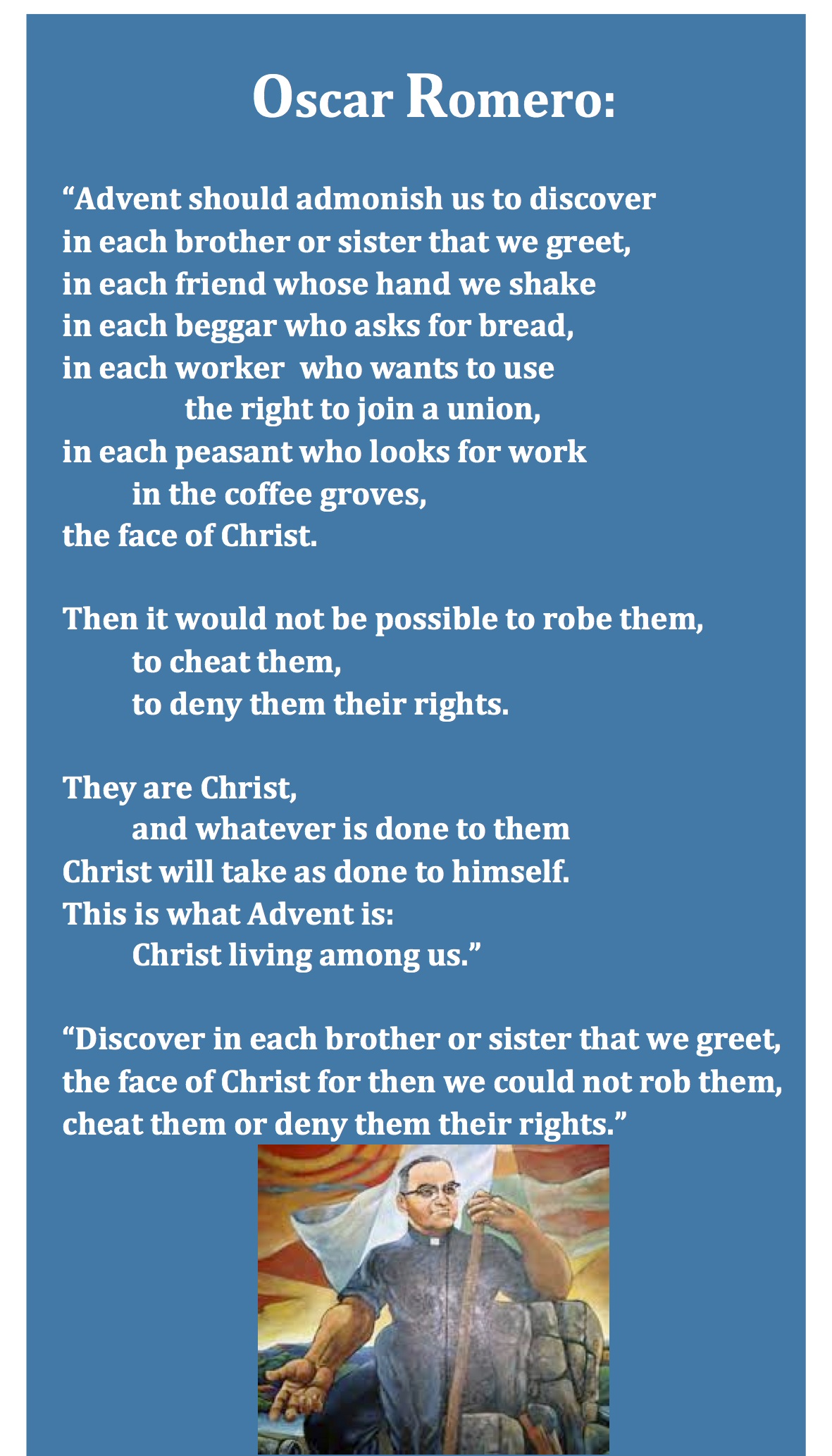
Discovering the Face of Christ

John the baptist blue

As our Advent waiting continues we hear the cries of John the Baptist who calls to us from the wilderness; a herald preparing the way for Christ. Calling the people to repent, to turn around, to remember who they are and whose they are, heralds are often unwelcome guests in the houses and halls of power. Today, the words of a modern John the Baptist calls out on behalf of the poor and the oppressed. Like the herald of old, Oscar Romero was not welcomed by the rich and the powerful. His words call us to see the face of Christ in the faces of our sisters and brothers. As we hustle and bustle searching for bargains to bestow upon our loved ones, we would do well to remember those who pay the price for our good deals.

Oscar Romero Advent

You can learn more about the life and witness of Romero from this excellent film

2014 ReThinking Christianity Speaker: Michael Morword

Image

Morwood Poster

Preaching Christmas Eve in the Wake of New Testament Scholarship

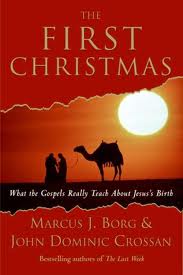
the first christmasIn 2008, our little congregation played host to John Dominic Crossan who has been acclaimed as world’s most famous New Testament scholar. Crossan’s visit to our congregation began with a public lecture based on his best-selling book The First Christmas in which he and Marcus Borg provide a splendid historical outline of the development of the birth narratives. I had the dubious honour of standing before his enlightened audience on Christmas Eve to preach in the great man’s wake. What follows is the Christmas Eve sermon I preached just three weeks after Dom’s illuminating visit.

Just a few weeks ago, this congregation was privileged to play host to a man who has the reputation of being the greatest New Testament scholar in the whole world. Dom, (we get to call him “Dom” now) wrote The First Christmas with Marcus Borg who is the guy who is heralded as the world’s leading expert on Jesus and Christianity in the 21st century. During his lecture, Dom provided us with all sorts of marvellous ways to understand the stories surrounding the birth of Jesus.  Ever since that visit, there have been folks who listened very carefully to what Dom had to say and who have been positively gleeful when they’ve asked me what I’m going to do about preaching on Christmas Eve.

I mean what could I possibly say to you after so many of you have just finished hearing from the best in the business! And then there are those of you who bought the book and you’ve read what the experts have to say about the first Christmas. Some of you weren’t able to hide the smirks when you wondered out loud just exactly how I’d go about following the eminent Dr. John Dominic Crossan.

I don’t mind confessing that on several occasions since, I’ve woken up in the middle of the night and wondered what on earth I’d say to you this evening. Even those of you who didn’t manage to hear Dr. Crossan; you’ve probably seen him on TV this week on one of the dozen or so, documentaries on which he appears as the expert scholar who the media turns to in order to unravel the Mysteries of the Bible or to dig up the truth about Jesus. In this the age of information, you can simply go to YOUTUBE  or to ITUNES U and download all sorts of podcasts where you’ll discover what pastors have been learning at seminaries for decades as the academic world has unlocked so many of the secrets of the ancient world in an effort to discover the real truth about what may or may not have happened so very long ago.  Ever since: “The shepherds returned, glorifying and praising God for all they had heard and seen, as it had been told them.”

Since the end of the first century, some 1900 years now, the story of the nativity has been told. Lately the church has become a little embarrassed by the way in which this story has been told. All sorts of experts have weighed in to tell us that it could never have happened the way we all remember it. Biblical scholars, historians, theologians, bishops, pastors, professors even scientists have cast doubt on the details of the story of the nativity. But even though we know how impossible some of the details may be, we cling to this powerful story.  Despite the wisdom of the experts, regardless of our doubts, this story still has the power to stop us in our tracks. No other story or image is more recognizable to people the world over than the Nativity scene of the birth of Jesus.

Tonight the images of a stable in Bethlehem, with Mary and Joseph gazing fondly at the baby Jesus, while the shepherds look on and the heavenly host sing their praises, these images are crystal clear to all of us. The story is part of us; it’s in our bones. And every year this story causes our lives to shift from the routine of winter, to the marvel of this night, when families are drawn together, and strangers greet one another with kindness and from near and far the hope of peace on earth is a dream shared by us all.

Now I know that somewhere in the deepest darkest recesses of our being, or for some of us, just beneath the surface of this dream,  the wisdom of the experts causes a shiver to run across our spines as we wonder how the hope for peace on earth can possibly lie with such an unbelievable story. That shiver used to haunt me, until the day I recognized the power of the truth that lies in the story of the birth of Christ.

You see truth is an amazing reality. Truth is never simple. And yet truth is quite simple really. At least for those who have eyes to see and ears to hear. But before I tell you about the truth, let me do what I do every Christmas Eve, Let me tell you a story. It’s a true story about a story about a story.

You see, the easiest way I know to reveal the truth about a story is to tell a story that sheds light on a story. It’s the most ancient way to reveal the truth and it’s the way that Jesus used when he wanted to reveal the truth about the scriptures.

This story took place just about two weeks ago. Our Confirmation students had gathered together for our last class before the Christmas break. Their final assignment was due. Each of the students was required to tell a story that revealed something about the nature of God. They were asked to write a gospel according to them.

One by one they got up and from this very pulpit and they told their gospel stories. I asked one of the students for permission to re-tell their gospel story this evening. The student agreed on the condition that I not reveal to you who actually wrote the story. Which is perfect really because despite all our best efforts nobody can really say who actually wrote the four gospels attributed to Matthew, Mark, Luke and John.  So, here I give you the gospel as it was told by one of Holy Cross’ confirmation students and recorded, after a fashion, by me.

It was a cold and snowy night in the town of Newmarket and a homeless couple wandered the streets of Davis and Yong searching for shelter and warmth. They were a strange looking couple; a man and a very, very, very, fat woman.

They were dirty and grubby and they wore layers and layers of clothes trying to macdsxmaskeep warm. They’d been wandering for a very long time and they were very, very, very hungry.

So they trudged up to Wendy’s, hoping to get a warm meal. But when they made their way up to the counter the guy behind the counter shouted at them and said, “Get outta here!  We don’t serve fat people at Wendy’s!”

So the hungry couple headed over to Tim Horton’s, but the woman was so fat that she couldn’t fit through the door so the people told her to go away cause there was no room for fat people at Tim Hortons.

So, on they trudged up to MacDonalds and low and behold the fat woman made it through the door and the man managed to get the servers to provide them with a warm meal and just as they were settling into a booth, there appeared a great flood!

And the very, very, very, fat woman leaped up onto the table, right there in the middle of MacDonalds! And the woman began to scream and moan. Because she wasn’t just some fat homeless person, she was with child. And after a lot of screaming and moaning a baby was born in the city of Newmarket. And all the people rejoiced! For unto us a child was given, a child born in the poverty of MacDonalds. For if God came to earth today, God would come where we least expect God to be. 

The Holy Gospel as it is told by a young person of this congregation. Thanks be to God.

So, if your struggling over some of the details of the nativity story, if the experts have left you perplexed, cynical or worried, do not be afraid, for I bring you tidings of great joy. The story is true, every last word of it is true. For just like Dom so wisely revealed to us, the story of the nativity is a parable and like all parable’s it represents a truth that cannot be fully expressed in words. Like all good parables the truth is not to be found in the details, but rather in the Spirit of God that breathes life into the parable. It’s a parable about so many things, but most of all it is a parable about peace on earth giving glory to God.

Now there are many down through the ages that have tried to weave stories of peace on earth, but none so everlasting as this.  And yes some of us would have rather have had a road map or an expert to set us on the path to peace. But alas, all the experts have failed in their efforts to guide us. The truth that they impart has been rejected. So, once again we are left with this parable.  A story so simple that even a child can understand it.  A parable that depicts the truth that was experienced by those who walked and talked, loved and learned from Jesus. And the truth echoes through the centuries and the message is clear to everyone who has ears to hear.

“And suddenly there was with the angel a multitude of the heavenly host praising God and saying, “Glory to God in the highest heaven, and on earth peace, goodwill among all people.” And we are left wondering at the power of a love great enough to triumph over death and we claim a Christmas Truth greater than any of the tradition it inspires: the truth of the mystical longing of the creature for the creator—the finite for the infinite— the human for the divine. It’s a longing that transcends culture, religion, language and custom—a longing that is represented tonight for us in the baby in the manger—the sudden, amazing and incomprehensible gift of grace: a God who loved us enough to become one of us.

Yes, we embody the wonder of Christmas in the gifts given, the meals shared, the gathering of family and loved ones. But the greater wonder is that the God who is love incarnate comes down to be among us over and over again. Christ comes to show us how to share that love with a world in desperate need of it— to a world yearning for “peace on earth, good will among all people”.           

That shalom—that peace—that unfamiliar hush is the peace on earth I’m praying for this Christmas— the shalom that doesn’t just mean the peace that comes when we’re no longer at war but the shalom that means that all human beings live together at peace with one another and with God, and in right relationship with all of the rest of God’s wondrous creation.        

Shalom, the Hebrew word for what we might describe as “turning the human race into the human family” —the peace on earth that we, are called to be about as followers of Christ, not just at Christmas but all year long.  The truth is that peace is the only way we can truly give Glory to God.

Peace is the only way to insure that every child born into this world will have an opportunity to play, to learn and to grow. To accomplish peace on earth we will all have to go out into this Christmas night and into this New Year and put our faith into action. That means prayers and protests; speaking up and stepping out; offering whenever and wherever possible the Good News of God’s shalom and realizing the truth of the angels chorus. For we are the followers of the one whose birth they herald. Howard Thurman, a fellow follower of Christ, put it best declaring that:

            When the song of the Angel is stilled,

            When the Star in the sky is gone,

            When the kings and the princes are home,

            When the shepherds are back with their flock,

            The work of Christmas begins:

            To find the lost,

            To heal the broken,

            To feed the hungry,

            To release the prisoner,

            To rebuild the nations,

            To bring peace among brothers and sisters—

            To make music in the heart.        

            And to radiate the Light of Christ,

            every day, in every way,

            in all that we do and in all that we say.

            The work of Christmas lies before us.

So, dear friends, rejoice and be glad, for unto us a child has been born, a child who is Christ our Saviour. May Christ lead each of us as we go forth to make peace on earth and good will to all.   Amen.

Midwife Divine Now Calls Us

Jann Aldredge-Clanton not only provides a new hymn-text to the familiar well loved carol, Lo How a Rose, she opens us to beautiful images of God, calling out new birth in us. Enjoy!

The Power of Empathy: Dr Brene Brown

St. Nicholas Is Too Old and Too Tired to Defeat the Selling Power of Santa Claus!

santa_as_satanToday, the Feast of St. Nicholas, the ancient precursor to the modern Santa Claus, will pass without much ado. Some will try to encourage us to resurrect St. Nicholas to save us all from Santa’s powers for we have gone astray.  To those well meaning souls who would rid Christmas of its flagrant consumerism, I can only offer up a feeble, “Baa Humbug!”

The very best traditions about St. Nicholas suggest that he was a protector of children while the worst tradition has him providing dowries so that young girls could be married off by their father rather than be sold into slavery. Meanwhile, the modern character Santa Claus grooms children to take up their role as consumers in the cult materialism. Some parents may bemoan the little gimmie-monsters that their children become, but most adults are rendered helpless by our own remembered indoctrinations and so we join in what we choose to deem as harmless fun.

T’is the season for contradictions.  ‘Tis the season when we prepare to celebrate  the incarnation of God in human form while also waiting for Santa Claus to come down our chimneys. Face it; most of the folks dashing about in the malls are more worried about the imminent arrival of Santa Claus than they are about God. I’d even go so far as to say that a good number of people have unconsciously substituted Santa Claus for God.  Santa Claus and the baby Jesus get into some pretty fierce competition at this time of year; and in the culture the larger loyalty belongs to Santa.

Besides, I don’t believe that consumerism is the most dangerous thing about Santa. So, before you accuse me of being a Scrooge or even a Grinch, ask yourself who it is that most children worship at this time of year, and I think you’ll agree that Santa is the one we’ve all been trained to bow down to, and not just at Christmas. It is difficult to deny that sometimes our view of God has been more influenced by Santa Claus than by Christ?  I dare you to compare the number of children standing in the lines at the shopping centre to get their picture taken on Santa’s lap to the number of children in Sunday School? So many of us made that same trip to see Santa when we were little and when we finally got to Santa’s lap, he asked us the big Judgement Day question that Santa always seems to ask, “Have you been good this year?” There’s only one way to answer that question – even though we may have been as deviousness might qualify us as servants of that other mythical character that begins with santa and ends with  n.  For all too many people this laptop confession begins a pattern for interactions with an image we create of the Father-God, who watches and records our offences, making a list if only for the purpose of forgiving us because an appropriate blood sacrifice has been made on our behalf.

Think I’m being harsh? Just listen to that song that pours from muzak speakers, the song that spells out a theology of Santa Claus.  “Oh, you better watch out.  You better not cry.  You better not pout. I’m telling you why. Santa Claus is coming to town.  He knows when you’ve been sleeping. He knows when you’re awake.  He knows if you’ve been bad or good, so be good for goodness sake. He’s making a list, checking it twice, gonna find out who’s naughty and nice. Santa Claus is coming to town.” The trouble with the theology of Santa Claus is that we keep applying it to God as we try to turn the Creator of all that is and ever shall be into a list-checking, gift-giver, whom we better watch out for, lest we be punished. Why then are we surprised that when our Santa-god fails to deliver or bad things happen to good people, that our childish faith in the Santa-god isn’t enough to sustain our trust?

Santa in his present incarnation is indeed pernicious, but like most mythical characters, he cannot be killed and any attempts to resurrect St. Nicholas to replace him are doomed, for the power of Santa’s materialism will always defeat the dim memories of St. Nicholas and his chocolate money. If we are going to break free of the cult of materialism, perhaps we out to try to convince Santa to use his mythical powers for goodness sake!

Yeah, that’s right, I’m going to say it, it’s time to let old St. Nick and his young assistant Santa die, so that a new Santa can be born; a Christmas resurrection if you will. We need a new Santa capable of changing our consuming ways. If the Coca Cola Company could use the advertising industry to transform St. Nick into Santa, surely we can resurrect Santa using the modern persuasive powers of social media to redesign the old salesman extraordinaire into a mythical character with powers fit for the needs of this century.

blue santina

SANTINA- all decked out in her Advent blue!

Imagine if you will, a new and improved Santina, all decked out in Advent blue, she has the power to open young minds to the needs of our neighbours and travels the world via her magic transporter beam, to gather the hopes and dreams of the poor and oppressed into one internet feed, which she magically imprints in our hearts and minds, so that we change the world, creating peace through justice! 

Oh, wait, we already have such a character. We don’t need St. Nicholas or Santa Claus, nor any new-fangled Santina.  We need the One we’ve always needed. The One who comes in the guise of a person. The One we seek is Christ. The One who lives and breathes in, with, and through us to create peace on earth through justice and love. The One who uses our hands, our feet, our lives to change the world!

Enjoy this version of Let There Be Peace on Earth in which Vanessa Williams uses not only inclusive language, but celebrates the Earth as our Mother!

We Need New Words to Praise the Silent Night Cosmically!

Silent NightSilent night, holy night is a perennial favourite! T’is the season for nostalgia. But what if we are serious about providing more than nostalgia in our worship? Can we, or do we even dare to offer worshippers new images that endeavour to engage our reality? Can we touch the spiritual but not religious crowds that wander into our sanctuaries seeking an encounter with the Mystery we call God, with a hint of our unknowing. Or are we content to address only the nostalgia seekers with safe images designed only to warm and not excite the imagination? Dare we beckon the nostalgia seekers beyond their memories toward the future? I wonder?  Maybe we can summon up the courage to compromise by simply adding a few new verses?  

The challenge belongs to all of us to write new words to enable us to sing our praise with integrity. Here’s a sample, with thanks to Keith Mesecher.

Keep Watch: John the Baptist, Like Christ Has Many Disguises!

homeless-manThere was a  young woman who lived in an apartment, in a very rough neighbourhood.  It was the east end of a very large city.  Many of the people who lived in this neighbourhood got by on welfare, others earned their living any way they could.  The young woman moved into the apartment because it was close to the office where she worked, the rent was cheap and quite frankly she was young and foolish.  She ignored all the warnings of her family and friends and moved into the apartment convinced that she could handle anything that came her way.

Her neighbourhood contained the most unsavoury of characters.  The office where she worked was just down the street from her apartment and every morning as she walked to work she would meet some of her neighbours returning home from an evening of plying their trade on the streets and in the alleys.  Each morning, she would be met at the entrance to her office by an old man named Ed.

Ed had been living on the streets for years.  He was very hairy, very dirty, and he tended to rant and rave a lot.  Ed was a wild man.  He slept on the doorstep of the young woman’s office because it was somewhat protected from the winter weather.  Even though Ed made the young woman nervous, she got used to seeing him in her way.

Ed always gave the young woman a warm welcome when she arrived.  He knew that when she got inside, she would brew fresh coffee. He used to tease her that, she was a sucker for a sad face as he waited patiently for her to bring him a cup of coffee.  They never talked much, though.  Ed would just rant and rave about the injustices of the world.   The young woman never found out how Ed ended up on the streets.  She didn’t know how he spent his days. Continue reading

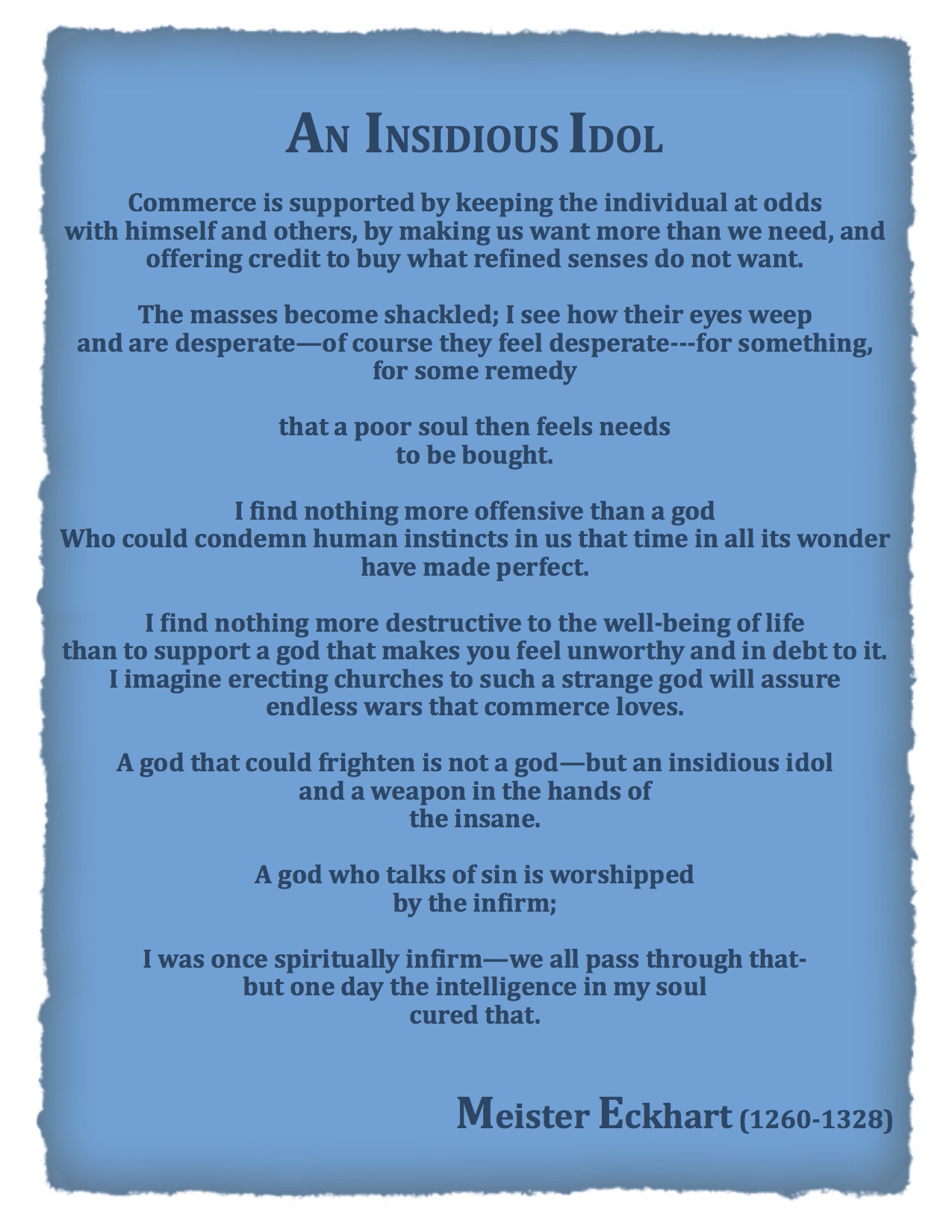
An Insidious Idol – Meister Eckhart

Image

Insidious Idol Meister Eckhart ww.pastordawn.ca

REPENT! TURN AROUND! REPENT! Become the Prophet Crying For the Wilderness! – a sermon preached on the Second Sunday of Advent when John the Baptist Cries

BCsunsetI didn’t know it at the time, but I actually met John the Baptist when I was fifteen years old. She didn’t look much like you’d imagine John the Baptist would look, but she had that same crazy intensity, that same focus on the fact that we’d better change our ways, we’d better repent, and start doing things differently or we’d be in real serious trouble. Lola was my friend Valerie’s mother and she simply couldn’t stop going on and on about the environment and how we were destroy the earth. At the time, I remember thinking she was a bit of a nut-case and on more than one occasion I wished she’d just shut up about it. I was just a kid, and the earth was just something I took for granted.  The earth was just there to provide for our needs. I couldn’t believe how much Lola went on and on about all the stuff we humans were doing to destroy the earth. I just wished she’d leave us along to get on with things, I couldn’t abide her incessant nonsense about how we were going to destroy the planet.  All her feeble little attempts to be kind to the earth, made me seriously question her sanity.

I tolerated Lola not just because she was my friend’s mother, but I didn’t really understand her until one day when the three of us were travelling together. We were coming home from church. I had only been going to church for a few months.  I was trying hard to understand this whole God thing. So, I went to church a lot.  My friend Valerie had persuaded me to start going to church with her and family had become like my second family as they supported me during my first attempts to explore the mysterious world into which I had begun to feel pulled. As we drove home from church, I was feeling a little glum. Try as I might, I couldn’t really understand this church thing; all that singing and praying didn’t really help me to feel closer to God. Mostly I just liked how people at church treated each other.  I liked how they went out of their way to help me feel at home. Whether or not God was there, well I really wasn’t sure. 

Anyway, we were driving along the road.  It was a partly over-cast day on the west coast of British Columbia, just a few clouds.  You could see the mountains off in the distance. We were chatting back and forth when all of a sudden Lola pulled the car over to the far side of the road, switched off the engine and got out.  Valerie followed her mother out of the car, so I figured I had better do the same.  Val and her mother scampered down from the road and onto the beach.  When they reached the water’s edge, they stopped and just looked off into the distance.  Apart from a tanker-ship making its way across the horizon, I couldn’t see much of anything. Lola had the most amazing expression on her face.  She positively glowed with happiness.  Valerie wore a similar expression.  I must have looked somewhat puzzled because Val smiled at me and said,  “Isn’t it the most beautiful thing you have ever seen?”  This only confused me more.  What were they looking at that had made them stop the car, scamper down the bank and stand there at the water’s edge on a cold autumn evening? 

Maybe my parents were right, these religious types are a little bit weird.  Happy, glowing, smiling people make me nervous. There they stood grinning from ear to ear.  What were they on?  And then, I saw it.  For the first time in my life, I saw it.  It had been there before.  But I had never really seen it before. The sky was amazing.  The colours were overwhelming.  It almost didn’t look real.  It looked like someone must have painted it that way.  It was magnificent, a work of art,  the most beautiful thing I have ever seen!

If you’ve never seen a late October, Pacific Coast Sunset before, you’ve missed one of the great wonders of the world. Neither Emily Carr’s paintings nor picture perfect post cards do a western sunset justice. Believe it or not, even though I had been living on the west coast for about four years, at that point I had never before really noticed just how beautiful a sunset could be.  No one in my experience had ever taken the time to stop and look at one. No one had ever pointed one out to me before.  I would never have dreamed of stopping a car and getting out to watch as the sun put on a show while setting. So I stood there. Overwhelmed by it all.  Amazed at just how beautiful it was. Wondering just who or what could be responsible for such a spectacular thing as this.  Before long my thoughts drifted to the Creator. Suddenly this God, that I had been trying so hard to fathom, was there. Right there.  Not just in the magnificence of the sunset, but right there on the beach.  At that moment, I was just as sure of God’s presence as I was of my own. I remember an overpowering feeling  of gratitude, gratitude for God’s presence, gratitude, because for the first time in all my life I was at home.  I knew that I was home. Home, not because of the place; home not because of the beauty of the sunset, but home because of God’s presence.  That longing that I had always felt; that longing that I have always labelled as homesickness, that over-powering longing was gone.  In that glorious moment, the presence of God, filled my longing and I was at home.

I’m sure that each of you could tell of a similar experience. So many of us have been blessed by the presence of God in creation. So many of us have had our longing for God filled by the wonder and majesty of creation. I suspect that our love of creation comes as a direct result of our relatedness to creation. For like creation and everything in creation we share a common Creator. My own love affair with creation kicked into high gear on the beach gazing at the magnificence of the setting sun and it has grown in intensity over the years. This past summer, Carol and I drove out to Vancouver and I have to say, if you want to renew your love for creation, drive across this magnificent country of ours.

You’ll find yourself absolutely besotted with creation as you fall in love all over again. By the time we reached my beloved Rocky Mountains, it was like some star-crossed lover, who simply couldn’t help herself from bubbling over with excitement. Not even the first rainy day of our trip could dampen my excitement as we drove south from Jasper toward the Columbia Ice fields. I couldn’t wait to gaze upon the grandeur of the glacier that I remembered from so many visits over the years. The rain was falling quite heavily as we pulled into the massive parking lot perfectly situated across from the ice-field. As we climbed the steps toward the viewing station, I couldn’t see much because I’d pulled my hood up over my head to protect me from the rain. When I reached the top and looked across the highway, it took my breath away, the mass of ice that was frozen in my memory, was gone.

I’m not sure if the drops of water falling down my cheeks were raindrops or teardrops, as I stood there frozen by a strange mixture of fear and sadness. In the decades that have passed since I first began to visit the ice-fields back in the 1970’s the ice has been receding at a rate of between 10 and 15 centimeters per decade. 120 centimeters may not seem like a great distance, but couple that with a decrease in the thickness of the ice and it is positively shocking to see the amount of ice that has vanished from view.

jokulsarlon-glacier-lakeTake a look at the iceberg that I asked Andrew to hang. This photograph was taken in a place I visited long ago. It’s a place were icebergs are born. I ended up there back in the days when I was in the travel business and ended up on a cheap Air Iceland flight that was delayed for a week in Reykjavík for a week. Back then Iceland’s airline must have had only two airplanes and when one of them suffered mechanical difficulties you literally had to wait around for them to fix it. It’s one of the reasons that flights were so cheap on Air Iceland.  You simply never knew how long your stopover in Iceland might be. I was trapped there for a week and during that time we decided to explore some of the most amazing geological sites that the earth has to offer. We travelled about 400 kilometers outside of Reykavik to the Jokulsarlon Lagoon; the birthplace of glaciers. It was in this strange lagoon, under an eerie twilight that lasted for the entire duration of my stay in Iceland, that I stud on the hull of a small tourist vessel, staring up at a magnificent glacier. I have no words to describe my terror. Continue reading

Has A Progressive Thief Stolen Advent and Christmas? A sermon for Advent One

o come o comeSometimes it feels like a progressive thief has stolen Advent and Christmas from us!  Sometimes being a progressive Christian is about as sad as being a who down in Who-ville; why sometimes I even miss old Santa Claus himself and in my nostalgic haze, I long for a simpler time and faith! How are we supposed to celebrate Advent and look forward to the coming of Christ, when some of the best stories of the season never actually happened they way we’ve been lead to believe?

Readings: Isaiah 2:1-5, “Amazing Peace” by Maya Angelou, Matthew 24:36-44

LEARNING TO WALK IN THE DARK – Barbara Brown Taylor

I have listened  to these lectures several times. Each time Taylor leads me into the darkness something new is revealed. This week, I have been busy preparing for the Season of Advent fearful that I might not be able to capture the anticipation of the season. In a bit of a panic, I shut my eyes and saw the darkness pulsing with a kind of invitation to enter into the sacredness of the dark. So, after a long winter’s sleep, I awoke wondering if darkness itself might be the key to embracing Advent. Over a leisurely breakfast, Taylor’s musings on the power of darkness have opened me to a whole new vision of the wonders and mysteries of Advent.  

Taylor spent fifteen years in parish ministry and was named one of the twelve most effective preachers in the English-speaking world by Baylor University in 1996. She became a professor of religion at Piedomont College in 1998 and also teaches spirituality at Columbia Seminary.  Still a priest in the Episcopal church, Taylor has travelled the world in pursuit of sacred wisdom finding most of what she needed in her backyard.

These 3 lectures are rich in images as Taylor explores the “thick darkness” in which God dwells. The lectures were described as “a negative theology for emergents” and I do believe that progressive Christians would do well to revisit Brown’s mastery of mythic communication. So, if you are afraid of the dark, stumbling in the dark, or intrigued by the dark you will find in these lectures a familiar darkness in which lies beauty and wisdom.  If you are a preacher, take the time to linger over Taylor’s images, you will be rewarded with inspiration. Linger over the richness of her words, you will not be dissapointed!

LEARNING TO WALK IN THE DARK – LECTURE 1

LEARNING TO WALK IN THE DARK – LECTURE 2 – Night Guides

LEARNING TO WALK IN THE DARK – LECTURE 3

Who is this Jesus for Whom We Wait?

Tamar, Rahab, Ruth, Bathsheba, Mary by Sallie Poet

Tamar, Rahab, Ruth, Bathsheba, Mary by Sallie Poet

As we enter Advent to await the coming of Christ, it is important for us to remember who Jesus was. I offer this snippet from an Advent sermon given by Bishop John Shelbly Spong on the first seventeen verses of the Gospel according to Matthew. After exploring the lives of the women the gospel writer includes in the genealogy of Jesus, Bishop Song invites us to re-think our image of Jesus. You can read a rough transcript of Bishop Spong’s sermon here There have been several Advent seasons when we have gone off lectionary in order to facilitate a re-thinking of our traditions. Using Matthew 1 as a gospel lesson has worked well for the first Sunday of Advent.

In this snippet, Bishop Spong invites us to re-think our image of God in light of our knowledge of Jesus. 

You are the Bethlehem point.
Let the power of God in Christ enable you to live and to love and to be.
Let the God presence within you flow through you so that the love of God might
be known among all the people that God has created
and that God still loves.
Be the light and love of the world,
In the name of Yahweh,  Christ, and Spirit, One
Maranatha, Come Lord Jesus.   Amen.

Eternity: That Which Has No End and I Dare Say – No Beginning

Catching StarsIf eternity is beyond the confines of time, then the definition of eternity is that which has no beginning and no end. As wayward snowflakes begin to fall, eventide on this December day promises a very long night. And I can’t help wondering about how long this soul of mine has been kicking around. Does this soul of mine have eternal life: life without beginning or end? I wonder? Does the stardust that continues to live in this body of mine point toward a limitless life? I wonder?  But for now, the wayward snowflakes remind me of falling stars and the dust  which I will one day return to with confidence. Enjoy!

The Rebel Jesus – Advent Greetings from a Heathen and a Pagan

From the very first time I heard it, Jackson Browne’s “Rebel Jesus” has haunted me. In a season dominated by nostalgia, Browne’s stark view of the historical Jesus calls us to remember the one who stood with the poor and the oppressed, the outcast and the wounded. As we enter the season of Advent, can we hold nostalgia at bay long enough to engage our deepest longings and desires for peace? Not some nostalgic peace that stretches only so far as our own needs, or our own loved ones, but the peace that embraces those beyond our circles of care? Can our compassion for the earth and all her creatures move us beyond the idol we have made of the baby in the manger, toward the complexity of embracing the desires and longings of a rebel we probably wouldn’t want to entertain at our festive gatherings? Or will our seasonal madness crucify the rebel once again? 

This year, like all the rest, my challenge is to live somewhere within the tension created by the rebel Jesus and the one his contemporary detractors condemned as a glutton and a drunkard; between choosing life and recognizing my culpability in the cries of the ones still waiting for us to join the rebellion. 

Advent is a time of waiting in the darkness…if we dare…trusting that the light will come…knowing that the light needs reflectors in order to dispel the darkness!  May your Advent be filled with the challenges of rebellion!

Theology From Exile Volume II – The Year of Matthew

Theology from Exile IIAttention progressive christians who despair over the lectionary!!!

A new Church Year brings a new lectionary resource for progressive christians. This coming Sunday, the church begins a new year. Which for preachers and those who partake of our sermons means the beginning of lectionary readings for “Year A”. For those of you who have been spared the need to know, many of the so-call “mainline” churches follow a three year cycle of readings call the Revised Common Lectionary which include four prescribed readings for each Sunday. During “Year B” the gospel readings are largely drawn from the Gospel According to Matthew.

Theology From Exile is written by Sea Raven, D.Min., an Associate of the Westar Institute (that’s right the home of the Jesus Seminar). In the Introduction Raven declares, “This project is grounded in the paradigm-shifting biblical scholarship of Karen Armstrong, Marcus J. Borg, John Dominic Crossan, Robert Funk, and Amy-Jill Levine, as well as the transformative work of Rev. Dr. Matthew Fox, whose theology of Creation Spirituality has reclaimed Catholic mysticism for post-modern cosmology.” Yippie!!! Yippie only begins to capture my delight at having found this resource!!! In addition to providing a lectionary commentary Raven puts her considerable  skills as a worship leader and planner to good use by providing suggestions for liturgical innovations.   I only wish I’d discovered Raven’s excellent work last year’s Volume I – The Year of Luke. 

For colleagues who have the daunting task of preaching in this the 21st century this resource is a must. For those who listen to sermons, you will find Raven’s work to be an excellent resource for Bible Study!!! Raven in her introduction accurately accesses the current conundrum of christianity which she hopes this provocative series will address: “The continued existence of a Christian “faith” as a religious system of belief is clearly under siege by twenty-first century Biblical scholarship as well as the continuing evolution of scientific knowledge. The question addressed by this series of commentaries is whether and how ancestral scriptures remain relevant and revelatory to twenty-first century cosmology.” Amen! Amen! Amen!

Preparing to Preach on Reign of Christ Sunday

basileiaIn the past fifteen years, I have only preached on Reign of Christ Sunday twice. I usually have the presence of mind to book my vacation or some sort of continuing education event for this festival of the church year. Formerly known as “Christ the King Sunday” an attempt to move beyond exclusively male imagery for Christ (in whom there is no east or west, male nor female) some church-folk have attempted to change the name of this festival to Reign of Christ Sunday. But neither title gets away seems to suffice in a pluralistic world. 

Born in an age that was birthing fascist regimes, this particular festival of the church clings to it’s christian imperialist past. Instituted in 1925, by Pope Pius XI,  (you can read the full proclamation here) the festival was designed to remind the world that Christ is the King of the World. The irony of proclaiming Christ as “King” when the life of Jesus of Nazareth positively denies “kingliness” seems lost on the church. The appropriateness of asserting Christ over the religions of the world lacks the kind of humility embodied by Jesus of Nazareth. So, even though it’s too late to book a vacation, I for one would rather not have the task of preaching on this particular festival. 

I was tempted to welcome the congregation on Sunday morning with something like: “Welcome to what I hope will be the last celebration of Reign of Christ Sunday here in this place.” But I suspect that between now and Sunday, I will find it within myself to be somewhat more circumspect. I suspect that rather than proclaiming Christ as the King of the World, I will look at the reign of the current rulers of the world and explore the contrasts between their reign and the justice that Jesus of Nazareth lived and died for.  This video clip seems like the place from which to begin writing the sermon.  

The First Funeral and the Power of Lament

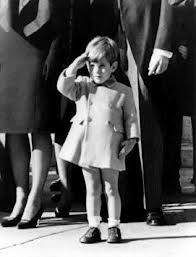
John JohnIn 1963, I was in grade one. My memories of my five-year-old self are vague; filled with blurred images and impressions. But one memory stands out. George Kennedy sat up close in the front row with me. George Kennedy was an odd looking little boy. I only know that he was an odd looking little boy because my classmates were in the habit of teasing him about his looks. I cannot tell you why they thought that he was odd looking because in my memory he looks like a cute little five-year-old boy. George Kennedy and I must have lived near one another because I can remember him walking up ahead of me and so I choose to believe that we were headed in the same direction and not that I was stalking him. My most vivid memory of George Kennedy happened the day that we were all unexpectedly sent home from school.

The crackly voice of the school principal announced over the PA system that President Kennedy had been shot and was dead and we were all told to go straight home. I did not know what a president was, I only knew that Mr. Kennedy was dead and so I remember walking home behind George Kennedy and feeling really bad because George’s daddy was dead.

I have flashes of memory from that week, spent huddled around the TV set with my mother and father, knowing that they were so very sad. I remember their tears. It is my first memory of them crying. President Kennedy’s funeral was the first funeral I can remember attending.  The first three funerals that I remember from my childhood were John Kennedy’s, Martin Luther King’s and Robert Kennedy’s funerals. In my mind’s eye, I can see clearly little John John’s salute, Corretta’s black veil, and Ethel standing there with all Bobby’s children. There is a song from those long ago days, a song that to this day makes me weep no matter where or when I hear it. It begins with the sound of a mournful flute.

“Anybody here seen my old friend Abraham, can you tell me where he’s gone?
He freed a lot of people but it seems the good they die young.
You know I just looked around and he’s gone.”

The sound of the electric organ gives us but a moment to breath as verse by verse our good friends John, Martin and Bobby are snatched from us.  That song is a lament that lives in the souls of those of us who grew up grieving common losses.

There have been other times when we have grieved together, times when we have lamented, like September 11, 2011, our cries of lamentation at the loss of so many lives on a day that forever changed our world. Not all our losses have been shared so widely. Sometimes we have gathered to lament losses that don’t quite make it to the world stage, but which are earth-shattering in their own circles. Sometimes we have lamented the ongoing pain that exists as a result of the lack of justice in this world.

The art of lament, in a world that hungers for closure so that it can be about its business, is a struggling art-form. It seems that our ancestors were so much better and lamenting and could launch forth into wailing and gnashing of teeth with much more abandon than we like are likely to tolerate in public places.

These days we think it unseemly for mourners to wail at a funeral, choosing celebrations of life over the wailing in the face death. But the act of lament has over the centuries played an important part in our human development and I would argue that the act of lament has also played an important role in the life of our God.

Lament is a transformative act. Lament moves us from one place in our lives to another. Lament moves us and thereby transforms our humanity. Lament is very much a part of our human evolution. And so I lament the disappearance of lament from our worship. Lament is the voicing of one’s anguish or complaints to God. 

Lament provides us with the opportunity to gather together and express our anguish in the presence of the ONE who is, was and ever more shall be. The ONE we call God. For in the pit of despair we are made painfully aware that our hope lies beyond ourselves.  Because hope is the only way out of the pit of despair we look to the ONE who is so much more than we can comprehend to through us a life-line and so we wail and weep, and shout and rant until we can begin to know the presence of the ONE. Often, the knowledge of the presence of the ONE comes to us through the presence of one-another. Sometimes, the knowledge of the presence of God comes to us in the very lament itself as we discover God in the midst of our pain. All too often our modern sensibilities tempt us to arrive at hope by trying to avoid the lament. But when we fail to utter our rage over suffering or injustice we tend to arrive at false hope, or failing hope.

Lament allows us to fully engage our despair, and by engaging one another and indeed God in our despair we are transformed. Lament is where we must begin if our rage at the suffering and injustice in this life is to be transformed into peace and justice. Lament is the place where our grief begins to move us from deadness of our shock and horror into a place were we can begin to cope and find healing. Lament is the place where we can begin to discover our God weeping with us; grieving with us and being transformed with us.

There’s a line from the Mystic Meister Eckhart that has been a sort of mantra for me of late: Eckhart insists that: “Every act reveals God and expands God’s Being.” As I look around me at the pain and suffering that exists in the world, I can’t help but lament all the poverty, the violence, and the hatred that exists as a result of our incomplete humanity. Most of us cope with the magnitude of suffering by limiting our exposure to it. We try not to dwell on it because we are afraid that it will overwhelm us and we won’t be able to cope. From time to time we let just a little bit of the suffering in; just a little lest we be overcome by despair. Sometimes we have no choice and the suffering bursts in on us and we are forced to deal with it. Either way, whether we let ourselves be touched by suffering or we have suffering thrust upon us, that suffering transforms us. Suffering can transform us in unhealthy ways or in healthy ways. But suffering will change us. If we have the courage to lament, to engage our God in our rage over the suffering; I mean really engage our God, we can be changed in ways that were once unimaginable.

In our lament we touched the pain of the suffering, we didn’t heal it, we didn’t cure it we just touched it. And the power of our lament changed us. We were changed by their impotent silence. And God, well God was revealed in our lament. And God’s being was expanded. Now I know that some will say that it was our perception of God’s being that was expanded and not God’s being itself.  But to deny that God’s Being is capable of expansion as a result of interaction with us, is to deny the reality of relationship. God lives and breathes in with and through us so our evolution as beings changes God. In with and through us God weeps, God bleeds, God cries and God waits, for transformation. Our lament is an act of trust. An act that declares our intent to wrestle with God, to struggle with God as we begin the difficult transformation into the beings that we are becoming. The power of lament to transform our mourning into dancing, injustice into justice, and violence into peace is transformative. 

Lament is a process, a process of transformation. There’s absolutely no point in lamenting the suffering of the world unless you’re prepared to be touched by that suffering and transformed by it.We are called to suffer with the poor in order that we might lend our strength to transform suffering into life-giving joy. Our God will wipe away every tear from every eye and our God will do this as God lives and breathes in with and through you. Taking up the cross of suffering is not about signing up for suffering for suffering’s sake. Taking up the cross of suffering is about engaging with those who suffer in ways that will forever change the world. It is about lamenting alongside, so that together we can be transformed. Engaging in the act of lament is no easy thing.  But just like the blues, lament has the power to transform our mourning into dancing. To transform our weeping, bleeding, crying, suffering God, into a powerful loving, justice making, peace keeping, God who works in with and through us to transform our world. Let it be so.