Advent Awake! – a sermon for Advent 1A

advent-awakeThis sermon is inspired by the work of the Reverend J. Edwin Bacon Jr. whose retelling of the Rev. Dr. Martin Luther King Jr.’s radical sermon “Remaining Awake Through a Great Revolution” inspires my own musings. Bacon is one of my favourite preachers and it is a privilege to be able to adapt and expand upon his work! Our readings included: “The Star Within” a creation story by Dr. Paula Lehman & Rev. Sarah Griffith, Matthew 1:1-17; and Matthew 24:36-44. Listen to the sermon here 

Perhaps, it’s the deeper and deeper periods of darkness as the nights go longer and longer. Maybe it’s the looming darkness of meaner and meaner politics as we endure the antics of the clown who masquerades as the most powerful man on the planet. Maybe it is the fearful darkness of the lives of half-a-million children trapped in the endless civil war in Syria. Or maybe, just maybe it is just the darkness that descends upon us as we begin to prepare for the most commercial, materialistic season of the year. Whatever the hue of this darkness, sometimes it feels like this is the season for sleepwalking as we stumble from one ritual tradition to another in our routine journey toward Christmas.

Once again the church’s season of Advent invites us to journey into the deepest darkness of our spirituality so that we might light a candle so that all the world might see; see though the darkness, see beyond our fear, beyond the despair, beyond the terror, beyond the mindless consumption, beyond the endless violence, to the hope that lies in the LOVE that we call God. But sometimes all this darkness lulls me into a state in which all I want to do is sleep. All too often, it is as if I am some sort of robotic, zombie, stumbling in my sleep toward the feint albeit unconvincing hope that it will all be worth it in the end. In my sleepwalking stupor I can scarcely even hear the Gospel’s cry to stay awake!  Awake, Awake, and greet the new morn! Keep awake! Wake and watch. Awake, awake, awake, wake-up, wake-up, wake-up. Light a candle against the darkness.

Week after week our Advent celebrations will begin with the lighting of one more candle in the Advent wreath. With each candle, we shine the light of hope, peace, love and joy into the ever-increasing darkness.

Hope, peace, love, and joy these are the dynamics of the enlightenment we little band of sleepwalkers are poked and prodded by the Gospel to offer to our world. Hope, peace, love, and joy, but the overarching value and dynamic represented by the increasing number of candles burning more brightly each week is the dynamic of enlightenment. Light. The ability to see what is going on in our lives. The value of alertness, of watchfulness of consciousness, of awareness.

The physician, Naomi Remen Stone, told Bill Moyers, when he interviewed her about healing and the mind in the early 90s, that all spiritual paths have four steps: show up, pay attention, tell the truth and don’t be attached to the results. Show up. Pay attention. Tell the truth. And don’t be attached to the results.

Jesus, the great healer, emphasized just how important it is for you and me not to sleepwalk through our lives, to wake-up and see exactly what is going on around us. Jesus is not the only religious founder to emphasize the importance of staying awake! The word “Buddha” contrary to popular misunderstanding is not the name of the founder of Buddhism. The word Buddha is a principle not a person. “Buddha” actually means, “awake”. When he was asked if he was a god the founder of Buddhism whose name was Gautama, responded, “No, I am not a God.” “Then what are you?”  he was asked. To which Gautama the man who would become the Buddha answered, “I am awake.” Continue reading

What Needs to Die So that Christ May Be Born In You? a sermon for Advent 1A

window4This sermon was preached at Holy Cross Lutheran November 28, 2010, sadly racism continues to live on in ways that threaten so many lives and the question of this sermon seems even more urgent today. The readings included Isaiah 2:1-5, “Amazing Peace” by Maya Angelou, and Matthew 24:36-44, during the sermon I read from the Qur’an Sura 19:1-30 which you can find by following the link in the body of the sermon.

While I was studying for an undergraduate degree in Religious Studies at the University of British Columbia, I worked as a volunteer women’s center. Because I was studying the religions of the world, women who were being persecuted as a result of religious belief were often referred to me.

I’d been working with a young woman who was being abused by her father and brothers because they felt that she was adopting Canadian ways and thereby abandoning Islam.  I remember visiting her in the hospital emergency room after her brothers had beaten her nearly to death. She told me that the last thing her brother said to her before tossing her out of the back of a van, was that she should consider herself lucky that they had talked their father into letting them beat her, instead of doing what he had ordered in the first place which was to kill her. I sat at her bedside wondering how a brother could do such a thing to his sister. I decided that they must be religious fanatics and I wondered how any religion could drive a father to seek the death of his own daughter.

The next morning I didn’t feel much like going to my Religious Studies Methodology Seminar. The Seminar was comprised of 7 students from various faith traditions along with 4 atheists and 3 agnostics. Together we studied the various methods of studying religion. We were about to embark on the phenomenological approach to the study of religion. “The Phenomenology of Religion” is a fancy academic way of describing the study of actual religious experiences of the divine. As we stumbled to our seats the professor announced that he would be dividing us into groups of two and he wanted us to learn all that we could about our partner’s religious experience. We would have two weeks to come up with a 1,000 words describing on the phenomenology of our partner’s religious life. I was paired with an Imam who was studying Western approaches to religion prior to taking up a position in a local mosque. Ibrahim was a recent immigrant from Pakistan. But he might as well have been from Mars as far as I was concerned. On that day of all days, Muslim men were not exactly my favorite characters. Continue reading

Has A Progressive Thief Stolen Advent and Christmas? a sermon for Advent 1A

o come o comeSometimes it feels like a progressive thief has stolen Advent and Christmas from us!  Sometimes being a progressive Christian is about as sad as being a “who down in Who-ville;” why sometimes I even miss old Santa Claus himself and in my nostalgic haze, I long for a simpler time and faith! How are we supposed to celebrate Advent and look forward to the coming of Christ, when some of the best stories of the season never actually happened they way we’ve been lead to believe?  In this sermon (preached on Advent 1A – Dec.1, 2013) the beloved myths of a birth long ago are proclaimed as  transformational stories that have the power to open to what lies beyond the words to the Word.  Readings: Isaiah 2:1-5, “Amazing Peace” by Maya Angelou, Matthew 24:36-44  

theifI couldn’t believe that this was happening to me.  You read and hear about it in the newspapers and on TV, but you never expect it to happen to you. You know that it happens all over the place, but you somehow believe that you are immune to the dangers. You take precautions, you’re not stupid, but you can’t live your life in fear. Then one day, when you least expect it, you find yourself face to face with a nightmare.

The back alley of a downtown street sounds like a risky place to be; a place you should never go alone. But when it’s the alley behind your own apartment building, the alley where you park your car, well you take the risk. Sometimes it made me nervous, sometimes I would rush from my car to the apartment because I thought I heard something in the darkness. But most evenings, I never gave the dangers of city life much thought and then one night, when I wasn’t expecting it, it happened. I was half way across the alley when from behind a parked car, he jumped out at me. He grabbed me by the arm and spun me around.  There was no time to think – – pure terror filled my mind. He pushed me up against a wall and for a moment just a moment I thought the unthinkable. Every fiber of my being decided immediately to resist and I managed to shake him off. That’s when he pulled out the knife. It wasn’t much of a knife really, just a tiny penknife, but it had the power to capture all my attention. His hand was trembling.  I took my eyes off the knife long enough to see that his whole body was trembling. I took a deep breath and looked him in the eyes.  His face was filled with fear. Sweat was dripping down from his forehead. He was breathing with a great deal of difficulty. We stood there in the darkness, staring at one another, both of us breathing heavily.

“Money!  Money give me your money!” Never did I ever imagine that these words would cause relief. He wasn’t after me; he was after my money. Then I realized that I had no money. But he didn’t believe me.   So, I tried to explain that I never carried cash. I use my bankcard for everything. I could see the panic race across his face. He was in bad shape. He needed money. No doubt he needed a fix. But I had no money on me.

What kind of fool walks around in the city without any cash?  I decided that if he was in as bad a condition as he looked, I just might be able to convince him. So, I told him that I had about twenty dollars upstairs in my apartment. I begged him to let me go upstairs and get the money for him. He shook his head in confusion, so I went on. If he just let me go upstairs, I’d get his money and then he could be on his way, there might even be more than twenty dollars. The state he was in made it impossible for him to think straight.   Why else would he have agreed? He let go of me. I raced to the apartment. It took several attempts before I could get the key in the door, but finally it opened and I dashed inside and pushed the door shut. I raced up the three flights of stairs and into my own apartment grabbed the phone and began explaining to the 911 operator that my attacker was waiting for me down in the alley. By the time the police arrived, he’d figured things out and was long gone. But they picked him up a few hours later. The next morning when I went into the police station to make a formal statement, an officer explained to me just how lucky I was. Often when an addict doesn’t get what they want, things don’t work out quite so well. The officer explained that I probably wouldn’t have to go to court because they had enough other things they could charge him with and I might as well save myself the trouble. Besides this guy knew where I lived. So, I went home vowing to be more careful, to stay alert.  To keep watch. The thief in the night changed the way I lived my life in the city. I became much more careful and to this day, I always make sure to have at least twenty dollars in my purse. Continue reading

Shady Ladies, Forgotten Stories, and Images of God: Casualties of Our Advent Lectionary

In the preface to her beautiful children’s book, “But God Remembered: Stores of Women from Creation to the Promised Land” Jewish writer Sandy Eisenberg Saso tells this revealing story:                                                                                             

“Before God created man and woman, God wanted to create Memory and Forgetfulness. But the angels protested. 

The angel of Song said, ‘Do not create Forgetfulness. People will forget the songs of their ancestors.’  

The Angel of Stories said, ‘If you create Forgetfulness, man and woman will forget many good stories.’

The Angel of Names said, ‘Forget songs? Forget stories? They will not even remember each other’s names.’

God listened to the complaints of the angels. And God asked the angels what kinds of things they remembered.
At first, the angels remembered what it was like before the world was formed. Then as the angels talked about the time before time existed, they recalled moments when they did not always agree.
One angel yelled at another, ‘I remember when your fiery sword burned the hem of my robe!’
‘And I remember when you knocked me down and tore a hole in my wing,’ screamed another.
As the angels remembered everything that ever happened, their voices grew louder and louder and louder until the heavens thundered.
God said, ‘FORGET IT!’
And there was Forgetfulness.
All at once the angels forgot why they were angry at each other and their voices became angelic again. And God saw that it was good.
God said, “There are some things people will need to forget.’
The angels objected. ‘People will forget what they should remember.’
God said, ‘I will remember all the important things. I will plant the seeds of remembrance in the soul of My people.’
And so it was that over time people forgot many of the songs, stories and names of their ancestors.
But God remembered.”

As we approach the Season of Advent, I can’t help wondering why the creators of the Revised Common Lectionary (RCL: the list of prescribed readings for Sunday worship) have failed to remember the stories and names of our foremothers? John the Baptist will strut across the stage again in this Sunday in churches all over the planet. We are about to begin a new cycle in the RCL. In what is know as “Year A”, the lectionary Gospel readings will focus upon readings from the Gospel according to  Matthew. But followers of the RCL will not hear the names of Tamar, Rahab, Ruth, or Bathsheba; no, not even Mary will put in an appearance despite the fact that all of these women are mentioned in the very first chapter of the Gospel according to Matthew! Last year was the same even though the RCL focussed upon the Gospel according to Luke, neither of the women of the Luke’s first chapter make an appearance without a great deal of effort. Unless worship planners are prepared to tinker with the lectionary Elizabeth and Mary will have to cede the stage to John the Baptist. So, all you worship planners and preachers out there, I say to you, “TINKER AWAY! TELL THE STORIES!”

As this is the year of Matthew, why not invite onto centre stage those “Shady gospel of matthewLadies” from Matthew Chapter 1: Tamar, Rahab, Ruth, and Bathsheba, verses 1-17 make an excellent reading! John Shelby Spong is an excellent resource, you can find a transcript of his excellent sermon here. At Holy Cross we will use Matthew 1:1-17 as our first reading and Matthew 18-24 as our Gospel reading. This will allow us to usher Mary onto centre stage. Then on the Fourth Sunday of Advent we will switch over to the Gospel according to Luke for all three readings: First Reading – Luke 1:26-38, Second Reading – Luke 1:39-45, Gospel Reading – 1:46-59.  

I am forever hearing people despair about biblical illiteracy as clergy and church-insiders bemoan the collective forgetfulness of our culture. I suspect that the snippets of readings that we hear year after year may be a factor in the gaps of our collective memory when it comes to the women of the New Testament. Let this Advent be different. Invite the women of the gospels onto the stage. John the Baptist will be happy out there in the wilderness until his feast day in June!

Preparing to Preach or Not to Preach on Reign of Christ Sunday

cosmic christI usually have the presence of mind to book my vacation or some sort of continuing education event that takes me far away from the pulpit on Reign of Christ Sunday. Formerly known as “Christ the King Sunday” an attempt to move beyond exclusively male imagery for Christ (in whom there is no east nor west, male nor female) some church-folk have attempted to change the name of this festival to Reign of Christ Sunday. But merely changing the title fails to get  beyond the struggles I have with this festival of the church year!!!!

Born in an age that was birthing fascist regimes, this particular festival of the church clings to it’s christian imperialist past. Instituted in 1925, by Pope Pius XI,  (you can read the full proclamation here) the festival was designed to remind the world that Christ is the King of the World. The irony of proclaiming Christ as “King” when the life of Jesus of Nazareth positively denies “kingliness” seems lost on the church. The appropriateness of asserting Christ over the religions of the world lacks the kind of humility embodied by Jesus of Nazareth. So, this year I am not prepared to celebrate Christ the King or the Reign of Christ Sunday. Instead, we will take a leaf out of Matthew Fox’s book and craft our worship around the theme of the Quest for the Cosmic Christ.

Cosmic ChristYears ago, long before I ventured to seminary, Matthew Fox’s book Original Blessing opened me to the wonders of Creation Spirituality. So, I eagerly worked my way through his book The Coming of the Cosmic Christ. I confess that my first reading of Fox’s tome left me in the dust of my own lack of understanding of traditional Christology. But even back then, without the benefit of theological training, I sensed something of the MYSTERY that I had always trust Christ to BE. I have returned to Fox’s work many times over the years and over and over again I have discovered a WISDOM that moves me beyond the limitations of the historical Jesus toward a more holistic vision of Christ, which like Fox I believe, has the potential to move us to a more wholistic relationship with Creation. I trust that the WISDOM of the Cosmic Christ will lead us into the Season of Advent so that we can be about the work of birthing the Cosmic Christ.

Reformation Sunday Resources

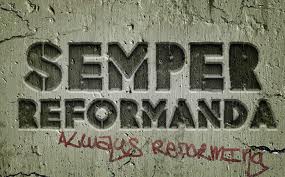
semper reformanda

Preparing for Reformation Sunday? Some of these posts might be useful:

”The Truth Will Set You Free. But First It Will Piss You Off!”

Echoing the Divine Plea: “I Lay Before You Life and Death. Choose Life!”

What if we won’t ever really understand Jesus’ life, death, and resurrection until we understand that God is dead?

Enough with “A Mighty Fortress” Already! Sing a New Song!

95 Theses for the Twenty-first Century

Freedom from What?  All this Reforming is Wearing Me Out!

What Darwin Never Knew

A Reformation Day Nailing to the Internet – John Shelby Spong

A Prayer for Reformation – Thomas Berry

“The Truth Will Set You Free, But First It Will Piss You Off!” – a Reformation Sermon – John 8:31-36

“You will know the truth and the truth will set you free.” Let me take a moment to face the truth about who we are as Lutherans. The truth is that from the beginning Lutherans have participated in hate-filled tribalism that gives rise to anti-Semitism. The irony of attempting to commemorate the Reformation on the day after the slaughter of Jewish sisters and brothers cannot be ignored. Sadly, our church’s tragic participation in anti-Semitism goes all the way back to Martin Luther himself. Luther’s anti-Semitic rants provided the theological grounding that empowered Nazi’s to fan the flames of the Holocaust. It took until 1983 for the Lutheran World Federation to confess and repent Luther’s words.

Let me read from our sister church, the ELCA’s Declaration to the Jewish Community:

“In the long history of Christianity there exists no more tragic development than the treatment accorded the Jewish people on the part of Christian believers. Very few Christian communities of faith were able to escape the contagion of anti-Judaism and its modern successor, anti-Semitism. Lutherans belonging to the Lutheran World Federation and the Evangelical Lutheran Church in America feel a special burden in this regard because of certain elements in the legacy of the reformer Martin Luther and the catastrophes, including the Holocaust of the twentieth century, suffered by Jews in places where the Lutheran churches were strongly represented.

The Lutheran communion of faith is linked by name and heritage to the memory of Martin Luther, teacher and reformer. Honoring his name in our own, we recall his bold stand for truth, his earthy and sublime words of wisdom, and above all his witness to God’s saving Word. Luther proclaimed a gospel for people as we really are, bidding us to trust a grace sufficient to reach our deepest shames and address the most tragic truths.

In the spirit of that truth-telling, we who bear his name and heritage must with pain acknowledge also Luther’s anti-Judaic diatribes and the violent recommendations of his later writings against the Jews. As did many of Luther’s own companions in the sixteenth century, we reject this violent invective, and yet more do we express our deep and abiding sorrow over its tragic effects on subsequent generations. In concert with the Lutheran World Federation, we particularly deplore the appropriation of Luther’s words by modern anti-Semites for the teaching of hatred toward Judaism or toward the Jewish people in our day.

Grieving the complicity of our own tradition within this history of hatred, moreover, we express our urgent desire to live out our faith in Jesus Christ with love and respect for the Jewish people. We recognize in anti-Semitism a contradiction and an affront to the Gospel, a violation of our hope and calling, and we pledge this church to oppose the deadly working of such bigotry, both within our own circles and in the society around us. Finally, we pray for the continued blessing of the Blessed One upon the increasing cooperation and understanding between Lutheran Christians and the Jewish community.”

Semper Reformanda, means always reforming, or keep on reforming, or always reform. I don’t know about you, but after some of the horrendous events this week, I’m almost too tired for any more reforming. Between the Make America Great Again bomber, the white supremist, anti-Semite shooter, the defunding of Ontario colleges, and the abandonment of protections designed to ensure workers at the low end of the pay scale, see not only a dollar an hour raise but more than just a few paid sick days, I’m tried. I don’t even have it in me to pay attention to the worst humanitarian crisis in human history, so please don’t show me any of those horrendous pictures of starving children in Yemen, and whatever you do, please don’t remind me of the genocide of Rohingyan people Between the orange yahoo south of the boarder and our own moronic blowhard at Queen’s Park, I’m so very tired of bad news.  Don’t get me wrong, I want to save the world, I just can’t seem to face the world right now. I am in bondage to compassion fatigue and I cannot free myself. I can’t even begin to live up to the standards I set for myself. The onslaught of news that comes flooding in at a fevered pace, has left me longing to just hide away, curl up into a ball and forget that I ever believed that I had a role to play in making the world a better place.

When I was too young to know any better, I fell in love with an image of myself that I’ve been failing to live up to year after year, decade after decade. The truth about who and what I am is far from the ideal image of the person I long to be. The gap between our ideal self and our real self is a truth most of us would prefer to deny. The truth that we are far from the perfect ideal person that on our good days we aspire too, is tough to swallow. As relatively healthy human beings most of us recognize that we are missing the mark. Missing the mark is how the word sin is defined in the Hebrew Scriptures. We can try to put our faith in ideals, or rules or as the Apostle Paul and Martin Luther would say we try to put our faith “in the Law.” But ideals, or rules, or Law cannot save us from the reality that we are incomplete beings, ever-evolving beings, beings still hoping to become all that we can be. Continue reading

This Persistent Woman Is Wearing Me Out – a sermon on Genesis 32 and Luke 18:1-8

wrestlingBefore I read our Gospel text I took a few moments to reflect upon the story from the Torah that was our First Reading (Gen.32).  I showed the short film below which was created by Jewish scholars to help rabbis teach the stories of the Torah to young children. I use this video to teach the stories of the Torah to our Confirmation students. I think it is important for those of us who follow the teaching of the Rabbi Jesus, to pay attention to the way in which the stories that spoke to Jesus continue to speak to Jewish people here and now. Watch the video and then listen to the sermon here 

Our Gospel reading comes to us from a story told by an anonymous writer named Luke, who tells a parable that he attributes to the Rabbi Jesus: According to Luke: “Jesus told the disciples a parable on the necessity of praying always and not losing heart. “Once there was a judge in a certain city who feared no one—not even God. A woman in that city who had been widowed kept coming to the judge and saying, ‘Give me legal protection from my opponent.’ For a time the judge refused but finally the judge thought, ‘I care little for God or people, but this woman won’t leave me alone. I’d better give her the protection she seeks or she’ll keep coming and wear me out!’” Jesus said, “Listen to what this corrupt judge is saying. Won’t God then do justice to the chosen who call out day and night? Will God delay long over them? I tell you, God will give them swift justice. But when the Promised One comes, will faith be found anywhere on earth?”

I too have met this tiresome, troublesome, annoyingly, persistent widow who constantly cries out for justice. This woman won’t leave me alone. I must confess that I would rather not have this woman clamouring at my door! Each and every time I encounter this woman, she goes on and on, she wears me out! I cannot go anywhere without seeing this woman. She is everywhere. Pointing to her oppressor and demanding justice. She is on the radio in my car as I go about my business. She is on my computer screen as I try to keep up with the news of the day. She is in my living room as I try to relax flipping channels seeking respite from her persistent cries for justice. She appears in my facbook feed, and tweets at me from my phone, I cannot escape her cries for justice. I am sick and tired of this annoying woman. I cannot escape her shouts for justice.
I’m not sure that anything at all can be done to secure justice for this annoying woman. Too much time has passed. There are no witnesses. Boys will be boys. She needs to forgive, forget and move on. Why doesn’t she just leave me alone. There’s nothing that I can do for her. There’s nothing I want to do for her.
I have my own troubles. People to see, places to go, things to do. If only she’d leave me alone. Her persistent cries for justice have begun to haunt me and not even sleep gives me respite from her persistent cries for justice. If only she’d stop going on and on and on and on about her oppressor, about the injustice that has been perpetrated against her.
Maybe if she would just shut up about it, I wouldn’t have to wrestle with her in the night. Round and round we go, pinning one another down, she demanding justice, me pleading for peace. This wrestling over things beyond my control is wearing me down. I’m starting to wonder who this woman thinks she is. Hell, I’m beginning to wonder who I think this woman is. In the darkness of the night I sometimes wonder if this persistent, complaining woman, is just some trumped up version of myself. In her eyes, I sometimes think I see a glimmer of something far too familiar, something ugly, fearsome, unpleasant, and lurking in my own memories. In the wee hours before dawn, I think I can actually see myself in her.
But no, I’m not going there. We are not going there. Women all over the world don’t want to go there. Defenseless, innocent, naive children all over the world we dare not see them in the face of this persistent woman.
And then, just when I think that I have her pinned down and I’m about to wrestle something anything out of this insane encounter, the light begins to dawn on me, as I realize that there in the face of this persistent woman is the ONE in whom we all live and breathe and have our being; the ONE whose name eludes us.
I awaken to the realization that this place where we have all been, this place where we cannot escape is indeed Peniel, for here and now, in the face of this persistent woman, in the face of every persistent woman, indeed in the face of every persistent man, woman, and child, crying out for justice we have seen God face to face. It isn’t always pretty, it isn’t always what we want to see or where we want to see it, but it is the face of the ONE that we call God; the face of God shouting, crying, pleading, for justice.
Wrestling with the persistent, pleading, ones who continue to demand justice from me, I rise wounded from Peniel – the place where I know that I have seen God face to face, and yet my life has been spared. Limping away, forever changed, knowing that the wound that changes the way I walk in this world is the blessing given to me by those who have the courage to cry out for justice. Transformed by this wound I begin to see that I am at one and the same time both the judge who has the power to create justice and the one who cries out for justice.
In this Peniel, is  where ever and when ever we have the courage to look into the face of another and see the face of God, and our lives have been preserved. We cannot walk away from an encounter such as this without responding to the ONE in whom we see the face of God, with justice. Whether our role in this life long wrestling match is that of the judge or the seeker of justice, may we see God face to face.

Whose Persistence? Preparing to Preach on the Parable of the Pleading Widow

pleading widowLooking back on a sermon I preached twelve years ago on this week’s readings from Genesis 32:22-31 and Luke 18:1-8, I am struck by how much my own images of the DIVINE ONE we call “God” have changed and yet remain oddly similar. The intervening years have afforded me the opportunities to begin to leave behind notions of an anthropomorphic God who intervenes in our lives. As I have embraced the writings of progressive and evolutionary theologians, I have struggled to understand and articulate DIVINITY’s nature from the perspective of panentheism (everything is in God). There are those who suggest that this is a departure from the Christian tradition. Yet looking back, I am beginning to see this movement as a natural progression of the tradition. Indeed, so much of what I have always loved about Lutheran theology has freed me to explore this path. So, I offer this old sermon as a snapshot of my own pathway toward new visions of the Divine. I trust that my early efforts to move beyond the notion of God as the “unjust judge” will move some to begin to see God in, with, and through all those who persistently plead for justice. 

What little I know about the art of wrestling I learned from my brother Alan. He and I are just eighteen months apart in age and together we participated in many a wrestling match. All too often one or the other of us would be bothering the other and before we knew it we were rolling around on the floor wrestling. I’ll have you know that up until the age of about twelve I was quite a good wrestler. Up to that point I usually managed to hold my brother to the ground and with my knees firmly pinning his arms I would be able to get my brother to agree to my point of view. But my brother’s adolescent growth spurt put an end to my winning streak. Just as soon as my brother was big enough to pin me to the ground I decided to stop bothering him. Bothering my brother became dangerous and I had to give it up in order to save my dignity. Continue reading

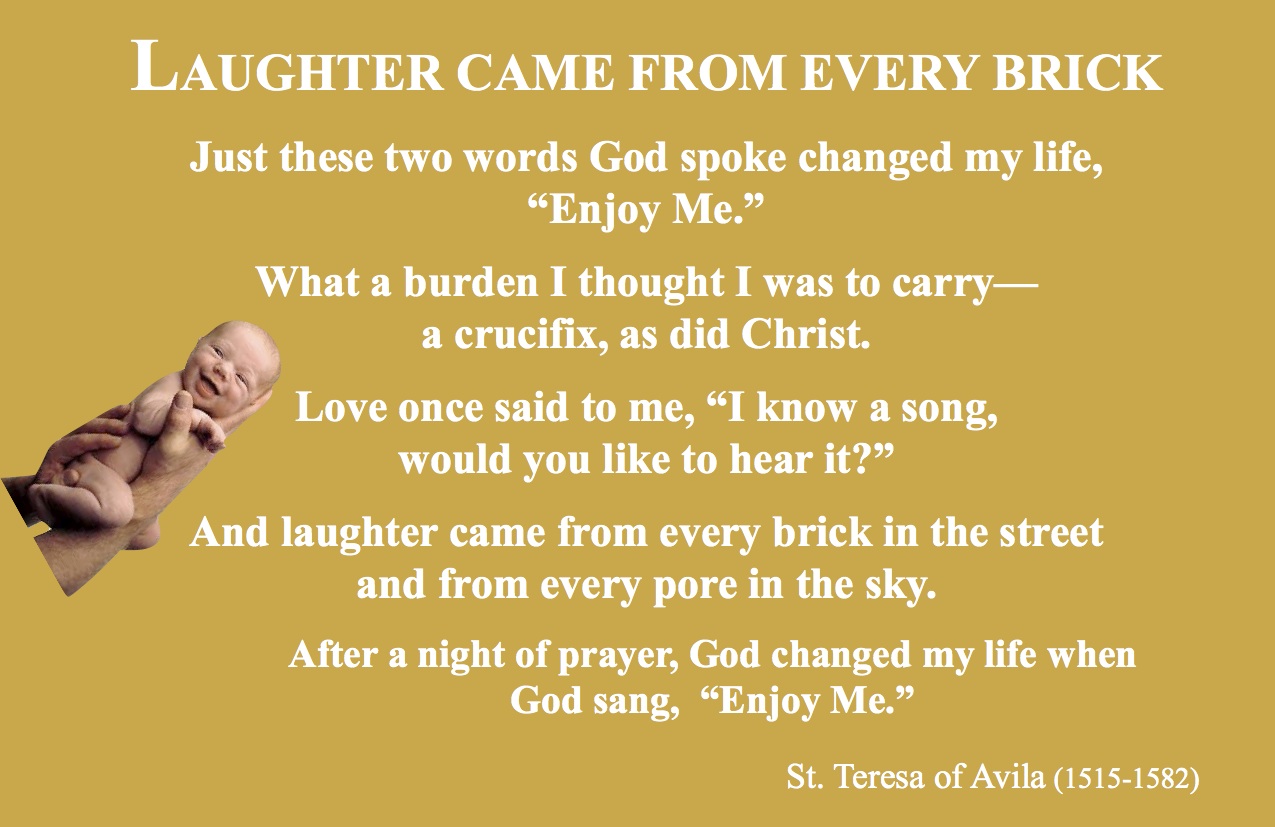
Today We Celebrate the Life and Witness of St. Teresa of Avila

An excerpt from “Love Poems From God” by Daniel Ladinsky,

(Penguin Compass, London: 2002)

(1515-1582)  “Teresa was born in Avila, a beautiful high mountain village of Spain.  She was one of thirteen children, three girls and ten boys, in a wealthy family.  The Spain in which Teresa grew up was permeated with 700 years of Arabian culture; the eradication of Arab power was followed by one of Spain’s darkest periods, the insanity of the Inquisitions, which, in the fourteenth century, along with other grievous deeds, forced mass conversions of Jews to Christianity.”

“Teresa was her father’s favourite child, and the most spirited.  Her mother died during childbirth when Teresa was thirteen, after which she had little supervision.  It is believed she had a lover at the age of fifteen, which caused her father to send her to a convent boarding school, only to see her return home two years later because of poor health.  When she was twenty-one, Teresa ran away from home to join a convent.  At that time many convents were more like hotels for women, allowing them a great deal more independence than they would be allowed at home, though after two years at the convent Teresa had a near-death experience that changed her life.  A spiritual awakening began in which she cultivated a system of meditation that sought quieting the mind to such an extent that God could then be heard speaking.  Over the next twenty years she experienced many mystical states but not until she was fifty did she begin the most far-reaching aspects of her life’s work.” Continue reading

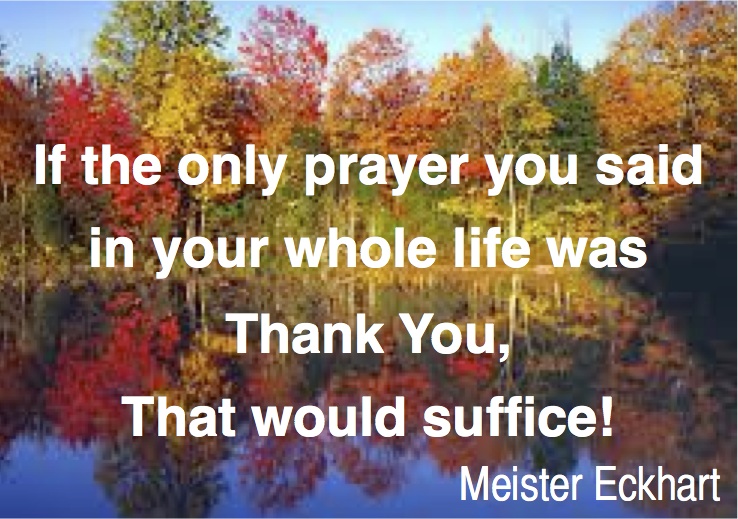
To Whom Shall We Go to Say Thank-you? – Thanksgiving Sunday sermons

Thankyou autumn

Follow the links for previous sermons:

Reckless Generosity a sermon with a Monty Python flair!

Who IS God? – Not One, Not Two – inspired by Garrison Keillor & Joan Chittister

The Blessing of Michael’s Story – a Thanksgiving

Brussel Sprouts, Ebola, and Thanksgiving – seeking the ONE who IS

To Whom Shall We Go to Say Thank-you

After You Move Beyond Personifying God?

Over the course of the past nine years a group of little people have come into my life. Lovely little people who call me Gran. There are seven of them and participating in their little lives is a source of such great joy. Each stage of their development is a wonder to behold. I particularly enjoy watching their parents as they attempt to teach these little darlings the things that they need to know about being human. One of the first things that we teach little humans is the fine art of saying thank-you. It takes a fair amount of repetition to teach a child to say thank-you. Over and over again, after giving them exactly what they want, we ask, “Can you say thank-you?” and the little darlings repeat the words “Thank-you.” Sometimes all we have to do is ask the question: “What do you say?” in order to hear the words “Thank-you” uttered in such a delightful way as to inspire us to praise them as such good little girls and boys.

Expressing gratitude is a skill that all tiny little people must learn in order to develop into well-rounded human beings. Indeed, scientists insist that being grateful is a prerequisite of happiness. Happy humans it seems, are humans who embody gratitude. But there is more to gratitude than simply saying thank-you. I remember learning that gratitude includes more than simply expressing our thanks. It happened when I was about sixteen and actually noticed the beauty of a sunset and for the first time I realized that I was part of something so much bigger than myself. I know I must have seen the sunset before, but this time I actually saw the sun set. We were driving down the road, my friend Valerie and I were riding in a car driven by her mother, Lola. It was a partly over-cast day on the west coast of British Columbia.  Just a few clouds.  You could see the mountains off in the distance. We were chatting back and forth when all of a sudden, Lola pulled the car over to the far side of the road, switched off the engine and got out. Valerie followed her mother out of the car, so I figured I had better do the same. Val and her mother scampered down from the road and onto the beach. When they reached the water’s edge, they stopped and  just looked off into the distance. Apart from a tanker-ship making its way across the horizon, I couldn’t see much of anything. Lola had the most amazing expression on her face. She positively glowed with happiness. Valerie wore a similar expression. I must have looked somewhat puzzled because Val smiled at me and said “Isn’t it the most beautiful thing you have ever seen?” This only confused me more. What were they looking at that had made them stop the car, scamper down the bank and stand there at the water’s edge on a cold autumn evening. 

These happy, glowing, smiling people made me nervous. There they stood grinning from ear to ear.  What were they on? And then, I saw it. For the first time in my life, I saw it.  It had been there before. But I had never really seen it before. The sky was amazing.  The colours were overwhelming. It almost didn’t look real. It looked like someone must have painted it that way. It was magnificent. A work of art. The most beautiful thing I have ever seen. If you’ve never seen a late October, Pacific Coast Sunset before, you’ve missed one of the great wonders of the world. Neither Emily Carr’s paintings nor picture perfect post cards do a western sunset justice.          

Believe it or not, even though I had been living on the west coast for about four years, at that point I had never before really noticed just how beautiful a sunset could be. No one in my experience had ever taken the time to stop and look at one. No one had ever pointed one out to me before. I would never have dreamed of stopping a car and getting out to watch as the sun put on a show while setting. So, I stood there.  Overwhelmed by it all. Amazed at just how beautiful it was. Wondering just who or what could be responsible for such a spectacular thing as this. Before long my thoughts drifted to the Creator. Actually noticing a magnificent sunset was the beginning of a journey beyond myself as the reality that I am part of something so much bigger than myself continues to permeate my being.

Back then, I expressed my gratitude by very much the same way as my grandchildren are being taught to express their gratitude, simply by saying “Thank-you”. The object of the Thank-you being God. At the time, God was an old bloke up there in the sky somewhere. As my images of God changed over the years, my Thank-you’s continued to be expressed to my ever-changing images of God. But I must confess, that it was a whole lot easier to say thank-you to God when God was some big guy up there, out there somewhere? It was so much easier when I thought of God as “Father” or even as “Mother” to express my gratitude by simply mimicking the behaviour that I’d been taught as a child, “Can you say “Thank-you” Oh yes indeed I can say thank-you. “God is great, God is God, let us thank him for our food. By his hand we must be fed, Give us Lord Our Daily Bread.” Continue reading

Hell Is Here On Earth – Luke 16:19-31

1 percentFor those of you who are working on the Parable of Lazarus and the Rich Man, here’s a copy of a sermon I preached a few years ago.

I moved out of my parent’s house when I was quite young and like most young people I didn’t have much money so I lived in some pretty weird places. I once shared a house with a bunch of people that I met working in the travel industry. I didn’t know them very well when I first moved in but as the months dragged on, I got to know some of them better than I would have liked. There were five of us living in a four-bedroom house about a block from Spanish Banks in Vancouver. The house’s proximity to the beach made up for some of my roommates’ shortcomings and the rent was cheap.  So, even though I didn’t like the idea, I didn’t kick up much of a fuss when one of my roommates brought home a puppy.

Now there are those people who would argue that all puppies are cute, I just don’t happen to be one of them. Besides this thing was a Doberman and I don’t care if it was cute, I don’t like Dobermans. I was trying to convince my roommate David that he couldn’t possibly keep a Doberman in our house, when two of my other roommates showed up and quickly became besotted with the creature. One of my roommates when so far as to insist that the puppy was the cutest thing she had ever seen and that we simply had to keep it. While she was hugging and kissing the puppy, David got quite annoyed and pulled the puppy away from her and insisted that this dog was not going to be a pet. He declared that we needed this dog to grow up and be a guard dog, and if that was going to happen then we needed to start treating this dog as we meant to continue.

I had no intention of sharing a house with a Doberman, let a lone a guy who wanted to have one as a guard dog, so I started looking for another place to live. Before I moved out of that house, I had the unfortunate opportunity to watch David as he tried to train his puppy. First of all, David had to give the dog a name and it had to be a name that would instill fear into people, so that’s how the puppy ended up with a name like Vader, as in Darth Vader.  None of us were supposed to cuddle the dog or pat the dog or play with the dog. That was just fine with me. But one of our roommates, Ellie was forever getting into trouble for treating the puppy like a baby. So, David insisted that Vader be chained up outside. A few months after I moved out of the house, I went back to visit and discovered that even Ellie was afraid to go into the backyard because Vader was actually turning into a viscous guard dog. She told me that David had been leaving Vader chained up for longer and longer periods of time and no one in the house would dare to go out into the back yard to feed Vader. I found out from the others that even though they’d tried to get David to pay more attention to Vader, he insisted that it there was nothing wrong with the way he was treating Vader. For months David left Vader chained in the backyard for days at a time and as the dog got bigger and bigger, the three roommates that were left in the house with David became more and more afraid of the dog and eventually they had to insist that David move out.  A few months later, I heard that David and Vader had parted ways. It seems that Vader had taken a chunk out of David’s arm and David had to have the poor creature put down. For some reason Jesus’ parable about Lazarus reminded me of Vader the Doberman. Continue reading

Jesus Was and Is an Absolute Fool – Luke 15

lost-and-foundI am indebted to two beloved seminary professors for the formation of this sermon: Dr. Donna L. Seamone and Dr. Ed Riegert. All preachers stand on the shoulders of those who have gone before us!!!

Jesus was and is an absolute fool! An absolute fool, I tell you! Among the teachings of Jesus, the parables of the lost and found are so well known, so familiar that we are in peril of failing to hear the foolishness they advocate.

Although only a few of us have had the opportunity to tend a flock of sheep, most of us at one time or another have been responsible for the welfare of a flock. Whether that flock be sheep or co-workers, clients, customers, students, friends, or children none but the foolish among us would leave 99 to the perils and dangers of the wilderness in order to go looking for one idiot who’d been stupid enough to get themselves lost.

We may not keep our coins at home, but I daresay that most of us have felt the sting of loosing a drachma or two or three in this recession. Only a fool would waste a moment searching for our losses when our portfolio’s are so full. I dare say that if we managed to find or recoup our loss, we’re hardly likely to invite the neighbourhood to a party that would in all likelihood eat up more than we had found. Continue reading

Entertaining Angels: Hebrews 13:1-3

Hebrews 13Readings:  Luke 14:1,7-14; Mechthild of Magdeburg’s “The Flowing Light of the Godhead”; Hebrews 13:1-3

Listen to the sermon here:

I am often reminded of the fact that one of the most basic parts of my job of being a pastor is pointing out the sacred. Most of what I do revolves around noticing when we are in the presence of the HOLY, the MYSTERY, the ONE who is so much more that we are, the LOVE that lies at the heart of all that IS. My job is to point to the sacred ONENESS, the LOVE that many call GOD and say “there,” or “here,” or “now,” “don’t miss IT.” All too often we find ourselves in the company of angels, messengers of the LOVE that IS God, and we don’t even notice it.
For the most part we humans can’t quite grasp the magnitude of the MYSTERY that lies at the very heart of reality and so we do what humans always do: we personify this ONEness, or we use symbols and metaphors to indicate the presence of the sacred in our midst, and we tell stories. Stories that include burning bushes, ladders into the sacred realm, shepherds, lost coins, all sorts of symbols and metaphors that point to the ONE who IS. We have told some of those stories so often that the REALITY of the MYSTERY that these stories were created to bring down to earth, seems ever so distant and far away, lost in the mists of time. The REALITY that so many call God has been cast out there far away beyond our reach. So, week after week, I try to bring the stories, symbols and metaphors a little closer to the world that we inhabit so that you might be able to see in your own stories the angels that you have entertained without even knowing it. 
In October of 1977, when I was twenty years old. I was young and adventurous. With a rail pass in my hand, a back pack slung over my shoulders and several hundred dollars worth of American Express Travellers cheques in my pocket, I boarded a train in Zurich, Switzerland, bound for Athens, Greece. I was tired. Several months of back-packing in Northern Europe had left me weary. In just five days my rail-pass would expire, so I decided to head for Greece, where the living is easy, where the warm sun, blue skies and equally blue waters held the promise of rest and relaxation.
As the train made its way through the Alps, I remembered a similar trip which I had made the year before and I tried to calculate whether my remaining funds would allow me to return to the village of Chania on the island of Crete. I knew that on Crete I could find work. So, I planned to mix a lot of rest and relaxation with just a little work and try to live out the winter on the Mediterranean. As the train rattled through Austria, towards what was then called Yugoslavia, it began to get dark. I was disappointed that my journey through Yugoslavia would be completed in darkness. I remembered my previous journey, by car, through Yugoslavia and how at the time, I had marvelled at the diversity of this strange little country. I remembered men and women driving oxen as they ploughed their fields in much the same way as their ancestors had done. I also remembered my surprise at entering the ultra modern city of Belgrade; the showcase of what was then Tito’s communist regime.I fell asleep pondering the sharp differences between the lives of the poor people in the villages who appeared to live without any modern conveniences at all and the lives of those who inhabited the city of Belgrade with its towering sky-scrapers and streets filled with automobiles. Several centuries seemed to co-exist in Yugoslavia.
I was awakened from my dreams by the sound of people shuffling to find their papers as the train conductor instructed us to get our passports and visas ready for customs inspection. When the Yugoslavian custom officials, with their rifles over their shoulders boarded our train they were preceded by men guided by vicious looking German shepherds. Even though I knew that I had all the right papers and that my back pack contained nothing more offensive than some dirty laundry, the sight of the dogs, guns, and uniformed officials struck fear into my heart. I nervously handed over my precious passport to an official who looked younger than my twenty years. He carefully read over the Visa which I had obtained in Zurich the day before; a visa that I could not read because it was written in an unfamiliar language and an unfamiliar alphabet.The young man handed my passport over to an older official and before I knew what was happening, I was being escorted off the train. I was shaking so badly that the young men on either side of me had to hold me up. I am not sure that my feet even touched the ground. After a long lonely wait in a drab windowless room, a woman entered. In broken English she told me that my visa was not in order. I gathered from what she was trying unsuccessfully to explain to me, that my passport contained the visa from my previous visit to Yugoslavia, but was missing an official exit stamp. She demanded to know why there was no exit stamp in my passport. Needless to say, I could not explain. I told her that I had only spent a little over a week in Yugoslavia the year before and then gone on to Greece. I told her that I didn’t know that an exit stamp was necessary and that I couldn’t understand why the Yugoslavian consulate would have issued my current visa if my paper work was not in order. She kept insisting that I needed an exit stamp. After several fruitless attempts to try and get her to tell me what I was supposed to do, I found myself in a small room. Its only window was reinforced with bars.
In the darkness of a Yugoslavian holding cell, I sat down and I began to cry. I cried like I have never cried before or since. I was terrified and my sobbing was uncontrollable. After a while I became conscious of a sound that did not come from me. “Susssssssssh.”
I realized that I was not alone in the darkness. Someone else was in the room with me. In the shadows, I could make out the shape of a woman. My sobbing began to subside as she continued, “Shussssssh.” The woman began to pace back and forth in our tiny room and gradually her shusssh turned into humming. She hummed unfamiliar tunes that somehow managed to calm me. Occasionally her humming would turn to singing. She sang softly and quietly and my sobbing began to ease.
In the shadows I could not tell how old she was. Her hair was long, dark and curly. She wore a plain cotton dress, ankle socks and a beaten up pair of shoes, whose laces flapped back and forth as she paced. It took only a few hours for my travelling companion to contact the British Embassy, sort out the mess and secure my freedom. The sunlight was just beginning to find its way into our room when my captor arrived to release me. As I left, I took a close look at my roommate. I smiled, hoping that she would understand my smile as gratitude for her kindness. Her tender sounds had calmed me and helped me through one of the darkest nights of my life. She returned my smile and added a wave of her own. Then the guard roughly escorted me out into the bright lights of the customs house.
Before I boarded a train that would take me safely out of Yugoslavia, I thought that perhaps I should try to help my roommate. Maybe I should try to find out why she was being detained. Perhaps I should try to help her get out. But this was not a place that welcomed questions and the warm sun of Greece beckoned me. And so, I boarded the train and I left. My few hours of captivity – I chalked up to just one more adventure on the road and I rarely thought of my room-mate again. Continue reading

So Bent Out of Shape are We! Stand Up and See Beyond the “war on terror!” – a sermon on Luke 13:10-17

salaam alaikumOver and over again as I have explored the stories handed down to us by our ancestors, I have been struck by the significance of names in ancient literature. The ancient writers used names as a tool to reveal important details. A character’s name in a story can be used to remind us of other characters in other stories that also carried that name, or a character’s name can be taken from a word that has significant meaning.  We can use the names of biblical characters to explore deeper meanings within the stories. We would do well to pay attention to the names of biblical characters. The lack of a name is just as important as any given name. I believe that there’s a reason that the anonymous gospel storyteller we call Luke failed to give a name to the woman we find bent over in chapter. The writer we call Luke can be very deliberate about names when he wants to be. I believe that the storyteller wants us to see this woman as our very selves.

So, let’s play along shall we? Stand up. Stand up and bend over. Please, if you are able stand up and lean over 45 degrees. I want you to have a sense of the woman’s predicament. For a few moments, just a few moments I want you to feel the strain on your back, and the burden on your shoulders that that woman felt for 18 years. I want you to look and see how being bent limits your vision. See how your perspective is shorter. Stooping, you cannot easily look into the faces of those around you, you can’t be on the same level with anyone, you can’t see the whole church. It’s not so easy to look toward the horizon to see a glorious sunrise or sunset. Vistas of God’s wondrous works on earth are restricted. So bent out of shape, how could you ever gaze into the awesome stars at night.

Listen to the story one more time: Jesus was teaching in one of the synagogues on the Sabbath. And there appeared a woman with a spirit that had crippled here for eighteen years. How many of us arrive on the Sabbath with spirits that have crippled us? She was bent and quite unable to stand up straight. She was bent….in Greek the word is “kyphotic.” She was a kyphotic woman. The word kyphotic literally translates as bent together or bent with. It is as if this woman is bent in on herself. It’s a picture of someone who has not only borne the yoke but who really owns it in her very body. She is not just a woman with an infirmity but the Scripture says, with the spirit of an infirmity. Whatever it was that had bent her, whatever emotional or physical burden she had borne, the Scripture suggests, ultimately became part of her until her very body was confirmed to its image. There is nothing she can do now to help herself out of the spiritual pretzel her life has become. Each of us knows this infirmity intimately. At one time or other, over and over again, we have all experienced this infirmity in our lives and in our bones.* (Jana Childers “The Kyphoptic Woman” 2005)

Each of us have been bent with the burdens of our relationships, our jobs, our finances, or our health and sometimes even our lovelessness. We have all been this woman who is bent out of shape by her burdens. We have all been bent in on ourselves. But today, I want to take the image of this woman a few steps further to see what she reveals about our culture.

Okay, you can sit down now. Sit back and relax as I tell you the story of two communions; two communions that are not limited in time or space to the actual communions that they reveal. The first communion is indeed my first communion. I was just 15 years old and I’d only just begun to attend church. It was a small Lutheran church and back then they only celebrated communion a few times a year. I wasn’t prepared for communion. I’d only been attending church for a few weeks and I had no idea what it was all about. I still remember wondering what I should do. I was leaning toward just sitting where I was and waiting until after the service so that I could ask the pastor for an appointment to talk to him about what I needed to do in order to make sure that I was prepared properly to go to the table. That’s when my friend’s mother Lola leaned over and asked me if I wanted to go up for communion with them. I whispered that I’d never been to communion before. She smiled and took my hand and said that’s okay, you’re welcome at the table. I didn’t see any table and I was sure that I was missing something. So, I stood there with my hand in hers and listened very carefully as the Pastor told the story,  “In the night in which he was betrayed, our Lord Jesus took bread and gave thanks; broke it and gave it to his disciples saying: Take and eat; this is my body, given for you. Do this for the remembrance of me. Again after supper, he took the cup gave thanks and gave it for all to drink….” Continue reading

The Bent Over Woman – Luke 13:10-17

bentover woman1It was hot. Already the sun had parched the earth. The air was still. The ground beneath her feet radiated the heat. She was tired. Earlier she had thought about staying at home. Her weary body could use a rest. All week long she had toiled in the heat of the sun. On this Sabbath she longed to rest her crumpled, aching body. She tried to ignore the weakness she felt. She had suffered long and hard. She couldn’t even remember when or how she had become so weak. Over the years, her weakened spirit had left her body bent and crippled. The evidence of her heavy burdens could be seen in her crooked spine. She was ashamed of her appearance.

It had been eighteen long years since she had stood straight and tall. She vaguely remembered running when she was a child. She ran everywhere back then. She ran faster than anyone else in the town. She loved to run. Running made her feel free.

Her mother used to warn her not to run. Her mother tried to stop her. But she was so full of life. She wanted to see everything. She wanted to do everything. She wanted to go everywhere.

Her mother warned her not to be so curious. Her mother tried to keep her busy. Her mother tried to keep her out of trouble. But it was no use, no matter how many tasks her mother gave her; she always managed to find time to explore. She had so many questions. She wanted to know how things worked. Life was so very exciting. She dashed from one adventure to the next. She ran everywhere, everyday. Except of course on the Sabbath. On the Sabbath she walked. She walked with her family to the synagogue. She loved to go to the synagogue. As her father and brothers took their places at the feet of the rabbis, she sat quietly with her mother and sisters and the other women and girls in the back of the synagogue. She listened carefully as the men and boys talked.  Continue reading

I’m a Doubter Not a Believer – Preaching on FAITH – Hebrews 11:1-16, Pentecost 9C

Preaching on Luke 12:32-40 and Hebrews 11:1-16

doubters welcome“Do not be afraid, little flock, for it is your Abba’s good pleasure to give you the kin-dom” So begins the gospel reading for this coming Sunday. But I am afraid and my fear is not about the the thief who this text insists may break into my house or that the HUMAN ONE is coming at some unexpected hour. No, my fear is wrapped up in my desire to pay little or no attention to the second reading prescribed for this Sunday from the letter to the Hebrews: Faith is the reality of all that is hoped for; faith is the proof of all that is unseen. Because of faith, our ancestors were approved b God. By faith, we understand the world was created by the word from God, and that what is visible came into being through the invisible…..”

Do I have faith? Do any of us have faith? For that matter: What is faith? According to Hebrews faith “is the reality of all that is hoped for; faith is the proof of all that is unseen.” Faith is the stuff that makes it possible for us to hear Jesus words: “Do not be afraid, little flock, for it is your Abba’s good pleasure to give you the kin-dom.”  Faith is the stuff that makes it possible for us to believe. So I wonder: Do I have faith? Do I have the faith that makes it possible for me to believe? Do you? Do any of us?

I write this as one who finds it difficult and sometimes even impossible to believe much of anything. I am a doubter by nature. Doubting is part of who I am. I know that there are those who are more inclined to believe and I am envious of believers. I envy those who are sure and are able to find comfort in the Scriptures. For a very long time I was ashamed of my inability to believe. I often sat in church and wondered if I might just be a hypocrite. I wondered if someone who had as many doubts as I have belongs in the church.  So, I tried to conquer my doubts by studying the Scriptures. Continue reading

Hosea: the Coronation Street of Ancient Israel

A Sermon on the Book of the Prophet Hosea

Coronation StI am indebted to Bishop John Shelby Spong for his insights into the Book of the Prophet Hosea. Without Jack’s thoughtful portrayal of Gomer, I would not have recognized her as the Leanne Battersby of her time. Also, thanks to Marcus Borg for his definition of the verb “believe”!

Listen to an older version of this the sermon, interesting how our god-language changes over the years:

I must confess that I am one of the millions and millions of people across the globe who enjoys a guilty pleasure about five days a week. It’s a habit that began back when I was but a wee child. From time to time, circumstances have forced me to give up this guilty pleasure, but over the years, as technology has improved I’ve been able to indulge myself on a more regular basis than I would have thought possible back when I was just a little girl and only able to enjoy this pleasure during the summer holidays. Now a days, I can delay my indulgence to a convenient time. So about 5 times a week, I find myself relaxing in my favourite chair with a mug of tea, ready to enjoy a episode of my favourite soap opera.  

Continue reading

Prayer: To Whom Shall We Go? Luke 11:1-13

PanentheismJesus’ teaching on prayer in the gospel text Luke 11:1-13 begs the question: “To Whom Shall We Go?” Liberated from perceptions that reduce images of the MYSTERY we call God to those of a cosmic superhero, who abides up or out there ready to manipulate events here in the world at the request of those who pray, the activity of prayer takes on a whole new meaning and shape. Our images of who, where and what the MYSTERY is will direct our prayers in ways that impact our expectations of prayer. Who do we pray to and what we expect of the ONE who hears our prayers will shape how and why we pray.

Before we can even begin to understand what so much of the Christian tradition means when it talks about praying to God, we need to take a step back and look at what we mean when we say the word “god.” Throughout the Jewish and Christian traditions you can trace two very distinct ways of understanding and talking about the MYSTERY that we call God. Continue reading

Preaching on Prayer: Shush!

BATH QOLIn this coming Sunday’s gospel reading Luke 11:1-13, Jesus’ disciples ask him to teach them to pray. As a pastor I have been asked to teach people to pray. Each time I have been asked to teach someone to pray I have cringed inside because I do not feel up to the task. For some reason the old hymn “I Come to the Garden Alone” keeps playing in my mind. I keep telling it to, “Shush!” so that I might hear the “bath qol” but the daughter of a sound eludes me. Below is a portion of a sermon I preached a couple of years ago on the subject of prayer. If nothing else, it reminds me to shush!

I began this sermon by asking the congregation to sing from memory the old hymn: I Come to the Garden Along. Feel free to sing it to yourself!

I think my earliest memory of prayer is a distant memory I have of skipping along the sidewalk chanting a familiar refrain: “Don’t step on a crack or you’ll break your mother’s back.” Most of us can remember a moment from our childhood when a superstition was instilled in us that caused us to perform some ritual in order to placate the unseen power that could determine our fate. Whether it was avoiding cracks, or walking under ladders or black cats, we were trained from an early age to believe that there were powers out there that could determine our future.   Continue reading