Despite a snow-storm, our Atheism for Lent Study is of to a great beginning! Posted below is the Keynote presentation that was used to facilitate the class. Each slide will play for 5 seconds and can be stopped by using the pause button. Videos used in the class are included in the Keynote presentation.
Category Archives: HOLY CROSS LUTHERAN
Canadian Lutheran World Relief Sunday: sermon
Jesus, the Lamb of God Who Takes Away the Sin of the World? It ain’t necessarily so! (a sermon for Epiphany 2A – John 1:29-42)
Looking back upon what I preached the last time John 1:29-42 appeared in the lectionary, I realize just how indebted I am to John Shelby Spong for giving me the words to articulate my own objections to the label attached to Jesus by a late first century writer also known as John. Most if not all of this sermon is derived from Jack Spong’s work. For more details I would refer you to Jesus for the Non-Religious and The Fourth Gospel: Tales of a Jewish Mystic. We at Holy Cross were privileged to have Jack speak to us about both of these books. In fact a year before it was published, Holy Cross was the test audience for the material in The Fourth Gospel: Tales of a Jewish Mystic. This sermon ought to have all sorts of footnotes, but I trust you will forgive me for simply confessing that I can no longer tell were Jack leaves off and I begin. Suffice it to say that this sermon is my feeble attempt to put Jack’s work into the form of a sermon.
When I turn the gospel according to John and read about John the Baptist pointing to Jesus, saying: “Here is the Lamb of God who takes away the sin of the world!” I want to scream, “NO!” I have come to believe that our images of God are far too narrow. As far as I’m concerned most of our ideas about God fall far short of every even beginning to describe who God might be. One thing I’m absolutely certain of is if we can imagine ourselves being more loving, more gracious, or more merciful that our theology suggests that God is, then we had better go back to the drawing-board and think again. The ways in which we have traditionally interpreted the life, death and resurrection of Jesus the Christ, paint a picture of a God who is far less loving, gracious or merciful than you or I. Nobody in this room, would demand a blood sacrifice of a lamb, let alone the blood sacrifice of their own child. So, the image of God that is based on this kind of theology must be judged as inadequate to the task of evening beginning to provide us with a glimpse of who our God is.
As we go back to the drawing-board, we ought to take a long hard look at how we arrived at this image in the first place. Thank goodness for the work of our friend Jack Spong who has enabled us to see beyond the literal to the more-than-literal meanings of the various ways in which the followers of Jesus have understood the life and teachings of Jesus. During the years that followed the crucifixion, Jesus’ followers were left wondering what it was all about. How could someone in whom they had seen the fullness of God, be taken from them in such a horrendous way? How could their God allow it? What were they to do? Over the years that followed, Jesus’ followers looked back at the life, death, and resurrection of Christ through the lens of their own religious experiences. Jesus’ followers were primarily Jewish and so it didn’t take long for the familiar Jewish symbol of the Lamb of God to be applied to Jesus as a way of making some sense out of his death. Today most Christians associate the symbol of the Lamb of God with the Jewish celebration of Passover. While the Gospel narratives do indeed locate the time of Jesus death during the celebration of the Passover, and there is indeed a sacrificial lamb involved in the Passover, the actual phrase “the Lamb of God” comes not from the religious rites of Passover, but rather the religious rites of Yom Kippur: The Day of Atonement. Phrases like “the Lamb of God”, “died for our sins” and “washed in the blood of the lamb” can all be found in the religious rites of Yom Kippur. Continue reading
God Is a River – Peter Mayer
They Don’t Go Home Humming the Sermon!
Liturgy has the power to from us in ways that preachers can only dream of. The truth is worshippers don’t go home humming the sermon. What we sing in worship matters precisely because music has the power to both open us up and shut us down to change. As our theology evolves, so too what we sing in worship must evolve. But familiar chestnuts are familiar for a reason. Our favourite hymns are singable! Sadly, so many of the best loved hymns inscribe theologies that posit a god that few of us are willing to worship. But rather than throw the babies out with the bath water, we can give the best loved hymn tunes a new lease on life with texts that do not re-inscribe theories of atonement that we are trying to leave behind. I have been asked to share some of the resources that we have found helpful at Holy Cross and over the next few weeks I hope to post several resources.
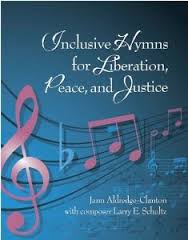
It hasn’t been easy to find new words with which to resurrect old hymns. But there are two resources that warm the heart of this particular worship planner. Both “Inclusive Hymns For Liberating Christians” and “Inclusive Hymns for Liberation, Peace, and Justice” are the work of Jann Aldredge-Clanton who is responsible for the hymn texts and Larry E. Schultz who provides a few new tunes for Aldredge-Clanton’s texts. I highly recommend both volumes for those progressive Christian worship planners who seek to use music to open people to the possibilities of more expansive theologies. Aldredge-Clanton’s texts go far beyond “inclusive language” for God and for people.
Jann Aldredge-Clanton currently serves as adjunct professor at Perkins School of Theology and Richland Community College, Dallas, Texas. Her vivid imagery opens the mind while familiar tunes comfort the spirit.
The good news is that although these resources are not easy to get in Canada, I ordered mine from Amazon.com in the U.S. and the shipping charges were minimal. Better yet, with the purchase of 10 or more you get permission to reproduce hymns for worship.
Here are two videos that provide of just two of the pieces sung in very different worship styles.
Introducing “Painting the Stars” Contributors: Bruce Sanguin
This coming Sunday, we at Holy Cross will begin the new Living the Questions interactive DVD adult education program Painting the Stars. Throughout this week I will be posting introductions to the various contributors to the program. So, if you are anywhere near Newmarket this Sunday consider joining us as we explore the dynamic relationship between science and faith!
One of the primary contributors to the program is Canadian Bruce Sanguin. Until recently, Evolutionary Christian Bruce Sanguin was the minister at the Canadian Memorial United Church in Vancouver. This summer Sanguin left parish ministry to pursue his writing and expanding his speaking career.
Bruce has written several books that have to inspired my own worship planning. Two of his books are of particular value to any pastor who seeks to plan worship without slipping into the trap of words that re-inscribe old theological patterns: Darwin, Divinity and the Dance of the Cosmos: An Ecological Christianity and If Darwin Prayed: Prayers for Evolutionary Mystics. Sanguin’s latest book The Advance of Love: Reading the Bible with an Evolutionary Heart explores the relationship between science and faith to shed light on biblical texts.
This video in which Bruce is interviewed by fellow evolutionary Andrew Cohen will wet your appetite for Bruce’s work while giving you an interesting look into evolutionary Christianity. Enjoy!
Jesus Was and Is an Absolute Fool – a sermon on Luke 15 for Pentecost 17C
How appropriate that preachers all over the world will be preparing sermons this week on the gospel text Luke 15. These parables of the lost will have us remembering the work of a beloved scholar whose work on the parables influenced generations of preachers. Robert Farrar Capon died on Friday and looking over the various sermons that I have prepared over the years on Luke 15, I for one am grateful to have been influenced by such a great theologian! I am also indebted to two beloved seminary professors for the formation of this sermon: Dr. Donna L. Seamone and Dr. Ed Riegert. All preachers stand on the shoulders of those who have gone before us!!!
Jesus was and is an absolute fool! An absolute fool, I tell you!
Among the teachings of Jesus, the parables of the lost and found are so well known, so familiar that we are in peril of failing to hear the foolishness they advocate.
Although only a few of us have had the opportunity to tend a flock of sheep, most of us at one time or another have been responsible for the welfare of a flock. Whether that flock be sheep or co-workers, clients, customers, students, friends, or children none but the foolish among us would leave 99 to the perils and dangers of the wilderness in order to go looking for one idiot who’d been stupid enough to get themselves lost.
We may not keep our coins at home, but I daresay that most of us have felt the sting of loosing a drachma or two or three in this recession. Only a fool would waste a moment searching for our losses when our portfolio’s are so full. I dare say that if we managed to find or recoup our loss, we’re hardly likely to invite the neighbourhood to a party that would in all likelihood eat up more than we had found. Continue reading
Bishop John Shelby Spong interviewed on the day DOMA was consigned to the history books
“You don’t resist consciousness, nor do you turn it around. Nobody would contemplate re-segregating; no one would contemplate taking the vote away from women. Nobody will contemplate forcing gay and lesbian people to go back into the closet today – we just passed that, and consciousness doesn’t go in a two-way street; it’s always a one-way direction. You’re always more open to the future.” – Bishop John Shelby Spong
I first met Jack Spong in 2008 when he travelled to what he called “the frozen north” to help us launch our Re-Thinking Christianity Speaker Series at Holy Cross Lutheran Church in Newmarket. At that time, from the confines of my church imposed closet, I and many others were working together to end the Evangelical Lutheran Church in Canada’s discrimination against LGBT members. The terms of my closeted existence meant that I could not speak publicly about who I am lest my denomination take actions against me because of who I love. So, Jack and I spoke privately about the struggle that my life had become. His gentle encouragement “to be all that I am created to be” together with the love and support of so many others gave me the courage to come out into the struggle in more public ways as Holy Cross defied the discriminatory policies of our denomination.
Jack has returned to Holy Cross several times over the years and each time his love and support has been a blessing to our congregation and to so many people in our part of the world. A great deal of water has flowed under a good many bridges since our first meeting. Over the years, our community has continued to be blessed by Jack’s visits and his considerable support. The Evangelical Lutheran Church in Canada has removed constitutional barriers to the full inclusion of LGBT members and we continue the work of living into our vision of equality for all. Even though I have married the love of my life, I continue to serve as the pastor of what Jack has dubbed “the jewel of the north” and surprise, surprise, the sky has not fallen in. My wife Carol and I are both grateful to Jack and his lovely wife Christine for their ongoing love and encouragement!
The interview below took place on June 26th, 2013, the day the U.S. Supreme Court announced its monumental decisions on the Defence of Marriage Act and California’s Proposition 8. As I watched it, I was reminded that the struggle for the rights of LGBT folk is only one of many human-rights struggles that Jack has engaged in during his long and distinguished career. Jack is a giant among men; and not just because of his great height or his former office, but because he lives the benediction he teaches: “If God is the source of life, I worship God by living. If God is the source of love, I worship God by loving. If God is the Ground of Being, I worship God by being more fully human; the embodiment of the Divine.” Thank-you Jack for all you’ve done to help so many of us to embrace our humanity and thereby embody our Divinity!!!
Wolf Blitzer Learns that there are Indeed Atheists in Fox-holes!
Today’s Trinity Sunday sermon owes much to John Shelby Spong’s book a “New Christianity for a New World”
You can listen to the sermon here then watch the tail end of the Wolf Blitzer interview mentioned in the sermon.
We sang Shadow and Substance as our Hymn of the Day: view it here
Global Engagement, Chaos Theory, the Butterfly Effect and a New Pentecost
This sermon speaks to the experience of our Global Justice Team’s attempts to respond ethically to global injustice. We were guided by the Rev. Jonathan Schmidt of the Canadian Churches Forum for Global Ministries. John Philip Newell’s recent book New Harmony: The Spirit, The Earth, and The Human Soul provided new insights for the vision of a New Pentecost. The Gospel reading from Mark 2:1-12 replaced the regular Pentecost reading.
Readings can be found here
Listen to the sermon here the audio begins with the Acclamation Veni Sanctus Spiritus
God Is a River – Peter Mayer
Peter Mayer, one of my favourite folk singers, captures a hint of the essence of God when he sings. I have long since given up thinking of God as “My Rock and Salvation” and the image of God as a river in which I flow helps me to capture a hint of the ONE who is so much more than any of our images or metaphors can begin to capture.
This morning I will lead our Adult Education Class in a conversation about “eternal life”. As our images of God expand to include all we are learning about the cosmos, this song connects me to the Source of Life. I can’t help wondering how far our conversation will take us. I suspect that new images will emerge. I hope that we can learn to live in the ambiguity of our questions.
SHE Who Dwells Among Us – a Mothers’ Day Sermon
Another Option for Preaching on Mothers’ Day – Bring Many Names
Until we can fully recover images and names for God that include the feminine, it will continue to be difficult for many to see the face of God in women and girls. Mothers’ Day is an opportunity for preachers to uncover, explore and proclaim the feminine names, attributes, images and activities of the Divine. This Sunday we will begin our liturgy by singing “Bring Many Names” (Voices United Hymnal), we will sing an invocation to Sophia “Come, Sophia” (Miriam Therese Winter), “Sing Lo! Sing, O Sophia” (Miriam Therese Winter), acclaim women of faith in song with “Come Celebrate the Women” (Shirley Erna Murray), praise the Breasted One with our Hymn of the Day, “Womb of Life” (Ruth Duck), after communion we will “Rock-a My soul in the Bosom of She Who Is” (Miriam Theresa Winter) and send folks off rejoicing to “Faith of Our Mothers”. (copyright laws prevent me from posting the music, so message me and I’ll hook you up)
I offer this repost to inspire the bold women and lovers of women to proclaim the love of She Who Dwells Among Us this Mothers’ Day!
GOD’s Radical Mastectomy
Recently, I found myself in conversation with a young woman who insisted that inclusive language for God is nothing more than political correctness that has been imposed upon the church by feminists. She insisted that because women have now achieved equality with men, the need for inclusive language for God has served its purpose and need no longer be of concern to worship leaders. I am grateful that my age afforded me the maturity not to explode on this young woman who can well afford her opinion as a direct result of some of the language battles that I and my contemporaries struggled to overcome while she was but knee high to a grasshopper. Our conversation has stuck with me and caused me to review some things that I wrote long ago about the impact our language has not only on our images of the Divine but on the way we live together in community. What follows is a portion of a piece I wrote about the disappearance of the Breasted One as a name for God.
“We believe in one God, the Father the Almighty… We believe in one Lord, Jesus Christ, the only Son of God, eternally begotten of the Father… We believe in the Holy Spirit, the Lord, the giver of life, who proceeds from the Father and the Son. With the Father and the Son he is worshipped and glorified. He has spoken through the prophets. In this God: “We believe” and “His kingdom will have no end!” God in three persons: Father, Son and Holy Spirit, our blessed Trinity. As we proclaim our faith in the words of the Nicene, Apostles’, or (heaven forbid) the Athanasian creeds we proclaim a particular image of the Triune God. For generations, a majority of Christians have assumed all three persons in this Trinity are male. Until recently this assumption has resulted in the exclusive use of male images, symbols and pronouns to represent the Triune God which Christians worship. God has been declared to be male. This is not an easy declaration to make. In order to make such a declaration, many of God’s attributes which are revealed in the biblical accounts have been eradicated from the Christian tradition.
Long before the Christian church began to formulate its exclusively male image of the triune God, the Hebrew people used several words to refer to God. The earliest of these words is “El” which is the generic Semitic word for a god.
Pyrotheology – Peter Rollins
Jesus was wrong! Can I Get an Amen? – a sermon for Easter 7C – John 17:20-26
Before I could go to seminary I had to obtain an undergraduate degree. So I enrolled at the University of British Columbia in their religious studies program. In order to obtain a degree in religious studies, we were required to study the religions of the world. My professors and classmates were Islamic, Hindu, Jewish, Christian, Buddhist, atheist, agnostic, and together we explored all sorts of religions, both ancient and modern. I remember registering in a course on ecumenism where I expected that we would study the various movements to restore unity to Christianity. We did that, but we also did so much more. We learned that ecumenism is not just about Christian unity. Ecumenism includes inter-faith dialogue.
During the course I was required to write papers on Hindu-Christian dialogue, as well as a paper concerning what was written about Jesus in the Islamic Qur’an. This course introduced me to the reality that unity does not mean uniformity. In his book entitled “Who Needs God”, Rabbi Harold Kushner writes: “Religion is not primarily a set of beliefs, a collection of prayers, or a series of rituals. Religion is first and foremost a way of seeing. It can’t change the facts about the world we live in, but it can change the way we see those facts, and that in itself can often make a real difference.”
Sadly, over the centuries the religions of the world have shaped the way we see people whose religious practices are different than our own in ways that have made it possible for us to pre-judge our neighbours. Studying the religions of the world broadened my horizons and I actually began to believe that at long last I had escaped the prejudices that were bred into me. Continue reading
Nanny’s Mugs: The Agony of Dementia – A Sermon for Easter 5C
In my kitchen there are some teacups that we call Nanny’s mugs. They are smaller and more delicate than all the other mugs in the cupboard. Whenever I drink tea from them, I think of my Grandmother. That first summer, I moved to Newmarket; some 3,000 miles from my home, my Grandmother decided that she was going to move in with me. She lived with me in the parsonage for about 3 months. It was an impulse decision on her part; a decision that I had very little say in. Nanny decided that I was the only one in the family she could trust and so she would move in with me. She was in her late eighties at the time. I didn’t fully understand her lack of faith in the other members of the family. I never dreamed that her suspicions about the relative trustworthiness of our relatives was the beginning of the end. I loved my Nanny and I was determined to provide a home for her. I was delighted when she arrived. I was always delighted when my Nanny arrived. I remember as a child, I would long for Nanny to arrive.
Nanny was always full of fun and I have all sorts of wonderful memories of us
getting into trouble together. Nanny was all of 5 feet tall, she was just a wee little woman, but there was more power and strength in that wee little woman from Belfast than in most of the women I’ve ever met in my life. She was kindness and fierceness all rolled up into a woman who loved nothing better than a good laugh. Nanny was born in Belfast the oldest of 14 children. When all three of her children ended up living in Canada, even though they were well into their sixties she and my Grandda immigrated to Canada to begin a new life in a new country. Immigrating at any age is an incredible undertaking, but immigrating in your 60’s takes guts. I was twelve years old when my Grandparents arrived in Vancouver. I watched my Grandda begin a new job and my Nanny try to make the best of life far away from everything that was familiar to her. Nanny’s homesickness was palpable. Continue reading
A Tough Week for the Planet: Earth Sunday Sermon
On the heels of Peter Rollins visit to our congregation last weekend, this Earth Sunday sermon flows out of Peter’s work. You can listen to Peter’s sermon which is the jumping off point for this Earth Day sermon here
Listen to the Earth Day sermon here
Worship Bulletin here
The readings are here
The video of the excerpt from Chief Seattle’s Response is below
“A Revelation of Darkness” – Sermon
Embracing Mystery and Unknowing: Peter Rollins
I’m busy preparing the liturgy for this coming Sunday when Peter Rollins will be our guest preacher. It’s an interesting challenge considering the season. Easter is a time when we practice certainty with our shouts of “Christ is risen! Christ is risen indeed! Alleluia!”, so everything I’ve heard and read of Rollins’ work is calling me into the darkness of unknowing. Part of me wishes we’d booked Peter’s weekend visit with us during the season of Lent or maybe even this past weekend when terrified followers of the Way huddled in an upper room in fear for their lives could have set the tone for our worship together. But part of me is relishing Peter’s serious challenges to the church that Peter clearly expresses during the interview in the video below. For those of you who live in Southern Ontario, consider joining us this weekend! For details click here
Humpty Dumpty, Doubting Thomas, and Resurrection
Second Sunday of Easter – April 7, 2013
I am indebted to Bernard Brandon Scott’s reminder of the story about Humpty Dumpty in Frank McCourt’s novel “T’is”
Listen to the sermon here