“At a moment when the world seems to be spinning out of control, religion might feel irrelevant — or like part of the problem. But Rabbi Sharon Brous believes we can reinvent religion to meet the needs of modern life. In this impassioned talk, Brous shares four principles of a revitalized religious practice and offers faith of all kinds as a hopeful counter-narrative to the numbing realities of violence, extremism and pessimism.”
Merry Christmas one and ALL!!! Here’s the Christmas Eve sermon based on the Gospel readings from Luke 1:26-38; 1:39-55; 2:1-20. I cannot remember where I first heard the story I tell in the sermon. I suspect it is from some sermon I heard long ago because the outline is on a fading piece of foolscap in my barely legible handwriting. I did a quick search and could only discover the was a version of the story in a sermon by Janis B. Scott who does not site her source. My retelling/elaboration of the story is, I hope, a reflection of the MYSTERY that is once again born on this holy night.
Silent night, holy night is a perennial favourite! T’is the season for nostalgia. But what if we are serious about providing more than nostalgia in our worship? Can we, or do we even dare to offer worshippers new images that endeavour to engage our reality? Can we touch the spiritual but not religious crowds that wander into our sanctuaries seeking an encounter with the Mystery we call God, with a hint of our unknowing. Or are we content to address only the nostalgia seekers with safe images designed only to warm and not excite the imagination? Dare we beacon the nostalgia seeks beyond their memories toward the future? I wonder? Maybe we can summon up the courage to compromise by simply adding a few new verses?
The challenge belongs to all of us to write new words to enable us to sing our praise with integrity. Here’s a sample, with thanks to Keith Mesecher.
This sermon was preached last Christmas Eve at Holy Cross Lutheran Church. Listen to the sermon here
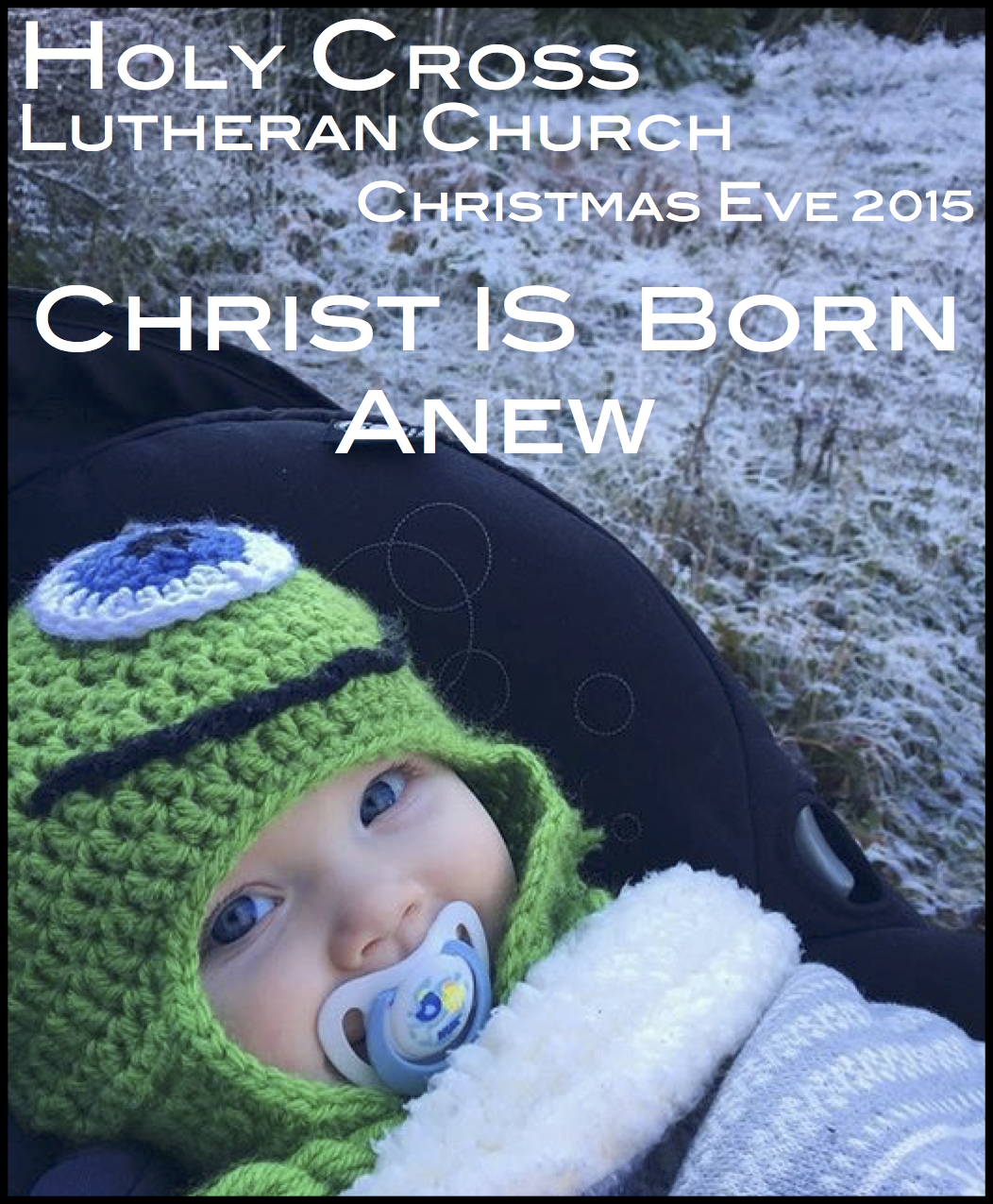
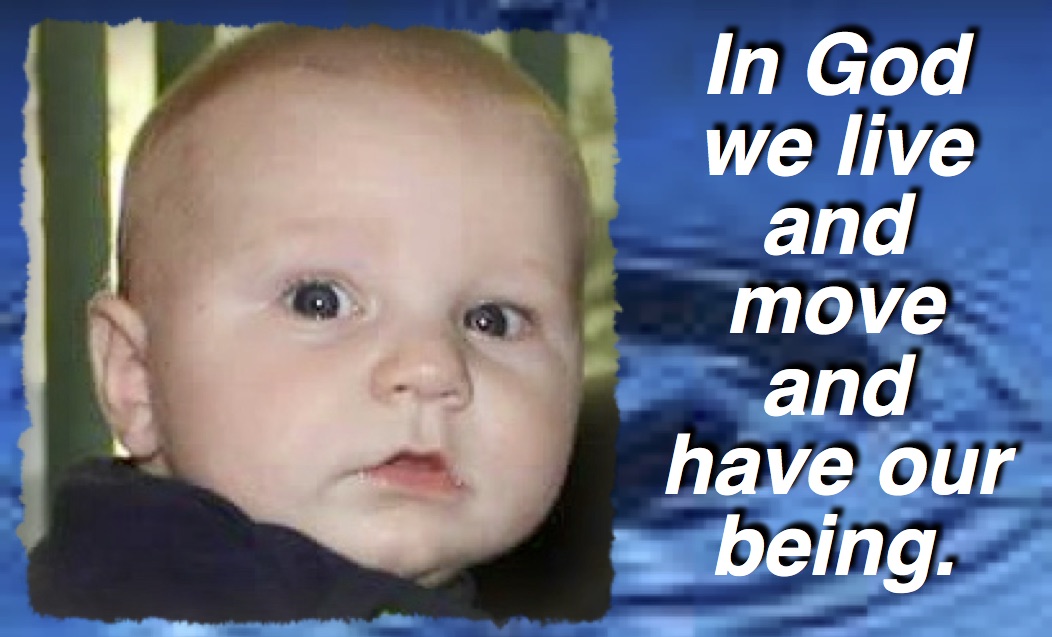
The little fellow on our bulletin is my great-nephew, Sawyer in whom I continue to see the face of the Christ-Child! May we all see in everyone the face of Christ!
It has been said that the shortest distance between humanity and the truth is a story. On this night of nights, we gather together around a story that reveals the truth of our humanity. Together, on this holy night, we participate in the birth of a child. Tonight, we see in the image of a new born baby swaddled in our hopes and dreams. All our longings for love and peace rest in the images that live and breathe in this story that has been handed down to us. It is a story we know so well and yet, it is a story that we have barely begun to understand. Like all stories, we can simply listen to it, or read it, and respond with little more than a nostalgic nod to simpler times when hoped that someone or something out there or up there would come and save us from ourselves and our warring madness, and selfish greed or we can open ourselves to the transformative power of that some stories have and
We can dare to participate in the story, engage it, wrestle with it, and make it our own. If we let it, this story can open us to that which lives and breathes beyond the words of the story. The characters in this story can live and breathe and have their being in us.
Sadly, we all too often get bogged down in the words themselves, measuring them and testing them as we try to pinpoint the origins of the words and miss all together the many truths that this story can convey. Some folks never get past arguing about the history. They just can’t seem to understand the power of myth to convey truth. The ancient scribes, who passed this story on to us, knew well the wisdom using mythology to convey truth. So, on this holy night, in the presence of one another, let us seek the wisdom of the ages remembering that wisdom is a precarious treasure; a treasure that has the ability to enrich our lives.Continue reading →
Readings from the first chapter of Luke included the stories of the Angel Gabriel’s Annunciation to Mary, Mary’s Visitation to Elizabeth and Mary’s radical song – The Magnificat. Listen to the sermon here
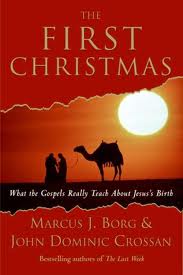
In 2008, our little congregation played host to John Dominic Crossan who has been acclaimed as world’s most famous New Testament scholar. Crossan’s visit to our congregation began with a public lecture based on his best-selling book The First Christmas in which he and Marcus Borg provide a splendid historical outline of the development of the birth narratives. I had the dubious honour of standing before his enlightened audience on Christmas Eve to preach in the great man’s wake. What follows is the Christmas Eve sermon I preached just three weeks after Dom’s illuminating visit.
Just a few weeks ago, this congregation was privileged to play host to a man who has the reputation of being the greatest New Testament scholar in the whole world. Dom, (we get to call him “Dom” now) wrote The First Christmas with Marcus Borg who is the guy who is heralded as the world’s leading expert on Jesus and Christianity in the 21st century. During his lecture, Dom provided us with all sorts of marvellous ways to understand the stories surrounding the birth of Jesus. Ever since that visit, there have been folks who listened very carefully to what Dom had to say and who have been positively gleeful when they’ve asked me what I’m going to do about preaching on Christmas Eve.
I mean what could I possibly say to you after so many of you have just finished hearing from the best in the business! And then there are those of you who bought the book and you’ve read what the experts have to say about the first Christmas. Some of you weren’t able to hide the smirks when you wondered out loud just exactly how I’d go about following the eminent Dr. John Dominic Crossan.Continue reading →
Recognizing that many do not make it to church on Christmas Eve or Christmas morning, we usually read the entire birth narrative on the Fourth Sunday of Advent. This weekend’s release of Star Wars: Rouge One makes this sermon particularly appropiate.
The quotes in this sermon are from Steven Pinker’s book “The Better Angels of Our Nature” and Joseph Holub’s “Fear Not” The Acclamation sung, on the audio recording, prior to the sermon is “The Magnificat” from Holden Evening Prayer, by Marty Haugen, featuring Gary Curran and Linda Condy: Listen to the sermonhere
This week as millions of people flock to theatres all over the world to see the latest Star Wars epic (Rogue One), I am reminded of the old joke: you know you might be Lutheran if, when you hear: “The force be with you.” you must fight the urge to say, “And also with you.” While I confess that I have not yet seen the new Star Wars movie, and my memories of the original Star Wars movie are decades old, my social media feeds have been filled with allusions to “The Force”. Over the course of the past few days, I’ve read more than a few articles from would be theologians, which insist that “The Force” of Star Wars is akin to the way many progressive Christians describe our understanding of God. While it is true that may of us who have long since given up images of God the portray the super-natural being who lives off in a galaxy far, far, away, who from time to time meddles in the affairs of earthlings, and many of us have indeed have embraced notions of God that reflect early Christian teachings about the One in whom we live and move and have our being.
The panentheistic view of God as the one who both lies at the very heart of reality and permeates reality so that God is in all and yet more that all, the one who lives and breathes, in, with, through, and beyond us, may on the surface bear a slight resemblance to “The Force” I can assure you that God is so very much more than the limited notions of “The Force”.
Right about now, I expect that some of you are wondering, why on earth I am rambling on about a childish science fiction movie just days before Christmas when I have all the ramifications of the greatest story every told from which to draw a sermon on this the fourth Sunday of Advent. Well bear with me for a bit, and if we are lucky and the force is with me, I try to explain just how Mary’s response to an angelic annunciation relates to our cultures fascination with “the force” and maybe just maybe assure you of the Good News that the God in whom we live and move and have our being is so much more of a force than the force that would be Jedi warriors all over the planet are embracing. The little that I do know about George Lucas’ force is that it inhabits a dualistic universe that is divided into to camps. On one side, we have “The Empire”, the dark evil side represented by the Sith, on the other side, the good side, the Rebellion, represented by the Jedi. The Force, is the name given to the collection of the energies of all living things that are fed into one Cosmic Force. The Force that is available to both Jedi Rebellion and the Empire of the Sith because The Force has two sides. The Force is neither malevolent or benevolent, neither good nor evil it has a bad side involving hate and fear, and it has a good side, involving love, charity, fairness and hope. The Force can be used for good or for evil. The Force is if you will, humanity write large, or the human psyche deified. The Force is nothing more than our collective strengths and weaknesses writ large.
This sermon is an adaptation and expansion of a sermon preached way back when by one of my favourite preachers: Glynn Cardy. Glynn’s work continues to inspire me!!! We both source our favourite New Testament scholars John Dominic Crossan and Robert Funk. My adaptation is also inspired by John Shelby Spong. It is always a pleasure to work with such great material!!! The Gospel Reading was Matthew 3:1-12. You can listen to the sermon here
There was a young woman who lived in an apartment, in a very rough neighbourhood. It was the east end of a very large city. Many of the people who lived in this neighbourhood got by on welfare, others earned their living any way they could. The young woman moved into the apartment because it was close to the office where she worked, the rent was cheap and quite frankly she was young and foolish. She ignored all the warnings of her family and friends and moved into the apartment convinced that she could handle anything that came her way.
Her neighbourhood contained the most unsavoury of characters. The office where she worked was just down the street from her apartment and every morning as she walked to work she would meet some of her neighbours returning home from an evening of plying their trade on the streets and in the alleys. Each morning, she would be met at the entrance to her office by an old man named Ed.
Ed had been living on the streets for years. He was very hairy, very dirty, and he tended to rant and rave a lot. Ed was a wild man. He slept on the doorstep of the young woman’s office because it was somewhat protected from the winter weather. Even though Ed made the young woman nervous, she got used to seeing him in her way.
Ed always gave the young woman a warm welcome when she arrived. He knew that when she got inside, she would brew fresh coffee. He used to tease her that, she was a sucker for a sad face as he waited patiently for her to bring him a cup of coffee. They never talked much, though. Ed would just rant and rave about the injustices of the world. The young woman never found out how Ed ended up on the streets. She didn’t know how he spent his days. Continue reading →
This sermon is inspired by the work of the Reverend J. Edwin Bacon Jr. whose retelling of the Rev. Dr. Martin Luther King Jr.’s radical sermon “Remaining Awake Through a Great Revolution” inspires my own musings. Bacon is one of my favourite preachers and it is a privilege to be able to adapt and expand upon his work! Our readings included: “The Star Within” a creation story by Dr. Paula Lehman & Rev. Sarah Griffith, Matthew 1:1-17; and Matthew 24:36-44. Listen to the sermon here
Since 1925, the last Sunday of the church year has been celebrated as Christ the King or Reign of Christ Sunday. This year at Holy Cross we celebrated “Jesus the Christ Sunday” with readings from Galatians 3:26-28 and Luke 23:33-43.
Yesterday, my Auntie died. Barbara was a kind woman. A good woman. A woman who welcomed me into her home even though we met long after the marriage that tied us together as kin had ended. A woman who welcomed me into her home even though she could scarcely afford to take care of herself and her two children. A good woman who chose to be hospitable, kind, and welcoming, when it would have been perfectly acceptable for her to send me on my way.
I was a teenager when I first met my Auntie Barb. I was doing what a lot of young people have done since time began. I left the safety of my home to travel the world. I didn’t have much money, just a back-pack on my back, a few dollars in my pocket and all the confidence of a nine-teen year-old, looking for adventure. Barbara must have been in her late forties when I arrived on her doorstep. Her marriage to my uncle was ending and she was struggling to make ends meet. Her two children, my cousins were just kids twelve and fourteen; demanding all the things that kids have always demanded of their parents. Barbara could barely afford to put their food on the table, and yet when I arrived on her doorstep, Barbara opened her door, invited me in, and took me on as one of her own. Her many kindnesses to me, came from somewhere deep inside of her that said, no matter how tough my own life is, no matter how little I have to give, I choose to give, I choose to be kind, I choose to open my door to welcome, I choose to be hospitable. My Auntie Barbara died yesterday, and the lives that she touched are sorely grieved at her passing, but the world goes on. So, what does it matter that Barbara choose kindness when there were so many other less costly options open to her?
Today, in churches all over the world, Christians are celebrating Christ the King Sunday or in as those churches that try to be more inclusive in their use of language, call it, the Reign of Christ Sunday. It is the last Sunday of the Church year and since 1925, the last Sunday of the church year has been used to declare that Christ Reigns; that despite what the world says, Christ and not the rulers of this world reigns supreme. It is no coincidence that Christ the King Sunday began in 1925, by the decree of Pope Pius the 11th. You see in Italy in 1925, there was a king other than Christ. ll Duce, Benito Mussolini rode the crest of fascism to become the supreme ruler of Italy in 1925, declaring himself the heir to the Roman Empire. Il Duce declared that the fascist state of Italy was born out of the eternal need of the Aryan and Mediterranean races to ensure the purification of their people. Christ the King Sunday was established in defiance of Il Duce. The church chose to insist that Christ and not racism ruled supreme. It wasn’t the first time that the followers of Jesus insisted that something other than fear would rule their lives. From the very beginning the followers of Jesus insisted that Jesus and not Caesar is LORD. The very first creed was as simple and as complicated as that. Jesus is LORD. Jesus rules not Caesar. This simple and yet complicated creed, was enough to get you killed in the first century. And yet, people chose to insist that the ways of Jesus would rule their lives and not the ways of the empire. So swift and harsh was the reaction of the Roman Empire to the rebel claim that Jesus rules, that hundreds and thousands of Jesus followers were crucified for insisting that there was another way to live; a way to live free from fear.
As the followers of Jesus were persecuted for living in the hope that love and not hate offered a better way, it became more and more dangerous to confess that Jesus is LORD, and so the rebels developed ways of recognizing one another that set them apart from those who lived in fear of the powers of the Empire. The Ichthys, the symbol of the fish arose as a way of identifying those who chose love over fear. Ichthys the symbol of the fish was adopted by the early followers of Jesus because the Greek word for fish, ICHTHYS was an acronym for the word fish. The first letters of the Greek words Jesus Christ Saviour of the World, spell the Greek word for fish. The symbol of the Ichthys was simple to draw; it could be traced in the dirt, quietly so the authorities would not notice, the same authorities that insisted that Caesar was the saviour of the world.
Quietly, defiantly, the followers of the way, the way of the one who first called the fishers from Galilee, the rebel Jesus of Nazareth, who dared to suggest that love was more powerful than fear, chose to identify themselves with the symbol of the fish. It wasn’t until 364, when Constantine co-opted Christianity as the religion of the Empire that the Cross usurped the fish as the symbol of Christianity. The adoption of the cross, the instrument of state execution was an act of defiance. The most fearful symbol of Roman oppression was transformed from an instrument of torture into a symbol of torture and death’s inability to kill hope. Where once the Roman Empire had used crucifixion to terrorize the peoples they had conquered, the very people they conquered used the sign of the cross to declare that hatred could not kill love.
The forces of hatred over and over again have used fear to drive out love. Over and over again, people have found ways to resist hatred in spite of their fears. History is littered with stories of leaders who have insisted that the only way to survive is to play to our fear. Fear mongering is nothing new. Fear mongering has often tried to dominate the hearts and minds of people. During the darkest days of the second world war, when the fascist regime of Germany’s Third Riche rose to power they did so, by playing on the fears of the German people. But despite the fearsome methods of the loathsome fascists, there were those who continued to choose not to be ruled by their fears.
There are all sorts of stories of those who resisted insisting that fear would not rule their lives. There is a story of quiet resistance that happened Norway after the Norwegians were defeated by the Nazi’s. In the darkest days of the German occupation some Germans, adopted the symbol of the paper clip, worn in their lapel pockets as a symbol that hatred would be defeated. As powerful and as frightening as those dark days were, there were those who choose not to be ruled by fear. A symbol as innocuous as a paper clip, declared that love and not hate would rule the day.
Once again there are those who seek power by playing to our fears. Symbols that we thought had been banished to the pages of history are being drawn on mosques and synagogues all over the world. Just this past week, in Ottawa and in Toronto Swastikas have declared that we should be afraid and let hatred rule. Once again there are those who choose not to let fear rule. Safety pins are appearing everywhere declaring that despite the best efforts of those who choose fear and hate as their rulers, hatred will not be allowed to rule those who choose love. Something as innocuous as a safety pin has become a symbol of hope as people declare themselves safe places for those who are being oppressed.
The human spirit is an amazing and fragile work of beauty. The human spirit can and is often crushed by fear and hatred. But the human spirit can also be restored and empowered by love. We can choose to live in fear, or we can choose to live in hope. Our fears can feed hatred. Our hopes can feed love.
For those of us who seek to follow the teachings of the one whose love could not be conquered by what at the time appeared to be the most powerful Empire on earth, symbols like the fish, the cross, a paper clip and a safety pin point to a way of being in the world that moves us beyond our fears so that love is empowered. The symbols in and of themselves are nothing really, just signs pointing to something beyond the powers that be, to something capable of giving life to love.
Sometimes the horrors of our history are so overwhelming that we begin to fear that fear itself with conquer us. Sometimes, in the face of the enormity of our fears, all we need is something simple like a sign, or a symbol to point us beyond our fears so that love can triumph over fear and hatred. Sometimes that sign comes in the form of a fish, a cross, a paper clip, or a safety pin, and sometimes that sign comes in the form of an open door, a welcome, a hot meal, a cup of water, a warm embrace, or the presence of a friend or ally. The symbol itself is not much in and of itself; insignificant really in the grand scheme of things, but more powerful than the most potent rulers. When you think about it, Jesus himself is but a sign, a symbol pointing beyond himself to the most potent thing in all of creation, the power of love over fear.
My Auntie died yesterday. Hers was an insignificant death in the grand scheme of things. But the love she embodied is more powerful than death. The love she embodied lives on in all the lives she touched. We can live into our fears or we can live beyond our fear. We can be ruled by those who use fear to rule or we can be ruled by a power greater than all our fears. Choose LOVE and live beyond our fears. Choose LOVE.
a season to scatter stones and a season to gather them;
a season for holding close and a season for holding back;
a season to seek and a season to lose;
a season to keep and a season to throw away;
a season to tear and a season to mend;
a season to be silent and a season to speak;
a season to love and a season to hate;
a season for hostilities and a season for peace.” (Ecclesiastes 3:1-8)
“The birds they sang
at the break of day
Start again
I heard them say
Don’t dwell on what
has passed away
or what is yet to be.
Ring the bells that still can ring
Forget your perfect offering
There is a crack in everything
That’s how the light gets in.” (Anthem by Lenard Cohen)
What a season we are in; a time to grieve, a time to weep, a time to harken back through the ages to seasons when our ancestors spoke of rending their garments.
Tearing their clothing, the fabric that protects them from the elements.
Tearing the fabric that adorns their body, the fashion that identifies them, shows the world who and what they are ripped and torn as they throw themselves down to the ground and wail in their grief.
In these past few days, the sound of rending garments has haunted my very being as if the fabric of civility is torn in two and our hopes and dreams as timid as we allow them to be, are ripped asunder.
Wailing and gnashing of teeth can only begin to express our grief.
What we need is the ululation, that long, wavering, high-pitched scream, the kind of howling that has long since got out of fashion in our civil society.
“We asked for signs
the signs were sent:
the birth betrayed
the marriage spent
Yeah the widowhood
of every government —
signs for all to see.”
Our hopes and dreams of a new season had barely begun to surface.
When our own demons tore the curtain asunder to reveal the reality that white supremacy and male supremacy, are not going gently into the great night.
“Ah the wars they will
be fought again
The holy dove
She will be caught again
bought and sold
and bought again
the dove is never free.”
Women grabbed as once again misogyny is worn as a badge of honour.
Walls erected.
People of colour taunted with lynching ropes.
Our fragile planet groaning under the pressure of our filth, threatened by the ignorance of powerful deniers who now wield the power of the richest purse.
“Ah the wars they will
be fought again
The holy dove
She will be caught again
bought and sold
and bought again
the dove is never free.”
Conversion therapy is on the books again.
Tired tropes of white supremacy.
Muslim bans, deportation squads, treaties broken, pipelines built, clean coal replacing suspicious solar, as our energies are directed and distracted by promises of taking back and making great again.
“The holy dove is never free.
The wars they will be fought again,”
water-boarding and torture back in vogue again.
Even generals cower before visions of their new commander-in-chief, promises to “bomb the shit out of them” as the generals wonder who are “them.”
Let’s build a wall. Let’s build it high.
Let’s dig a moat. Let’s fill that moat with crocodiles.
Let’s keep them out.
What a season this is.
Only the promise of winter can cheer our hearts, the drifting snow, the promised birth.
Let Jesus come.
Let Christmas mirth distract us here.
Jesus saves.
But Christians cheer.
They’ve found their saviour.
“Two Corinthians” is their guy.
Pussies be damned we hear them preach.
What a season this is.
I’ve struggled wondering what to say to you this morning; what hope can I offer?
When the message of the one we profess to follow has been used in ways that have convinced 81% of white evangelicals to vote for change such as this?
The majority of Roman Catholics joined in.
33% of the women who voted cast their lot with a misogynist.
75% percent of those who voted profess to be Christian.
Jesus weeps.
The curtain is torn.
Wars and rumors of wars.
“The holy dove
She will be caught again
bought and sold
and bought again
the dove is never free.
Ring the bells that still can ring
Forget your perfect offering
There is a crack in everything
That’s how the light gets in.”
“Here we stand.”
We Canadians.
Convinced that we are above it all.
Polite and kind are we.
Have a nice day.
Your welcome.
Excuse me.
“Here we stand.”
We who have yet to elect a female prime minister or a prime minister of colour.
Our last prime minister called for a burka ban and a barbaric practices hotline and we had already elected him 3 times.
But we’re not them.
No orange tan, just pretty locks of hair and a name that takes us back to simpler days when the just society, and multiculturalism inspired a mania whose child now feeds our arrogant notions of sunny ways.
We’re not them.
Our fingers point to the racist south while First Nations die in a slow creeping genocide.
It’s been a year since McLeans’ announced that our Indigenous peoples are incarcerated at ten times the rate as other Canadians.
But we are not them, despite the fact that our Indigenous peoples are murdered at more than six times the national average.
NO we are not them, even though our Indigenous peoples must survive on 40% less than the average wage in Canada.
We are not them.
139 active drinking water advisories in 94 First Nations communities across the country, more than 1000 missing and murdered indigenous women and girls and to which we say,
“Have a nice day
your welcome.”
We are not them.
Even if it is true that by almost every measurable indicator Canada’s indigenous population suffers a worse fate and more hardship than the African American population in the United States.
We are not them.
We are not racist.
“The birds they sang
at the break of day
Start again
I heard them say
Don’t dwell on what
has passed away
or what is yet to be.”
There is a season turn turn turn, to every purpose under heaven.
Jesus saves.
And here we stand, right smack in the middle of a season in which the Gospel and the church are associated with bigotry, racism, misogyny, sexual assault, climate change denial, and persecution of people based on ancient myths interpreted as facts.
Here we stand, an inclusive, progressive, science loving, historically critical, knowledge loving family that continues to struggle with the teachings of Jesus, refusing to take the Bible literally while trying to take it seriously.
Here we stand, convinced that we can do no other.
Opening our arms wide, extending a promise of radical welcome.
“Ring the bells that still can ring
Forget your perfect offering
There is a crack in everything
That’s how the light gets in.”
Ring the bells that still can ring:
the bells of justice
the bells of hope
the bells of peace
the bells of joy
“Forget your perfect offering.”
The cracks are there for all to see.
The light shines in.
And still we sing.
And still we stand.
Trusting that every tear will be wiped away.
That all shall be well and all manner of things shall be well.
LOVE will turn our mourning into dancing.
Here we stand for we can do no other.
Ring the bells that can still ring.
The LOVE that is God is the only hope I have to offer you in this strange season that we are in.
The LOVE that is God is the best hope that we have to give.
The young woman can still remember one particular Remembrance Day when her words and actions did nothing more than offend someone she loved very much. It was the one and only argument she ever had with her Grandmother and it happened over Remembrance Day. At the time, she was living in London. She remembers thinking that Londoners take Remembrance Day very seriously indeed. More so, she thought, than in her native Canada. She wondered if the blitz had something to do with it.
While most of the poppies people wore were red, she began to see white poppies appear on the lapels of more than just a few people. She read in the newspaper that those who were committed to peace and believed that for the most part, Remembrance Day only serves to glorify war were donning white poppies. You could pretty well draw a dividing line between the generations using the colors of poppies as your guide. Young people, who had never experienced war tended to wear white poppies, while those who were older and who had memories of war, tended to wear red poppies. In many homes poppies in and of themselves managed to start wars.
The idealistic young woman was just twenty and her commitment to peace determined her choice. She was wearing a white poppy the day she traveled up to the Midlands to visit her Grandmother. It was the day before Remembrance Day when she arrived on her Grandmother’s doorstep. She’d forgotten all about the white poppy that adorned her lapel. She couldn’t help thinking that there was something odd about the reception she received from Grandmother. It wasn’t exactly what you would call warm. Her Grandmother was upset about something. But the young woman couldn’t quite figure out what, because her Grandmother appeared to be giving her the silent treatment. She just served dinner and listened quietly as the young woman chatted on about her week in London.Continue reading →
All Saints’ Sunday readings: Contemporary reading: “A Return to Love: Reflections on the Principles of a Course in Miracles” by Marianne Williamson, Gospel: Luke:6:20-31 – extensive quote within the sermon from evolutionary scientist Stephen Jay Gould – the hymn sung before the gospel is “I Am the Dream” words: S. Curtis Tufts, Music: Rick Gunn
All Saints’ Day is a day for remembering. The word saint simply means “holy”. In the New Testament, all those who believe and were baptized were referred to as saints. It wasn’t until round about the third century that the church began using the word saint to refer to those who had been martyred for the faith. Over time these martyred saints were held up for veneration and people used to pray to them to intercede on their behalf. I’m not going to go into all of the institutional abuses that led Martin Luther and the later reformers to abolish the veneration of the saints. Except to say, that while the Reformation put an end to the veneration of the saints in the protestant churches, it did not abolish the concept of sainthood.
Within the mainline protestant denominations, we use the term in much the same way as it was used in the New Testament to describe the faithful. We talk about the communion of saints to describe all the faithful who have gone before us who now rest in God, together with all the living who walk in faith. So today as we celebrate the saints, we give thanks for all the faithful those living and those who have gone before us.
Today, I remember and rejoice as I give thanks and praise to God for the witness of St. Joyce of Belfast. St. Joyce who in her own way taught her children to love God and to pray always. And so today, I give thanks and praise to God for the life and witness of St. Joyce of Belfast, my Mom, who was the first to teach me the Lord’s Prayer, and who puts flesh on Christ’s command that we love our neighbours as we love ourselves.
Today I remember and give thanks for the life and witness of St. John of Wales, whose life in the church as a choir-boy was followed by long years of self-exile and whose keen wit and lack of patience with hypocrisy instilled in me a desire for honesty and integrity in the articulation and living of the faith. I give thanks for St. John, my Dad, whose open heart has stretched his discerning mind and enabled many to see the humour in this God-given life we live.
Today, I remember and rejoice as I give thanks and praise to God for the witness of St. Valerie of Ladner. St. Valerie so loved and feared God that she dared to reach out and invite a wayward soul to come and worship God. St. Valerie sang God’s praise, rejoiced in the communion of saints and helped a young friend find a home in God’s holy church. And so toady, I give thanks and praise to God for the life and witness of St. Valerie, my high school friend, who was the first to invite me to come and worship God.
Today, I remember and rejoice as I give thanks and praise to God for the witness of St. Wilton of Lunenburg. St. Wilton loved God all the days of his life and served God with gladness and distinction. St. Wilton went far beyond his call as pastor, he opened up the scriptures to those who eagerly sought the truth of God’s Word with love and dedication and he went on to inspire a diligence to scholarship that nurtured the faith of so many young people. And so today, I give thanks and praise to God for the life and witness of St. Wilton, my first pastor, who taught me to be uncompromising in my study of the scriptures, and steadfast in my love for God.Continue reading →
Despite the fact that my parents named me Dawn, I have never been much of a morning person. Those who know me well would probably agree that I should have been called Dusk instead of Dawn. But Dawn I am and so from time to time, I actually venture out to explore this phenomenon for which I am named. Earlier this week, after a long sleepless night, of tossing and turning, wondering and worrying, I decided that as sleep was eluding me, I might as well give up and get up. The sun was about to rise and so out I went into the quiet world of our little subdivision. We moved into our subdivision nine years ago. The subdivision was built about six years before we moved in, so our little community is only about fifteen years old. Before the subdivision was built, the land was used by a farmer to grow corn. On the fringes of our subdivision, they are expanding further into the cornfields. The neighbourhood is expanding, growing, and changing. The demands of modern life are encroaching on a lifestyle that is disappearing from countrysides all over the planet. Modern subdivisions are built to a pretty standard plan. Before the streets and infrastructure can be developed, some pretty basic problems need to be addressed, not the least of which is water run-off. As near as I can tell, modern developers deal with the problem of drainage by establishing ponds which function as catchment basins for rainwater runoff. At the foot of our subdivision there are four such ponds around which the developers created footpaths so that we suburbanites can at our leisure have someplace to take a walk.
When we first moved in, the ponds weren’t exactly picturesque. Just open pits into which runoff had poured, surrounded by paths and building sites. In the beginning these ponds were more like scares on the landscape and failed to inspire us to wander past very often. Indeed, if we wanted to take a walk, Carol and I would often get in the car and drive to a nicer spot to walk. But over the past nine years something miraculous has happen and in our neck of the woods Mother Nature has healed the Earth’s wounds and those ponds have become a favorite place to walk. Where once there was just muck and the open wounds of the Earth, now there are well healed pathways, beautiful bushes, fruit filled trees, and a whole host of wildfowl. Nature has repaired what we humans came close to destroying.
So, as the sun was rising in the east, I couldn’t help thinking about the natural rhythms and blessings of this life. And because I had been kept awake by worrying about the content of this Reformation sermon, my mind began to think about the similarities between the relationship of nature to the pond which humans created where once there was no pond and the relationship between God and the church humans created where once there was no church.Continue reading →
Drawing on John Caputo’s book “The Folly of God,” Peter Rollins articulates four ways of thinking about God. As our adult education class explores relationship to the Divine in a world beyond the creeds of our ancestors, these ways of thinking about God provided us with lenses to see beyond what is all too often a theological darkness. To view more of Pete’s facebook live videos click here or check out his website here

 “At a moment when the world seems to be spinning out of control, religion might feel irrelevant — or like part of the problem. But Rabbi Sharon Brous believes we can reinvent religion to meet the needs of modern life. In this impassioned talk, Brous shares four principles of a revitalized religious practice and offers faith of all kinds as a hopeful counter-narrative to the numbing realities of violence, extremism and pessimism.”









 pastordawn