While Preachers Dutifully Ponder the Doctrine of the Trinity, Our Congregations Shrink???

This Sunday is Trinity Sunday.  In anticipation, preachers all over the world are dutifully pondering the Doctrine of the Trinity desperately searching for something to say to encourage their congregations.

Preachers will trot out tired old clichés conjuring up images of triangles, shamrocks around, or point to H20’s ability to appear as water, ice, or steam while still maintaining it’s unified essence. Or have you heard the one about the 3 blind men and the elephant in the room. That old chestnut is trotted out by many a desperate preacher struggling to put flesh on the doctrine of the trinity. But for the life of me I can’t see how 1 blind man touching the elephant’s trunk and presuming that there is a tree in the room, while a second blind man catching wind of the elephant’s ear is convinced that there is some sort of giant fan in the room, while a third man grabs hold of the tail and is sure that he has hold of a rope, helps you to conclude that just because they’re all sharing a room with an elephant you can now confess that God is indeed Father, Son, and Holy Spirit, one God, forever and ever amen. But all sorts of mental gymnastics will be exercised in the vain attempt to make some sort of sense of the doctrine of the Trinity!

On Trinity Sundays, mindful of the fact that trying to explain the doctrine of the Trinity usually leads to heresy: dusty theological books that have not seen the light of day since last Trinity Sunday have been poured over to ensure that the formula’s learned in seminary are repeated correctly and heresy scrupulously avoided. The imaginative among us have attempted to baffle our congregations with our theological intellect, the pragmatic among us have attempted to baffle our congregations with something akin to BS, while the desperate among us have simply tried to survive the Trinity Sunday hoping against hope that no one will notice that we haven’t a clue what we’re talking about.

Perhaps only dear old Dr. Martin Luther possessed the theological integrity sufficient to save a preacher from the perils of preaching on Trinity Sunday. So, before I launch, forth, let me remind you what the instigator of the Reformation had to say on the subject of the Trinity. Martin Luther warned that: “To deny the Trinity is to risk our salvation; to try and explain the Trinity is to risk our sanity.”

I will confess that Martin Luther had much more at stake, literally at stake, than I do, because the truth is that for centuries the punishment for heresy would have found many an ancient preacher burned at the stake. But while the death penalty for heresy has been lifted, the risk to one’s sanity remains.

Now, I will confess that when faced with a particularly difficult theological knot, I prefer to begin by quoting Jesus and not Luther, but alas Jesus remained silent on the issue of the Trinity. So, I did try to find something helpful in the words of the Apostle Paul. But alas, without some really amazing theological gymnastics that are beyond my abilities to comprehend, even the Apostle Paul remains mute on the issue of the Trinity. So keeping in mind Dr. Luther’s dire warning that to,  “To deny the Trinity is to risk our salvation; but to try and explain the Trinity is to risk our sanity.”

Let me remind you that the Trinitarian formula appears in Scripture only once, in Matthew 28, during what is called the Great Commission, when Jesus commands the disciples to go forth, baptizing in the name of the Father, and of the Son, and of the Holy Spirit. But the doctrine of the Trinity does not appear in the Bible

– The doctrine of the trinity, as we know it, was first formulated in the fourth century, by a couple of guys named Gregory and a woman called Marcrina.

– The doctrine of the Trinity was then developed over hundreds of years

– The doctrine of the Trinity was at the heart of several wars

– Thousands of Christians were killed because they came down on the loosing side of arguments over the doctrine of the Trinity

– No one has ever been able to adequately explain the Trinity

– Every explanation of the Trinity that I have ever come across includes some form of heresy

By the way, just so we’re clear, I rummaged through some of my previous sermons on the doctrine of the Trinity and I must confess that if this were the twelfth century, an angry mob would be stoking up the fires beneath my feet  because based on things I have proclaimed on various Trinity Sundays a charge of Modalism could very successfully be laid against me, as could a charge of Sabellianism. You might be interested to know, that more traditional preachers than I, will no doubt preach sermons this Sunday which will prove them guilty  of Arianism or at the very least Subordinationism. All of these heresies in a bygone age would have left us with a severe shortage of clergy in the church, as many of us would be smoldering at the stake for our crimes. Deciding who is right and who is wrong, who is in and who is out is a deadly preoccupation of humanity, a preoccupation that the church has not been able to escape.

So, with apologies to Dr. Luther, I’m going to go ahead and risk my salvation by declaring that the doctrine of the trinity is but a feeble attempt to comprehend the incomprehensible mystery of the very nature of our God.  We can echo all the creeds of Christendom with as much confidence as we can muster, and as enlightening as some of those creeds may be, they cannot begin to unravel the mystery of the creator of everything that ever was and ever shall be, nor can they fully describe the magnitude of the revelation provided in the life, death and resurrection of the one we call Christ, and when it comes to the power of the Holy Spirit, all our creeds together cannot tell the story of her wondrous beauty.

The doctrine of the trinity is just a tool to help us along the way, the trinity is not God, nor is God the trinity. The trinity is merely a way to speak of the unspeakable. And yet down through the centuries we have used the doctrine of the trinity as an idol and demanded that we worship the trinity as if it were God’s very self.

We have worried more about believing in the trinity than relating to the very One whose relationship the Trinity attempts to describe. For when it comes down to it, what we know of our God finds expression our attempts to describe God as a relational being. For what is the doctrine of the Trinity if it is not the declaration that God is Creator, Christ and Spirit, intimately connected as One; at God’s very core we find a relationship. This should be our first clue that any understanding of God must begin with relationship. Surely it is more important to experience God than to explain God. Surely it is more important to relate to God than it is to preserve a doctrine that has long since failed to describe God.

You’d think that after nearly 2000 years the Christian church would have learned to be more humble in its declarations about God. And yet, today, as we strive to learn more and more about creation, some things remain out of bounds. The church remains unwilling to revisit long established doctrines, choosing instead to insist that we simply believe, because what was good enough for grandma ought to be good enough for us. And if we should doubt the doctrine of the Trinity then all we need to do is study harder and we will eventually understand. And if we are unwilling to work at understanding the Trinity we should simply trust that folks much smarter than us have figured it out so we should simply stop questioning and simply mouth the words. Let the tired clichés and the worn out illustrations suffice, forget about our questions and simply drink the kool-aid and our doubts will somehow magically disappear. And so together we focus on believing what has been handed down to us. And for a great many people that’s good enough. All we really need to do is believe, to have faith and all will be well. But oh so many more of us have grown weary of the tired insistence on belief; you only have to think of the children missing from our churches to know that our doctrines are failing to engender relationship.

I’d like to be able to say, here just learn this and believe this and all will be well,  all we need to do is figure out more up to date methods to deliver the same old doctrines and your grown children will learn to believe, but  I too have my doubts.   You see I don’t believe that the point of a religion is to engender belief. I believe that the point of religion is much bigger than belief. For if a religion does no help you relate to God or to God’s creatures, or enhance your experience of creation, then religion is not life giving and all its doctrines are but fleeting attempts to deny death.

It is far more important to have a relationship with our God than it is to understand doctrines about God. In so far as the doctrine of the trinity helps us to relate to God then it can be said to be life-giving. When the doctrine of the trinity helps us relate to God’s creatures and to God’s creation, then it can be said to be life-giving. But reduced to a formula that we must believe the doctrine of the trinity runs the risk of inhibiting our experience of God and robbing us of a life-giving relationship with God and with the world that God loves.

I am convinced that the only way to ensure that the doctrine of the trinity remains life-giving is to free it from the confines of the past. Despite it’s fear, the church must re-examine its creeds and confessions, open up our dusty doctrines to the light of the 21st century so that those that fail to enhance our relationship to God and to one another can be given a decent Christian burial and those that nurture our relationship to God and to one another can thrive.

We need to prioritize relationship and experience over ancient creeds and doctrines, least our preoccupation with correct belief causes us to miss an encounter with our God.

Trying to understand the very nature of God, is, when you think about it actually an arrogant thing for simple creatures such as we. We cannot hope to understand the nature of God.  So perhaps the most faithful sermon on the Trinity is one that merely sniffs around the edges of the mystery, hunting for something closer to an experience rather than an understanding.  God is the elusive stranger.

Sometimes it is possible to identify God, before God gets away. But most of the time we only recognize God after God is gone, like the drifter who wants to tell you his story only you do not have time, so you hand him a dollar and walk away.  Or the woman with the tearstained face who disappears while you decide whether to ask her what is wrong; or the bewildered child whose mother scolds him for being alive and whose sorrowful eyes catch yours just as she drags him away. These are the strangers who lay claim to our hearts, although they make no claims for themselves.  In their presence we fail them.  It is only after they are gone that we know who they were.  That is why it is so easy for us to sacrifice them.  We did not know.  How could we have known?  Who expected Christ to show up looking like that?

Is it possible for us to attend to our peripheral vision, to see out of the corner of our eyes, to notice those faint sounds of birdsong in the background, to catch those elusive fragrances, that might well be God, the Holy One, coming to us in ordinary space and matter, longing for an intimate encounter?

Let us be ready to notice the Spirit of God in a burning bush, to turn aside for a moment in order to encounter the mysterious, intimate God who comes to us, so that in the power of the trinity we ourselves may be made holy!

            Heirs with Christ –  inheritors and distributers of all God’s love.

            There you see, I’m not suggesting that we toss it all away.

            Down through the centuries God has revealed so much.

            I’m simply pleading that we walk humbly with our God.

            And revel in the mystery.

In a dusty library years ago, I discovered a pearl about the Trinity, which I treasure. It came from St. Augustine, a 4th century bishop who helped to craft the doctrine of the trinity.

            Augustine’s metaphor for the Trinity is that

            God is:  Lover, Beloved, and Love itself.  

            May we learn to walk humbly with that love.

Global Engagement, Chaos Theory, the Butterfly Effect and a New Pentecost

Expands God's Being

This sermon speaks to the experience of our Global Justice Team’s attempts to respond ethically to global injustice. We were guided by the Rev. Jonathan Schmidt of the Canadian Churches Forum for Global Ministries. John Philip Newell’s recent book New Harmony: The Spirit, The Earth, and The Human Soul provided new insights for the vision of a New Pentecost. The Gospel reading from Mark 2:1-12 replaced the regular Pentecost reading.

Readings can be found here

Listen to the sermon here the audio begins with the Acclamation Veni Sanctus Spiritus

God Is a River – Peter Mayer

riverPeter Mayer, one of my favourite folk singers, captures a hint of the essence of God when he sings. I have long since given up thinking of God as “My Rock and Salvation” and the image of God as a river in which I flow helps me to capture a hint of the ONE who is so much more than any of our images or metaphors can begin to capture.  

This morning I will lead our Adult Education Class in a conversation about “eternal life”. As our images of God expand to include all we are learning about the cosmos, this song connects me to the Source of Life. I can’t help wondering how far our conversation will take us. I suspect that new images will emerge. I hope that we can learn to live in the ambiguity of our questions. 

The Power of Laughter – John O’Donohue

Laughter St Teresa

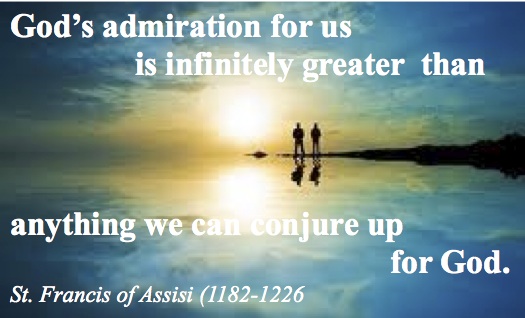
God’s Admiration for Us…

God's Admiration for us copy

“So, When People Say, ‘That Doesn’t Line Up With Lutheran Doctrine’ I Couldn’t Care Less!”

Bell bkFor me the heart of this conversation is expressed by Rob Bell: “The word ‘evangelical’ means ‘good news’ right? Yea, so we’re all about good news, right? So whatever else that word means, I would hope that we are all people of good news. So, if that word refers to a tribal group deeply aligned with an industrial military complex and the furthering of an empire that has on occasion stormed through the world a little more briskly than we would like, tied into a political party that has an agenda often run by multi-national corporations, I’m not interested. But if its referring to an open tomb and hope for everybody, I’m in. “

“So, you either walk away from the word, and say I don’t want anything to do with that, or the word ‘radical’ has its root in the word radix which is a Latin word that means root. The radical is the person who goes back to the roots. So, you either walk away from it or you grab it and say, ‘No, this is what it means.’ And you just hold on tightly. Secondly, I’m interested in anybody who has fresh word about Jesus: Lutherans or Methodists or Anglicans or Evangelicals, or Catholics, or Jedi. If you have fresh insight into Jesus, that’s what I’m interested in. So, when people say that doesn’t line up with Lutheran doctrine, I couldn’t care less. Is that a fresh word about Jesus?”

“I actually think that what you are realizing right now is that some of these tribal systems are falling apart because all of a sudden I’m having fish tacos with Richard Rohr and Peter Rollins shows up and its just an absolute potluck of  Jesusness. I think what’s tipping now is people are going, ‘You’re interested in following Jesus and I’m interested in follow Jesus and that trumps whatever institution we get our pay-cheque from.”

Video recorded in April 2013 at the Seattle School of Theology. The interviewer lacks depth, but if you fast forward to the Q & A (28min mark) the students questions provide Bell with an opportunity to delve a little deeper.

Pentecost Tongues Aflame with the Prayer attributed to Jesus

flaming tonguesIt was the first prayer I ever learned. I suspect my Mother taught it to me, but I have no memory of ever learning it. It is part of who I am. I suspect that the origins of this prayer are as murky as my own memory of learning it. Many New Testament scholars have disputed the historicity of Jesus’ authorship of this prayer. While I agree that the prayer’s antecedents can be found in the Jewish tradition, I’ll leave those arguments to another post and turn my attention to the various interpretations of the prayer. All translations are in and of themselves translations. The festival of Pentecost with it’s images of speaking in tongues provides an excellent opportunity to explore some of the many interpretations of the prayer.

In the language of Aramaic, Jesus is said to have taught his followers the prayer we know as “The Lord’s Prayer.” It was then translated into Greek and recorded in the Gospels (Matt. 6:9-13; Luke 11:2-4).  Since then this prayer attributed to Jesus has been translated into hundred’s of languages. Most familiar to many of us are the English translations based on adaptations of the King James and NRSV versions of the Bible. The fact that language continues to change over time, means that the work of translation is never complete. Jesus’ prayer is alive and well in all the world and many translations embody the breath of life that this rich Word of God inspires.

For several years our Pentecost liturgy has included a cacophony of voices as our worshipping tongues pray this prayer using an interpretation of their choice. A selection of interpretations is printed in a folder and while the presider prays the prayer in Aramaic the congregation prays an interpretation. Follow this link for a copy of the interpretations (designed to be printed double-sided and folded together in a booklet) and enjoy the video which will give you an idea of how the Aramaic may have sounded.

This Pentecost practice moved our community beyond the “contemporary versus traditional” arguments over which translation of the “Lord’s Prayer” ought to be used in worship. We know have a plethora of choices!

Celebrating Pentecost in the 21st Century

pentecost celebrate 2Michael Morwood has the uncanny ability to articulate progressive Christianity in ways that enable worshippers to move beyond images and ideas that entrap us in ancient world views. I love his prayers and use them often in worship!

Adapted from “Praying a New Story” by Michael Morwood

The Celebration of Pentecost in the 21st century moves us beyond the story of Jesus ascending to “heaven” in order to send the Spirit upon us.  Pentecost is the wonderful story of God’s Spirit always present, always active in human development and given total and free expressing in human form by Jesus of Nazareth.

It is the amazing story of people coming to awareness through reflection on the life of Jesus that the same Spirit that moved in Jesus moved in them.  They realized it was no their responsibility to give witness to the Spirit in their lives as totally and as freely as Jesus had.

Pentecost is the wonderful good news that all people who live in love live in God and God lives in them. Pentecost presents a challenge to humanity:  What would life on earth be like if the actions of all people were motivated by their awareness of being “temples of God’s Spirit”?

by Michael Morwood

by Michael Morwood

SHE Who Dwells Among Us – a Mothers’ Day Sermon

Womb-like God

Mothers’ Day Readings which include the Mothers’ Day Proclamation  here

Listen to the sermon here

Worship Bulletin here

Walking the Line: Johnny Cash

johnny cashI’m not what you would call a country music fan. But when it comes to Johnny Cash, well let’s just say, I was raised on his music. My Dad was a big fan and it was from my Dad that I learned to appreciate not just Cash’s music but his life and witness. But country music wasn’t cool where I grew up, so I tried not to let on that I like Johnny Cash. I remember waiting until my parents were out, before slipping the live album Folsom Prison Blues onto my Dad’s prized Hi Fi and crooning along with Mr. Cash as if I was June Carter herself.folsom prison blues

I stumbled across this Memorial Tribute to the Man in Black and it not only brought back all sorts of treasured memories, it reminded me of a life lived with integrity and called me to remember all the many causes that Cash’s quest for truth introduced me to. I can’t think of a better way honour the Sabbath than to rest in Cash’s music. I trust that in addition to hearing the spirit of the man, you will also hear the Spirit of the God Johnny did his best to embody.

Enjoy! This one’s for you Dad!

You Shall Be Like a Garden: John Philip Newell

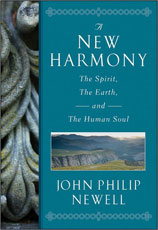
john philip newellI am currently reading John Philip Newell’s “A New Harmony: The Spirit, The Earth, and The Human Soul. It is a wonderful excursion into the depths of a modern Celtic soul which I find difficult to put down. Newell provides a new vision of what he sees as the “new Pentecost” and I’ve already discovered several sermons waiting to be written. Happily Newell will be speaking in Guelph next week and I will have the opportunity to journey further along the way with this gentle soul. I suspect that his vision of Pentecost will spark some flames of the Spirit as I prepare for the celebration of Pentecost!  A New Harmony

Newell is a poet, author, and peacemaker. He is the co-founder of Salva Terra: A Vision Towards Earth’s Healing. Formerly Warden of Iona Abbey in the Western Isles of Scotland, he is currently Companion Theologian for the American Spirituality Center of Casa del Sol at Ghost Ranch in the high desert of New Mexico.

Enjoy this video “Prayer for Creativity Chant: You Shall Be Like a Garden”. Music composed by Linda Larkin.

This is Water: David Foster Wallace

goldfish“Because here’s something else that’s weird but true: in the day-to day trenches of adult life, there is actually no such thing as atheism. There is no such thing as not worshipping. Everybody worships. The only choice we get is what to worship.” David Foster Wallace
– This Is Water: Some Thoughts, Delivered on a Significant Occasion, about Living a Compassionate Life

As a pastor, I am often asked to define spirituality. Over the years I have explored many definitions of spirituality; all of which fall short of capturing the experience of the awareness of the sacredness of life that I believe spirituality is. In his efforts to define the value of the value of an education, David Foster Wallace comes close to describing an awareness that is spirituality. Spirituality opens us to the awareness that there is life before death, here and now and that life is sacred. Enjoy the video. You can read the full text of the speech here

The audio comes from a commencement speech given by David Foster Wallacewallace in 2005 to at Kenyon College. The video was made after David Foster Wallace died. Wallace was an American novelist, short story writer, essayist, and professor at Poma College who has been described as “the most gifted and linguistically exuberant American novelist and short story writer of his generation. 

Preaching on Mothers’ Day – Don’t Compromise!

True Mother Julian of NorwichPreachers have several choices when it comes to proclaiming the Gospel on Mothers’ Day.  We can of course ignore the fact that it is Mothers’ Day. After all Mothers’ Day does not appear on the Church calendar of feasts and commemorations. However, Mothers’ Day is reported to be the third highest attendance day; out numbered only by Easter and Christmas! I suspect that a great many offspring choose the day to placate their mothers. So ignoring the event seems like adding insult to injury to those guilt-ridden offspring who hope that their efforts won’t go unnoticed. Sadly, the presence of the Christmas and Easter crowd, all too often tempts the preacher to resort to sentimentality in order to entertain the infrequent worshippers. The history of the creation of Mothers’ Day ought to compel preachers to resist temptation and find the courage not to compromise. 

Most of us think of Mothers’ Day as a kind of conventional holiday that celebrates traditional family values; the kind of traditional values that encourage women who are mothers to keep on keeping on.  But celebrating the traditional motherhood is definitely not what Mothers’ Day was originally intended for.  The very first Mothers’ Day was intended to be a celebration not just of mothers, but rather it was designed to be a call to action by all women. 

One of the first founders of Mother’s Day was Anna Jarvis back in 1858.  Anna Jarvis gathered women of the Appalachian mountains together in what she called mother’s day work clubs. Where women worked together to eliminate poverty.  When the Civil War came about, the mother’s day work clubs created medical camps.  They were places of nonviolence for men from both sides who were wounded in the war. 

At the end of the Civil War, Anna Jarvis organized the Mother’s Day Friendship Day, which was a call for radical peace.  Anna Jarvis brought together the leaders from the north and the south for a time of reconciliation.  Mother’s Day was originally about reconciliation and peace.

Then along came a  woman named, Julia Ward Howe who wrote “The Battle Hymn of the Republic”. Julia Ward Howe called for women to protest the cruelties of war everywhere and to gather together to call for peace.  She called for a national day of peace for all women.  She issued women’s’ declaration, and from the streets women shouted :

“Arise then women of this day, arise all women who have hearts, say firmly our husbands shall not come to us reeking with the carnage for caresses and applause.  Arise women of peace.” 

Anna Jarvis’ daughter also named Anna Jarvis approached President Wilson and petitioned for a national Mother’s Day.  It was Woodrow Wilson who called for the second Sunday of May to be the national Mother’s Day. Shortly thereafter, n anti-suffragette movement spoke out against the women who were calling for peace.  So instead of being a day for women who were active and present in the world, it became a day to celebrate mothers who stayed at home with the children.

Anna Jarvis the founder of Mother’s Day was so angry with Woodrow Wilson that she filed a law suit, that petitioned the courts to put a stop to Mother’s Day because as the court papers insisted, instead of it being run by women, suddenly Mother’s Day was being run by men in an effort to keep them in the house barefoot and pregnant. 

Sadly, the world was not ready for such strong willed women to shout out loud. And so, Anna Jarvis was arrested at a Mother’s Day celebration and she spent the rest of her life in a sanatorium? 

On mothers’ day we would all do well to remember Julia Ward Howe’s Mothers’ Day Proclamation.  Dated 1870 but sadly it is still so very relevant today:

Arise, then, women of this day! Arise, all women who have hearts, whether your baptism be that of water or tears!

Say firmly: “We will not have great questions decided by irrelevant agencies. Our husbands shall not come to us, reeking with carnage, for caresses and applause. Our sons shall not be taken from us to unlearn all that we have taught them of charity, mercy and patience. We women of one country will be too tender of those of another to allow our sons to be trained to injure theirs.”

From the bosom of the devastated earth, a voice goes up with our own. It says, “Disarm, Disarm!” The sword of murder is not the balance of justice. Blood not wipe out dishonor, nor violence indicate possession. As men have often forsaken the plow and the anvil at the summons of war, let women now leave all that may be left of home for a great and earnest day of counsel. Let them meet first, as women, to bewail & commemorate the dead. Let them solemnly take counsel with each other as to the means whereby the great human family can live in peace, each bearing after his own time the sacred impress, not of Caesars but of God.

In the name of womanhood and of humanity, I earnestly ask that a general congress of women without limit of nationality may be appointed and held at some place deemed most convenient and at the earliest period consistent with its objects, to promote the alliance of the different nationalities, the amicable settlement of international questions, the great and general interests of peace.”

What the Hell is Heaven?

Heaven – Brett Dennen

Beyond the rules of religion
The cloth of conviction
Above all the competition
Where fact and fiction meet
 
There’s no color lines cast or classes
There’s no fooling the masses
Whatever faith you practice
Whatever you believe
 
Oh, Heaven, Heaven
What the hell is Heaven?
Is there a home for the homeless?
Is there hope for the hopeless?
 
 Throw away your misconceptions
There’s no walls around Heaven
There’s no codes you gotta know to get in
No minutemen border patrol
 
You must lose your earthly possession
Leave behind your weapons
You can’t buy your salvation
And there is no pot of gold
 
Mmm Heaven, Heaven
What the hell is Heaven?
Is there a home for the homeless?
Is there hope for the hopeless?
 
Heaven ain’t got no prisons
No government, no business
No banks or politicians
No armies and no police
 
Castles and cathedrals crumble
Pyramids and pipelines tumble
The failure keeps you humble
And leads us closer to peace
 

Oh, Heaven, Heaven
What the hell is Heaven?
Is there a home for the homeless?
Is there hope for the hopeless?

Is there a home for the homeless?
Is there hope for the hopeless? 

Knowing Beyond Belief: Julian of Norwich

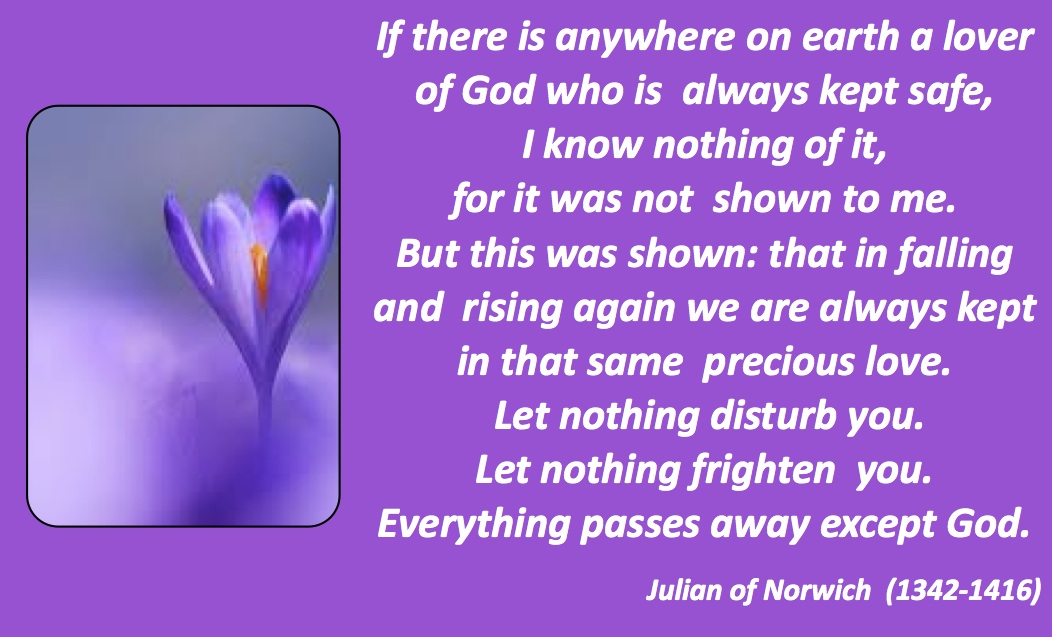
dying and rising copy

Today the church commemorates the life and witness of Julian of Norwich.

Click here for an Evening Prayer liturgy with texts from Julian of Norwich

Julian of Norwich lived as a contemplative; that is to say she spent a good deal ofhazelnut time pondering the big picture. One day Julian had a vision. It was a vision of Jesus and in that vision Jesus was holding a ball; that ball was all of creation and instantly Julian understood that contained in the vision was the gift of knowledge and that knowledge is that all of creation was created by God, held by God and loved by God. Suddenly, there was in Julian’s hand a hazel nut. A tiny little hazel nut and staring down and that hazel nut, Julian knew that that beautiful, wondrous little nut was created by God, held by God and loved by God.  The gift of that knowledge led to an even greater gift of knowledge because suddenly Julian knew beyond the shadow of a doubt that she Julian was created by God, held by God, and loved by God and that very knowledge led her to have the faith she needed to believe that “all will be well; all things will be exceedingly well.”

I see Julian’s insight as a beautiful definition of what faith is: knowing beyond belief that you are created by God, you are held by God, you are loved by God. There’s no need to sweat the details, because “All will be well; all things will be exceedingly well.” That’s the gift of faith, the knowledge that we are created held and loved by God and that all will be well; all things will be exceedingly well. That gift of faith, the knowing beyond belief that you are created, loved and held, gives you the freedom to live and the freedom to die: to die secure in the knowledge that all will be well; all things will be exceedingly well. As for the details, the gift of faith means you don’t need to worry about the details. It’s enough to know that when a seed falls into the earth and dies, it remains a single grain; but if it dies, it bears much fruit. We don’t have the details. I can’t give you a list of details and say, “hey here you go just believe these answers and all will be well.”  All I can tell you is the same thing that I declare loudly and clearly at every graveside I’ve ever presided over: in the words of the Apostle Paul I declare: “Lo! I tell you a mystery.  We shall not all sleep, but we shall all be changed, in a moment, in the twinkling of an eye, at the last trumpet. For the trumpet will sound, and the dead will be raised imperishable, and we shall all be changed.  For this perishable nature must put on the imperishable, and this mortal nature must put on immortality. When the perishable puts on the imperishable, and the mortal puts on immortality, then shall come to pass the saying that is written:  ‘Death is swallowed up in victory. O death, where is they victory? O death, where is thy sting?’”

Trusting that we need not fear death is a powerful freedom that liberates us to live fully here and now, knowing beyond belief that all will be well!

Love Julian

Jesus was wrong! Can I Get an Amen? – a sermon for Easter 7C – John 17:20-26

window4Before I could go to seminary I had to obtain an undergraduate degree.  So I enrolled at the University of British Columbia in their religious studies program. In order to obtain a degree in religious studies, we were required to study the religions of the world. My professors and classmates were Islamic, Hindu, Jewish, Christian, Buddhist, atheist, agnostic, and together we explored all sorts of religions, both ancient and modern.  I remember registering in a course on ecumenism where I expected that we would study the various movements to restore unity to Christianity.  We did that, but we also did so much more.  We learned that ecumenism is not just about Christian unity.  Ecumenism includes inter-faith dialogue.

During the course I was required to write papers on Hindu-Christian dialogue, as well as a paper concerning what was written about Jesus in the Islamic Qur’an.  This course introduced me to the reality that unity does not mean uniformity. In his book entitled Who Needs God, Rabbi Harold Kushner writes: “Religion is not primarily a set of beliefs, a collection of prayers, or a series of rituals. Religion is first and foremost a way of seeing. It can’t change the facts about the world we live in, but it can change the way we see those facts, and that in itself can often make a real difference.”

Sadly, over the centuries the religions of the world have shaped the way we see people whose religious practices are different than our own in ways that have made it possible for us to pre-judge our neighbours. Studying the religions of the world broadened my horizons and I actually began to believe that at long last I had escaped the prejudices that were bred into me. Continue reading

Don’t Piss God Off! – a sermon for Easter 6C – Acts 16:9-15


“Warning!” written by Jenny Joseph

When I am an old woman I shall wear purple
With a red hat which doesn’t go, and doesn’t suit me.
And I shall spend my pension on brandy and summer gloves
And satin sandals, and say we’ve no money for butter.
I shall sit down on the pavement when I’m tired
And gobble up samples in shops and press alarm bells
And run my stick along the public railings
And make up for the sobriety of my youth.
I shall go out in my slippers in the rain
And pick the flowers in other people’s gardens
And learn to spit.

You can wear terrible shirts and grow more fat
And eat three pounds of sausages at a go
Or only bread and pickle for a week
And hoard pens and pencils and beermats and things in boxes.

But now we must have clothes that keep us dry
And pay our rent and not swear in the street
And set a good example for the children.
We must have friends to dinner and read the papers.

But maybe I ought to practice a little now?
So people who know me are not too shocked and surprised
When suddenly I am old, and start to wear purple.

lydia of philippiLydia is one of the many mothers of Christianity. Lydia was the first European convert to Christianity. Lydia was the founder of the church at Philippi. The Scriptures tell us that before Paul and Silias proclaimed the Gospel to Lydia, she was a “God Fearer”. God Fearers, was the name given to people who were not Jewish but who were so intrigued with the God that the Jews worshipped that they lived their lives as if they were Jews. Indeed, most God Fearers followed all the Jewish laws except for circumcision. Circumcision, for adult males, living in the first century, when sanitary conditions were primitive and no antibiotics were available could lead to death.  So, most male converts to Judaism, were not called Jews but God Fearers. Generally women were given the same designation as their husbands or fathers.

So right from the beginning of the story, Lydia is described in an unconventional way. We are told that Lydia was “a God fearer; a worshipper of God and a dealer in purple.” Now an introduction like that may not seem very unconventional to us but we have to remember that for the writer of the Book of Acts to have described a situation where, Paul and Silias, two strange men in town meet a woman, any woman was in and of itself unconventional.

When the Acts of the Apostles was written sometime between at the end of the first century, (most scholars date it between 80 to 100) this sort of encounter would have been considered outrageous; women and men, especially strange men, simply didn’t have encounters in public. And as for Lydia being a dealer in purple; well people hearing this story in the first century would have been amazed at the very idea of a women conducting business. And as for the colour purple: it took thousands of mollusks; mollusks are tiny little crustaceans…shellfish; and you’ve got to crush and treat thousands of the little suckers just to make enough dye to make a yard or two of purple cloth. So it was very expensive, worth its weight in silver. Wearing purple was a statement of status and wealth. Purple was the Gucci handbag or Rolex watch of the first century. Lydia is selling purple; purple cloth, purple robes, the power of purple. She’s not local. Lydia’s is from Thyatira, a town well know for making purple cloth.  Lydia seems to be the head of her household, there’s no man mentioned and that alone is remarkable, because Lydia is traveling in the public realm, to trade her wares. As a seller of purple, she’s not poor; a poor woman wouldn’t be able to afford that kind of stock. She’s not Jewish, but she believes in God. She’s not part of any organized religion.

According to the story, when Paul and Silias arrive in Philippi to proclaim the good news about Jesus Christ, they begin by looking for a synagogue. They figure a synagogue is a good place to begin because that’s where the folks who already believe in God hang out. But to have a synagogue you need ten men who will meet together to say prayers. Philippi, it seems, didn’t have a ten men to form a synagogue. So if there’s no synagogue, then any Jews or God Fearers that happen to be in the town or passing through know to meet down by the river on the Sabbath to pray.

So, Paul and Silias head down by the riverside, hoping to preach the gospel to the men; and down by the river they find only women. And the scripture tells us that Paul and Silias, “sat down and spoke to the women who had gathered there.  A certain woman named Lydia, a worshiper of God, was listening to them; she was from the city of Thyatira and a dealer in purple cloth. We’re told that, “The Lord, opened her heart to listen eagerly to what was said by Paul.” And then we are told that Lydia and her household were baptized and Lydia invited Paul and Silias to come and stay with her.

Many scholars agree that the church that was formed in Philippi, the church to whom Paul address his letter to the Philippians; this church, the first church in Europe was in all likelihood founded and then led by the first European convert to Christianity; a woman named Lydia.

Looking back to a time when we have been lead to believe that conventions demanded that women to stay out of the public realm,  we see that even the Apostle Paul, who down through the centuries has been credited with trying to keep women silent in the churches, even Paul promoted the proclamation of the Gospel by  entering into all sorts of ministries that were actually lead by women. Lydia was one of several women, named and unnamed who established the first congregations in their homes. Most of these women were wealthy women of means who saw to it that the church had what it needed to grow and flourish.

From the very beginning Christianity has flouted convention.  Yet so many of those of us who call ourselves Christians, spend so much of our time content to be conventional. Christianity is not about preserving the status quo. Christianity is not about being conventional.  Christianity is dangerous. Those who call ourselves Christian need to put away our desire to play it safe. We need more purple hues in our lives! We need to dare to step out of bounds, and take some risks. Christians need to colour outside the lines!

Don’t shun the unconventional. Remember Lydia and ask yourself:  are you old enough to wear purple; how about a red hat that doesn’t go, and doesn’t suit you?

Do you think your ready, to make up for all those years of following the rules? Do you want to go out in your slippers in the rain, or pick the flowers in other people’s gardens and learn to spit? NO. Well maybe you’re right; maybe you’re not old enough just yet. But maybe you ought to practice a little now? So people who know you are not too shocked and surprised when suddenly you are old, and start to wear purple. Come on, what have we got to lose, listen to the ways the Spirit of God is moving in you. Come on let’s take a chance and mosey on down by the riverside!

Let’s dare to wear purple! Perhaps, in daring to be unconventional we will know the peace the promised peace of Christ. So, let’s mosey on down by the riverside…

Lydia’s band of women down by the riverside reminded me of Sister Rosetta Tharpe; an unconventional woman who dared to be who she was. There’s another sermon here somewhere about the peace that Christ offers. Preach it!

For more about Sister Rosetta click here


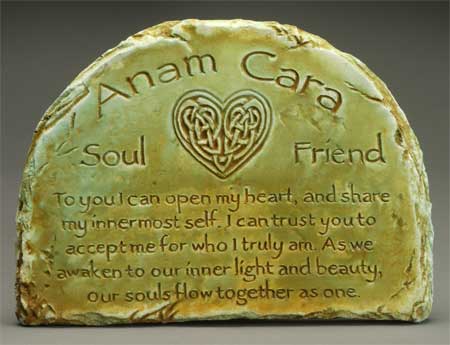
Anam Cara, The Blessing of a Soul Friend

anam-cara-wall-plaque

The sunshine of these May days have beaconed me outside into the newly awakened garden. My companion on these respites is John O’Donohue’s “Anam Cara: A Book of Celtic Wisdom.” Anam Cara is Irish Gaelic for “soul friend”. As the gentle breezes and the warm sunlight caress me, I am struck by the pleasure of knowing the Earth as my anam cara.

Conversations Beyond Church: A Place for Rob Bell’s New Book

Bell bkIn the twenty-first century, all too many of the conversations about God are simply beyond the Church. By that I mean, talking about God to people who are outside of the Church is simply beyond the Church’s demonstrated abilities. The faithful remnant who scurry about within Christianity may talk about talking to people who have left the church, or people who have rejected the church, or even to people who have never darkened the door of a church. But when push comes to shove, very few of us are capable of engaging in serious conversation with those who live their lives beyond the Church. Rob Bell’s newly released book: “What We Talk About When We Talk About God” may not be a deep theological endeavour. It may not offer much that is new or insightful. But it does have a place in the conversations that don’t seem to be happening between church-goers and those who live beyond the Church. Indeed, Bell’s book might enable those of us who talk about talking to those outside the walls of the Church to actually begin a conversation with someone who does not share our beliefs. 

In my experience of speaking to those who have rejected Christianity and the Church, I have discovered that the God and the religion that so many people have walked away from the Church over, is not the God or the religion that Christianity, at its best, actually proclaims. Bell’s book articulates a Christianity that is closer to the faith most church-goers actually embrace.

Following the success and controversy surrounding his book “Love Wins”, Bell has the notoriety to generate the kind of interest that leaves the average church professional drooling in an  “if only I could generate that much interest” kind of way. So there will be plenty of “tut, tuts” coming from those who will insist that it’s not a serious academic work. But don’t let their jealousy of Bell’s appeal fool you. Bell has matured some. He’s been talking to scientists and he’s been influenced by academics and he has made an attempt to talk about God in ways that the unchurched as well as the churched will find engaging. Bell’s also been talking to Peter Rollins (Irish philosopher and theologian) whose work appears to have had a refreshing influence on Bell. Indeed, Bell has chosen a title that  could be considered a positive restatement of Rollins’ first book title “How (not) to Speak of God”. 

Whether your a fan of Bell’s work or not, it’s difficult not to concede that Bell has mastered the art of communicating in this social media world in which we live. “What We Talk About When We Talk About God” provides an effective tool that will enable many of us to engage in conversations beyond Church. I’ve already purchased several copies and can’t wait to engage in a conversation or two with folks who are ready to engage in talk about God. Bell has given us the gift of a place from which to begin to engage in some serious God-talk.

Below you will find a promotional video created to promote the book, that will wet your appetite for the second video in which Bell lecture at Vanderbilt addresses some of what you will find in the book. Enjoy and after you read the book, use it to begin a conversation beyond Church.

Promotional Video for “What We Talk About When We Talk About God”

Rob Bell Speaking at Vanderbilt University

Beauty: A Human Calling and An Aspect of God – John O’Donohue

John O'DonohueHaving only recently been introduced to the work of John O’Donohue, (thanks Susan!) I find myself totally enthralled! O’Donohue was an Irish poet, philosopher, theologian, environmental activist, and storyteller whose writings explore the wisdom of Celtic Christianity. O’Donohue was an imbiber of beauty which he heralded as a human calling and an aspect of God. I’ve spent a good deal of time this week absorbed in the beauty of his masterpiece Anam Cara: A Book of Celtic Wisdom (1998). Anam Cara is Gaelic for “soul friend” and the book is just that as it gently guides you through the spiritual landscape of Irish imagination. The book reads like a prayer. O’Donohue insisted that “it is within our power to transform our fear of death so that we need fear little else this life brings.” Sadly, O’Donohue died young (just 52 in 2008), but he left a legacy of wisdom in a series of books that I look forward to immersing myself in. 

“When love awakens in your life, in the night of your heart, it is like the dawn Anam Carabreaking within you. Where before there was anonymity, now there is intimacy; where before there was fear, now there is courage; where before in your life there was awkwardness, now there is a rhythm of grace and gracefulness; where before you used to be jagged, now you are elegant and in rhythm with your self. When love awakens in your life, it is like a rebirth, a new beginning.” (Anam Cara)

As I bask in the beauty of O’Donohue’s wisdom, I am delighted to discover a film he made shortly before his death to compliment Anam Cara. The film in and of itself is a “soul friend.” You can enjoy it below. If you are familiar with O’Donohue’s wisdom or if you’ve never encountered the man, you will enjoy the brief video of O’Donohue speaking to a gathering of psychotherapists on the subject of observation. Quoting Heidiegger “true listening is worship” O’Donohue draws in his audience with humour and makes listening a joy while slipping in his subversive advocacy of a  “kind of un-thearaphy”.  His humour will wet your appetite for the longer film, which is well worth the time. I recommend putting your feet up with wee dram to add to your enjoyment!

Anam Cara – 2008