Shusssh…Peace…Shalom…Shusssh… Oh No! the apocalypse is here in this Sunday’s Gospel Reading from Luke 21:5-19

The end is nearIn October of 1977, I was twenty years old.  I was young and adventurous and with a rail pass in my hand, a back pack slung over my shoulders and several hundred dollars worth of American Express Travellers cheques in my pocket, I boarded a train in Zurich, Switzerland, bound for Athens, Greece.

I was tired.  Several months of backpacking in Northern Europe had left me weary.  In just five days my rail-pass would expire, so I decided to head for Greece, where the living is easy, where the warm sun, blue skies and equally blue waters held the promise of rest and relaxation.

As the train made its way through the Alps, I remembered a similar trip which I had made the year before and I tried to calculate whether my remaining funds would allow me to return to the village of Hannia on the island of Crete.  I knew that in Crete I could find work.  I planned to mix a lot of rest and relaxation with just a little work and try to live out the winter on the Mediterranean.

As the train rattled through Austria toward what was then Yugoslavia it began to get dark. I was disappointed that my journey through Yugoslavia would be completed in darkness.  I remembered my previous journey, by car, through Yugoslavia and how at the time, I had marvelled at the diversity of this strange little country.  I remembered men and women driving oxen as they ploughed their fields in much the same way as there ancestors had done.  I also remembered my surprise at entering the ultra modern city of Belgrade; the showcase of Tito’s communist regime. I fell asleep pondering the sharp differences between the lives of the poor people in the villages who appeared to live without any modern conveniences at all and the lives of those who inhabited the city of Belgrade with its towering skyscrapers and streets filled with automobiles.  Several centuries seemed to co-exist in Yugoslavia.

I was awakened by the sound of people shuffling to find their papers as the train conductor instructed us to get our passports and visas ready for customs inspection.  When the Yugoslavian custom officials, with their rifles over their shoulders boarded our train they were preceded by men guided by vicious looking German shepherds.  Even though I knew that I had all the right papers and that my back pack contained nothing more offensive than some dirty laundry, the sight of the dogs, guns and uniformed officials struck fear into my heart.  I nervously handed over my precious passport to an official who looked younger than my twenty years.  He carefully read over the visa which I had obtained in Zurich the day before; a visa that I could not read because it was written in an unfamiliar language and an unfamiliar alphabet. Continue reading
Wrestling With the Almighty: Locating Our Very Selves in the Sacred Story – a sermon on Genesis 32:3-31

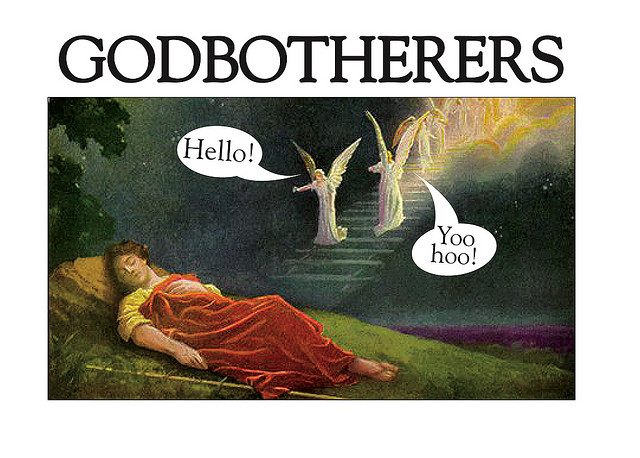
Godbotherers

For those of you preaching on the text from Genesis 32:3-31:

You may not be able to tell from looking at me. But let me assure you that you are looking at someone who used to be a champion wrestler. Believe it or not, my wrestling skills actually helped me rise to the level of a world champion wrestler. Well, perhaps I should qualify that statement. When I was an amateur wrestler, I was a world-class champion wrestler. But like so many athletes, when my status changed from amateur to professional, I lost my championship status and although I still qualify as a professional wrestler, and I like to see myself as a champion, I’m no longer what you would call world-class.

Like many professional wrestlers my career began when I was but a child. Growing up I had a very clear advantage as I developed my wrestling skills. You see having a brother who was just 18 months younger than me meant that I had ample opportunities to hone my wrestling skills. My brother and I were always at it. I’ve got to say that even though we shared the same weight class for most of our childhood, when it came to world class wrestling holds, I had him beat. I had this wicked arm-hold sleeper, and that together with my full Nelson followed by a knee-arm press, was guaranteed to have my brother screaming uncle and agreeing to be my obedient servant until in no time at all. For years I reigned as the champion of our little world! I was unbeatable. My brother didn’t stand a chance. My reign as world champion would have continued if it weren’t for the abrupt ending of my amateur status.

One morning when I was about 13 and my brother was 9 and a half, we were going at it,  and to his credit my bother had me in an ingenious hold. Somehow, he’d managed to secure me with what we professional wrestlers call an arm bar. That’s where you’re opponent wrenches your arm behind your back and applies just enough pressure to cause pain, but not enough to break anything. But just when Alan was approaching the point of no return, I managed with a feat of superhuman strength to rise up, twist around and swing for all I was worth and connect with what I though must be my brothers chest. I expected that such a thrust would have released my arm from Alan’s iron grip. But he still had me. I was about to hit him again, when for no apparent reason Alan released me from his grip. In an instant I wiggled free, spun around and connected with what I figured would be a fatal blow. Just before my blow connected with it’s victim, I realized that I was doomed.

Continue reading

God in the Guise of a Pleading Widow a Sermon on Luke 18:1-8

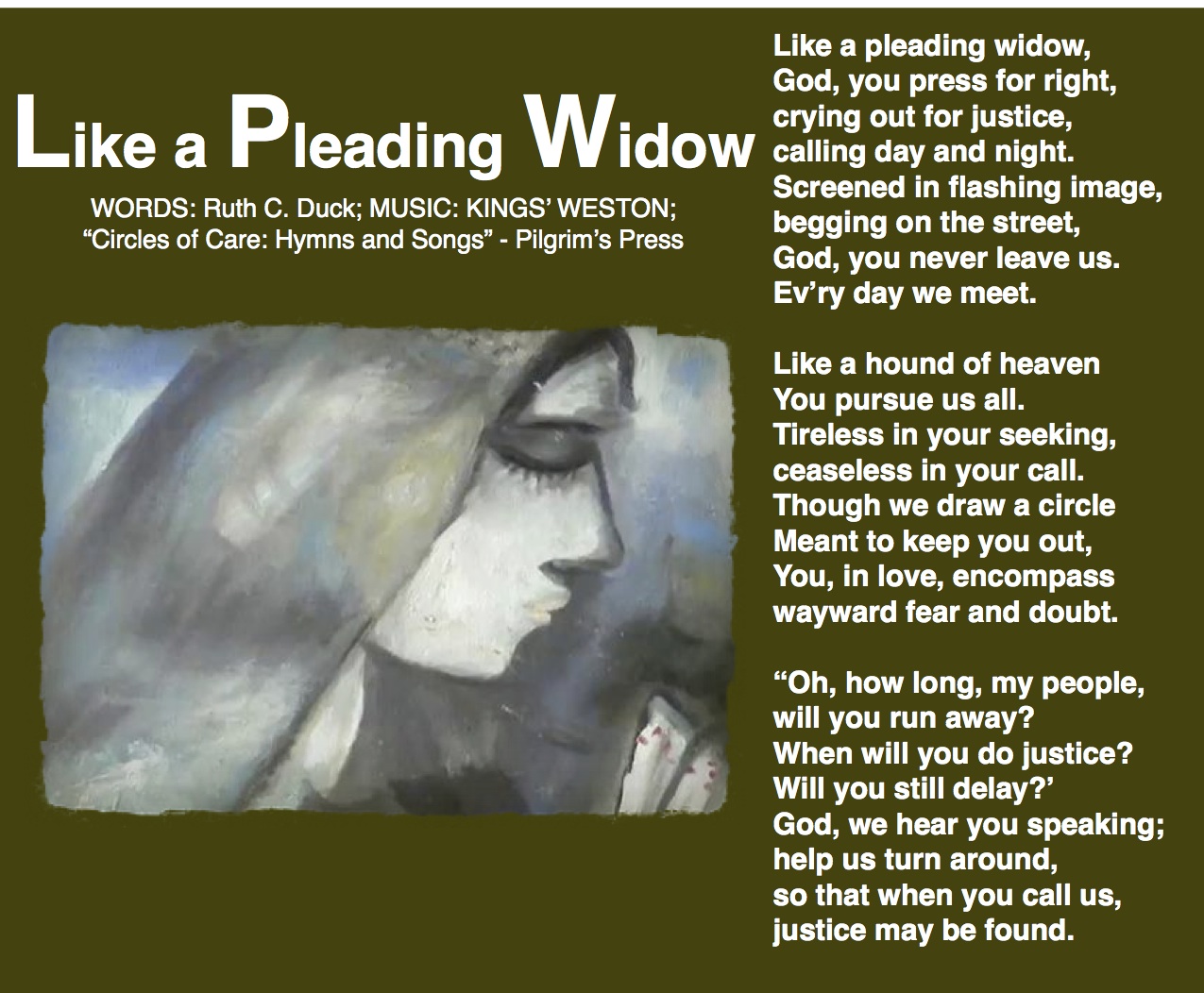
Like a Pleading WidowAi Weiwei’s exhibit “According to What? at the Art Gallery of Ontario inspired me to look beyond traditional interpretations of Jesus’ parable of the Pleading Widow to see our role as the unjust judge. The gentle breath of a newborn granddaughter enabled me to hear God persistently pleading for justice. Read the sermon manuscript below or Listen to the sermon here:  

I spent time exploring the Ai Weiwei exhibit at the Art Gallery of Ontario. It is a powerfully, disturbing, fascinating and compelling exhibit that I know will stay with me for years to come. Ai Weiwei is, according to the AGO’s description, “an artist with a very new kind of visibility. He has transcended his artwork to become a worldly figure who, for many, symbolizes the assertion of freedom of expression against great odds. Using the fame and recognition garnered by his art, Ai Weiwei has taken on issues that could not be raised publically in China.” The exhibit provides a unique window into a part of the world that continues to remain impenetrable.

Ai Weiwei and I are the same age but it is as if our worlds are light-years apart. I first became aware of his work during the Beijing Olympics in 2008. Ai is responsible for the spectacular design of the Beijing Olympic Stadium that has become known as the Bird’s Nest. With his conception of the Bird’s Nest Ai hoped to represent freedom. He saw the Olympics as a splendid opportunity to demonstrate that China was opening up after decades of seclusion with a dismantling of the barriers erected by successive totalitarian régimes. Sadly, Ai’s dreams were dashed as the stadium was constructed and the Chinese government resorted to old methods to drive the poor from their homes in order to build on Olympic sites.

On the opening day of the Olympics, Ai wrote this about his of his decision to boycott the events: “Today China and the world will meet again. People will see that the planet is now smaller than at any time in history, that mankind should bid farewell to arrogance and indifference, to ignorance and discrimination, and understand that we share the same small piece of land. It will be a time to rediscover each other, to share what is good in life, to look each other in the eye and link all 10 fingers. The colourful festival is a time not just for celebration, but also for peace and friendship. To rediscover our future, we should say goodbye to our past. We must bid farewell to autocracy. Whatever shape it takes, whatever justification it gives, authoritarian government always ends up trampling on equality, denying justice and stealing happiness and laughter from the people.

We should also leave behind discrimination, because it is narrow-minded and ignorant, denies contact and warmth; and corrodes mankind’s belief that we can better ourselves. The only way to avoid misunderstanding, war and bloodshed is to defend freedom of expression and to communicate with sincerity, concern and good intentions.

The “Bird’s Nest” National Stadium, which I helped to conceive, is designed to embody the Olympic spirit of “fair competition”. It tells people that freedom is possible but needs fairness, courage and strength. Following the same principles, I will stay away from the opening ceremony, because I believe the freedom of choice is the basis of fair competition. It is the right I cherish most. If we want it to be, today can be a moment of courage, hope and passion. This day will test our faith in the human race, and our determination to build a better future.”

The Chinese government has not reacted kindly to Ai’s public descent and he has felt the weight of their abuse. He remains under house arrest and was not allowed to travel to Toronto for the opening of his exhibit. It is only, Ai’s world renown as an artist and public dissident that protects him from the ultimate fate of so many Chinese dissidents.  Ai Weiwei’s courage in speaking out against injustice over and over again, has robbed him of his liberty and put his life in grave danger and yet he continues to publically protest the abuses of his overlords. Ai’s testimony, expressed in his art, speaks volumes to the world and even tough his protests fall on what appear to be the deaf ears of a régime that continues to oppress the people of China, one wonders how long these unjust judges will be able to resist his persistent pleas for justice. Continue reading

The Science of Happiness – An Experiment in Gratitude

thanksgiving canadaIn place of the sermon this Sunday, we watched the video “An Experiment in Gratitude” followed by brief comments about embodied gratitude. You can watch the video below and listen to our conversation here below are the notes from on which the comments are based:

Your Mom and Dad were right when they taught you that “thank-you” is a magic word. Science now confirms what we learned at our parents’ knees all those years ago. However, many of us do not need science to confirm the power of gratitude. As far back as the 14th century Meister Eckhart insisted that “If the only prayer you said in your whole live was “Thank –you, That would suffice!”
What does gratitude look like when you no longer worship an image of God that personifies or anthropomorphizes God? When God is more than the source of our being, when God is being itself, how do we offer our thanksgiving? When God is the One in whom we live and move and have our being, how do we say thank-you? When we begin to understand that everything is in God and God is in everything, what prayer of thanksgiving will suffice? Leaves – seeing the hand of our Creator in Creation – who do we embody gratitude to creation? Humans seeing God in everyone – how do we embody gratitude to everyone? Jesus pointed to LOVE as the definition of God, God is LOVE and those who know LOVE know God. Jesus said, that he Jesus, this imperfect human being was ONE with God. Jesus taught us to see God in one another, when you give a cup of water to the least of these, you give it to me. Our gratitude is expressed in our loving.

LOVE encompasses a whole lot of things.

John Shelby Spong: “If God is the source of life, I worship God by living. If God is the source of love
I worship God by loving. If God is the ground of being, I worship God by having the courage to be more fully human;the embodiment of the divine.”
Augustine described God as: “LOVER, BELOVED, AND LOVE ITSELF” let LOVE be our embodiment of gratitude!

Happy Thanksgiving!

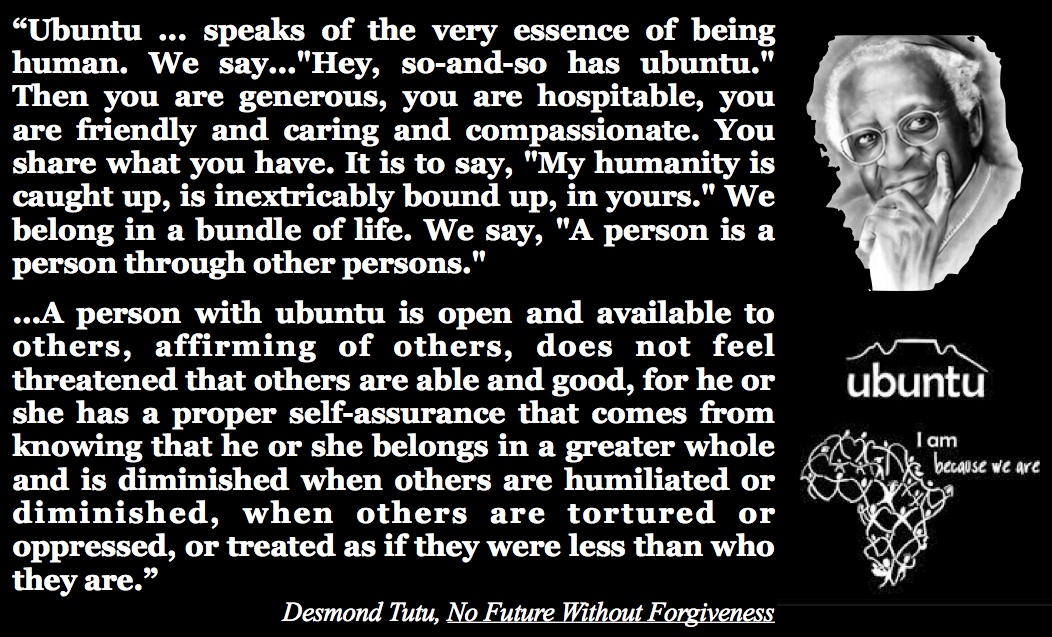
Ubuntu: A Person Is A Person Through Other Persons – Luke 17:5-10 – The Parable of the Mustard Seed

Ubuntu -- pastordawn.com

colemansListen to the sermon here: 

In his book, “The Orthodox Heretic”, Peter Rollins creates a parable which he calls “Finding Faith.”

According to Pete, “There was once a fiery preacher who possessed a powerful but unusual gift. He found that, from an early age, when he prayed for individuals, they would supernaturally lose all of their religious convictions. They would invariably lose all of their beliefs about the prophets, the sacred Scriptures, and even God. So the preacher learned not to pray for people but instead he limited himself to preaching inspiring sermons and doing good works. However, one day while travelling across the country, the preacher found himself in a conversation with a businessman who happened to be going in the same direction. The businessman was a very powerful and ruthless merchant banker, who was honored by his colleagues and respected by his adversaries. Their conversation began because the businessman, possessing a deep, abiding faith, had noticed the preacher reading from the Bible. He introduced himself to the preacher and they began to talk. As they chatted together this powerful man told the preacher all about his faith in God and his love of Christ. He spoke of how his work did not really define who he was but was simply what he had to do.

“The world of business is a cold one,” he confided to the preacher, “And in my line of work I find myself in situations that challenge my Christian convictions. But I try, as much as possible, to remain true to my faith. Indeed, I attend a local church every Sunday, participate in a prayer circle, engage in some your work and contribute to a weekly Bible study. These activities help to remind me of who I really am.’

After listening carefully to the businessman’s story, the preacher began to realize the purpose of his unseemly gift. So he turned to the businessman and said, ‘Would you allow me to pray a blessing onto your life?’

The businessman readily agreed, unaware of what would happen. Sure enough, after the preacher had muttered a simple prayer, the man opened his eyes in astonishment. ‘What a fool I have been for all these years!’ he proclaimed.  ‘It is clear to me now that there is no God above, who is looking out for me, and that there are no sacred texts to guide me, and there is no Spirit to inspire and protect me.’

As they parted company the businessman, still confused by what had taken place, returned home. But now that he no longer had any religious beliefs, he began to find it increasingly difficult to continue in his line of work. Faced with the fact that he was now just a hard-nosed businessman working in a corrupt system, rather than a man of God, he began to despise his work. Within months he had a breakdown, and soon afterward he gave up his line of work completely.

Feeling better about himself, he then went on to give to the poor all of the riches he had accumulated and he began to use his considerable managerial expertise to challenge the very system he once participated in, and to help those who had been oppressed by the system.

One day, many years later, he happened upon the preacher again while walking through town. He ran over, fell at the preacher’s feet, and began to weep with joy.

Eventually he looked up at the preacher and smiled, ‘thank you, my dear friend, for helping me to discover my faith.’”

In a parable handed down to us from our ancestors in the faith, Jesus’ disciples ask him to “increase their faith”. It is a request that I believe many of us can identify with for who among us has not at some point or other asked for the gift of more faith? If only we had more faith we would be able to believe and if we could believe we’d have the courage to  cope with whatever crisis is overwhelming us. If we could only believe, we’d be able to understand why, or how, this or that. If we could just believe strongly enough, we’d have the courage to risk, to speak out, to stand-up for, to open up to, to ask for, to go on, to do something. If only we could believe in God, believe in the life death and resurrection of Jesus, believe in the power of the Holy Spirit if only we could get it all straight in our heads we’d be able to tell all the world what it is we believe. In the meantime, we’ll just keep on struggling to believe.

For years, and years, I used to believe that what was necessary was to just believe. So, I struggled to understand what all those “I believe statements” that the church, the community of believers asks its followers to make.

“I believe in God the Father Almighty,

maker of heaven and earth and in Jesus Christ,

his only Son our Lord,

he was conceived by the power of the Holy Spirit

and born of the virgin Mary.

He suffered under Pontius Pilate,

Was crucified, died and was buried.

He descended into hell.

On the third day he rose again,

He ascended into heaven,

and is seated at the right hand of the Father.

He will come again to judge the living and the dead.

I believe in the Holy Spirit,

the holy catholic Church, the communion of saints,

the forgiveness of sins,

the resurrection of the body and the life everlasting. Amen.”

Over and over again, in liturgies, Sundays after Sunday, the church; the institution of the faith, offered me the opportunity to stand among the faithful to declare what it is that we believe. Whether it was the Apostles or the Nicene or heaven forbid the Athanasian creeds, the Church made it very clear exactly what it is that we are supposed to believe in order that we might number ourselves among the faithful. The very word “creed” itself, was handed down to us from our ancestors creed from the Latin “creedo” which translates into English as “I believe”. Continue reading

Jesus You’ve Got to be Kidding!!! a sermon Luke 14:25-33 and Deuteronomy 30:15-20 for Pentecost 16C

choose lifeI am indebted to Pastor Michael Rodgers for preaching a sermon long ago that stuck with me for decades. This sermon is inspired by his work! 

Jesus you’ve got to be kidding! “Whoever comes to me and does not hate father and mother, wife and children, brothers and sisters, yes and even life itself, cannot be my disciple?…None of you can become my disciple if you do not give up all your possessions?”

Hate your father; hate your mother; hate your wife; hate your children; hate you brothers; hate your sisters; hate even life itself and oh yes while you are at it give up all you possessions and then, and only then will you be ready to take up your cross and follow Jesus. What is Jesus talking about? Has Jesus forgotten about the fourth commandment? Are we to forget about honouring our parents? Wasn’t it Jesus who said that we are to love our neighbours as we love ourselves? Didn’t Jesus try to talk people into loving their enemies?  Has Jesus forgotten that God is love? Why does Jesus rant and rave about hating our father’s, mothers, children, sisters, brothers and even life itself?

It is difficult to recognize the Jesus in this text. This is not the gentle Jesus of my childhood. This is not the happy Jesus who smiled out from the pictures in my illustrated Bible.This is not the Jesus that the rightwing conservative Christians point to when they harp on about family values. This is not the gentle Jesus we have come to expect. This Jesus sounds to harsh. This Jesus wants to turn us into religious fanatics who hate everybody and give up everything, even life itself.

For a few years now, there has stood on the shelf above my desk a quotation from Deuteronomy 30. I put it there so that these word’s of God might guide me in my decision making. According to the writers of Deuteronomy, God says:  “I have set before you life and death, blessings and curses. Choose life so that you and your descendants may live”. God says “Choose life!” How do I reconcile this to the Gospel lesson in which Jesus  says whoever does not hate even life itself, cannot be a disciple of Jesus? Why was Jesus so harsh?  What is going on here? Continue reading

The Bent Over Woman – Luke 13:10-17

bentover woman1It was hot. Already the sun had parched the earth. The air was still. The ground beneath her feet radiated the heat. She was tired. Earlier she had thought about staying at home. Her weary body could use a rest. All week long she had toiled in the heat of the sun. On this Sabbath she longed to rest her crumpled, aching body. She tried to ignore the weakness she felt. She had suffered long and hard. She couldn’t even remember when or how she had become so weak. Over the years, her weakened spirit had left her body bent and crippled. The evidence of her heavy burdens could be seen in her crooked spine. She was ashamed of her appearance.

It had been eighteen long years since she had stood straight and tall. She vaguely remembered running when she was a child. She ran everywhere back then. She ran faster than anyone else in the town. She loved to run. Running made her feel free.

Her mother used to warn her not to run. Her mother tried to stop her. But she was so full of life. She wanted to see everything. She wanted to do everything. She wanted to go everywhere.

Her mother warned her not to be so curious. Her mother tried to keep her busy. Her mother tried to keep her out of trouble. But it was no use, no matter how many tasks her mother gave her; she always managed to find time to explore. She had so many questions. She wanted to know how things worked. Life was so very exciting. She dashed from one adventure to the next. She ran everywhere, everyday. Except of course on the Sabbath. On the Sabbath she walked. She walked with her family to the synagogue. She loved to go to the synagogue. As her father and brothers took their places at the feet of the rabbis, she sat quietly with her mother and sisters and the other women and girls in the back of the synagogue. She listened carefully as the men and boys talked.  Continue reading

I’m a Doubter Not a Believer – Preaching on FAITH – Pentecost 12C

Preaching on Luke 12:32-40 and Hebrews 11:1-16

doubters welcome“Do not be afraid, little flock, for it is your Abba’s good pleasure to give you the kin-dom” So begins the gospel reading for this coming Sunday. But I am afraid and my fear is not about the the thief who this text insists may break into my house or that the Human One is coming at some unexpected hour. No my fear is wrapped up in my desire to pay little or no attention to the second reading prescribed for this Sunday from the letter to the Hebrews:

“Faith is the reality of all that is hoped for; faith is the proof of all that is unseen. Because of faith, our ancestors were approved b God. By faith, we understand the world was created by the word from God, and that what is visible came into being through the invisible…..”

Do I have faith? Do any of us have faith? For that matter: What is faith? According to Hebrews faith “is the reality of all that is hoped for; faith is the proof of all that is unseen.” Faith is the stuff that makes it possible for us to hear Jesus words: “Do not be afraid, little flock, for it is your Abba’s good pleasure to give you the kin-dom.”  Faith is the stuff that makes it possible for us to believe. So I wonder: Do I have faith? Do I have the faith that makes it possible for me to believe? Do you? Do any of us?

I write this as one who finds it difficult and sometimes even impossible to believe much of anything. I am a doubter by nature. Doubting is part of who I am. I know that there are those who are more inclined to believe and I am envious of believers. I envy those who are sure and are able to find comfort in the Scriptures. For a very long time I was ashamed of my inability to believe. I often sat in church and wondered if I might just be a hypocrite. I wondered if someone who had as many doubts as I have belongs in the church. And so, I tried to conquer my doubts by studying the Scriptures. Continue reading

Doubt: Preaching on Hebrews 11:1-16

The Place Where We Are RightLooking over the readings for this coming Sunday and the subject of faith jumps out from the Hebrews reading (Hebrews 11:1-16) which begs questions about doubt.  I have read and blogged about Richard Holloway’s “Faith and Doubt” and Lesley Hazleton’s insistence that “Doubt is Essential to Faith” and both posts provide an interesting jumping off point. This little video of Richard Holloway on “Why doubt is a good thing” provides insights for preaching on doubt as the foundation of faith!!!

Hosea: the Coronation Street of Ancient Israel

A Sermon on the Book of the Prophet Hosea

Coronation StI am indebted to Bishop John Shelby Spong for his insights into the Book of the Prophet Hosea. Without Jack’s thoughtful portrayal of Gomer, I would not have recognized her as the Leanne Battersby of her time. Also, thanks to Marcus Borg for his definition of the verb “believe”!

Listen to the sermon:

I must confess that I am one of the millions and millions of people across the globe who enjoys a guilty pleasure about five days a week. It’s a habit that began back when I was but a wee child. From time to time, circumstances have forced me to give up this guilty pleasure, but over the years, as technology has improved I’ve been able to indulge myself on a more regular basis than I would have thought possible back when I was just a little girl and only able to enjoy this pleasure during the summer holidays. Now a days, I can delay my indulgence to a convenient time. So about 5 times a week, I find myself relaxing in my favourite chair with a mug of tea, ready to enjoy a episode of my favourite soap opera.  

Continue reading

Prayer: 21st Century Questions – There’s an App for that! Luke 11-1-13

prayer appJesus’ teaching on prayer in the gospel reading Luke 11:1-13 leaves me wondering what an enlightened 21st humanoid is supposed to do with Jesus 1st century ideas???

Cast you minds back to another time and place and tell what the numbers 33, 45, and 78 have in common??? Vinyl Records anyone? When I was a kid music came from a portable RCA record player. The sound quality wasn’t all that great, but somehow we didn’t seem to care. Later when I was a teenager, my parents got a fancy state of the art Phillips stereo cabinet and suddenly sound seemed to be coming from booth ends of the room. I never did understand how those old record players managed to pick up sound from the grooves in the vinyl to45 produce music. I still remember my father’s first reel-to-reel tape recorder, and then there were the eight-tracks, followed by cassettes, followed by CD’s.  I can remember these things, but I have no idea how they made music. It doesn’t matter how many times people try to explain it to me, I still think it’s a miracle that such beautiful sounds can come out of machines.

These days I don’t use records, tapes or CDs to listen to music. My music is stored in “the cloud” and when I want to hear I song I make sweeping motions on my iphone screen and presto, I can make music fill the room. I don’t know what the cloud is. I asked the personal assistant on my iPhone, her name is Siri and she told me she was sorry but she couldn’t tell me because Steve told her not to tell anyone. Some people think the cloud is located in a 225-acre facility that Apple built in North Carolina. Continue reading

Prayer: To Whom Shall We Go? Luke 11:1-13

PanentheismJesus’ teaching on prayer in the gospel text Luke 11:1-13 begs the question: “To Whom Shall We Go?” Liberated from perceptions that reduce images of God to those of a cosmic superhero who abides up or out there ready to manipulate events here in the world at the request of those who pray, the activity of prayer takes on a whole new meaning and shape. Our images of who, where and what God is will direct our prayers in ways that impact our expectations of prayer. Who do we pray to and what we expect of the One who hears our prayers will shape how and why we pray.

Before we can even begin to understand what so much of the Christian tradition means when it talks about praying to God, we need to take a step back and look at what we mean when we say the word “god.” Throughout the Jewish and Christian traditions you can trace two very distinct ways of understanding and talking about God. Continue reading

The Steadfast LOVE that GOD IS: a sermon for Hosea 11:1-11

God's Admiration for us copyHere’s a sermon I preached a few years ago on this Sunday’s reading from the Book of the Prophet Hosea. Just as the people of Israel’s images of God changed over time, my own images of the Divine have changed since I preached this sermon. However, I still resonate with ways in which the Book of Hosea seeks to broaden the reader’s understanding of God away from traditional notions of anger and wrath toward images of steadfast love, for I too have had to broaden my own understanding of the Divine many times over the years. I suspect that I am only just beginning to imagine the contours of the steadfast Love that God Is.

Tommy was one of those kids that, no matter how hard he tried, he just couldn’t stay out of trouble. I was never quite sure whether or not Tommy was rotten or whether trouble just followed him wherever he went. Whatever the reason, Tommy managed to live up to the reputation of the typical middle child. His older brother seemed to be perfect in every way, the model child and his younger sister was the cute and adorable baby of the family, leaving the field wide open for Tommy to become the black sheep of the family. And as black sheep go, Tommy was a doosey.  Tommy was also the son of my friends and so even though, I would have rather not have been part of this kid’s life, the fact that he was the Karen’s beloved son, meant that I had to learn to deal with him.

I can still remember an afternoon, long ago, when Tommy was barely three years old. A bunch of us had gathered to celebrate Karen’s birthday.  Tommy was in a foul mood.  I decided that he just didn’t like the fact that on this particular day he wasn’t the center of attention.  He seemed to do whatever he could to upset his mother. 

Her patience with him was beginning to get on my nerves and I was relieved when Karen announced that it was time for Tommy to take his nap. After a very long and loud temper tantrum, Tommy was eventually quiet in his room; a little too quiet, it seems. It wasn’t until I got into my car to leave and happened to glance up toward Tommy’s bedroom window that I realized just why he had been so quiet. Hanging outside of Tommy’s bedroom window was the evidence of this little boy’s stubborn streak. Somehow, to this day I still don’t know how he managed to do it, but somehow little Tommy had managed to stuff the mattress from his bed out the window. Continue reading

“Martha, Martha, Martha!” – Preaching on an all too familiar text! Luke 10:38-42

From an Academic Paper to a Sermon

You can read the academic paper here and the sermon here

martha 2I am usually on vacation at this time of the year. So, I have only had a couple of  opportunities to preach on this coming Sunday’s gospel text (Luke 10:38-42). The story of Jesus’ sojourn at the home of Mary and Martha is such a familiar text, which over the years has been used and abused by preachers to inflict such harm on their listeners. During my seminary years, this text awakened the feminist in me in ways that I am still unpacking. So, I went back to my seminary years to uncover an academic treatment of this text that I included in my Masters Comprehensive paper in 1998. Reading the paper took me back to a time when I seriously doubted my call to ordained ministry. Back then I was unsure about my ability to tolerate the institutional church or indeed whether or not the institutional church would be able to tolerate me. I am happy to report that there are pockets of the institutional church were feminists can thrive and I have been blessed to be called to serve in one of those pockets. 

I preached on this text was in 2004 and I post both the academic paper and the sermon based on the paper as a resources for those of you who will take up the text this week. I have not edited the sermon, despite my inclination to do so. Old sermons provide a snapshot of old preachers. Like most snapshots, I’m not altogether happy with the picture of myself. I’ll post a copy of a more recent sermon on this text in the next blog post…stay tuned!

You can read the academic paper here   and   the sermon here

Imagining Donald J. Trump as the Good Samaritan – reflecting on the bruised and battered church…Luke 10:25-37

trump busJesus’ parable of the Good Samaritan is one of the most familiar stories of all time. The trouble with such a familiar story is that we all know it so well that  we hear it on autopilot. We know the characters almost as well as we know how we are expected to respond to this story. We can point to the priest and the Levite and explain why they acted the way they did. We can even explain how shocking it would have been to a first century Jewish audience to hear a Samaritan described as “good.” Most of us have heard this parable interpreted so many times that we already know exactly how we are expected to feel when we hear it and what we are expected to learn from it. “Love God with all your heart, with all your soul, with all your strength, and with all your mind and love your neighbour as yourself” and who is your neighbour, why even the lowly Samaritan, the one you would least expect is your neighbour. We know this story backwards and forwards and yet like any good story, there is always something that we can learn from it or it wouldn’t have been told as often as we have all heard it. But just in case familiarity with the story is getting in our way of hearing the radically outrageous truth to which this story points, let me tell it one more time with a slightly different twist.

Like all parables this didn’t actually happen but then again it is always happening. Last week on my way back from Chautauqua, let’s say somewhere near Buffalo, I was attacked by a band of thieves. They stole my car and left me lying by the side of the road. A bishop happened to be passing on her way to Toronto, she saw me lying there bruised and battered, but she had people waiting for her, meetings to attend, and she could not be late, after all she is a bishop and people are counting on her. So, she put her foot down on the accelerator and hurried past me. Later, a bunch of pastors who were car-pooling home from a spirituality retreat came tooling down the highway. They saw me lying by the side of the road and they considered stopping to lend a hand but they had congregations to return to, members to visit, and sermons to consider. So after much consideration the pastors decided to hurry past lest they be waylaid by my problems. Suddenly, travelling from the opposite direction came a sleek, decked out bus with the words “TRUMP Make America Great Again!”  in bold letters along the side. Lo and behold it was the orange fellow himself, Donald J. Trump heading up to Buffalo to appear before a “huuuge crowd” of adoring fans. Without hesitating for a moment, the Donald appears with a first-aid kit and begins to dress my wounds. I recognized him right away, and wanted to crawl away and die, but the Donald just loads me into the back of his bus and off we go to the nearest casino, which he just happens to own. At the casino the Donald puts me up in a room fit for a queen and instructs the staff to take very good care of me. It sure wasn’t easy being helped like that, by such a loathsome, despicable man. You know that I’d have to be in a very vulnerable state to accept help from the likes of Trump and his merry band of nut-bars. Thank goodness that this didn’t actually happen. But I can’t help wondering what I might learn about my own prejudices from such an encounter, or what I might learn about his woundedness, or indeed what we both might learn about our shared humanity. (stop it now!!! I know what you’re thinking…just try to remember the Donald is human)

Over the years, I believe that I have played most of the characters in the Parable of the Good Samaritan.  I suspect that most of you have as well. Most of us have at one time or another played the role of the lawyer, trying to get Jesus to explain the secrets of life to us. Most of us have at one time or another played the role of the priest when we see a broken down car on the side of the road, with its occupants standing around looking desperate for help, but we pass by, not because we are bad people, but because the rules of our society tell us that only fools would consider stopping on the side of the road to help strangers. After all it might be a trap, and surely they have a cell phone so they can call the police who will surely come soon to help them and all of you have surely played the role of the Levite. Oh, you may want to be a good Samaritan, but there are just too many street people, too many requests for money, too many people sleeping out in the cold, and to many vacant faces staring up at us. It’s so difficult to know how or who to help. So, we strike up uneasy compromises with to salve our consciences. We give away whatever coins we happen to have as if a few coins can really help. We go about our business failing to even bother asking how we might help, for fear that from the vacant face, we might hear a voice that demands more of us.  Continue reading

Demons or Baggage: Stop and Listen – a sermon for Pentecost 5C: Luke 8:26-39

voice withinBobby wasn’t like any other 10-year-old boy. Bobby had the face of an angel but the temperament of a devil. Bobby was a beautiful child. His blond hair and blue eyes together with his alabaster skin, pointed toward his Scandinavian heritage.  At first sight, Bobby appeared to be the kind of child that any congregation would be proud to count as a member. But, Bobby’s physical appearance was deceiving and Bobby’s presence in church was not welcome. Bobby didn’t go down to Sunday school classes with the other children.  The Sunday school teachers had tried to include Bobby, but after several parents threatened to withdraw their children, they asked Bobby’s parents not to send Bobby anymore. So Bobby stayed in the sanctuary with the adults. Most of the adult members tried to tolerate Bobby’s presence but for some, Bobby’s presence was simply unnerving. Bobby is autistic. Sitting and behaving in church was impossible for him. As long as we were singing hymns, Bobby was happy.  He would catch the rhythms of the music and rock back and forth and sing. He never sang the same words as the rest of the congregation.  But it was clear from his movements and the sounds that emanated from his lips that Bobby was singing. The trouble was that Bobby never stopped singing when we did. When his parents would attempt to put an end to Bobby’s song, he would flail about and sometime throw himself on the floor.

Now there are some churches where flailing about and throwing one’s self to the floor would be interpreted as a sign that the Holy Spirit was at work. But in this little Lutheran church, the reaction of the worshippers to Bobby’s outbursts made it clear that they feared that Bobby was possessed by spirits of the evil variety. Oh, they would never have come out and said that Bobby was possessed by demons, they just acted as if he were. Bobby’s favorite part of the service was communion.  I think that he enjoyed the opportunity to walk up to the front of the church and kneel at the altar.  When the Pastor would place a communion wafer in his hands, Bobby would giggle with glee.  Bobby never ate the communion wafer; he would just hold it up to the light and smile. The communion wine was another thing altogether. Sometimes Bobby’s mother would try to help him drink from the common cup.  Sometimes Bobby would dunk his wafer into the intinction cup and slop wine everywhere.  At other times Bobby would be so preoccupied with his wafer that he just let the cup pass him by. On a good day Bobby’s behavior only made people uncomfortable. On a bad day, Bobby’s behavior embarrassed some, offended others, and sometimes outraged many.

I remember being summoned to an extra-ordinary council meeting. The meeting had been called to deal with the complaints and concerns of several long time members of the congregation that had decided that Bobby’s presence could now longer be tolerated at worship. The people who were complaining were not bad people.  They were fine upstanding members of the congregation who found themselves unable to deal with Bobby’s presence in their midst. During the meeting we agonized over what to do.  Continue reading

Mary and Elizabeth: Visitation or Escape?

rape victimsMay 31st is the day the Church commemorates “The Visitation” the story of Mary’s visit to Elizabeth  as it is recorded in the Gospel According to Luke 1:39-56. Since reading Jane Schalberg’s “The Illegitimacy of Jesus”, I can’t help but wonder if Mary’s visited her cousin Elizabeth or escaped to her cousin Elizabeth seeking protection for the crime of being raped in a culture that all too often blamed the victim.  Historians estimate that Mary may have been all of twelve years old when she became pregnant. There is ample evidence in the New Testament accounts of Mary’s story that suggest that she may indeed have been raped.  So rather than sweep the possibility under the rug, on this the Feast of the Visitation, I’m reposting a sermon I preached a few years ago during Advent.  I do so because women young and old continue to be raped and to this day, are forced to flee from the accusations and persecutions of cultures that continue to blame the victim. What follows is a written approximation of the sermon which in addition to Jane Schalberg is also indebted to John Shelby Spong’s “Born of a Woman” and “Jesus for the Non Religious” along with John Dominic Crossan and Marcus Borg’s “The First Christmas”.

Sadly, one doesn’t have to travel too far into the past to arrive at the time when women’s voices were not heard. Indeed, in the Lutheran church, it was only a few short decades ago.  For most of us that time is within our own lifetime. For generations, men have told our sacred stories. Men have decided which stories made it into the canon of Sacred Scriptures. Men have interpreted the stories that were allowed to be told. Men have translated, taught, and commented upon those stories from pulpits, in universities, in seminaries, in commentaries and in the public square. Continue reading

Wolf Blitzer Learned that there are Indeed Atheists in Fox-holes! – a sermon for Trinity Sunday

Eckhart rid me of GodThis Trinity Sunday sermon owes much to John Shelby Spong’s book a “New Christianity for a New World” You can listen to the sermon here then watch the tail end of the Wolf Blitzer interview mentioned in the sermon.   

In the midst to the devastation and debris that was left of the town of More, Oklahoma, it was all to clear that the power of the tornado that whipped through such a heavily populated area had left behind the kind of destruction that tears not only the foundations of buildings but also of lives. In living rooms around the world millions of people watched as the news media descended on what was left in the wake of nature’s wrath. One particular news report is still reverberating around the Internet. I had just come from my office where I had spent the afternoon, reviewing the Doctrine of the Trinity in order to write this sermon. My wife Carol was in the kitchen cooking supper and I sat down to catch up on the news events of the day. I tuned into CNN and there amidst the rubble of More Oklahoma was the familiar face of Wolf Blitzer. It was the day after the tornado and the big name newscasters had been rushed to the scene in time to provide color-commentary on the evening news. Wolf was interviewing a young mother named Rebecca Vitsmun who was holding a squirming her 19 month old, toddler Anders in her arms. The young mother gave a blow-by-blow account of her narrow escape from. All afternoon Rebecca was paying attention to the weather reports. Rebecca was not from More, but rather from New Orleans and so she was not used to tornado warnings. She’d grown up with Hurricane warnings and so her first instinct was to evacuate the area. But her husband and neighbours had told her that the safest thing to do would be to take shelter. Six-teen minutes before the tornado struck the weather service issued a warning to take shelter. As Rebecca’s husband raced home from work, this young mother grabbed her laptop, a mattress and her toddler and took shelter in the bathtub. Huddled in the tub covered by a mattress she anxiously watched the reports on her laptop. Tracing the path of the tornado, Rebecca realized that the tornado was headed straight for her street. Rebecca’s New Orleans’ instinct kicked in and with her baby in her arms she jumped into her car and without taking time to put her baby in the car seat, she drove as fast as she could out on to the freeway where she pulled over and put Anders into his car seat and then drove some more. After the tornado, Rebecca reunited with her husband, and they headed back to what was left of their home. The bathtub was so full of debris that it was clear to them that Rebecca’s instincts had saved her life.

After telling her harrowing tale, Wolf Blitzer congratulated Rebecca for saving her baby’s life and then said to this young woman, “You gotta thank the Lord.” Rebecca was clearly taken aback by the comment and hesitated. I held my breath, annoyed as hell at Blitzer for asking such a stupid question. Rebecca’s hesitation gave Blitzer the opportunity to move on, but no he just had to have an answer, and so he persisted. “Do you thank the Lord?” Rebecca gave Blitzer the kind of look that says, “Are you kidding me?” Then Rebecca gave Blitzer an answer that he sure wasn’t expecting from an American from the heartland of Oklahoma; Rebecca smiled as she answered, “I’m actually an atheist.”

As Rebecca laughed awkwardly, I cheered so loudly that Carol came into the room to see what was going on. I was so proud of that young woman for not going along with Blitzer’s nonsense. Who in their right minds would believe in a Lord who would pluck one family out of a bathtub and let seven children die in an elementary school? I mean, if this Lord that Bilitzer is so willing to give credit too is such a great rescuer, why didn’t this Lord change the twister’s path and send it out over the cornfields where the only damage it could do would be to crops?

I know they say there are no atheists in fox-holes, but I for one think that that bathtub Rebecca was hunkered down in was indeed a fox-hole and I’m delighted that when all was said and done, she and little Anders were saved by her instinct for survival. As for this Lord of Blitzer’s, well, judging by the awkwardness that Blitzer exhibited after Rebecca stood her ground, I can only guess that this reporter misjudged the situation. Blitzer a city-slicker from New York, assumed that all the local yokels must be bible-thumping Christians, and he probably thought that his question would have received a mindless ra, ra, yeah God, kind of response from all Oklahomans. I trust he won’t make that mistake again. I kind of feel sorry for him, because after all it only took a few hours before some televangelist’s were suggesting that God did indeed send the tornado to teach people a lesson. According to some bible-thumpers, if people prayed hard enough they would have been saved. Some even went so far as to suggest that the tornado was punishment for gay marriage. Continue reading

The Athanasian Creed and an Unholy Trinity – a sermon for Trinity Sunday

Beyond the Beyond - Dawn Hutchings

I don’t remember the first time I ever saw him. I was barely 17 months old when my brother Alan arrived. Despite the fact that he ruined my gig as an only child, Alan and I grew close over the years. We moved around a lot so we became one another’s best friends. But we went our separate ways when we became teenagers. When I tell the stories, I say that we went our separate ways because Alan became preoccupied with sports.  I suspect that when Alan tells the stories, he says that we went our separate ways because I became preoccupied with the church. Either way you tell it, family and friends used to say that it was hard to believe that we grew up in the same household. Alan developed a reputation for being a bit of a redneck. I developed a reputation for being a bit of a radical. Alan drove four-wheel-drives and went hunting. I drove old beat up cars and lived at an ecumenical retreat centre.  Alan learned a trade, settled down and raised a family. I travelled the world and didn’t get around to figuring out what I was going to be when I grew up, I went back to school at the age of 30.

Alan and I didn’t get around to understanding one another until we were in our mid-40’s. When I grew to appreciate the gentle man that he has become and Alan began to respect the person I’ve become. We still love to talk politics, but these days we tend to agree more than we disagree, I’m not sure who mellowed, the redneck or the radical. We don’t talk much about religion, though. Growing up, Alan would claim to be an atheist, and scoffed at my involvement with the church. These days, Alan, suggests he is an agnostic, and although he’s come to respect my life in the church, he still scoffs at the hypocrisy of the church.

I still remember the very first time that I saw Manjit. Her face was the colour of pure milk chocolate. Her jet-black hair was long and wavy. She sat at the very back of the classroom. When the teacher introduced me to Manjit, her toothy grin welcomed me. We were twelve years old. I was the new kid in town and Manjit was the only East Indian in the class. We were to share a double-desk for the remainder of the school year. I remember my first trip to Manjit’s home. A science project needed our attention. I can still smell the aroma of Manjit’s home where exotic curries released their pungency into the air. Over several meals at Manjit’s, I learned to like my food hot and spicy. Manjit’s mother would blend her own spices and she never forgot to send a package or two of her specially blended curries home with me.

Manjit is a gentle soul who introduced me to the wonders of her faith. Manjit is a Hindu. Manjit never tried to encourage me to become a Hindu.  Although over the years she would remind me of the Hindu saying that admonishes Hindus to be better Hindus, Muslims to be better Muslims, Jews to be better Jews, Buddhists to be better Buddhists, and Christians to be better Christians.  Manjit grew into a kind and gentle woman. She works as a social worker in Vancouver’s rough east-end neighborhoods. The last time I saw Manjit she was patiently guiding the students of a confirmation class that I taught, around her Temple. Later that evening Manjit and I talked a long time about Jesus. Manjit told me that she’d always been fascinated with Jesus’ teachings and that she had no problem believing that Jesus is God, but then she explained that Hindus have a thousand god’s.

I can still remember the very first time that Henry walked into my office. A long black beard together with the yarmulke that he wore on his head gave Henry away. So, from the very beginning I knew that Henry was Jewish. But it took a few years of working together before I discovered that in addition to being a graphic artist, Henry is also a rabbi. Henry became a dear friend of mine and over the years he shared so much of his wisdom with me. Many a night Henry and I sat up to the wee hours discussing the Scriptures. Henry even arranged for me to study Hebrew at his Yeshiva. I learned a great deal from Henry. We often talked about Jesus. We rarely agreed about Jesus, but we often talked about him.

Alan, Manjit and Henry, some would call them an unholy Trinity. But to me they are, each of them, sacred. Trinity Sunday is my least favorite Sunday of the Church year. It’s the only festival of the church year that is designed to celebrate not God, nor Jesus, not even the Holy Spirit, but rather a doctrine of the church. The notion that God is One in Three; a doctrine that was created by theologians to explain the inexpressible, a doctrine the church “fathers” began to cast in stone in the words of the Apostle’s, Nicene and Athanasian Creeds.  Three Creeds that make up an unholy trinity in and of themselves. Three Creeds that the Lutheran Church continues to hold as articles of the faith. Three Creeds that continue to hold sway in our church.Three Creeds that in my humble opinion make up an unholy trinity. Three Creeds upon which the doctrine of the Trinity rests.

The Apostles’ and Nicene creeds are familiar to most people who’ve spent time in the churches of Christendom. But it’s the 3rd creed of this unholy Trinity that makes Trinity Sunday my least favorite Sunday of the Church year and for me calls into question the entire doctrine of the Trinity. I still remember the first time I actually heard the third creed. I was about 20. I’d been attending church for about five years and I’d already learned to recite the Apostles creed which we used almost every Sunday and the Nicene Creed which we used on the high holy days like Easter, Pentecost and Christmas. But somehow in those five years I never came across the Athanasian Creed. I must have missed a few Trinity Sundays because in the Lutheran Church tradition dictates that on Trinity Sunday the Athanasian Creed be used. So, on this particular Sunday after the Hymn of the Day the pastor instructed us to turn to page 54 in our Lutheran Book of Worship.    Continue reading

While Preachers Dutifully Ponder the Doctrine of the Trinity, Our Congregations Shrink???

This Sunday is Trinity Sunday.  In anticipation, preachers all over the world are dutifully pondering the Doctrine of the Trinity desperately searching for something to say to encourage their congregations.

Too many preachers will trot out tired old clichés conjuring up images of triangles, shamrocks around, or point to H20’s ability to appear as water, ice, or steam while still maintaining it’s unified essence. Or have you heard the one about the 3 blind men and the elephant in the room. That old chestnut is trotted out by many a desperate preacher struggling to put flesh on the doctrine of the trinity. But for the life of me I can’t see how 1 blind man touching the elephant’s trunk and presuming that there is a tree in the room, while a second blind man catching wind of the elephant’s ear is convinced that there is some sort of giant fan in the room, while a third man grabs hold of the tail and is sure that he has hold of a rope, helps you to conclude that just because they’re all sharing a room with an elephant you can now confess that God is indeed Father, Son, and Holy Spirit, one God, forever and ever amen. But all sorts of mental gymnastics will be exercised in the vain attempt to make some sort of sense of the doctrine of the Trinity!

On Trinity Sundays, mindful of the fact that trying to explain the doctrine of the Trinity usually leads to heresy: dusty theological books that have not seen the light of day since last Trinity Sunday have been poured over to ensure that the formula’s learned in seminary are repeated correctly and heresy scrupulously avoided. The imaginative among us have attempted to baffle our congregations with our theological intellect, the pragmatic among us have attempted to baffle our congregations with something akin to BS, while the desperate among us have simply tried to survive the Trinity Sunday hoping against hope that no one will notice that we haven’t a clue what we’re talking about.

Perhaps only dear old Dr. Martin Luther possessed the theological integrity sufficient to save a preacher from the perils of preaching on Trinity Sunday. So, before I launch, forth, let me remind you what the instigator of the Reformation had to say on the subject of the Trinity. Martin Luther warned that: “To deny the Trinity is to risk our salvation; to try and explain the Trinity is to risk our sanity.”

I will confess that Martin Luther had much more at stake, literally at stake, than I do, because the truth is that for centuries the punishment for heresy would have found many an ancient preacher burned at the stake. But while the death penalty for heresy has been lifted, the risk to one’s sanity remains.

Now, I will confess that when faced with a particularly difficult theological knot, I prefer to begin by quoting Jesus and not Luther, but alas Jesus remained silent on the issue of the Trinity. So, I did try to find something helpful in the words of the Apostle Paul. But alas, without some really amazing theological gymnastics that are beyond my abilities to comprehend, even the Apostle Paul remains mute on the issue of the Trinity. So keeping in mind Dr. Luther’s dire warning that to,  “To deny the Trinity is to risk our salvation; but to try and explain the Trinity is to risk our sanity.”

Let me remind you that the Trinitarian formula appears in Scripture only once, in Matthew 28, during what is called the Great Commission, when Jesus commands the disciples to go forth, baptizing in the name of the Father, and of the Son, and of the Holy Spirit. But the doctrine of the Trinity does not appear in the Bible

– The doctrine of the trinity, as we know it, was first formulated in the fourth century, by a couple of guys named Gregory and a woman called Marcrina.

– The doctrine of the Trinity was then developed over hundreds of years

– The doctrine of the Trinity was at the heart of several wars

– Thousands of Christians were killed because they came down on the loosing side of arguments over the doctrine of the Trinity

– No one has ever been able to adequately explain the Trinity

– Every explanation of the Trinity that I have ever come across includes some form of heresy

By the way, just so we’re clear, I rummaged through some of my previous sermons on the doctrine of the Trinity and I must confess that if this were the twelfth century, an angry mob would be stoking up the fires beneath my feet  because based on things I have proclaimed on various Trinity Sundays a charge of Modalism could very successfully be laid against me, as could a charge of Sabellianism. You might be interested to know, that more traditional preachers than I, will no doubt preach sermons this Sunday which will prove them guilty  of Arianism or at the very least Subordinationism. All of these heresies in a bygone age would have left us with a severe shortage of clergy in the church, as many of us would be smoldering at the stake for our crimes. Deciding who is right and who is wrong, who is in and who is out is a deadly preoccupation of humanity, a preoccupation that the church has not been able to escape. Continue reading