Every Bush Is Burning: Earth Sunday Sermon

earth-day-2013Three years ago, on the heels of Peter Rollins visit to our congregation, I preached this Earth Sunday sermon which flows out of Peter’s work. You can listen to Peter’s sermon which is the jumping off point for this Earth Day sermon here

Listen to the Earth Day sermon here

Worship Bulletin here

The readings are here

The video of the excerpt from Chief Seattle’s Response is below

On April 22nd this planet will celebrate Earth Day; a time to pause and celebrate the wonders of this planet and to consider the fate of this planet. The church has no day on its calendar to either celebrate the Earth or to pray for the survival of the Earth. Indeed, there are churches in Christendom that actively pray for the demise of the planet, so as to hasten the arrival of Christ.  We here at Holy Cross have been celebrating Earth Sunday since 2007. This week I went back over my sermons for the past six Earth Sundays and discovered that I usually point out some ecological disaster and encourage us all to take better care of the planet.  While there are plenty of ecological disasters that I could point to that’s not what I want to talk to you about today because let’s face it, I’d only be preaching to the choir. All of you know that the planet is in grave danger and that we all have a role to play in saving the planet. Today, I want to talk to you about something that lies at the very heart of our abuse not only of the planet but of one another. You see all week; I’ve been haunted by a line from Pete Rollins sermon last week.

Peter was talking about the gift that Christianity has to offer the world a gift that has the potential to move us beyond religion toward a more connected holistic way of being in the world. The line that has been haunting me all week came near the end of Peter’s sermon. It was almost a throwaway line and with Belfast Peter’s accent and the speed with which he speaks, I almost missed it. Peter said that all too often what we see in religion is our desire to have some sort of holy experience; a burning bush experience like Moses. We want to find this place where the Holy is and there always seems to be things getting in the way of our having this holy experience.

There are people getting in the way and structures getting in the way of this burning bush experience. Pete insisted that in the what he described as the Apostle Paul’s conversion of bedazzlement, in this incomprehensible blinding revelation that seems so incomprehensible, so transformative has the power to transform us so that we can see inside of ourselves and we can begin to see that every bush is burning. We can begin to see that the sacred are everywhere; that the persecuted ones are the place of our transformation and our conversion. Continue reading


Nanny’s Mugs: The Agony of Dementia – A Sermon for Easter 5C

NANNY'S MUGSIn my kitchen there are some teacups that we call Nanny’s mugs. They are smaller and more delicate than all the other mugs in the cupboard. Whenever I drink tea from them, I think of my Grandmother. That first summer, I moved to Newmarket; some 3,000 miles from my home, my Grandmother decided that she was going to move in with me.  She lived with me in the parsonage for about 3 months.  It was an impulse decision on her part; a decision that I had very little say in. Nanny decided that I was the only one in the family she could trust and so she would move in with me. She was in her late eighties at the time. I didn’t fully understand her lack of faith in the other members of the family. I never dreamed that her suspicions about the relative trustworthiness of our relatives was the beginning of the end.  I loved my Nanny and I was determined to provide a home for her. I was delighted when she arrived. I was always delighted when my Nanny arrived. I remember as a child, I would long for Nanny to arrive.

Nanny was always full of fun and I have all sorts of wonderful memories of usImage 19 getting into trouble together.  Nanny was all of 5 feet tall, she was just a wee little woman, but there was more power and strength in that wee little woman from Belfast than in most of the women I’ve ever met in my life. She was kindness and fierceness all rolled up into a woman who loved nothing better than a good laugh. Nanny was born in Belfast the oldest of 14 children. When all three of her children ended up living in Canada, even though they were well into their sixties she and my Grandda immigrated to Canada to begin a new life in a new country. Immigrating at any age is an incredible undertaking, but immigrating in your 60’s takes guts. I was twelve years old when my Grandparents arrived in Vancouver. I watched my Grandda begin a new job and my Nanny try to make the best of life far away from everything that was familiar to her. Nanny’s homesickness was palpable. Continue reading

What is Judas Doing Here Now? – A sermon for Easter 5C

A sermon based on the readings for the fifth Sunday after Easter

Revelation 21:1-6 and John 13:31-35

Judas hanging

Think very carefully about a couple of questions. The questions are simple ones. They are designed to help you form images in your mind; images that will help to shed light on a particular kind of wound. But before I ask the questions, let me give you a definition of the verb that drives both of the questions that I’m going to ask. The verb comes from the Latin verb “tradere” which means to hand over. In English we say:  betray. The word betray literally means to hand over to an enemy by treachery or fraud. The word betray can also mean to be unfaithful; to violate trust or to deceive. So, here’s my first question: Have you ever been betrayed? Think about it very carefully. Has someone ever turned you over to the enemy by treachery or fraud? Has someone ever disappointed you; been unfaithful to you, violated your trust, or deceived you? Have you ever been betrayed?     

The second question is this: Have you ever betrayed someone? Think about it carefully. Have you ever handed someone over to the enemy? Have you ever let someone down, been unfaithful, violated a trust or deceived someone? Have you ever betrayed someone? 

Now take those two questions further: Have you ever been betrayed by someone you love?  Have you ever betrayed someone you love?   Continue reading

Jesus, How Long are You Going to Keep Us in Suspense? – a sermon for Good Shepherd Sunday

Beyond the Beyond - Dawn Hutchings

Readings Psalm 23 and John 10:22-30

Listen to the sermon here

The Raising of LOVE: the “more-than-literal” meaning of the Raising of Tabitha – a sermon on Acts 9:36-41

dorcas

“Can the ways in which we tell the stories of resurrection transform us into followers of Jesus who embody a way of being in the world that can nourish, ground, and sustain the kind of peace that the world yearns for?”  I preached this sermon on the raising of Tabitha years ago, as an attempt to convey the academic essay of New Testament scholar Rick Strelan into the form of a sermon. I believe that it is vital for preachers to convey the wealth of insights that are bandied about in the halls of academia, so that congregations can let go of so many interpretations of scripture that insult their intelligence, so that we can  begin to explore the “more-than-literal meaning” (Marcus Borg) of biblical texts. Rick Strelan’s essay appeared in “Biblical Theology Bulletin, May 1, 2009, under the title “Tabitha: the gazelle of Joppa”. 

Yesterday, I went for a walk. As I was walking along, minding my own business, a bright light appeared in the sky. The light nearly blinded me and so it took a while for me to figure out what was happening. Suddenly, it was so clear that the light was actually coming from a very large spaceship. I could scarcely believe by eyes. I stood frozen to the spot as the space ship landed in the middle of the road. You’ll never believe what happened after it landed. A couple of little green creatures with giant eyes gout out, took my picture, and then got back in the spaceship and flew off into the farthest reaches of space.

You don’t believe me, do you? You think that I’m making a joke of some sort, or maybe I’ve been working too hard and I’ve finally lost the plot. I know there’s probably nothing that I can say that would convince you that little green men have photographed me. Quite frankly that’s a relief because if you’ll believe that, you’d probably believe anything.

I do find it interesting that you won’t allow yourself to believe that I encountered aliens from another planet, and yet, you’ll suspend your disbelief when I tell you a story from the Bible. Or will you? Take our first lesson from the book of Acts.    The miraculous story of how the Apostle Peter raised a disciple named Tabitha from the dead. You all know that when someone is dead, that’s it they are dead. You can pray over them all you want, but they’re never going to sit up, let alone stand up like Tabitha. There’s about as much chance of a person standing up after they’ve actually been dead as there is little green men from outer space landing on the street outside this church. The story of the raising of Tabitha is one of those stories that we wouldn’t believe for a second if it weren’t in the Bible. I suspect that when it comes to stories from the Bible, most of us don’t really believe that they happened exactly the way the Bible says they happened. Or do we?Now maybe you’re the generous type and so you say, “Don’t be too hasty, it could happen if the person wasn’t really dead.”  I mean, maybe Tabitha’s friends got it wrong and she just appeared to be dead. The story says that Tabitha died, then her friends washed her body and laid her out in an upper room. Then, since Lydda was near Joppa, the disciples sent two couriers to Peter, who was in Lydda and they asked Peter to head back to Lydda, which was about 10 miles away. That’s a 20 mile round trip on foot with a walking speed of about 3 miles per hour it would take at least 7 hours. She was definitely dead. According to the story Peter sends everyone out of the room, knelt down and prayed and then said, “Tabitha, stand up!”  and she did just that.

The story of the raising of Tabitha is one of those stories that we wouldn’t believe for a second if it weren’t in the Bible. I suspect that when it comes to stories from the Bible, most of us don’t really believe that they happened exactly the way the Bible says they happened. Or do we? Continue reading

Sometimes I wonder if our liturgical utterances of resurrection are in danger of becoming the last gasps of a Church that is all but dead. – a sermon for the Third Sunday of Easter

grave-clothesAre we who gather in churches on a Sunday morning members of a church that is the living body of the risen Christ or are we mourners at the funeral of a religion that died in the last century because it did not have the stamina for the 21st century? As we continue to ask, “Can the ways in which we tell the stories of resurrection transform us into followers of Jesus who embody a way of being in the world that can nourish, ground, and sustain the kind of peace that the world years for?” we cannot ignore the tattered grave-clothes that litter the empty tomb the church is becoming. The tattered, raggedy, remains of original sin, virgin birth, theories of atonement that cast God as judge and executioner, physical resuscitation of a corpse, individual salvation, triumphalism, violence, greed, misogyny, doctrines, and dogma are the discarded grave-clothes that litter the empty tomb.

The resurrection stories of John 21 and Acts 9 were our readings today.

You can listen to the sermon here

“Resurrection: Not a One-Time Miracle” – Richard Rohr

richard rohr

Can the ways in which we tell the stories of resurrection transform us into followers of Jesus who embody a way of being in the world that can nourish, ground, and sustain the kind of peace that the world yearns for? In responding to this question, our understanding of the Christ all too often restricts the way in which we tell our stories of resurrection. Richard Rohr’s sermon preached at All Saint’s in Pasadena follows readings from Acts 5:27-32 and John 20:19-31 and pushes us to broaden our visions of the risen Christ. 

“A Revelation of Darkness” – Peter Rollins sermon on Acts 9:1-20 – Paul’s Revelation

peter rollins_thumb[1]On the third Sunday of Easter 2013, Peter Rollins was our guest preacher and took us beyond the surface of the story of Paul’s revelation toward the darkness from which we all too often hide.

The scripture readings can be found here – The Worship Bulletin here

You can listen to Peter sermon here

A Way to Understand the Resurrection – Richard Holloway

Peter Callesen's Papercut Resurrection

Peter Callesen’s Papercut Resurrection

Richard Holloway, the former Primate of the Scottish Episcopal Church, interprets the story of the resurrection not as an historical tale, but as our own story. Holloway has written of his longing for a humbled and broken church. His own humility and brokenness shines through this video as Holloway embodies his own longing.

Can the ways in which we tell the stories of resurrection transform us into followers of Jesus who embody a way of being in the world that can nourish, ground, and sustain the kind of peace that the world yearns for?

resurrectionA sermon for the
Second Sunday of Easter

Our first reading was the traditional gospel story for the Second Sunday of Easter in which we heard the story of Doubting Thomas for John 20:19-31. This was followed by a video in which Richard Holloway retells the story of Peter’s denial and the encounter between the resurrected Jesus and Peter. You can view the video here . This was followed by the gospel reading from John 21:15-20 You can listen to the sermon here

“Forgive and Forget: What a load of bollocks!” – a sermon on John 21:1-19

Practicing Resurrection pastordawnOur first reading was the traditional gospel story for the Second Sunday of Easter in which we heard the story of Doubting Thomas for John 20:19-31. This was followed by a video in which Richard Holloway retells the story of Peter’s denial and the encounter between the resurrected Jesus and Peter. You can view the video here . This was followed by the gospel reading from John 21:15-20 You can listen to the sermon here

It has been said that, “The shortest between a human being and truth is a story.” It has also been said that the greatest story ever told is the story of resurrection. Like all really good stories, the story of resurrection has been told over and over again as storytellers attempt to convey the truth. We have heard Easter’s story of resurrection so many times that you would think the truth of resurrection would be obvious to us all and yet we struggle to find truth in Easter’s familiar story. Some of us have been shaped by this particular story. Some of us have built our lives around the truth that others have reported to us about this story. Some of us have rejected this story and filed it with all the other idle tales in which we can find no truth. Some of us have moved on from this story convinced that there is no longer any truth to be found. Some of us love to hear this story because it takes us back to familiar truths that inspire a nostalgic sense of well-being. Some of us, are determined to wrestle with this story until it releases all the truth that it harbors in, with, and between the lines which call us toward a new way of being that we long to embrace.

I myself, I am a wrestler. Like Jacob of old, I wrestle with this familiar story determined to get from this ancient tale not just truth but an inkling of the Divine who dwells in, with, through, and beyond all of our stories. The gospel storyteller who we know as John tells Easter’s resurrection story in a particular way, determined to reveal the truth that dwells in him and among the people with whom he dwelled. One of the things that we 21st century truth-seekers are particular fond of is deconstructing stories. We love to take stories apart. Dissecting every line. Examining each and every detail, each and every word so as not to miss a single nuance of the author’s intent. We are also skilled in the imperfect art of attempting to place stories back into their historical context so that we can establish exactly what was going on in the first century lives of the story-teller and his listeners. We look to the historical context in the hope that we can determine the original meaning of the story. Convinced that history can tell us what the story-teller cannot we wrestle with the facts, as best as we can determine them, so that we can be sure that the truth we thought we knew is more than just the summation of our mistaken interpretations.

Together, we have wrestled with Easter’s story of resurrection and together, I must say that we are pretty good wrestlers. We have deconstructed this story, we have applied the historical-critical method, we have approached it from all sorts of angles and employed the best 21st century scholars to aid us in our struggle to wrestle the truth from the piles and piles of dogma, which have been heaped upon it. But this morning, I’d like to approach Easter’s story of resurrection from the perspective, not of wrestlers determined to find the truth, but rather as people touched by the story itself. But even though we are not going to wrestle, like Jacob of old, we run the risk of being touched and even wounded by the truth as the Divine One is revealed and we are compelled by our wounds to walk in a different way. Continue reading

Leap of Doubt – How Do We Believe Resurrection? – an interactive sermon (Easter 2)

Leap of Doubt pastorDawnThis sermon is an interactive exploration which was recorded last year. It provides a timely reminder of the journey we have been on in our progressive Christian community. Below, you will find the text of my introduction to this powerful conversation which took place in the midst of an internet furor that erupted on the internet following several posts in which I denied the resurrection of the body.  Many thanks to the people of Holy Cross for their participation and to Peter Rollins for his beautiful words from his book Insurrection. Readings:  John 20:1-18, Philippians 3:10-14, John 20:19-31

Listen to the sermon here 

“They gathered in an upper room and the doors were locked because they were afraid of the religious authorities.” While I struggled to write this morning’s sermon, I was tempted not to lock the doors but rather to make sure that the recording device was turned off when I preached on the resurrection. I thought that I might just have a bit of a lock in, just you and me, no recording for our followers on the internet, so that together we could explore the ways in which some of us are beginning to understand the meaning of resurrection. Whenever I have posted anything on the resurrection, traffic on the blog goes up. Some visitors are just like us, trying to find ways to understand resurrection in light of all that we are learning about the nature of the cosmos There are some visitors who stop by the site to confirm their suspicions that I am a heretic and they take great delight in reporting my heresy to the religious authorities.

When letters are written in which charges are made and discipline is demanded those letters usually make reference to something I’ve posted on the subject of resurrection.So, rather than incur the wrath of those who know for sure that Jesus physically rose from the dead, I thought why not just turn off the recorder and have a private conversation among ourselves about the nature of the resurrection, not because we are afraid of the religious authorities, but just because we’d be able to go much further if we didn’t have to worry about the people who know exactly what happened But then I remembered an email that I received during last year’s Easter season. The email came from a life-long Lutheran who had been struggling to believe in the resurrection; let’s call him FRED…

Fred lives in Alberta of all places. Fred is tempted to leave his congregation, because every time Easter rolled around and he heard the story of Thomas’ encounter with the risen Christ, he knew that if he’d been Thomas he would have stuck his fingers in those wounds just to make sure that they were real. Fred wrote that during the Easter season he feels like a hypocrite because for the life of him he cannot bring himself to believe in the physical resuscitation of a corpse. Fred’s pretty sure that the people sitting in the pews with him each Sunday are also struggling to believe in the physical resuscitation of a corpse but none of them are willing to take the risk of saying anything about their struggles for fear of the religious authorities. So, even though it’s tempting to turn off the recording and lock our doors, so to speak, let’s throw caution to the wind, trusting that the wind; the breath, the Ruach, the Spirit will live and breath in, with, through and beyond us. So, I hope that you are willing to engage in as open a conversation as we can have together about the nature of the resurrection, knowing that people will be listening in to our conversation.

Now we have been blessed in this congregation by having enjoyed multiple visits from two of the world’s leading progressive Christian thinkers; John Shelby Spong has been here three times and John Dominic Crossan has been here twice and we have learned a great deal from both of them. But despite all the work we’ve done studying the historical and theological materials that have been generated about the resurrection, I suspect that just like Fred, some of us, myself included, are left wondering exactly how a 21st Century Christian can reconcile our expanding knowledge of the cosmos with the church’s teachings about resurrection

So, I’m going to stop talking for a bit and take a big risk here and ask you to be brave and share your thoughts about the resurrection…..Now I realize that this is a big subject, so let me help you with a question: Do you think it necessary to believe that Jesus physically rose from the dead in order to call yourself a Christian?  What do you think happened? Is resurrection physical, or more than physical?

Conversation. At the end of our conversation I reminded the congregation of Peter Rollins powerful words on Resurrection

 Peter Rollins: “Without equivocation or hesitation I fully and completely admit that I deny the resurrection of Christ. This is something that anyone who knows me could tell you, and I am not afraid to say it publicly, no matter what some people may think… I deny the resurrection of Christ every time I do not serve at the feet of the oppressed, each day that I turn my back on the poor; I deny the resurrection of Christ when I close my ears to the cries of the downtrodden and the oppressed. Every time I do not serve my neighbour, every time I walk away from the poor. I deny the resurrection every time I participate in an unjust system. However there are moments when I affirm that resurrection, few and far between as they are. I affirm the resurrection when I stand up for those who are forced to live on their knees, I affirm the resurrection when I speak for those who have had their tongues torn out,  I affirm the resurrection, when I cry for those who have no more tears left to shed. I affirm the resurrection each and every time I look into your eyes and see the face of Christ.”

Christ has died. Christ has risen. Christ will come again and again. This is the mystery of our faith. Christ is Risen! Christ is Risen Indeed! Alleluia! Christ is risen in you and in me and beyond you and I. In the words of Martin Luther:  “This is most certainly true!” Can I get an Amen?

Other sermons for the Second Sunday in Easter: 

Humpty Dumpty, Doubting Thomas, and Resurrection click here

Oh Me of Little Faith: reflecting upon Doubting Thomas click here

Practicing Resurrection click here

Oh Me of Little Faith: reflecting upon Doubting Thomas

leap of doubt pastorDawnIt happens every year as Doubting Thomas makes his Easter appearance. It’s a kind of resurrection of a glimmer of the faith that I long to recall in my flesh. I harken back to the time when I could embrace those wounds as proof. Oh how that faith comforted me. Resurrecting the memory of Thomas, who for years functioned as a trusted hero in my scant faith, now sends me into the dream of belief as the answer in and of itself; a kind of innocence that once gone is never forgotten. My nostalgia for my faith in belief will pass. But for just a moment or two, I pause to embrace the wounds, waiting for my doubts to open me to the evolving reality of now.  Jump!!!

Nickel Creek – A Doubting Thomas

Humpty Dumpty, Doubting Thomas, and Resurrection – John 20:19-31 – Easter 2C

humpty dumptyChrist is Risen! Christ is Risen Indeed! Alleluia! Here we are still in the early days of the fifty daylong celebration of Easter and I’m already wondering how long we should keep chanting that Christ is risen! Sometimes, it seems that after the first flush of Easter Sunday’s excitement, our shouting that Christ is Risen sounds a little like we doth protest too much. The crowds of Easter are pretty much gone and churches all over Christendom are trying to keep up the excitement with the remnant of believers who turn up at church more often than Christmas and Easters. Our shouts of Christ is risen seem a little feeble; almost as if we are trying to convince ourselves that the celebrations of last Sunday actually mean something. After all it’s pretty safe to shout that Christ is risen in church. Nobody is going to challenge us in here about what we mean by that. But what if we were shouting that Christ is risen on the street corners or at work? Would we be comfortable telling people what we mean?

Christ is risen! Are we really willing to shout when it comes to declaring our belief in the resurrection? And if we are willing to shout about the resurrection, what is it that we would be shouting about? After all people have been arguing about the resurrection ever since the rumors about the empty tomb first began and after 21 centuries we still can’t agree what happened to Jesus after he died. Over the centuries the word resurrection has taken on so much baggage that it is difficult for many of us to talk about resurrection because we all bring so much to the conversation whenever we try to discuss it. Most of us grew up believing that we needed to believe in physical resurrection in order to belong. So we have learned to accept that resurrection means the physical resuscitation of a corpse. Yet even the stories that we tell in church don’t necessarily insist that Jesus physically rose from the dead.

The Irish novelist who wrote the famous book about his childhood in Ireland called Angela’s Ashes, also wrote a less famous book about his early years as a teacher in the United States. The book was called T’is and even though it didn’t sell quite as well as his first novel, McCourt’s I love it because it lends some keen insights into a teaching and teaching is one of the things I love about being a pastor. McCourt tells a story about Humpty Dumpty that illustrates some of the difficulties we face when we begin a discussion of the resurrection. McCourt tells his class the story of Humpty Dumpty to his class and for a whole class period there’s a heated discussion of “Humpty Dumpty” itself. (I’m using the term “itself” because no where in this English nursery Rhyme does it indicate what gender Humpty Dumpty is) In McCourt’s class Humpty Dumpty’s gender was automatically assumed to be male. But it was the sixties and so nobody argued about Humpty’s gender when McCourt recited the well known rhyme: “Humpty Dumpty sat on the wall, Humpty Dumpty had a great fall; All the kings horses And all the king’s men Couldn’t put Humpty together again.” Then Frank asked his class what is going on in the nursery rhyme and all the hands shot up to say things like: This egg falls off the wall and if you study biology or physics you know that you can never put an egg back together again. I mean it’s common sense really. That’s when Frank asked the question that set the class at odds with him. “Who says it’s an egg? Of course it’s an egg! Everyone knows that! Where does it say that it’s an egg? The class is thinking. They’re searching the text for egg, any mention, any hint of egg. They just won’t give in. There are more hands and indignant assertions of egg. All their lives they knew this rhyme and there was never any doubt that Humpty Dumpty was an egg. They’re comfortable with the idea of egg and why do teachers have to come along and destroy everything with all this analysis. McCourt insists that he’s not destroying. He just wants to know where they got the idea that Humpty Dumpty is an egg. Because the class insists, it’s in all the pictures and whoever drew the first picture must have known the guy who wrote the poem or he’d never have made it an egg. So Frank says, All right. If you’re content with the idea of egg we’ll let it be but I know the future lawyers in this class will never accept egg where there is no evidence of egg. And so by tacit agreement Humpty Dumpty becomes now and always an egg. (I am indebted to Bernard Brandon Scott’s reminder of the story about Humpty Dumpty in  Frank McCourt’s novel “T’is”)

For me the subject of the resurrection of Jesus has a great deal in common with Humpty Dumpty because by some sort of tacit agreement it was decided long ago that the resurrection of Jesus just has to be a physical resuscitation of a corpse; this despite the fact that the earliest writer on the subject of the resurrection, the Apostle Paul denies that the resurrection of Jesus was a physical resuscitation of a corpse. Continue reading

Easter: 50 Days to Practice Resurrection!

Sermon for the Second Sunday of Easter April 15 2012

resurrection

A few years ago on the Second Sunday of Easter, I tried something new for me at the time: introducing a video clip into the sermon! You can view the video within the written text of the sermon below or listen to the audio version provided. I am indebted to the work of James Rowe Adams for much of the New Testament Scholarship in this sermon.

The Scripture texts were John chapter 20:19-31 and Acts 4:32-35

Audio Version of the Sermon click here

Practicing Resurrection

Christ is Risen! Christ is Risen indeed!  Alleluia!

So, Christ is Risen!  So What???

What can it possibly mean to you and to me, that a rag-tag bunch of Jesus’ followers gathered together in an upper-room and talked about their experiences of Jesus and decided that not even death could extinguish the life that they experienced in Jesus? What difference does it make to you or to I that Christ is risen?

The truth is that it can make absolutely no difference what so ever. Now there are a whole lot of people who will tell you that the important thing about resurrection is that you believe it. Those same folks absolutely love the story of doubting Thomas. And so every year on the second Sunday of Easter we read the story of doubting Thomas as a kind of inoculation against Thomas’ disease.

I sometimes think that the designers of the lectionary were trying to build up our resistance to doubt. Having problems believing in resurrection, well don’t do what Thomas did, don’t doubt, because you’ll be proven wrong. Jesus is alive, the wounds in his hands proved that to Doubting Thomas, so have no doubt about it the resurrection happened!  Believe in the resurrection!

The trouble with believing in stuff is that it belief can make absolutely no difference what so ever. I can believe in justice for all, but unless I’m prepared to seek justice, to be fair, or to resist injustice, it makes absolutely no difference what so ever. You can shout, “Christ is risen!” all you want but unless you are willing to live it, the resurrection means very little at all.

In order to live the resurrection you have to begin practicing resurrection. In order to practice something, you have to know what it looks like, what it sounds like, or what it feels like.

I’ve been trying to figure out how to show you what resurrection looks like in the flesh. Then I remembered a video that’s been doing the rounds on the internet, so I want you to watch this modern miracle of resurrection.

WATCH THE VIDEO CLIP FROM:  Alive Inside

Christ is Risen! Christ is Risen indeed!  Alleluia!

2000 years ago a bunch of rag-tag Jesus followers were huddled together in fear. Their beloved leader had been brutally executed by the powers that be and they were terrified that they would be next. Paralyzed by their fear, hiding behind a locked door, something happened that gave them the strength to burst forth from their own tomb and change the world.

Ever since they began to practice resurrection, people have been trying to figure out exactly what happened; what could have changed these bumbling, terrified, betrayers, abandoners, who seemed to be always getting things wrong, into a bunch of leaders who began a movement that spread through out the Empire within their own life-times and then based on the power of their witness, spread throughout the world and continues to nourish and sustain millions of people from generation to generation?

Now there are those that insist that it was the power of Jesus having been physically resuscitated from the dead that motivated his followers to change their lives and the lives of millions who have come after them.  But we live in the 21st century and we have access to all sorts of information that the generations who have gone before us did not. Most of us, myself included, are not swayed by arguments about a physical resuscitation of Jesus’ body. But I can tell you without a doubt that I do believe in resurrection and I know that Christ is risen and I also know that the same power that the early followers of Jesus used to change the world is available to you and to me.  And now more than ever the world needs us to start using that power. It’s long past time for us to start practicing resurrection.

So, if they weren’t talking about a physical resuscitation when they spoke of Jesus’ resurrection, what did the early followers of Jesus actually mean when they spoke of Jesus having been raised from the dead? During the first century many Jews had adopted a vision of the future that dealt with the prevailing question of the day:  “How could a just God allow his people to suffer endlessly at the hands of their enemies?” Or as Dom Crossan puts it:   When was God going to clean up the world so that justice could prevail? Continue reading

Jesus’ Resurrection is Extraordinary Precisely Because Any Thing At All Made It Out of That Bloody Tomb! – an Easter sermon

Christ Is Risen in Us pastordawn

Our readings this beautiful Easter morning included: Luke 24:1-12, 1 Corinthians 15:1-11; and John 20:1-18. I am indebted to Clay Nelson for reminding me of “ordinary resurrections,” Bernard Brandon Scott for his excellent exegesis of 1 Corinthians 15:1-11, and most of all to Clara Thomas for always embodying the LOVE that we call God in ways that continue to encourage me to wake-up and stand-up. You can listen to the sermon here

Is God Coming Back to Life? – an Easter Sermon – with links to previous sermons

time god coversThis sermon is the second of a two parter which began on Good Friday (you can find that sermon here). It is the fruit of conversations that have been going on at Holy Cross Lutheran Church for a number of months. I am indebted to the members of the congregation for their courage, wisdom and curiosity which they so graciously share. I am indebted to Dom Crossan, Jack Spong, Barbara Brown Taylor, Michael Morwood, and Dick Rauscher whose work has inspired and emboldened me in my preaching. You can listen to the sermon below and I have also provided the manuscript (which is never quite the same as what comes out from the pulpit) Shalom. 

Links to previous sermons:  Easter: Yes, Yes, Yes, Laugh – here 

Easter: The Greatest Story Ever Told – here

I Plead Guilty to Denying the Resurrection – But I aint’ leaving – here

Preparing to Preach on Resurrection: Giving up the notion of a physical resuscitation. here

Approaching Resurrection: What Did Paul Actually Say – here

A Resurrection Story In Memory of Nellie, My Gran – here

Words Will Always Fail Us – here

On Good Friday we gathered here to grieve the death of God. I began my Good Friday sermon with the Parable of the Mad Man that was written by Frederich Nietzsche back in 1882. The mad man in the parable goes around announcing that God is dead. The parable gained notoriety 1966 when an issue of Time Magazine asked the question: Is God Dead? The question appeared on the cover of the magazine and created quite a stir. It referenced Nietzsche’s parable as the inspiration behind the “God is dead movement” which insisted that “man” has killed God because “man” has evolved beyond our need for gods.

So, on Good Friday my sermon took a long hard look at the god who is indeed dead. In my sermon, I grieved the death of The Father-god, the Sky-god, God the grand puppeteer, who watches over us like a kindly shepherd, and listens to us, and interferes on our behalf, and judges us and longs to welcome us into heaven, but is willing to let us languish in hell if need be.

I pointed out that parables like the parable of the mad man are stories that tell us what we already know and Nietzsche’s Mad Man was right, this god that so many of us have loved and worshipped for so many years is indeed dead; sacrificed on the altars of reality.All that we have learned about the cosmos; all the scientific breakthroughs, our technologies, our philosophies, biblical scholarship and our evolving theologies have killed the personification of god that we once worshipped and adored.

I looked upon the cross and I wept because the death of the personified god is not easy to bear and I miss the Father-god because I really did love him, and he really did save me. For most of my life the personification of God was the only way I had of knowing anything of the Force that lies at the very heart of reality. God is dead; the Father God, the Sky God, the kindly Shepherd that I was counting on to make me lie down in green pastures, is dead. Our science, technology, philosophy, history, and our theologies have killed this personified deity that we both feared and adored.  God is dead and we have killed him.  Continue reading

Words Will Always Fail Us – A Resurrection Story – John 20:1-18

Christ Is Risen in Us pastordawn

You can listen to the story here

The doctor who signed her death certificate and I crossed paths in the driveway. We recognized one another from the few times that our visits to the house had coincided. I hadn’t been a pastor for more than about a year and I remember thinking the first time I’d seen the doctor arrive with her medical bag, “at least she has some real pain medication in there.” All I had in my bag was a bible and my tiny, little communion kit. Just some old wine and a few stale wafers. I envied the doctor with her knowledge, her pills, her medicine and her skills. The doctor sighed, “Oh thank-God you’re here! They’re a real mess in there.” As I stood there, wondering what to say to that, I remember wishing the doctor had something in her bag of tricks that could give me the courage to enter the house, I felt like a fool. What was I suppose to do?

This wasn’t my first visit. A parishioner had called me just a few months earlier, “Could I go and visit a friend of hers who was dying; cancer it won’t be long now. She iss being cared for at home; she wants to die at home. She used to go to church and now as the end draws near she wants to reconnect.” Would I please go and see her.”

I knew I was out of my depth from the moment I hung up the phone. I thought this is it. This is the real stuff of being a pastor. This is where they discover that I don’t have what it takes to do this job. Leading worship, preaching, and teaching is one thing, this,

this is something entirely different. But the parishioner was insistent, her friend, let’s call her Anna, her friend Anna, you’ll never guess she was once a Lutheran; yes she went to Sunday School, Confirmation, had her kids baptized and even taught Sunday School. But since they moved to Newmarket they had fallen out of the habit of going to church. There wasn’t a Lutheran church in Newmarket when they first moved here some ten or was it twenty years ago.  “Anyway Pastor, she really needs to get close to God right now, so I told her you would come; you will go and see her won’t you, I know she’s not a member, but she really needs to get things in order before she goes.”

Standing there in the driveway feeling like a fool, I said good-bye to the doctor and tried to get myself to go inside.The black van in the driveway signaled the presence of the funeral home; there to collect the body. Her husband welcomed me at the door, fell into my arms and said only, “It is almost finished, they’ll be gone soon.” Continue reading

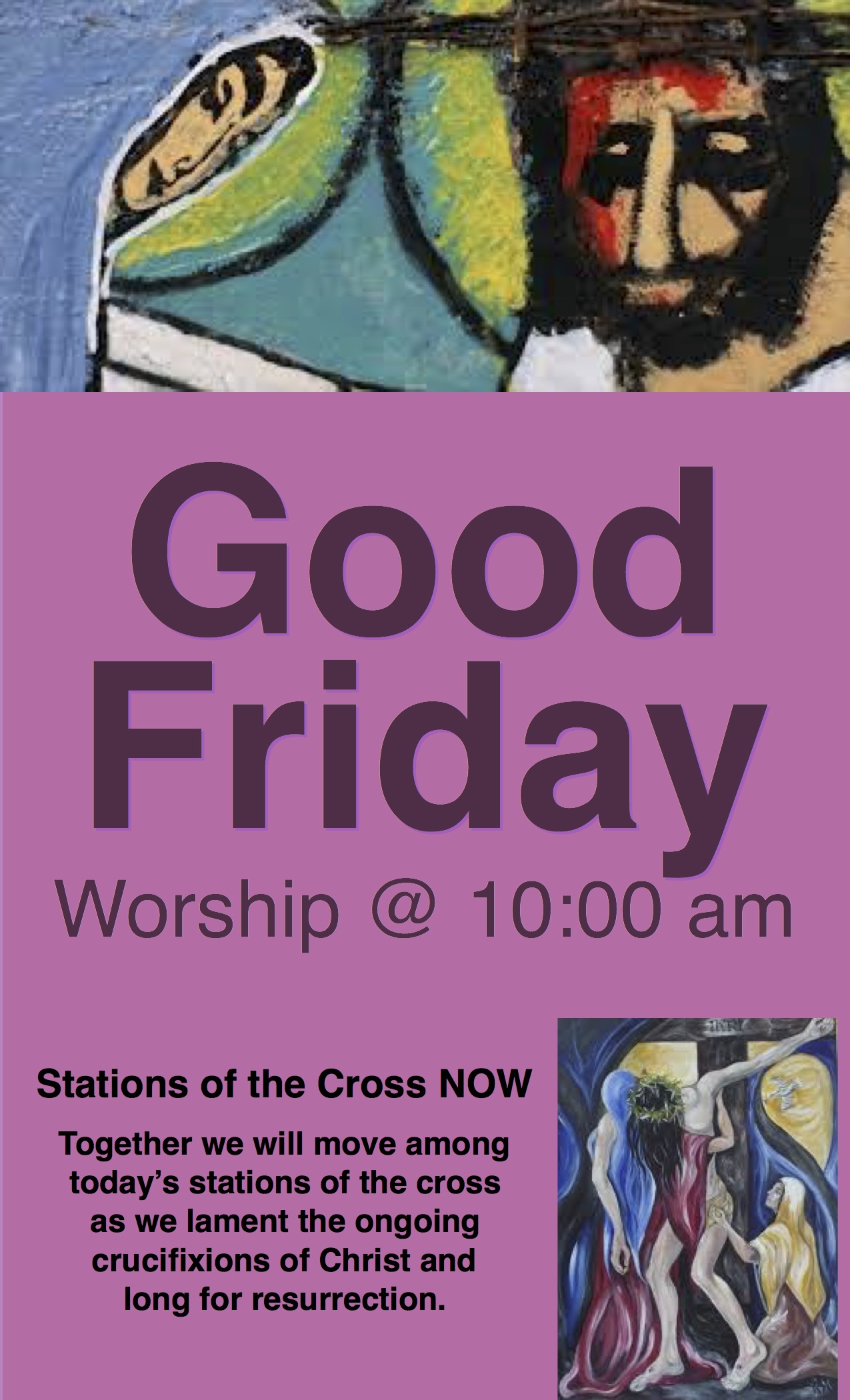
Good Friday Sermons

Good Friday 2016Holy Week marks a sharp uptick in visitors to this blog. From comments, messages, and emails I hear from fellow preachers who, like me, are daunted by the task of preparing the Good Friday sermon. That task is even more daunting for those of us who serve progressive communities. My fellow progressive-christian-preachers tell me of the dearth of progressive-christian Good Friday sermons to be found on the internet and encourage me to re-post my own attempts to rise to the occasion. So, here are the links to some of the Good Friday sermons I have preached over the years of my journey with the progressive community which I serve. The people Holy Cross Lutheran Church has over the years provided an invigorating space for me to pursue my questions. They have also provided the resources which make this blog possible. So, if you find the work posted here  of value to you and your community, please consider supporting this ministry of Holy Cross. I rarely solicit donations. But Holy Cross is a small community that continues to give to others in so many ways and your encouragement is greatly appreciated!!! (Holy Cross Lutheran Church, 1035 Wayne Dr., Newmarket, On. L3Y 1N3)

Follow the links to Good Friday sermons and feel free to use/adapt/repost

2015 Not Salvation! Solidarity and Transformation click here

2014 God Is Dead? click here

2013 Giving Up the Theories of Atonement in Order to Move Toward an Evolutionary Understanding of Jesus. click here

2012 Good Friday Rituals or Crimes Against Divinity? click here

PREPARING TO PREACH ON GOOD FRIDAY. Searching beyond the talk of sacrifice to see the Good News.

The Church’s Good Friday obsession with talk of  “sacrifice for sin” has been breed into the bones of this particular preacher.  I have been trained to speak the language of the Church.  I know full well the many doctrines of atonement that have been proposed to explain the reasons Jesus died upon a cross.  I’ve been studying the historical context and the theological consequences of Jesus’ death for more years than I care to admit.   Yet every year, I find myself wanting to book a vacation or call in sick so that I can avoid the awesome task of preaching on Good Friday.

I put off tackling the Good Friday texts as long as I dare.  Then I pick up my copy of “The Last Week” by John Dominic Crossan and Marcus Borg, together with my copies of John Shelby Spong’s “Resurrection: Myth or Reality” and “Jesus for the Non Religious” as well as Marcus Borg’s final book “Convictions” and Dom Crossan’s “How to Read the Bible and Still Be Christian” and James Carroll’s  “Christ Actually: the Son of God for the Secular Age” spend days in pursuit of a sermon.

What follows is not the sermon I will preach on Good Friday, but rather, the notes I made a few years ago to remind myself not to fall into the trap of talking about the events surrounding Jesus’ death in the way I was trained to speak of those events.  I offer up my notes hoping that those who are engaged in the struggle of grappling with how to talk about the cross in the 21st century might find some solace in a fellow struggler’s ruminations.  For those of you who don’t have to come up with a sermon for Good Friday, I offer these notes as my humble attempt to see beyond the rhetoric about the cross to the Good News. As always I am indebted to the progressive scholars for their invaluable resources. However, in the end, the only way to discover the sermon is to wander into the darkness, trusting that the hours of preparation will allow you to let go, breathe, and trust the One who lives in, with, through, and beyond you. 

There are many ways in which our focus upon the cross is disturbing.   Not the least of which is the way in which we as Christians tend to talk about the crucifixion as Jesus’ passion.  I have always thought it a tragedy that we should describe the events of Jesus’ crucifixion as Jesus’ passion. I’ve always understood talk of an individual’s passion to be concern with those things that people lived for. And so to insist that Jesus’ lived to die a horrible death might sooth those who seek to turn Jesus into some sort of preordained blood sacrifice.

But for those of us who look to Jesus in search of the face of God, such talk seems is indeed a crime against divinity. For what kind of petty, sadistic god would engineer the birth of, foster the life of, and then engineer the death of a beloved child. Surely such a god is no more than a wicked illusion of our own making. I wonder what Jesus himself would make of the god we have created. I wonder what Jesus himself would make of our Good Friday commemorations? I suspect that if Jesus is anything like the accounts of his life suggest, he would be mortified, and I mean that literally…I think that Jesus would be mortified …mortified ie shamed to death…of what has become of his life’s passion; for if Jesus’ was passionate about anything, he was passionate about life. Jesus declared, “I have come so that you may have life and live it abundantly.” Jesus’ passion was about living. Living fully, abundantly.  Continue reading